**I watched a rich kid destroy the one thing my dead brother left me… and he laughed like it was the funniest thing he’d ever done.**
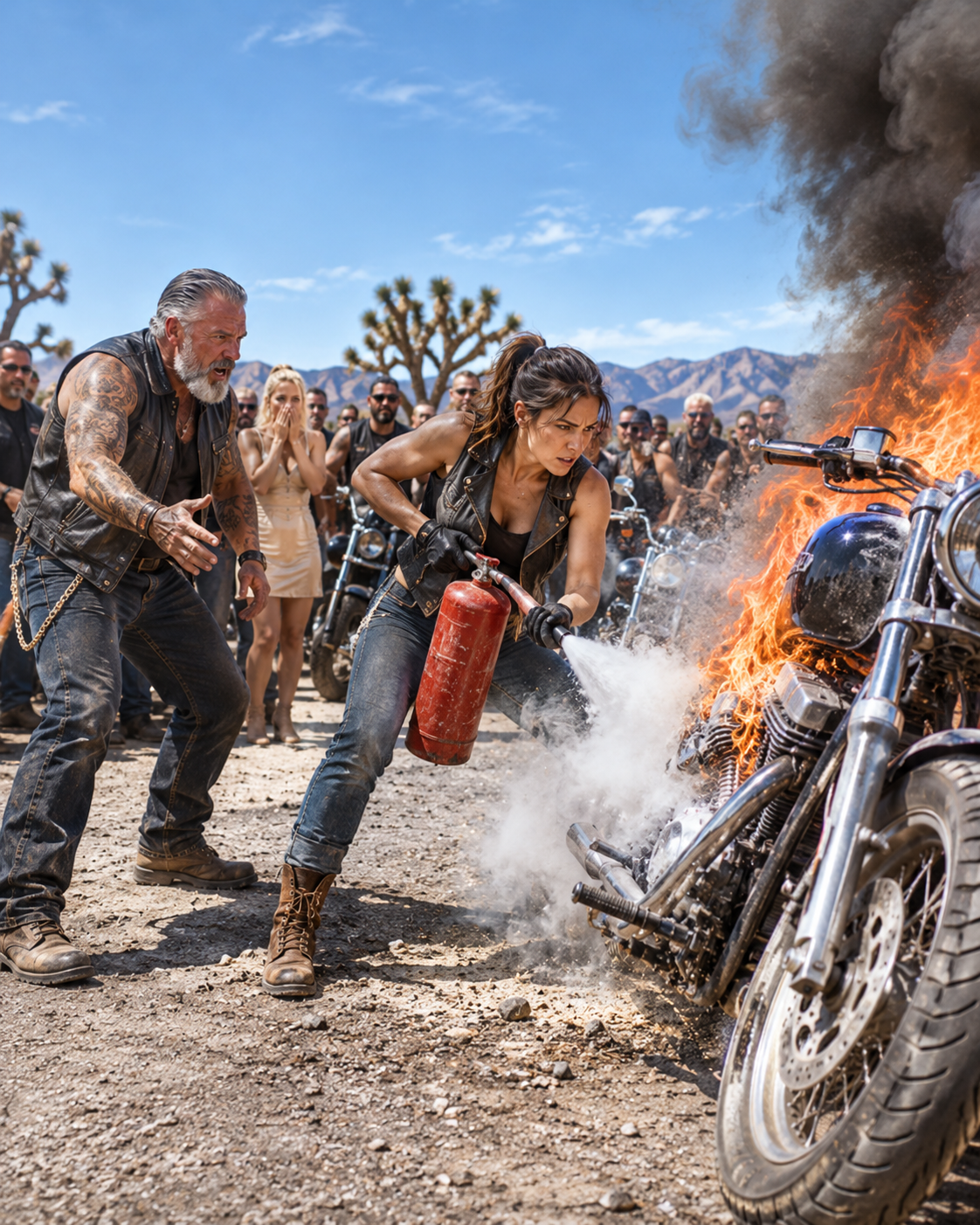
He was seventy-two years old, six-foot-three, with a gray beard that reached his chest and a scar running from his left eyebrow to his jaw. I’d known him for almost thirty years. I’d seen him angry. I’d seen him drunk. I’d seen him cry at funerals. But I’d never seen him look the way he did when he approached my Harley. He stopped a few feet away. Then he removed his sunglasses. “Oh, Dean,” he whispered. My throat tightened. “Bear, what is it?” He didn’t answer immediately. He knelt beside the damaged motorcycle and carefully touched the dented fuel tank. His fingers trembled. Then he looked up at me. “Where did you get this bike?” I frowned. “You know where. My brother left it to me.” “I know that.” “Then what’s the question?” Bear stood slowly. “Did Dean ever tell you why he rebuilt it?” I glanced at the motorcycle. “He loved working on engines. He rebuilt it after Vietnam. That’s all I know.” Bear shook his head. “No, brother. That’s not all.” Behind him, the riders began removing their helmets. Some were old enough to remember the Vietnam era. Others were younger men and women who had joined the club years later. Blake, the kid who had shoved my Harley, suddenly looked very small. His friend lowered his phone. Bear turned toward them. “Which one of you did this?” Blake raised his chin. “Me. So what?” Bear studied him. “How old are you?” “Twenty-two.” “Then you’re old enough to understand what respect means.” Blake rolled his eyes. “Look, man. It was an accident. I’ll pay the old guy. No need to make this a whole thing.” I stepped forward. “Don’t call me old guy.” Bear raised one hand. “Let me handle this.” He turned back to Blake. “That motorcycle belonged to a man who saved my life. And what you’re standing beside is the last thing his little brother has left of him.” Blake laughed nervously. “Okay, well, I didn’t know all that.” Bear’s expression hardened. “That’s the problem with people like you. You think something only matters after somebody explains its value.” Nobody moved. Then Bear said something that made my knees feel weak. “That bike has something inside it that Dean wanted you to find.” I stared at him. “What?” Bear looked at the damaged fuel tank. “Your brother left you more than a motorcycle.”
Twenty minutes later, we were inside the diner. The owner, a woman named Martha, had brought out coffee for everyone. Blake and his friend were sitting at a table near the window, surrounded by several members of the club. Nobody touched them. Nobody threatened them. But for the first time that afternoon, they weren’t laughing. Bear sat across from me. He placed an old photograph on the table. It showed three young men standing beside a military jeep. One was Bear. Another was my brother Dean. The third man was someone I didn’t recognize. “Where was this taken?” I asked. “Vietnam. Nineteen seventy-one.” I studied Dean’s face. He looked younger than I’d ever seen him. His hair was dark, his smile wide, and his eyes didn’t carry the sadness that followed him home. “Your brother was a good man,” Bear said. “Better than most.” “I know.” Bear shook his head. “No, you don’t know the half of it.” He took a sip of coffee. “One night, our unit got separated during a patrol. We were moving through a village when everything went bad. I was hit. Couldn’t walk. Dean dragged me behind a wall while the rest of the men pulled back.” He paused. “He stayed with me for hours. We both thought we were going to die.” I looked down at the photograph. “He never told me that.” “Dean didn’t like talking about the war.” “I know.” Bear continued. “When the evacuation finally came, he carried me out. But before we left, he went back for something.” “What?” “A little boy. Maybe seven years old. His family had been caught in the fighting. Dean found him hiding under a collapsed building.” Bear looked toward the window. “He carried that kid for nearly a mile.” I swallowed. “Did the boy survive?” Bear nodded. “His name was Minh.” He reached into his jacket and pulled out another photograph. This one showed a young Vietnamese man standing beside a motorcycle. On the back was a handwritten message. To Dean, who gave me a second chance at life. I stared at it. “Who is he?” Bear leaned back. “That’s the part I’ve been trying to tell you.” He lowered his voice. “Minh came to America twenty years ago. He found Dean through a veterans’ support organization. They became close. Closer than brothers, in some ways.” I looked at the photograph again. “Why didn’t Dean ever mention him?” “He probably didn’t want to burden you with another story about the war.” Bear hesitated. “Before Dean died, he asked me to make sure something reached you.” My heart started beating faster. “What something?” Bear pulled a small brass key from his pocket. It was old, scratched, and attached to a faded leather tag. On the tag were two words. UNIT 17. “Your brother gave me this five years ago,” Bear said. “He told me that when you were ready, I’d know where to find you.” I stared at him. “Ready for what?” Bear looked at the broken Harley. “To understand why he spent three months rebuilding that motorcycle.”
We returned to the parking lot. Blake was still sitting inside the diner. His friend had stopped recording. I walked toward my bike and crouched beside it. The damage was worse than I’d first thought. The mirror was shattered. The handlebar was bent. The tank had a deep dent along its side. Bear stood beside me. “There’s a storage facility outside town. Your brother rented a unit there for years. I paid the rent after he passed.” “Why?” “Because he asked me to.” I looked at the key. “What’s inside?” Bear gave a small smile. “That’s for you to find out.” Before we left, I turned toward Blake. He stood beside his truck, looking uncomfortable. “Sir,” he said. I waited. He glanced at the motorcycle. “I’m sorry.” It sounded awkward. Almost forced. But it was the first sincere thing I’d heard from him all afternoon. I nodded. “Then help me pick up the pieces.” He looked confused. “What?” I pointed at the shattered mirror. “Start by picking those up. Someone could get hurt.” For a moment, I thought he might argue. Instead, he crouched and began collecting the broken glass. His friend joined him. Bear watched quietly. When they finished, Blake approached me again. “Can I ask you something?” “Go ahead.” “Why didn’t you hit me?” I looked at him. “Because your father would have to explain to a judge why his son got punched over a motorcycle.” Bear laughed. But I wasn’t finished. “And because my brother taught me that just because someone does something stupid doesn’t mean you should become stupid too.” Blake lowered his eyes. I climbed into Bear’s truck, and we headed toward the storage facility.
Unit 17 was at the far end of an old warehouse complex. The place smelled of dust, hot metal, and forgotten memories. Bear unlocked the door. Inside were shelves of motorcycle parts, several cardboard boxes, a workbench, and an old wooden chest. On the wall hung a photograph of Dean. He was standing beside the Harley. The same motorcycle. But in this photograph, the fuel tank had not yet been painted. A small metal plate was visible beneath the seat. I stepped closer. “What’s that?” Bear pointed. “Look underneath.” I crouched and ran my fingers along the plate. There was a tiny keyhole. My hands started shaking. I took out the brass key. It fit perfectly. The lock clicked. I lifted the plate. Beneath it was a small waterproof compartment. Inside lay three things. An envelope. A folded piece of paper. And a silver military dog tag. I picked up the dog tag first. It had two names engraved on it. DEAN HARRIS. MINH TRAN. I looked at Bear. “Why are there two names?” Bear pulled a chair toward me. “Because Dean wanted you to know the truth about the man he saved.” I opened the envelope. The handwriting was unmistakably my brother’s. Little brother, If you’re reading this, then Bear finally did what I asked him to do. There’s something I’ve carried for a long time. I should have told you sooner, but I never found the right words. After Vietnam, I spent years trying to forget what happened there. I thought if I kept busy, fixed enough engines, and stayed away from people who asked questions, the memories would eventually disappear. They didn’t. But one day, I received a letter from a man named Minh. He was the little boy I carried out of that village. He had survived, grown up, and eventually found his way to America. He told me he had spent his entire life looking for the man who saved him. When we finally met, he told me something I’ll never forget. He said that because I saved his life, he had been able to grow up, marry, raise children, and build a future he never thought he’d have. I had spent thirty years believing I only remembered the terrible things I had done and witnessed. But Minh reminded me that there were good things too. Little brother, I want you to understand something. We all carry things we wish we could change. But sometimes, the smallest act of kindness becomes the biggest part of somebody else’s life. That’s why I rebuilt the Harley. I wanted to create something that would keep helping people long after I was gone. Look inside the wooden chest. Everything you need is there. Love, Dean. I lowered the letter. For several seconds, I couldn’t speak. Bear rested a hand on my shoulder. “Your brother was trying to tell you that the bike wasn’t just something he left behind.” I looked at the chest. “What did he build?” Bear nodded toward it. “Open it.”
Inside the chest were dozens of photographs, letters, and financial documents. There were also several folders labeled with names. Each folder contained information about a veteran Dean had helped. Some needed motorcycle repairs. Some needed help finding work. Others needed financial assistance after medical bills had taken everything they owned. At the bottom was a handwritten ledger. I opened it. The first page read: THE SECOND MILE PROJECT. I frowned. “What’s this?” Bear pulled up another chair. “Dean started it fifteen years ago. He used the money he made rebuilding motorcycles to help veterans who were struggling after coming home.” I turned the pages. There were records of donated engines, repaired trucks, rent assistance, grocery payments, and medical bills. Hundreds of entries. Some donations were only twenty dollars. Others were thousands. “How did he afford all this?” Bear smiled sadly. “He didn’t. Not always. Sometimes he sold parts he wanted to keep. Sometimes he worked through the night. Sometimes people helped him.” I looked at the photographs. There was Dean standing beside a young veteran whose wheelchair had been lifted into a truck. Another showed him handing keys to an elderly man. Another showed him laughing with a group of children at a community center. I had never seen any of these pictures. Not one. My brother had spent his final years quietly helping people while I thought he was simply hiding from the world. I turned another page. There was a note in Dean’s handwriting. The motorcycle belongs to my brother. But the mission belongs to whoever is willing to carry it forward. I stared at those words. Then I noticed a document beneath the ledger. It was a deed. The storage unit was only one part of the story. Dean had also purchased a small repair shop outside Kingman. It had been closed for several years. The property was legally mine. I looked up at Bear. “Why didn’t you tell me?” “Because Dean asked me not to.” “Why?” Bear leaned forward. “He said you had spent your whole life taking care of everybody else. He wanted you to have something that was yours before he asked you to take care of anyone again.” I shook my head. “That sounds like him.” Bear smiled. Then he became serious. “There’s one more thing.” He pointed to a sealed envelope tucked beneath the deed. “That came from Minh.” I opened it. The letter was dated two months before Dean died. Dear Dean, I hope you are feeling better. My daughter is graduating this spring. She has been accepted into nursing school. Every time I look at her, I remember the little boy who was hiding beneath the broken wall. I remember the man who carried me out. I wish I could tell you how many lives you changed that night. You saved one child. That child grew up and became a father. His daughter will become a nurse. One day she will help someone else survive. That is how kindness travels. You may never see all the people your actions touch. But they are there. Thank you for giving me a future. Your brother, Minh. I folded the letter carefully. Then I sat down on the concrete floor. I cried. Not because my brother was gone. Not only because I missed him. I cried because for twenty-three years I’d been riding a motorcycle without understanding the journey my brother had intended it to represent.
The next morning, Bear and I visited the repair shop. It stood on the edge of Kingman, behind an old tire store. The building was nothing special. Faded blue paint. A rusted sign. Two garage doors that hadn’t opened in years. But when I unlocked the front entrance, I could almost smell Dean’s motor oil. There was an old workbench inside. A set of tools hung neatly on the wall. And above them was a photograph. Dean and me. I must have been seventeen. We were standing beside the first motorcycle he’d ever taught me to repair. He had one arm around my shoulder. I was grinning like an idiot. I touched the frame. “How long have you known about this place?” Bear shrugged. “Since Dean bought it.” “Why didn’t you ever tell me?” “Because I promised him.” I turned toward him. “Well, I guess the promise is over.” Bear nodded. “What are you going to do with it?” I looked around. For the first time in years, I had a clear answer. “Open it.” Bear grinned. “Then let’s get to work.”
The following weeks were harder than I expected. The roof leaked. The electrical wiring needed replacing. The compressor was dead. Half the equipment was covered in rust. But I wasn’t alone. Bear brought five riders the first Saturday. The next weekend, there were twelve. By the third week, nearly twenty people were working on the building. Some were veterans. Some were mechanics. Some had never held a wrench in their lives. They came because they believed in what Dean had started. One afternoon, a young woman named Rachel walked through the door. She was twenty-six and had recently left the military. Her old pickup truck was parked outside with a broken transmission. She held a small envelope in her hand. “I heard you might be able to help.” I looked at the truck. “What’s wrong with it?” She explained the problem. Then she showed me the envelope. Inside was a few hundred dollars. “It’s all I have right now.” I pushed the money back toward her. “Put it away.” She frowned. “I don’t want charity.” I nodded. “Neither did my brother. That’s why he called this a second-mile project.” I handed her a pair of gloves. “Come inside. I’ll show you how to help me fix it.” She looked confused. “You want me to work on my own truck?” “Unless you’d rather watch me do all the work.” For the first time, she smiled. We spent the next two days repairing that transmission. When she drove away, she didn’t look like someone who had received a handout. She looked like someone who had regained control of her life. That evening, I wrote her name in Dean’s ledger. Then I added a note. Helped repair her own truck. Left with a skill, not just a receipt. I understood then what Dean had been trying to build. Not a place where people came to be rescued. A place where people could discover they still had something to offer.
Three months after the diner incident, I received a phone call. It was Blake. I almost didn’t answer. But curiosity got the better of me. “Hello?” “Sir? It’s Blake.” I leaned back in my chair. “What do you want?” He hesitated. “I wanted to ask if I could come by the shop.” I looked at the clock. “Why?” “I owe you for the motorcycle.” I sighed. “Your father already paid for the damaged parts.” “I know. But that’s not what I mean.” There was a long silence. Then he said something I hadn’t expected. “My dad wants me to start working at his dealership. He says I should just forget about what happened.” I waited. “But I can’t.” “Why not?” “Because I keep thinking about the way you looked at that bike after I knocked it over.” His voice became quieter. “You weren’t angry like I expected. You looked… hurt.” I stared at the photograph of Dean on the wall. “That bike was my brother’s.” “I know. Bear told me.” “Then you understand why it mattered.” “Yeah.” Another pause. “I’ve been thinking about it. I have a camera, and I make videos. I thought maybe I could help the shop. Film some of the repairs. Tell people’s stories.” I didn’t answer immediately. “Why?” “Because I made a video of myself destroying something that mattered to somebody else. Maybe I can use the same phone to show people how to help instead.” I looked through the open garage door. Bear was working on a motorcycle outside. I remembered what he’d told me about respect. And I remembered Dean’s words. Sometimes the smallest act of kindness becomes the biggest part of somebody else’s life. “Come by Saturday,” I said. Blake exhaled. “Thank you.” “Don’t thank me yet. We start at seven.” He laughed nervously. “I’ll be there.”
Saturday morning, Blake arrived at six fifty-five. He was wearing jeans, work boots, and an old T-shirt. No designer sunglasses. No expensive truck. He had brought a box of pastries for everyone. Bear looked at him suspiciously. “You lost?” Blake smiled. “Maybe.” I handed him a broom. “Then start by finding the floor.” He laughed. And he worked. He cleaned tools, organized shelves, and filmed interviews with veterans who wanted to share their stories. Over the next few months, his videos began attracting attention. But instead of filming expensive cars and reckless stunts, he filmed people rebuilding their lives. He recorded Bear talking about Dean. He interviewed Rachel about learning to repair her own truck. He even made a video apologizing publicly for what he’d done at the diner. He never asked me to appear in it. He simply told the truth. One evening, he showed me the finished video. At the end, he had placed a photograph of Dean beside a picture of the repaired Harley. The caption read: Some things are worth more than money. You don’t understand their value until you learn to respect the people connected to them. I watched it twice. Then I nodded. “Your brother would’ve liked that,” Bear said from behind me. Blake looked at me. “Do you think you can forgive me?” I considered the question. “Blake, forgiveness doesn’t mean what happened didn’t matter.” He lowered his eyes. “It means I don’t want one stupid afternoon to decide who you become for the rest of your life.” He nodded. I held out my hand. “Just keep showing up.” He shook it. And that was the beginning of something neither of us had expected.
Six months later, the shop officially opened. We called it Dean’s Second Mile Garage. There were no fancy decorations. Just a freshly painted sign, a few folding chairs, and a long table covered in food. Forty-three motorcycles lined the street outside. Bear stood beside me as we watched people arrive. “Your brother would be proud,” he said. I looked at the garage. “I wish he could see it.” Bear nodded. “Me too.” Then a car pulled into the parking lot. A silver sedan. An older Vietnamese man stepped out. He wore a dark jacket and carried a small wooden box. I recognized him from the photographs. Minh. He walked slowly toward us. Bear smiled. “Well, look who finally made it.” Minh embraced him. Then he turned toward me. “You’re Dean’s brother.” I nodded. “Yes, sir.” He held my hands. “Your brother saved my life.” I looked down. “I’ve read your letters.” Minh smiled. “Then you know he never told you the best part.” “What was that?” He reached into the wooden box. Inside was a photograph. A little boy stood beside a broken wall, holding the hand of a young American soldier. Dean. The boy was Minh. But beneath the photograph was another picture. A recent one. A young woman in a nursing uniform stood beside Minh. “My daughter,” he said. “She graduated last month. She starts at the veterans’ hospital next week.” I smiled. “That’s wonderful.” Minh nodded. “She asked me to give you something.” He handed me a small envelope. Inside was a handwritten note. To Dean’s brother, My father told me what your brother did for him. I wanted you to know that because Dean saved one frightened child, I had the chance to become a nurse. I hope I can spend my life helping people the way he did. Thank you for keeping his kindness alive. I read it twice. Then I looked at Minh. He was crying. So was I. Bear put a hand on my shoulder. And suddenly, I understood the real meaning of the motorcycle. It wasn’t a memorial. It was a message. A reminder that a life could keep moving forward even after the person who started the journey was gone.
That evening, after the crowd had left, I rolled the Harley into the garage. The repairs had taken weeks. We had replaced the mirror, straightened the handlebar, and restored the damaged fuel tank. But I refused to erase the small dent completely. I had it repaired enough to make the motorcycle safe, but I left a faint mark where Blake had pushed it over. Not because I wanted to remember the humiliation. Because I wanted to remember what came after. I stood beside the bike and ran my hand across the tank. “Well, Dean,” I whispered. “We did it.” The garage was quiet. Then Bear appeared in the doorway. “You coming?” I smiled. “Where?” He pointed toward the parking lot. “Ride.” I looked at the Harley. For twenty-three years, that motorcycle had carried memories of my brother. Now it carried something else. His unfinished dream. I climbed onto the seat and turned the key. The engine started with its familiar rumble. Bear fired up his own bike. Then the other riders joined us. Forty-three engines came alive. We rolled out of the garage together and headed west toward the desert. The sun was setting behind the mountains, painting the sky orange and red. I rode at the front. For a while, I imagined Dean beside me. His old leather jacket. His crooked smile. His voice telling me to stop riding like an idiot. I laughed inside my helmet. And for the first time since he died, the memory didn’t hurt quite as much.
A year after the incident at the diner, I returned to the same parking lot. Martha came outside when she heard the motorcycles. She looked at the repaired Harley and smiled. “Well, look at that. She’s still running.” I nodded. “Better than ever.” Bear parked beside me. A few minutes later, Blake arrived. He was driving an ordinary used pickup truck now. He had sold the expensive one and donated part of the money to the garage. He walked toward me holding a small package. “I brought you something.” I opened it. Inside was a new motorcycle mirror. Chrome. Exactly like the one that had shattered that afternoon. I looked at him. “What’s this for?” “Just in case.” I laughed. “Keep it. I’ve already got one.” He smiled. “Then maybe we can put it on somebody else’s bike.” I looked at him for a long moment. Then I nodded. “That’s a good idea.” We spent the next hour talking with Martha about turning part of the diner parking lot into a community gathering spot for local riders. Before leaving, I stood beside the Harley and looked at the place where it had fallen. I remembered Blake’s laughter. I remembered the sound of forty-three engines. And I remembered Bear kneeling beside the motorcycle, whispering my brother’s name. What had seemed like the worst afternoon of my life had become the beginning of something I never could have planned. Not because the damage was worth it. It wasn’t. But because people had chosen to respond to it with something better than anger.
That night, I sat alone in the garage. Dean’s photograph hung above the workbench. The ledger was open beside me. I had added hundreds of names. Hundreds of stories. Hundreds of people who had walked through our doors believing they had nowhere else to turn. I took out a pen and wrote one final entry for the year. The motorcycle was damaged. The work continued. People showed up. Nobody was left behind. Then I closed the book. I looked at my brother’s photograph. “You know something, Dean?” I whispered. “I spent twenty-three years thinking the most important thing you left me was this motorcycle.” I touched the chrome. “I was wrong.” I looked toward the open garage doors, where Bear and the others were laughing outside. “You left me people. You left me a purpose. And you left me a reason to keep going.” I turned off the lights. The next morning, the garage would open again. There would be engines to repair. Veterans who needed help. Young people who needed someone to believe they could become better than their worst mistake. And there would always be room for one more person willing to lend a hand. Because my brother had taught me something long before I understood it. The true value of something isn’t measured by what it costs to replace. It’s measured by the lives it touches. A motorcycle can be rebuilt. A broken mirror can be replaced. Even a person who has made a terrible mistake can choose a different road. But the kindness someone gives another human being? That can travel farther than any motorcycle ever will. And sometimes, the greatest thing a person leaves behind isn’t something you can hold in your hands. It’s something you carry forward. Dean left me a Harley. But what he really left me was a reason to make sure nobody had to ride through the hardest miles of life alone.