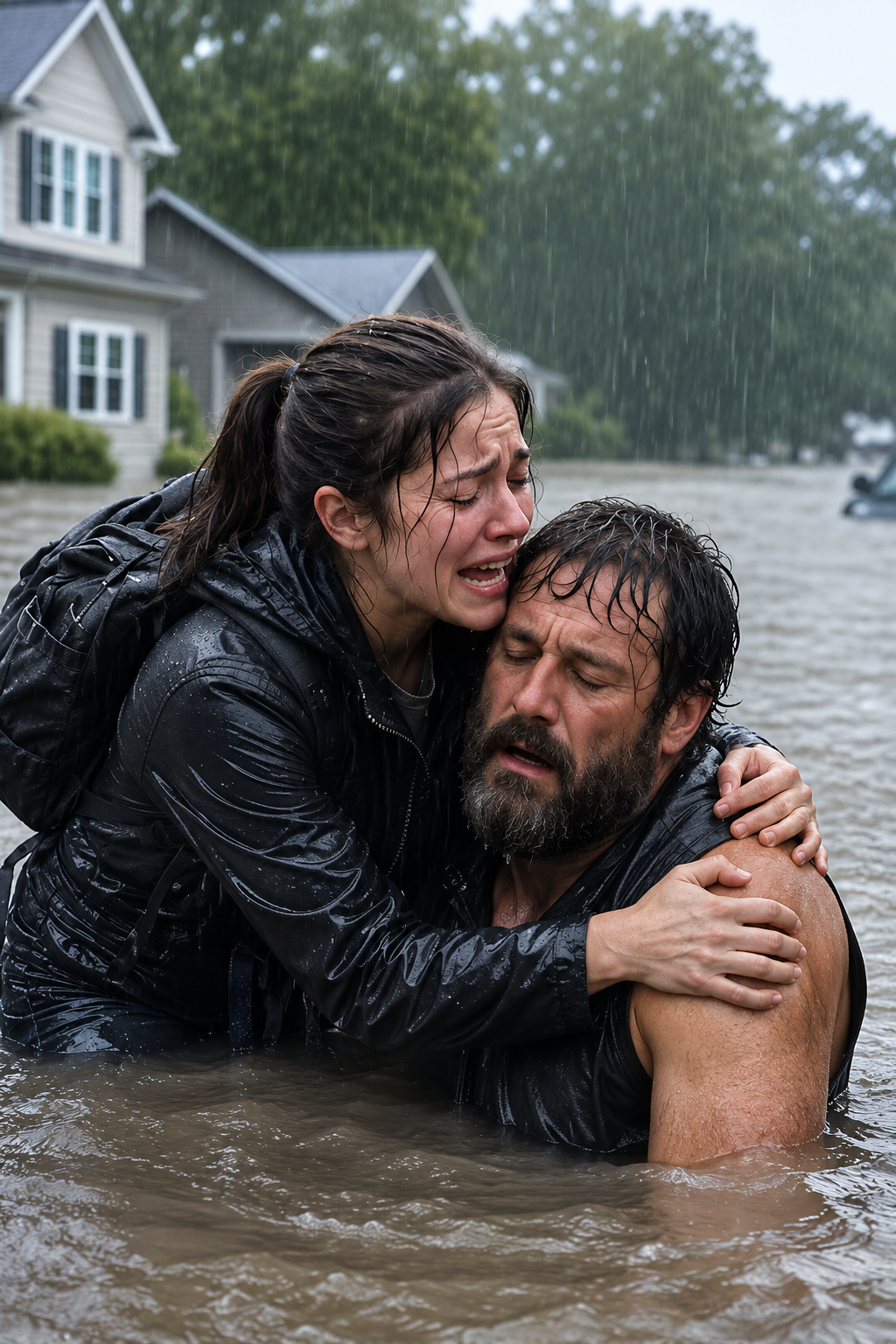
I risked my life to save a Hells Angels biker from a raging flood, only to discover that the disaster might never have happened in the first place.
The company was Whitmore Infrastructure Group.
Five years earlier, they had been responsible for inspecting the drainage system near the road where my little brother drowned. Their final report had concluded that Ethan’s death was the result of an unpredictable natural disaster.
My parents had accepted that explanation because they were too devastated to fight it.
I never had.
Now, standing in the pouring rain with Garrick’s bloody backpack in my hands, I was looking at photographs that suggested something far worse than negligence.
“Where’s your daughter?” Liam asked, kneeling beside Garrick.
“Old music room. Basement level,” Garrick whispered. “There’s an emergency shelter underneath the gym. They moved some families there when the community center flooded.”
Liam’s expression changed.
“Who told you that?”
“My daughter called me. Her teacher had an emergency phone. Then the connection died.”
A paramedic approached and began examining Garrick’s injured leg.
“You need to get to the hospital.”
Garrick grabbed Liam’s jacket.
“Not until somebody gets Rosie out of there.”
Liam immediately radioed the incident commander, explaining what we’d discovered.
The response came through amid heavy static.
“Negative. Cedar Falls Elementary was cleared at approximately two thirty this morning.”
“According to whom?” Liam demanded.
“Municipal emergency coordinator. School administration confirmed.”
Garrick closed his eyes in frustration.
“They’re wrong.”
I pulled the handwritten map from the backpack. Several locations had been circled in red, including a maintenance entrance behind the gymnasium.
Beside the entrance, Garrick had written a warning.
MAIN ACCESS BLOCKED. LOWER HALLWAY VULNERABLE TO FLOODING.
“Why do you have this?” I asked.
“I used to work maintenance at that school,” he answered. “Before Whitmore got me fired.”
Before I could ask another question, a terrible cracking sound came from the damaged bridge behind us.
Everyone turned.
A section of concrete broke loose and disappeared into the water.
Garrick struggled to stand.
“Rosie doesn’t know how to swim.”
The desperation in his voice was something I recognized immediately. It was the same desperation I’d heard in my father’s voice the night Ethan disappeared.
Liam looked at me, then reached for his radio again.
“Dispatch, we’re requesting an immediate water rescue assessment at Cedar Falls Elementary. Possible trapped children.”
This time, he didn’t wait for permission to take the report seriously.
Within minutes, two additional firefighters joined us. Their names were Marcus and Elena, and both had specialized flood rescue training.
I helped them carry equipment toward a high section of road overlooking the school.
Garrick was taken to a temporary medical station, but not before grabbing my wrist.
“Promise me you’ll tell them about the backpack.”
“I promise.”
“And please tell Rosie her daddy’s coming.”
The elementary school looked like an island surrounded by a violent brown ocean.
Water had already reached the bottom of the first-floor windows. Playground equipment floated across the parking lot, and a school bus had been pushed sideways against a chain-link fence.
Liam studied the building through binoculars.
“No movement.”
Then Elena pointed toward an upper window.
“Wait. What’s that?”
Something white appeared behind the glass.
It vanished, then appeared again.
Someone was waving a piece of cloth.
“There are people inside!” I shouted.
Liam radioed the discovery.
For several seconds, nobody responded.
Then a different voice came through.
“Rescue personnel are advised that structural integrity has been compromised. Do not enter until an engineering assessment is completed.”
Liam stared at his radio.
“There are children in that building.”
“Maintain your position.”
He requested immediate rescue support through the fire department’s command channel rather than relying on the municipal coordinator.
Additional boats were dispatched, and Marcus and Elena prepared to approach the school.
I remained at the staging area, helping coordinate information and passing Garrick’s map to the rescue team.
Every instinct told me to follow them, but Liam stopped me.
“You helped save one person tonight,” he said. “Don’t make us rescue you, too.”
I watched their boat disappear into the rain.
Eleven minutes later, Liam’s voice came over the radio.
“We’ve located survivors. Eight children and two adults on the second floor.”
Relief swept through me.
Then came another transmission.
“Correction. We’re being told three children and one teacher are missing. Last known location, basement music room.”
My relief vanished.
Garrick had been right.
The first group of survivors arrived shortly afterward. Among them was an elderly woman wearing a bloodstained cardigan.
She introduced herself as Mrs. Donnelly, a retired school secretary who had been volunteering at the emergency shelter.
“Who told everyone the building was empty?” I asked.
Her face tightened.
“A man named Preston. He came with the emergency management people. Said the buses were outside and everybody needed to move upstairs.”
“Did he count the children?”
“He had a clipboard. I told him Ms. Alvarez was downstairs with three students. He said somebody would get them.”
Nobody had.
Mrs. Donnelly began crying.
“They left us. We watched their vehicles drive away.”
I wrote down everything she said.
Meanwhile, the rescue team discovered that the basement stairwell was almost completely submerged. They were searching for another access point when I remembered something on Garrick’s map.
A narrow space beneath the auditorium connected to the old music room.
I showed the diagram to the rescue coordinator, who relayed the information to Liam.
For the next twenty minutes, I stood beneath a temporary canopy, staring at the school.
I thought about Ethan.
He had been nine years old when the flood swept him away. I was supposed to be watching him that afternoon, but I’d been distracted by an argument with a friend.
For five years, I had replayed those final moments in my head.
Every birthday, every Christmas, every family photograph taken without him had felt like another accusation.
Then Liam’s voice broke through the radio.
“We have contact!”
I rushed toward the rescue coordinator.
“We can hear someone behind an interior door. Possible adult female.”
The next several minutes were agonizing.
Finally, the rescue team reported finding Ms. Alvarez and two children inside an elevated storage area adjoining the music room.
They were alive.
But Rosie wasn’t with them.
According to Ms. Alvarez, Rosie had slipped away when rising water separated the group. She had been trying to retrieve medication from another child’s backpack.
Nobody had seen her since.
I covered my mouth.
Not again.
Please, not again.
A rescue boat returned carrying the teacher and two children. Ms. Alvarez was barely conscious, but she kept repeating Rosie’s name.
“She was helping Oliver,” she whispered. “He couldn’t breathe. She went back for his medicine.”
Oliver, a little boy wrapped in a thermal blanket, was crying.
“She said she’d come right back.”
At that moment, a pickup truck pulled into the staging area.
Three enormous men wearing Hells Angels vests jumped out.
One introduced himself as Arthur Vance.
“Where’s Garrick?”
I explained that he’d been transported to a medical station and that Rosie was still missing.
Arthur looked toward the school.
“She’s my goddaughter.”
The other men unloaded blankets, bottled water, flashlights, and emergency supplies. Instead of interfering with the rescue operation, they asked the firefighters where they could help.
Arthur stayed beside me.
“Garrick called us before the barrier broke,” he said. “Said something wasn’t right.”
“Did he tell you about Whitmore?”
Arthur nodded.
“He’s been collecting evidence for over a year. Lost his job, nearly lost his house. People started calling him paranoid.”
“Why didn’t he go to the police?”
“He did. Went to the city council, the county, the newspapers. Everybody wanted somebody else to investigate.”
Arthur reached into his jacket and pulled out his phone.
“He sent me this yesterday.”
The video showed Garrick standing beside the flood barrier, pointing toward water seeping through damaged concrete.
A man wearing a Whitmore jacket was arguing with him.
“You’re trespassing,” the man said.
“There’s a school downstream!” Garrick shouted. “You can’t keep pretending these cracks aren’t there!”
The man stepped toward the camera.
“You lost your job because you couldn’t follow instructions. Don’t make things worse for yourself.”
Arthur stopped the video.
I suddenly felt sick.
This wasn’t a warning somebody had overlooked by accident.
Someone had known.
At 6:42 a.m., another section of the school partially collapsed.
The rescue crews immediately withdrew from the affected area.
I watched a portion of the roof sink into the floodwater.
Arthur muttered something under his breath and turned away.
Then, almost unbelievably, a firefighter stationed near the rear of the building spotted movement through a small ventilation opening above the waterline.
A child’s hand.
The crews repositioned, and a technical rescue team approached the damaged section from a safer access point.
For nearly half an hour, nobody could tell us anything.
Then Liam emerged from the school carrying a little girl wrapped in his jacket.
Her brown hair was plastered against her face. One shoe was missing, and she wasn’t moving.
Arthur ran toward the landing area.
“Rosie!”
Paramedics immediately surrounded her.
I stood frozen as they worked.
Finally, she coughed.
It was the smallest sound I’d ever heard, but it seemed louder than the entire storm.
Arthur dropped to his knees.
I began sobbing.
Liam approached me, exhausted and shaking.
“She found an old equipment platform,” he explained. “Climbed onto it when the room filled up. Smart little kid.”
I couldn’t speak.
He pulled me into a hug.
For the first time in five years, I had watched floodwater give somebody back.
At the hospital, Garrick was awaiting surgery when Rosie was brought into his room.
A nurse wheeled her bed beside his.
“Daddy?”
Garrick turned his head.
The moment he saw her, his entire face crumpled.
“Hey, ladybug.”
Rosie reached for his hand.
“I lost my shoe.”
He laughed and cried at the same time.
“That’s okay, baby. We’ll get you another one.”
I stood outside the room with Arthur, watching them hold hands.
Then Garrick noticed me.
“The backpack,” he said.
I held it up.
“It’s safe.”
“Don’t give it to anyone from the city.”
“Why?”
His expression became serious.
“Because some of the people who were supposed to protect us are the reason this happened.”
Two days later, after Garrick’s surgery, he told me everything.
He had worked for a subcontractor responsible for maintenance near the flood barrier and had discovered discrepancies between inspection records and actual repairs.
Materials listed as installed were missing. Structural damage had been photographed but excluded from official summaries.
When he reported the discrepancies, his supervisor ordered him to stop asking questions.
Garrick refused.
He was reassigned to school maintenance and eventually dismissed for allegedly violating workplace policies.
But he’d kept copies of the records.
During his investigation, he discovered older documents connected to several Whitmore projects.
One of them involved the drainage system where Ethan had drowned.
“I didn’t know he was your brother,” Garrick said.
He handed me a folder.
Inside was a maintenance report dated nine days before Ethan’s death.
It described a blocked drainage channel, malfunctioning equipment, and a significant risk of flooding on the adjacent roadway.
A supervisor had recommended immediate closure of the road during heavy rainfall.
The recommendation had been rejected.
At the bottom was a signature.
Daniel Whitmore.
The company’s president.
I read the document three times.
For years, I had blamed myself for letting Ethan walk ahead of me that afternoon.
Now I was learning that adults who had been paid to protect that road had known it was dangerous.
“Did they know somebody could die?” I whispered.
Garrick looked down.
“They knew there was a serious risk.”
I walked out of his hospital room and into an empty stairwell.
Then I screamed.
I screamed until my throat hurt. I cried until I could barely breathe.
I wasn’t suddenly innocent of every decision I’d made that day, but for the first time, I understood that the responsibility I’d carried wasn’t mine alone.
When I finally called my parents, my mother was silent for so long that I thought the connection had failed.
“Are you sure?” she asked.
“I’m looking at the report, Mom.”
My father took the phone.
“Bring it home.”
That evening, we spread the documents across our kitchen table.
Dad stared at the signature.
Mom held Ethan’s school photograph against her chest.
Nobody ate dinner.
The following morning, I received a phone call from an unfamiliar number.
A man introduced himself as Preston Hale, the city’s emergency management coordinator.
He said he’d heard I possessed documents belonging to Whitmore Infrastructure Group.
“They may contain confidential information,” he explained. “We’d appreciate your cooperation in returning them.”
“What about the children left inside the school?”
“That’s an unfortunate misunderstanding.”
“Three children almost drowned.”
“The situation was extremely chaotic.”
I asked whether he’d personally confirmed the building was empty.
He ended the call.
An hour later, a black SUV pulled into our driveway. A well-dressed man approached our front door and handed my father a legal notice demanding the return of allegedly stolen corporate property.
Fortunately, Garrick had already made copies of much of his evidence.
Arthur arranged for us to meet an attorney experienced in whistleblower cases, and we provided the material to independent investigators and a journalist named Rachel Morgan.
Rachel spent weeks verifying the records, interviewing former employees, and comparing maintenance invoices with inspection photographs.
What she uncovered was worse than any of us had imagined.
Whitmore had received millions in public funds for flood prevention projects. Investigators found evidence that some essential work had never been completed despite being billed and certified.
Several employees admitted they had been pressured to approve misleading inspection reports.
And Preston Hale, who had reported the school evacuated, had previously worked as a consultant for Whitmore.
During the flood, he had authorized the evacuation status using incomplete information supplied by personnel who had left the shelter.
Warnings from Mrs. Donnelly and others had never been properly recorded.
Rachel’s investigation appeared on the front page of a regional newspaper.
Within twenty-four hours, national reporters were calling.
Whitmore denied wrongdoing.
Preston issued a statement blaming communication failures.
Then something extraordinary happened.
People began coming forward.
A retired engineer produced emails he’d saved after being pressured to approve repairs.
A former accountant provided financial records.
A school employee confirmed that Garrick had repeatedly warned administrators about the danger of using the basement as an emergency shelter.
The strongest testimony came from a woman named Linda Harper.
Her husband had died during another flood three years earlier.
Like my parents, she had been told that nothing could have prevented his death.
She brought an entire box of correspondence to the attorney’s office.
“This isn’t just about your brother,” she told me. “And it’s not just about my husband. How many families are out there who still don’t know?”
Six months after the disaster, state investigators announced criminal charges against Daniel Whitmore and several company executives.
Preston resigned and later faced charges related to the investigation.
The legal process took nearly two years.
During that time, Garrick received threatening messages, endured public accusations, and struggled through multiple surgeries on his injured leg.
Some people questioned his credibility simply because he belonged to a motorcycle club.
One defense attorney even suggested that Garrick had fabricated the documents out of resentment over losing his job.
But the independent records, financial evidence, and testimony from former employees supported his account.
Ultimately, several executives were convicted of fraud and related offenses. Additional proceedings addressed the failures surrounding the evacuation.
Families received compensation through separate civil settlements, and the state introduced stricter independent oversight of publicly funded flood protection projects.
None of it brought Ethan back.
That was the hardest part to accept.
On the afternoon the verdict was announced, I drove to the cemetery alone.
I sat beside Ethan’s headstone and told him everything.
“We finally know what happened,” I whispered. “I’m sorry it took so long.”
For years, I’d imagined that discovering the truth would somehow end my grief.
Instead, I realized that grief wasn’t something justice could erase.
But justice could prevent another family from being handed the same convenient explanation.
A year later, Cedar Falls opened a new elementary school on higher ground.
Outside stood a memorial honoring those who had lost their lives in the floods.
Ethan’s name was engraved on it.
Beside the memorial, the community established an emergency preparedness program for families and children.
Garrick helped develop it alongside firefighters, engineers, teachers, and local volunteers.
Arthur and the other bikers organized fundraising rides to support displaced families and purchase emergency equipment.
I completed formal emergency response training and eventually joined the county’s disaster preparedness team.
I wanted the next frightened volunteer to have the knowledge I’d lacked that morning.
At the school’s opening ceremony, Rosie, now ten years old, walked onto the stage wearing a yellow dress.
She unfolded a piece of paper.
“My daddy says being brave doesn’t mean you’re not scared,” she began. “It means you do something good even when you are.”
Garrick wiped his eyes.
Rosie looked toward me.
“And sometimes the people who save you are people you haven’t even met yet.”
Afterward, she handed me a small package.
Inside was a red keychain shaped like a backpack.
“So you don’t forget us,” she said.
I hugged her.
As though I ever could.
Later that afternoon, Garrick and I stood beside the memorial.
He leaned on his cane, watching Rosie chase her friends across the playground.
“You know what’s crazy?” he said.
“What?”
“For fourteen months, people looked at my vest and decided what kind of man I was before I even opened my mouth.”
He glanced toward Ethan’s name.
“Meanwhile, the men wearing expensive suits got believed without having to prove a thing.”
I thought about that long after he said it.
I had once assumed that danger would announce itself through frightening appearances, rough voices, and intimidating strangers.
But the people responsible for our suffering had hidden behind professional titles, polished reputations, and official signatures.
And the man who exposed them was a heavily tattooed biker whom many people wouldn’t have invited into their homes.
That flood taught me that character cannot be measured by clothing, wealth, occupation, or social standing.
It is revealed by what people choose to do when telling the truth becomes inconvenient and helping someone comes at a personal cost.
Garrick had risked his livelihood to warn a town that refused to listen.
Rosie had risked her own safety trying to help another child.
And countless strangers had come together to rescue people they didn’t know.
I still miss Ethan every single day.
Sometimes, when I hear heavy rain against my windows, I wake up remembering the sound of that terrible afternoon.
But I no longer see his death as the end of everything good in my life.
His memory has become the reason I keep showing up.
The reason I ask difficult questions.
The reason I refuse to dismiss someone simply because their story is uncomfortable to hear.
I couldn’t change what happened to my little brother five years earlier.
But on that terrible morning in Cedar Falls, I reached toward a stranger instead of turning away.
That stranger helped me uncover the truth, forgive myself, and discover a purpose beyond my grief.
I thought I was saving a Hells Angels biker from a flood.
I never imagined that the man holding onto that twisted railing would ultimately be the person who helped pull me out of the darkness I’d been drowning in for five long years.