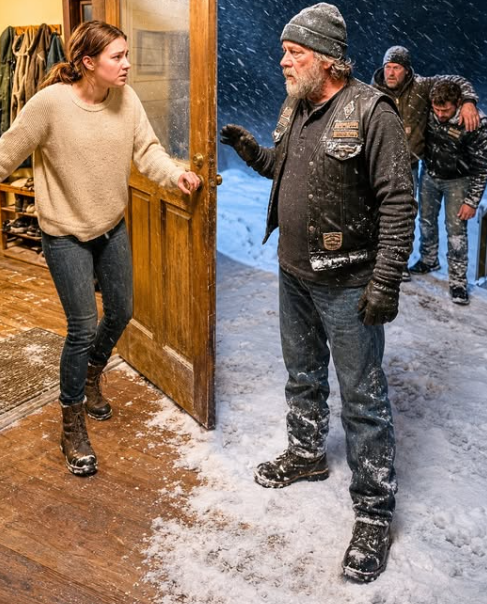
Eleven days after I buried my grandmother, three Hells Angels bikers showed up at my farmhouse in the middle of the night.
“Carbon monoxide,” Nathan said, holding up the device. “You can’t smell it, you can’t see it, and by the time you realize something’s wrong, it can be too late.”
I stared at the propane heater beside my grandmother’s rocking chair. It had been running since the electricity went out that afternoon.
“But Grandma used that heater for years.”
“And something’s wrong with it tonight,” he replied. “Get your coat. We’re leaving.”
Arthur grabbed Liam beneath his shoulders while Nathan supported his legs. I reached for my winter jacket, but the moment I bent down, the kitchen seemed to tilt sideways.
My knees buckled.
Arthur caught me before my head struck the floor.
“Easy, sweetheart. I’ve got you.”
I wanted to tell him I could walk. Instead, I vomited onto the kitchen tiles and barely managed to remain conscious.
Arthur lifted me into his arms as easily as if I were a child. Nathan and Liam struggled toward the front door, and seconds later, the four of us were outside.
The wind struck my face with such violence that I couldn’t breathe. Snow immediately gathered around my collar, and the cold penetrated my clothes.
“There’s a barn!” I shouted, pointing toward the dark shape behind the farmhouse.
“Any vehicles inside?” Arthur asked.
“Grandma’s old pickup. It hasn’t run in years.”
“Better than standing out here.”
We fought our way through the storm. Arthur carried me while Nathan practically dragged Liam through snow that reached above their knees.
Halfway across the yard, Liam collapsed.
Nathan shouted his name, but there was no response.
Arthur lowered me beside the barn door and went back for him. Together, the two men carried Liam inside.
The barn smelled of hay, old leather, and motor oil. I could barely distinguish the shapes of my grandmother’s abandoned equipment in the darkness.
Nathan switched on a flashlight and examined Liam.
“He’s breathing, but we need to get him somewhere warm.”
Arthur pulled open the pickup’s passenger door and discovered several old horse blankets behind the seat. We wrapped Liam in them, adding our own coats.
I sat against a wooden post, trembling uncontrollably.
“How did you end up here?” I asked.
“Our truck slid into a ditch about a mile back,” Arthur explained. “We were headed home from a funeral. Liam went looking for help before we realized how bad the storm was. By the time we found him, he’d been outside too long.”
I looked at their leather vests.
“You were riding motorcycles in this weather?”
Arthur shook his head.
“Even we’re not that stupid. Bikes are back at the clubhouse.”
Under different circumstances, I might have laughed.
Nathan searched through his emergency bag and pulled out a satellite communicator. He stepped toward the barn entrance, trying to establish a connection.
Arthur looked around the building, shining his flashlight over the walls.
Then he stopped.
His light rested on an old photograph hanging beside my grandmother’s workbench.
It showed Grandma standing next to a red motorcycle. She was young, probably in her early thirties, wearing faded jeans and a denim jacket. A group of bikers stood behind her.
Arthur approached the photograph slowly.
“Where did you get this?”
“It belonged to my grandmother.”
He turned toward me.
“What was her name?”
“Evelyn Carter.”
For several seconds, Arthur didn’t move. His expression changed so completely that I wondered whether he was experiencing symptoms of carbon monoxide poisoning himself.
“Evelyn?”
“Yes.”
“Evelyn with the little scar above her left eyebrow?”
My stomach tightened.
“How do you know that?”
Arthur took another look at the photograph. His enormous hand rose to his mouth.
“Son of a gun,” he whispered. “We finally found her.”
Nathan returned from the doorway.
“I got a distress message through. Rescue services know our approximate location, but the roads are buried. Could be hours.”
Arthur didn’t respond.
“Doc,” he finally said, pointing toward the photograph. “Come look at this.”
Nathan approached the wall. His eyes widened.
“No way.”
I looked between them.
“Would somebody please tell me what’s going on?”
Arthur crouched in front of me.
“Your grandmother saved my life thirty-two years ago.”
I thought I had misheard him.
“What?”
He removed his gloves and pointed toward a skinny young man standing at the edge of the photograph.
“That idiot right there is me.”
I leaned closer. Beneath the long hair and youthful face, I recognized his eyes.
Arthur explained that when he was twenty-six, he had been traveling through Montana with several friends. A sudden snowstorm had caused a terrible accident on a remote road.
He suffered a broken leg and serious injuries. His friends couldn’t reach emergency services.
Then a woman driving an old pickup truck appeared.
“She was half my size,” he remembered. “But she ordered everybody around like a military commander. Got us into her truck, drove us to safety, stayed with us until help arrived.”
That woman was Evelyn.
Grandma had worked as a nurse before retiring to raise me, but she had never mentioned rescuing a group of bikers.
“She wouldn’t accept a penny,” Arthur continued. “We tried to pay her back. She told us that if we ever found somebody who needed help, we should remember what it felt like to be helpless.”
Nathan smiled faintly.
“She made us promise.”
Arthur nodded.
“We visited whenever we passed through. Then she moved, and eventually we lost contact. I never knew where she ended up.”
I swallowed hard.
“She died eleven days ago.”
Arthur’s smile vanished.
He lowered his head, staring at his boots.
Nathan gently removed his cap.
For the first time since the funeral, I found myself sitting beside people who understood that my grandmother had been more than an elderly woman living on an isolated farm.
They knew something about her that even I hadn’t known.
Arthur reached into his vest and pulled out his wallet. From behind his driver’s license, he removed a folded photograph, yellowed and damaged along the edges.
It was another picture of Grandma.
On the back, in handwriting I recognized immediately, were five words.
“Make your second chance count.”
I pressed my fingers against the photograph and began to cry.
Arthur didn’t tell me to stop. He simply sat beside me until Nathan interrupted us.
“Arthur, we’ve got another problem.”
Liam had stopped shivering.
His face looked frighteningly pale, and he barely responded when Nathan spoke to him.
Nathan explained that Liam’s condition was becoming critical. The blankets weren’t enough. We needed better shelter and professional medical assistance.
I suddenly remembered something.
“There’s a cabin.”
Both men turned toward me.
“Grandma built it near the southern pasture. She used to stay there during calving season. It has a woodstove.”
“How far?” Arthur asked.
“Maybe three hundred yards.”
“Can you find it in this?”
I hesitated.
I’d walked there hundreds of times, but the storm had erased every familiar landmark.
“There’s a fence running from the back of the barn straight toward the pasture. If we follow it, we’ll reach the cabin.”
Arthur immediately began preparing to leave.
Nathan secured Liam inside the blankets while I searched the workbench for anything useful. I found a heavy flashlight, several pairs of work gloves, and the wooden sled Grandma once used to carry feed.
We placed Liam on the sled.
Arthur pulled it while Nathan kept watch over him. I led the way, gripping the fence with one hand.
The storm was worse than before.
Within minutes, my eyelashes froze together. Snow filled my boots, and each step felt like lifting a concrete block.
I tried counting fence posts to keep track of our progress.
At the seventeenth post, I discovered the fence had disappeared beneath a massive snowdrift.
“We have to go around!” I shouted.
Arthur couldn’t hear me.
I moved toward him, but my foot suddenly sank into an invisible depression. The ground vanished beneath me, and I fell into a drainage ditch.
My shoulder struck something hard.
I screamed.
Snow slid around my legs as I tried to climb out.
Arthur appeared above me almost immediately. He dropped onto his stomach, reached down, and grabbed my wrist.
“Hold on!”
With Nathan’s help, he pulled me free.
My right ankle throbbed, and I couldn’t put my full weight on it.
“I can keep going,” I insisted.
Arthur looked at the sled, then at me.
“You don’t have to prove anything to us.”
He helped me onto the sled beside Liam.
For the remainder of the journey, Arthur dragged both of us through the snow while Nathan cleared a path and checked Liam’s condition.
Finally, a familiar wooden roof emerged from the darkness.
“There!” I cried.
The cabin door was frozen shut.
Arthur struck it with his shoulder until the ice cracked. The door swung inward, revealing a tiny room with a table, two narrow beds, and Grandma’s old cast-iron woodstove.
We found dry firewood stacked beside it.
Within minutes, Arthur had a fire going after checking the stove and chimney. Nathan helped Liam out of his wet clothing and continued caring for him while Arthur searched the cupboards.
Grandma had left bottled water, canned soup, crackers, blankets, and an emergency supply box.
Even after her death, she was still taking care of people.
I sat on one of the beds, staring at my swollen ankle.
Nathan examined it and wrapped it carefully. He reminded me that I’d also been exposed to carbon monoxide and needed medical evaluation as soon as possible.
Arthur handed me a blanket.
“You’ve done good, kid.”
I shook my head.
“I almost killed all of us with that heater.”
“You didn’t know.”
“I should’ve known. Grandma would’ve known.”
Arthur sat opposite me.
“Evelyn knew plenty of things because she’d spent decades learning them. You’re twenty years old. You’re allowed to learn, too.”
Something about those words broke through the wall I’d built around myself since the funeral.
I told him everything.
How my parents had abandoned me when I was four. How Grandma had worked extra shifts to buy my school clothes. How she’d taught me to cook, repair fences, and drive a tractor.
I told him about finding her unconscious one morning and following the ambulance to the hospital.
Then I admitted something I hadn’t told anyone.
“I might lose the farm.”
Arthur’s expression hardened.
“Why?”
“There’s a mortgage. Medical expenses. Property taxes. Grandma always handled everything. I thought we owned the place outright, but we didn’t.”
A property investor named Martin Briggs had approached me two days after the funeral.
He claimed Grandma had owed him money and insisted that selling immediately was my only chance to avoid losing everything.
He’d offered me a fraction of what the property was probably worth.
“He keeps saying I’m running out of time,” I whispered. “He wants me to sign the papers next week.”
Arthur exchanged a look with Nathan.
“Have you shown those papers to a lawyer?”
“I can’t afford one.”
“Don’t sign anything until somebody qualified looks at them.”
“But what if he’s right?”
“Then you’ll deal with the truth. Not whatever version of it he’s trying to sell you.”
Before I could answer, Nathan called Arthur over.
Liam’s breathing had become dangerously shallow.
Nathan knelt beside him, checking his condition repeatedly.
“Come on, buddy,” he murmured. “Stay with us.”
Arthur took Liam’s hand.
“Remember that fishing trip you owe me? You don’t get out of it this easy.”
I watched him struggle to maintain his composure.
Liam wasn’t simply another biker. He was Arthur’s younger half-brother, seventeen years his junior. Their mother had died when Liam was a teenager, and Arthur had practically raised him.
Suddenly, I understood the terror in Arthur’s voice when he’d begged me to open my door.
He was afraid of losing the last person who made him feel like somebody’s family.
At 3:16 a.m., Nathan’s communicator received a message.
A rescue team had reached the county road, but a fallen tree and deep snow prevented them from getting any closer.
They were attempting to approach on tracked rescue vehicles.
We gave them the cabin’s location.
The next hour felt endless.
Nathan worked beside Liam while Arthur paced across the floor. I prayed for the first time since Grandma’s funeral.
Just before dawn, Liam opened his eyes.
“Art?”
Arthur dropped beside the bed.
“Right here, little brother.”
“I’m cold.”
Arthur laughed through sudden tears.
“Yeah, well, Montana’s got a reputation for that.”
Nathan managed a relieved smile, although he warned us that Liam was far from safe.
Then came a sound none of us would ever forget.
An engine.
Arthur rushed to the window. Through the storm, two powerful headlights appeared.
The rescuers had found us.
Paramedics entered the cabin carrying medical equipment and oxygen. They assessed all four of us before transporting us toward the waiting emergency vehicles.
As they loaded Liam onto a stretcher, Arthur squeezed my shoulder.
“You opened the door,” he said. “That’s why he’s still here.”
I looked at Nathan.
“And you walked through it. That’s why I’m still here.”
At the hospital, doctors confirmed that I had suffered carbon monoxide poisoning. My ankle was badly sprained, and I needed oxygen therapy and observation.
Liam remained hospitalized for several days because of severe hypothermia.
But he survived.
The following afternoon, a nurse brought three visitors into my room.
Arthur entered carrying flowers. Nathan held a bag of sandwiches, and behind them came a gray-haired woman wearing an expensive wool coat.
“This is my wife, Margaret,” Arthur introduced her. “She’s an attorney.”
I immediately understood why she was there.
Margaret offered to review my grandmother’s estate documents without charging me. I protested, but she waved away my objections.
“Consider it a family favor.”
A week later, Margaret discovered that Martin Briggs had been misleading me.
Grandma’s mortgage balance was considerably smaller than he’d suggested. The documents he wanted me to sign included terms that would transfer valuable additional property rights to his company.
His supposed personal loan to Grandma was unsupported by any reliable documentation.
There were legitimate debts, but I wasn’t facing the immediate foreclosure he’d threatened.
Margaret helped me navigate the estate process, communicate with the lender, and arrange a manageable repayment plan.
When Martin arrived at the farmhouse expecting my signature, he found Margaret sitting at the kitchen table.
Arthur was repairing my porch outside.
Martin left within fifteen minutes.
I never heard from him again.
But the biggest surprise came two Saturdays later.
I woke to the sound of engines approaching the farmhouse.
When I looked through the window, I counted motorcycles, pickup trucks, trailers, and a snowplow.
Nearly forty people had arrived.
Arthur stood in the yard directing everyone.
“What is this?” I asked.
“A work party.”
“Arthur, I can’t pay these people.”
“Good thing nobody sent an invoice.”
Electricians inspected the wiring. A licensed heating technician removed the damaged propane heater and installed a safer heating system. Others repaired the barn roof, fixed broken fences, and stocked my woodshed.
They installed carbon monoxide detectors throughout the farmhouse.
Women brought casseroles, groceries, and homemade bread. Children played in the snow.
Liam, still recovering, sat on my porch wrapped in a blanket, complaining that everybody was treating him like an old man.
For the first time since Grandma died, the farmhouse felt alive.
Later that afternoon, an elderly biker approached me carrying a wooden box.
He introduced himself as Frank.
“I knew Evelyn back when Arthur still thought he was invincible.”
Inside the box were photographs, handwritten notes, and postcards.
They belonged to people Grandma had helped throughout her life.
A waitress whose medical bills she’d contributed toward. A teenage boy she’d encouraged to finish high school. A stranded mother she’d sheltered during a snowstorm.
There was even a letter from a man who’d spent years in prison and credited Grandma with encouraging him to rebuild his relationship with his children.
“She kept telling people they were worth more than their worst mistake,” Frank said.
I carried the box inside and placed it beside her rocking chair.
That evening, after most of the visitors had departed, Arthur asked whether I’d show him Grandma’s grave.
We drove to the small cemetery overlooking the valley.
Arthur stood before her headstone for a long time.
Finally, he removed his gloves and laid the old photograph against the stone.
“I tried to make it count, Evelyn,” he whispered. “I hope you’d think I did all right.”
I slipped my arm through his.
“She would.”
He looked at me, his eyes wet.
“You know, I spent years wishing I could repay her. Never thought she’d give me the chance.”
“She didn’t give you the chance,” I said. “You made the choice.”
He smiled.
“That’s something she would’ve said.”
Over the following months, Arthur and Margaret became regular visitors. Nathan helped me find resources to complete my education, and Liam called every Sunday, usually with some ridiculous story about his brother.
I enrolled in a nursing program at the local community college.
It was something Grandma had always encouraged me to pursue, but I’d been afraid to leave her alone.
Now, whenever I doubted myself, I remembered the woman in those photographs and the extraordinary lives she’d touched without ever seeking recognition.
Two winters after the blizzard, I reopened the little pasture cabin as a registered emergency warming shelter in cooperation with the county’s emergency management team.
Volunteers helped maintain it. We stocked supplies, installed proper safety equipment, and established procedures for helping stranded travelers.
Above the doorway, Arthur hung a wooden sign bearing Grandma’s name.
EVELYN’S HAVEN.
At the opening ceremony, Liam stood beside me, looking healthier than I’d ever seen him.
“Pretty strange, isn’t it?” he said.
“What is?”
“If our truck hadn’t gone into that ditch, we might never have found you.”
“And I might never have made it out of that farmhouse.”
He looked toward the cabin.
“Guess something good came out of a pretty terrible night.”
I thought about that for a moment.
I didn’t believe the storm had happened for a reason. I didn’t believe losing Grandma had been necessary to bring these people into my life.
Sometimes terrible things simply happen.
But I had learned that what follows those terrible things can depend on the choices people make.
A frightened girl chose to open a door.
Three strangers chose not to leave her behind.
And decades earlier, a young nurse had chosen to stop her pickup truck on a lonely Montana road.
None of us had known what those decisions would eventually mean.
Years later, after graduating from nursing school, I returned to the farmhouse permanently. Arthur and Margaret attended my graduation, cheering so loudly that several people turned around.
I kept Grandma’s rocking chair beside the window. Her photographs remained on the walls, and Arthur’s old picture was framed beside them.
Every winter, when snow began falling across the valley, I checked the cabin’s emergency supplies and made sure everything was ready.
One December evening, there was a knock at my front door.
A frightened young mother stood outside holding her little boy. Her car had broken down nearby, and she didn’t know whom to call.
I helped them get warm, arranged roadside assistance, and prepared something for them to eat.
When the woman offered me money, I shook my head.
“Just remember this the next time you meet somebody who needs help.”
The words came naturally.
They were Grandma’s words, traveling through another generation.
After the woman and her son left safely, I sat in the rocking chair and watched the snow drift across the pasture.
For years, I had believed that being abandoned by my parents meant I would eventually be abandoned by everyone.
Grandma’s death had made that fear seem inevitable.
But family, I discovered, wasn’t always something you inherited at birth. Sometimes it was built through compassion, loyalty, and the willingness to show up when another person had nowhere else to turn.
The three enormous men I’d once feared had become part of mine.
Grandma had left me something far more valuable than the farmhouse.
She had left behind a lifetime of kindness that continued moving through the world, returning in ways neither of us could have imagined.
And on the coldest night of my life, when I believed I had absolutely nobody left, that kindness came knocking at my door.