I let 15 bikers into my garage during the worst storm our town had seen in years. By midnight, the sheriff was shouting their names over the emergency radio—and I realized I might have just put my entire town’s fate in the hands of strangers.
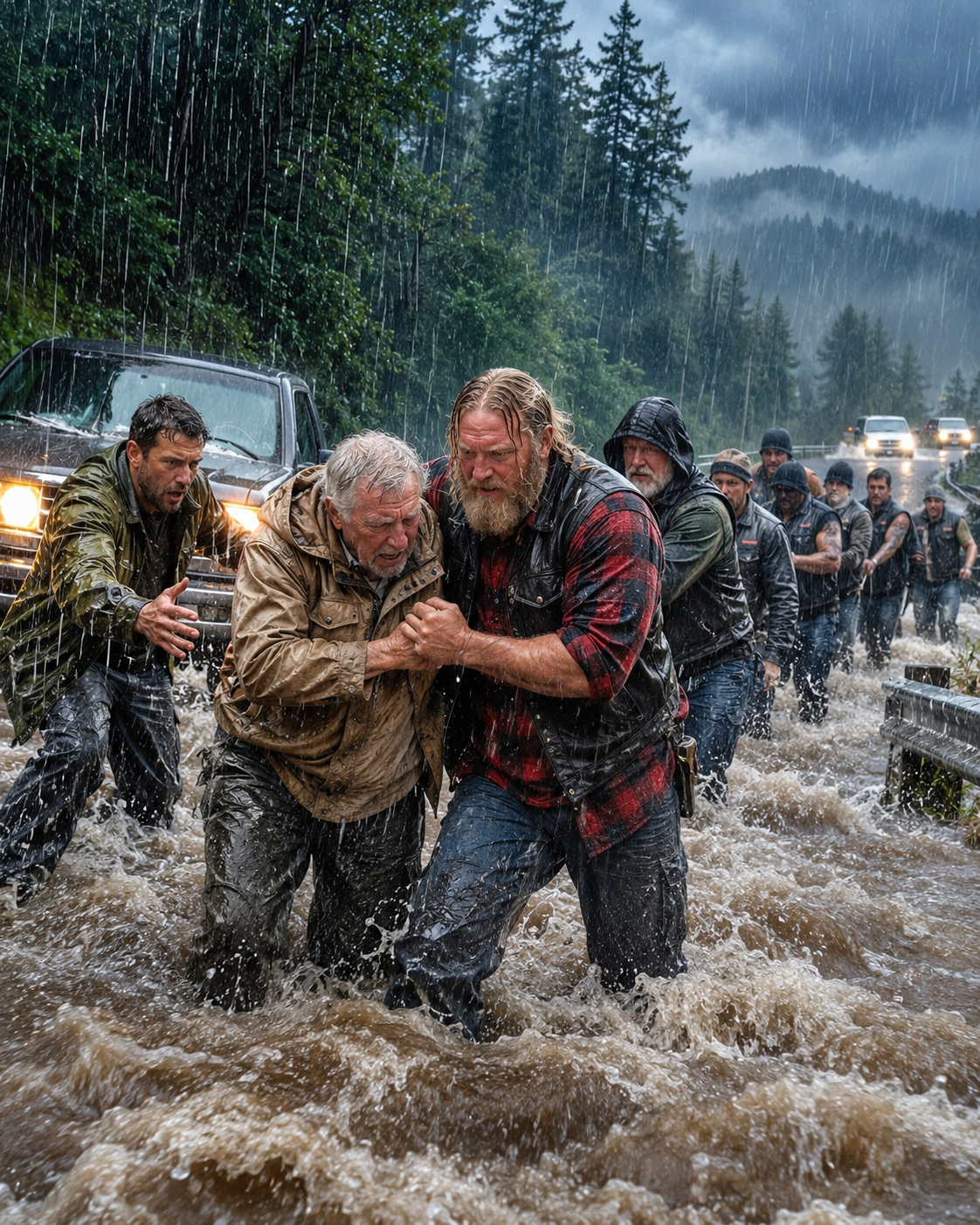
You’ll drown before you get halfway there.” He nodded. “Then we won’t take the road.” One of the older bikers, a broad-shouldered man with a gray beard, stepped forward. “Boss, I’m coming.” Caleb looked at him. “You’re not coming, Red. Your shoulder’s still messed up.” Red shook his head. “That didn’t stop me in Afghanistan.” “You’re not in Afghanistan anymore.” The old man looked away. I had no idea what these men had been through, but something in their voices told me they understood danger better than most people. Caleb turned to the others. “Marcus, take the medical kit. Duke, get the ropes. Tommy, check the portable lights. Nobody moves without a partner. We’re going in prepared, and we’re coming back together.” Then he looked at me. “Arthur, we need your help.” I glanced toward the staircase. Lily was standing there, holding a blanket against her chest. “Dad?” I walked over and knelt in front of her. “I’m going to help some people.” “Are you coming back?” Her question hit harder than the freezing rain outside. I brushed a strand of hair from her forehead. “Always.” She looked past me at Caleb. “Please bring my dad back.” Caleb crouched until he was eye level with her. “I promise we’ll do everything we can.” Then he stood. And fifteen strangers prepared to walk into a storm.
The first thing we did was open the old county road map. I knew Fletcher Mill better than most people in Silver Creek. My father had worked there when I was a boy, before the mill closed and the property was converted into a small timber operation. There was an old maintenance trail behind the ridge. It hadn’t been used in years. But it connected to a service entrance less than half a mile from the mill. “The trail is steep,” I explained, pointing at the map. “And there’s a drainage ditch running beside it. If that ditch overflows, the whole slope could collapse.” Caleb studied the map. “How long to walk it?” “Normally? Forty minutes.” “And tonight?” I looked toward the window. “Could be twice that.” He nodded. “Then we’d better leave now.” We divided the equipment between us. Ropes, flashlights, medical supplies, blankets, bottled water, and a portable radio. The injured biker, whose name was Ethan, insisted on coming. He had a deep cut above his eyebrow and a swollen ankle. Caleb refused. “You can barely stand.” Ethan looked down. “Those people are trapped.” “Which is why you’re staying here.” The young man opened his mouth to argue. Then Lily appeared beside him. She handed him a cup of hot chocolate. “My dad says being brave doesn’t mean being stupid.” Ethan looked at Caleb. Caleb stared at the ceiling. “Your kid’s getting too smart.” I smiled despite myself. “She gets it from her mother.” For a moment, nobody spoke. Then Caleb placed a hand on Ethan’s shoulder. “Watch over the garage. You’re in charge until we get back.” Ethan nodded. “Yes, sir.” We stepped into the storm.
The wind nearly knocked me sideways as soon as we left the garage. Rain blew horizontally across the parking lot. The temperature had dropped below freezing, and ice was beginning to form on the exposed branches. We moved in a line, Caleb at the front and me behind him. The motorcycles were useless in these conditions. Their riders had left them parked beneath my garage roof. Instead, we carried our equipment on foot. Every few minutes, the radio crackled. “Arthur, this is Dispatch. Do you copy?” I pressed the button. “Go ahead.” “Be advised, the water level at Fletcher Mill has risen another eighteen inches. The sheriff’s office is trying to get a rescue vehicle to the northern entrance.” I looked toward Caleb. He shook his head. “That entrance will be underwater by now.” I responded. “Tell them we’re approaching from the old maintenance trail.” There was a pause. Then the dispatcher said something that made me stop walking. “Arthur, who exactly is with you?” I looked at the men around me. “People willing to help.” The dispatcher hesitated. “Are these the motorcycle club members?” “Yes.” Another pause. “Be careful.” I almost laughed. Not because it was funny. Because even with six lives hanging in the balance, some people still seemed more concerned about who was helping than whether anyone would survive. We continued. After twenty minutes, we reached the first bend in the trail. A large tree had fallen across the path. Caleb signaled for everyone to stop. “Arthur, is there another way around?” I examined the slope. “There’s a narrow ledge above it. But the ground is soft.” Caleb looked at the others. “We go one at a time. Keep three points of contact. Nobody rushes.” We secured the ropes to a thick tree and carefully crossed the ledge. Halfway across, one of the younger riders slipped. His boot slid over the edge. For a terrifying second, he disappeared from my sight. Then Marcus grabbed his jacket. Caleb and another man pulled them both back. “Everybody good?” Caleb shouted. The rider nodded, breathing hard. Caleb looked at him. “That’s your warning. Next time, listen to the mountain.” We moved on. By the time we reached the old service entrance, my hands were numb. Then we heard something. A faint voice. “Help!” Caleb raised his flashlight. There, beyond the flooded loading yard, was the mill. And on the second-floor platform, six people were waving desperately. One of them was holding a small child. I counted them twice. Six. All alive. But the water was rising so quickly that the ground floor was already disappearing beneath it. I pressed the radio. “Dispatch, we have visual contact. Six civilians confirmed.” The response came immediately. “Arthur, rescue teams are still blocked. Can you hold position until the water recedes?” I looked at the flooded yard. Then at the people on the platform. “No. We need to get them out now.” Caleb turned to me. “What’s the safest way?” I pointed toward a metal staircase attached to the side of the building. “That leads to the upper platform. But the lower section is underwater.” He examined it. “Can we reach the stairs?” “Maybe from the loading dock. But the dock is unstable.” Caleb nodded. “Then we find another route.”
We moved along the edge of the property until we found an old concrete utility shed. From there, we could see the upper platform. A woman was shouting. “Please! My son has asthma!” I felt my stomach tighten. The child was small, perhaps seven years old. His mother was holding him close, trying to shield him from the freezing rain. Caleb raised his flashlight. “We’re here! Help is coming!” The woman began crying. One of the older men beside me, Red, stepped forward. “That’s enough waiting.” He pointed toward a steel maintenance ladder that connected the shed roof to an elevated walkway. I shook my head. “That ladder is rusted.” Red looked at me. “Can it hold one person?” I examined the brackets. “Probably.” “Then we check it before anyone climbs.” Caleb nodded. We secured a safety line and tested the ladder carefully. The first rider climbed several steps, then stopped. The metal groaned. He climbed back down. “Not safe.” Caleb looked at the platform. The child was coughing now. We were running out of time. Then I remembered something. “There’s an old conveyor support behind the shed. It runs toward the upper loading platform.” I pointed through the darkness. “It might still be standing.” We found it buried beneath fallen branches. The metal frame was battered, but its main supports were intact. Caleb studied the structure. “We can secure a line along it. Nobody walks on the conveyor itself. We use the supports to reach the platform.” I nodded. It was risky. But it was the only possible route we could identify without entering the flooded building. We worked together, anchoring ropes to the strongest available supports and checking every connection. Caleb went first. Then Marcus. Then me. The rain stung my face. Below us, the water rushed through the mill yard, carrying pieces of wood and broken equipment. Halfway across, I heard a metallic crack. One of the support brackets shifted. I froze. “Caleb!” He turned. “Don’t move!” The structure groaned again. For a moment, I thought the whole thing would give way. Then Red shouted from behind us. “Keep the line tight!” We carefully redistributed our weight and made our way to the platform. When I finally stepped onto solid concrete, my legs nearly gave out. A man rushed toward us. “Thank God!” He was probably in his late fifties, wearing a soaked work jacket. His name was Frank Miller. I recognized him from town. He owned the small hardware store on Main Street. Beside him were his wife, a younger woman, and two other workers. The sixth person was the boy. Frank grabbed my arm. “Arthur, I thought nobody was coming.” I looked toward the storm. “You’re not forgotten.” Caleb moved immediately toward the child. “What’s his name?” “Ben.” “How old?” “Seven.” “What’s wrong with him?” “Asthma. His inhaler is almost empty.” Marcus opened the medical kit. “We’ve got an emergency inhaler and a spacer. Let’s see what we can do.” He checked the boy carefully and helped his mother administer the medication according to the instructions. After a few tense minutes, Ben’s breathing began to settle. His mother held him and cried. I looked at Caleb. He nodded. “One problem at a time.” But getting them onto the platform was only half the battle. We still had to get everyone out.
The radio suddenly crackled. “Arthur! This is Sheriff Daniels. Do you copy?” I grabbed the microphone. “Go ahead, Sheriff.” “Where are you?” “At Fletcher Mill. We have all six civilians with us.” “How many rescuers?” I looked around. “Fourteen club members and me.” There was a long silence. Then the sheriff said, “Listen carefully. The creek has overtopped the southern bank. A section of the access road just collapsed. We cannot bring vehicles within a mile of your position.” Caleb looked at me. “What’s our route back?” I studied the map in my head. “The maintenance trail.” “Can it handle six civilians?” “Not if the water keeps rising.” The sheriff continued. “There’s another problem. The emergency shelter at the elementary school is losing power. We have twenty-three residents there, including elderly people and several children. The generator isn’t working.” I stared at the radio. “Why are you telling us this?” “Because the road crew can’t reach them either. And we just received a report that a retaining wall above the school is showing signs of movement.” My blood ran cold. The elementary school sat below a steep hillside. If that wall failed, the consequences could be devastating. Caleb looked at me. “How far?” “About two miles from here.” “Can we reach it?” I glanced at the people waiting beside us. “We have six civilians to get out first.” Caleb nodded. “Then that’s what we do.” He turned toward the riders. “Nobody leaves anyone behind.”
Getting back to the maintenance trail was even harder. The water had risen, and the wind had intensified. We formed two groups. Caleb, Marcus, and three others helped guide the civilians across the elevated walkway. I stayed near the back with Frank. His wife was struggling to walk, and one of the workers had injured his knee. Red took the boy in his arms. He was enormous, but he held Ben with extraordinary gentleness. “You’re doing great, little man,” he said. Ben looked at his beard. “Are you a giant?” Red laughed. “Depends who you ask.” For a moment, the child smiled. Then the ground shook. A deep rumble rolled across the valley. We turned toward the hillside. Part of the slope above the mill had collapsed. Mud, branches, and water poured across the lower yard. The old maintenance structure disappeared beneath the flood. I stared. If we’d waited another ten minutes, we might have been trapped. Caleb shouted. “Move! Now!” We hurried toward the trail. When we reached the fallen tree, the crossing had become even more dangerous. The ledge was partially submerged. Frank looked at me. “I can’t make it.” I grabbed his arm. “Yes, you can.” He shook his head. “My knee’s gone.” Marcus stepped forward. “Then we’ll help you.” He and another rider supported Frank between them. Red carried Ben. The others guided the remaining civilians. We crossed slowly. Nobody rushed. Nobody complained. And when the last woman reached the other side, Caleb looked back at the mill. For several seconds, he simply stood there. Then he said quietly, “Let’s get these people home.”
When we returned to my garage, Lily was waiting at the door. The moment she saw me, she ran. “Dad!” I dropped to my knees and wrapped my arms around her. She held me so tightly that I could barely breathe. “You’re freezing!” “So are you.” She pulled back and looked at my face. “Are you hurt?” “Just tired.” Then she noticed the people behind me. She saw the little boy in Red’s arms. She saw the injured workers. And she saw Caleb. She disappeared upstairs. A few minutes later, she came down carrying every blanket in the house. “Everybody gets one,” she announced. Caleb smiled. “Looks like we’ve got ourselves a new club president.” Lily shook her head. “No. I’m just helping.” Frank sat beside the heater, holding a cup of coffee. His wife was wrapped in a blanket. The young boy had fallen asleep on Red’s shoulder. For the first time that night, I allowed myself to breathe. Then the emergency radio crackled again. “All units, emergency update. Retaining wall above Silver Creek Elementary has failed. Water and debris are moving toward the lower parking area. Immediate assistance required.” The garage went silent. I looked at Caleb. He looked at the rescued families. Then at his men. “We’re not done.”
The sheriff’s next message was worse. The storm had damaged the main power lines, leaving the school without heat or reliable communication. The people inside had been moved to the gymnasium, but water was beginning to enter the lower hallway. There were twenty-three residents. An elderly man with limited mobility. Several children. Two teachers. And a volunteer nurse. The sheriff had managed to evacuate the nearby houses, but the school was isolated. I grabbed the map. “There used to be an access road behind the water tower.” Caleb leaned over my shoulder. “Does it still exist?” “Mostly. But the hill is steep, and there’s a drainage channel running across it.” “How dangerous?” I looked at the weather. “Very.” He nodded. “Then we don’t go blindly.” I turned to the rescued group. “Frank, can you stay here with Lily?” Frank nodded. “Of course.” Lily stepped forward. “Dad, take my red backpack.” I frowned. “Why?” “I packed the emergency supplies from upstairs. Flashlight, batteries, first-aid kit, water, and the extra blankets.” I looked at the bag. She had even included the little stuffed rabbit she’d slept with since her mother died. I knelt in front of her. “You did good, sweetheart.” She touched my cheek. “Bring everybody home.” I kissed her forehead. Then I stood. This time, when Caleb looked at me, I didn’t hesitate. “Let’s go.”
The road to the elementary school was almost impassable. We reached the water tower after twenty minutes. Beyond it, the old access path was covered in mud. A section of fencing had collapsed. The ground was shifting. Caleb ordered everyone to stop. “We need to find out whether that slope is stable before we move.” One of the riders, a former construction worker named Duke, examined the hillside from a safe distance. He shook his head. “That section is compromised. We should stay away from the edge.” I looked at the map. “There might be another way through the woods.” Duke studied the terrain. “Longer?” “By about half a mile.” Caleb nodded. “Longer is better than buried.” We changed direction. The rain continued falling. Our boots sank into the mud. Twice, we had to stop and regroup. But eventually, we reached the back of the school. A faint light was visible through the gymnasium windows. I raised my flashlight. Three quick flashes. A moment later, someone inside responded. They were there. We approached the building and found the side entrance partially blocked by fallen branches. Caleb and two riders cleared enough space for us to reach the door. A teacher opened it. Her face was pale. “Thank God!” I recognized her. Mrs. Peterson. She had taught Lily second grade. She grabbed my hands. “Arthur, I don’t know what to say.” “Save it until everybody’s outside.” She nodded. Inside, the gymnasium was cold. Children sat together beneath blankets. Several elderly residents were gathered near the basketball hoops. A woman was holding a flashlight above a small group of kids. When Lily’s stuffed rabbit appeared from my backpack, one little girl smiled. I handed it to her. “Someone asked me to bring this.” She hugged it tightly. Caleb and the others began helping people toward the exit. But there was a problem. Mr. Harris, an elderly man who used a wheelchair, couldn’t be moved through the muddy path without proper assistance. Duke examined the chair. “We need a safer way to transport him.” Caleb looked toward the parking area. “We’ll use the portable evacuation sled from the emergency equipment room.” Mrs. Peterson pointed toward a storage closet. “There’s one in there.” We found it and carefully secured Mr. Harris. Two riders took the front handles. Two more supported the sides. He looked up at them. “Never thought I’d be rescued by a bunch of bikers.” Red smiled. “Never thought I’d be carrying a gentleman through a swamp at midnight. Life surprises you.” Mr. Harris laughed. And then the lights went out completely. A child screamed. The gymnasium fell into darkness. I switched on my flashlight. Caleb’s voice rose above the noise. “Everybody stay calm! We’re right here!” Then we heard something outside. A heavy cracking sound. Duke looked toward the windows. “The retaining wall!” A second rumble followed. The ground beneath us vibrated. I ran to the doorway and saw mud pouring across the lower parking lot. The route we’d planned to use was gone. Completely buried. I turned toward Caleb. “We can’t go back that way.” He stared at the flooded entrance. “Then we’ll find another way.”
For the next twenty minutes, the school became a shelter within a shelter. We moved everyone to the highest part of the building, away from the lower entrance. Caleb called the sheriff. “Daniels, this is Caleb. We have twenty-three civilians accounted for. We need an evacuation route.” The response was almost lost in static. “Caleb, listen. The bridge on County Road Six is gone. The northern access is blocked. We’re trying to get a rescue team in from the east.” “How long?” “At least an hour.” Caleb looked at the children. One hour could be too long. I studied the building. Then I remembered something my father had told me years ago. The school had once been connected to an old water-treatment station through an underground service corridor. It had been sealed after a renovation. But the corridor ran uphill, toward the community center. “There’s another exit.” Caleb turned. “Where?” “Below the maintenance stairs. An old service tunnel.” Mrs. Peterson frowned. “I’ve never heard of that.” “It was there when my father worked on the original building.” Duke looked at me. “Is it safe?” I hesitated. “I don’t know.” Caleb studied my face. “Can we check it without putting everyone at risk?” I nodded. We took two flashlights and went down the maintenance stairs. The lower hallway was wet, but the water hadn’t reached the steps. At the end was a heavy steel door. I tried the handle. Locked. Caleb examined the frame. “Can we open it?” “Maybe. There’s probably a manual release.” We searched the wall until I found a rusted metal cover. Behind it was an old emergency latch. I pulled. Nothing happened. I tried again. The mechanism groaned. Then the door shifted. A cold draft came through. Behind it was a narrow concrete corridor. Caleb raised his flashlight. “Well, I’ll be damned.” I stepped inside. The floor was damp, but the passage appeared intact. We followed it for about fifty yards. Then we saw daylight. The corridor opened near the old water-treatment station, well above the flood line. I hurried back to the gymnasium. “We’ve got a way out.” For the first time that night, Mrs. Peterson smiled.
We organized the evacuation carefully. The children went first, each holding the hand of an adult. The elderly residents followed. The wheelchair was moved slowly with four men supporting it. The nurse checked everyone as they passed. Caleb stayed at the rear, making sure nobody was left behind. When we reached the treatment station, the sheriff’s rescue team was finally approaching from the eastern ridge. Their lights appeared through the trees. I raised my flashlight. They responded immediately. One officer hurried toward us. “Arthur!” Sheriff Daniels. He looked exhausted. Then his eyes moved toward Caleb. He stared for several seconds. “You’re the motorcycle club?” Caleb nodded. “Yes, sir.” The sheriff looked at the twenty-three people emerging from the corridor. Then at the muddy, exhausted men standing beside them. He removed his hat. “Thank you.” Caleb shook his hand. “Just doing what needed doing.” The sheriff looked at me. “Arthur, you and these men may have saved this town tonight.” I glanced at the riders. “No, Sheriff. We just happened to be here.” But Caleb heard me. He placed a hand on my shoulder. “That’s how most good things happen, brother. Somebody happens to be there when they’re needed.”
By sunrise, the storm had finally weakened. Silver Creek looked like a town that had been through a war. Trees were down. Roads were washed out. Several buildings had lost their roofs. The creek had swallowed parts of the lower road. But everyone who had been trapped at Fletcher Mill and the elementary school was alive. Every single one. The injured were treated at the temporary shelter. The elderly residents were moved to the community center. And the children were reunited with their parents. I returned to my garage around seven in the morning. Lily was asleep on the couch. Frank sat beside her, holding a mug of coffee. He looked up when I entered. “She’s been waiting for you.” I walked over and gently touched her hair. She opened her eyes. “Dad?” “I’m home.” She wrapped her arms around my neck. Then she whispered, “Did you bring everybody back?” I looked toward the garage doors. Caleb and his men were sitting around the workbench. “Yes, sweetheart. Everybody.” She smiled. Then she fell asleep again. I stood there for a long time, listening to the quiet sounds of the garage. For three years, this place had felt like a reminder of everything I’d lost. Now it felt like a beginning.
The following afternoon, the sheriff came to see me. He wasn’t alone. Behind him stood Mayor Collins and several members of the town council. The mayor looked uncomfortable. He was a thin man with silver hair and a reputation for speaking carefully. “Arthur,” he said, “we owe you a great deal.” I nodded. “People are safe. That’s what matters.” He looked toward Caleb, who was repairing a damaged motorcycle near the back wall. “We’d like to speak with the club.” Caleb set down his wrench. “About what?” The mayor cleared his throat. “Well, there’s been some concern about the group staying in town.” I stared at him. “You’ve got to be kidding.” He raised his hands. “I’m not saying they did anything wrong. But people are nervous.” I looked around the garage. The same men who had carried children through freezing rain. The same men who had walked into a flooded building to rescue strangers. The same men who had stayed awake all night helping people they’d never met. “Nervous about what?” I asked. The mayor shifted his weight. “Some residents don’t feel comfortable with motorcycle clubs.” I took a breath. “Then perhaps those residents should have come down here last night and seen who these men really are.” The sheriff stepped forward. “Mayor, I think we’ve had enough of that conversation.” He turned toward Caleb. “I’ve already filed my report. Their actions were essential to the rescue.” The mayor looked embarrassed. Then he nodded. “Of course.” Caleb said nothing. He simply returned to his motorcycle. And somehow, that silence spoke louder than anything else.
Three days later, the town held a meeting at the community center. Every chair was occupied. People wanted to hear what had happened during the storm. The sheriff spoke first. He described the flooded mill, the evacuation of the school, and the difficult conditions faced by the rescue teams. Then he read out the names of the fifteen bikers. One by one. Caleb Morgan. Marcus Reed. Thomas “Duke” Lawson. Robert “Red” Walker. Ethan Cole. And the others. As each name was read, people stood. Some applauded. Others wiped their eyes. When the sheriff finished, he looked toward the back of the room. “These men risked their lives for people they had never met. They deserve to be recognized for that.” The applause grew louder. Then an elderly woman stood. It was Mrs. Harris, whose husband had been rescued from the school. She walked slowly toward Caleb. “I judged you before I knew you,” she said. Caleb shook his head. “Ma’am, you don’t owe me anything.” She reached for his hand. “Maybe not. But I owe you an apology.” Caleb smiled. “Then we’re even.” A young father stood next. He was Frank Miller’s son. He approached Marcus and thanked him for helping his parents. Then another woman stood. And another. Before long, half the room was on its feet. But the moment that stayed with me came when Lily walked to the microphone. She was wearing her mother’s old blue sweater. She looked out at the crowd. “My dad says you shouldn’t judge people by how they look.” Her voice trembled slightly. “But I think there’s something else.” She glanced toward Caleb. “You should judge people by what they do when nobody is making them do it.” The room fell silent. Then everyone applauded. I looked toward the ceiling and blinked hard. My wife would’ve been proud.
A week later, Caleb came to my garage with a folded piece of paper. “We’re heading out tomorrow,” he said. I looked up from an engine. “Already?” He nodded. “We’ve got people waiting for us two states over.” I wiped my hands. “Well, I suppose I can’t keep you here forever.” He laughed. “Probably not.” Then he handed me the paper. It was a photograph. Fifteen bikers standing outside my garage on that first night. They were soaked, exhausted, and smiling. On the back, someone had written: To Arthur and Lily. Thanks for opening the door when the rest of the world might have closed it. I looked at Caleb. “You didn’t have to do this.” “Neither did you.” He paused. “There’s something else.” He reached into his jacket and pulled out a small leather patch. It had a mountain, a wrench, and the words: SILVER CREEK – BROTHERHOOD. “We’d like you to have this.” I stared at it. “I’m not a biker.” Caleb smiled. “Never said you were.” He placed it on the workbench. “You’re a man who opened his door during a storm. That’s enough for us.” I picked it up carefully. Then I shook his hand. “Thank you.” He nodded. “Take care of that little girl.” “I will.” He turned toward the door. Then stopped. “Arthur?” “Yeah?” “Your wife would’ve been proud of you.” I looked away. For three years, I had avoided hearing those words. They made the empty space beside me feel real again. But this time, they didn’t hurt quite as much. “Thank you, Caleb.”
The next morning, fifteen motorcycles lined up outside my garage. The storm had passed. The mountains were shining beneath the early sunlight. Lily stood beside me, holding a small paper bag. She ran toward Caleb and handed it to him. “Mom used to make these cookies for Dad’s friends.” Caleb looked inside. Chocolate chip. His face softened. “These are my favorite.” Lily smiled. “Then you should take some for the road.” He knelt and hugged her. “Thank you, kiddo.” Then he climbed onto his bike. One by one, the engines roared to life. The riders raised their hands in farewell. I watched them disappear down the mountain road. And when the last engine faded into the distance, I realized something. I hadn’t just opened my garage to fifteen strangers. I’d opened a door I hadn’t even realized I’d closed.
Two months later, Silver Creek organized its first winter preparedness program. The idea came from Caleb. He’d called me from Tennessee and suggested that the town create an emergency volunteer network. The plan was simple. Mechanics would maintain generators. Former military personnel would teach basic emergency preparedness. Local businesses would store blankets, bottled water, and first-aid supplies. Residents would check on elderly neighbors during severe weather. And the motorcycle club offered to help coordinate volunteers across the mountain communities. The town council approved it unanimously. They called it the Open Door Project. The first meeting was held in my garage. There were teachers, farmers, firefighters, mechanics, and several young people who wanted to help. Even Mayor Collins showed up. He approached me before the meeting began. “Arthur, I owe you an apology.” I looked at him. “For what?” “For thinking I knew what those men were like before I’d ever spoken to them.” I nodded. “People make mistakes.” He smiled. “Apparently, so do mayors.” We shook hands. That evening, Lily sat at the workbench drawing a picture. I looked over her shoulder. It showed a little garage with fifteen motorcycles parked outside. Above the door, she’d written: EVERYBODY IS WELCOME. I smiled. “That’s pretty good.” She looked up. “Do you think they’ll come back?” I nodded. “I think they will.”
The following November, almost exactly one year after the storm, Silver Creek experienced another night of freezing rain. It wasn’t nearly as bad as the year before. But the emergency radio still crackled several times. This time, our town was ready. Generators had been tested. The shelter was stocked. Volunteer teams were already checking on elderly residents. And the old maintenance route near Fletcher Mill had been marked and closed during dangerous weather. I stood in the garage with Lily, listening to the rain. Then came a knock. I opened the door. A young man stood outside. He was soaked, shivering, and holding a small backpack. His car had slid into a ditch on the mountain road. He had no phone signal and nowhere to go. He looked nervous when he saw the garage. “Sorry to bother you, sir. I was wondering if I could use your phone.” I stepped aside. “Come in. You’re freezing.” He hesitated. “Are you sure?” I smiled. “There’s coffee on the counter. Lily’s making hot chocolate.” He stepped inside. She looked up from her homework. “Do you want some chili?” The young man smiled weakly. “That would be great. Thank you.” I handed him a blanket. Then I looked at the empty space where Caleb and his men had stood a year earlier. I could almost hear their engines. I could almost see Red carrying that little boy through the storm. And I remembered the words Caleb had spoken that night. Nobody deserves to die alone in the dark. I understood now that those words weren’t just about rescue. They were about how we treat one another every day.
Later that evening, after the young man had called his family and arranged a safe ride home, Lily and I sat together beside the heater. She leaned against my shoulder. “Dad?” “Yeah, sweetheart?” “Do you miss Mom?” I kissed the top of her head. “Every day.” “Does it ever get easier?” I thought about the question. About the years after my wife’s death. About the nights I’d spent fixing engines because the sound of tools was easier to bear than silence. About the strangers who had become friends. “It doesn’t exactly get easier,” I said. “But life gets bigger around the sadness.” She looked up. “What does that mean?” “It means you can miss someone and still be happy. You can remember someone and still make new memories. And you can be afraid of getting hurt again without closing your door to everybody.” She thought about that. Then she smiled. “I think Mom would’ve liked Caleb.” I laughed. “She would’ve made him clean his boots before coming inside.” Lily giggled. For the first time in a long while, the sound of her laughter filled the garage without being followed by silence.
That night, I walked outside and looked toward the mountains. The storm clouds were moving east. Somewhere beyond those hills, fifteen men were riding toward their next destination. I thought about the people in Fletcher Mill. The children at the school. The old man in the wheelchair. And the young biker who had been injured before he even reached my garage. All of them had been strangers to one another. All of them had needed help. And all of them had found it because one small decision had been made at the right moment. I had opened a door. Caleb had gathered his men. Lily had offered a bowl of chili. And together, we’d reminded an entire town that kindness doesn’t need a uniform, a title, or a familiar face. Sometimes it just needs someone willing to say, “Come inside.” I went back into the garage and looked at the leather patch Caleb had left behind. The mountain. The wrench. The words: SILVER CREEK – BROTHERHOOD. I hung it above the workbench, beside a photograph of my wife. Then I turned off the lights. Tomorrow, the garage would open again. There would be engines to fix, generators to check, and people who might need a warm place to sit. And if another stranger came knocking during a storm, I knew exactly what I would do. I’d open the door. Because the greatest danger in a small town isn’t always the storm outside. Sometimes it’s the fear that teaches us to keep our doors locked against the very people who might one day save us. I once believed those fifteen bikers were strangers who needed my help. By sunrise, I understood that they were neighbors I simply hadn’t met yet. And that is something I’ll never forget.