**For twelve years, I believed my father was a coward who let innocent people die in a fire. Then I walked into a Montana diner and saw a stranger wearing the jacket my dad had on the night he died.**
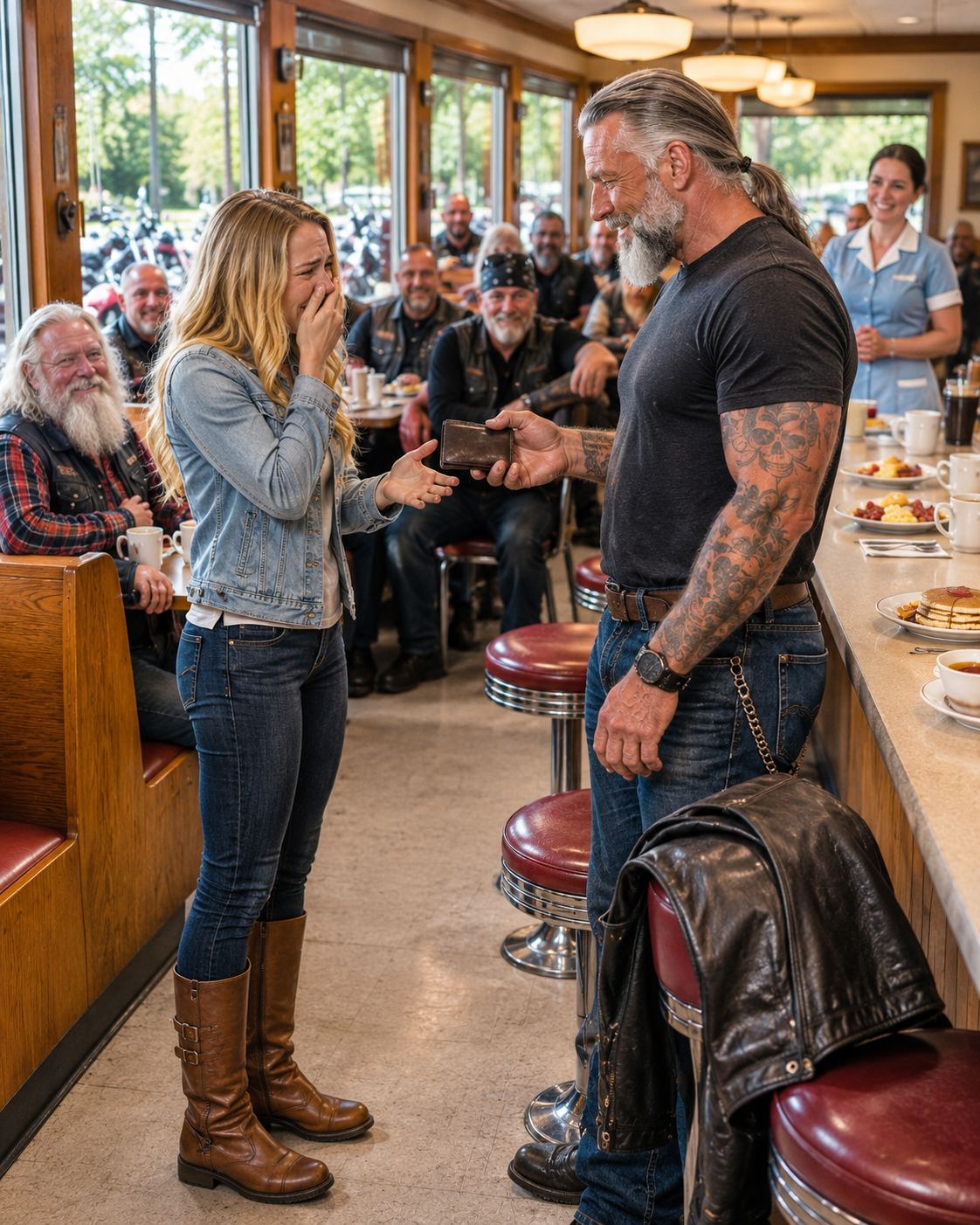
“But the report said my father abandoned the workers.” Bear’s jaw tightened. “Then the report was a lie.” The words hit me harder than I expected. For twelve years, I’d lived with the belief that my father had run away while other people burned. I’d stopped correcting people when they called him a coward. I’d stopped defending him. I’d even stopped telling people how much I missed him. And now a stranger was telling me that everything I’d believed was wrong. “Sit down, sweetheart,” Bear said gently. “This is going to take a while.” I slid into the booth. He sat opposite me, his enormous hands resting on the table. The other bikers gathered around us, but nobody interrupted. Bear took a deep breath. “Your father was the shift supervisor at the Bennett Industrial Warehouse. He wasn’t just responsible for the workers. He was the reason most of us had jobs.” I nodded slowly. “That sounds like him.” “He knew everybody’s name. Knew who had kids, who was behind on rent, who needed a day off to take his wife to the doctor. He wasn’t a rich man, Clara. But he was generous with what he had.” I stared at the jacket. “Why do you have it?” Bear looked down at the eagle stitching. “Because he gave it to me.” My throat tightened. “He gave it to you?” “Not exactly. I took it from the hospital after they brought him out. He’d asked me to keep it safe if anything happened.” I felt my eyes sting. “What happened that night?” Bear looked toward the window. For a moment, the diner seemed to disappear behind the reflection of the mountains. Then he began.
“It was October 14, twelve years ago.” I nodded. I remembered that date. It was the night my mother received the phone call that changed our family forever. Bear continued. “The warehouse had been storing industrial solvents, cleaning chemicals, and several shipments of electrical equipment. There had been complaints about the storage conditions for weeks.” “Complaints?” “Your father had filed three written safety reports. He said the ventilation system was failing, the electrical wiring was outdated, and certain chemicals were being stored too close to the loading area.” I frowned. “I never heard about any of that.” “Of course you didn’t. The reports disappeared.” He pulled a folded photograph from his vest pocket. It showed a younger man standing beside my father in front of the warehouse. My father was smiling. He had one arm around Bear’s shoulder. I recognized his face immediately. He looked exactly as I remembered him. Except younger. And happier. “Your father kept copies of everything,” Bear said. “He knew something was wrong.” I studied the photograph. “Why didn’t he tell anyone?” “He did. He went to management. He contacted the regional safety office. He even threatened to shut down operations until the problems were fixed.” “Then what?” Bear’s expression darkened. “His supervisor told him to stop making trouble. The company had just signed a major contract. Closing the warehouse would have cost them millions.” I felt something tighten in my stomach. “So they ignored him?” “They did worse. They threatened to fire him.” Bear leaned forward. “Your father had two choices. Keep quiet and collect his paycheck, or keep fighting and risk losing the only income his family had.” I swallowed. “He had me and Mom.” “I know. He talked about you constantly.” Bear smiled sadly. “He used to show me pictures of you riding your bicycle. He said you wanted to become a veterinarian.” I almost laughed through my tears. “I did.” “Your father was proud of you.” I looked away. For twelve years, I’d avoided talking about my childhood because every memory seemed to lead back to the fire. Now someone was handing those memories back to me. But I still needed an answer. “If he knew the warehouse was dangerous, why was he there that night?” Bear looked at me. “Because he was trying to get everybody out.”
According to Bear, the fire started shortly after 10:30 p.m. A maintenance worker had noticed smoke near an electrical panel in the rear storage section. He immediately called Daniel. My father was in the office finishing paperwork. He rushed toward the loading area and ordered the workers to evacuate. At first, everyone thought it was a small electrical fire. Then an explosion shook the building. The sprinkler system failed. Smoke filled the main corridor. Bear and several other workers were trapped near the loading bay. “The emergency exit had been chained shut,” Bear said. I stared at him. “Why?” “Management didn’t want people using that entrance because inventory had been disappearing. They’d chained it and never reopened it.” I covered my mouth. “That’s illegal.” “Yes.” His voice was hard. “And your father knew it.” Bear described how Daniel found a steel tool cabinet and used it to break through a side access door. He guided several men outside, then returned when he realized Bear and another worker were missing. “Your father found me near the loading bay. I had a broken leg. Couldn’t stand.” Bear paused. “He could have left me there. Nobody would have blamed him. The whole ceiling was coming down.” “But he didn’t.” “No. He put my arm around his shoulders and started dragging me toward the exit.” I could picture it. My father, who struggled to carry two grocery bags at once, trying to move a grown man through a burning warehouse. “What happened to him?” Bear’s eyes filled. “He got me through the side door. Then he heard someone screaming.” “Who?” “A young man named Michael Torres. He was an apprentice. Nineteen years old.” My heart sank. Bear continued. “Michael was trapped behind a fallen storage rack. Your father went back for him.” I closed my eyes. “Did he get him out?” Bear nodded. “He did. But by then, the fire had reached the chemical storage area.” The explosion came without warning. The blast shattered the remaining windows. Bear was thrown against a concrete barrier outside. When he regained consciousness, firefighters were already on the scene. My father was found near the loading corridor. He had managed to get Michael close to the emergency exit. But he never made it out. I pressed my fingers against my lips. “Michael survived?” “Yes. He’s alive. Has two kids now. Lives in Bozeman.” I started crying. Not quietly. Not politely. I cried like a nineteen-year-old girl who had spent twelve years defending herself against a story that had never been true. Bear reached across the table and placed his hand over mine. “Your father didn’t abandon anybody, Clara. He died trying to bring them home.”
I didn’t know what to say. For several minutes, I just sat there. Then I asked the question that had haunted me since I was nineteen. “Why did the investigation say he was responsible?” Bear’s expression hardened. “Because somebody needed to take the blame.” He opened a small leather pouch attached to his belt and removed a photograph of a document. It was a safety inspection report. My father’s signature appeared at the bottom. Except the date was wrong. And the handwriting wasn’t his. “Your father never signed this,” Bear said. “I saw him sign hundreds of reports. This wasn’t his writing.” I studied the document. It stated that the emergency exits had been inspected and that all fire suppression equipment was functioning properly. It had been dated three days before the fire. “Who signed it?” “According to the company, Daniel Bennett.” “Who actually signed it?” Bear looked around the table. “We believe it was a regional operations manager named Richard Voss.” A man in a black vest stepped forward. He was younger than Bear, perhaps in his forties, with a neatly trimmed beard. “My name is Frank Miller,” he said. “I was one of the workers who survived that night.” He placed another photograph on the table. It showed a stack of maintenance records. “Your father had been collecting evidence. He kept copies in his locker because he didn’t trust management.” I looked at Bear. “Do you still have them?” He nodded. “Some of them. But there’s something else.” He reached into his vest and removed a small metal key. “Your father gave me this the night before the fire.” I stared at it. “What does it open?” “An old storage locker at a bus station in Billings.” My heart started racing. “What’s inside?” Bear shook his head. “I never opened it. Your father told me that if he didn’t come back from that shift, I should give it to his daughter when she was old enough to understand what happened.” I looked at the key. Twelve years. He’d kept it for twelve years. “Why didn’t you find me sooner?” Bear’s face changed. “I tried.” He looked down at his hands. “After the fire, the company hired lawyers. They told us the investigation was complete. They warned us that making public accusations could cost us our jobs and expose us to lawsuits.” “But you knew my father was innocent.” “I knew what I’d seen. I didn’t know how to prove everything.” He swallowed. “Then your mother moved away. I lost contact. I searched for you, but all I had was an old address. By the time I found a reliable lead, I heard you’d left Montana.” I nodded slowly. My mother and I had moved to Oregon less than a year after the fire. We couldn’t bear staying in Billings. “How did you recognize me?” Bear smiled sadly. “You have your father’s eyes.”
The following morning, I drove to the Billings bus station with Bear and Frank. My Honda still made a strange noise, but I hardly noticed. The storage lockers were in an old section of the terminal. A maintenance employee unlocked the hallway for us. Locker 214. The key slid into the lock. I turned it. The door opened with a metallic click. Inside was a sealed plastic container. I pulled it out carefully. It was heavier than I expected. Bear watched silently as I opened it. There were several folders, a small digital recorder, a stack of photographs, and a letter addressed to me. My name was written in my father’s handwriting. Clara. I couldn’t hold back the tears. I opened the letter. “My sweet girl, If you’re reading this, something has happened that I hoped would never happen. I want you to know that I love you more than I have ever known how to explain. I know you’re growing up. I know you want to make your own decisions, and I hope you always have the courage to stand up for what you believe. There’s something happening at the warehouse that isn’t right. I’ve tried to fix it through the proper channels. I’ve written reports and spoken to management, but the people responsible care more about money than the lives of the workers. I have copies of everything. If I don’t come home, I need you to know that I did everything I could to protect the people working beside me. I never wanted you to be ashamed of me. You are my greatest achievement, Clara. Not my job. Not my paycheck. Not anything I could ever own. You. Please don’t spend your life carrying someone else’s lies. Be brave, sweetheart. Love, Dad.” I pressed the letter against my chest. Bear turned away, wiping his eyes. But the letter wasn’t the only thing inside the container. Frank opened the first folder. There were copies of safety complaints, photographs of blocked exits, maintenance requests, and internal emails. Some were dated months before the fire. One email particularly caught my attention. It was from Richard Voss to the warehouse manager. The subject line read: SAFETY REPORTS. The message said: “Make sure Bennett stops submitting these complaints. We cannot afford another inspection before the quarterly contract review. If he insists on creating problems, document him as the responsible supervisor for any outstanding safety deficiencies.” I felt sick. They had planned to blame him before the fire even happened. Bear looked at me. “Now you understand why I never threw that jacket away.” I looked at the eagle stitched across his chest. “Because my father saved you.” He shook his head. “Because he deserved to be remembered for what he actually did.”
I spent the next week contacting lawyers and locating the surviving workers. Some had moved. Some had changed careers. A few had died. But eleven people were still alive. Eleven people who remembered my father. And every one of them agreed to speak. Michael Torres was the hardest to find. I eventually located him through a construction company in Bozeman. When he answered my call, I almost lost my nerve. “Michael? My name is Clara Bennett. I’m Daniel Bennett’s daughter.” There was a long silence. Then I heard him exhale. “I’ve wondered if you’d ever call.” We met at a coffee shop two days later. Michael was thirty-one now, with a wedding ring and a small scar near his left eyebrow. He looked uncomfortable. “I’m sorry,” he said before I could speak. “For what?” “For not telling the truth sooner.” I sat down. “What do you mean?” He stared into his coffee. “I was nineteen. My family needed money. The company offered me a settlement if I signed a statement saying your father had ignored the evacuation order.” I felt the air leave my lungs. “You signed it?” He nodded. “I hated myself for it. But they told me I’d lose everything if I didn’t cooperate. My mother was sick. I was the only one working.” I looked at him. “Did you see my father that night?” Michael’s eyes filled. “Yes.” He took a breath. “He came back for me. I was pinned under a steel rack. He lifted enough of it for me to crawl free. Then he pushed me toward the exit.” He paused. “The last thing he said was, ‘Get home to your mother, son.'” I covered my mouth. Michael began to cry. “I heard the explosion. I turned around. I wanted to go back, but the firefighters wouldn’t let me.” He wiped his face. “Your father saved my life. And then I let them call him a coward.” I reached across the table. “Why are you telling me now?” “Because I have a son. He’s nineteen. I look at him, and I think about what your father did for me. I don’t want my boy growing up believing that a man who saved eleven people was a coward.” He reached into his jacket and handed me a sealed envelope. “I kept this all these years. It’s a copy of the original statement they made me sign, along with the settlement agreement.” I took it carefully. “Thank you.” He shook his head. “No. Thank you for giving me the chance to tell the truth.”
The case was reopened. At first, the authorities were reluctant. The fire had happened twelve years earlier. Records had been archived. Some witnesses had disappeared. But the evidence in the storage locker changed everything. The forged inspection report. The internal emails. The photographs. The original settlement agreement. And, most importantly, the testimony of the surviving workers. A former fire investigator named Helen Morris agreed to review the case independently. She spent six weeks examining the original reports and the new evidence. When she called me, her voice was serious. “Clara, I believe the original investigation was fundamentally flawed.” I sat down. “What does that mean?” “It means your father was blamed for safety failures that he had repeatedly reported. The company knew about those failures. Several of the documents submitted during the original investigation appear to have been altered.” I closed my eyes. “Can they correct the report?” “We’re working toward that. But there are criminal matters involved. We need to establish who altered the records and who authorized the false statements.” “Richard Voss?” “He’s one of the people we’re investigating.” I swallowed. “Is he still alive?” “Yes. And he currently serves as an executive at another industrial logistics company.” I stared at the wall. Twelve years. He had continued building his career while my father was remembered as a criminally negligent supervisor. I wanted to scream. Instead, I said, “Then we need to make sure the truth comes out.”
The confrontation happened two months later. Richard Voss had agreed to an interview with investigators after being presented with the documents. I attended as a witness. He was in his late sixties, with neatly combed white hair and a polished suit. When I entered the room, he glanced at me. “Who is this?” Helen Morris introduced me. “Clara Bennett. Daniel Bennett’s daughter.” Something flickered across his face. “Ah. I’m sorry for your loss.” I sat down. “Do you remember my father?” “Of course.” “Do you remember telling him to stop filing safety complaints?” He looked at Helen. “I don’t recall that conversation.” I placed a copy of the email on the table. His expression tightened. “That’s taken out of context.” “Then explain the context.” He cleared his throat. “Your father was a difficult employee. He had a tendency to exaggerate minor operational issues.” “Eleven people remember him risking his life to save them.” “That’s not what the official report said.” I leaned forward. “That’s exactly the problem, isn’t it?” He looked at me. I continued. “You signed a report saying the exits were clear. They weren’t. You signed a report saying the sprinklers worked. They didn’t. You blamed a man who had spent months warning you about those failures.” He folded his hands. “These are serious allegations.” “Yes. They are.” Helen placed another document in front of him. It was the original inspection record. The signature had been compared with several authenticated documents. The forensic examiner had concluded that it was likely forged. Voss looked at the paper. Then he looked at me. For the first time, he seemed afraid. “Your father was supposed to handle the evacuation,” he said quietly. “He did.” “He was the supervisor.” “He saved eleven people.” “Things got out of control.” I felt my hands shaking. “Because you ignored the warnings.” He looked away. “I never wanted anyone to die.” “Neither did my father.” The room fell silent. Then Voss finally admitted that he had instructed staff to keep the emergency exit locked and had approved the false inspection documentation. He claimed the warehouse manager had made the final decisions about the chemical storage. The investigation continued, and prosecutors later charged Voss and two former executives with offenses related to falsified safety records and obstruction of the investigation. The company was also ordered to cooperate with a civil review and compensate the families affected by the fire. But none of that brought my father back. And no courtroom could return the twelve years I’d spent believing he had been a coward.
The official correction came on a cold morning in November. Helen called me. “Clara, the review is complete.” I sat at my kitchen table. “What did they decide?” “The evidence establishes that your father repeatedly reported serious safety violations. He initiated the evacuation and assisted trapped workers. The original report incorrectly attributed responsibility for the warehouse’s safety failures to him.” I covered my mouth. “Are they changing his record?” “Yes.” She paused. “Daniel Bennett will no longer be listed as the employee responsible for the fire. The amended report recognizes his actions in attempting to save his coworkers.” I couldn’t speak. For twelve years, I’d carried a name I thought I needed to defend. Now I finally had something official to show the world. But I didn’t want a press conference. I didn’t want reporters. I wanted to tell my mother. She was living in Oregon, and I called her immediately. “Mom?” “Clara? Is everything okay?” I started crying. “Mom, they cleared Dad.” There was silence. Then I heard a sound I’d never forget. My mother sobbing. “Oh, sweetheart.” “They changed the report. They know what happened now.” She cried harder. “Your father would be so proud of you.” I closed my eyes. For the first time in twelve years, my mother and I were allowed to remember Daniel Bennett without having to explain ourselves.
A month later, I returned to the diner. Bear was sitting at the counter in the same leather vest. When he saw me, he stood. “Well?” I smiled through my tears. “They corrected the report.” The entire diner erupted in applause. Frank slapped the counter. Michael, who had driven over from Bozeman, raised his coffee cup. Bear walked toward me. He took off the leather jacket and held it out. “I think this belongs to you.” I stared at it. The silver eagle was slightly worn. The initials were still visible beneath the wing. D.B. I shook my head. “No. I think it belongs with you.” Bear frowned. “Clara…” “My father gave it to you, didn’t he?” “Yes.” “Then I think he wanted you to have it.” I touched the stitching. “But I have something to ask.” He looked at me. “Would you let me take a photograph of it? I want to show my children someday.” Bear smiled. “Anything you want.” He stood beside me while Frank took the picture. Thirty men gathered behind us. Some were old enough to have known my father personally. Others had joined the riding club years later. But every one of them understood why that photograph mattered. It wasn’t about a motorcycle club. It wasn’t about a leather jacket. It was about a man who had chosen to go back into a burning building when he could have saved himself.
Before I left Montana, Bear invited me to the memorial garden the riders had built near the old warehouse site. It was a small place surrounded by pine trees. There was a stone bench, a flagpole, and a plaque bearing the names of the twelve men who had died in the fire. My father’s name was at the bottom. But beneath it, someone had added a new line. DANIEL BENNETT A MAN WHO REFUSED TO LEAVE HIS PEOPLE BEHIND. I ran my fingers over the engraved letters. Bear stood beside me. “We’ve been waiting a long time for that to be corrected.” I looked at him. “Why did you all keep fighting for him?” Bear considered the question. “Because your father didn’t save us to become a hero. He saved us because he believed our lives mattered.” He looked toward the trees. “Men like that are rare. You don’t forget them.” I sat on the bench. For a while, neither of us spoke. Then I asked him something I’d been thinking about since the diner. “Did my father ever talk about me that night?” Bear smiled. “Actually, yes.” My heart stopped. “What did he say?” “He told me that if he ever got the chance, he wanted to take you to Yellowstone. He said you’d been asking to see the mountains for years.” I laughed softly. “I was.” “He said he was going to buy you a ridiculous souvenir hat.” I covered my face. “He hated souvenir shops.” Bear chuckled. “Apparently, you were the exception.” I looked toward the mountains. A picture came into my mind. My father standing beside me, laughing while I tried on an oversized cowboy hat. For twelve years, I’d thought about his final moments as a tragedy. Now, for the first time, I could imagine the ordinary moments he’d hoped to share with me. The little things. The ones that never happened. And somehow, that made me miss him even more. But it also made me feel closer to him.
Three months later, I made a decision. I used part of my savings to establish the Daniel Bennett Safety Scholarship. It would support workers who wanted to become certified in industrial safety, emergency response, and workplace inspection. The first recipients were the children of warehouse employees who couldn’t afford technical training. I worked with Bear, Frank, Michael, and several former coworkers to organize the program. At the first ceremony, Bear stood beside me. He was wearing the same leather jacket. I was holding a photograph of my father. I looked at the young people seated in front of us. “Most of you probably know my father’s name because of a terrible accident,” I began. “But I want you to remember him for something else.” I held up the photograph. “He was a man who understood that every worker deserved to come home safely. He spoke up when something was wrong, even when it cost him his job and put him in danger.” I paused. “For twelve years, I believed the worst thing about my father was that he had failed the people who depended on him.” My voice trembled. “Today, I know the truth. He did everything he could to protect them. And the people he saved never forgot.” I looked across the room. “If you ever find yourself in a workplace where safety is ignored, don’t stay silent because someone tells you to. Don’t assume that speaking up is more dangerous than looking away.” The room was completely still. “Sometimes doing the right thing is difficult. Sometimes it costs you something. But your courage may be the reason somebody else gets to go home.” The applause lasted several minutes. Afterward, a young woman approached me. She was studying industrial engineering. “Ms. Bennett?” “Clara is fine.” “Thank you for telling your father’s story. My dad works at a warehouse. He always says people like him don’t have the power to change anything.” I smiled. “Tell him he doesn’t have to change everything. Sometimes changing one dangerous decision is enough to save a life.” She nodded. Then she hugged me. I hugged her back. And I thought about how my father’s story had finally become something useful. Not just a tragedy. A warning. A lesson. A reason to do better.
A year after I first walked into that diner, I drove back to Montana. This time, my Honda was running smoothly. The weather was clear. The mountains looked almost unreal beneath the blue sky. I stopped at the same diner and ordered coffee. Bear was there, surrounded by his friends. He saw me through the window and raised his hand. I walked inside. “Well, look who’s back,” he said. I smiled. “Just checking whether you old men are still drinking terrible coffee.” The diner erupted in laughter. We sat together for nearly an hour. Bear told me about a new riding route he was planning. Frank complained about his knees. Michael showed me a picture of his son, who had just graduated from high school. Then Bear reached into his pocket. He handed me a small envelope. “Found this in an old box of your father’s things. I thought you should have it.” Inside was a photograph of my father sitting on his motorcycle. He was wearing the leather vest. The silver eagle gleamed in the sunlight. On the back, he’d written: “One day, Clara will understand that being brave doesn’t mean never being afraid. It means refusing to let fear decide what kind of person you become.” I read it twice. Then I held the photograph against my chest. My father had been afraid. Afraid of losing his job. Afraid of leaving his family. Afraid of what might happen if he kept fighting. But he’d spoken up anyway. And when the fire came, he hadn’t run. I looked at Bear. “Thank you for keeping his memory alive.” He shook his head. “Your father did that himself, sweetheart. We just made sure nobody could bury the truth.” When I finally stepped outside, the motorcycles were lined up in the parking lot. Thirty engines started almost together. The sound rolled across the highway. I stood beside my car and watched the riders pull away. Bear was at the front. My father’s jacket moved in the wind. For a moment, I imagined Dad sitting behind the handlebars, turning around to give me that familiar smile. I didn’t feel ashamed anymore. I didn’t feel the need to explain his name. I knew who he was. He wasn’t the coward described in an old report. He wasn’t a perfect man, either. He was a father who loved his daughter, a supervisor who cared about his workers, and a human being who chose to protect others when it mattered most. And I had finally learned something that took me twelve years to understand: The truth about a person isn’t always found in the stories people tell after they’re gone. Sometimes, it’s found in the lives they saved, the courage they showed, and the people who still remember what they did. I climbed into my Honda and started the engine. As I drove toward the mountains, I rolled down the window and let the cool Montana air fill the car. For the first time in twelve years, I wasn’t driving away from my father’s memory. I was carrying it with me. And that was enough.