**For ten years, I believed I killed my best friend. Then a dying man asked me to come home—and someone sent me a message that made me question everything about that night.**
The Truth About That Night I didn’t sleep that night. I sat on the edge of my bed until sunrise, staring at the message on my phone. Ten years of silence, ten years of guilt, and now one stranger had managed to tear open a wound I’d spent a decade trying to bury. There was only one place I could go. Cedar Ridge. I packed a small bag, checked the oil in my Harley, and stood in the garage for a moment before climbing on.
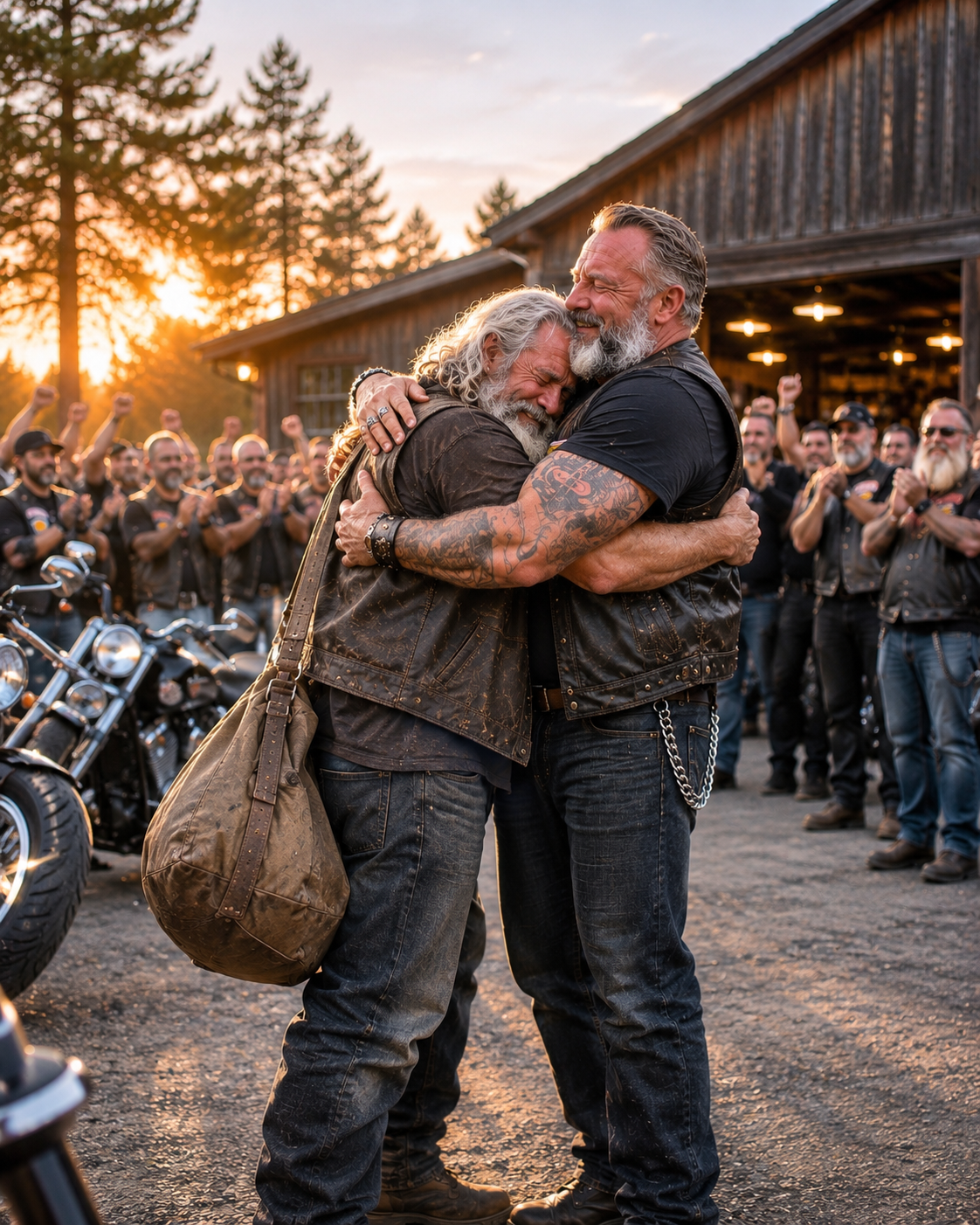
The old bike coughed twice before the engine finally came alive. For ten years, I’d convinced myself that leaving the club was the right thing to do. I told myself those men would be better off without me. I told myself Gabriel’s death was something I had to carry alone. But as I pulled onto the highway, I wondered whether I’d really been protecting anyone. Or whether I’d just been running away. The ride from Prescott to Cedar Ridge took nearly six hours. The desert stretched endlessly beneath a pale morning sky. Every mile brought back another memory. Gabriel laughing at a gas station. Gabriel stealing fries from my plate. Gabriel shouting over the roar of our engines that I was getting too old to ride in front. He’d been forty-two when he died. He had a daughter named Sophie who was only nine years old at the time. I remembered her standing beside his coffin in a little black dress, holding her mother’s hand. She hadn’t cried. She’d just looked at me and asked, “Why did Daddy go riding without me?” I never found an answer. By the time I reached Cedar Ridge, the sun was beginning to set. The clubhouse stood at the end of an old gravel road, surrounded by pine trees and a rusted iron fence. The paint had faded. The wooden sign above the entrance still carried the club’s name: IRON HORIZON. I slowed my Harley. Nothing had changed. Except everything had. I parked outside and killed the engine. For a moment, I couldn’t bring myself to move. Then the front door opened. A tall man stepped outside. Marcus Reed. He’d been the club’s vice president when I left. Now his beard was almost completely gray, and there was a noticeable limp in his right leg. He stared at me for several seconds. Then he shook his head. “Well, I’ll be damned.” I forced a smile. “Hey, Marcus.” He walked toward me slowly. I expected anger. Maybe a punch. Maybe ten years of questions. Instead, he grabbed my shoulders and pulled me into a hug. “About damn time, brother.” Those four words nearly broke me. I looked past him. “How’s Elijah?” Marcus’s expression changed. “Not good. He’s at the house behind the clubhouse. Doctors say his heart is failing. He’s been refusing treatment for weeks.” “Why?” Marcus looked me directly in the eyes. “Because he says there’s one thing he needs to do before he dies.” I already knew the answer. “See me.” Marcus nodded. I followed him inside. The clubhouse smelled exactly as I remembered. Old leather, coffee, motor oil, and wood smoke. There were photographs covering the walls, some faded by time. I stopped in front of one. It was taken eleven years earlier. Gabriel stood on my left, Marcus on my right, and Elijah sat in the middle holding a beer. I was laughing. Gabriel had his arm around my shoulder. I hadn’t seen that photograph in ten years. I reached out and touched the frame. “Nobody’s moved anything,” I whispered. Marcus shook his head. “Elijah wouldn’t let us.” Then I saw it. The chair. My chair. It sat at the far end of the long wooden table. A small piece of masking tape remained attached to the backrest. JULIAN. My name was written in Elijah’s crooked handwriting. I couldn’t hold back the tears. Marcus put a hand on my shoulder. “He’s waiting.” I followed him down the hallway. Elijah’s room was small, with a single bed, an oxygen machine, and a photograph of his late wife on the nightstand. The old man looked smaller than I remembered. His face was thin. His hands trembled beneath the blanket. But when he saw me, his eyes opened wide. “Well,” he whispered. “Look what the wind finally brought home.” I dropped beside his bed. “Elijah.” He reached for my hand. I held it tightly. “I’m sorry,” I said. He frowned. “For what?” “For leaving. For Gabriel. For everything.” Elijah closed his eyes for a moment. Then he looked at me. “Son, there’s something I’ve been trying to tell you for ten years.” My stomach tightened. “What?” He swallowed painfully. “Gabriel didn’t die because of you.” I felt the air leave my lungs. “Don’t.” “I’m not asking you to believe me. I’m asking you to listen.” I shook my head. “I was leading that night. I chose the road. I saw the truck behind us. I saw it.” Elijah’s fingers tightened around mine. “Then you saw exactly what you were supposed to see.” I stared at him. “What does that mean?” Before he could answer, someone knocked on the door. Marcus stepped inside. “Sorry to interrupt. Clara’s here.” I turned. Clara stood in the doorway. She looked older, of course. There were silver strands in her dark hair, and the years had left tired lines around her eyes. But she still had the same gentle expression I remembered. For a moment, neither of us spoke. Then she walked toward me. “Julian.” I stood. “I’m sorry, Clara.” She looked at me for a long time. Then she said something I never expected. “I know.” I swallowed. “You know what?” “I know you didn’t cause the accident.” The room seemed to tilt. Clara reached into her handbag and pulled out a small envelope. “Gabriel left this with Elijah three days before he died.” I stared at it. “Why didn’t anyone give it to me?” “Because Elijah promised Gabriel he wouldn’t open it unless you came home.” My hands were shaking when I took the envelope. My name was written across the front. In Gabriel’s handwriting. I sat down beside the bed and opened it. Inside was a folded sheet of paper. There were only a few paragraphs. Julian, If you’re reading this, something has happened that I couldn’t stop. I hope I’m wrong about everything. I hope you never need to read this letter. There’s someone in the club who has been moving money without permission. I’ve been keeping records. I think he’s using the club’s name to cover something much bigger. I don’t know who I can trust anymore. If anything happens to me, don’t blame yourself. You’ve always looked out for me, even when I didn’t deserve it. And whatever you do, don’t let them convince you that you were the one who made the mistake. Your brother, Gabriel. I read it twice. Then a third time. My eyes stopped at one sentence. “Don’t let them convince you that you were the one who made the mistake.” I looked at Clara. “Who was he talking about?” She glanced at Marcus. Marcus’s jaw tightened. “That’s what we’ve been trying to find out.” Elijah shifted in his bed. “No,” he whispered. “We know who.” Everyone turned toward him. The old man took a shallow breath. “His name is Raymond Cole.” My blood ran cold. Raymond. He’d been the club’s treasurer ten years ago. A quiet man. Always polite. Always ready to help. The kind of person nobody ever suspected. After Gabriel’s death, Raymond had disappeared from Cedar Ridge. We’d been told he moved to Nevada. “Where is he now?” I asked. Marcus answered. “Back in town.” I stood so quickly the chair scraped across the floor. “Why?” “Because somebody’s been asking questions about Gabriel’s old records.” I looked down at the letter. Then I remembered the message on my phone. Come back to Cedar Ridge, Julian. It’s time you learned what really happened that night. I pulled out my phone and showed Marcus. He read it. His face turned pale. “Where did you get this?” “Unknown number.” Marcus looked toward Elijah. The old man slowly nodded. “He’s been watching.” “Who?” I demanded. But Elijah’s eyes were already closing. “Raymond.” For several seconds, nobody spoke. Then the oxygen machine began making a strange sound. Clara rushed toward the bed. “Elijah?” His eyes opened briefly. He looked at me. “There’s a box,” he whispered. “Under the floor… in the old office.” I leaned closer. “What box?” “Gabriel’s truth.” His breathing became shallow. “Don’t let it die with me.” Then his eyes closed. The room erupted into movement. Clara called for the doctor. Marcus grabbed the emergency phone. I stood beside the bed, holding Gabriel’s letter. For the first time in ten years, I wasn’t thinking about the night he died. I was thinking about the man who might have caused it. And I was afraid of what I would find.
The old office hadn’t been used in years. It was a small room behind the clubhouse kitchen. Gabriel used to keep his paperwork there because he didn’t trust computers. Marcus found a flashlight. I moved the old filing cabinet while he pulled up a loose section of wooden flooring. Beneath it was a metal box covered in dust. My hands went cold. There was a combination lock. Marcus stared at it. “Any idea?” I looked at the numbers stamped into the metal. 0427. Gabriel’s birthday. The lock clicked open. Inside were several notebooks, a flash drive, a stack of bank statements, and a photograph. I picked up the photograph first. It showed Raymond standing beside a black pickup truck. Another man stood next to him. I recognized the second man immediately. Deputy Sheriff Thomas Keller. He’d been the officer who investigated Gabriel’s accident. The same man who had told us the crash was caused by excessive speed and wet pavement. The same man who had looked me in the eye and said there was no evidence of another vehicle being involved. I felt my stomach turn. “Marcus.” He looked at the photograph. “Son of a…” I opened the first notebook. Gabriel had recorded dates, transactions, and names. The deeper we looked, the uglier it became. Raymond had been diverting money from the club’s charitable fund into accounts connected to a construction company. Some of the money had come from donations intended for veterans and struggling families. Gabriel had discovered the transfers. He had confronted Raymond. And according to his notes, Raymond had threatened him. One entry was underlined three times. Raymond knows I have the records. He says I don’t understand how far this goes. If I go to the police, he’ll make sure nobody believes me. I felt sick. For years, I’d thought Gabriel died because I chose the wrong road. Now I was beginning to understand that somebody might have chosen it for us. The flash drive contained scanned documents, photographs, and several audio recordings. Marcus plugged it into an old laptop. The first recording was Gabriel’s voice. “April fourteenth. Meeting with Raymond Cole.” A second voice followed. Raymond. “You need to leave this alone, Gabe.” “You stole from people who trusted us.” “You’re making this bigger than it needs to be.” “Then give the money back.” A long silence. Then Raymond spoke again. “Some things are bigger than you and me.” Gabriel laughed bitterly. “That’s what cowards say when they don’t have an answer.” The recording ended. Marcus leaned back. “That bastard.” I clicked on another file. This one was dated the night of the accident. The audio was muffled, but Gabriel’s voice was clear enough. “If anything happens tonight, Julian has nothing to do with it. You understand?” A second voice answered. “Then don’t make me do something I’ll regret.” Raymond. I stood up. My fists were clenched so tightly my nails dug into my palms. “He threatened him.” Marcus nodded. “And Keller was helping him.” I looked at the photograph again. “What if Keller covered up the accident?” Marcus didn’t answer. Because we both knew that was exactly what Gabriel had been trying to tell us. Then we heard a sound outside. A car door. We froze. Marcus switched off the laptop. Footsteps approached the office. Slow. Unhurried. Someone stopped outside the door. Then came a familiar voice. “Marcus? Julian? I know you’re in there.” Raymond Cole. Marcus looked at me. I motioned for him to stay quiet. The doorknob turned. Locked. Raymond sighed. “Come on, boys. We don’t need to make this difficult.” I stepped toward the door. “What do you want, Raymond?” Silence. Then he laughed softly. “To talk.” “Funny. You’ve had ten years.” “Ten years is a long time to carry a misunderstanding.” I looked at Marcus. He had already taken out his phone and begun recording. I opened the door. Raymond stood there in an expensive jacket, his hair neatly combed, and a polite smile on his face. He looked almost exactly as I remembered. That was the frightening part. “Julian,” he said. “You’ve aged.” “So have you.” His eyes moved past me. He saw the open box. The smile disappeared. “I was hoping you wouldn’t find that.” I stepped into the hallway. “Gabriel found out what you were doing.” Raymond shook his head. “Gabriel was a good man. Too good, sometimes. He couldn’t understand that the world doesn’t work the way he wanted.” “You stole from the club.” “I borrowed money.” “From veterans. From families who needed help.” “Money comes and goes.” I stared at him. “People don’t.” For a moment, something ugly appeared in his eyes. Then it vanished. He lowered his voice. “Listen carefully. Whatever Gabriel wrote in those notebooks, it doesn’t change what happened on that highway.” My heart began pounding. “What happened?” Raymond looked directly at me. “You made a mistake. You took the turn too fast. Gabriel lost control. That’s the truth.” I felt ten years of guilt rise inside me. But this time, I didn’t look away. “Then why were you following us?” Raymond said nothing. I took a step closer. “Why was Keller with you?” His jaw tightened. “You’re playing with things you don’t understand.” “Then explain them.” Raymond glanced down the hallway. “Somebody should have kept you away from Cedar Ridge.” He turned to leave. Marcus stepped forward. “You’re not going anywhere.” Raymond laughed. “You think a box of old papers is enough to bring me down?” Marcus raised his phone. “Maybe not. But this conversation might help.” Raymond’s expression changed. He lunged toward Marcus, knocking the phone from his hand. I grabbed Raymond’s jacket. He swung at me. His fist caught my cheek. Pain exploded across my face. For a second, I was twenty years younger, standing in a roadside bar with a man who thought he could intimidate me. But this wasn’t a bar. And I wasn’t interested in winning a fight. I pushed him away. “Stop!” The sound came from behind us. Clara. She stood at the end of the hallway, holding her phone. “I called the sheriff’s department,” she said. “And I sent copies of Gabriel’s records to a state investigator.” Raymond went pale. “You wouldn’t.” Clara’s voice trembled, but she didn’t back down. “Gabriel trusted you. I trusted you. And you used that trust to destroy my family.” Raymond looked toward the exit. Then another voice spoke. “Don’t bother.” We turned. Two officers stood at the front entrance. Behind them was a woman in a dark suit. She introduced herself as Special Agent Morgan from the state investigative unit. “Raymond Cole,” she said, “we’d like you to come with us.” Raymond looked at me. For the first time, I saw fear in his eyes. “You don’t know what you’re doing, Julian.” I wiped the blood from my lip. “You’re right.” I glanced toward Gabriel’s photograph on the wall. “But I know what you did.” The officers took him away. Nobody cheered. Nobody celebrated. We simply stood there, listening to the sound of his car pulling away. Because catching the man responsible didn’t bring Gabriel back. And it didn’t give any of us back the years we’d spent believing the wrong story.
The investigation took months. Gabriel’s records turned out to be only the beginning. The investigators uncovered years of financial fraud, falsified reports, and payments made to people who were supposed to protect the public. Thomas Keller was eventually charged with helping Raymond conceal evidence connected to the accident. The evidence also revealed something none of us had expected. On the night Gabriel died, Raymond had followed our motorcycles in his black pickup. He had been trying to recover the documents Gabriel carried in his saddlebag. When we reached the highway, Raymond had attempted to force Gabriel toward the shoulder. Gabriel’s motorcycle struck loose debris and went down. The police report had described the crash as a single-vehicle accident. But the evidence from Gabriel’s recordings, together with recovered vehicle damage and witness statements, helped investigators establish what had really happened. The truck had been there. And I hadn’t imagined it in my rearview mirror. The worst part came later. Investigators found a message Raymond had sent to Keller hours after the crash. The other rider survived. Make sure he believes it was his fault. He’ll disappear on his own. I read those words in the investigator’s office. Then I put the paper down. I couldn’t breathe. Ten years. Ten years of believing I had killed my brother. Ten years of waking up at night hearing the sound of his motorcycle hitting the road. Ten years of thinking I didn’t deserve to sit at a table with the people who loved me. And somebody had known exactly what he was doing. He hadn’t just taken Gabriel from us. He had stolen ten years of my life by turning my grief against me. I walked outside and sat on a bench. Marcus came out a few minutes later. He didn’t say anything. He just sat beside me. After a long silence, I whispered, “I should have fought harder.” Marcus looked at the sky. “You did what a lot of good men do when they’re hurt, Julian. You believed the worst thing about yourself because it was easier than believing someone else could be that cruel.” I looked at him. He continued. “That doesn’t make you guilty. It makes you human.” I covered my face with my hands. For the first time in ten years, I cried for Gabriel without blaming myself for his death.
Elijah didn’t live long enough to see the investigation finish. Three weeks after Raymond’s arrest, his condition worsened. I was sitting beside his bed when he woke up one morning and asked for coffee. I laughed. “Doctor says you’re not supposed to have any.” Elijah frowned. “Doctors have been telling me what to do for eighty years. Never made them right.” I brought him a small cup anyway. He took one sip and smiled. “Still tastes terrible.” “Some things never change.” He looked at me. “How’s the boy?” “Marcus?” “No. You.” I stared into my coffee. “Trying to figure out how to live without hating myself.” Elijah nodded slowly. “That’s a good start.” He reached toward the nightstand and picked up a small wooden object. It was an old key. He placed it in my palm. “Remember the shed behind the clubhouse?” I nodded. “Your old workshop?” “Gabriel and I built it before you came along. Never did finish the roof.” I smiled. “What does this key open?” “Something I want you to see.” He waited until I leaned closer. “There’s a ledger in there. Every dollar the club ever raised for charity. Every family we helped. Every veteran we got back on his feet.” I looked at him. “Why are you telling me this?” “Because I want you to understand something.” His voice grew weak. “Gabriel didn’t spend his life trying to prove he was a good man. Neither did I. We just tried to leave things better than we found them.” He squeezed my hand. “You spent ten years punishing yourself because you thought you owed the world something for surviving.” I couldn’t speak. Elijah continued. “Son, surviving isn’t a debt. It’s a responsibility. Don’t waste the rest of your life paying for something you didn’t do.” I bowed my head. He touched my shoulder. “And don’t let an empty chair become a grave.” Those were the last words he said to me. Elijah died the following morning, peacefully, with Clara beside him and my hand resting over his. At his funeral, the entire club stood in formation. There were veterans, mechanics, families, and people I’d never met. One old woman approached me afterward. She held my hand and said, “Elijah helped my husband when nobody else would. He never told us he was running a charity. He just showed up.” I looked toward the clubhouse. I finally understood why he had kept my chair. He wasn’t waiting for me to apologize. He was waiting for me to stop believing I was beyond forgiveness.
A month later, I returned to the garage in Prescott. I packed my tools. I sold nothing. I simply loaded everything onto a trailer and drove back to Cedar Ridge. The club had offered me my old position. I turned it down. Not because I didn’t love those men, but because I wanted to build something different. I asked Marcus if we could reopen the old workshop behind the clubhouse. He smiled. “Elijah would’ve liked that.” We repaired the roof, replaced the windows, and cleaned out years of dust. Then I put a sign above the door. GABRIEL’S GARAGE FREE MOTORCYCLE AND CAR REPAIRS FOR VETERANS AND FAMILIES IN NEED. The first person through the door was an old veteran named Walter. His pickup truck had been sitting in his driveway for three months. He couldn’t afford the repairs. I spent the afternoon fixing it. When I handed him the keys, he looked at me with tears in his eyes. “How much do I owe you?” I shook my head. “Nothing.” He tried to argue. I pointed toward the sign. “Someone helped me once. I’m just passing it along.” Word spread. Soon, the workshop was full most days. Marcus handled appointments. Clara organized donations. Several younger club members volunteered on weekends. And then, one afternoon, someone walked through the door whom I hadn’t seen in ten years. Sophie Brooks. Gabriel’s daughter. She was nineteen now. Tall, confident, with her father’s dark eyes. For a moment, I couldn’t move. She looked around the workshop. “Is this where you fix bikes?” I nodded. “That’s the idea.” She smiled faintly. “Mom told me what happened.” I lowered my eyes. “I’m sorry I wasn’t there for you.” She stepped closer. “I used to hate you.” I felt the words land. “I understand.” “But Mom showed me the letter Dad wrote. And she told me about the investigation.” She looked toward the old motorcycle lift. “Dad used to say you were the only person crazy enough to ride in front of him because you never knew when to slow down.” I laughed through my tears. “That sounds like Gabriel.” She smiled. Then she pulled a small object from her pocket. A silver keychain. It had a tiny motorcycle engraved on it. “Dad gave me this when I was little. He said if I ever got lost, I should find the people who made me feel safe.” She placed it on my workbench. “I think he would’ve wanted me to come here.” I looked at her. “You’re welcome here anytime, Sophie.” She nodded. Then she said something that stayed with me. “Can you teach me to ride?” I stared at her. “Your father would probably haunt me.” She laughed. “Probably.” I looked toward the old Harley parked beneath the workshop window. It was the same bike I’d ridden the night Gabriel died. For ten years, I’d thought hearing its engine would destroy me. Now I realized it was simply a machine. The memories belonged to me. And I could choose what to do with them. “All right,” I said. “But we’re starting in the parking lot.”
Six months passed. The investigation moved forward, the workshop grew, and Cedar Ridge slowly began to feel like home again. Raymond eventually pleaded guilty to multiple charges related to the financial fraud and the conspiracy surrounding Gabriel’s death. Keller lost his badge and faced criminal charges for his role in concealing evidence. Justice was imperfect. It couldn’t return Gabriel. It couldn’t restore Elijah’s final years. And it couldn’t give me back the decade I’d spent hiding. But it did something important. It gave us the truth. On the anniversary of Gabriel’s death, the club gathered at the old highway overlook. The sky was gray. A light rain fell against our jackets. I stood beside Clara and Sophie, holding a photograph of Gabriel. Marcus placed a small bouquet of flowers near the guardrail. Nobody spoke for a while. Then Sophie turned to me. “Do you still think about that night?” “Every day.” “Does it still hurt?” I looked toward the road. “Yes.” She nodded. “Mom says some things don’t stop hurting. You just learn how to carry them differently.” I smiled. “Your mom’s a wise woman.” Sophie slipped her hand into mine. Then she looked at the photograph. “Dad would’ve liked what you’re doing.” I swallowed hard. “I hope so.” We stood there until the rain stopped. Before leaving, I walked to the edge of the overlook. For the first time in ten years, I spoke to Gabriel without asking him to forgive me. “I found out what happened, brother,” I whispered. “And I’m done letting that man decide how the rest of my life goes.” The wind moved through the pine trees. I placed the photograph beside the flowers. Then I walked back to the others.
That evening, the clubhouse was full. People laughed around the tables. Someone played an old rock song on the jukebox. Marcus argued with a younger rider about motorcycle maintenance. And at the far end of the table sat my chair. The masking tape was still attached to the back. JULIAN. I ran my fingers over the faded letters. Then I looked at the empty chair beside mine. It had belonged to Gabriel. I pulled it closer. Clara noticed and smiled. She placed a framed photograph of Gabriel on the table between us. For a moment, I felt the old sadness return. But this time, it didn’t come alone. There was gratitude beside it. Love. Forgiveness. And something I hadn’t felt in ten years. Peace. I raised my glass. “To Elijah,” I said. Everyone lifted theirs. “To Elijah.” Then I looked at Gabriel’s photograph. “And to the brothers who never really leave us.” The room fell quiet. Marcus cleared his throat. “Welcome home, Julian.” I looked around the table. At the people who had waited. At the people who had forgiven. At the people who had never stopped believing there was still a place for me. And I finally understood something Elijah had tried to teach me. Sometimes the hardest road isn’t the one that takes you away from home. It’s the one that asks you to turn around. I spent ten years believing that taking responsibility meant punishing myself forever. I was wrong. Taking responsibility means facing the truth, making amends where you can, and choosing to do something meaningful with the life you still have. You cannot change the moment that broke your heart. You cannot bring back the people you lost. But you can decide whether grief will turn you into a prisoner or make you more compassionate toward the people still standing beside you. That night, I didn’t leave the clubhouse early. I didn’t sit alone in my truck. I didn’t look for an excuse to disappear. I stayed. And when the laughter grew loud around the table, I laughed too. For the first time in ten years, I wasn’t a man hiding from his past. I was Julian Drake. A brother. A friend. A mechanic. And a man who had finally come home. Because sometimes forgiveness doesn’t begin when someone tells you that you’re innocent. Sometimes it begins when you finally believe that you still deserve a future.