A homeless young woman walked into my motorcycle garage asking for a job, and within five minutes, she exposed a mistake that my most experienced mechanic had completely missed.
I opened my desk drawer and pulled out a set of keys. “Emily, I need you to listen carefully to what I’m about to tell you.” She looked at the keys, then at me. “You’re not getting a handout. You’re getting a job. A real one. Starting tomorrow morning, you work here as a mechanic’s apprentice. You’ll earn the same starting wage I’d pay anyone else with your experience, and if you prove yourself, you’ll get raises just like everybody.”
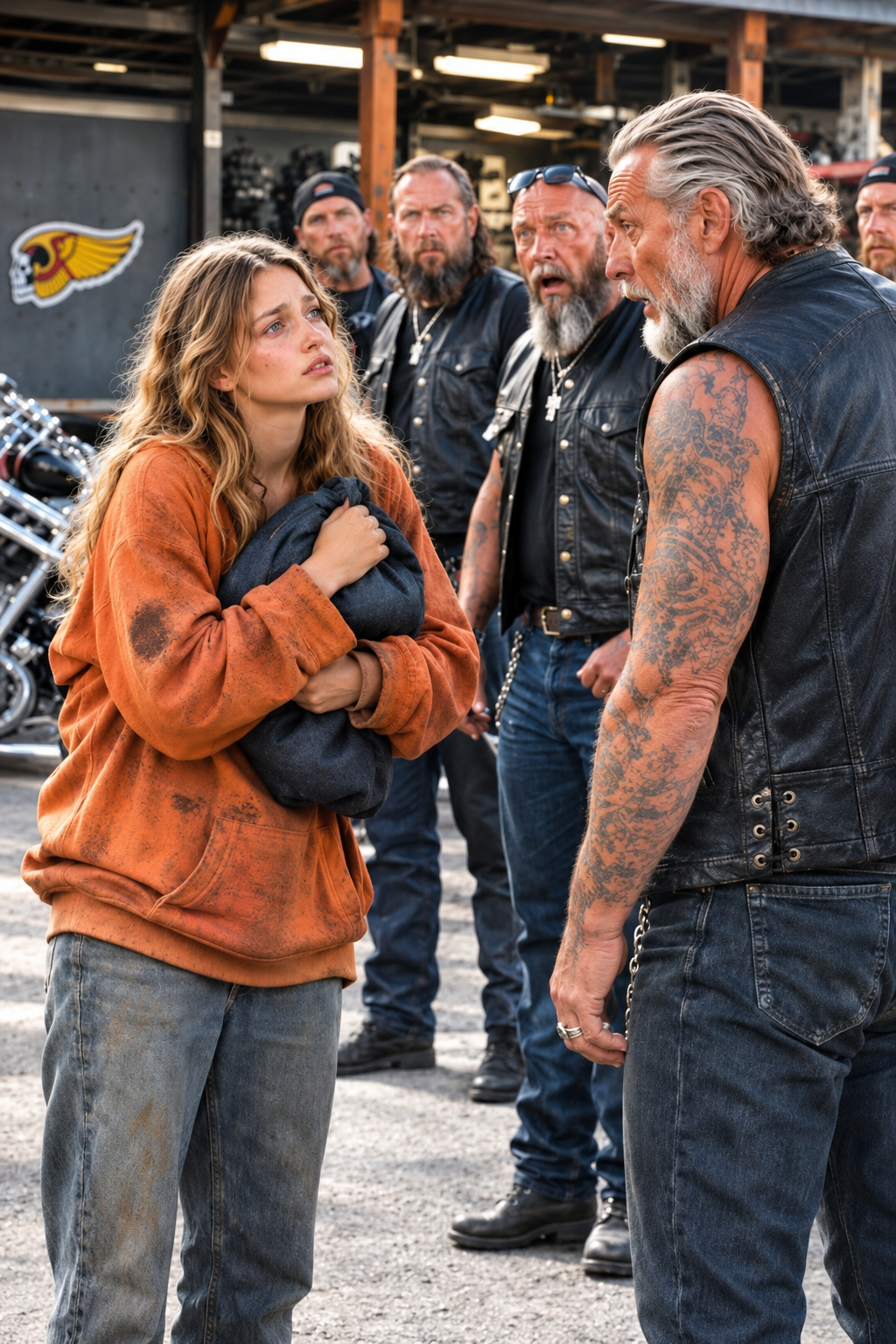
Her eyes widened. “But there’s one more thing.” I slid the keys across the desk. “There’s a small apartment above the garage. It used to belong to my brother before he moved to Oregon. It’s empty. You can stay there. No rent for the first three months. After that, we’ll figure something out based on your paycheck.” Emily stared at the keys without touching them. “Sir, I can’t accept all that.” “Why not?” “Because I haven’t earned it.” I leaned back in my chair. “Then earn it by showing up tomorrow. That’s all I’m asking.” She swallowed hard. For a moment, I thought she might cry, but she simply nodded. “Yes, sir. I’ll be here.” One of my older mechanics, a man named Frank, cleared his throat. “Boss, you sure about this?” I looked at him. “Frank, she just caught something you missed.” He glanced toward the motorcycle. “Yeah. I know.” “Then maybe we should all be asking what else she knows.” Emily finally picked up the keys. And that was how everything began. The next morning, she arrived fifteen minutes before opening. She was wearing the same battered sneakers, but she’d washed her clothes and tied her hair back. Her father’s notebook was tucked safely inside her backpack. I handed her a work shirt with the garage logo stitched over the chest. She ran her fingers over it. “What’s wrong?” I asked. “Nothing, sir. It’s just been a long time since somebody gave me something with my name on it.” I didn’t know what to say to that. So I showed her where to clock in. Frank wasn’t particularly thrilled about having a young woman working beside him. He’d been turning wrenches for nearly thirty years, and he wasn’t the kind of man who liked being surprised. He gave her the dirtiest jobs. Cleaning parts. Sorting bolts. Draining oil. Sweeping floors. Emily didn’t complain. She worked quietly, carefully, and with a kind of concentration I hadn’t seen in a long time. Around ten that morning, Frank was rebuilding a carburetor on an older Harley. He had the parts spread across his workbench and was muttering to himself. Emily walked past, stopped, and looked down. “Can I ask you something?” Frank didn’t look up. “What?” “Did you check the float height?” He frowned. “I’ve been doing this longer than you’ve been alive.” “Yes, sir. I just noticed the needle looks worn.” Frank picked it up, examined it, and went quiet. The needle was worn. He replaced it without another word. By lunchtime, two other mechanics had asked Emily to look at problems they couldn’t figure out. She didn’t act like she knew everything. In fact, she asked questions constantly. But when she gave an answer, she usually had a reason behind it. That afternoon, I found her sitting on an overturned bucket, carefully writing something in her father’s notebook. “What are you working on?” “Recording the problems we found today.” “Why?” “So I don’t forget. My dad always said a mechanic who trusts his memory more than his notes eventually makes an expensive mistake.” I smiled. “Your father sounds like he knew what he was doing.” Emily looked down at the notebook. “He did.” There was something in her voice that told me there was more to that story. I didn’t push. Over the next few weeks, Emily became part of the garage. She learned our routines, remembered our customers’ names, and treated every motorcycle as though somebody’s life depended on getting the repair right. Because sometimes it did. She was particularly good at diagnosing problems that didn’t announce themselves. A strange vibration. An inconsistent idle. A noise that disappeared whenever the engine warmed up. She listened before she touched anything. And when she couldn’t figure something out, she went back to the beginning. Frank began leaving difficult jobs on her workbench. He never admitted it, but I noticed. One evening, after everyone else had gone home, I found him standing beside her while she examined a motorcycle that had been giving its owner trouble for months. “You hear that?” Frank asked. Emily tilted her head. “There’s a slight hesitation when the engine settles.” “Good. Now tell me what you think is causing it.” She thought for a moment. “I’d like to check the ignition system before replacing anything.” Frank nodded. “That’s what I was thinking.” I stood in the doorway and watched them. A month earlier, Frank had laughed when she walked through the door. Now he was teaching her. And she was teaching him a few things, too. But the biggest surprise came on a Thursday afternoon. A customer named Richard brought in a nearly new motorcycle. He was a wealthy man who owned several businesses around town. He was the sort of customer who expected everyone to stop what they were doing when he entered a room. His motorcycle had been losing power intermittently. “Three shops have looked at it,” he told me. “Nobody can fix the problem. I want it done by Friday.” I told him we’d take a look. Frank spent most of the afternoon examining it. He checked the fuel system, electrical connections, and ignition components. He even took it for a short test ride. Everything appeared normal. Emily had been working on another bike, but when Richard started the engine, she looked up. “Can I listen?” Richard glanced at her. “Who are you?” “Emily. I’m an apprentice.” He laughed. “An apprentice is going to fix something three professional shops couldn’t?” Frank’s jaw tightened. “She’s good at what she does.” Richard shrugged. “Fine. Just don’t charge me for guessing.” Emily didn’t react. She stood beside the motorcycle and listened. Then she asked Richard a question. “When does it lose power?” “Usually after I’ve been riding for twenty minutes. Sometimes longer.” “Does it happen more often when the engine is hot?” “Yes.” “Have you noticed whether it happens after hitting bumps?” Richard paused. “Actually, yes. A couple of times.” Emily looked at Frank. “Could we inspect the wiring harness around the steering head?” Frank frowned. “Why there?” “Because the handlebars move, and if a wire is damaged internally, it might only lose contact in certain positions.” Frank looked at me. I nodded. “Check it.” They carefully inspected the wiring according to the service manual and found a damaged section concealed beneath the protective covering. The conductor had fractured internally. It was an intermittent electrical fault, exactly the kind of problem that could disappear during a routine inspection. Frank looked at Emily. “How’d you think of that?” “My dad taught me to look for things that only happen under certain conditions.” Richard stared at the damaged wire. Then he looked at Emily. “Well, I’ll be.” That repair brought us several new customers. But it also brought something else. A man named Daniel. He arrived on a Saturday morning, carrying a leather folder and asking whether Emily was working. I found him standing near the office. “Can I help you?” “I’m looking for a young woman named Emily Carter.” I felt my shoulders tighten. “Why?” He opened the folder and showed me an old photograph. It was Emily, perhaps sixteen years old, standing beside an older man in front of a motorcycle. “That’s her father, David,” Daniel explained. “I’m an old friend.” I called Emily over. The moment she saw the photograph, her face changed. “Uncle Daniel?” He smiled sadly. “Hello, kid.” She stood frozen for a second before stepping forward and hugging him. I left them alone in the office. But I could hear fragments of their conversation through the half-open door. Her father. An accident. A hospital. A motorcycle. And finally, the words that made me stop walking. “The notebook.” Daniel’s voice was quiet. “Emily, your father wanted me to find you. I’ve been looking for months.” When they came out, Emily looked pale. She held the leather folder against her chest. “Can we talk?” she asked me. We sat in my office. Daniel explained that he had worked with David Carter for years at a motorcycle restoration shop. David had been a talented mechanic, but more importantly, he had been an engineer who specialized in diagnosing unusual mechanical failures. Emily had grown up around engines. Her father had taught her how to listen to them, understand them, and respect the people who rode them. When David became ill, he spent his final months teaching her everything he could. After he passed away, Emily had gone to live with a distant relative. Things hadn’t worked out. She had eventually left, carrying only her backpack and her father’s notebook. Daniel had been trying to find her ever since. “Why didn’t you tell me?” I asked. She looked embarrassed. “I didn’t want you thinking I was here because of some family connection.” Daniel opened the folder. “There is something else.” Inside were several documents, photographs, and handwritten letters. David had been developing a diagnostic system for older motorcycles. It was a simple but clever method of identifying recurring mechanical problems through carefully recorded symptoms and test results. The notebook Emily carried contained much of his research. Daniel explained that David had wanted to turn the idea into a training program for young mechanics. He had never finished it. Emily slowly opened the notebook. “I didn’t know any of this.” Daniel looked at her. “Your dad wanted you to finish it.” She stared at the pages. For the first time since I’d met her, she looked completely lost. Not because she didn’t know what to do with a motorcycle. Because she had just discovered that her father’s final dream might still be alive. I told her she didn’t have to make any decisions immediately. She nodded. But the following Monday, something happened that changed everything. We received a call from a local motorcycle touring organization. One of their members had suffered a serious accident on a mountain road. The investigation was still ongoing, but the motorcycle had experienced a sudden mechanical failure before the crash. The rider survived, though he was badly injured. His family wanted to know whether the motorcycle had been properly maintained. The organization had heard about Emily’s work and asked whether we could inspect several motorcycles in their fleet. I agreed. A few days later, six motorcycles arrived. They were used for long-distance charity rides across Montana. Their maintenance records looked excellent. But Emily noticed something strange. Several of the bikes had similar wear patterns around their rear brake assemblies. She examined the records, compared mileage, and began making notes. Then she asked Frank to join her. “Look at these inspection dates.” Frank leaned over the workbench. “What about them?” “All six motorcycles had their rear brake systems serviced at the same place within the last year.” Frank studied the records. “So?” “Three of them have the same unusual vibration.” She showed him the notes. The first bike had a loose rear brake line. The second had a worn mounting bracket. The third showed signs of abnormal movement around a connection point. Frank’s expression became serious. “Those aren’t isolated problems.” Emily shook her head. “I don’t think so.” I called the touring organization’s director and told him we needed to inspect every motorcycle in their fleet before any of them went back on the road. He agreed. We spent the next two days examining every machine. What we found was disturbing. Several motorcycles had been maintained using incorrect replacement hardware and poorly documented repairs. Some components were showing signs of premature wear. We didn’t know whether the problems were connected to the accident, and we weren’t going to pretend we did. But we knew enough to stop the fleet from operating until qualified inspections could be completed. The organization was furious. They contacted the previous maintenance provider. That provider denied responsibility and threatened legal action. Then Richard, the wealthy customer whose motorcycle Emily had repaired, called me. He had heard about the situation. “I know someone at the state transportation office,” he said. “If you have documented safety concerns, I can help you get the right people involved.” I thanked him. For the next several days, our garage became a place of paperwork, inspections, and phone calls. Emily worked harder than anyone. She photographed every issue, recorded measurements, and cross-checked each repair against the manufacturers’ specifications. Frank supervised the mechanical inspections. Daniel helped organize David’s old notes. I handled communication with the organization and the appropriate authorities. Nobody was trying to prove that Emily was a genius. We were trying to make sure nobody else got hurt. Then came the day that nearly broke her. A representative from the previous maintenance provider arrived with two lawyers. He demanded to know who had inspected the motorcycles. I told him we had conducted the inspections. He pointed at Emily. “That girl?” I stepped forward. “Her name is Emily.” “She’s an apprentice. She has no business making claims about professional maintenance.” Emily stood very still. I could see her fingers tightening around her notebook. He continued. “Your report is based on the opinions of an inexperienced employee. It could damage our business.” Frank finally spoke. “Then explain the damaged components.” The representative looked at him. “We followed standard procedures.” “Then show us the records.” Nobody answered. The meeting ended without a resolution. That evening, I found Emily sitting alone on the steps behind the garage. Her notebook lay open beside her. “Something bothering you?” She wiped her eyes quickly. “I shouldn’t have said anything.” “Why?” “Because now everyone is angry. What if I’m wrong? What if I ruin somebody’s business over something I misunderstood?” I sat beside her. “Emily, listen to me. Being responsible doesn’t mean being certain about everything. It means being honest about what you know, what you don’t know, and what needs to be checked.” She looked at the ground. “My dad used to say that.” “Then he was a smart man.” She closed the notebook. “I’m scared.” I nodded. “That’s not a reason to stop doing the right thing.” For a while, neither of us spoke. Then I told her something I’d never told anyone at the garage. Years earlier, my younger brother had been involved in a motorcycle accident. His bike had been serviced shortly before the crash. An overlooked mechanical problem had contributed to what happened. He survived, but he never rode again. I had spent years wondering whether somebody could have caught the problem before he left that shop. That was one reason I’d started taking safety so seriously. “Sometimes,” I told Emily, “the smallest thing in a garage can become the biggest thing in somebody’s life.” She looked at me. “And that’s why I want you here.” The following week, the independent inspection results came back. They confirmed that multiple motorcycles had been fitted with incorrect hardware and that certain maintenance procedures had not been performed according to manufacturer specifications. The findings supported our concerns. However, investigators could not establish that those defects had directly caused the earlier crash. That distinction mattered. The touring organization permanently suspended the previous maintenance contract and arranged for all its motorcycles to receive comprehensive inspections. They also created a new safety review process. Emily’s careful records had made a difference. Not because she had accused anyone. Because she had documented everything. A few days later, the organization’s director returned to the garage. He shook my hand and then turned to Emily. “We owe you a thank-you.” She looked uncomfortable. “I was just doing my job.” “Exactly. And you did it well.” He offered our garage a long-term maintenance contract. I accepted, but I made one condition. Emily would be paid for every hour she worked, and she would receive proper training and certification opportunities. He agreed. That evening, we celebrated with pizza in the garage. Frank even bought Emily a new pair of work boots. She laughed when she opened the box. “These cost too much.” Frank shrugged. “Then wear them long enough to make them worth it.” It was the first time I’d heard him joke with her. But there was still one more chapter to her story. Six months after she walked into my garage, Emily had become one of our most dependable mechanics. She had earned her certifications, passed every assessment, and developed a reputation for solving difficult problems without rushing into unnecessary repairs. The little apartment above the garage had become a real home. She had curtains in the windows, books on the shelves, and a small photograph of her father beside the kitchen table. One Sunday afternoon, Daniel visited again. He brought a large cardboard box. Inside were more of David’s notebooks, old photographs, technical drawings, and a collection of letters. Emily sat on the floor for nearly an hour, reading them. Then she found one addressed to her. The handwriting was unmistakable. She opened it carefully. Her father had written it shortly before his death. It wasn’t a long letter. He wrote that he knew she would face difficult days. He knew people might underestimate her. He knew she might sometimes wonder whether she was good enough. But he wanted her to remember something. Being a good mechanic wasn’t about knowing every answer. It was about caring enough to keep looking, being humble enough to ask for help, and understanding that every machine belonged to someone who trusted you with their safety. At the bottom, he had written: “Never let the world convince you that your circumstances determine your worth. The right people will recognize what you carry inside.” Emily read that final sentence twice. Then she folded the letter and held it against her chest. I pretended to be busy with some paperwork. There are moments when a man doesn’t need to say anything. The following year, we did something David would have loved. With help from Daniel, Richard, and several members of our motorcycle club, we established a small apprenticeship program at the garage. It was designed for young people who wanted to learn mechanical skills but couldn’t afford formal training. We provided tools, work clothes, safety equipment, and paid apprenticeships. We didn’t ask where someone came from. We asked whether they were willing to learn. Emily helped run the program. She insisted that every apprentice keep a notebook. Not because she wanted them to copy her father’s methods, but because she wanted them to develop their own. She also insisted that nobody be allowed to mock a beginner for asking questions. “Everybody starts somewhere,” she’d tell them. Frank became the program’s senior instructor. If you’d told me a year earlier that the same man who laughed at Emily would eventually spend his Saturdays teaching young apprentices, I probably would have laughed. But people can change when they’re willing to admit they were wrong. On the anniversary of the day Emily first walked into our garage, we held a small gathering. The whole crew showed up. Richard brought food. Daniel brought an old photograph of David. And Emily arrived carrying her father’s notebook. She stood beside the motorcycle that had first caught her attention that rainy afternoon. The same motorcycle whose loose rear brake line had exposed a mistake that our most experienced mechanic had missed. She looked around the garage. Then she turned toward me. “I never thanked you properly.” I shook my head. “You’ve thanked me every morning by showing up.” She smiled. “I was terrified that day. I thought you might laugh at me, too.” I looked toward Frank. He raised both hands. “All right, all right. I’ve heard enough about that.” Everyone laughed. Emily continued. “I thought I was asking for a job. I didn’t realize I was asking for a chance to start over.” I looked at the young people standing around us. Some had come from difficult homes. Some had struggled in school. One had spent months sleeping in his car. They all had something in common. They needed somebody to look past their circumstances long enough to see their potential. I cleared my throat. “There’s something I learned that day, too.” Everyone turned toward me. “I spent years thinking I could tell what kind of person someone was by looking at them. I thought experience made me a good judge of character. Then a young woman walked through my door in wet clothes and worn-out sneakers, and I nearly missed the most talented mechanic I’d ever met.” I looked at Emily. “She didn’t need somebody to rescue her. She needed somebody willing to give her a fair chance.” Emily lowered her eyes, smiling. “And we got more out of that deal than we ever could have imagined.” After the gathering, I found her standing beside the old workbench. She had opened her father’s notebook to a clean page. “What are you writing?” I asked. She turned it around. At the top, she’d written: THE NEXT GENERATION. Underneath were the names of the young apprentices she was training. “Your dad would be proud,” I said. She looked at the photograph of him hanging above the workbench. “I hope so.” Then she picked up a pen and added another name to the list. Her own. I understood why. For a long time, Emily had seen herself as someone carrying her father’s unfinished dream. Now she was beginning to understand that she had a future of her own. That evening, after everyone had left, I locked the garage and stood beneath the rain-soaked awning. I thought about that first afternoon. The young woman with the broken sneakers. The battered backpack. The notebook full of grease stains. And the question she had asked me. “Are you hiring?” I had thought I was offering her a job. But the truth was, she had given all of us something much bigger. She reminded us that talent doesn’t always arrive with a polished résumé. That knowledge doesn’t always come with age. That experience is valuable, but humility is what allows us to keep learning. And most importantly, she taught me that sometimes the person who needs a chance isn’t the only person who will be changed by receiving one. We never found out exactly how many people Emily helped through that apprenticeship program. There were too many to count. Some became mechanics. Some opened their own businesses. Others simply found the confidence to believe they could build a better life. But every single one of them learned the same lesson. You don’t have to have everything figured out to deserve an opportunity. You just need someone willing to let you prove what you’re capable of. And if you ever find yourself sitting behind a desk, holding the keys to an opportunity that could change someone’s life, remember this: Don’t judge the person standing in front of you by the condition of their clothes, the money in their pockets, or the road that brought them to your door. Look at their character. Listen to what they have to say. Give them a fair chance. Because the person you’re about to turn away might be carrying the very thing your business, your community, or your life has been missing. And sometimes, the greatest thing you can give someone isn’t money, sympathy, or even a place to stay. It’s the chance to discover their own worth. That rainy afternoon, I thought I was giving Emily a job. I was wrong. I was giving a young woman a place to rebuild her life. And she was teaching an entire garage what it truly meant to be human.