“The police lights were flashing across my parents’ quiet driveway when my sister Sabrina screamed
Part 2
The police cars were parked outside the duplex when I turned onto Mercer Street.
One officer was standing near the front gate while another was speaking to a man and woman who looked like they had just stepped out of a real estate brochure.
Sabrina was standing on the front steps with her arms folded.
She saw me and immediately started shaking her head.
“Don’t do this.”
I walked toward the officer.
“I’m the owner.”
He nodded.
“We verified the deed.”
Sabrina stepped forward.
“You don’t understand what happened.”
“I understand that you entered my house without permission.”
“I had a key.”
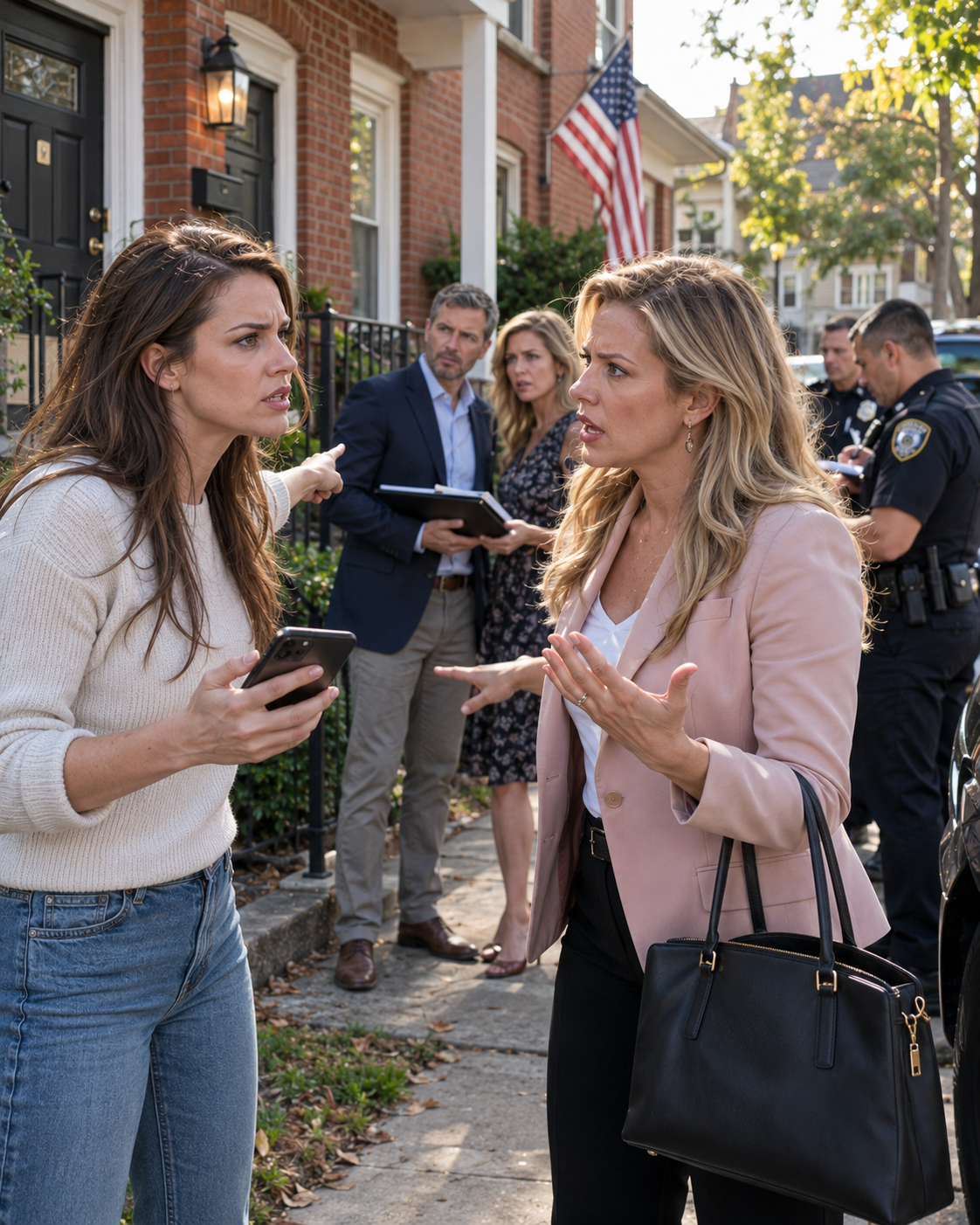
“That doesn’t make it legal.”
The two prospective buyers looked at each other.
The woman finally said, “You told us you owned this property.”
Sabrina’s face hardened.
“I was handling the transaction.”
The man held up his phone.
“Your listing says three hundred forty thousand.”
I looked at the screen.
There it was.
My duplex.
My address.
Photographs I had taken myself.
My renovated kitchen.
My upstairs bathroom.
My brick patio.
And beneath the pictures was Sabrina’s name.
For sale.
$340,000.
My stomach turned.
She had not only entered the property.
She had tried to sell it.
One of the officers asked her, “Do you have documentation showing ownership?”
She hesitated.
“I have an agreement.”
“With whom?”
She looked at me.
There was something almost pleading in her expression.
“With my family.”
I stared at her.
“I am your family.”
She lowered her voice.
“You know how this works.”
“No.”
“You buy properties, renovate them, make money, and eventually everyone benefits.”
“Everyone except the person whose name is on the deed?”
Her eyes flashed.
“Don’t be cruel.”
I almost couldn’t believe those words.
“You stole my key.”
“I borrowed it.”
“You listed my house.”
“I was going to flip it.”
“Without telling me.”
“I thought you’d understand.”
One of the buyers stepped backward.
“We were going to give her five thousand dollars today.”
My eyes went to Sabrina.
She looked away.
I asked the officer, “Did she ask them for an earnest payment?”
He nodded.
“She represented herself as the seller.”
That was the moment the last piece clicked into place.
Sabrina hadn’t stumbled into my property.
She had built a plan around it.
She had created fake paperwork.
She had advertised a house she did not own.
And she had found people willing to trust her with thousands of dollars.
I told the officers I wanted to make a formal trespass complaint.
My sister stared at me as though I had just committed some unforgivable betrayal.
“You’d really do that to me?”
I answered honestly.
“You did this to yourself.”
The locksmith arrived twenty minutes later.
We changed every exterior deadbolt.
We reprogrammed the alarm.
We replaced the keypad.
We documented the damage.
Then I contacted the listing platform.
The fraudulent advertisement was removed that afternoon.
I thought that would be the end.
It wasn’t even close.
Arthur recommended a real estate attorney named Evelyn Vance.
She was sharp, composed, and completely uninterested in family excuses.
I brought her every document I had.
She spread the paperwork across a conference table.
Deed.
Listing screenshots.
Security logs.
Police report.
Email records.
Then she found something I hadn’t seen.
Sabrina had drafted purchase agreements.
Not rough notes.
Actual forms.
The documents named her personal LLC as the receiving party for a $5,000 earnest payment.
Evelyn leaned back.
“This is serious.”
“How serious?”
She looked at me.
“Potentially criminal.”
I felt strangely hollow.
Not triumphant.
Not angry.
Just tired.
Evelyn continued.
“She’s presenting herself as someone with authority to sell property she does not own.”
I said nothing.
“She’s also using a business entity to receive funds.”
“Could she lose her broker license?”
“Yes.”
“Could she face charges?”
“Depending on what the evidence establishes.”
I stared at the documents.
For years, I had imagined what it would feel like to finally stand up to Sabrina.
I had thought I would feel powerful.
Instead, I felt like I was watching my childhood collapse backward through time.
Every excuse my parents had made for her.
Every bill they had covered.
Every crisis they had asked me to quietly absorb.
It all looked different now.
Not like helping someone.
Like teaching someone that consequences belonged to other people.
Evelyn drafted a formal demand letter.
It was precise.
There were no insults.
No threats.
Just facts.
Ownership.
Unauthorized entry.
False representation.
Fraudulent listing.
Solicitation of earnest money.
Potential professional consequences.
When Sabrina received it, she hired a defense attorney.
Within days, negotiations began.
She eventually signed a binding nondisclosure and acknowledgment stating clearly that I held unencumbered ownership of the Mercer Street duplex.
She also wired me $3,550.
Every dollar covered legal fees, locksmith charges, emergency vacancy costs, and related expenses.
In exchange, Evelyn agreed not to pursue a formal board complaint while the settlement terms were honored.
There was no dramatic courtroom scene.
No handcuffs.
No cheering crowd.
There was only a signature.
And somehow that felt heavier.
When my mother learned about the settlement, she called me crying.
“You are destroying your sister.”
I sat at my kitchen table and listened.
“She made a terrible mistake.”
“This was more than a mistake.”
“Family should forgive.”
“Family should also respect boundaries.”
My father called later.
He sounded exhausted.
“I never thought she’d do something like this.”
Neither did I.
That was the saddest part.
Not because I trusted her completely.
Because I realized how long everyone had benefited from not looking closely.
My father asked whether I could drop everything and start over.
I told him I couldn’t.
He said, “She’s still your sister.”
“I know.”
“Then why can’t you help her?”
I looked through the window at the city lights.
“I spent my whole childhood helping her.”
There was silence.
Then I said, “I’m done confusing rescue with love.”
He didn’t answer.
Neither did I.
The Mercer Street duplex stayed mine.
The upper unit sat empty for a little while because I needed time to feel safe there again.
Then Arthur introduced me to a graduate student named Claire.
She was studying urban planning, worked part-time at a transportation nonprofit, and wanted a quiet place near downtown.
She toured the unit once.
Then she looked at me and said, “You did all this yourself?”
“Most of it.”
She smiled.
“Then I promise to take care of it.”
I signed the lease.
That evening, I drove home past Mercer Street and looked up at the windows.
For the first time since the police had arrived, I felt calm.
Not because Sabrina had lost.
Because I had finally understood that my life did not need to orbit her mistakes.
And once I understood that, something inside me started moving forward.
Part 3
I began looking at properties again.
Not because I wanted to prove anything to my family.
Not because I wanted to beat Sabrina at some imaginary game.
I simply liked building things that lasted.
Arthur called me one Tuesday morning.
“I found another one.”
“A house?”
“Triplex.”
“Price?”
He gave me the number.
It was undervalued.
I smiled.
“Send me the paperwork.”
That became my new routine.
Work.
Study.
Inspect.
Calculate.
Negotiate.
Build.
The difference was that I no longer felt guilty about wanting more.
For years, I had believed ambition would make me selfish.
Now I understood that there was nothing selfish about wanting security that didn’t depend on somebody else’s approval.
My mother still called sometimes.
Sometimes we talked about ordinary things.
Sometimes she brought up Sabrina.
I stopped arguing.
I stopped defending myself.
I stopped trying to convince them that I wasn’t the villain in their story.
That was perhaps the strangest freedom of all.
I no longer needed my parents to admit what they had done.
I only needed to stop repeating it.
One evening, I visited Mercer Street after work.
The tenants downstairs had planted flowers along the front walk.
Claire had put a small desk beside the upstairs window.
Warm yellow light filled the room.
I stood on the sidewalk looking at the building.
Six years earlier, I had been saving money in silence, terrified that one emergency would wipe out everything.
Now I owned a property.
I had another under negotiation.
I had a career I had built with my own effort.
And the person who had spent my childhood making me feel like the least important member of the family no longer controlled the direction of my life.
I went home and opened the folder where I kept the original deed.
There was my name.
Only my name.
No asterisk.
No family clause.
No hidden ownership.
No one waiting to take credit.
Just a signature attached to something I had built quietly.
I thought about Sabrina’s fake listing and how close it had come to becoming real damage for people who knew nothing about our family.
Those buyers had trusted her.
They had brought money.
They had walked through rooms believing the future was already theirs.
That realization stayed with me.
The most dangerous part of entitlement isn’t always the person who expects everything.
Sometimes it’s the people around them who keep cleaning up the evidence.
I decided I would never do that again.
Not for Sabrina.
Not for anyone.
A month later, the triplex offer was accepted.
Arthur shook my hand in the parking lot.
He grinned.
“You’re getting good at this.”
I looked at him.
“I had a good teacher.”
He laughed.
“Just remember what I told you on Mercer.”
“Protect it before you need protection.”
“Exactly.”
That night, I drove home with the city glowing around me.
There was no celebration.
No expensive dinner.
No family announcement.
I didn’t even post about it online.
I simply parked, walked upstairs, and set the new paperwork beside the old deed.
Then I sat there in the quiet.
I realized something I wish I had understood much earlier.
Being overlooked had taught me to become observant.
Being underestimated had taught me patience.
Being forced to handle problems alone had taught me competence.
None of those things erased the hurt.
But they had become tools.
And I had finally stopped using those tools to hold together a family that refused to stand on its own.
I still loved my parents.
I still hoped Sabrina would someday become someone who didn’t need to be rescued from every consequence.
But hope was no longer an obligation.
Love was no longer permission.
And family was no longer an excuse for surrendering every boundary I had worked six years to create.
Sometimes I think about that Sunday dinner.
The roast chicken.
My father’s carving knife.
My mother’s nervous smile.
Sabrina telling everyone about her “new business.”
And me sitting there silently while police officers were securing the property she had tried to sell.
It was a strange moment.
My whole life had trained me to stop disasters before they became visible.
That time, I let the truth arrive exactly as it was.
I didn’t scream.
I didn’t threaten.
I didn’t humiliate anyone.
I simply stood still and let the documents speak.
The deed spoke.
The cameras spoke.
The listing spoke.
The fraudulent contracts spoke.
And for once, I didn’t have to rescue the person who caused the damage.
That lesson followed me into every property I bought afterward.
I kept detailed records.
I checked every lock twice.
I read every contract carefully.
I invested in things that could survive without applause.
But the deepest change wasn’t financial.
It was personal.
I stopped measuring my worth by how much trouble I could absorb.
For most of my childhood, I thought being the reliable one meant taking the hit so everyone else could stay comfortable.
Now I knew better.
Sometimes the healthiest thing you can build is a boundary.
And sometimes the strongest answer to being overlooked is not revenge.
It is a life so carefully built that nobody else gets to decide whether it counts.
Years later, I still have the original Mercer Street deed framed in my office.
My name is stamped across the bottom.
Only mine.
Whenever I look at it, I don’t think about Sabrina.
I don’t think about the police.
I don’t think about the fake listing or the five thousand dollars she almost collected.
I think about a younger version of myself sitting at a tiny kitchen table, counting every dollar he had saved and wondering whether quiet effort would ever amount to anything.
Then I look at that signature.
And I remember the answer.
It amounted to everything.
Not because anyone finally chose me.
Not because my family suddenly understood me.
But because, after years of being the person who quietly fixed everyone else’s broken things, I finally built something no one could take credit for.
A future with my name on it.
A future I paid for.
A future I protected.
And a future that, for the first time in my life, belonged completely to me.