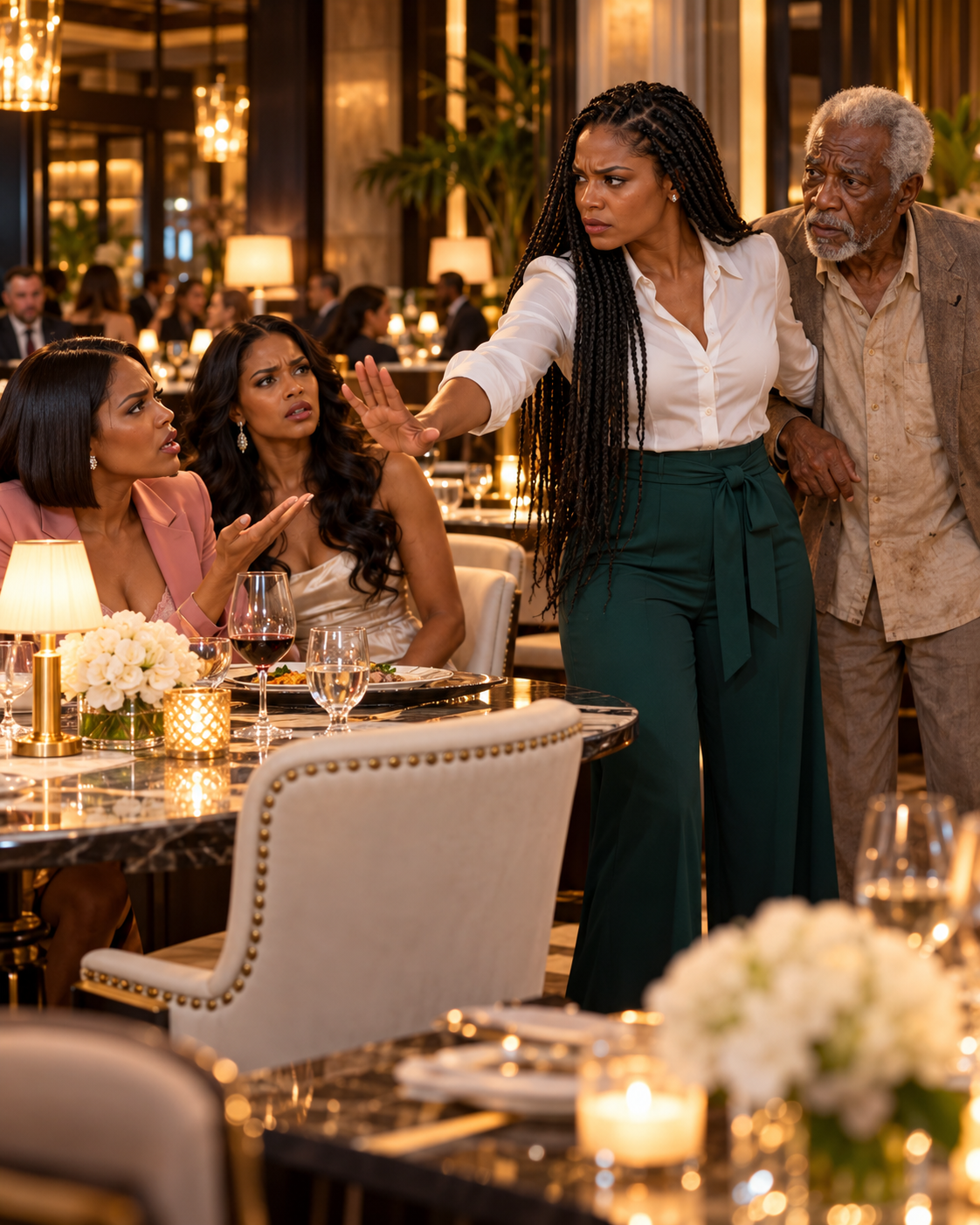
The dining room went SILENT when I blocked a polished socialite from throwing her wine at an old man over a bowl
I read the sentence again.
“Ask Daniel who wanted you to find this.”
For several seconds, I could hear nothing except the refrigerator humming behind me.
Daniel Balogun was Chief Balogun’s son, the polished executive who had spent the last two months praising my instincts and asking me to trust the evidence.
I had admired him.
That made the message feel like a blade.
I slid the photograph beneath a folder and called the laboratory listed on the DNA report.
The receptionist confirmed the report number.
It was real.
The sample belonged to Michael Reed and an eight-year-old boy named Noah Morgan.
“Who submitted the test?” I asked.
There was a pause.
“The request came through a legal intermediary.”
“Name?”
“We can’t disclose that without authorization.”
I thanked her and ended the call.
Then I phoned Michael.
He answered on the fourth ring.
“Claire?”
“Did you know about Noah?”
Silence.
Not surprise.
Not confusion.
Silence.
My throat tightened.
“Michael, answer me.”
He finally said, “Where did you get that name?”
That was enough.
I drove home before I could cry.
He was waiting in our kitchen when I arrived, his hands folded on the counter like a man standing before a judge.
“I was going to tell you.”
“When?”
“I don’t know.”
“Before or after I found out from someone else?”
He closed his eyes.
“It wasn’t simple.”
“Nothing is ever simple with you.”
His face crumpled.
“Claire, I love you.”
I laughed once, and the sound frightened me because it was empty.
“Then why did you spend five years deciding what truths I was allowed to know?”
He sat down.
“Noah was born eight years ago.”
I stared at him.
“Yes.”
“You were engaged to Tessa then.”
He nodded.
“The relationship ended badly.”
“Did you cheat on her?”
He looked at the floor.
“Yes.”
The word landed without drama.
Some truths don’t need shouting.
They simply rearrange your understanding of every room you’ve ever stood in.
“Is Noah yours?”
“I believed he might be.”
“Might?”
“I paid for a test.”
“And?”
“It came back negative.”
I studied his face.
“Show me.”
He didn’t move.
“Michael.”
“I don’t have it.”
That answer opened a cold space inside me.
“Where is it?”
“Chief Balogun gave it to me years ago.”
I stepped back.
“What?”
Michael looked up.
“He told me the laboratory had ruled me out.”
I could barely breathe.
“Why would the owner of your company be holding a DNA result about your child?”
“I didn’t know.”
But I knew someone did.
The next morning, I went to Daniel.
He was in the executive conference room reviewing quarterly reports when I walked in.
“You asked me to trust the audit,” I said.
“I still do.”
“You also knew about Noah.”
His expression changed by a fraction.
“How did you find that?”
“Answer me.”
He leaned back.
“I knew there was a child.”
“Did you know Michael was the father?”
“I knew there was an unresolved paternity issue.”
“That isn’t what I asked.”
He looked toward the window.
“Claire, there are matters in this family that were buried for years.”
“Then stop burying them.”
He stood.
“You are about to walk into something you don’t understand.”
“Then explain it.”
He was silent.
I realized then that the silence was not uncertainty.
It was strategy.
That night, the Balogun family’s general counsel requested a private meeting with me.
He placed an original laboratory report on the table.
The result was unmistakable.
Michael Reed and Noah Morgan shared biological parentage at a 99.99% probability.
I stared at the page.
“This is not the report Michael received.”
“No.”
“Who changed it?”
The attorney’s eyes hardened.
“Chief Balogun.”
I felt something crack inside me.
“Why?”
“Because the family feared scandal.”
I stood up so quickly the chair struck the wall.
“You destroyed a man’s life to protect a reputation.”
“The family believed the situation could be contained.”
“Contained?”
I could barely keep my voice steady.
“My husband lost his career.”
“He made mistakes.”
“Your son said the fraud case needed reopening because the evidence was questionable.”
The attorney said nothing.
That silence was another confession.
I left his office with both reports in my hands.
One said Michael was not the father.
The other proved he was.
Two pieces of paper had controlled years of human suffering.
When I confronted Michael, he did not deny it.
He sat on the edge of our bed and stared at the floor.
“I suspected Noah was mine.”
“Suspected?”
“The timing was too close.”
“Why didn’t you tell me?”
“I was ashamed.”
“Of what?”
“Everything.”
He rubbed his palms together.
“I lost my job, I lost my standing, and I couldn’t face you with another disaster.”
“Another disaster?”
He looked at me.
“I kept working inside the company in a junior contract role after they blacklisted me.”
My breath caught.
“You told me you were freelancing.”
“I was.”
“Why secretly?”
His eyes filled.
“Because I wanted to see Noah.”
The room went still.
“You saw him?”
“Sometimes.”
“How often?”
“Whenever I could.”
I stared at the man I had loved for five years.
He had been living a second life, not with another woman, but beside a child who might have been his.
“You let me believe you were rebuilding yourself while secretly following a boy.”
“I never touched his life.”
“But you built your entire life around a secret.”
He lowered his head.
“I didn’t know how to tell you.”
I wanted to forgive him.
That was the worst part.
Love does not disappear when the truth arrives.
Sometimes it remains, wounded and bewildered, asking why you were not considered worthy of honesty.
Three days later, a new envelope arrived.
This one contained hotel surveillance from eight years earlier.
Michael and Tessa were shown entering a suite together.
The timestamp covered the period when Tessa had been married to Noah’s future legal father, Robert Morgan.
My hands shook as I watched the images.
The affair had overlapped the end of Michael and Tessa’s engagement.
Noah had been conceived during that chaos.
At the bottom of the envelope was another note.
“Ask why the first DNA test was forged.”
I already knew the answer.
To protect the family name.
But another question had begun to burn.
Why had someone wanted me to know?
I searched the metadata on the photographs.
They had been extracted from a private security archive using credentials belonging to the executive strategy office.
Daniel’s office.
I drove to headquarters and found him waiting in the same conference room.
“Was it you?”
He didn’t answer.
“Did you send the hotel footage?”
He remained silent.
“You sent the DNA test too.”
His eyes hardened.
“Claire, listen to me.”
“No.”
I placed the photograph on the table.
“You used me.”
He finally admitted it.
“I needed you to see what the family would never tell you.”
I felt sick.
“So you destroyed my marriage.”
“I exposed what was already broken.”
“You decided for me what truth I could survive.”
“Your integrity gave me access nobody else could challenge.”
I stared at him.
“You chose me because you knew I would follow evidence.”
“Yes.”
“And because you knew I would never stop once I found something wrong.”
“Yes.”
I looked away.
He continued quietly.
“My father would protect the family again.”
“So you needed a weapon.”
“I needed someone he couldn’t control.”
“That someone was me.”
Daniel nodded.
I felt the full weight of it then.
I had not stumbled into the investigation.
I had been placed inside it.
Every compliment.
Every carefully worded request.
Every convenient discrepancy.
He had been opening doors and waiting for me to walk through them.
“Why didn’t you expose Brian yourself?”
“Because my father would have closed ranks.”
“So you detonated my marriage instead.”
His face tightened.
“I knew the truth would hurt.”
“You didn’t know.”
I stepped closer.
“You calculated it.”
For the first time, Daniel looked ashamed.
“Yes.”
The room seemed smaller.
I asked him about Brian.
He finally gave me the entire story.
Brian had exploited his access as CFO and used Tessa’s terminal during a period when she had delegated credentials to staff.
He diverted corporate funds through multiple shell companies.
When Michael’s transaction appeared in the system, Brian altered the records and planted enough circumstantial evidence to make Michael look responsible.
Then he blackmailed Tessa.
He had discovered Noah’s biological connection to Michael years earlier.
If Tessa spoke, Brian threatened to expose the affair, the paternity issue, and the family’s efforts to suppress the original test.
“He owned everyone,” Daniel said.
“No,” I replied. “He frightened everyone.”
Daniel looked at me.
“Sometimes that’s enough.”
The board convened an emergency meeting.
Chief Balogun entered last.
He looked at me without the warmth he had shown the night of my suspension.
Perhaps he already knew I had the original DNA report.
Perhaps he had finally realized the woman he once saw as a waitress had become the one person in the room who could not be managed by prestige.
I placed the forged report on one side of the table.
Then I placed the authentic report beside it.
“Which one should the company believe?”
No one spoke.
Chief Balogun finally said, “I made a mistake.”
I looked at him.
“You made a decision.”
His shoulders lowered.
“I was trying to protect my family.”
“You protected the image of your family.”
He closed his eyes.
“Yes.”
That single word carried more weight than any defense.
Brian entered the next meeting with attorneys on both sides.
He insisted the transfers were legitimate.
Then the forensic team projected the terminal access logs onto the screen.
His credentials had been used during the exact minutes the money moved.
The routing instructions matched accounts tied to shell companies controlled through intermediaries.
He watched the evidence accumulate until even his lawyers stopped taking notes.
Then Tessa walked into the room.
She looked exhausted.
“I let Michael take the blame,” she said.
Every head turned.
Brian’s face went white.
Tessa continued.
“He threatened to tell Robert that Noah was Michael’s son.”
Her voice broke.
“I was terrified.”
Michael stood near the wall, motionless.
I looked at him.
He looked back.
There was no triumph in his face.
Only grief.
When the fresh DNA test was ordered independently, the result came back four days later.
99.99%.
Michael was Noah’s biological father.
He received the news alone.
I found him in the parking garage that evening.
He was sitting in his car with the engine off.
“He’s my son,” he whispered.
I nodded.
“Yes.”
He pressed his forehead against the steering wheel.
“I should be happy.”
“You can be heartbroken and happy at the same time.”
He looked at me.
“I’m sorry.”
“I know.”
“I never wanted to hurt you.”
“But you did.”
He nodded.
Neither of us tried to pretend otherwise.
The board formally terminated Brian’s employment and referred the financial misconduct for criminal investigation.
Tessa stepped away from the executive role pending further review and withdrew from the family office.
Michael’s fraud record was officially cleared.
His employment file was corrected, his professional blacklist removed, and the company issued a written statement acknowledging that the original accusation had relied on manipulated evidence.
The public announcement called it a governance failure.
I called it what it was.
People had chosen reputation over truth.
And ordinary people had paid the price.
Chief Balogun later offered Michael his old career back.
Michael declined.
He said he needed to build something that did not begin with someone else’s permission.
Noah eventually met him.
I was not there.
That was one boundary I chose for myself.
Some reunions belong to the people whose lives created them.
Ours did not end with forgiveness.
It ended with clarity.
Michael and I separated quietly.
There was no public fight, no dramatic courtroom scene, no satisfying speech that made the pain disappear.
There were forms.
Long conversations.
A counseling session where neither of us knew what to say.
There were nights when I reached for my phone before remembering that he was no longer the person I called first.
The hardest truth was this.
I did not stop loving him.
I simply stopped confusing love with entitlement to trust.
Months later, Chief Balogun asked me to stay with Meridian.
I told him I would, but only under one condition.
“No more invisible decisions.”
He knew what I meant.
“No more altered records, suppressed findings, or family exceptions.”
He studied me.
“You’re asking me to change how this company operates.”
“I’m telling you that is the price of keeping people like me.”
For a long moment, he said nothing.
Then he nodded.
The reforms began the following quarter.
Independent compliance review.
Protected reporting channels.
No executive override without written justification.
Mandatory disclosure of conflicts.
Independent custody of sensitive fiduciary and legal records.
Small changes on paper.
Massive changes for people whose lives could be destroyed by a signature.
One evening, months later, I returned to Meridian’s dining room.
The same windows overlooked the city.
The same polished tables reflected the lights.
I remembered standing there with my badge in my hand, humiliated because I had defended an old man in a plain shirt.
He had been powerful.
I had not known.
That was the point.
Character should not depend on knowing who can reward you.
I stood by the window and watched a server carry pepper soup to an elderly guest.
She smiled at him before setting the bowl down.
No fear.
No hesitation.
Just respect.
For a moment, I felt something loosen inside my chest.
Then my phone buzzed.
A message from Daniel.
“The reforms are only the beginning.”
I stared at the screen.
Another message arrived.
“There’s one document my father never told you about.”
I closed my eyes.
Even after everything, another secret was waiting.
But this time, I did not feel afraid.
I had learned that truth can destroy illusions, marriages, careers, and carefully protected reputations.
But lies destroy something deeper.
They teach you to doubt your own instincts.
And that was the part I refused to lose.
I walked back into the dining room with my head high, knowing I could not control what powerful people chose to hide, but I could control whether I helped them hide it.
Some families protect their names.
Some corporations protect their profits.
Some people protect themselves at any cost.
I had finally learned to protect my conscience.
And when I opened Daniel’s final document the next morning, I saw my own name on the first page.
Not as a victim.
Not as an employee.
As the person who had been selected years earlier to inherit a truth no one else was brave enough to carry.
I turned the page.
And there was a photograph of my mother standing beside Chief Balogun, taken long before I ever knew either of them.
On the back, in her handwriting, were seven words.
“One day, you will understand why I lied.”