On the twentieth floor, my boss held up a champagne glass and called me a THIEF in front of Sterling Meridian’s executives
Part 2
Lillian did not speak immediately.
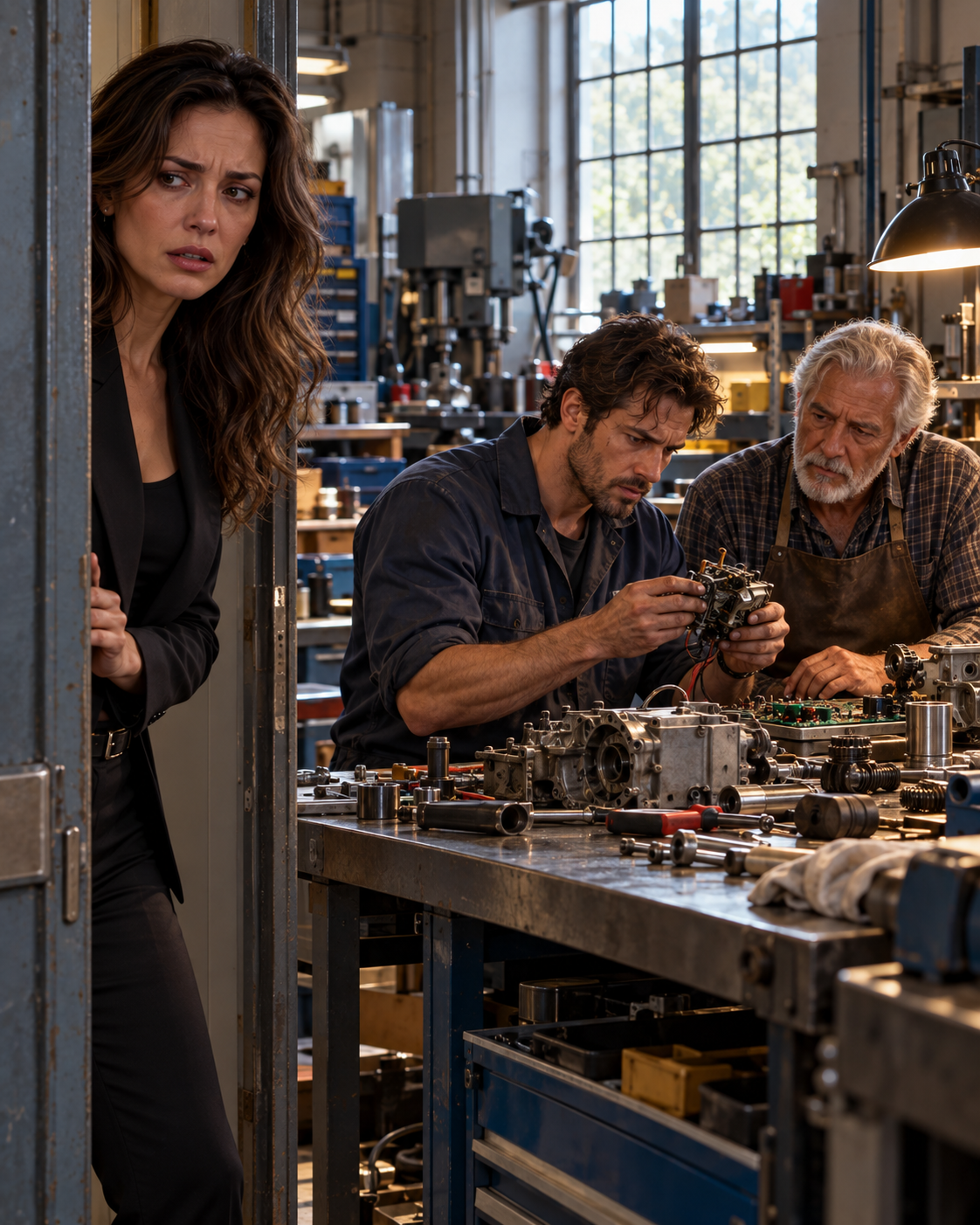
Her eyes moved from the wheelchair on the workbench to the piles of salvaged motors, then to Arthur, and finally to the eight-foot rig humming behind me.
She looked nothing like the woman from the twentieth floor.
There was no champagne glass.
No boardroom smile.
No polished certainty.
Only a quiet expression that seemed almost frightened.
“I followed you,” she said.
Arthur crossed his arms.
“We noticed.”
Her eyes settled on the test rig.
“What is that?”
“The reason I didn’t confess.”
She walked closer.
The monitor displayed three separate temperature readings.
One from Vanguard’s controller.
Two from my independent sensors.
The vendor display was green.
My sensors were deep in the danger zone.
Lillian stared at the numbers.
“Run it again.”
I hesitated.
She looked at me.
“Please.”
That one word changed the room.
I reset the system.
Arthur closed the loading door.
The motor began to spin.
Lillian watched in silence as the first surge hit.
The vendor dashboard stayed green.
The independent probe climbed.
She leaned closer.
The second surge hit.
The winding temperature accelerated.
The monitor from Vanguard still claimed the system was operating normally.
Lillian looked from the screen to me.
“What am I looking at?”
“A failure that your dashboard says isn’t happening.”
She swallowed.
“How long did you know?”
“Three months.”
“How many times did you report it?”
“Three.”
Her face tightened.
“Show me.”
I pulled up the reports.
Each one contained the same basic information.
Observed anomaly.
Thermal evidence.
Load conditions.
Potential failure mode.
Recommended immediate suspension of deployment until independent validation.
At the bottom of each report was a routing history.
Submitted to field reliability.
Forwarded to operations review.
Closed pending procurement milestone.
The final closure carried Evelyn’s authorization.
Lillian read it twice.
Then she looked at me.
“Did she ever speak to you about these?”
“Once.”
“What did she say?”
I remembered Evelyn standing in the maintenance bay with a folder tucked under one arm.
“You technicians see ghosts in every shadow,” she had said.
Then she walked away.
Lillian’s jaw tightened.
“Why did you take the decommissioned parts?”
“Because I needed hardware for independent testing, and procurement would not release enough equipment.”
“You knew that violated policy.”
“Yes.”
“Why didn’t you stop?”
I looked at the wheelchair behind her.
“Because stopping was easier for people with titles.”
Silence filled the room.
Arthur quietly returned to his workbench.
He gave us privacy without leaving.
Lillian looked around the co-op again.
There were donated appliances.
Cracked heaters.
Mobility devices.
Children’s winter coats stacked against a wall.
My salvaged motors were tagged with handwritten names.
“So this is where everything goes.”
“Whatever we can save.”
She turned toward the pile of equipment.
“How much company material have you brought here?”
“I don’t know.”
“Did you profit from any of it?”
“No.”
“Did Arthur?”
“No.”
“Who did?”
I looked at her.
“People who couldn’t afford new equipment.”
Lillian exhaled slowly.
“I thought you were stealing.”
“I know.”
She glanced back at the test rig.
“And I thought you were hiding something.”
“I was.”
That caught her attention.
“I was hiding the truth because every time I put it in the system, somebody buried it.”
Her eyes dropped to the reports.
For a long moment, neither of us spoke.
Then she pulled out her phone.
“What happens if this surge occurs in a live facility?”
“We don’t wait until tomorrow to find out.”
She called her chief engineer.
“Wake your reliability team.”
A pause.
“Tonight.”
Another pause.
“Bring thermal specialists and controls engineers.”
She ended the call.
Then she called legal.
Then internal audit.
Then the head of infrastructure.
Within forty minutes, that dead machine shop looked like the center of a corporate emergency.
Three engineers arrived first.
They ran their own measurements.
Then they asked me to rerun the sequence without telling them which probes were mine.
The results matched.
Vanguard’s monitor said safe.
Independent instruments said danger.
One engineer stared at his notebook and whispered, “We’ve been blind.”
I watched Lillian hear that sentence.
She did not defend the contract.
She did not call Vanguard for an explanation.
She asked one question.
“Can we prove exactly how this happens?”
“We already can,” I said.
“What do you need?”
“Access to the installed units.”
She nodded.
“You’re getting it.”
By three in the morning, the engineers had replicated the fault in two different controller generations.
They opened the hardware.
Inside the sleek gray housing were components I recognized immediately.
Older power relays.
Outdated thermal protection circuits.
A control board design I had not seen deployed in years.
The casing was new.
The bones were not.
One engineer cursed under his breath.
“They repackaged obsolete components.”
“And the firmware?” Lillian asked.
A controls engineer answered.
“Filters the spike.”
“Why?”
“To prevent nuisance alarms.”
I stared at the screen.
“So the system is programmed to look stable.”
“Only after it crosses the first warning threshold.”
Lillian’s voice became very quiet.
“That isn’t stability.”
“No,” the engineer said.
“It’s concealment.”
At 4:17 a.m., Lillian froze the Vanguard procurement file.
At 4:19, she suspended the signing scheduled for the next morning.
At 4:27, she ordered a hold on all deployments.
Then she sent one message to the board.
“Emergency session at 8:30.”
Before dawn, my phone buzzed.
It was a message from Lillian.
“Be at headquarters by eight.”
There was no apology.
Not yet.
I drove my dented sedan through the gray morning, wondering whether truth could still matter after a room full of powerful people had already decided I was disposable.
At 8:30, the boardroom doors closed.
Evelyn arrived wearing the same navy suit she had worn the night before.
She sat beside the legal counsel as though nothing had happened.
Lillian entered last.
She placed a stack of documents on the table.
“Before we discuss the Vanguard contract,” she said, “we are discussing what happened to the safety reports.”
Evelyn’s expression changed.
Only slightly.
But I saw it.
The first crack.
She looked at me.
Then at Lillian.
“What is this?”
Lillian opened the top folder.
“It is an internal audit.”
Evelyn leaned back.
“You are launching an audit based on an employee who violated policy.”
Lillian’s eyes hardened.
“No.”
She slid the first routing log across the table.
“We are launching an audit because an employee violated policy while trying to compensate for management failing to follow it.”
Evelyn’s face went pale.
Then Lillian laid out the report history.
Three warnings.
Three closures.
Three times the warnings were stopped before executive review.
The room became silent.
Evelyn looked at the timestamps.
“Those were operational determinations.”
“You signed them.”
“I approved the recommendations of my team.”
“You also accelerated the Vanguard signing schedule after each one.”
Evelyn pushed back from the table.
“That is unfair.”
Lillian placed a second file beside the first.
“Then explain this.”
It contained email chains.
Meeting summaries.
Procurement milestones.
Messages instructing staff not to elevate “non-critical anomalies” until after contract execution.
Evelyn stared at the pages.
Nobody spoke.
Then she looked at me.
“You have no idea what you are doing to this company.”
I felt something break inside me.
Not fear.
Something older.
The need to be believed.
“I know exactly what I am doing.”
My voice shook.
“I’m trying to stop it from burning.”
The words landed harder than I expected.
Lillian closed the file.
“We are not signing Vanguard.”
Evelyn opened her mouth.
Lillian raised one hand.
“And as of this morning, all decisions connected to the contract are under independent review.”
Evelyn’s chair scraped against the floor.
“You can’t do this.”
Lillian looked at her.
“I can.”
For the first time, Evelyn looked small.
Not powerful.
Not untouchable.
Just a person standing inside the consequences of what she had chosen.
The board voted unanimously to suspend her authority pending investigation.
I thought that would be the end.
It wasn’t.
Because the audit had only started.
Part 3
Over the next six weeks, the story spread through Sterling Meridian faster than any rumor I had ever heard.
Investigators found fourteen additional safety reports that had been downgraded.
Eight had never reached executive review.
Four had been rewritten before being archived.
Two engineers had asked for independent testing and been told their concerns were “outside scope.”
The pattern was impossible to dismiss.
It was not one mistake.
It was a system built to reward silence.
Vanguard denied intentional concealment.
Their attorneys blamed a firmware interpretation issue and disputed our characterization of the internal components.
But the physical evidence remained.
The thermal traces remained.
The failed stress tests remained.
And so did the emails.
The forty-two-million-dollar contract was formally canceled.
Sterling Meridian notified every affected facility and began independent inspections.
The company had to spend millions undoing what it almost purchased.
Some executives complained that the cancellation would damage the company.
Lillian answered them with a sentence I would never forget.
“Reputation is damaged by the fire, not by the alarm.”
Evelyn resigned before the internal proceedings concluded.
The audit findings were sent to the board, the insurer, and the appropriate legal teams.
I never learned whether she believed she had done the right thing.
I stopped needing to know.
Two months later, Lillian asked me to come to her office.
The same office where, only weeks earlier, she had told me to confess or lose my job.
She stood beside the window.
My old security file sat on her desk.
Beside it was a new folder.
She pushed it toward me.
“Director of Field Reliability.”
I stared at the title.
“I want you to lead the function.”
I looked at the city below.
“What happens when I disagree with you?”
She smiled faintly.
“I expect you to tell me.”
“What happens when my supervisor disagrees with me?”
“You document it.”
“What happens when someone doesn’t like the report?”
“You escalate it.”
“And what happens when management tries to bury it?”
Lillian didn’t answer immediately.
She knew the question was bigger than me.
Bigger than the title.
So I placed the folder back on her desk.
“I’ll take it on one condition.”
She looked at me.
“Name it.”
“I want a permanent reporting channel that no department head can block.”
She said nothing.
“I want technicians, mechanics, drivers, operators, field engineers, anyone on the front line, to be able to send a safety concern directly to an independent executive review team.”
I kept going.
“No filtering.”
“No rewriting.”
“No waiting for someone to decide whether it’s important enough.”
“And I want every submission timestamped so nobody can pretend it never existed.”
Lillian studied me for a long moment.
Then she said, “Build it.”
So I did.
We called it the Clear Line.
Every report went directly into a protected system visible to executive leadership, independent reliability staff, and internal audit.
The system could not be edited by middle management.
It could be annotated.
It could be investigated.
But the original report stayed intact.
Every technician could see the status.
Every unanswered warning triggered an escalation timer.
Nobody could make a concern disappear simply by closing a file.
Six months later, a junior maintenance mechanic used it.
He had noticed an unusual vibration in a conveyor motor at a facility in Indiana.
He submitted a report at 2:11 p.m.
At 2:18, the reliability team called him.
By midnight, the facility was shut down safely.
The bearing had nearly failed.
Nobody was hurt.
The mechanic received no punishment.
He received a thank-you note from Lillian.
That mattered to me more than the promotion.
Because I remembered how it felt to stand in that boardroom while people debated whether I deserved to remain employed.
I remembered the photographs.
I remembered Evelyn calling me arrogant.
I remembered Lillian looking at me as though I had become a problem.
And I remembered the basement.
The grease on my knees.
The soldering iron burning a blackened line across my fingertips.
The ugly machine that had told the truth when the beautiful machine had lied.
Sterling Meridian eventually created an official salvage program for the community repair centers.
Arthur’s co-op became one of the first partners.
Old motors became wheelchair parts.
Unused heaters went to families through local aid groups.
Control cabinets were stripped for useful components.
Equipment that once sat behind locked doors became second lives in neighborhoods that needed it.
Arthur never stopped teasing me about the title.
“Director,” he would say, handing me a wrench.
“Sounds expensive.”
“I still drive the same car.”
“Good.”
“Why is that good?”
He would grin.
“Because dents remind people that machines live real lives.”
I laughed the first time he said it.
Then I realized he was talking about more than cars.
People get dented too.
Careers.
Reputations.
Confidence.
Sometimes all it takes is one room full of powerful people deciding your truth is inconvenient.
I kept the old security photographs.
Not as revenge.
As a reminder.
They showed me carrying stolen parts.
What they did not show was the wheelchair waiting behind me.
They showed me opening restricted equipment.
What they did not show was the test rig I built because nobody else would listen.
They showed me alone in a locked room.
What they did not show was that I had stopped trusting a system designed to tell me everything was fine.
On a cold Friday evening, nearly a year after the boardroom confrontation, I parked that same dented sedan outside Sterling Meridian.
The twentieth-floor windows glowed above me.
Inside, executives were meeting about a new expansion.
No champagne.
No launch speeches.
At least not yet.
I carried a box of salvaged motors through the lobby because Arthur had called that morning.
A family needed a heater.
A clinic needed a lift repaired.
There were still problems that never made it into executive presentations.
That was why I stayed close to the work.
As I stepped into the elevator, my phone vibrated.
A new Clear Line report had been filed.
I opened it.
A technician had written four sentences about a control cabinet that behaved strangely under heavy load.
I stopped reading the moment I recognized the pattern.
Not because I was afraid.
Because I knew what came next.
The report was already visible to executive review.
No one had erased it.
No one had softened it.
No one had called the technician difficult.
I pressed the button for the twentieth floor.
The elevator rose through the building.
For years, I had thought success meant finally being invited into rooms where decisions were made.
Now I understood something different.
The real victory was making sure the people on the floors below never had to beg someone upstairs to listen.
When the elevator doors opened, the city stretched beyond the windows like a field of lights.
I could still smell grease on my jacket.
I could still feel the scar on my finger from that first night in Arthur’s shop.
And somewhere beneath the polished glass, behind all the dashboards and contracts and carefully worded reports, I knew the truth that had nearly been buried.
A machine can be made to look perfect.
A report can be hidden.
A reputation can be manufactured.
But sooner or later, something real starts burning beneath the surface.
And when that happens, the most important person in the room is not the one holding the champagne.
It is the one willing to smell the smoke.