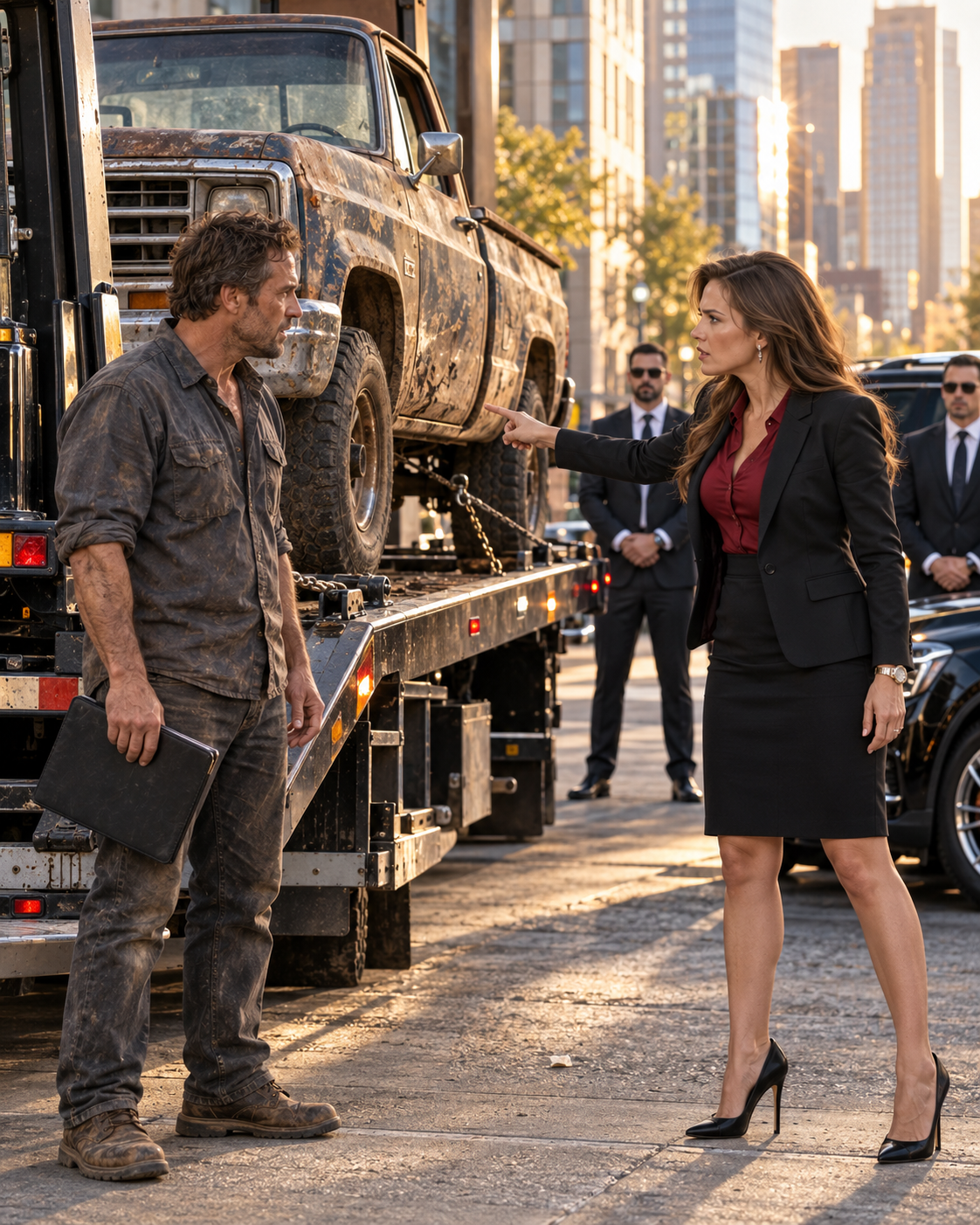
“My Silverado was being TOWED from the glass lobby of Kendrick Development Tower while Victoria Kendrick
Part 2
The elevator opened directly into a hallway lined with photographs of buildings Kendrick Development had constructed across the country.
Glass towers.
Luxury hotels.
Apartment blocks with rooftop gardens and names that sounded expensive enough to belong in magazines.
I had never seen so much money concentrated in one place.
Brenda walked beside me without saying anything.
Her jaw was tight.
She stopped outside a set of double doors and looked at me.
“Once we go in, don’t exaggerate anything.”
“I won’t.”
“Don’t guess.”
“I won’t.”
“Just show them what you have.”
“I will.”
She opened the door.
Eleven people sat around a long walnut table beneath a wall of windows overlooking Kansas City.
Victoria Kendrick was at the head.
Julian sat to her right.
A private equity representative was speaking beside a presentation screen displaying the redevelopment site.
The words “Closing Overview” were projected across the room.
Everything looked calm.
Professional.
Certain.
Then Brenda walked me inside.
Julian froze.
Victoria slowly removed her sunglasses.
“What is this?”
Brenda answered.
“This is the man whose meeting you were told was canceled.”
Julian stood.
“I already handled this.”
Brenda didn’t look at him.
“No, you didn’t.”
She placed the tablet on the table.
“Your scheduling record says his appointment was canceled at 8:49.”
“Yes.”
“The official calendar shows no cancellation.”
Julian’s face tightened.
“That’s an administrative issue.”
Brenda turned the screen toward Victoria.
“The timing is not the issue.”
She tapped the redevelopment map.
“The issue is that this footprint appears to include parcels classified as occupied residential property and one active community facility.”
Nobody moved.
Victoria looked at the screen.
“That block was certified vacant.”
I set Arthur’s folder on the table.
“It isn’t vacant.”
Julian shook his head.
“We are not doing this.”
I opened the first deed.
“This property belongs to Arthur Vance.”
I opened the second.
“This one belongs to the Bell family.”
Then the third.
“And this one.”
I laid out four documents in a row.
“Four households.”
Finally, I unfolded the certified map overlay.
“And this is the community center.”
A man at the far end of the table leaned forward.
“Those parcels are inside the acquisition boundary.”
“They’re inside the acquisition boundary because the boundary was drawn through occupied properties.”
Julian interrupted.
“Mr. Hale doesn’t understand zoning.”
I looked at him.
“A man doesn’t need a law degree to tell the difference between a living household and an empty parcel on a zoning map.”
Silence hit the room.
It was the kind of silence that arrives when everyone suddenly realizes the meeting has become something else.
Victoria stood.
“Where did these records come from?”
“Public archives.”
“Certified?”
“Yes.”
“Current?”
“Some were recorded this year.”
Julian stepped closer to the table.
“The records don’t prove what you’re implying.”
Brenda pulled another document from her tablet.
“Actually, they do.”
She turned the screen toward the executives.
“Utility connections.
Property tax payments.
Occupancy records.
Permit history.
Community-center operating license.”
She looked at Julian.
“All four homes were documented as active properties before the redevelopment certification.”
One of the investors spoke.
“Who certified the site as vacant?”
Nobody answered.
Victoria turned toward Julian.
“Who?”
He cleared his throat.
“It was part of the environmental and title review.”
“That wasn’t my question.”
He swallowed.
“I don’t have the names in front of me.”
Brenda answered for him.
“I do.”
She displayed an internal approval chain.
At the bottom was Julian’s authorization code.
Victoria stared at the screen.
“Why was this meeting canceled?”
Julian’s face had gone pale.
“We were expecting private equity today.”
“I know.”
“I didn’t want an outside party disrupting the process.”
“An outside party?”
He looked at me.
“I thought he was a disgruntled contractor.”
Brenda cut in.
“You knew exactly who he was.”
She tapped another document.
“His appointment was attached to the Arthur Vance property file.”
Victoria’s eyes narrowed.
“Arthur Vance?”
Julian said nothing.
I felt the air change.
Victoria looked from Julian to me.
“Is Arthur related to you?”
“No.”
I hesitated.
“He’s one of your shareholders’ headaches.”
That earned a few confused looks.
I explained.
“Arthur was the one who found the original deeds.
He spent months at the county archive after someone told him his house was scheduled for demolition.
He didn’t trust the maps.
He said the block had been changed on paper before anyone touched a brick.”
Victoria sat slowly.
“Why didn’t he come himself?”
“Because he can’t walk far anymore.”
I placed the green logbook on the table.
“He sent me because he thought they’d ignore him.”
I opened it.
The first pages were Arthur’s notes.
Dates.
Names.
Property numbers.
Then photographs.
Children standing in front of the community center.
A church picnic.
A block party.
A Thanksgiving food drive.
Toby’s name was nowhere in that book.
Clara’s name wasn’t either.
But I recognized the handwriting of people trying to preserve something before it vanished.
Victoria read a page.
“What is this?”
“Arthur’s record of every family on the street.”
“Why would he keep this?”
“Because somebody has to remember.”
A private equity executive leaned toward the map.
“How much does this affect the project?”
Brenda answered carefully.
“Potentially everything.”
Julian’s voice sharpened.
“This is being blown completely out of proportion.”
Victoria turned to him.
“Did you know these homes were occupied?”
He hesitated.
That hesitation said more than any answer.
“Did you know?”
“Not in the way you’re suggesting.”
Victoria’s voice became very quiet.
“That’s not an answer.”
Julian looked around the table.
“The acquisition team believed the properties could be cleared.”
“Cleared?”
“Relocated.”
“Relocated?”
“The residents.”
“Without their consent?”
He didn’t answer.
Brenda did.
“Several residents never received formal notices.”
Victoria closed her eyes.
The room seemed to shrink around her.
She looked at the redevelopment screen.
Then at the street map.
Then at me.
“What would happen if this deal closed today?”
I told her the truth.
“The bulldozers would move in.”
She stared at the red boundary.
“And the people?”
“They’d have nowhere to go.”
For a long moment, nobody spoke.
Then Victoria reached for the remote and turned off the presentation.
The giant screen went black.
“Deal suspended.”
The investor beside her started speaking.
“Victoria, we have signed commitments.”
“I said suspended.”
She looked at Julian.
“You are relieved of all authority effective immediately.”
“Victoria—”
“Security will escort you.”
His chair scraped backward.
“This is a misunderstanding.”
Brenda stood.
“No, Julian.”
She slid the authorization record across the table.
“This is a paper trail.”
Two security officers entered.
Julian looked at me one last time.
There was no smugness left.
Only anger.
I expected satisfaction.
I didn’t feel any.
I felt tired.
Because while executives argued over millions, Arthur’s kitchen window was still boarded from a storm that spring.
Mrs. Bell still woke every night afraid her son would lose the only house he knew.
And my truck was sitting in an impound lot with a bent rear axle.
Victoria came downstairs with me.
She didn’t call a driver.
She followed me into the elevator.
Neither of us spoke until the doors opened.
Outside, the sky had darkened.
Rain was beginning to fall.
“I’m coming with you,” she said.
“Where?”
“To the impound lot.”
I looked at her.
“Why?”
She answered quietly.
“Because this started with my name on a building.”
At the impound lot, my Silverado sat beneath a chain-link canopy.
The rear axle was twisted.
One taillight was broken.
The passenger door was scraped.
And the glove compartment was hanging open.
The green logbook lay exposed between the seats.
Victoria stopped walking.
She looked at the battered truck.
Then she looked at the book.
She bent slightly and saw Clara’s handwriting.
“Toby’s first day of kindergarten.”
Her expression changed.
“Who is Clara?”
“My wife.”
“Was?”
“She died.”
Victoria nodded slowly.
“I’m sorry.”
I didn’t answer.
She asked, “And Toby?”
“My son.”
She looked at the logbook again.
“How old?”
“Ten.”
There was a long pause.
Then Victoria said something I never expected to hear from a woman whose company had billions moving beneath her name.
“I thought I was looking at an old truck.”
She touched the edge of the glove compartment.
“I didn’t realize I was looking at somebody’s life.”
That was the first honest thing she had said all day.
The second came a few minutes later.
“What do I owe you?”
“Nothing.”
“I damaged your property.”
“You didn’t drive the tow truck.”
“But I ordered it.”
I looked at her.
“Then make it right.”
She nodded.
She took out her phone.
Within an hour, she had paid the impound fees, the emergency repairs, and the transport back to my shop.
Then she did something even stranger.
She opened her banking app and purchased a new work truck herself.
A 2024 Silverado.
She put the entire charge on her personal card.
I stared at the screen.
“You’re serious?”
“I am.”
“You don’t have to do this.”
“I know.”
She met my eyes.
“Your shop needs a vehicle.”
I didn’t know what to say.
But she wasn’t finished.
“I’ll also pay for the complete frame-off restoration of your old truck.”
I looked at the dented pickup.
“That restoration could take months.”
“Then it takes months.”
“Why?”
She glanced at the green book.
“Because compensation is not the same thing as repair.”
Three days later, Kendrick Development announced that the project footprint would be frozen pending a full independent review.
A week after that, Brenda was placed in charge of a neighborhood remediation fund.
The four homes were removed from the demolition plan.
The community center was protected.
Arthur’s street was marked for permanent preservation.
And Julian Vance was never invited back into the building.
He wasn’t the only thing removed from the project.
The word “vacant” disappeared too.
But changing a document was easier than changing what had already happened.
Families had spent nights afraid.
Arthur had spent months believing his home would vanish.
And I had learned how quickly a powerful person could look at an ordinary life and see nothing worth protecting.
Still, something had shifted.
For the first time, someone inside that tower had decided that the neighborhood mattered more than the deadline.
That was enough to begin.
The real work, however, was only starting.
Part 3
By November, my new Silverado became the truck I used every day.
It hauled engines.
It carried brake parts.
It transported broken lawn equipment and old generators people couldn’t afford to replace.
Toby named it “Blue Two” because he said the old truck was still the real Blue One.
The old Silverado rested on my hydraulic lift at the shop.
Piece by piece, it came apart.
Fenders off.
Bed removed.
Engine lifted.
Frame cleaned.
Every bolt cataloged.
The restoration team wanted to replace anything damaged.
I insisted on saving what could be saved.
“That’s how Clara would have done it,” I told Toby.
He smiled.
“You always say that.”
“Because it’s true.”
One afternoon, a package arrived with no company logo.
Inside were factory-matched heritage components I had spent months trying to find.
Original trim.
Correct-era hardware.
A replacement instrument cluster.
A set of components that hadn’t been manufactured in decades.
There was no invoice.
Only a note.
“Keep these.
Some things deserve another chance.”
I knew immediately who had sent them.
Two weeks later, Victoria Kendrick appeared at my garage.
I almost didn’t recognize her.
No silk suit.
No sunglasses.
No limousine.
She wore work flannel, old jeans, and sleeves rolled to her elbows.
In both hands she carried a heavy wooden crate.
“I was told this is where you keep the impossible projects.”
I looked at the crate.
“What did you do?”
She smiled.
“I went hunting.”
She opened it.
Inside were rare factory-matched parts I had only seen in collector catalogs.
I picked up one of the trim pieces.
“Where did you find these?”
“Three states.
One estate sale.
One collector who hated negotiating.”
That made me laugh despite myself.
She laughed too.
Then she put the crate down.
“I want to help.”
I stared at her.
“Help with what?”
She looked at the stripped frame beneath the lift.
“That.”
I shook my head.
“You’ve never restored a truck.”
“No.”
“You don’t know what you’re doing.”
“No.”
“Then why are you here?”
She took a breath.
“Because for a long time, I thought fixing a problem meant paying for it.”
Her voice dropped.
“It doesn’t.”
She looked around the garage.
“Arthur’s neighborhood is being rebuilt without being erased.
The families have legal protection.
The community center has permanent funding.
Brenda’s team is auditing every property file we own.”
She paused.
“But I still think about that truck.”
I said nothing.
“And I think about that green book.”
She swallowed.
“I keep wondering how many lives I overlooked because I was trained to see parcels instead of people.”
There was no dramatic music.
No boardroom applause.
No headlines.
Just a woman standing in my garage with dirt already staining the knees of her jeans.
I handed her a grease rag.
“Then start there.”
She took it.
“What do I do?”
I pointed at the workbench.
“Clean the parts before you touch anything.”
She smiled.
“Fair enough.”
We worked for three hours.
She learned how to label hardware.
She learned not to force a rusted bolt.
She learned that old steel sometimes needed patience more than pressure.
Toby sat on a stool nearby, watching her struggle with a stubborn bracket.
“You’re doing it wrong,” he told her.
Victoria laughed.
“I was afraid somebody would say that.”
Toby took the wrench from her.
“Here.”
He showed her the right angle.
She watched carefully.
“Thanks, Toby.”
He shrugged.
“My dad says cars tell you when they’re hurt.”
Victoria looked at me.
“Does he?”
“Yeah.”
She thought for a second.
“People do too.”
That evening, after Toby went home, Victoria stayed behind.
The garage had gone quiet.
The hydraulic lift creaked as I lowered the frame.
She stood beside me.
“Do you think Arthur will trust us?”
I considered the question.
“I think trust takes longer than a press release.”
She nodded.
“Then we’ll give it time.”
Months passed.
The preserved street stayed intact.
The community center received a new roof.
Arthur’s house got repairs.
Mrs. Bell’s son finally had a wheelchair ramp that wasn’t built from scrap wood.
Brenda’s remediation fund paid local workers instead of outside contractors.
And the old Silverado slowly came back to life.
One spring morning, we bolted the restored grille into place.
The metal caught the light.
For a moment, I saw the truck as Clara had seen it.
Not as machinery.
As a witness.
That night, I opened the green logbook.
Toby was older now.
His handwriting had grown.
On a blank page beneath one of Clara’s old notes, he had written:
“Mom would like the truck now.”
I closed the book.
I couldn’t speak for a minute.
Victoria was standing across the shop.
She didn’t ask what was wrong.
She had learned by then that some moments didn’t need fixing.
The first day we started the restored engine, everyone in the garage went silent.
I turned the key.
The engine coughed.
Stopped.
I tried again.
Then it roared.
Not perfectly.
Not loudly enough to impress a showroom crowd.
But steadily.
Honestly.
Alive.
Toby laughed.
Victoria smiled.
I put both hands on the steering wheel and let myself breathe.
The old truck had carried Clara.
It had carried Toby’s first baseball glove.
It had carried tools, groceries, broken furniture, birthday presents, and a thousand ordinary mornings.
It had carried us through grief.
It had carried us when we had nothing else.
And now it carried a lesson I hadn’t known I needed.
A machine can be restored because someone decides its history matters.
A neighborhood can be restored for the same reason.
And sometimes a person has to stand in front of another human being and say, without excuses, “I was wrong.”
Victoria had learned to say it.
Julian never did.
Arthur lived long enough to see his street protected.
The community center stayed open.
My son grew taller.
My new Silverado kept working every day.
And my old truck, scarred but shining again, remained beside the lift in my shop.
I never sold it.
I never will.
Because the most valuable thing it carried was never under the hood.
It carried names.
It carried memories.
It carried proof that ordinary lives are not empty spaces waiting for somebody richer to draw a line through them.
Years later, people would ask me how the whole thing started.
They expected me to tell them about the boardroom.
I usually told them about the parking lot instead.
About the morning somebody looked at my battered truck and saw junk.
About the moment they tried to drag it away.
About the green book lying open in the glove compartment.
And about the woman who finally understood that the damage was never just metal.
Because when you build your life around numbers, it is easy to forget that every number is attached to a name, every property line surrounds a home, and every old object may be holding memories that money cannot replace.
The day Victoria first walked into my garage in work flannel, she asked me where to begin.
I pointed at the workbench.
“Right here.”
She wiped her hands on the rag.
Then she picked up the wrench.
And together, we rebuilt the truck one piece at a time.
Not because the truck needed saving.
But because, by then, we both understood something deeper.
Restoration is not about making something look new.
It is about honoring what it survived.
And some of the things worth saving in this life are the very things the world has learned to overlook.