My parents stole every dollar my grandfather had saved for my future. They spent it on my older sister’s luxury car and college education.
I looked at my father, wondering whether he had heard a single word I’d said.
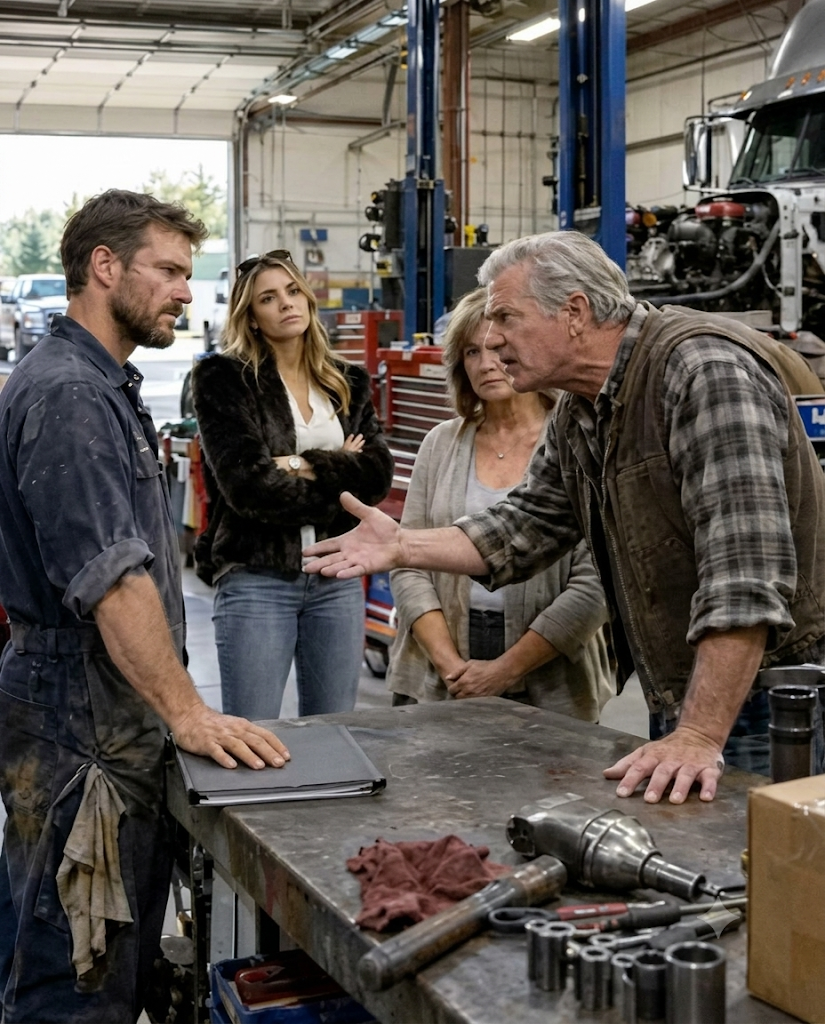
He was standing in the middle of the repair shop I’d spent years building, holding documents that proved how badly he’d betrayed me, and somehow his biggest concern was still finding another way to give Tessa something that belonged to someone else.
“You want me to take money out of Maya’s education account and give it to Tessa?” I asked.
Dad shifted his weight.
“I’m saying your sister needs help right now. Maya’s still young. She has plenty of time.”
I stared at him.
“That’s exactly what you said about me.”
Mom folded her arms.
“Don’t start making everything about your childhood again.”
“Then stop repeating it.”
Behind us, one of my mechanics dropped a wrench. The metallic clang echoed through the shop, but nobody laughed or made a joke.
Everyone had heard enough to understand what was happening.
I stepped toward the office door and held it open.
“I think you should leave.”
Dad’s face hardened.
“You’re really going to turn your back on your own sister?”
“No,” I said. “I’m refusing to sacrifice another kid for her.”
Mom looked at the metal box in my hand.
“You think those old papers make you better than us?”
I shook my head.
“No. They just prove I wasn’t crazy for remembering what happened.”
For the first time in my life, I watched my parents walk away without getting what they wanted.
I thought that would be the end of it.
I was wrong.
The next morning, my phone started ringing before seven.
Three missed calls from Mom. Two from Dad. A voicemail from Tessa.
I ignored all of them until I finished breakfast with Elena and our two children.
Elena watched me turn the phone facedown.
“They’re not going to let this go, are they?”
“Probably not.”
She reached across the table and squeezed my hand.
“Then we deal with whatever comes next. Together.”
That was something I’d never experienced growing up.
Someone choosing to stand beside me without asking what I could give them first.
By lunchtime, Tessa had sent me a message.
I can’t believe you’re humiliating Mom and Dad over money from twenty years ago. You have a successful business and a nice house. Some of us aren’t so lucky.
I read it twice.
Then I typed a response.
Luck didn’t build my business. And I didn’t spend anyone else’s college fund to get here.
Her reply arrived almost immediately.
You always hated me.
I set the phone down.
The strange thing was, I hadn’t.
As children, I’d wanted my sister to like me. I’d wanted her to invite me along when she went out with friends, defend me when our parents treated me unfairly, or at least acknowledge that things weren’t equal.
But Tessa had grown comfortable being the center of our family.
Eventually, she stopped noticing that anyone else existed.
That evening, I received a call from someone I hadn’t expected.
It was Daniel, Tessa’s husband.
We weren’t particularly close, but we’d always been civil.
“Can we talk?” he asked.
“About what?”
“Tessa. And the money your parents asked you for.”
I almost told him no.
Then he said something that changed my mind.
“I don’t think you know the whole story.”
We met the following afternoon at a diner about fifteen minutes from my shop.
Daniel looked exhausted.
His dress shirt was wrinkled, and there were dark circles beneath his eyes.
He waited until the waitress brought our coffee before speaking.
“Your parents told you Tessa has some debt?”
“That’s what they said.”
He gave a humorless laugh.
“That’s one way to describe it.”
He explained that Tessa had been spending far beyond what their household could afford.
Designer clothes, expensive vacations, restaurant bills, and a second luxury vehicle she’d insisted they needed.
At first, Daniel had tried to keep up.
Then he’d started asking questions.
That was when he discovered the credit cards.
Some were in Tessa’s name. Others were joint accounts she’d used without telling him how much she owed.
“How bad?” I asked.
He stared into his coffee.
“Just over a hundred and forty thousand dollars.”
I leaned back.
That was more than my grandfather had originally saved for my education.
Daniel continued.
“I’ve been trying to work out a repayment plan. I told her we’d have to sell the extra car and cut expenses.”
“And?”
“She called your parents.”
Of course she had.
“They told her not to worry,” he said. “They said you had plenty of money and would help.”
I rubbed my forehead.
“Did they tell you I agreed?”
He nodded.
“They said you owed the family.”
I almost laughed.
Instead, I asked him something that had been bothering me.
“Why are you telling me this?”
Daniel hesitated.
“Because I have two kids in that house. And I’m tired of watching everyone pretend this is normal.”
He pulled a folded piece of paper from his pocket.
It was a list of their outstanding debts.
I glanced over it, then pushed it back.
“I’m not paying those.”
“I know.”
He looked relieved rather than disappointed.
“I didn’t come here to ask you to.”
We sat quietly for a moment.
Then Daniel said, “There’s something else.”
My stomach tightened.
“Your mother told Tessa about Maya’s education account.”
I felt a cold sensation settle in my chest.
“How?”
“She said you admitted it during their visit.”
“That’s true. But what does Tessa have to do with it?”
Daniel looked uncomfortable.
“She’s furious. She thinks you’re trying to make her look like a bad mother.”
Maya was Daniel’s daughter from his first marriage.
She was sixteen, quiet, hardworking, and far more mature than most adults I knew.
Tessa had married Daniel when Maya was seven.
Two years later, they had a son together, Owen.
I loved both kids.
But I’d watched the family dynamic shift in ways that reminded me painfully of my own childhood.
Owen received expensive birthday parties, new electronics, and promises about college.
Maya received practical gifts and reminders that she should be grateful.
When Maya mentioned wanting to study engineering, Mom had actually laughed.
“That’s an expensive dream for a girl who isn’t even a blood relative.”
I’d never forgotten that.
Neither had Maya.
“What exactly is Tessa planning?” I asked.
Daniel shook his head.
“I don’t know. But she’s been asking questions about whether the money can be withdrawn.”
I stared at him.
“She can’t touch it.”
“Good.”
He stood to leave, then paused.
“For what it’s worth, Maya talks about you all the time. She says you’re the only adult who takes her plans seriously.”
After he left, I sat there for another ten minutes.
My grandfather had once been that person for me.
Now I understood why he’d fought so hard to protect what he’d saved.
That night, I called the financial institution managing Maya’s account.
I confirmed the account’s ownership, beneficiary information, and withdrawal procedures.
I also contacted an attorney named Rebecca Collins, who had helped me with several business contracts.
When I explained the situation, she advised me to review the account documents and make sure the arrangement matched my intentions.
We scheduled a meeting.
I wasn’t going to let my family find another loophole.
Three days later, Maya appeared at my shop.
She stood near the entrance with her backpack hanging from one shoulder.
I could tell she’d been crying.
I walked over.
“Hey, kiddo. Everything okay?”
She shook her head.
“Can I talk to you?”
I took her into my office and closed the door.
She sat across from me, staring at her hands.
“Did you really start saving money for my college?”
I hesitated.
I’d wanted it to be a surprise when she graduated.
But there was no point lying.
“Yes.”
Her eyes filled with tears.
“Why?”
The question hurt more than I expected.
“Because you’re smart, and you work hard, and you deserve a chance to build the life you want.”
She wiped her cheeks.
“But I’m not really your niece.”
I leaned forward.
“Who told you that?”
She didn’t answer.
She didn’t need to.
“Maya, listen to me. Family isn’t just about who shares your blood. You’re my niece because you’re part of my life, and I care about you. That’s enough.”
She started crying harder.
I moved around the desk and hugged her.
After a while, she whispered, “Tessa says you’re only doing it to embarrass her.”
I felt anger rising, but I kept my voice calm.
“That’s not why.”
“She said if I accept your money, I’m choosing you over my family.”
I pulled back enough to look at her.
“You don’t have to choose anyone. This isn’t a competition.”
She nodded, but I could tell something else was bothering her.
“There’s more, isn’t there?”
She looked toward the door.
“Tessa found out I applied for a summer engineering program.”
“That’s great.”
“She said we can’t afford it.”
I frowned.
“How much does it cost?”
“Eight hundred dollars, including materials.”
That was less than Tessa had spent on a handbag she’d shown off at Christmas.
Maya continued.
“She said Owen needs money for his future, and I should stop asking for expensive things.”
I sat back.
There it was again.
The same words.
The same excuses.
A different child.
I asked Maya to bring me the program information.
Then I called Daniel.
He confirmed that the program was legitimate and that Maya had earned a place through a competitive application.
He also told me he’d wanted to pay for it himself, but their finances were so strained that he couldn’t responsibly promise the money.
I offered to cover the fee directly.
Daniel went quiet.
“You don’t have to do that.”
“I know.”
“I’ll pay you back.”
“Don’t worry about that right now.”
There was a long pause.
Then he said, “Thank you.”
The following Monday, Maya’s enrollment was confirmed.
She called me from school, practically shouting with excitement.
For the first time in weeks, I felt like something good had come out of the mess.
Then Tessa showed up at my house.
It was Saturday afternoon.
Elena was in the backyard with our children when the doorbell rang.
I opened the door and found my sister standing on the porch, wearing sunglasses and carrying an expensive leather handbag.
She didn’t bother greeting me.
“You need to stop interfering with my family.”
I stepped outside and closed the door behind me.
“Hello to you, too.”
“Don’t be sarcastic.”
“Then tell me what you want.”
She removed her sunglasses.
“You paid for Maya’s engineering camp.”
“Yes.”
“After I specifically told her she couldn’t go.”
“Daniel approved it.”
Her jaw tightened.
“Daniel doesn’t understand what we’re dealing with financially.”
“From what I’ve heard, he understands it pretty well.”
Her expression changed.
“He’s been talking to you?”
I said nothing.
She laughed bitterly.
“Unbelievable. Everyone’s suddenly against me.”
“Tessa, nobody is against you. But you can’t keep expecting other people to pay for your decisions.”
She stepped closer.
“You think you’re so much better than me because you own a garage?”
“A diesel repair shop. And no, I don’t.”
“Mom and Dad gave you everything you needed.”
I stared at her.
For a second, I genuinely wondered whether she believed that.
“They emptied my education account to buy you a car.”
She rolled her eyes.
“That again?”
“Yes. That again.”
“You act like I personally stole it.”
“Did you know where the money came from?”
She looked away.
That was all the answer I needed.
“Tessa.”
She sighed.
“I knew Grandpa had saved some money for you. Mom said it was family money and that they could use it however they wanted.”
“And you never questioned that?”
“I was nineteen!”
“You were nineteen when they bought the car. You were twenty-three when you graduated. And you’re nearly forty now.”
Her cheeks flushed.
“What do you want me to say?”
“The truth would be a good start.”
She looked at me for a long moment.
Then she said something I’ll never forget.
“Grandpa always liked you more anyway.”
I felt the words settle between us.
There it was.
The resentment she’d carried all these years.
Not because she’d been neglected.
But because one person in our family had refused to neglect me.
“Grandpa loved both of us,” I said.
“He left you money.”
“He saved for my education because Mom and Dad weren’t going to.”
“He still favored you.”
I shook my head.
“Tessa, you got a car, college, spending money, and every opportunity they could give you. I got one person who believed I deserved an opportunity too. And you still think that was unfair?”
She didn’t answer.
Instead, she put her sunglasses back on.
“You’re going to regret turning your back on us.”
I watched her walk down the driveway.
I didn’t chase her.
Two weeks passed.
Then my parents began calling relatives.
I learned about it when my aunt Margaret called one evening.
Margaret was my father’s younger sister.
She’d always been kind to me, but we’d lost touch after Grandpa died.
“Sweetheart,” she said, “I need to ask you something.”
“Sure.”
“Your mother says you’re threatening to sue them over Grandpa’s estate.”
I closed my eyes.
“No.”
“She also says you’re hiding money that belongs to the family.”
“That’s not true either.”
Margaret sighed.
“I thought so.”
Then she surprised me.
“Your grandfather told me what happened.”
I sat up.
“What?”
“Before he died. He told me your parents had taken the education money.”
My throat tightened.
“Why didn’t you ever say anything?”
“Because he asked me not to interfere while he tried to resolve it. After he passed, I thought you knew everything.”
I looked toward the metal box sitting on my office shelf.
“I knew about the withdrawals. But I didn’t know how many people knew.”
Margaret was quiet.
Then she said, “Arthur was heartbroken. Not because of the money itself, but because he knew what it meant to you.”
I swallowed hard.
She continued.
“He told me he was leaving you something separately. He wanted you to have a fair start.”
I nodded, even though she couldn’t see me.
“He did.”
Margaret asked if she could visit.
I told her she was welcome anytime.
She arrived the next weekend carrying a small cardboard box.
Inside were photographs, old receipts, and a leather notebook.
“This belonged to your grandfather,” she explained.
I opened it carefully.
The pages were filled with his handwriting.
There were notes about his savings, household expenses, and plans for the future.
Near the back, I found a page with my name at the top.
My hands began to tremble.
He’d written about the first time I repaired a torn truck seat using the stitching techniques Grandma had taught me.
He described how proud he’d been when I refused payment from a neighbor who couldn’t afford the repair.
Then came a sentence that made my eyes burn.
That boy understands the value of money because he’s never been allowed to forget the cost of earning it.
I sat there silently.
Margaret reached across the table.
“He was proud of you long before you owned that shop.”
I couldn’t speak.
For years, I’d measured my success by the business I’d built and the security I’d created.
But Grandpa had seen something worthwhile in me when I was still a teenager with a needle, a spool of thread, and a secondhand toolbox.
Margaret left the notebook with me.
That night, I showed Elena.
She read the page and leaned against my shoulder.
“He knew who you were.”
I nodded.
“And he made sure I wouldn’t forget.”
A month later, the situation with Tessa became worse.
Daniel called to tell me he’d moved into a temporary apartment.
He and Tessa were separating.
I wasn’t surprised, but I was sad for the children.
He explained that after discovering additional debt, he’d insisted they meet with a financial counselor.
Tessa refused.
Instead, she’d taken out another loan without discussing it with him.
That had been the final straw.
“She’s blaming you,” Daniel said.
“Of course she is.”
“She says you poisoned everyone against her.”
I sighed.
“How’s Maya?”
“Quiet. Worried about Owen.”
I offered to take both kids out for lunch.
Daniel agreed.
We met at a small restaurant near the park.
Maya talked about her engineering program, showing me photographs of a small robotic arm she’d helped build.
Owen, who was nine, listened with wide eyes.
“Can you make one that picks up my toys?” he asked.
Maya laughed.
“Maybe.”
For a moment, they were just two kids enjoying lunch.
No arguments about money.
No competition.
No adults deciding which child mattered more.
Afterward, we walked through the park.
Owen ran ahead toward the playground.
Maya stayed beside me.
“Uncle, can I ask you something?”
“Anything.”
“Do you hate Tessa?”
I thought carefully before answering.
“No.”
“But she was mean to you.”
“She was.”
“And she’s mean to me sometimes.”
I stopped walking.
“Maya, you can love someone and still recognize that the way they treat you isn’t okay.”
She looked down.
“Does that mean I have to forgive her?”
“No. Forgiveness is something you decide for yourself. Nobody gets to demand it.”
She nodded slowly.
Then she asked, “Do you think she’ll ever change?”
I watched Owen climb the playground steps.
“I hope so. But you can’t put your future on hold waiting for someone else to become better.”
Maya smiled faintly.
“Grandpa Arthur sounds like he was a good person.”
“He was.”
“I wish I’d met him.”
I looked at her.
“In some ways, I think you would have reminded him of himself.”
That evening, I made a decision.
I called Rebecca and asked her to help me establish a small education fund in Grandpa’s memory.
Not just for Maya.
For young people who had talent and determination but lacked financial support.
Rebecca helped me work through the legal and financial structure.
Victor, my old mentor, was one of the first people I told.
He was retired now, but he still stopped by the shop several mornings a week to drink coffee and complain about how modern trucks had too many computers.
When I explained my idea, he grinned.
“About time you did something with all that stubbornness.”
I laughed.
“You think it’ll work?”
“I think you know what it feels like to need somebody to open a door.”
He took a sip of coffee.
“Just make sure you’re teaching them how to walk through it.”
Over the next several months, we worked with a local trade school to establish the Arthur Memorial Scholarship.
The first award would cover tuition and essential tools for one student entering a skilled trade.
I contributed the initial funding.
Victor offered to help interview applicants.
Several local business owners agreed to donate equipment or provide internships.
I didn’t announce it to my family.
But word spread.
A local newspaper published a short article about the scholarship.
It included a photograph of me standing outside the shop with Victor.
The headline mentioned my grandfather.
Three days later, Dad called.
I almost didn’t answer.
But something told me to pick up.
“I saw the article,” he said.
“Okay.”
“You named a scholarship after my father.”
“Yes.”
There was a pause.
“You could have told us.”
“I didn’t think you’d be interested.”
He sighed.
“That’s not fair.”
I looked around my office.
At the framed photograph of Grandpa.
At the metal box.
At the notebook Margaret had given me.
“Neither was taking his money.”
Dad went silent.
Then, unexpectedly, he said, “I know.”
I sat very still.
It was the first time I’d ever heard him acknowledge what he’d done.
He cleared his throat.
“Your mother and I made some bad decisions.”
“Bad decisions?”
“We thought Tessa needed more help.”
“And I didn’t?”
He didn’t answer immediately.
Then he said, “You always seemed capable of handling things yourself.”
I closed my eyes.
That explanation hurt more than I expected.
Because I’d heard versions of it my entire life.
I was independent, so I didn’t need support.
I was hardworking, so I didn’t need encouragement.
I was responsible, so I could be trusted to sacrifice.
“Dad,” I said quietly, “I became capable because nobody helped me.”
He breathed out slowly.
“I never thought about it that way.”
“I know.”
He asked whether we could meet.
I agreed, but only under one condition.
Mom had to come, and we would meet somewhere neutral.
No surprise visits to my business.
No demands.
No discussions about giving Tessa money.
He accepted.
We met the following Thursday at a quiet café.
Mom looked older than I remembered.
Dad seemed nervous.
For several minutes, we talked about ordinary things.
The weather.
The shop.
My children.
Then I put Grandpa’s letter on the table.
“I want you to read this again.”
Mom looked uncomfortable.
“We’ve already been through that.”
“Then you should understand why we’re here.”
Dad picked up the letter.
He read it slowly.
Mom stared at her coffee.
When he finished, I asked a question I’d carried for nearly two decades.
“Did you ever intend to pay the money back?”
Neither answered.
Finally, Mom whispered, “We couldn’t afford to.”
“That wasn’t what I asked.”
Dad rubbed his face.
“No.”
The word was quiet.
But it changed something inside me.
For years, I’d wondered whether there had been some misunderstanding.
Some complicated explanation.
Some reason they’d believed taking my future was justified.
Now I knew.
They’d simply decided my sister’s wants mattered more than my needs.
Mom began crying.
“We were trying to give Tessa a good life.”
I nodded.
“And you were willing to take mine apart to do it.”
She looked at me.
“We never wanted to hurt you.”
“But you did.”
Dad stared at the letter.
Then he said, “Your grandfather never forgave us.”
I felt my chest tighten.
“He loved you,” Dad continued. “But after he found out, things were never the same.”
“Did you ever apologize to him?”
Dad shook his head.
“No.”
Mom wiped her cheeks.
“We thought he’d eventually forget.”
I looked at both of them.
“That’s been the problem with this family. You keep expecting time to erase things you refuse to repair.”
Neither argued.
For once, they listened.
I told them about Maya.
About the education account.
About the scholarship.
And about the promise I’d made to myself that no child in my life would ever be treated as less valuable simply because another child was easier to favor.
Mom asked whether I could forgive them.
I considered the question.
“I don’t know,” I admitted.
She looked disappointed.
“But I’m willing to see whether you can become different people.”
Dad nodded.
“What would that take?”
“Start by telling the truth.”
He frowned.
“To whom?”
“Everyone you’ve lied to about Grandpa’s money. Everyone you’ve told that I was ungrateful. And Tessa.”
Mom looked alarmed.
“That will cause a lot of problems.”
I stood.
“Then you understand why telling the truth matters.”
I left enough money on the table to cover my coffee.
Before walking away, I added, “I’m not asking you to embarrass yourselves. I’m asking you to stop making me carry the shame for something you did.”
Two weeks later, Margaret called.
Dad had spoken to several relatives.
He’d admitted that he and Mom had used my education savings without authorization.
He’d also acknowledged that Grandpa had left me a separate inheritance and that I’d built my business through years of work.
It wasn’t a public announcement.
It wasn’t dramatic.
But it was the truth.
And for the first time, I didn’t have to be the one defending it.
Tessa reacted badly.
She called Mom crying, then sent me a long message accusing me of destroying the family.
I didn’t respond.
A few days later, Daniel told me she’d finally agreed to meet with a financial counselor.
She had also started selling some of her expensive belongings.
I didn’t know whether it was genuine change or simply desperation.
But it was a beginning.
The following spring, the Arthur Memorial Scholarship awarded its first grant.
The recipient was an eighteen-year-old named Caleb.
He’d been working evenings at a grocery store while helping his mother care for his younger siblings.
He wanted to become a diesel technician.
During the interview, Victor asked why he’d chosen the trade.
Caleb smiled nervously.
“Because I like fixing things. And because I want my little brothers to know you can build a good life with your hands.”
Victor looked at me.
I knew what he was thinking.
We awarded Caleb the scholarship unanimously.
At the ceremony, Maya stood beside me.
She’d recently been accepted into a university engineering program.
Her education account wouldn’t cover every expense, but it would make a meaningful difference.
More importantly, she knew she had people who believed in her.
Owen was there too, holding a handmade sign congratulating his sister.
Daniel stood nearby, looking proud.
My parents attended quietly.
They sat in the back row.
I hadn’t expected them to come.
After the ceremony, Dad approached me.
He held out a small envelope.
“What’s this?” I asked.
“A contribution.”
I opened it.
Inside was a check made out to the scholarship fund.
It wasn’t an enormous amount.
Certainly nowhere near what they’d taken years earlier.
But it was more than I’d expected.
Dad looked embarrassed.
“I know it doesn’t fix anything.”
“No,” I said. “It doesn’t.”
He nodded.
“But I wanted to do something your grandfather would have approved of.”
I studied his face.
Then I folded the envelope.
“Thank you.”
Mom came over and hugged Maya.
For once, she didn’t mention Owen’s achievements or compare the children.
She simply told Maya she was proud of her.
Maya smiled politely.
I didn’t know whether she believed it yet.
Trust takes time.
And sometimes the people who break it have to learn to live with the fact that rebuilding it happens on someone else’s schedule.
Later that evening, after everyone had gone home, I returned to the shop.
The building was quiet.
The repair bays were empty.
I walked into my office and opened Grandpa’s metal box.
For years, I’d kept it as evidence.
Proof that I hadn’t imagined the betrayal.
Proof that my parents had taken something they had no right to touch.
But that night, I realized the box represented something else.
My grandfather had known he couldn’t control what my parents did.
He couldn’t force them to be fair.
He couldn’t make them recognize my worth.
But he could leave me the truth.
And he could give me enough of a foundation to build something better.
I took out his notebook and turned to the page with my name.
Then I placed a photograph from the scholarship ceremony beside it.
Caleb stood between Victor and me, smiling so widely his eyes were nearly closed.
Maya stood next to Elena, holding her university acceptance letter.
Owen was grinning in the front row.
I imagined Grandpa looking at that picture.
I thought he’d be proud.
Not because I’d become wealthy.
Not because I’d proven my parents wrong.
But because something that began with his belief in one overlooked child had grown into an opportunity for others.
I closed the notebook.
For most of my life, I’d believed that justice meant getting back what had been stolen.
The money.
The opportunities.
The years.
The feeling of being wanted.
But some things can’t be returned.
No check could give me the childhood I’d missed.
No apology could erase the night my parents admitted they’d emptied my education account.
And no amount of success could make them become the parents I needed back then.
What I could do was decide what happened next.
I could refuse to pass the same hurt to another generation.
I could make sure Maya never had to wonder whether her dreams mattered.
I could help Caleb build a future.
I could raise my own children without teaching them that love was something they had to compete for.
And I could allow my parents the opportunity to change without pretending they’d already earned my trust.
A few minutes later, Elena called.
“Are you coming home?”
I smiled.
“Yeah. Just finishing something.”
“Everything okay?”
I looked at Grandpa’s photograph.
“For the first time in a long time, I think it really is.”
I locked the office and turned off the lights.
As I walked across the parking lot, I remembered something Grandpa used to say whenever I complained about how unfair things were.
“You can’t always choose what people hand you, son. But you can choose what you build with it.”
Back then, I thought he was talking about work.
About tools, engines, and earning a living.
Now I understood.
My parents had taken the money he saved for my future.
But they hadn’t taken what he’d taught me.
They hadn’t taken my ability to work, to love, or to recognize when someone else needed a chance.
And in the end, the most valuable thing my grandfather left me wasn’t the inheritance that helped me buy my shop.
It was the example he set.
He showed me that loving someone means investing in their future without demanding ownership of their life.
My parents spent years treating love like a reward for whichever child pleased them most.
I chose to make it something different.
Something that didn’t have to be earned through obedience or competition.
Something that could be given freely, without keeping score.
I never recovered the money they stole.
But I stopped letting that loss define the rest of my life.
And when Maya called me a few months later to tell me she’d earned a place on her university’s engineering team, I heard the excitement in her voice and realized something extraordinary.
The money my grandfather had intended to help one child had, in a different way, become the beginning of several futures.
That was a legacy worth protecting.
And it was finally mine to carry forward.
Because the greatest inheritance isn’t always what someone leaves in your hands. Sometimes it’s what they teach you to give to others.
THE END.