My mother suddenly became obsessed with my wedding after spending most of my life acting like I barely existed.
THE WEDDING MY FAMILY TRIED TO STEAL — AND THE SECRET THAT CHANGED EVERYTHING
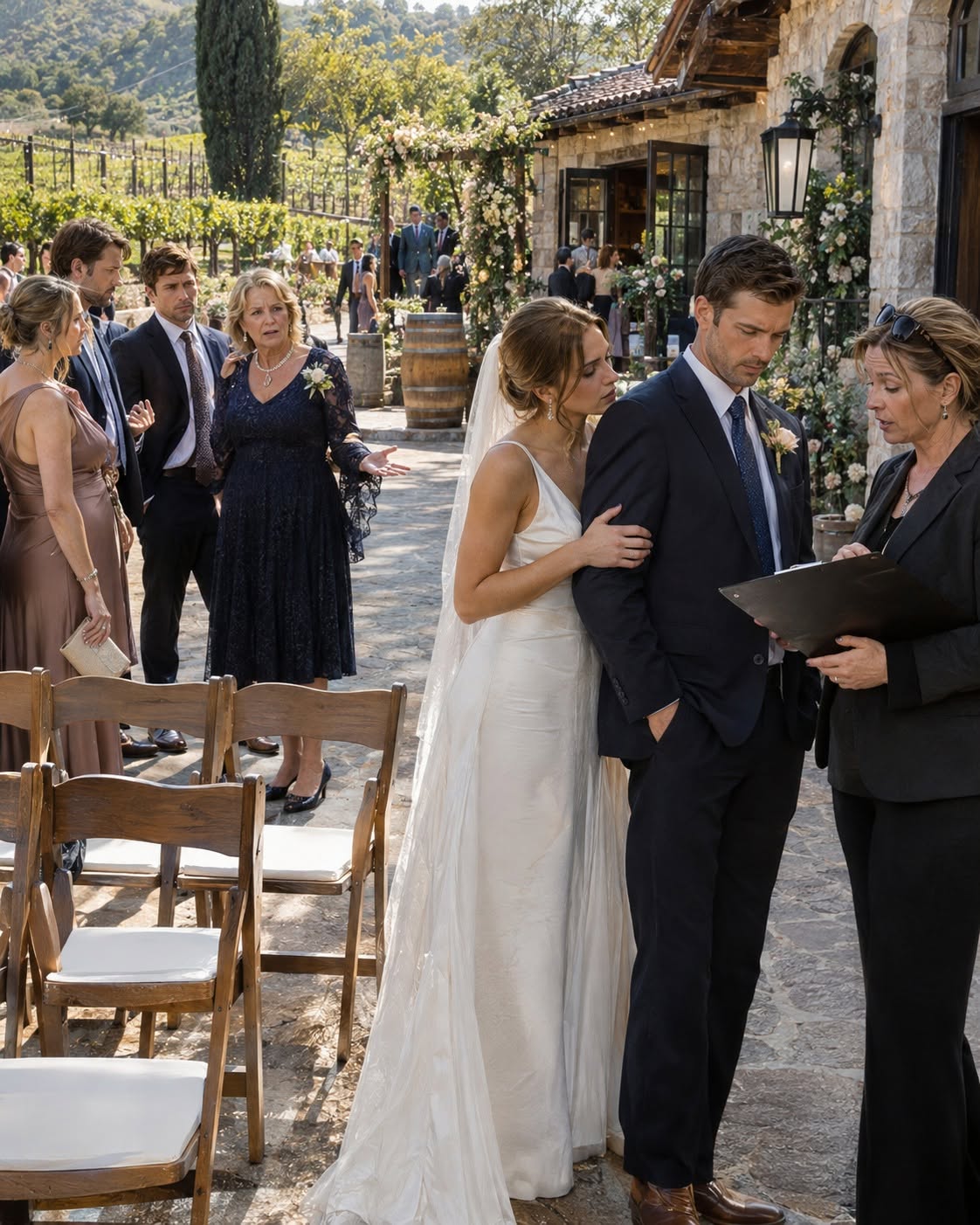
I thought the hardest part of my wedding day was over when security escorted my parents and my older brother out of the vineyard.
I was wrong.
Because while Clara and I were exchanging vows beneath that wooden arch, my mother was already making phone calls that would turn our first weeks of marriage into something neither of us could have imagined.
And the person who eventually exposed everything was the last person I expected to stand up for me.
But I didn’t know any of that yet.
At that moment, all I could see was Clara.
She stood in front of me, her eyes shining with tears, her fingers trembling slightly inside mine.
When the officiant asked whether I promised to love and honor her, I didn’t hesitate.
“I do.”
Two words.
Simple words.
But after spending most of my life feeling like an afterthought, they meant more than I could explain.
Clara smiled through her tears.
“I do, too.”
Our guests applauded when we kissed, and for the first time that morning, I completely forgot about my parents.
The reception was everything we’d hoped for.
There were long wooden tables beneath strings of warm lights, music drifting across the vineyard, and people laughing without worrying about appearances.
Harold gave a toast that nearly broke me.
“When Clara first brought this young man home,” he said, raising his glass, “I noticed something about him. He always thanked us for the smallest things. A place at dinner. An invitation to a family barbecue. Even a cup of coffee.”
A few guests chuckled.
Harold’s expression softened.
“At first, I thought he was just unusually polite. Then I realized he wasn’t used to being included.”
I felt Clara’s hand tighten around mine.
Harold looked directly at me.
“Son, I want you to understand something. You never have to earn your chair at our table. It will always be there.”
I lowered my head because I couldn’t stop the tears.
That was the moment I truly understood what I’d gained.
Unfortunately, my mother was about to remind me what I’d left behind.
Three days after the wedding, Clara and I were enjoying our honeymoon at a quiet coastal resort when my phone started vibrating.
Seventeen missed calls.
Nine messages.
And a voicemail from Nolan.
Of all my family members, Nolan had always been the least cruel. He hadn’t defended me when we were younger, but he hadn’t actively tormented me either.
He had simply watched.
I almost ignored the voicemail.
Something made me listen.
“Hey,” Nolan began awkwardly. “I know you probably don’t want to hear from me. But Mom’s telling everyone you had Dad physically removed from your wedding because he refused to pay for it.”
I sat upright.
“What?” Clara asked.
I put the phone on speaker.
Nolan continued.
“She’s saying Clara’s parents convinced you to cut us off because they’re wealthy and don’t want our family embarrassing them. Gavin’s backing her up. Heather’s posting about it online.”
There was a long pause.
“Look, I know that isn’t what happened. I just thought you should know.”
The message ended.
Clara stared at me.
“Your mother is seriously doing this during our honeymoon?”
I opened my messages.
There were screenshots from distant relatives, accusations about money, and a lengthy post Heather had written about the importance of honoring parents.
Apparently, I was now an ungrateful son who had publicly humiliated the people who raised him.
The post included a photograph of my mother crying in her elaborate wedding outfit.
The caption read, “No parent deserves to be treated like a stranger at their own child’s wedding.”
I stared at it for a long time.
Then I laughed.
Not because it was funny.
Because the woman who had barely noticed me for thirty years was suddenly devastated that she couldn’t stand at the center of my wedding photographs.
Clara reached for my phone.
“Don’t respond tonight.”
“People are believing her.”
“Some people will believe whatever story makes them comfortable,” she said. “That doesn’t mean we owe them our honeymoon.”
She was right.
I turned off my phone.
For four days, we swam, explored little restaurants, watched sunsets, and talked about the life we wanted to build.
We agreed on something important.
Our marriage would never become a courtroom where we constantly had to defend our happiness.
When we returned home, however, a thick envelope was waiting in our mailbox.
There was no return address.
Inside were printed photographs from our wedding.
Not the beautiful photographs our photographer had taken.
These were blurry images captured from outside the vineyard gates.
One showed my father arguing with security.
Another showed my mother pointing angrily toward the ceremony area.
The last photograph showed me standing beside Clara, smiling.
Someone had drawn a black circle around my face.
Underneath, in my mother’s unmistakable handwriting, were six words.
“You will regret choosing them over us.”
Clara read the message twice.
Then she quietly placed it on the kitchen counter.
“That’s not normal.”
I wanted to dismiss it as another emotional outburst.
But something about the photographs disturbed me.
Someone had remained outside the vineyard long enough to watch our ceremony.
Someone had deliberately documented our happiness as though it were evidence of a crime.
I called Toby.
He came over that evening with Nadia.
Nadia looked at the photographs and immediately frowned.
“There’s something I haven’t told you,” she said.
My stomach tightened.
“About the wedding?”
She nodded.
“After security escorted your family out, your mother tried to get into the venue’s administrative office.”
I stared at her.
“Why?”
“She claimed she needed to retrieve financial documents.”
Clara straightened.
“What financial documents?”
“That’s what concerned me,” Nadia replied. “Your parents hadn’t paid for anything. Every contract was in your names.”
She opened her laptop.
“I asked the venue manager to preserve the security footage because the situation felt strange.”
On the screen, we watched my mother walking toward the administrative building while Gavin distracted one of the employees.
Heather stood nearby, holding her phone.
My mother tried the office door.
It was locked.
She looked through the window, then walked away.
The entire incident lasted less than a minute.
But it changed how I viewed everything.
My mother hadn’t merely wanted to control the ceremony.
She had been looking for something.
“What could she possibly want?” Clara whispered.
I didn’t know.
Two days later, Nolan called again.
This time, he sounded frightened.
“Can we meet?” he asked.
“Why?”
“Because there’s something going on with Dad’s business, and I think it involves you.”
I hadn’t been involved with my father’s company in years.
Arthur owned a small commercial property management business. Gavin worked there as operations director, while Nolan handled maintenance contracts.
I had once hoped to join them.
Dad had made it clear there wasn’t a place for me.
“What does that have to do with my wedding?”
Nolan hesitated.
“Please. Just meet me.”
We chose a coffee shop halfway between our homes.
When I arrived, Nolan was already sitting in a corner booth.
He looked exhausted.
There were dark circles beneath his eyes, and his coffee sat untouched.
“I should’ve said something years ago,” he began.
I folded my arms.
“About what?”
“About how they treated you.”
I hadn’t expected that.
Nolan stared at his hands.
“I knew it was wrong. I told myself it wasn’t my business. And every time Dad favored Gavin, I was relieved it wasn’t me being pushed aside.”
I waited.
He swallowed.
“That was cowardly.”
For a moment, neither of us spoke.
Then he slid a folder across the table.
“Three months ago, Dad started trying to sell one of the company’s properties. The bank rejected the transaction because there’s an unresolved ownership issue.”
I opened the folder.
Inside were copies of property records, old correspondence, and a document bearing my grandfather’s signature.
My paternal grandfather, Walter, had died when I was nineteen.
He’d been one of the few people in my childhood who genuinely seemed happy to see me.
He taught me to fish.
He remembered my birthdays.
And every Christmas, he gave me a handwritten card with the same message.
“Never let anyone convince you that you matter less.”
I’d kept every card.
“What am I looking at?” I asked.
Nolan took a breath.
“Grandpa transferred part of the old commercial building into a trust before he died. Dad was supposed to manage it until you turned twenty-five.”
I looked up.
“What trust?”
Nolan’s face went pale.
“The one nobody told you about.”
I read the document again.
Then again.
My name was printed clearly beneath the beneficiary section.
I felt the coffee shop tilt around me.
“Are you saying Grandpa left me property?”
“I’m saying the records suggest he did. And Dad’s been collecting rent from that building for years.”
I couldn’t speak.
Nolan continued.
“Gavin found out when the bank started asking questions. Dad tried to resolve it quietly, but the attorney said they couldn’t sell the property without dealing with your interest.”
Suddenly, my mother’s obsession with my wedding took on a different meaning.
The timing.
The sudden attention.
The insistence that the wedding represented the entire family.
The strange attempt to enter the venue office.
I looked at Nolan.
“Did they want me to sign something?”
He nodded slowly.
“I heard Mom and Gavin arguing about getting you to sign a family agreement. They thought if they could make you feel included again, you’d cooperate.”
My chest tightened.
“And when I refused?”
“They got desperate.”
I leaned back against the booth.
All those years, I’d wondered why my parents had treated me as though I was less valuable than my brothers.
Now I was discovering that my grandfather might have left me something substantial.
And instead of telling me, my family had apparently hidden it.
“Why are you telling me this?” I asked.
Nolan looked miserable.
“Because I have two kids. And last week, my oldest asked why Uncle Gavin gets invited to every family dinner while you don’t.”
He rubbed his forehead.
“I started explaining that families are complicated. Then I heard myself making the same excuses Dad always made.”
His voice cracked.
“I don’t want my children growing up thinking that’s normal.”
I took the folder home.
Clara read everything carefully.
Then she said something I hadn’t considered.
“Before we assume anything, we need an attorney.”
She was right.
Documents could be misunderstood.
Family stories could be distorted.
And I wasn’t about to make a decision based solely on Nolan’s interpretation.
The following week, we met with an estate attorney named Rebecca Shaw.
She reviewed the records and requested certified copies of the trust documents.
Three days later, she called.
“Your grandfather established a trust naming you as the beneficiary of a forty-percent interest in the property,” she explained. “Your father was appointed trustee while you were younger, but his authority was limited.”
I gripped the phone.
“What happened when I turned twenty-five?”
“Under the trust terms, you should have received an accounting and been informed of your rights.”
I stared across the room at Clara.
“That never happened.”
Rebecca paused.
“Then we have some serious questions to ask.”
Over the next several weeks, the situation became uglier.
The building had generated rental income for years.
Some money had gone toward maintenance, taxes, and legitimate expenses.
But substantial transfers appeared to have benefited the family business.
Rebecca warned us that the records were incomplete and that we shouldn’t assume every transfer was improper.
Still, one thing was undeniable.
My father had never disclosed the trust to me.
And the company was now attempting to sell an asset in which I had a significant interest.
Then came the detail that explained my mother’s behavior.
Rebecca obtained an email Gavin had sent to the family’s accountant shortly before our wedding.
It discussed preparing documents for my signature.
One sentence stood out.
“If we can get him comfortable with the family again, he probably won’t question the numbers.”
I read that sentence until the words blurred.
For the first time, I understood that my mother’s sudden affection might never have been about affection at all.
It might have been about convenience.
But the worst revelation was still coming.
Rebecca arranged a formal meeting with my father’s attorney.
Arthur arrived with Gavin.
Brenda came too, although she wasn’t involved in the legal proceedings.
I brought Clara.
Nolan attended separately.
The conference room was quiet when we entered.
My father looked older than I remembered.
His hair had gone almost completely gray, and the confidence he usually carried seemed strained.
Gavin, however, looked furious.
“This has gotten completely out of hand,” he announced before anyone sat down.
Rebecca calmly opened her folder.
“We’re here to discuss the trust and the accounting obligations.”
Gavin leaned forward.
“Nobody stole anything.”
“I haven’t accused anyone of theft,” Rebecca replied. “We’re requesting records.”
My mother turned toward me.
“Do you see what you’re doing to this family?”
I looked at her.
“No, Mom. I’m trying to understand what was kept from me.”
She shook her head.
“Your grandfather loved all three boys. He never meant for you to use this against your brothers.”
“Then why did he put my name on it?”
She had no answer.
My father finally spoke.
“Your grandfather worried about you.”
I stared at him.
“Worried about me?”
“He thought you needed something of your own because you weren’t interested in the business.”
I almost couldn’t believe what I was hearing.
“I begged you to let me work there.”
Dad looked away.
“You weren’t suited for it.”
“You never gave me a chance.”
Gavin scoffed.
“Here we go. The same old victim routine.”
Something inside me settled.
For years, comments like that would have made me defend myself.
I would have explained how hard I’d worked, how much I’d accomplished, how desperately I’d wanted their approval.
This time, I didn’t.
I simply turned back to Rebecca.
“Please continue.”
She outlined the financial questions and the documents required.
My father’s attorney listened carefully.
Then Rebecca mentioned the wedding.
“We also need clarification regarding the agreement your family intended to present to my client.”
My mother’s expression changed.
“What agreement?”
Rebecca placed a printed email on the table.
Gavin stopped moving.
I watched my father’s eyes close.
And suddenly, I knew.
He had known.
Maybe not every detail.
Maybe not every plan.
But he had known that my wedding was being used as an opportunity to obtain my cooperation.
“Was that why you wanted to walk me down the aisle?” I asked quietly.
Dad didn’t answer.
“Was it because you loved me, or because you wanted me to feel grateful enough to sign whatever Gavin put in front of me?”
My mother began crying.
“We wanted to bring the family together.”
“Then why didn’t you tell me about Grandpa’s trust?”
Silence.
I looked around the table.
No one answered.
That silence hurt more than any insult.
Because it was finally honest.
The meeting ended without an agreement.
Rebecca advised us to continue gathering records.
As we stood to leave, my father said my name.
I stopped.
He looked at me with an expression I couldn’t read.
“Your grandfather always thought you were the strongest of the three.”
I waited.
“He said you were the only one who wouldn’t confuse money with love.”
For a second, I almost felt sympathy.
Then I remembered the years of exclusion.
The weddings where I’d sat in the back.
The birthdays forgotten.
The countless family gatherings I discovered through photographs.
“Then you should’ve listened to him,” I said.
I walked out with Clara beside me.
I thought that was the end of the confrontation.
But two weeks later, Gavin showed up at our house.
It was nearly nine at night.
Clara and I were watching a movie when the doorbell rang.
Through the window, I saw his truck parked in our driveway.
I opened the door but didn’t invite him inside.
“What do you want?”
He looked different.
His usual arrogance had been replaced by something frantic.
“You need to drop this.”
“No.”
He glanced past me.
“Do you have any idea what happens if the company loses that property?”
“That’s something you should’ve considered before trying to sell it.”
He clenched his jaw.
“People could lose their jobs.”
That made me pause.
The company employed several maintenance workers and office staff.
Some had been there for decades.
I didn’t want innocent people suffering because of my father’s decisions.
But I also knew Gavin was using that concern against me.
“Then we should find a solution that protects them,” I said.
His eyes narrowed.
“You think you’re better than us now?”
“No.”
“You’ve always acted like you were too good for this family.”
I stared at him.
“Gavin, I spent years trying to be part of it.”
He laughed bitterly.
“You have no idea what it was like being Dad’s favorite.”
That surprised me.
He continued before I could speak.
“Every mistake I made became a disaster. Every success was expected. Dad put the entire business on my shoulders, and when things started falling apart, he blamed me.”
For the first time, I saw something beneath his anger.
Fear.
But fear didn’t excuse what he’d done.
“You had opportunities I never got,” I said. “And when you saw how Dad treated me, you joined in.”
Gavin looked away.
“I know.”
Those two words startled me.
He rubbed his face.
“I know, okay?”
For a moment, I thought he might apologize.
Instead, he said, “But if you keep pushing, you’re going to destroy everything.”
I shook my head.
“I didn’t create this problem.”
He stood there for several seconds.
Then he turned and walked back to his truck.
The next morning, Rebecca called with unexpected news.
Gavin had contacted the company’s accountant and authorized the release of several years of financial records.
Apparently, our conversation had affected him more than I’d realized.
The documents revealed a complicated situation.
The business had suffered financially for years, and my father had used income connected to the trust property to support its operations.
Some expenditures were legitimate.
Others lacked proper authorization.
Rebecca explained that the missing distributions and accounting failures could expose my father to significant civil liability.
We had options.
We could pursue aggressive litigation.
We could negotiate repayment.
Or we could seek a settlement that separated my interest from the family business.
I spent several nights thinking about it.
Part of me wanted to fight for every dollar.
Not because I needed revenge, but because I was tired of being treated as someone whose rights didn’t matter.
Another part of me remembered the employees who depended on the business.
Clara never told me what to choose.
She simply asked one question.
“What decision will let you sleep peacefully ten years from now?”
That question changed everything.
I asked Rebecca to explore a settlement.
Not a cheap surrender.
Not a secret handshake.
A legally enforceable agreement with independent valuations, full disclosure, and repayment of the amounts properly owed to me.
My father initially refused.
Then the company’s lender threatened to withdraw financing unless the ownership dispute was resolved.
Suddenly, everyone became willing to negotiate.
Over the following months, the lawyers worked through the records.
An independent accountant reviewed the transactions.
The property was appraised.
The final agreement required the family business to purchase my trust interest through a structured payment arrangement, backed by security and subject to strict deadlines.
It also required my father to provide a complete accounting.
The company could continue operating.
The employees could keep their jobs.
And I would finally receive what my grandfather had intended for me.
It wasn’t a perfect ending.
Some of the financial records were messy.
Some decisions couldn’t be neatly explained.
And the settlement couldn’t return the years I’d spent believing I was unwanted.
But it was a beginning.
The day the agreement was signed, my father asked to speak privately.
We stood outside the attorney’s office.
For once, he didn’t look angry.
He looked tired.
“I never thought things would end like this,” he said.
I watched cars passing on the street.
“Neither did I.”
He swallowed.
“Your mother says you’ve changed.”
I smiled faintly.
“I have.”
He nodded.
“Maybe that’s my fault.”
I turned toward him.
It was the closest he’d ever come to admitting responsibility.
Then he said something that stayed with me.
“I thought if I made you independent, you’d become stronger.”
I studied his face.
“You didn’t make me independent, Dad. You made me feel disposable. I became independent because I had no choice.”
His eyes filled with tears.
I had never seen my father cry.
“I’m sorry,” he whispered.
I wanted those words to fix something.
I wanted to feel the enormous relief I’d imagined as a child.
But the truth was quieter.
His apology mattered.
It simply wasn’t enough to erase the past.
“Thank you for saying that,” I replied.
He looked hopeful.
“Does that mean we can start over?”
I took a breath.
“It means you can start showing me who you want to be now. I can’t promise what our relationship will look like.”
He nodded slowly.
And for once, he didn’t argue.
My mother reacted differently.
When she learned the settlement had been finalized, she sent a long message accusing me of taking advantage of my father’s guilt.
She claimed my grandfather’s money should have stayed within the family.
I almost responded.
Then Clara pointed out something obvious.
“It is staying within the family. You’re his grandson.”
I laughed so hard I nearly dropped my phone.
I didn’t answer my mother’s message.
Instead, I blocked her number for a while.
Not to punish her.
To give myself peace.
Several months passed.
Life became wonderfully ordinary.
Clara and I planted a vegetable garden.
We adopted a scruffy rescue dog named Murphy, who immediately decided our couch belonged to him.
We hosted Sunday dinners with Harold and Martha.
Toby visited often, usually bringing terrible jokes and expensive cheese.
And Nolan began coming over with his children.
At first, our conversations were awkward.
There was too much history between us.
But Nolan kept showing up.
He apologized without making excuses.
He asked about my work.
He remembered Clara’s birthday.
He invited us to his children’s school events.
Little by little, we built something that had never existed between us before.
A relationship based on choice instead of obligation.
One afternoon, Nolan’s youngest daughter asked me a question while we were making pancakes.
“Uncle, why didn’t you come to our house much before?”
I glanced at Nolan.
He looked uncomfortable but didn’t interrupt.
“Sometimes grown-ups have problems they don’t know how to fix,” I said.
She considered that.
“Did you fix yours?”
I smiled.
“We’re working on it.”
She nodded seriously.
“Good. Because you make better pancakes than Daddy.”
Nolan laughed.
And for the first time in years, I laughed with my brother instead of feeling like the outsider watching everyone else.
Then, almost exactly one year after our wedding, a letter arrived.
It was from my father.
Inside was a photograph of my grandfather standing beside me when I was about ten years old.
We were holding fishing rods beside a lake.
I remembered that day.
Grandpa had spent hours teaching me how to cast.
I’d caught nothing.
He’d told me it didn’t matter.
The photograph had a handwritten note on the back.
“To my youngest grandson, who always notices the things everyone else misses.”
I stared at those words.
There was also a letter from Dad.
He explained that he’d found the photograph while clearing out his office.
He wrote about the mistakes he’d made.
Not vague mistakes.
Specific ones.
He admitted he’d favored Gavin.
He admitted he’d allowed Nolan to become invisible whenever Gavin needed attention.
And he admitted he’d treated me as though love were something I had to earn through obedience.
One paragraph stopped me.
“When your grandfather left you that property interest, I resented it. I told myself he was interfering with my business. The truth is that he saw how I treated you, and he wanted to make sure you had something I couldn’t take away. I should have been ashamed then. Instead, I became angry.”
I read that paragraph three times.
The letter ended with a simple sentence.
“I don’t expect forgiveness. I just wanted you to know that you were never the problem.”
I sat at the kitchen table for a long time.
Clara found me there.
She read the letter, then sat beside me without speaking.
Eventually, I said, “I waited my whole life to hear something like this.”
She rested her head on my shoulder.
“And now?”
I looked at the photograph.
“Now I think I can finally stop waiting.”
I didn’t rush to call my father.
I didn’t invite him over the next day.
But I wrote back.
I told him I appreciated his honesty.
I told him I wasn’t ready for a close relationship.
And I told him that if he genuinely wanted to know me, he would need to accept that my life no longer revolved around earning his approval.
He responded with four words.
“I understand. Take care.”
For once, there was no demand attached.
No guilt.
No expectation.
Just an acknowledgment.
That was enough for the moment.
A few weeks later, Clara told me she was pregnant.
She stood in our bathroom holding the test, her eyes wide with disbelief.
For several seconds, neither of us spoke.
Then she started laughing and crying at the same time.
I wrapped my arms around her.
“We’re really doing this?”
She nodded against my chest.
“We’re really doing this.”
I had never felt joy and terror so intensely at once.
That evening, we told Harold and Martha.
Martha burst into tears.
Harold hugged me so tightly I could barely breathe.
“You’re going to be a wonderful father,” he said.
I wanted to believe him.
But later that night, lying beside Clara, I admitted something I’d never said aloud.
“I’m scared I’ll become like Dad.”
Clara turned toward me.
“Why?”
“Because I grew up watching him. What if that’s all I know?”
She touched my cheek.
“You’re already asking questions he never asked. You’re worried about how your child will feel. That matters.”
I looked at her.
“What if I make mistakes?”
“You will,” she said gently. “So will I. But we’ll apologize. We’ll listen. And we’ll never make our child compete for love.”
I held her close.
That became our promise.
Not that we’d be perfect parents.
But that our child would never wonder whether there was room for them in our lives.
When Nolan heard the news, he was thrilled.
Gavin sent a brief congratulations through him.
My mother found out from a relative.
She immediately tried to call.
I didn’t answer.
Instead, I sent a message explaining that Clara and I were keeping the pregnancy private and would share updates when we felt comfortable.
She replied with a paragraph about grandparents’ rights and family traditions.
I didn’t engage.
A few days later, my father sent a card.
It contained no advice.
No demands.
Just a short message.
“Congratulations to you both. I hope your child grows up knowing how loved they are.”
I placed the card beside Grandpa’s photograph.
I didn’t know whether my father and I would ever become close.
Maybe we would.
Maybe we’d remain two people connected by history but separated by too many years of hurt.
Either way, I was no longer afraid of that uncertainty.
Because something had changed.
I no longer measured my worth by how much attention my parents gave me.
I no longer needed Gavin to treat me like an equal.
I no longer needed my mother to approve of my choices.
I had a wife who loved me.
Friends who stood beside me.
In-laws who treated me like their own.
A brother who was learning how to show up.
And a child on the way who would never have to earn a place at our table.
One Sunday afternoon, Clara and I returned to the vineyard where we’d gotten married.
The owner had invited us to a small anniversary celebration for couples who’d held weddings there.
We walked past the same wooden arch.
The flowers were different.
The chairs had been rearranged.
But I remembered everything.
The confrontation.
My mother’s anger.
My father’s final accusation.
And the moment I’d told him I was choosing the family that chose me.
Clara slipped her hand into mine.
“Do you regret anything?”
I thought carefully.
“I regret spending so many years believing I had to prove I deserved to be loved.”
She smiled.
“Anything else?”
I looked toward the spot where we’d exchanged vows.
“I wish Grandpa could’ve been here.”
Clara squeezed my hand.
“In a way, he was.”
I thought about the trust he’d established.
The cards he’d written.
The photograph of us fishing.
And the quiet ways he’d tried to protect a little boy who never understood why he was always left behind.
For years, I’d believed my grandfather’s greatest gift was the property he’d left me.
But standing there beside my wife, I realized it was something else.
He’d seen me.
Long before I knew how to see myself.
A few months later, our daughter was born.
We named her Willa, after Walter.
The first time I held her, she opened her tiny eyes and wrapped her fingers around mine.
I couldn’t stop staring.
She was so small.
So completely dependent on us.
And somehow, she had already changed everything.
I leaned close and whispered something I wished someone had told me every day when I was growing up.
“You never have to do anything to earn your place here.”
Clara watched from the hospital bed, smiling through tears.
I kissed our daughter’s forehead.
“You’re already enough.”
And in that quiet hospital room, I finally understood the difference between the family I’d been born into and the family I was building.
One had taught me to fight for a seat at the table.
The other had taught me that love should never require an audition.
I didn’t know what the future would bring.
I didn’t know whether my parents would change, whether Gavin would ever fully understand the damage he’d done, or whether the relationships I’d lost could someday be repaired.
But I knew one thing with absolute certainty.
My daughter would never sit at the back of a room wondering why she didn’t matter.
She would never have to compete with someone else for her father’s affection.
And she would never mistake being tolerated for being loved.
Because the greatest inheritance I could give her wasn’t money, property, or a family name.
It was the certainty that she belonged.
And that was something nobody could ever take away from her.
THE END.