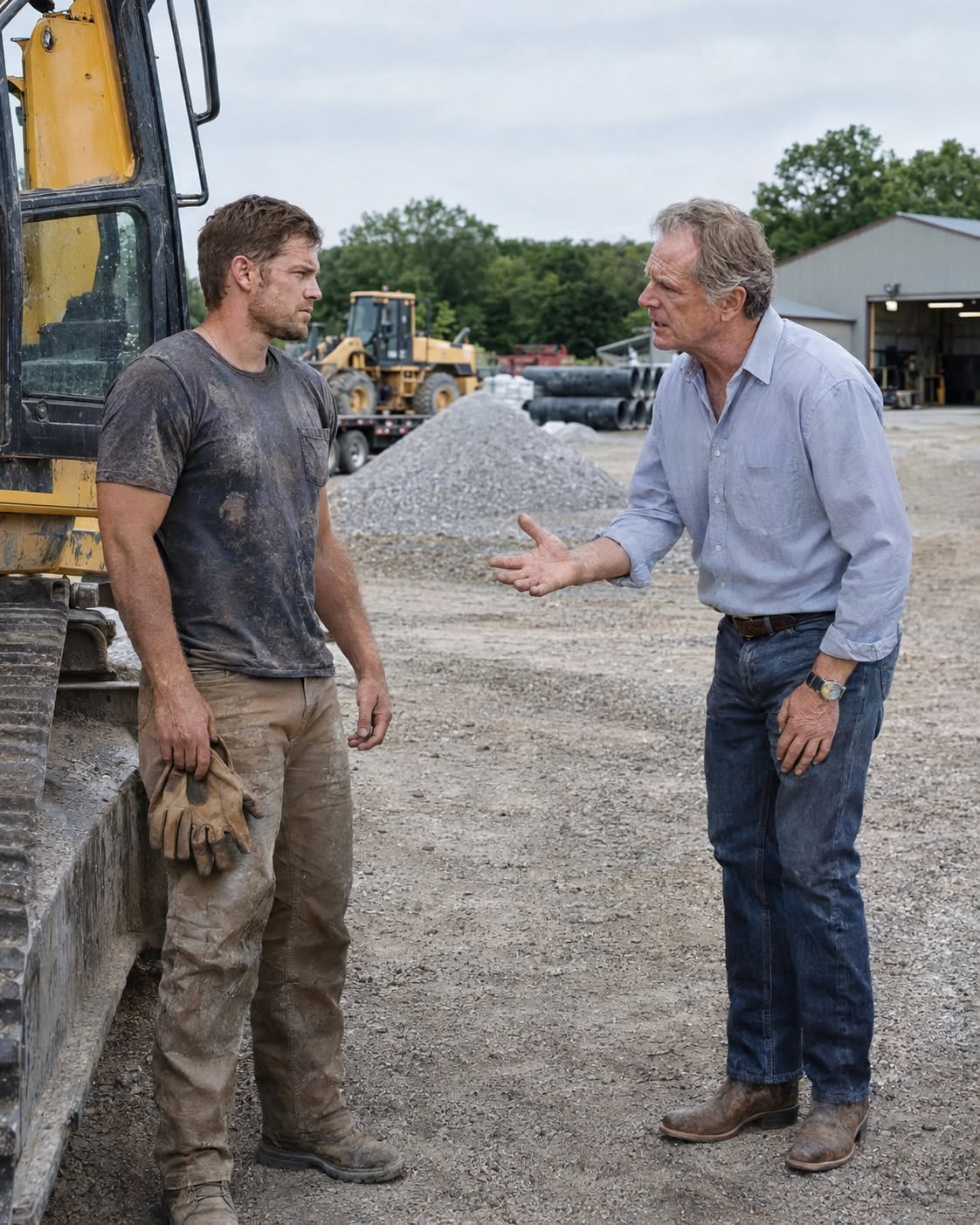
My father showed up at my excavation shop for the first time in years. But he didn’t come to apologize for throwing me out of the family business.
The moment I told Dad my terms, the color drained from his face.
“I’ll take over the foundation work,” I said. “But my company gets the contract directly. My engineers inspect everything before another shovel hits the ground. The client gets a full explanation of what happened, and nobody uses my name without my permission again.”
Dad stared at me like I had slapped him.
“You’re trying to steal your brother’s biggest project.”
“No,” I replied. “I’m trying to keep someone from getting hurt because you’re too proud to admit you made a mistake.”
My brother, Ryan, stood beside the flooded excavation pit, staring at his boots.
Dad turned toward him.
“Are you going to let him talk to me like that?”
Ryan didn’t answer.
That was when Mom stepped forward.
“Before anybody signs anything,” she said, “there’s something your father needs to tell both of you.”
Dad’s jaw tightened.
“Linda, this is neither the time nor the place.”
She looked directly at him.
“Then when, Frank? After the bank takes the house? After somebody gets buried in that hole?”
The entire crew went quiet.
Even the diesel engine idling behind us seemed suddenly too loud.
I looked from Mom to Dad.
“What house?”
Mom reached into her purse and pulled out a folded envelope.
“The house you grew up in,” she said. “Your father used it as collateral to keep the business running.”
Ryan looked up sharply.
“You told me the house was paid off.”
“It was,” Mom answered. “Until three years ago.”
Dad stepped toward her.
“Give me that.”
She moved the envelope out of his reach.
“And there’s something else,” she continued. “The bank doesn’t just have our house. It has a lien against almost everything the company owns.”
Ryan’s face went pale.
“What about my trucks?”
Mom looked at him with an expression I had never seen before.
Pity.
“Those too.”
For several seconds, nobody spoke.
Then Ryan turned toward Dad.
“You told me those trucks were mine.”
“They are yours,” Dad snapped.
“Then why does the bank own them?”
Dad opened his mouth, but nothing came out.
I had spent years imagining what it would feel like to watch my father finally lose control.
I thought I would enjoy it.
Instead, standing beside that flooded foundation, I felt something much more complicated.
Because the man who had once told me I didn’t belong in the family business was now standing in the middle of the wreckage he had created.
And he still couldn’t admit it.
I turned to my superintendent, Marcus, who had come with me to inspect the site.
“Shut the operation down. Nobody enters that excavation until we get a geotechnical engineer out here.”
Marcus nodded and immediately started speaking to the crew.
Dad grabbed my arm.
“You can’t shut down my job.”
I looked at his hand.
“Take your hand off me.”
For a moment, the old anger flashed across his face.
Then he released me.
“You always did think you were smarter than everybody else.”
“No, Dad. I just learned that pretending a problem doesn’t exist doesn’t make it disappear.”
I walked toward my truck.
Behind me, Ryan called my name.
“Wait.”
I stopped.
He approached slowly, holding his phone.
“I need to show you something else.”
He opened a folder containing photographs of the foundation before the flooding started.
The first few pictures showed ordinary excavation work.
The next ones made my stomach tighten.
There were cracks running through the temporary retaining structure. Water was seeping through the soil beneath the neighboring property. A section of the excavation wall had already shifted.
“Who took these?” I asked.
“One of the operators. Three days ago.”
“Did he report it?”
Ryan swallowed.
“To Dad.”
“And?”
“He told us to keep working.”
I stared at my brother.
“Ryan, somebody could have died.”
“I know.”
“No, I don’t think you do. A wall like that doesn’t give you a warning when it finally lets go.”
His eyes filled with tears.
“I tried to stop the crew yesterday. Dad threatened to fire me.”
For the first time in my life, I saw my older brother looking genuinely afraid of our father.
Not annoyed.
Not frustrated.
Afraid.
And suddenly, a lot of things from our childhood made sense.
Dad had never just favored Ryan.
He had controlled him.
Every truck, every promotion, every dollar came with an invisible string attached.
I had been pushed out because I refused to let him pull mine.
Ryan had stayed because he never learned how to cut his.
“Listen to me,” I said. “Whatever happens next, you need to start telling the truth. All of it.”
He nodded.
“I will.”
I wanted to believe him.
But I had heard promises from my family before.
And promises had never been enough.
By noon, the client arrived.
Her name was Eleanor Whitcomb, and she was the development director for a regional healthcare organization building a new outpatient medical center.
The project wasn’t just another commercial foundation.
It was supposed to become a facility serving several rural communities where people currently drove over an hour for basic medical care.
That made the situation even worse.
Delays meant more than financial penalties.
They meant patients waiting longer for treatment.
Eleanor stepped out of her SUV wearing work boots and a navy jacket.
She studied the standing water, the exposed soil, and the idle equipment.
Then she looked at me.
“Are you Daniel?”
“Yes, ma’am.”
She extended her hand.
“Your father said you were supervising the difficult excavation work.”
I shook her hand.
“I wasn’t aware of that until today.”
Her expression changed.
“What do you mean?”
“I mean my company has no contract with this project. We haven’t performed any work here, and I haven’t approved any of the excavation plans.”
She slowly lowered her hand.
“That’s not what I was told.”
Dad hurried over.
“Eleanor, there’s been a misunderstanding.”
She turned toward him.
“Frank, you told our board that Daniel’s company was handling the specialized ground stabilization.”
“We were arranging it.”
“You said it was already arranged.”
Dad glanced at me.
I said nothing.
Eleanor pulled a folder from her vehicle.
Inside was a printed project update sent to her board two weeks earlier.
Near the bottom was a paragraph describing the excavation strategy.
And there, in black and white, was my company’s name.
Not just mentioned.
Presented as a committed specialist subcontractor.
Below it was a signature.
My signature.
Except I had never signed that document.
For a second, everything around me seemed to go silent.
I took the page from Eleanor.
The signature looked convincing.
Someone had copied it from an old document.
I knew exactly which one.
Five years earlier, before Dad pushed me out, I had signed a purchase agreement for a used excavator he wanted the company to buy.
He had kept the paperwork.
Now my signature was sitting on a document I had never seen, connected to a multimillion-dollar construction project.
I looked at Dad.
“Did you forge my signature?”
His eyes darted toward Ryan.
“It’s not what you think.”
“Then explain it.”
“We needed the client to feel confident.”
“You signed my name.”
“It was only preliminary paperwork.”
Eleanor stepped between us.
“Frank, did Daniel authorize this?”
Dad said nothing.
She repeated the question.
“No,” he finally admitted.
Eleanor took the document back.
“Then we have a serious problem.”
She called her legal department from the site.
Dad stood beside his truck, watching his world unravel.
And I realized something important.
This wasn’t about saving my brother’s business anymore.
It was about protecting my own.
That afternoon, I called my attorney, Rebecca Shaw.
Rebecca had helped me establish my company when I was operating out of a rented storage unit with two employees and a truck that barely started in winter.
She knew my history with my family.
But when I explained what happened, she didn’t ask about my feelings.
She asked one question.
“Do you have a copy of the document?”
“Yes.”
“Send it to me immediately. And Daniel, don’t sign anything. Don’t move equipment onto that property. Don’t even give them a verbal commitment until we’ve reviewed everything.”
I leaned against my truck.
“There’s a safety issue.”
“Then report the safety issue through the proper channels. Protecting people doesn’t require accepting liability for someone else’s misconduct.”
She paused.
“And Daniel?”
“Yeah?”
“Your father may have exposed you to a much bigger problem than a bad foundation.”
I knew she was right.
But knowing that didn’t make the next decision easier.
Because the following morning, Marcus called me before sunrise.
“Boss, you need to get down here.”
“What happened?”
“Part of the excavation wall collapsed overnight.”
My heart dropped.
“Was anybody inside?”
“No. The site’s been secured since yesterday.”
I closed my eyes.
Thank God.
Marcus continued.
“But the collapse damaged a drainage line near the neighboring property. Water’s moving toward the excavation, and the engineer says the entire area needs emergency stabilization.”
I was already reaching for my boots.
“Keep everyone outside the exclusion zone. I’m on my way.”
When I arrived, the site looked like a disaster zone.
A section of the excavation wall had slumped into the pit. Mud covered the bottom. The damaged drainage line was pouring water into the already unstable soil.
The neighboring property owner stood behind the safety fence, furious.
Eleanor was there with two engineers.
Dad and Ryan stood near the site trailer.
Nobody looked happy to see me.
Except Marcus.
He handed me a hard hat.
“Engineer’s setting up a temporary stabilization plan. We can help once it’s approved.”
I nodded.
Then I walked toward Eleanor.
“My attorney is preparing a formal notice regarding the unauthorized use of my company’s name,” I told her. “But I understand you have an emergency.”
She studied me carefully.
“Are you willing to help?”
“Yes. Under a separate emergency services agreement, with the proper engineering approvals, insurance verification, and clearly defined responsibilities.”
“And the rest of the project?”
“We’ll discuss that after the site is safe.”
She nodded.
“Fair enough.”
Dad stepped forward.
“You’re really going to charge us while we’re drowning?”
I turned toward him.
“I’m going to pay my employees, protect my equipment, and do the work correctly.”
“We’re family.”
Those two words hit harder than I expected.
For years, I had wanted him to say them.
Not because he needed something.
Because he meant them.
Now they sounded like an invoice he expected me to pay.
“Family doesn’t mean you get to put my people at risk,” I said.
He looked away.
The emergency work took three days.
We brought in pumps, established controlled drainage, and installed temporary stabilization measures according to the engineer’s plan.
Every move was documented.
Every load was tracked.
Every worker attended the safety briefings.
My crew worked with the quiet precision that had taken me years to build.
And while we worked, Ryan stayed on-site.
Not as the boss.
Not as Dad’s favorite son.
As another man wearing muddy boots and trying to make himself useful.
On the second afternoon, I found him helping one of my operators clean equipment.
He looked exhausted.
“You don’t have to do that,” I said.
“I know.”
“Then why are you?”
He shrugged.
“Because I finally realized I don’t know half as much as I thought I did.”
I leaned against the trailer.
Ryan wiped his hands on a rag.
“Dad always told me you left because you thought you were too good for us.”
I laughed bitterly.
“He told me I wasn’t part of the business.”
Ryan stared at me.
“He said you quit because you wanted more money.”
“That’s not what happened.”
“I know that now.”
He looked toward the excavation.
“When you left, I thought I’d won.”
I didn’t answer.
“I got the bigger truck. The office. The contracts. Everybody called me the future of the company.”
He swallowed.
“But I couldn’t make a decision without asking Dad. If I disagreed with him, he’d remind me who bought everything.”
I studied my brother.
“Why didn’t you leave?”
“Because I was scared.”
It was the first honest answer he’d ever given me.
Ryan sat on the trailer steps.
“You built something because nobody gave you anything. I never built anything because Dad gave me everything.”
I sat beside him.
For a while, we watched the equipment move across the site.
Then he said something I hadn’t expected.
“I was jealous of you.”
I turned toward him.
“Of me?”
He nodded.
“You had your own company. Your own people. Nobody could take it away from you just because you disagreed with them.”
I thought about the nights I’d slept in my truck between jobs.
The winters when I couldn’t afford to replace broken equipment.
The payroll Fridays when I’d paid my employees before paying myself.
Freedom had cost me almost everything.
But it had been worth it.
“You can still build your own life,” I told him.
Ryan looked down.
“Not if Dad loses everything.”
“His decisions aren’t yours to carry forever.”
He didn’t respond.
But I could tell he was thinking about it.
On the fourth day, Rebecca called.
“I’ve reviewed the documents,” she said. “We have enough evidence to establish that your company never authorized its involvement. The client is cooperating, and your father has agreed to preserve all records.”
“That’s good.”
“There’s more.”
I waited.
“Your father didn’t just use your signature on the project update. He submitted a document representing your company as a committed subcontractor to the project’s lender.”
I closed my eyes.
“Of course he did.”
“The lender is reviewing the matter. They may require additional disclosures, and there could be legal consequences.”
“What happens to the medical center?”
“That depends on the client, the financing, and whether a qualified contractor can finish the work.”
I looked across the job site.
My crew had stabilized the immediate danger.
But the foundation itself was still months from completion.
“Can we take over the project?”
“Possibly. But only through a completely new agreement, with proper risk allocation and independent engineering review.”
I knew what she was really saying.
I could help.
But I couldn’t rescue my father by pretending nothing had happened.
That evening, Eleanor invited me to meet with the project’s board.
They had gathered in a small conference room at the healthcare organization’s headquarters.
There were six board members, two attorneys, a structural engineer, and a representative from the lender.
Dad wasn’t invited.
Neither was Ryan.
Eleanor opened the meeting.
“Daniel, you’ve helped prevent further damage to the site. We appreciate that. But we need to know whether your company is willing to complete the excavation and foundation preparation.”
I took a breath.
“My company can handle the work. But I won’t take responsibility for the previous contractor’s decisions, and I won’t guarantee a schedule until the engineers complete their assessment.”
One board member frowned.
“We’re already behind.”
“I understand.”
“Can you promise we won’t have more surprises?”
“No.”
The room went quiet.
I continued.
“Anyone who promises you there won’t be surprises underground is selling you something. What I can promise is that we’ll investigate the conditions properly, tell you what we find, and make decisions based on engineering instead of wishful thinking.”
The engineer sitting across from me nodded.
I laid out a proposed approach.
Independent soil testing.
A revised drainage design.
Additional foundation engineering where necessary.
A transparent budget with contingency allowances.
Weekly progress reports.
No shortcuts.
No hidden change orders.
No promises made just to win approval.
When I finished, Eleanor looked around the table.
“Any questions?”
The lender’s representative leaned forward.
“One. Why should we trust you after what happened with your father’s company?”
I expected the question.
“Because I’m the person who told you the truth when keeping quiet would have been easier.”
Nobody spoke for several seconds.
Then Eleanor smiled faintly.
“That’s the first answer today that’s made me feel better.”
Two weeks later, my company was awarded the replacement excavation contract.
Not because of my last name.
Because of our qualifications, our safety record, and the plan we’d submitted.
Dad’s company was formally removed from the project, with its remaining contractual obligations handled through attorneys and insurers.
The decision nearly destroyed him.
He called me the evening the new agreement was signed.
I was sitting at my kitchen table, reviewing equipment schedules.
“You got what you wanted,” he said.
I sighed.
“What are you talking about?”
“My company is finished. You’re taking my biggest client. Everybody thinks I’m a liar.”
“Dad, you signed my name without permission.”
“I was trying to save what I built.”
“And you almost destroyed what I built in the process.”
He was silent.
Then his voice hardened.
“You’ve been waiting years to get even with me.”
I looked at the framed photograph on my desk.
It showed my first crew standing beside a rented excavator.
Three exhausted men covered in mud, smiling like we’d just won the lottery because we’d completed a small parking lot job ahead of schedule.
I remembered how proud I’d felt that day.
Not because I’d beaten my father.
Because I’d finally proved to myself that I could survive without his approval.
“Dad,” I said quietly, “I stopped trying to get even with you a long time ago.”
“Then why are you doing this?”
“Because people are counting on me.”
I ended the call.
For the first time, I didn’t feel guilty.
But the story wasn’t over.
Three days later, Mom came to my office.
She looked older than she had a month earlier.
She sat across from me and placed a folder on my desk.
“I need your advice,” she said.
Inside were bank statements, loan documents, and a list of outstanding bills.
Dad’s business was in worse shape than I’d imagined.
He owed suppliers, equipment lenders, and several subcontractors.
But one item caught my attention.
A personal loan.
The original amount was nearly two hundred thousand dollars.
I looked up.
“What’s this?”
Mom folded her hands.
“Your father borrowed that money seven years ago.”
“Seven years?”
She nodded.
“The year you left.”
I stared at the date.
“Why?”
Her eyes filled with tears.
“He had a chance to expand the business. He bought equipment he couldn’t afford. When the work slowed down, he borrowed more to cover the payments.”
I kept reading.
Then I noticed something that made my stomach twist.
The loan proceeds had been deposited just weeks before Dad told me there wasn’t enough money to keep me on the crew.
He hadn’t pushed me out because there was no work.
He had been expanding.
He had chosen to spend money on equipment and Ryan’s position while telling me I wasn’t worth keeping.
Mom saw the realization on my face.
“I should have told you years ago.”
“Why didn’t you?”
“Because I thought keeping the family together meant staying quiet.”
I looked at her.
“And did it?”
She shook her head.
“No. It just gave your father more room to hurt everyone.”
She wiped her eyes.
“I’ve spent thirty-eight years making excuses for him. I’m not doing it anymore.”
Then she said something that surprised me.
“I’m separating from your father.”
I sat back.
“Mom…”
“I’ve already spoken to an attorney. I’m going to protect what I can and start over.”
She managed a small smile.
“I suppose I should have learned that from you sooner.”
I reached across the desk and took her hand.
“You don’t have to do it alone.”
She squeezed my fingers.
“I know.”
A month later, Dad’s company entered a court-supervised insolvency process.
The bank repossessed several pieces of equipment.
Suppliers filed claims.
The forged documents were reviewed by the appropriate parties, and Dad eventually signed a settlement acknowledging that my company had never authorized the representations made in its name.
There were financial consequences and legal expenses.
I didn’t know whether every creditor would recover what they were owed.
And I didn’t pretend the damage could be erased with an apology.
But something unexpected happened during that difficult period.
Ryan came to my office carrying a résumé.
He stood in the doorway looking embarrassed.
“I heard you’re hiring operators.”
I looked at the paper.
He had listed his equipment certifications, project experience, and safety training.
For the first time, there was no family connection listed as a qualification.
“You want a job?” I asked.
He nodded.
“Not a management position. Just a job.”
I studied him.
“You understand you’d report to Marcus?”
“Yes.”
“And you’d start at the same pay rate as anyone else with your verified experience?”
“Yes.”
“No special treatment.”
“I don’t want any.”
I leaned back.
“Why should I hire you?”
He thought for a moment.
“Because I know how to operate equipment. Because I made mistakes and I’m willing to learn. And because I want to find out what I can accomplish without Dad making every decision for me.”
I looked at him for a long time.
Then I picked up my phone and called Marcus.
“I’ve got an applicant for you to interview.”
Ryan smiled.
I held up a finger.
“Don’t thank me yet. Marcus is harder to impress than I am.”
He laughed.
It was the first genuine laugh we’d shared in years.
Marcus hired him after a practical assessment and reference checks.
And to Ryan’s credit, he worked.
He arrived early.
He followed instructions.
He took the dirty assignments without complaining.
When he made mistakes, he admitted them.
A few of my employees were skeptical at first.
They knew what my family had done to me.
I didn’t ask them to forget it.
I simply told them Ryan would be judged by the same standards as everyone else.
Over time, he earned their respect.
Not because he was my brother.
Because he showed up and did the work.
Six months after we took over the medical center project, the foundation was complete.
The revised drainage system passed inspection.
The engineered stabilization measures performed as designed.
And the project moved forward without another major excavation incident.
There had been delays.
There had been expensive surprises.
But every problem had been documented and addressed.
On the day the final foundation inspection was approved, Eleanor invited me to walk the site with her.
We stood beside the finished concrete, looking across the future building footprint.
“You know,” she said, “when this project started falling apart, I thought we were going to lose everything.”
“I thought you might too.”
She laughed.
“At least you’re consistent about telling the truth.”
Then she handed me a small envelope.
Inside was an invitation to the medical center’s groundbreaking ceremony for the next phase of construction.
“I’d like you and your crew to be there,” she said.
I smiled.
“We’d be honored.”
She hesitated.
“There’s something else. One of our board members asked me why you didn’t simply walk away when you discovered what your father had done.”
I looked toward the machinery parked beyond the fence.
“Because the people who’ll use this building had nothing to do with my family problems.”
Eleanor nodded.
“That’s what I told them.”
A few weeks later, the ceremony took place under a bright blue sky.
Local officials gave speeches.
Doctors talked about what the facility would mean for the surrounding communities.
Families stood near the temporary stage, holding small flags and smiling for photographs.
My crew stood together near the back.
Marcus wore a clean shirt for once.
Ryan stood beside him, looking uncomfortable in a jacket.
Mom sat in the front row.
She had moved into a small house of her own and started working part-time at a local garden center.
She looked happier than I’d seen her in years.
When Eleanor called my name, I walked to the microphone.
I wasn’t much for public speaking.
But I knew what I wanted to say.
“Construction is a funny business,” I began. “Most people only see the finished building. They don’t see what’s underneath.”
A few people smiled.
“They don’t see the soil tests, the drainage systems, the long nights, or the mistakes that have to be corrected before the foundation can be trusted.”
I glanced toward my crew.
“The same is true of people. What matters isn’t always what everybody sees. Sometimes it’s the work you do when nobody’s watching.”
I paused.
“This project reminded me that a strong foundation doesn’t come from pretending the ground is perfect. It comes from understanding what’s wrong and doing the work to make it right.”
The applause surprised me.
But what happened afterward surprised me even more.
As the crowd began to disperse, I saw Dad standing near the edge of the parking lot.
He wore an old work jacket.
His hair looked grayer.
He wasn’t standing with the officials or the contractors.
He was alone.
For a moment, I considered walking the other way.
Then I saw him looking at Ryan.
My brother had just been congratulated by Marcus for his work on the project.
Dad watched quietly.
There was no anger on his face.
Only something I couldn’t immediately recognize.
Regret.
I walked toward him.
“Didn’t know you were coming,” I said.
He looked at the ground.
“Your mother told me about it.”
I nodded.
We stood in silence.
Then he said, “I watched your speech.”
“Okay.”
“You did good.”
Two words.
For most of my childhood, I would have given anything to hear them.
Now they felt strangely small.
But not meaningless.
“Thanks,” I said.
Dad looked toward the finished foundation.
“I drove past here a few times while you were working.”
“I figured.”
“You fixed what I couldn’t.”
I didn’t respond.
He rubbed his hands together.
“I spent my whole life thinking the business was mine because my name was on the trucks.”
He swallowed.
“Turns out a name doesn’t mean much if nobody trusts it.”
I looked at him.
For once, he wasn’t making excuses.
“I was wrong about you,” he said.
My throat tightened.
He continued.
“I was wrong when I pushed you out. I was wrong when I told Ryan he couldn’t make it without me. And I was wrong to use your name.”
He paused.
“I don’t expect you to forgive me.”
I watched a group of children running across the grass near the ceremony tent.
“I don’t know if I can forgive everything,” I said.
He nodded slowly.
“I understand.”
“But I appreciate you saying it.”
His eyes grew wet.
He looked away before the tears could fall.
Then he reached into his jacket pocket and pulled out a small object.
It was an old brass key.
I recognized it immediately.
The key to the original workshop where I’d learned to rebuild hydraulic cylinders and repair engines as a teenager.
Dad placed it in my hand.
“The bank sold the property,” he said. “I kept that key before I turned everything over.”
I looked at the worn metal.
It had scratches along the edges from years of use.
“I don’t know why I kept it,” he admitted.
I closed my fingers around it.
“I think I do.”
He gave a faint smile.
Then he walked away.
I didn’t chase him.
I didn’t promise we’d suddenly become a happy family.
Some wounds need more than one conversation.
Some relationships can be repaired.
Others can only become something different.
And I was finally comfortable not knowing which one ours would be.
A year later, the medical center opened its doors.
My company had grown again.
We’d added two crews, expanded our training program, and started offering paid apprenticeships to young people who wanted to enter the trades.
Ryan had become one of our most dependable operators.
He still reported to Marcus.
And he liked it that way.
One afternoon, he came into my office holding a photograph.
It showed the two of us as kids, standing beside Dad’s first excavator.
Ryan was grinning at the camera.
I was holding a wrench almost as long as my arm.
“Mom found this,” he said.
I laughed.
“Look at that haircut.”
“Yours or mine?”
“Both.”
He placed the picture on my desk.
“Remember how we used to argue about who’d run the company someday?”
“Yeah.”
Ryan smiled.
“Funny how that worked out.”
I studied the photograph.
Back then, I thought the greatest thing I could ever inherit was Dad’s business.
I thought having his approval would mean I’d finally made it.
But the business had collapsed.
The trucks were gone.
The old workshop belonged to someone else.
And somehow, we were both better off than we’d been when everything looked successful from the outside.
Ryan started toward the door.
Then he stopped.
“Hey, Daniel?”
“Yeah?”
“I’m glad you didn’t let Dad talk you into putting our name on that contract.”
I raised an eyebrow.
“Why?”
“Because if you had, we’d still be pretending everything was fine.”
He smiled.
“And I think we’re finally done pretending.”
After he left, I placed the old photograph beside the one of my first crew.
Two pictures.
Two different foundations.
One built on expectations.
The other built on hard work.
That evening, I drove past the medical center on my way home.
The parking lot was full.
Lights glowed through the windows.
A mother was helping her little boy out of a car near the entrance.
An elderly man sat on a bench, waiting for someone inside.
People were going about their lives, completely unaware of the arguments, betrayals, and difficult decisions that had nearly prevented that building from existing.
And that was exactly how it should be.
They didn’t need to know my name.
They didn’t need to know what my father had done.
They just needed the building to be safe.
I sat in my truck for a moment, looking at the place where a flooded excavation pit had once threatened to destroy everything.
Then I reached into the center console and picked up the old brass workshop key.
For years, I’d believed that being thrown out of the family business meant I’d lost my future.
But standing there, I finally understood something.
Dad hadn’t taken my future away.
He had taken away the future he’d chosen for me.
And that had forced me to build my own.
I put the key back, started the engine, and headed home.
I still loved my father.
I still wished our family had been different.
But I no longer needed him to tell me I belonged.
I had employees who trusted me, a brother who was learning to stand on his own, a mother who had found the courage to start over, and a business built on a reputation nobody could borrow without earning.
And I had something far more valuable than the company I’d once expected to inherit.
I had peace.
Because the greatest lesson my father ever taught me wasn’t how to operate an excavator, negotiate a contract, or read the ground beneath my feet.
It was something he never intended to teach at all.
You can spend your whole life begging someone to give you a place at their table, or you can build something strong enough that you no longer need their permission to stand.
And sometimes, the people who refuse to give you a foundation are the very reason you learn how to build one that lasts.
THE END.