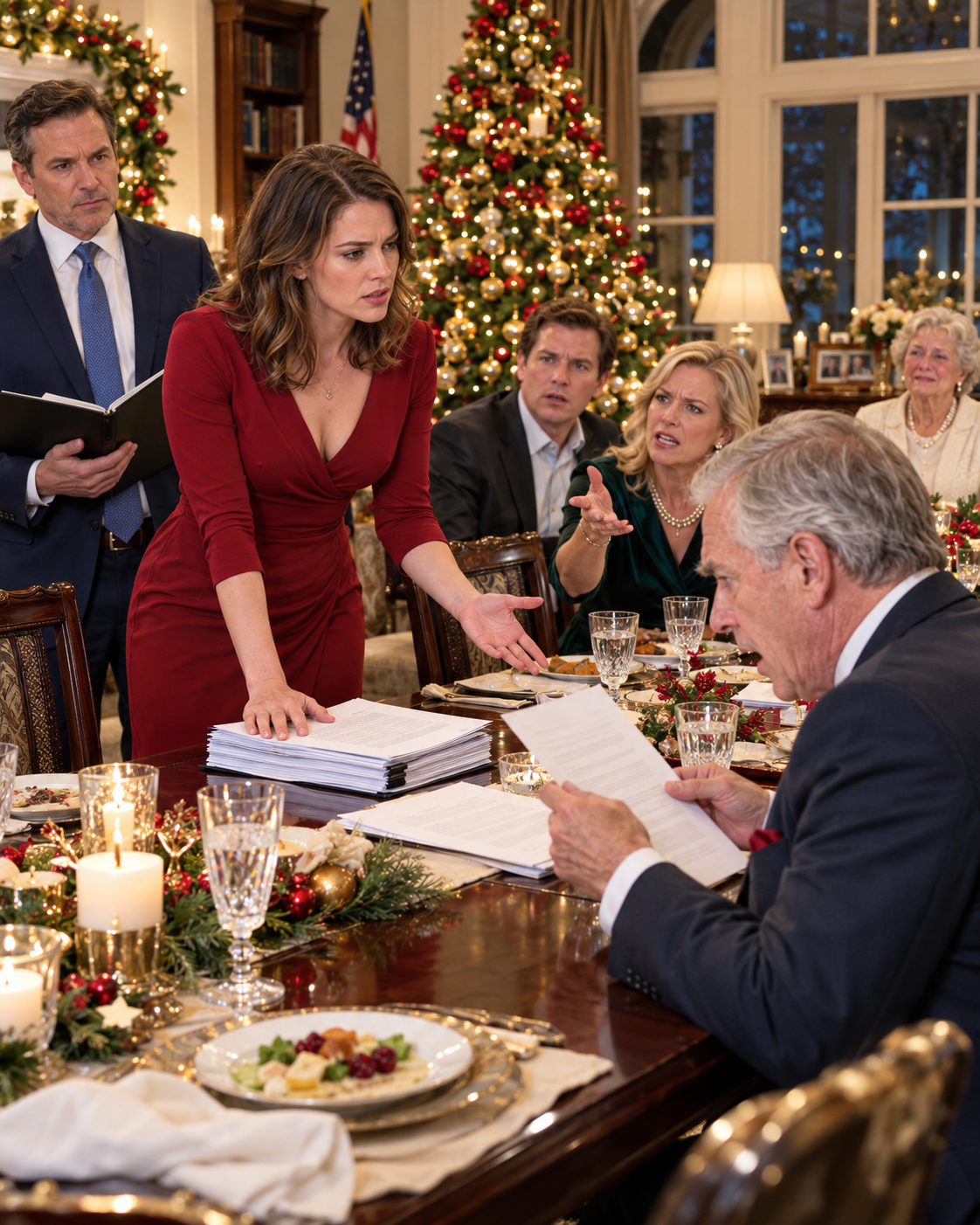
My father shoved Martha’s Christmas plate onto the floor and told her she had thirty days to leave the estate
The brass key felt heavier than it should have in my palm.
I stared at the words on the tag until they blurred.
“Vance Vault?”
Martha nodded.
“Your grandfather called it the place where our family history would outlive our family’s lies.”
The laughter I had heard from her moments earlier vanished.
She looked toward the empty mansion.
“Your father never knew it existed.”
We waited until the last moving truck disappeared beyond the gates before Martha told me where to go.
The vault was not beneath the estate.
It was behind an old stone chapel twenty minutes away, on land my grandfather had bought and kept separate from every family property record.
The chapel had been abandoned for years.
Its windows were cracked, ivy crawled across the walls, and the bell tower leaned slightly toward the road.
Martha walked slowly beside me, one hand on my arm.
“This place belonged to your grandfather’s father,” she said.
“I thought Grandma said he sold it.”
“He told your father that.”
I stopped.
“Why would he lie to his own son?”
“Because he knew his son had begun stealing.”
The words hit harder than the winter air.
Inside the chapel, Martha led me behind the altar and pressed the brass key into a narrow iron lock hidden beneath the wood.
The door opened with a deep metallic groan.
A staircase descended into darkness.
At the bottom sat a small room lined with steel cabinets.
No gold.
No jewelry.
No treasure.
Just boxes.
Hundreds of them.
Every box carried a year.
1987.
1991.
1998.
2004.
2010.
2015.
My breath caught.
Martha whispered, “Your grandfather prepared for the day someone would call him paranoid.”
We opened the first box together.
Inside were copies of estate documents, bank records, letters, photographs, and handwritten notes from my grandfather.
The earliest note was dated twenty-six years before.
“Thomas has begun borrowing from Martha without her knowledge.”
Thomas was my father.
I covered my mouth.
The next note was worse.
“He says the money is temporary, but temporary theft becomes permanent the moment shame stops being a barrier.”
My mother’s name appeared beside his in later records.
Together, they had taken loans against accounts Martha barely remembered opening.
They had persuaded her to sign documents while telling her they were estate updates.
Then they had slowly isolated her from independent financial advice.
The pattern was deliberate.
It was patient.
It had been building long before I was old enough to understand why my parents hated having Grandma speak to attorneys.
I opened another file.
There was a photograph of my father standing beside my grandfather in the study.
On the back was a sentence in my grandfather’s handwriting.
“Thomas believes he is inheriting this house.”
Then beneath it.
“He is inheriting nothing.”
I looked at Martha.
“Why did you never tell me?”
She lowered herself onto a wooden chair.
“Because I wanted you to have one person in your family who loved you without making you choose sides.”
My eyes burned.
“You let me believe I was the failure.”
“No,” she said softly.
“They wanted you to believe that.”
She opened the next folder.
Inside was a sealed letter addressed to me.
My name was written in my grandfather’s handwriting.
I had not seen that handwriting since I was a child.
I broke the seal.
“My dear Laurel,” it began.
“If this letter ever reaches you, then either my plan worked or my fears were correct.”
I stopped breathing for a second.
He wrote that he had watched my parents become obsessed with status.
They measured love in money and obedience.
They confused inheritance with entitlement.
Most frightening of all, he wrote that he believed they would one day try to remove Martha from the very home she had helped build.
That day had come.
He explained that the trust was not merely designed to protect his wife.
It was designed to protect whoever proved capable of protecting her.
He had chosen me because, even as a child, I was the only one who defended Martha when my siblings mocked her.
“You may think I chose you because you are stronger than the others,” he wrote.
“I did not.”
“I chose you because you still know the difference between what belongs to you and what belongs to someone else.”
I had to put the letter down.
For years, my family had used the word failure until I almost believed it.
Now I understood why their definition of success had never included me.
They could not control someone who did not worship what they worshipped.
Martha reached into another cabinet.
“There is more.”
She handed me a ledger.
The entries showed that my father had diverted money from Martha’s account into a shell company.
The shell company had paid vendors who renovated the estate.
Those vendors then overbilled the company.
The difference returned to my father.
He had been laundering family money through construction projects inside a house he did not legally own.
I stared at the numbers.
“How much?”
“Enough to ruin him.”
The room seemed suddenly too small.
Then Martha pointed to one final folder.
“This is why I waited.”
Inside were medical records from years earlier, property evaluations, and a handwritten statement from my grandfather’s longtime attorney.
The statement explained that Martha’s mental capacity had been questioned after a minor stroke.
My parents had used that diagnosis to justify taking control of her finances.
But the attorney had independently examined Martha and declared her competent.
Someone had altered that assessment.
My father had paid an employee at the old legal office to replace the original.
That was the moment the case changed from family betrayal to criminal fraud.
I called our attorney, Helen Mercer.
She arrived the next morning with two associates and a face that became increasingly serious as she reviewed the documents.
“This is not just a trust dispute,” she said.
“No.”
“It is a pattern of financial exploitation, document alteration, and potential fraud.”
She looked at Martha.
“Mrs. Vance, do you want to pursue this?”
Martha looked at me.
Then she smiled.
“I want my granddaughter to stop being afraid.”
Helen nodded.
“Then we build the case properly.”
We spent weeks organizing evidence.
Every transaction was matched against bank statements.
Every questionable signature was compared with authenticated samples.
Every altered document was traced to the office where it had been changed.
The deeper we dug, the uglier the truth became.
My father had convinced himself that because Martha was old, stealing from her was not really stealing.
My mother had convinced herself that because the house had raised her children, the house belonged to her.
My siblings had accepted their version because accepting it meant they never had to ask uncomfortable questions.
I wondered whether they truly knew what was happening.
Then one afternoon my sister called.
“You destroyed this family.”
I said nothing.
“You took everything.”
“No,” I replied.
“I stopped you from taking what was never yours.”
She laughed bitterly.
“You think Grandma is innocent?”
“I think the records can speak for themselves.”
She hung up.
Two days later, my brother arrived at Helen’s office.
He did not apologize.
He did not threaten me.
He placed a folder on the desk.
“I found this in Dad’s study.”
Helen opened it.
Inside was a list of payments made to the employee who had altered Martha’s legal records.
My brother stared at me.
“I did not know it was this bad.”
I believed him.
That did not erase what he had done.
“You should tell the investigators everything.”
He nodded.
“Will you ever forgive me?”
“I don’t know.”
He looked down.
“But I hope one day you forgive yourself enough to become different.”
He left without another word.
That was the first crack in the wall my parents had built around the family.
The second came from my mother.
She requested a private meeting.
I almost refused.
Helen advised me to let the meeting happen with counsel present.
We met in a conference room.
My mother sat across from me, suddenly smaller without the mansion behind her.
“You think your grandfather loved you more than us,” she said.
“I don’t know.”
“He always thought I was greedy.”
“He wrote that he feared you were helping Dad steal from Martha.”
Her face tightened.
“He never understood what it took to keep that family together.”
I looked at her.
“Martha kept it together.”
My mother shook her head.
“Your grandmother was weak.”
“No.”
“She let your grandfather control everything.”
“No.”
“She was too old to manage money.”
“No.”
My voice stayed calm.
“She trusted people who lied to her.”
My mother stared at me.
“That is not the same thing.”
For the first time, her expression broke.
“You have no idea what it is like to spend your life being afraid of losing everything.”
I understood then that beneath all her cruelty was fear.
It did not excuse what she had done.
But it explained why she had clung so violently to an illusion of security.
I said, “You were afraid of losing a house.”
Her eyes filled.
“I was afraid of becoming nobody.”
I answered quietly.
“So was I.”
Neither of us spoke for a long time.
Then she said something I still remember.
“You were always the strongest one.”
I almost laughed.
“You spent my entire childhood telling me I was the weakest.”
“I know.”
It was not an apology.
Not yet.
But it was the first honest sentence she had ever given me.
The investigation moved quickly after that.
The financial records were subpoenaed.
The altered documents were examined.
The trust was confirmed.
The estate was legally transferred under the terms my grandfather had written decades earlier.
My father was forced to repay a portion of the stolen funds and faced criminal proceedings related to the falsified records.
My mother was named in the financial investigation, though her attorney argued that she had relied on my father’s representations.
The family that had looked untouchable at Christmas became a collection of people answering difficult questions in separate rooms.
And somehow, none of it felt like victory.
It felt like grief finally being given a name.
The mansion stood empty.
Every room carried memories that were both beautiful and cruel.
Martha and I walked through it one final time.
In the dining room, she touched the long table where she had once eaten standing up because my mother wanted the chairs reserved for guests.
“In this house,” she said, “I learned that people can mistake wealth for worth.”
I looked around at the chandeliers.
“And what did you learn outside it?”
“That peace is something you build.”
She handed me the old brass key.
“You build it one honest choice at a time.”
Six months later, the estate was sold.
The buyer planned to demolish the house and build something entirely new.
I attended the final day because I thought I needed closure.
When the first wall came down, dust rose into the sunlight.
Martha stood beside me wearing a pale blue coat.
She watched the mansion disappear without shedding a tear.
“How does it feel?” I asked.
She smiled.
“Like finally turning off a television that has been playing the same argument for forty years.”
I laughed.
Then I cried.
She held my hand.
We moved to Napa soon afterward.
Our new home was smaller, brighter, and surrounded by vines rolling toward the hills.
Martha planted roses along the garden fence.
She named the first white one after me.
“Why Laurel?”
“Because you survived shade.”
That sentence stayed with me.
For the first time, mornings did not begin with someone criticizing how I poured coffee or how late I woke or how much space I took up at the table.
Martha drank tea beneath the porch light.
I worked remotely for a legal advocacy group that helped elderly people protect themselves from financial exploitation.
I never planned that career.
The past chose it for me.
Years later, I would still receive occasional letters connected to the case.
One came from my brother.
One came from my mother.
None came from my father.
Then, on a warm October evening, Martha called me into the garden.
She was holding a small envelope.
“You have another letter,” she said.
My stomach tightened.
“From whom?”
She turned it over.
There was no return address.
Only my name.
The handwriting was my grandfather’s.
I stared at it.
“That cannot be real.”
Martha’s smile faded.
“I know.”
I opened the envelope with trembling hands.
Inside was one page.
“Dear Laurel, if you have found the vault, then there is one final thing you must understand.”
I read the next sentence twice.
“The trust protected Martha and you from your parents, but it was never the true secret.”
My heart stopped.
Below that was a date.
Three months after my grandfather’s supposed death.
I looked at Martha.
Her face had gone completely still.
“What does this mean?”
She took the letter from my hand.
There was a long silence.
Then she whispered, “Your grandfather may not have been dead when they told us he was.”
The vineyard suddenly felt very quiet.
The roses moved in the evening wind.
Somewhere beyond the rows of vines, a gate creaked open and closed.
Martha folded the letter against her chest.
For the first time since we had escaped the mansion, I saw fear return to her eyes.
Not the fear of losing money.
Not the fear of losing a house.
Something older.
Something she had carried alone for decades.
“What happened?” I asked.
She looked toward the darkening hills.
“I thought it was finally over.”
Then she reached for my hand.
“I was wrong.”
And in that quiet Napa garden, beneath the roses she had planted to prove that broken things could bloom again, I realized the hardest part of our story might never have been taking back the house.
It might be discovering why my grandfather had prepared for a betrayal that had not happened yet.
Some truths free you when they are uncovered.
Others open another door.
Ours had just opened.