My father looked me straight in the eyes across the holiday dinner table and demanded that I risk everything I had built to save my brother-in-law’s business.
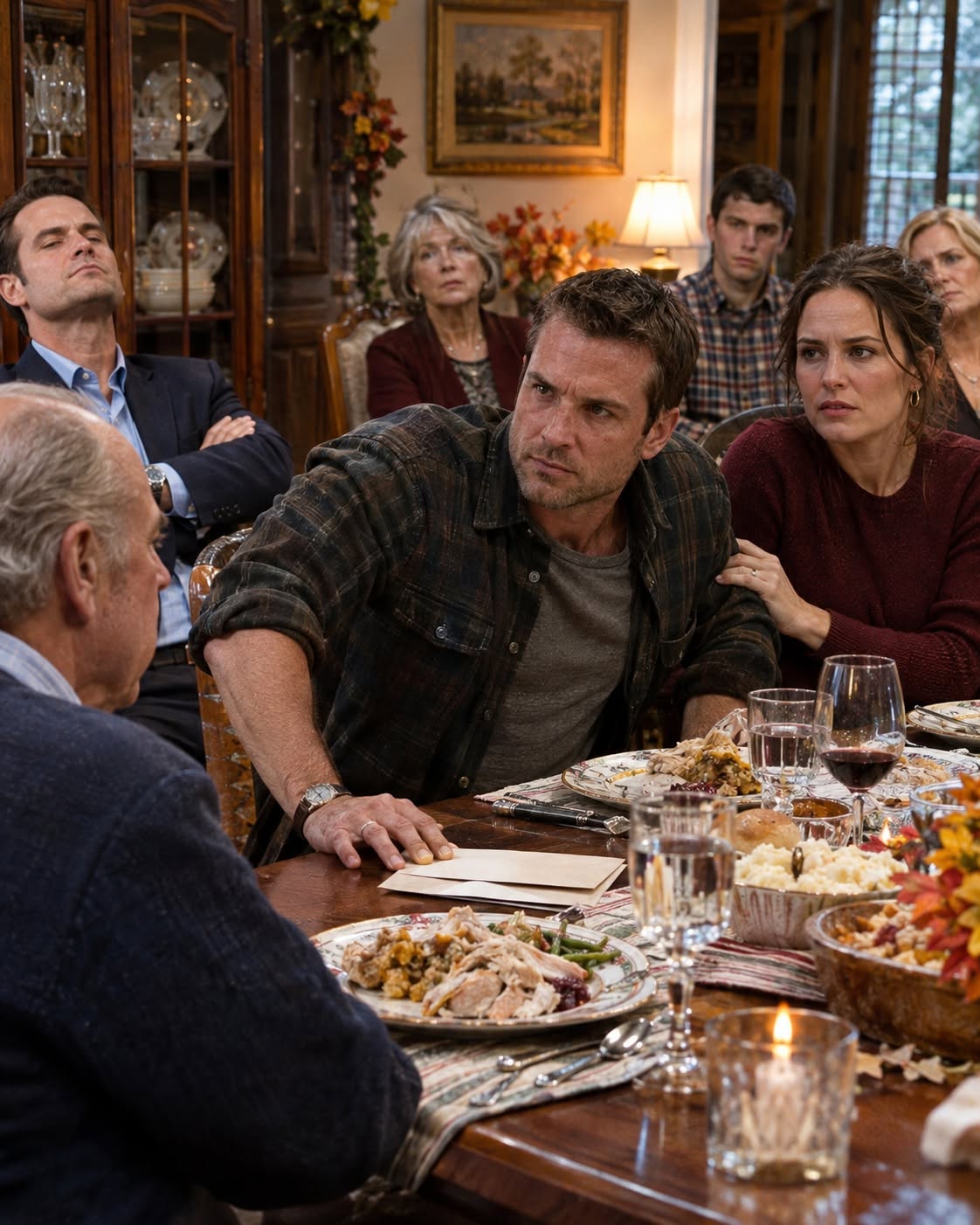
My mother picked up the letter, and for a moment, I thought she was going to put it back down.
Instead, she unfolded it carefully, her hands trembling as she read the first few lines.
Then her face went pale.
“Robert,” she whispered, looking at my father. “Is this true?”
My father stood so abruptly that his chair scraped against the floor.
“Give me that.”
But my mother held the letter tighter.
“No. Let me finish.”
Everyone at the table stopped eating. My sister, Lauren, looked between them, confused. Mark’s smug expression slowly disappeared.
My wife squeezed my hand beneath the table.
I had never seen my mother look at my father like that before. She wasn’t afraid of making him angry anymore. She was looking at him like she had just discovered she had spent forty years living beside a stranger.
The letter was dated April 14, 1998.
My aunt had written:
“Robert, I have spoken with the school, and they confirmed that David has been accepted. I am more than happy to cover his tuition, books, and living expenses for the first two years. He has a gift for design, and I don’t want him to lose this opportunity because of money. Please tell him to contact me. I have already sent him three letters, and I am beginning to worry that he thinks I have forgotten my promise.”
My mother stopped reading.
“Three letters?” she asked.
My father said nothing.
I felt something inside me tightening.
I remembered those years vividly. I remembered sitting on the edge of my bed with the acceptance letter in my hands, trying to imagine a life in California. I remembered my father walking into my room and telling me Aunt Eleanor had called.
“She can’t afford it anymore,” he had said. “Things changed. Don’t get your hopes up.”
I had cried that night, but I had stopped crying by the following morning.
I had learned early that disappointment was something you swallowed quietly in our house.
My mother continued reading.
The next letter was dated six weeks later.
“Robert, I don’t understand why David hasn’t responded. The school says they need confirmation by the end of the month. I have the money ready. If he has changed his mind, I wish he would tell me himself. I don’t want to make decisions for him, but I would never forgive myself if he lost this chance because he believed he couldn’t afford it.”
My mother lowered the paper.
“Why would you do this?”
My father looked around the table, searching for someone to rescue him.
“It’s not as simple as you’re making it.”
“Then explain it,” I said.
He pointed at me.
“You were young. You didn’t understand what was happening. You were going to leave, and I needed help at the business.”
I almost laughed, but there was nothing funny about it.
“So you lied to me?”
“I was trying to protect the family.”
“From what? Me going to school?”
“You would have left us with no one to help. The generator business was struggling. Your sister was still in college. I had responsibilities.”
Lauren stared at him.
“Dad, you told me David didn’t have the grades to get into that program.”
I turned toward her.
“What?”
She looked embarrassed, as if she had suddenly realized she was part of something she never understood.
“He told me you weren’t accepted. He said you were disappointed and that it would be better not to bring it up.”
My father slammed his hand against the table.
“Enough! You people are acting like I committed a crime!”
Aunt Eleanor, who had been standing near the doorway, finally spoke.
“You committed something worse, Robert. You stole a choice from your own son.”
The room fell silent.
My father looked at her.
“You should stay out of this.”
“I stayed out of it for twenty-six years because you told me David wanted nothing to do with me. You told me he was angry about the money and embarrassed about his failure. I believed you because you were his father.”
She shook her head.
“I have spent years wondering why he stopped writing. I thought I had done something wrong. Now I find out you were the one answering questions he never received.”
My mother started crying.
Mark, who had spent the entire evening talking about his financial problems, suddenly leaned back.
“This is a family issue. Maybe we should deal with it privately.”
I turned toward him.
“Funny how you want privacy now. You had no problem discussing my building, my finances, and my future in front of everyone.”
He frowned.
“That’s different.”
“No. It isn’t.”
My father grabbed the letters from the table, but my mother caught his wrist.
“Don’t you dare.”
He looked at her in disbelief.
She had never spoken to him that way in front of anyone.
“Put them down, Robert.”
For a moment, he looked like he might shout again. Then he dropped the letters.
I gathered them slowly, one by one.
My hands were no longer shaking.
“I’m not buying your lake property,” I said.
My father stared at me.
“David, you’re making a terrible mistake.”
“No. I made one twenty-six years ago when I believed you. I’m not making another one.”
I took my wife’s hand.
Lauren stood up.
“David, wait.”
I paused.
She looked at me with tears in her eyes.
“I didn’t know. I swear I didn’t know about the school. I thought you had chosen to stay.”
I believed her. But believing her didn’t erase the years.
“I know you didn’t,” I said quietly. “But I need some time.”
Then I walked out.
This time, no one called me selfish.
No one followed me to the driveway.
And for the first time in my life, I didn’t turn around to see whether my father was watching.
The weeks that followed were harder than I expected.
I had imagined that learning the truth would make me feel free. Instead, I felt like I had lost something all over again. I would be working in my shop, painting lettering on a truck or designing a storefront, and suddenly I would remember the school I never attended.
I wondered what my life might have looked like.
Would I have become a designer in Los Angeles?
Would I have worked for a studio?
Would I have traveled?
Would I still have met my wife?
The questions had no answers, and that was the cruelest part.
My father called every few days.
At first, he left angry messages.
“You’re turning your mother against me.”
“You’re letting your aunt manipulate you.”
“You’ve always been too sensitive.”
Then the tone changed.
“David, we need to talk. The business is in trouble.”
I stopped answering.
My wife, Rachel, sat beside me one night while I listened to the latest voicemail.
“Do you want to call him back?” she asked.
“No.”
“Then don’t.”
I stared at my phone.
“I keep thinking he might apologize.”
Rachel rested her head against my shoulder.
“An apology would be nice. But you can’t build your life around waiting for one.”
That sentence stayed with me.
Meanwhile, Lauren called.
She didn’t ask me to forgive our father. She didn’t try to explain him away.
She simply asked if we could meet.
We met at a coffee shop halfway between our homes. She arrived looking exhausted. For the first time since we were kids, she didn’t seem like the daughter who could do no wrong.
“I’ve been thinking about what you said,” she began.
I waited.
“Dad always told me you were irresponsible. That you had big dreams but no discipline. Whenever you talked about your shop, he said you were lucky to have a hobby that paid the bills.”
She looked down at her cup.
“I believed him. I think I used to repeat those things because it made me feel better about myself.”
“Why?”
“Because he was proud of me. And I didn’t want to lose that.”
I couldn’t blame her for wanting our father’s approval. I had wanted it too.
She took a breath.
“I’m sorry, David. I should have respected what you built. I should have stopped laughing when Mark made those comments. I didn’t.”
For the first time, her apology didn’t feel like another request for me to make things easier for everyone.
“Thank you,” I said.
We didn’t hug. We didn’t magically become close again.
But we talked for almost two hours.
And when we left, it felt like a door had opened a little.
Mark, however, wasn’t interested in repairing anything.
A month later, he called me directly.
“Look, I know dinner got awkward,” he said. “But I have a serious proposal.”
I almost hung up.
“What proposal?”
He explained that his business needed a cash injection. He had an opportunity to expand into a new market, but his bank was refusing to extend credit without collateral.
He wanted me to invest in his company instead of my father buying him time.
I listened until he finished.
Then I asked, “Have you actually reviewed your numbers?”
“Of course.”
“Have you hired an accountant to evaluate the business?”
There was a pause.
“Why would I need to do that? I know what I’m doing.”
“Then you don’t need my money.”
He laughed.
“You’re still holding a grudge.”
“No, Mark. I’m holding onto my building.”
I hung up.
Two months later, I learned through Lauren that Mark’s business had been in trouble far longer than he admitted. He had taken out several loans, used new credit to pay old debts, and had been counting on my property as a last-minute rescue.
The expansion he described wasn’t a real opportunity.
It was a desperate attempt to keep the business from collapsing.
My father had known about the debt. He had hoped that if I agreed to help Mark, the pressure would disappear. Then, when the business continued to struggle, he could ask me to help him with his own debts.
The lake property was only the beginning.
I didn’t feel triumphant when I learned the truth.
I just felt tired.
The generator business my father had spent his life building was also falling apart. His customers were aging, his contracts were shrinking, and he had refused to adapt to the changing market. He had borrowed against equipment and property to keep things running, telling himself that next year would be better.
Now next year had finally arrived, and there was nowhere left to hide.
My mother called me one afternoon.
“Your father wants to see you.”
“Why?”
“He says he needs to talk.”
“Does he want to apologize?”
She hesitated.
“I don’t know.”
I agreed to meet him, but not at his house.
We met at a small diner near his business.
He arrived looking older than I remembered. His shoulders were slumped, and his hands trembled slightly as he unfolded the menu.
For several minutes, neither of us spoke.
Finally, he said, “I never thought you’d find those letters.”
I looked at him.
“That’s what you want to talk about?”
He sighed.
“I made mistakes.”
“You made a decision about my life without asking me.”
“I thought I was doing what was best.”
“Best for whom?”
He looked out the window.
“I was afraid.”
“Of what?”
“Of losing you.”
I stared at him.
“You didn’t lose me because I wanted to go to school. You lost me because you lied.”
His eyes filled with tears, but I couldn’t tell whether he was crying because he regretted what he had done or because he was finally facing the consequences.
“I was afraid the business would fail,” he said. “I was afraid I’d have nothing to leave you boys and girls. I wanted you to stay. I thought if I kept you close, everything would work out.”
“You weren’t keeping me close. You were keeping me trapped.”
He didn’t answer.
I leaned forward.
“Do you know what I needed from you back then? I didn’t need you to pay for my dreams. I needed you to believe I was capable of having them.”
He covered his face with his hands.
For the first time, I saw my father not as the man who had controlled every decision I made, but as someone who had spent his life being terrified of losing control.
That didn’t excuse him.
But it helped me understand.
“I can’t fix your business,” I said. “And I won’t buy your property. I won’t sign anything that puts my shop at risk.”
He nodded slowly.
“I understand.”
I wasn’t sure he did.
Then he said something I hadn’t expected.
“Your aunt was right. I stole your choice.”
I sat quietly.
It was the closest thing to an apology I had ever heard from him.
But it wasn’t enough to undo the past.
And I wasn’t going to pretend it was.
The following spring, my father sold the generator business.
He had to let go of the building, the equipment, and most of the contracts. The sale wasn’t glamorous, but it allowed him to pay off the debts he could and avoid dragging my mother into a financial disaster.
Mark’s company eventually closed.
Lauren and Mark separated not long after. She told me she had spent years believing she had to defend him because our father always treated him like the son he wished he had. Eventually, she realized she had been carrying someone else’s expectations at the expense of her own life.
She moved into a small apartment and started working again.
My mother stayed with my father, but she began making her own decisions. She took a part-time job at a community garden and started visiting Aunt Eleanor every week.
As for me, I never went back to my father’s business.
I didn’t need to.
My sign shop kept growing slowly. I hired one apprentice, then another. I began designing murals for local restaurants and lettering vintage cars. Some months were difficult. Some jobs barely covered expenses.
But every time I unlocked the doors in the morning, I remembered that the building belonged to me.
Not because my father had given it to me.
Not because anyone had rescued me.
Because I had earned it.
One Saturday, Aunt Eleanor came by the shop carrying a small wooden box.
“I thought you should have these,” she said.
Inside were the original letters, the school acceptance notice, and a photograph of me at seventeen, standing beside a drawing I had made of a storefront sign.
I stared at the picture.
“I don’t remember you taking this.”
“You were proud of that design,” she said. “You showed it to me about twenty times.”
She smiled sadly.
“I never stopped believing you could do something with it.”
I asked her why she had kept everything.
She shrugged.
“Because I knew one day you might need to see the truth for yourself.”
That evening, I framed the photograph and hung it in my office.
Not as a reminder of what I had lost.
But as a reminder of what I had survived.
A year later, I was asked to paint a mural at a local youth center. The project included a wall where teenagers could display their artwork and a small workshop where they could learn basic design and sign painting.
During the opening, a boy approached me.
He was about sixteen, carrying a sketchbook with torn edges.
“Do you think I could actually make money doing this?” he asked.
I looked at his drawings.
They weren’t perfect, but they were full of imagination.
“Absolutely,” I told him. “But don’t let anyone convince you that your dream has to look like theirs.”
He smiled.
I gave him my old brushes and showed him how to prepare a surface for lettering.
For a moment, I thought about the letters I had found, the opportunity I had lost, and the years I had spent trying to earn approval from someone who never understood what I wanted.
Then I realized something.
My father had taken an opportunity from me, but he hadn’t taken my ability to create one.
I couldn’t recover the years I had lost.
I couldn’t force him to become the father I had needed.
And I couldn’t change what happened to my family.
But I could decide what happened next.
That night, Rachel and I sat outside the shop, watching the sunset spill across the painted windows.
“Do you ever wish you had gone to California?” she asked.
I thought about it for a long time.
“Sometimes,” I admitted. “But I don’t spend my life wondering anymore.”
She took my hand.
“Why?”
I looked at the building, at the lights inside, at the tools I had spent years learning to use.
“Because I finally stopped asking permission to be proud of myself.”
And for the first time, that felt like enough.
The letters had taught me something I wished I had learned much earlier.
Family is not supposed to demand that you sacrifice your future to protect someone else’s choices.
Love doesn’t require you to surrender your independence.
And sometimes, the most courageous thing you can do isn’t forgiving someone immediately, or saving everyone who asks.
Sometimes, it’s simply refusing to let someone else’s fear become the blueprint for your life.