I was halfway into my F-16 cockpit when Colonel Arthur Vance stopped beneath the scorching Arizona sun
Part 2
General Marcus Sterling walked into the provost marshal’s office like he owned the building.
Military lawyers followed him in dark suits carrying folders thick enough to make the room feel smaller.
Nobody spoke at first.
The only sound was the air conditioner rattling overhead.
Sterling looked at Agent Hayes.
“This investigation is now being transferred.”
Hayes didn’t move.
“No.”
He blinked.
“You may not understand the implications of classified defense logistics.”
“I understand them very well.”
“This concerns national security.”
“So does attempted murder.”
The general’s eyes moved to me.
For the first time, I saw something behind his expression.
Not anger.
Recognition.
He knew exactly who I was.
And he knew exactly what I had found.
“You filed the Inspector General complaint,” he said.
I looked at him.
“You knew?”
“We knew.”
The room seemed to tilt.
Derek stared at me.
Dan’s face went pale.
Sterling continued.
“You should have understood that some matters are larger than a junior officer’s career.”
“I was told to report corruption.”
“You were told to use judgment.”
“I did.”
His lawyer stepped forward.
“General Sterling’s authority supersedes this local inquiry.”
Hayes held up the federal warrant.
“Not when federal crimes are involved.”
Sterling laughed once.
“You think paperwork protects you?”
I remembered Vance saying almost the same thing that morning.
The irony was so sharp it almost steadied me.
I looked at Hayes.
Then at Derek.
Then back at Sterling.
“There is something you don’t know.”
The general’s expression hardened.
“What is that?”
I sat down at the table.
Then I placed my hands flat against the metal surface.
“When I got into that cockpit, I knew there was a chance you would try exactly this.”
No one moved.
“So I prepared a contingency.”
Vance spoke for the first time.
“What contingency?”
I looked at him.
“The one that starts with the photographs Dan took.”
Dan’s eyes widened.
I continued.
“Then it includes Toby Renfro’s confession.”
Sterling’s face changed slightly.
“And then,” I said, “it includes every logistics authorization bearing your signature.”
The room went silent.
One of Sterling’s lawyers stepped toward me.
“Those documents are classified.”
“I know.”
“You had no authority to transmit them.”
“I didn’t.”
Hayes slowly turned toward me.
“What did you do?”
I looked at the general.
“I sent them to someone who did.”
Sterling’s jaw tightened.
“Who?”
I finally told them.
“The father of Lieutenant Valerie Cross.”
Nobody in the room understood why the name mattered.
I did.
Valerie was my friend.
She had flown beside us for years.
Then a grounding accident ended her career and left her furious, grieving, and determined to understand why so many maintenance irregularities had been ignored.
Her father, Senator Thomas Cross, sat on the Senate Armed Services Committee.
He had been asking questions for months.
I had trusted him with a truth that could no longer be buried.
The photographs.
The serial numbers.
The confession.
The authorization logs.
Everything.
Derek stared at me.
“When did you send them?”
“Before I started the engine.”
Vance stepped forward.
“You’re lying.”
I shook my head.
“No.”
I had uploaded the evidence in layers, through channels that could not be quietly erased once received.
I had done it while sitting alone in that cockpit, listening to the engine spool and wondering whether I was about to die.
Sterling’s lawyer began whispering urgently into his phone.
Hayes watched him.
Then her own phone vibrated.
She answered.
“Hayes.”
She listened.
Her expression changed.
“Understood.”
She ended the call.
“The committee received everything.”
Sterling looked at her.
Hayes continued.
“Emergency holds have been authorized on the implicated logistics accounts.”
Vance stepped backward.
The lawyer’s face had gone white.
Hayes’s phone vibrated again.
Then again.
“Federal investigators have entered facilities tied to the supply network.”
Sterling slammed a hand against the table.
“You have no idea what you’re doing.”
Hayes stared at him.
“I know exactly what I’m doing.”
Another call came through.
She answered.
Then looked directly at Sterling.
“Swiss authorities have been notified.”
That was the moment I watched the general understand that the walls were gone.
For years, men like him had survived because every person who knew the truth believed the truth needed permission to matter.
He had built his power on silence.
He had mistaken silence for loyalty.
He had never imagined one frightened captain could make that silence impossible.
Sterling turned toward me.
“You’ve ruined everything.”
I stood.
“No.”
I looked at him.
“You ruined it yourself.”
His face twisted with fury.
“You think you’re a hero?”
“No.”
I shook my head.
“I think I was scared.”
That stopped him.
“I was scared before takeoff.”
I looked toward the window where the first traces of evening were beginning to stain the desert sky.
“I was scared because I knew someone wanted me dead.”
My voice dropped.
“And I was even more scared because I knew how many people had already decided that truth was too inconvenient to protect.”
Hayes stepped beside me.
“General Marcus Sterling, you’re under federal arrest.”
Two agents moved in.
Sterling stared at them.
Then at me.
Then at the photographs on the table.
He finally understood that there was nothing left to threaten.
Vance tried to move toward the door.
Hayes turned.
“Colonel Arthur Vance.”
He stopped.
“You’re under arrest for conspiracy and attempted murder.”
The handcuffs clicked shut.
His shoulders dropped.
I expected satisfaction.
Instead, I felt tired.
Not victorious.
Tired.
Because the people who had almost killed me were standing in restraints, but Lieutenant Valerie Cross was still grounded.
The good mechanics who had warned us had still been ignored.
The junior officers who had noticed discrepancies had still been told to stay quiet.
And there was no clean ending to a system that had gone rotten quietly.
The real ending would take years.
Audits.
Trials.
Records.
Depositions.
Names.
But that night, at least, the truth was no longer trapped inside a file.
Part 3
I walked back onto the runway at sunset.
The flames were gone.
The foam had been cleared.
The F-16 stood silent beneath the fading light, scarred but still recognizable.
Dan came to stand beside me.
“You know,” he said, “most people would have just refused to fly it.”
“I considered that.”
“You could have walked away.”
“I know.”
He looked at me.
“Why didn’t you?”
I watched the sun sink behind the mountains.
“Because walking away would have left them the question.”
“What question?”
“Who would they try next?”
Dan didn’t answer.
He didn’t need to.
Derek joined us a moment later.
He had that exhausted grin pilots get after surviving something they don’t quite know how to explain.
“You’re officially the worst wingman I’ve ever had.”
I laughed.
“That sounds almost affectionate.”
“It isn’t.”
For the first time all day, I smiled without forcing it.
Then my phone rang.
It was Valerie’s father.
I stepped away from the others and answered.
His voice was tired.
“Captain.”
“Senator.”
“I just wanted you to know something.”
“What?”
“My daughter never stopped believing there was a reason you kept asking questions.”
I closed my eyes.
“Tell her I haven’t forgotten her.”
“I will.”
He paused.
“She also told me something years ago.”
“What?”
“She said the best people in uniform are not the ones who never break.”
I waited.
“They’re the ones who keep doing the right thing after they realize the institution can break too.”
I looked across the runway.
The last sunlight touched the canopy of the aircraft.
For weeks, I had thought the enemy was the person who wanted me dead.
That was only part of it.
The deeper danger was the idea that fear should make you silent.
That rank should make you obedient to corruption.
That protecting your career mattered more than protecting the people beside you.
I had almost believed that myself.
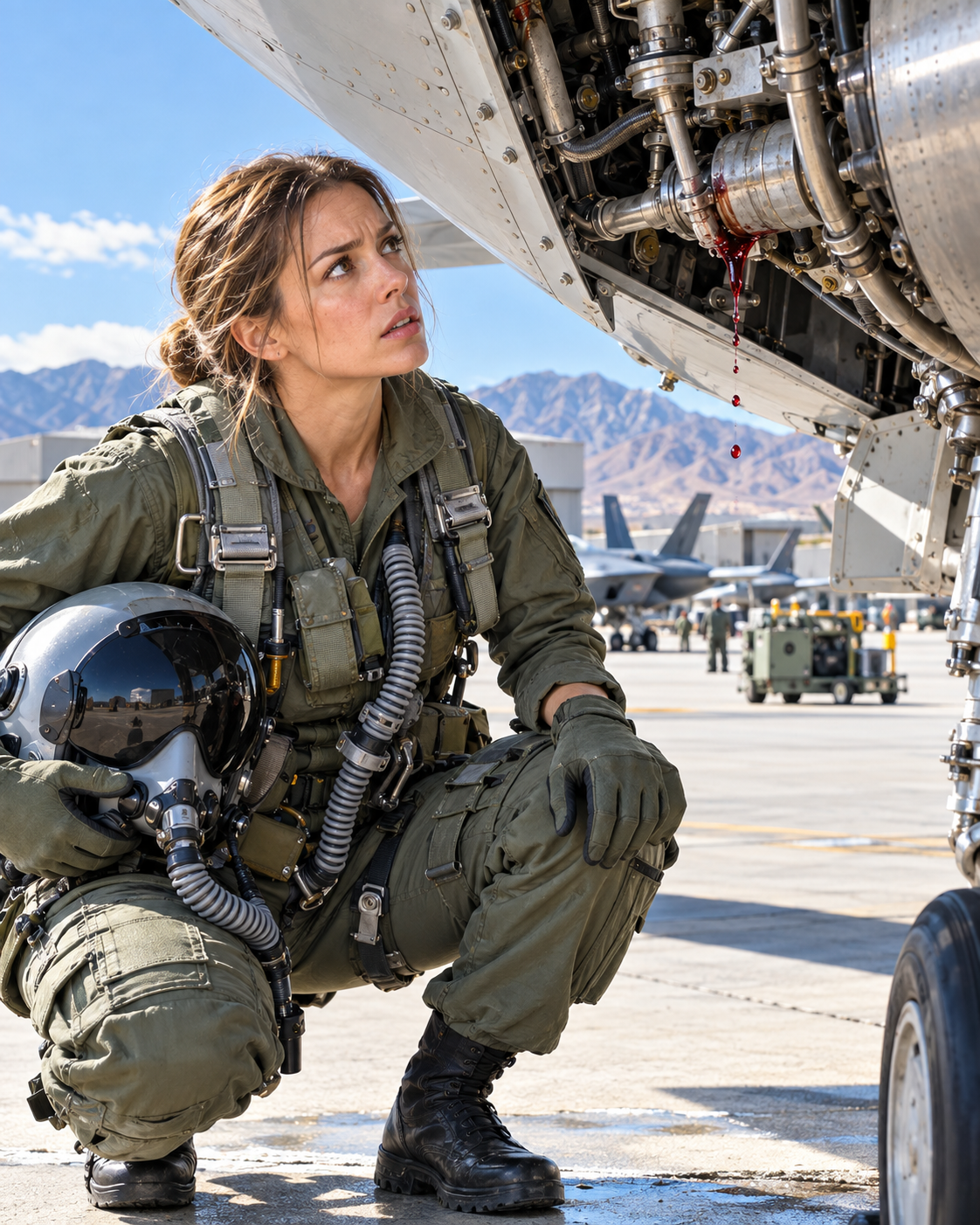
Then I remembered the sliced hydraulic line.
The tiny red gleam beneath my inspection light.
The moment I realized someone had chosen a method that would make my death look accidental.
It changed something in me.
Not because it made me fearless.
It made me precise.
From then on, I understood that courage was not the absence of terror.
It was refusing to let terror make your decisions for you.
Months later, after hearings began and the investigation spread across contractors, depots, and overseas accounts, I returned to the flight line for the first time without an armed escort.
The runway looked exactly the same.
Same heat.
Same wind.
Same mountains.
Different feeling.
A younger pilot approached me.
“Captain?”
I turned.
“Yes?”
“I heard what happened.”
I almost groaned.
Stories grow larger after people retell them.
He looked nervous.
“I wanted to ask you something.”
“What?”
“How did you know something was wrong?”
I glanced at the aircraft.
“I didn’t.”
He looked confused.
“I just noticed something nobody else noticed.”
“That’s it?”
“That was enough.”
He nodded slowly.
Then he looked at me.
“How do you know when to trust your instincts?”
I thought about every alarm in my head that morning.
Every little detail I almost dismissed.
Vance’s stare.
The clean inspection.
The fresh fluid.
The binoculars in the tower.
The warning I couldn’t prove.
“You don’t always know,” I said.
“You listen anyway.”
He smiled faintly.
I watched him walk back toward his aircraft.
Then I stood there alone.
The desert wind moved over the concrete.
It lifted a little dust and carried it across the runway.
For a moment, I could almost hear the alarms again.
Almost smell the smoke.
Almost feel the engine vibrating through the cockpit as I waited for the trap to reveal itself.
I thought about how close I had come to dying in a fireball nobody would have understood.
I thought about how easy it would have been for the official story to say equipment failure, pilot error, tragic accident.
And I realized that the most important thing I had done that day was not save myself.
It was refuse to let a lie become history.
I looked at the runway until the last light disappeared.
Then I put on my helmet and walked back toward the hangar.
Not because I had won.
Not because the system was suddenly clean.
And not because I believed powerful people could never hurt ordinary ones again.
I walked back because there were still people worth protecting.
There were still questions worth asking.
There were still young pilots who deserved to trust the machines beneath them.
And there were still friends like Valerie who deserved the truth, even when the truth was expensive.
That night, I learned something I will carry for the rest of my life.
A lie does not become truth because powerful people sign it.
A crime does not become duty because someone stamps it classified.
And fear does not become wisdom just because everyone in the room is too frightened to speak.
Sometimes all it takes to break a conspiracy is one person willing to look carefully at a tiny thing that does not belong.
A red glimmer beneath a wing.
A signature on a page.
A name repeated too many times.
A silence that lasts too long.
I used to think survival meant getting out alive.
Now I know it means something harder.
It means walking away without surrendering the part of you that knew something was wrong.
The sun disappeared behind the Arizona mountains, and the runway finally went dark.
I stood there for one last second, listening to the wind move through the empty space where a fire had almost taken my life.
Then I turned toward the lights of the base.
And for the first time, I did not feel like I was walking away from danger.
I felt like I was walking toward the truth.