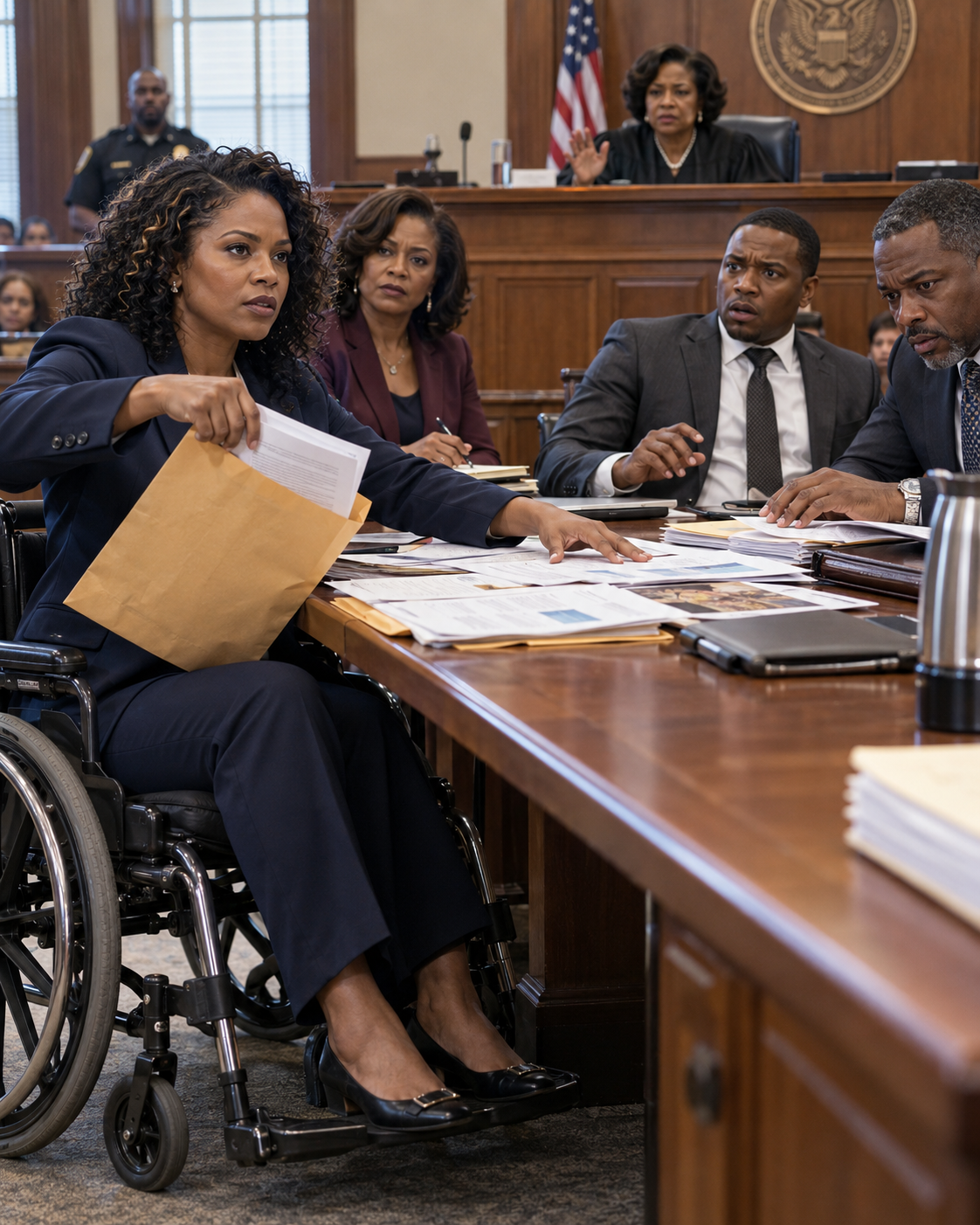
I sat in my wheelchair beneath the cold lights of the county courtroom while Matthew smirked across the aisle
Matthew was still holding the envelope when the choir director called the children inside.
Liam looked back at us through the glass doors, confused by the way his father and I had suddenly gone silent.
I forced a small smile and waved.
“Go ahead,” I told him.
“I’ll be right behind you.”
He nodded and disappeared into the crowded hallway.
I turned back to Matthew.
“What is that?”
His fingers tightened around the envelope.
“I found it in the storage room when I was cleaning out the house.”
“You could have thrown it away.”
“I almost did.”
Something about the way he said it made my stomach tighten.
I reached for it, but he didn’t let go immediately.
Then he released it.
The paper felt brittle beneath my fingers.
My name was written across the front in handwriting I knew instantly.
My father’s.
My father had been dead for eleven years.
I stared at the envelope without opening it.
For several seconds, the school hallway seemed to fade around me.
“Where did you find this?”
“In the old filing cabinet in the garage.”
I looked at him.
“Why would my father have something in our house?”
Matthew swallowed.
“Because he gave it to me.”
The words landed harder than they should have.
“When?”
“Before we got married.”
I felt something inside me shift.
Matthew looked toward the auditorium doors, then back at me.
“I was supposed to give it to you when you turned forty.”
I almost laughed because the alternative was crying.
“You’ve had this for three years?”
He lowered his eyes.
“Yes.”
“Why didn’t you?”
“I was afraid.”
That answer angered me more than any excuse could have.
“You were afraid to give me a letter from my dead father?”
“No.”
He rubbed his jaw.
“I was afraid of what the letter would change.”
I stared at him until he finally looked at me.
Then he said the words I never expected to hear.
“Your father knew about Sterling Crest.”
My hand went cold.
“What do you mean?”
“He knew Matthew Construction was struggling.”
“That’s not news.”
“He knew your money was keeping the company alive.”
I looked down at the envelope.
“And?”
Matthew’s voice dropped.
“He knew I had plans to separate the business from you if things went wrong.”
For a moment, I couldn’t breathe.
“You planned this before I was injured?”
He shook his head.
“Not exactly.”
“Then explain.”
He looked ashamed.
“Your father confronted me years ago.”
The hallway seemed suddenly too narrow.
“He told me that if I ever treated you like an investment instead of my wife, he would make sure you knew everything.”
I opened the envelope.
Inside was a single letter and several folded pages.
My father’s handwriting filled the first page.
Claire,
If you are reading this, something has gone wrong enough that I no longer trust the people around you to tell you the truth.
I stopped reading.
My vision blurred.
Matthew said nothing.
I continued.
Your husband is not a monster, but fear can turn a decent man into someone capable of terrible choices.
I folded the page slightly and stared at those words.
That was my father.
He had never believed people were simply good or bad.
He believed fear was where people revealed themselves.
I read on.
You have always been stronger than you think, but never confuse strength with enduring everything someone does to you.
Your money is yours.
Your work is yours.
Your life is yours.
If someone loves you, they should not require you to become smaller so they can feel large.
Tears slipped down my face.
Matthew looked away.
The next page contained copies of financial records.
Old ones.
Records from years before my accident.
I scanned them quickly.
There were transfers from our joint account into a company that had eventually become Sterling Crest.
But there was something else.
A handwritten note from my father was attached to one statement.
He had written a date.
And beside it were four words.
Ask Matthew about the land.
My heart began pounding.
“What land?”
Matthew closed his eyes.
“I knew you’d find that.”
“Find what?”
“The property your father left you.”
I stared at him.
“My father didn’t leave me property.”
“He did.”
My mouth went dry.
“Where?”
“Outside Cedar Ridge.”
I knew the place.
A wooded parcel my father had talked about for years.
He used to say it was where he wanted to build a small cabin after retirement.
After he died, I had asked Matthew whether anything remained in my father’s estate.
He told me there was nothing significant.
“Why didn’t you tell me?”
“Because the property had debt attached to it.”
“So you sold it?”
“No.”
His voice cracked.
“I put it into Sterling Crest.”
The hallway tilted.
I gripped my cane.
“Without telling me?”
“Yes.”
“How much was it worth?”
He didn’t answer.
“Matthew.”
“Nearly eight hundred thousand dollars.”
I stared at him.
For years, I had believed my father’s final gift had been a watch sitting in my dresser.
Instead, there had been land.
And Matthew had used it.
But the letter contained one final page.
I unfolded it with trembling fingers.
Claire,
There is one thing I could not protect you from.
I discovered that the land was not the only thing attached to your inheritance.
There is an old trust.
If you are reading this, ask an attorney to find it.
Do not ask Matthew.
I looked up slowly.
Matthew’s face had gone pale.
“You knew.”
He nodded.
“I knew there was a trust.”
“How much?”
“I don’t know.”
“You knew enough to hide it.”
“I knew enough to be scared.”
The choir music began inside the auditorium.
Children’s voices floated through the doors.
For several seconds, neither of us spoke.
Then Matthew said something that made my anger disappear for one terrible second.
“I didn’t start hiding things because I hated you, Claire.”
I looked at him.
“I started because I was terrified you would discover how badly I had failed.”
“That doesn’t excuse it.”
“I know.”
His eyes filled with tears.
“And when you got hurt, I saw how much you needed me, and I hated myself for feeling trapped by it.”
I said nothing.
He continued.
“I convinced myself that if I controlled the money, the house, the custody agreement, everything would be easier.”
“Easier for whom?”
He looked down.
“For me.”
That was the truth.
Not a satisfying truth.
Not a heroic confession.
Just an ugly human one.
Fear had made him selfish.
And selfishness had become deception.
The next morning, I took the letter to Laura.
She read it twice.
Then she looked at me.
“Claire, your father was right about one thing.”
“What?”
“We need to find the trust.”
Within forty-eight hours, Laura had located the estate documents.
The trust existed.
It had been established almost twenty years earlier.
And the beneficiary was me.
The value was far greater than I expected.
But the trust contained something else.
A condition.
If I became permanently disabled before the age of forty-five, the trust would provide additional funds for my long-term care and the education of my children.
I sat in Laura’s office staring at the document.
My father had planned for a future I never imagined.
He had somehow prepared for the possibility that life might take something from me.
But Matthew had known.
And he had still tried to convince a judge that I was financially irresponsible and incapable of providing a stable home.
Laura closed the folder.
“You don’t have to use this to destroy him.”
“I know.”
“You can use it to rebuild your life.”
I looked at her.
For the first time, I understood the difference.
Revenge would have kept me tied to Matthew.
Rebuilding would set me free.
The legal process continued for months.
Matthew had to disclose every account, every property, every business interest.
Some assets were recovered.
Others were sold.
The construction company survived, but its structure changed.
I refused ownership because I no longer wanted a business that reminded me of every lie.
The family house sold in late autumn.
On the final day, I rolled through the empty rooms one last time.
The kitchen still had the small scratch near the island where Liam had once dropped a baseball.
The staircase still carried the faint pencil marks showing how tall Chloe had grown.
I stopped in the doorway of our bedroom.
For nineteen years, I had thought that room contained my marriage.
Now I realized it had only contained the place where my marriage happened.
There was a difference.
Outside, Matthew was loading boxes into his truck.
He came inside when he saw me.
“Do you want to say goodbye?”
I looked around.
“I already did.”
He nodded.
Then he handed me a small wooden box.
“What is this?”
“Your father’s.”
Inside was his old watch.
The same watch I had always believed was the only thing left to me.
Beneath it was a tiny key.
I looked at Matthew.
“What does this open?”
He shook his head.
“I don’t know.”
For once, I believed him.
Months passed.
Our children adjusted slowly.
There were awkward dinners.
Missed pickups.
School meetings where Matthew and I sat on opposite sides of the same table.
There were moments when Liam was angry at me for leaving the house.
There were moments when Chloe cried because she wanted everything to go back to the way it was.
I never told them their father had lied.
I told them adults sometimes make choices they regret.
I told them love does not mean pretending those choices never happened.
And I told them they were not responsible for repairing what adults had broken.
One evening, Liam asked me something while we were washing dishes.
“Mom, are you happier now?”
I stopped.
The question hurt because I didn’t know how to answer it.
Then I said, “I’m learning how.”
He nodded as if that made perfect sense.
Maybe children understand recovery better than adults do.
They don’t demand that you become who you were.
They just want to know whether you are still there.
My physical therapist was right, too.
Struggle did not mean never.
It meant not yet.
The first time I walked ten steps with a cane, I cried.
Not because the distance was impressive.
It wasn’t.
Ten steps would have meant nothing to the woman I used to be.
But to me, then, it was ten steps nobody could take away.
The first time I walked into Chloe’s school without a wheelchair, she ran toward me.
She threw her arms around my waist and whispered, “I knew you could.”
I held her tightly.
“I didn’t.”
She pulled back.
“I did.”
I smiled.
“Then you were carrying some of my hope for me.”
She nodded seriously.
“I can do that.”
By spring, Matthew and I could stand in the same room without flinching.
We weren’t friends.
We weren’t enemies.
We were parents who had once loved each other and had failed each other in ways neither of us could erase.
One afternoon, he asked if he could talk.
We sat on a bench outside the children’s school.
He looked older.
Not dramatically.
Just honestly.
“I’ve been going to counseling,” he said.
I didn’t answer.
“I thought I needed to fix my business.”
He paused.
“I actually needed to fix myself.”
I looked at him.
He continued.
“I don’t expect forgiveness.”
“Good.”
A sad smile crossed his face.
“I deserved that.”
Then he handed me another envelope.
My stomach tightened.
“What now?”
“This one is from your father too.”
I didn’t take it.
“What does it say?”
“I don’t know.”
“Then why give it to me?”
“Because I finally understand that it was never mine to keep.”
I accepted it.
The handwriting was the same.
Claire,
If you have made it this far, then I hope you have learned what I wanted you to know before I died.
People will sometimes mistake your softness for weakness.
Let them.
You do not have to become cruel to prove you are strong.
Protect your peace.
Protect your children.
And never measure your worth by what your body can or cannot do.
I stopped reading.
There was one final sentence.
If Matthew is still beside you in any form, remember that forgiveness is not the same thing as trust, and trust is not the same thing as love.
I closed my eyes.
That sentence stayed with me for a long time.
Because forgiveness, I realized, wasn’t giving Matthew his old place in my life.
It was giving myself permission to stop carrying him inside my anger.
A year after the courtroom hearing, I sold the last property connected to Sterling Crest.
With part of the trust, I created education accounts for Liam and Chloe.
Another portion went toward adapting my new home.
The rest stayed invested for the future.
Not his future.
Not the future we once imagined.
Mine.
One evening, I sat on my porch while the children played in the yard.
Matthew had dropped them off and was standing beside his truck.
He hesitated.
Then he said, “Claire.”
I looked up.
“I finally understand why you never fought me the way I expected.”
I raised an eyebrow.
“You thought I was trying to punish you?”
“I thought you were trying to win.”
I looked at the children.
“No.”
I smiled faintly.
“I was trying to stop losing.”
He nodded.
Then he left.
I watched his truck disappear down the road.
For years, I had thought recovery meant getting back what I lost.
My marriage.
My body.
My old home.
My old life.
But none of those things were coming back.
And strangely, that no longer frightened me.
Because the woman sitting on that porch was not the woman Matthew had underestimated.
She was someone new.
Someone who had learned that dignity could survive betrayal.
That motherhood could survive divorce.
That a body could change without a person’s worth changing with it.
And that sometimes the most powerful thing you can do to someone who tried to control your life is simply build a life they no longer have access to.
That night, after the children went to bed, I opened my father’s final envelope again.
I noticed something I had missed before.
There was a small handwritten number in the corner of the page.
An address.
Not mine.
Not Matthew’s.
Not any property I recognized.
I searched it online.
It was an old commercial building downtown.
My pulse quickened.
I called Laura.
She answered on the third ring.
“Claire?”
“I think I found something.”
There was a pause.
“What?”
I stared at the address.
“I don’t know yet.”
Outside, the porch light flickered against the darkness.
For the first time, I wasn’t afraid of what the truth might cost me.
I was afraid of what it might reveal.
And somewhere in that old building, behind a door my father had apparently expected me to find one day, another piece of my life was waiting.
Maybe the story had never really been about what Matthew took from me.
Maybe it had always been about what my father had spent years trying to protect.
I folded the letter carefully and reached for my cane.
Then I stood.
Not perfectly.
Not easily.
But on my own.
And this time, when I took the first step into the dark hallway, I wasn’t walking away from my past.
I was finally walking toward the truth.