At the Sterling Vault, my husband watched his mother slide a $50,000 check toward my father and coldly told him to disappear
Part 2
For several seconds, nobody moved.
The waiter stood several feet away, holding a bottle of wine, completely unaware that the most important conversation in the room had nothing to do with dinner.
Julian finally whispered,
“Who is that?”
My father looked at him.
“Marcus Vance.”
Julian swallowed.
“I know who Marcus Vance is.”
“No,” Dad said quietly.
“I don’t think you do.”
Eleanor suddenly sat forward.
“Jonathan, this is getting ridiculous.”
Dad ignored her.
On the phone, Marcus was still waiting.
“Sir, should I notify legal?”
“Yes.”
“And security?”
“Yes.”
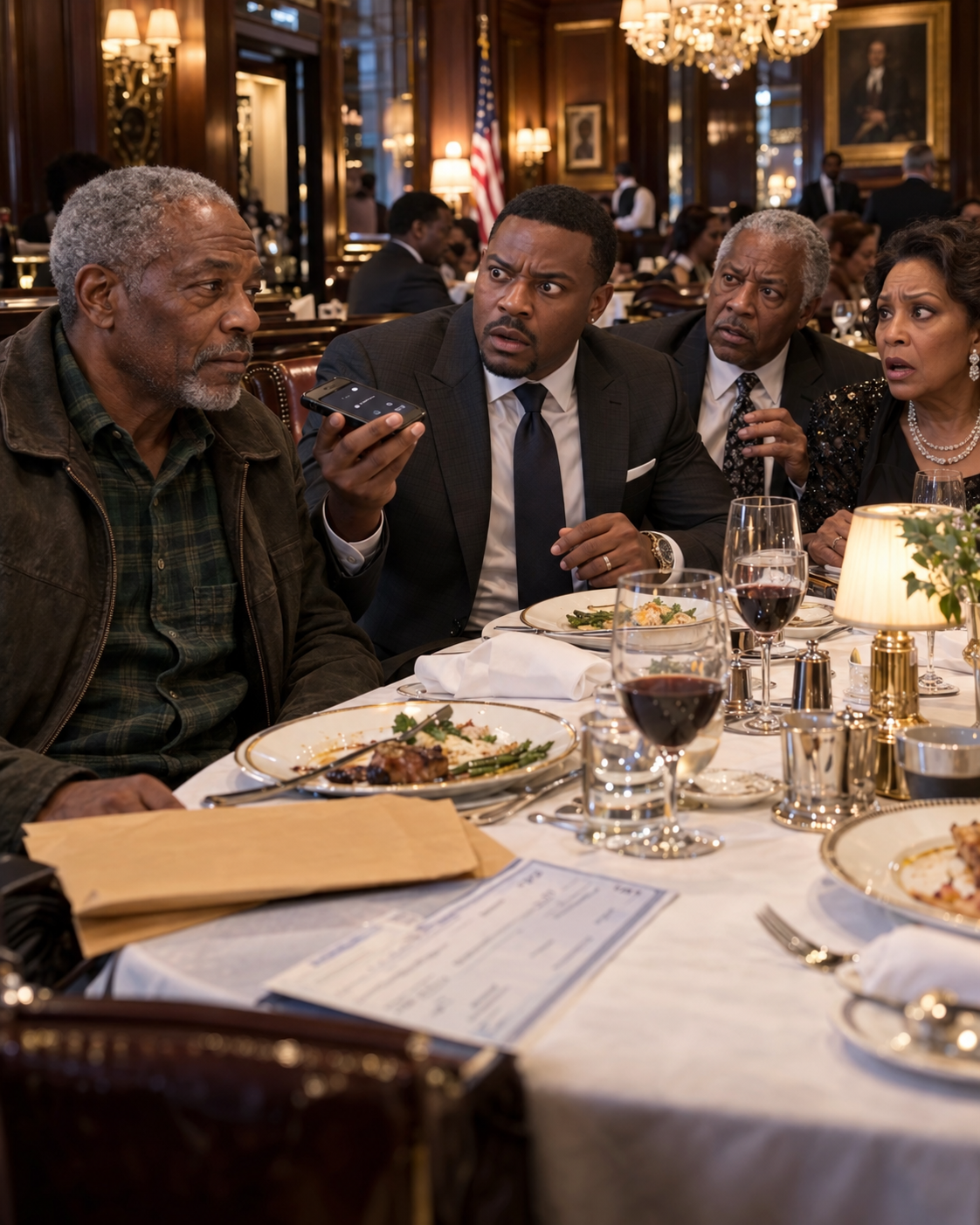
“And should I prepare the voting records?”
Jonathan paused.
“Bring everything.”
Julian’s face went white.
I looked from him to my father.
“What is happening?”
Dad looked at me.
There was something painful in his eyes.
Not pride.
Not triumph.
Regret.
“I never wanted you caught in this.”
I shook my head.
“Tell me.”
He exhaled slowly.
“Apex Logistics was founded by me.”
I stared at him.
The words did not make sense.
My father?
The man who grew tomatoes?
The man who drove a dented pickup?
The man who repaired his own roof?
He continued.
“I started the company thirty-one years ago with one truck, a rented warehouse, and a loan I almost couldn’t repay.”
Julian looked like someone had pulled the floor out from under him.
Dad glanced toward him.
“Over the years, the company grew.”
I whispered,
“How much of it do you own?”
Dad’s eyes dropped to the old phone in his hand.
“Enough.”
Marcus’s voice came through the speaker.
“Mr. Mercer, you still hold seventy-eight percent of the majority voting shares.”
Julian closed his eyes.
Eleanor’s hand flew to her mouth.
Lawrence looked at the floor.
I suddenly remembered all the strange details from my childhood.
The men in suits who occasionally visited Dad’s cottage.
The calls he took outside.
The old locked filing cabinet he never let anyone touch.
The weekends when he would disappear and return without explanation.
I had assumed they were contractors.
Business partners.
Friends.
My father had never told me.
He had spent decades deliberately staying out of the spotlight.
“I sold the company to the public years ago,” he said.
“But I kept control.”
Julian finally found his voice.
“Why didn’t you tell me?”
Dad looked at him.
“You never asked.”
That sentence destroyed him more than any accusation could have.
Eleanor abruptly stood.
“This is absurd.”
Dad looked at her.
“You offered my daughter and me a fifty-thousand-dollar payment to erase me from your family.”
“It was a misunderstanding.”
Lawrence immediately nodded.
“Yes, exactly.”
Eleanor grabbed the envelope.
“It was simply a test.”
I stared at her.
“A test?”
She forced a laugh.
“We wanted to see whether you were loyal to Julian.”
Dad’s expression did not change.
“Interesting.”
Lawrence leaned toward him.
“Jonathan, surely we can resolve this privately.”
Marcus spoke from the phone.
“There will be no private resolution.”
Everyone looked at the speaker.
Marcus continued,
“The document was drafted on Apex letterhead and presented as an executive expense.”
He paused.
“That constitutes unauthorized use of corporate assets.”
Julian looked at me.
“I didn’t write it.”
“You approved it,” I said.
He shook his head.
“I thought it was Eleanor’s idea.”
Eleanor turned sharply.
“Julian.”
He looked at her.
For the first time, I saw something in his face I hadn’t seen in months.
He was afraid.
Not of losing me.
Not of hurting me.
Of losing everything he had spent his life chasing.
His title.
His money.
His status.
His place at the table.
I slipped my wedding ring from my finger.
The diamond caught the chandelier light.
For eight years, that ring had represented promises I thought we both understood.
I placed it on top of the fifty-thousand-dollar check.
Then I pushed both across the table.
Julian stared at them.
“What are you doing?”
“I’m done.”
His voice cracked.
“Please.”
I shook my head.
“You didn’t lose me tonight.”
He stared at me.
“You lost me months ago.”
I stood.
My father stood with me.
Eleanor whispered my name.
I didn’t turn around.
Outside, the night air felt colder than I expected.
I walked beside my father toward his battered truck.
For a while, neither of us spoke.
Then I said,
“Why didn’t you ever tell me?”
Dad opened the passenger door.
“Because I wanted you to become someone who didn’t need money to know her worth.”
I looked at him.
“You could have warned me.”
“I wanted Julian to show you who he was without my name standing behind you.”
That hurt.
But I understood.
Dad had not abandoned me.
He had trusted me enough to let me see the truth for myself.
The next morning, the call came before sunrise.
Julian had been suspended.
By noon, his executive credentials were revoked.
By the following day, the emergency board meeting had become the only subject anyone at Apex Logistics cared about.
Within forty-eight hours, Julian was no longer CEO.
His appointment was formally reviewed.
The board cited ethical violations, misuse of corporate resources, and conduct inconsistent with executive responsibilities.
His family tried to call me.
Then they tried to call my father.
Then they tried to explain.
Every explanation sounded smaller than the truth.
I did not answer.
Three weeks later, I filed for divorce.
Julian came to the house the night before the papers were finalized.
He looked exhausted.
Not broken.
Not transformed.
Just exhausted.
“I loved you,” he said.
I believed him.
That was the hardest part.
“I know.”
“I don’t know when I became this person.”
I looked at him for a long time.
“Neither do I.”
He looked at the ringless hand resting on the table.
“Is there really nothing I can do?”
I thought about the first Julian.
The young man who fixed fences with my father.
The man who once brought me coffee before my early classes.
The husband who used to read my students’ essays because he liked hearing what teenagers thought about the world.
Maybe that man had been real.
Maybe ambition had simply taught him to bury him.
“I’m not taking your money,” I said.
He frowned.
“What?”
“I don’t want your savings.”
“Why?”
“Because I don’t want anything from the life you chose.”
He lowered his eyes.
I signed the papers.
Then I walked away.
Part 3
My new apartment was small.
The kitchen barely fit two people.
The bedroom window faced a brick wall.
The heating system made a strange clicking sound at night.
But the first morning I woke there, I could breathe.
I went back to teaching.
My classroom looked exactly the same.
The chalkboard still squeaked.
The old radiator still complained.
My students still argued about whether a character’s intentions mattered more than their actions.
One afternoon, a student raised her hand and asked,
“Mrs. Mercer, do you think people can change?”
I looked at the sunlight falling across the desks.
I thought about Julian.
I thought about my father.
I thought about myself.
“Yes,” I said.
“But change begins when a person is willing to admit the truth about who they’ve become.”
She nodded slowly.
I turned back toward the board.
On the way home that evening, I stopped at my father’s cottage.
He was in the garden wearing his faded flannel shirt.
His old pickup sat beneath the oak tree.
Nothing had changed.
At least, nothing that mattered.
He was pulling weeds from around the tomato plants when I walked up.
“You’re early.”
“I finished grading.”
He smiled.
“That’ll do it.”
I sat beside him on the porch.
For a while, we watched the sun disappear behind the fields.
Then I laughed softly.
“What would you have done if Julian had treated you kindly?”
Dad thought about it.
“I would have liked him.”
I smiled.
“Even if he never knew who you were?”
“Especially then.”
I looked at him.
He shrugged.
“Character means more when nobody is watching.”
Those words stayed with me.
Months later, the story of what happened at the Sterling Vault became a rumor in certain business circles.
People whispered about the CEO who lost everything.
They talked about the mysterious majority shareholder who lived quietly in the countryside.
Some people wanted to meet my father.
Some wanted photographs.
Some wanted to know how a man with a fortune could still drive a twenty-year-old truck.
He refused all of it.
One Saturday morning, I found him under the hood of that same battered pickup.
“You could buy a new truck,” I said.
He looked up.
“Why?”
“Because you can.”
He wiped his hands on a rag.
“That’s not the same as needing one.”
I laughed.
He laughed too.
And for the first time in a long time, I understood something I had spent years teaching without fully living.
A person’s value is not determined by the room they enter.
It is revealed by how they treat people who cannot give them anything.
Julian had walked into the Sterling Vault believing my father was insignificant because he wore old clothes and drove an old truck.
Eleanor had believed fifty thousand dollars could erase a human being.
Lawrence had believed status could protect cruelty.
And I had believed that love alone could make someone remember who they were.
We were all wrong in different ways.
My father never needed to prove he was powerful.
He never needed the room to become quiet when he entered.
He never needed a five-figure watch to announce his importance.
He simply knew who he was.
That was enough.
Sometimes I still think about the check sitting beneath my wedding ring on that white tablecloth.
A piece of paper meant to purchase silence became the final receipt for a marriage that had already lost its meaning.
And sometimes I think about the old phone my father placed on the table.
It looked ridiculous beside the crystal glasses and expensive watches.
Yet when he made that call, the entire room learned something money had failed to teach them.
Power does not always arrive in a black car.
Sometimes it arrives in a dented pickup.
Sometimes it wears faded flannel.
Sometimes it has dirt beneath its fingernails.
And sometimes the person everyone laughs at is the only person in the room who has nothing to prove.
I still teach literature.
I still tell my students that stories matter because they teach us how to recognize ourselves before it is too late.
But now, whenever I teach a story about pride, I remember the Sterling Vault.
I remember the envelope.
I remember my husband’s face.
And I remember my father’s calm voice saying,
“Bring everything.”
Because the most powerful moment in my life was not when Julian lost his title.
It was when I finally stopped measuring my worth by whether someone else was proud to stand beside me.
My father taught me that without ever saying it directly.
He taught me that dignity is quiet.
That real strength does not need witnesses.
And that sometimes walking away from the person who wants you to feel small is not losing a life.
It is finally choosing your own.
Years from now, I may forget the exact price of that watch.
I may forget the name of the investors who sat in that room.
I may even forget the color of the carpet beneath my feet.
But I will never forget my father’s worn flannel, his calloused hand resting on that old phone, and the silence that followed when the people who thought they knew our worth finally discovered they had never understood it at all.
And every spring, when the first tomatoes appear in my father’s garden, I remember the lesson I wish I had learned sooner: true stature has never belonged to the person standing highest above everyone else, but to the person who can stand among others without needing anyone beneath them.