At the squadron debriefing, Major Damian Vance slammed his gloves onto the table and called me reckless in front of everyone
I read the sentence again.
Then again.
The wind coming off the runway suddenly felt colder.
“What does this mean?” I asked.
Colonel Thomas Vance kept his eyes on the aircraft moving in the distance.
“That is what intelligence wants to know.”
He finally looked at me.
“The fighters that intercepted your transport were not supposed to be anywhere near that corridor.”
I frowned.
“They crossed a restricted boundary.”
“Exactly.”
He handed me a second sheet of paper.
The route authorization for the mission had been approved three days earlier.
There was only one copy.
Or there was supposed to be.
A small discrepancy had been discovered in the routing data.
Somebody had altered a waypoint shortly before takeoff.
The change had pushed the transport several miles closer to the mountain corridor where the enemy fighters appeared.
My stomach tightened.
“Who changed it?”
“We don’t know.”
Colonel Vance folded his arms.
“But somebody knew enough about the mission to make that adjustment.”
I stared at the photograph in my hand.
The enemy fighter had not simply wandered into our path.
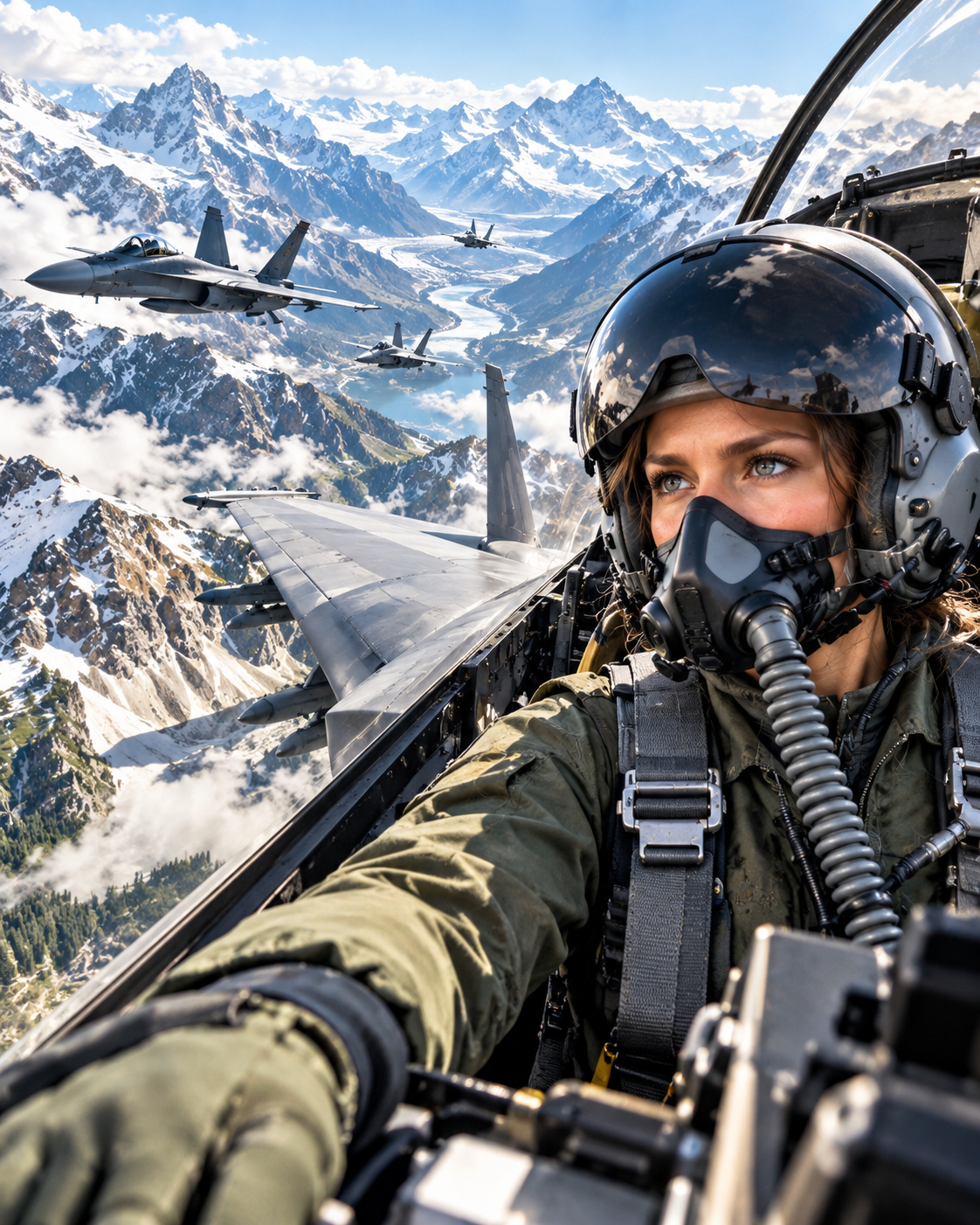
It had been waiting.
“Was the intelligence source supposed to be on that aircraft?”
“Yes.”
“Then somebody wanted him dead.”
Colonel Vance said nothing.
The silence was answer enough.
I looked back toward the squadron buildings.
Scythe was standing on the flight line.
He was surrounded by pilots who usually laughed at everything.
Nobody was laughing now.
“Does he know?”
“He knows enough to be angry.”
I almost smiled.
“He’s been angry for years.”
Colonel Vance’s expression softened.
“Not at you anymore.”
I turned.
Scythe was walking toward us.
For a moment, I expected another confrontation.
Instead, he stopped several feet away.
“Colonel.”
“Major.”
Scythe looked at me.
“The replay is hard to argue with.”
I waited.
He exhaled slowly.
“I was wrong.”
Those words sounded strange coming from a man like him.
They were not dramatic.
They were not polished.
They were simply difficult.
I nodded.
“You followed your training.”
“I followed my pride.”
His jaw tightened.
“I saw two fighters where I wanted two fighters to be, and I chased them.”
He looked at the mountain photograph.
“You saw what they were actually doing.”
I said nothing.
He continued.
“You knew because you flew transports.”
“I knew because transports taught me to watch the whole sky.”
He gave a faint smile.
“I used to think that made you less of a fighter pilot.”
“And now?”
“Now I think it might make you more dangerous than the rest of us.”
That was the first honest compliment he had ever given me.
I folded the photograph and put it away.
“What happens now?”
Scythe looked at Colonel Vance.
“That depends on who changed the route.”
Two days later, investigators began quietly reviewing access logs.
The mission plan had passed through multiple systems.
Most of the entries were ordinary.
One was not.
A planning terminal had been accessed at 2:13 a.m., hours before our mission.
The user credentials belonged to someone inside our own unit.
But the account owner was asleep at home.
Someone had stolen the credentials.
The discovery changed the atmosphere overnight.
Pilots who had spent years flying together suddenly watched one another differently.
Every briefing felt heavier.
Every door seemed too easy to lock.
Every unexplained delay became suspicious.
Then we received another assignment.
A rescue escort.
Three helicopters would enter a mountainous region to extract a downed reconnaissance team.
Weather was deteriorating.
Enemy activity had increased.
The assignment was exactly the kind of mission people remembered for the wrong reasons.
Colonel Vance gathered us in the briefing room.
“The priority is the rescue team.”
He pointed toward the route.
“No heroics.”
Scythe stood near the back.
He listened without interrupting.
Then Colonel Vance looked at me.
“Any concerns?”
I studied the map.
“There is a narrow valley here.”
I pointed.
“If they’re expecting us, that is where they’ll expect the helicopters to appear.”
Scythe stepped closer.
“I agree.”
Several pilots turned toward him.
He looked around the room.
“We learned something on the last mission.”
His eyes settled on me.
“Protect the vulnerable first.”
Nobody spoke.
The mission launched before sunrise.
Clouds hung low over the mountains.
The helicopters disappeared into the gray one after another.
I flew escort beside Scythe.
Specter monitored the tactical picture.
For twenty minutes, there was only static and engine noise.
Then Specter spoke.
“Contact.”
My eyes snapped to the display.
A cluster of returns appeared beyond the ridge.
Too many.
“Possible decoys,” I said.
Scythe answered immediately.
“Agreed.”
I looked at him.
He was already turning toward the valley mouth.
“Let’s keep the helicopters moving.”
The radio crackled.
One of the rescue aircraft had engine trouble.
Its speed was dropping.
The weather closed around us.
Then another warning appeared.
Something was approaching fast from the east.
“Missile launch,” Specter said.
My pulse kicked.
“Target?”
The answer came back.
“One of the helicopters.”
Scythe did not hesitate.
“I’m taking it.”
He surged forward.
I turned the opposite direction.
“Where are you going?” he demanded.
“Looking for the second threat.”
A second warning appeared.
Then a third.
The enemy had split their attack.
One group was drawing Scythe forward.
Another was moving low along the valley.
Exactly like before.
I heard Scythe shout over the radio.
“Do not leave your position.”
This time, there was no anger in his voice.
Only urgency.
“I know.”
I dove toward the valley.
The helicopters were almost swallowed by cloud.
“Rescue Three, descend two hundred.”
The pilot responded instantly.
“Copy.”
I watched the terrain.
The valley narrowed ahead.
The enemy aircraft appeared just beyond the ridge.
They had found the rescue formation.
I moved between them.
For several seconds, the world became noise.
Warnings.
Radio calls.
Wind.
Mountain.
The enemy turned.
I turned with them.
Scythe appeared high above.
Then another aircraft crossed his path.
He pursued it.
Not recklessly.
Deliberately.
He was no longer chasing the brightest threat.
He was protecting the mission.
The surviving helicopters slipped through the valley.
One after another, they disappeared behind the ridgeline.
Then the enemy aircraft turned toward me.
I felt the same cold focus I had felt on the first mission.
The difference was that this time I wasn’t alone.
“Eagle One,” Scythe called.
“Go.”
“I have your six.”
I glanced at the rear display.
There he was.
Holding position.
Watching the threat.
Trusting me.
I almost laughed.
“About time.”
“Don’t get sentimental.”
I smiled inside the helmet.
The battle lasted minutes.
It felt like hours.
Then the final hostile aircraft turned away.
The rescue helicopters were clear.
We escorted them home.
Nobody died.
When we landed, the flight line erupted.
Ground crews shouted.
Medics ran toward the returning helicopters.
The rescued team climbed out one by one.
Some were bleeding.
Some were shaking.
All were alive.
One of them stopped beside me.
“You’re the pilot who came through the valley.”
“Yes.”
He nodded.
“I thought we were finished.”
“You weren’t.”
He smiled faintly.
“That seems to be your specialty.”
I looked toward Scythe.
He was standing several yards away.
For once, everyone was looking at him too.
Not because he had won a fight.
Because he had protected the people behind him.
That afternoon, the squadron gathered on the flight line.
Colonel Vance walked to the center.
“I have an announcement.”
The conversations faded.
He turned toward Scythe.
“Major Vance, who do you recommend as flight lead for tomorrow’s rescue rotation?”
Scythe did not answer immediately.
Then he walked toward me.
Every eye followed him.
“You.”
I blinked.
He stopped in front of the squadron.
“I recommend Captain Mara Reed as flight lead.”
A murmur moved through the group.
Scythe continued.
“She sees the mission, not just the fight.”
He glanced at the pilots.
“She understands that an aircraft carrying people is never just a target to protect.”
Then he looked directly at me.
“It’s the reason we are in the sky.”
No one laughed about my transport background again.
No one called me soft.
The old insult disappeared without ceremony.
Something better replaced it.
Respect.
That evening, I stood alone beside my aircraft.
The sun sank into the Pacific, turning the mountains black against the horizon.
I thought about every pilot who had once believed bravery meant being the first to attack.
Maybe sometimes bravery was simply refusing to abandon the people who could not fight their way out.
Specter walked up beside me.
“You hear the new nickname?”
I shook my head.
“Which one?”
He smiled.
“Scythe says you’re the only person in this squadron who can make a fighter pilot feel like he’s flying a cargo plane.”
I laughed.
“That sounds like an insult.”
“Not anymore.”
He handed me a folded flight plan.
“Tomorrow’s route.”
I opened it.
My smile disappeared.
The waypoint near the mountain corridor had been changed again.
Same location.
Same narrow valley.
Same impossible coincidence.
I looked at Specter.
“Who approved this?”
He shook his head.
“No one.”
Behind us, the perimeter lights flickered on.
Then Scythe’s voice came over the radio.
“Mara, report to my office.”
I folded the map.
The war was supposed to have ended inside that mountain valley the day I learned to trust my instincts.
Instead, someone had just moved the battlefield into tomorrow.
And this time, I knew the enemy might not be waiting across the border.
They might already be standing beside us.