At Thanksgiving, my mother slammed her fork onto the table and called me HEARTLESS for refusing to save the family home
Part 2
My mother picked up the document with trembling hands.
“What is it?”
“A repayment agreement.”
Dad leaned forward.
I pointed to the first figure.
“Thirty-five thousand for the foreclosure.”
Then I pointed to the ledger.
“Fifty-eight thousand eight hundred in documented damages, interest, and losses caused by what you did.”
His face tightened.
“You can’t seriously expect us to pay all that.”
“I spent five years paying for a crime I didn’t commit.”
Mom wiped her cheeks.
“We never meant to hurt you.”
I looked at her.
“Intent doesn’t erase consequences.”
The contract required the full $93,800 combined debt to be repaid at seven percent interest through monthly payments of $1,200.
Every payment would be documented.
Every missed payment would trigger the remedies spelled out in the agreement.
And because this debt existed only because of identity theft and fraudulent use of my information, the contract included a clear acknowledgment that I reserved the right to pursue criminal remedies if they defaulted and failed to honor the agreement.
Bianca read the last page.
“This is insane.”
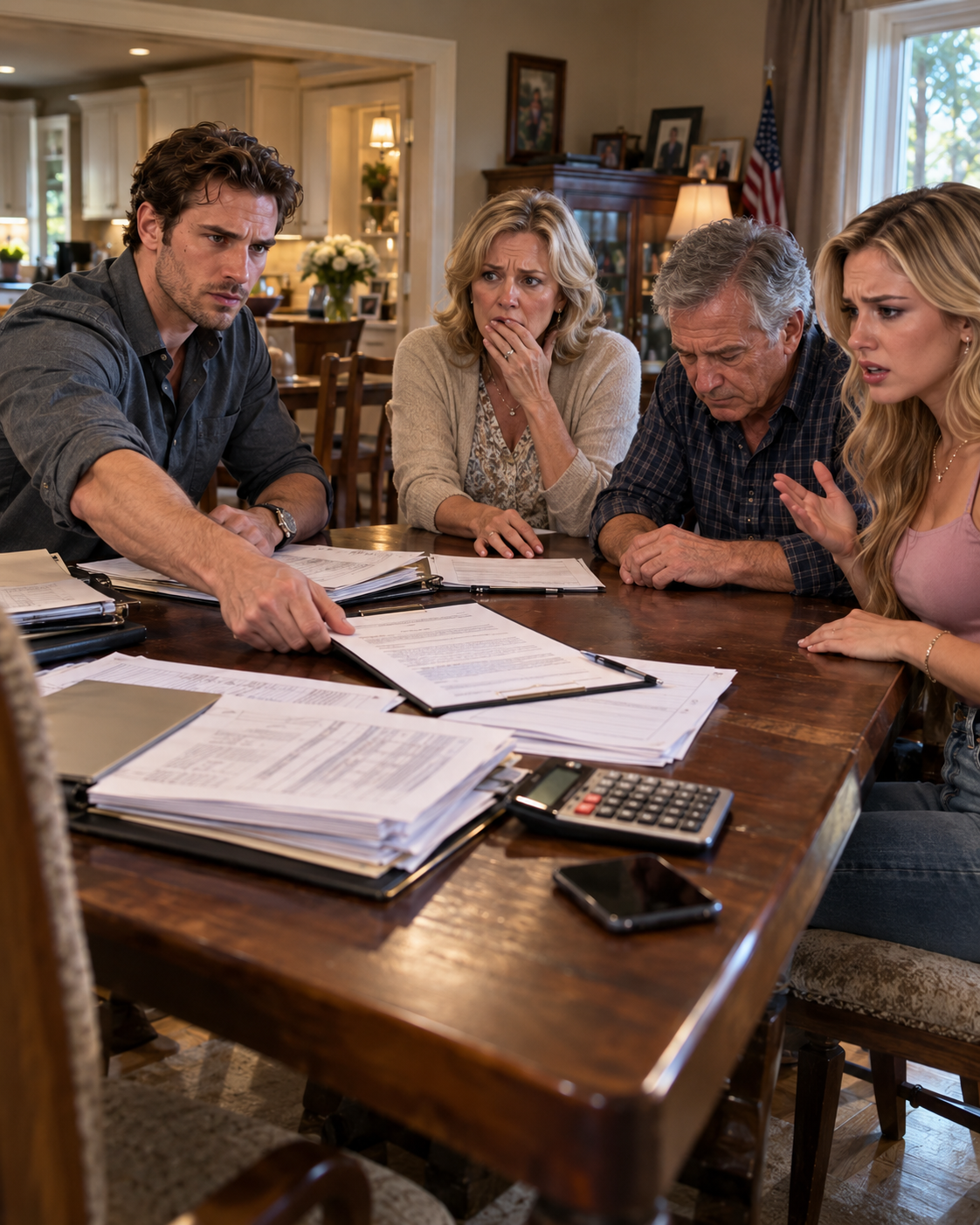
“No,” I said quietly.
“This is written down.”
That distinction mattered.
For years, everything had been verbal.
Promises.
Excuses.
Family harmony.
Now every word had a record.
Dad looked at the foreclosure notice.
Then at Mom.
Then at me.
“Please.”
It was the first time I had ever heard him ask me for something without pretending it was an obligation.
I pushed a pen across the table.
“Sign it.”
My mother signed first.
Her hand shook so badly that the signature looked nothing like the one she had forged years earlier.
Dad signed next.
Bianca refused for several minutes.
Then she saw the alternative.
Their house went into foreclosure.
The family reputation cracked.
And the financial truth became public.
She signed.
The next morning, I wired the $35,000.
The bank confirmed the payment.
The foreclosure stopped.
I felt no joy.
No satisfaction.
Just exhaustion.
I had saved the house.
But I had not saved the family fantasy that created the debt.
Thanksgiving arrived three months later.
My aunt Evelyn hosted it at her house in Naperville.
She had always been different from the rest of them.
She noticed things.
She remembered conversations.
She was the kind of person who could look at a smile and tell whether it reached the eyes.
I walked in late.
The room went quiet for a second.
My mother hugged me too tightly.
Dad asked how work was going.
Bianca arrived with her fiancé and spent twenty minutes talking about their plans for a new house.
I almost laughed at the timing.
Then Aunt Evelyn stood up with her wineglass.
“I think we need to stop pretending.”
Nobody moved.
Mom looked at her.
“Excuse me?”
Evelyn set down the glass.
“Your son rescued your house.”
Dad looked uncomfortable.
“He didn’t have to.”
“No,” Evelyn said.
“He did not.”
Then she looked around the table.
“And I want everyone here to understand why that rescue was necessary.”
My mother shook her head.
“Evelyn, this isn’t the place.”
“It is exactly the place.”
I didn’t know what she had seen.
Then she pulled out a copy of the repayment agreement.
My chest tightened.
She had found out.
Aunt Evelyn looked directly at my parents.
“He spent years repairing damage that never belonged to him.”
Mom started crying again.
Bianca stared at her plate.
Dad whispered, “This is a family matter.”
Evelyn’s expression hardened.
“No, it stopped being private when you demanded he sacrifice his future to protect your image.”
The room was silent.
Then she told them what I had never had the courage to say out loud.
My credit had been destroyed when I was a child.
My mother had used my identity.
My father had known enough to protect her.
Bianca had benefited from the money.
And when I confronted them, everyone had asked me to stay quiet for the sake of peace.
A cousin at the end of the table started crying.
Another relative asked me why nobody had told them.
My father had no answer.
My mother kept saying she was sorry.
Bianca finally snapped.
“I was a kid too.”
Evelyn looked at her.
“So was he.”
Bianca went silent.
That sentence changed the room.
For years, Bianca had been treated as the fragile child whose dreams justified every sacrifice.
But for the first time, someone had said what I had spent years trying not to feel.
I had been a child too.
Nobody had protected me.
Thanksgiving ended early.
I drove home alone through falling snow.
For the first time, I didn’t feel guilty.
I felt free.
The monthly payments began the following month.
One thousand two hundred dollars.
Then another.
Then another.
They arrived like clockwork.
Not out of love.
Not because the family suddenly understood me.
Because consequences had finally become more reliable than promises.
For a while, my mother still called.
Sometimes she cried.
Sometimes she said the past was the past.
Sometimes she reminded me that “family should help family.”
I stopped arguing.
I simply pointed her back to the agreement.
Then, almost a year later, Bianca called.
Her voice was cheerful.
Too cheerful.
“I have news.”
I leaned back in my chair.
“What kind?”
“I’m getting married.”
“Congratulations.”
“And we’re buying a house.”
I already knew where this was going.
“My fiancé and I need a co-signer.”
There was a pause.
“You have great credit now.”
I laughed.
She didn’t.
“You know Mom and Dad can’t do it.”
“Then find someone else.”
“We’re family.”
I looked through the window of my home.
The backyard was covered in snow.
Everything I owned stood exactly where I had chosen to put it.
Nothing was borrowed.
Nothing was promised.
Nothing was attached to Bianca’s dream.
“I’ve already helped your family once,” I said.
“You saved Mom and Dad’s house.”
“Yes.”
“So you can do this.”
“No.”
Her voice changed.
“You’re really going to say no?”
“Yes.”
Mom got on the phone in the background.
I could hear her crying.
Then came the familiar sentence.
“How can you do this to your sister?”
I closed my eyes.
There it was again.
The old script.
The golden child.
The responsible one.
The emergency fund.
But this time, I was no longer eighteen.
I was not sitting in a rotting rental room counting pennies.
I was not begging a credit bureau to believe me.
I was not afraid of losing people who had already decided what I was worth.
I answered calmly.
“She can build her own life.”
Bianca started crying.
I didn’t change my answer.
She hung up.
I set the phone down.
And the silence afterward felt almost holy.
Part 3
The strangest part was that nothing dramatic happened after that.
No lawsuit.
No screaming confrontation.
No movie-style revenge.
Just payments.
Month after month.
$1,200 at a time.
Seven years stretched ahead of them.
They had to live with the consequences of choices they once expected me to absorb.
And I had to learn something equally difficult.
I had to stop measuring my worth by how much pain I could endure for other people.
For years, I thought strength meant surviving whatever my family handed me.
Eventually I understood that strength also meant refusing to carry what was never mine.
My career kept moving.
The director’s office became busier.
My salary grew.
I hired engineers.
I mentored younger developers.
I watched people make mistakes without treating those mistakes as character flaws.
Maybe that was the lesson I needed most.
I never wanted to become my mother.
I never wanted to become someone who decided another person’s future was mine to control.
So I built a different life.
A quieter one.
One with boundaries.
One where love did not require financial obedience.
One where helping someone was a choice, not a debt imposed through guilt.
Sometimes Aunt Evelyn would call.
She never asked whether I had forgiven my parents.
She knew better.
Instead, she would ask whether I was sleeping enough.
Whether work was going well.
Whether I was enjoying the house I had worked so hard to buy.
I appreciated that.
Not because she rescued me.
But because she was one of the few people who had finally seen me clearly.
One winter evening, years into the repayment agreement, I stood in my kitchen making coffee before work.
The house was quiet.
The kind of quiet I had once been afraid of.
My phone buzzed.
Another payment had arrived.
I looked at the amount on the screen.
$1,200.
Exactly on time.
I put the phone down.
Then I noticed an old folder sitting on a shelf.
Inside was the credit report from when I was eighteen.
487.
Forty-seven thousand dollars.
My childhood address.
My stolen identity.
I opened it one last time.
I thought about the boy who had sat at the dining room table that night, convinced his future had been destroyed before it had even begun.
I wished I could go back and tell him something.
Not that everything would become easy.
It wouldn’t.
Not that his family would suddenly become the family he needed.
They wouldn’t.
I would tell him that one day, he would stop asking whether he deserved better.
He would simply build a life that proved he did.
I closed the folder.
Then I put it back on the shelf.
The debt was still being repaid.
The history could not be erased.
But neither could what I had built afterward.
That was the part nobody in my family had understood.
They thought taking forty-seven thousand dollars from me had taken forty-seven thousand dollars from my future.
They were wrong.
They had taken five years.
They had taken sleep.
They had taken trust.
They had taken opportunities.
They had taken a version of me that might have grown without learning everything the hard way.
But they had not taken the ability to begin again.
That belonged to me.
And eventually, so did everything else.
I drove to work that morning in a car I had bought with cash.
I passed the same streets where I had once delivered groceries, counted overtime hours, and wondered whether I would ever stop living in survival mode.
The city looked different.
Or maybe I did.
My phone buzzed once more at a red light.
Another payment.
Another quiet acknowledgment that choices have consequences, even when people spend years pretending they don’t.
I smiled.
Not because my family was finally paying me back.
Not because I had “won.”
I smiled because I no longer needed them to understand what they had done.
I understood it.
That was enough.
Accountability had never been about punishment for me.
It had been about refusing to let someone else’s betrayal become the definition of my life.
And that morning, as I pulled into the parking lot and stepped into the building where I now led an engineering team, I realized the most important thing I had ever bought was not my house, my career, or my financial freedom.
It was the right to wake up without fear.
The right to say no without guilt.
The right to know that my name belonged to me.
Some families teach you how to love.
Mine taught me something harder.
They taught me that love without boundaries can become exploitation, forgiveness without accountability can become permission, and peace built on silence is not peace at all.
Real peace began the moment I stopped carrying a debt that was never mine.
And from then on, every life decision I made carried the same quiet promise.
I would help when I chose to help.
I would love without surrendering myself.
And I would never again mistake being needed for being valued.