At my father’s sixtieth-birthday dinner in a Chicago steakhouse, my mother shoved the check toward me and hissed
I pressed play.
The room filled with Lucas’s voice from three nights earlier.
“You just need his signature.”
My heart had been prepared for anger.
It was not prepared for the sound of my own family discussing me like a resource to be harvested.
Rachel whispered, “Turn it off.”
I didn’t.
Lucas’s recorded voice continued.
“He’ll never notice because he trusts Mom.”
Then my mother’s voice came through.
“He always fixes everything.”
The recording ended.
Nobody moved.
My father stared at the floor as if the wood grain had suddenly become more interesting than the destruction of his son’s life.
I looked at him.
“You knew?”
He swallowed.
“I knew they needed money.”
“That’s not what I asked.”
His eyes finally lifted.
“I knew Rachel had signed something she didn’t understand.”
My chest tightened.
“And you said nothing.”
He rubbed his injured ankle.
“I thought I could handle it.”
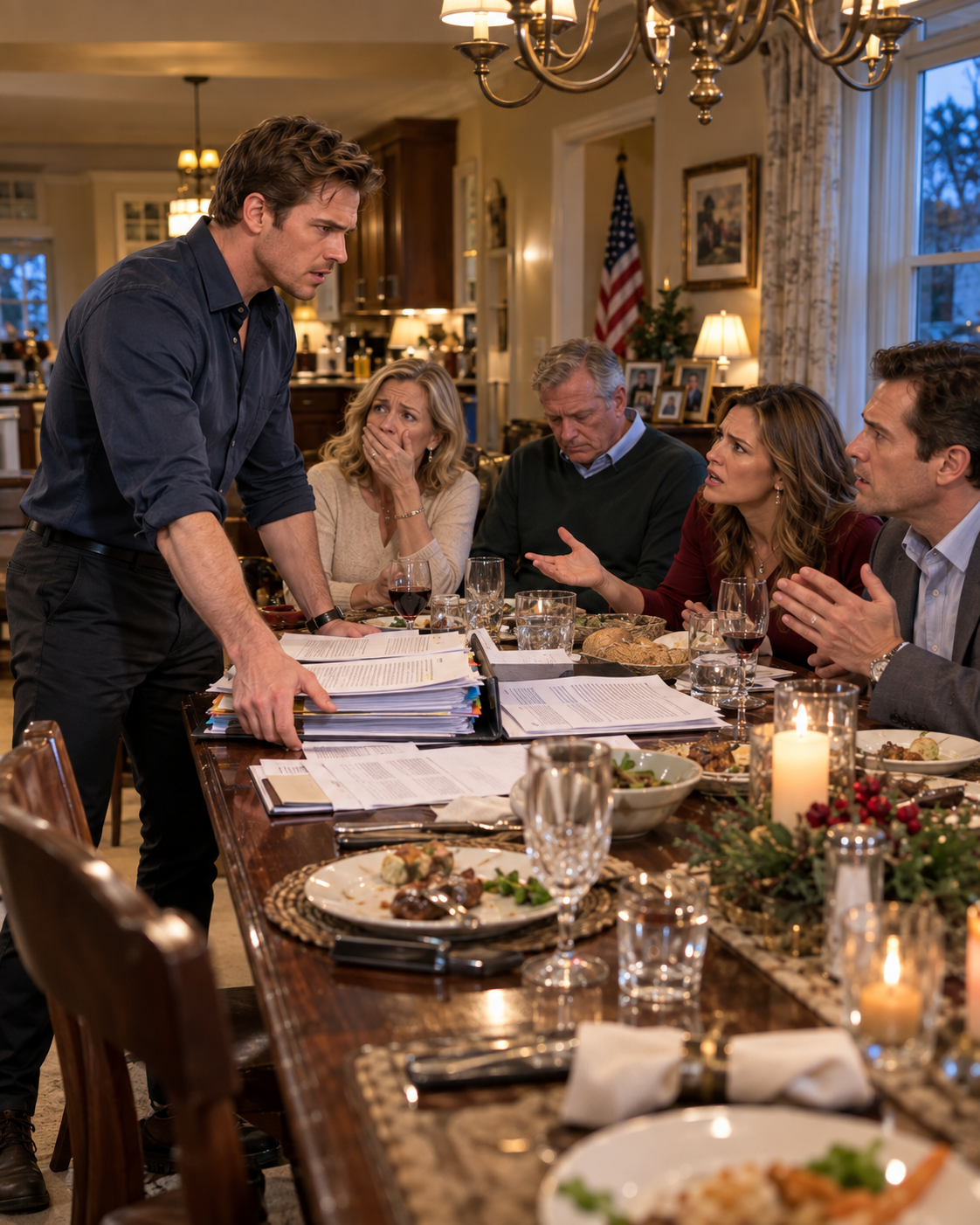
That sentence broke something inside me.
Not because it was convincing.
Because it was cowardly.
My entire childhood had taught me that Dad was the quiet one, the reasonable one, the man who avoided conflict because he believed silence kept families together.
Now I understood what his silence had actually done.
It had protected whoever was causing the damage.
I turned toward Rachel.
“Did you forge my signature?”
She started crying.
“I didn’t mean for it to go that far.”
“That’s not an answer.”
She looked at Lucas.
He looked back at her.
That was all the answer I needed.
My mother stood suddenly.
“How could you record us?”
I laughed once, without humor.
“How could you use my identity?”
She pointed at me.
“You’re destroying this family.”
“No,” I said.
“I’m finally refusing to destroy myself to keep it together.”
Lucas slammed his palm against the table.
“You think that job and fancy apartment make you better than us?”
I looked at him carefully.
“No.”
I tapped the binder.
“This is not about being better.”
I turned a page.
“This is about what you did.”
My attorney had already submitted the forensic handwriting report comparing my legitimate signatures against the loan documents.
The expert found significant inconsistencies and concluded the signatures attributed to me were not written by me.
The bank had been notified.
The credit bureaus had been notified.
The fraud investigation was underway.
Every linked account had been frozen pending review.
Lucas leaned back.
“You’d send your own family to court?”
I looked at him.
“You sent my identity there first.”
Rachel covered her face.
My mother began crying.
My father closed his eyes.
For years, those tears would have pulled me back.
That night, they did not.
I collected the binder.
“I’m done.”
My mother stepped in front of the door.
“You can’t just walk away.”
I looked at her.
“I already did.”
She moved.
I opened the door.
Lucas called after me.
“We’re still your family.”
I stopped on the porch.
“Being related to me is not permission to use me.”
Then I walked into the rain.
I expected relief.
Instead, I felt grief.
There was no triumphant music.
No sudden sense that everything had become fair.
There was only a strange emptiness where seven years of obligation used to live.
The next morning, my attorney called.
“The bank has temporarily removed your liability pending the fraud investigation.”
I sat on the edge of my bed.
“Temporarily?”
“They still have to complete their process, but the evidence is strong.”
I stared through the windows at downtown traffic.
For the first time, the noise outside sounded peaceful.
Two weeks later, the bank sent another letter.
My signature had been formally challenged.
My accounts were no longer connected to the home equity line.
But the consequences for my parents were beginning.
Their payments were severely behind.
The bank demanded immediate repayment under the terms of the defaulted loan.
They couldn’t produce it.
I knew what that meant before the lawyer said it.
“They may lose the house.”
I closed my eyes.
That house had been my childhood.
The kitchen where Mom taught Rachel to bake.
The garage where Dad taught me to change oil.
The backyard where I built a wooden ramp from scrap lumber.
Now all of it was tangled in a loan created through betrayal.
My attorney asked whether I wanted to negotiate for the property.
I said no.
I did not want the house.
I wanted my name back.
Weeks passed.
The family campaign against me collapsed under its own contradictions.
Relatives who had believed Rachel began seeing bank notices and legal letters.
One uncle called to apologize.
Another never did.
I stopped trying to convince anyone.
The truth no longer needed me to chase it.
It had paper attached to it.
Dates.
Signatures.
Receipts.
Transaction numbers.
Facts are strange that way.
People can argue with your feelings.
They struggle to argue with documents.
Then Lucas made the mistake that ended his own carefully protected reputation.
He contacted several people in my industry and told them I had committed financial fraud against my parents.
He assumed their version would travel farther than mine.
Instead, one of the people he contacted knew my attorney.
Another knew the bank investigator.
A third knew me personally and forwarded me the message.
Within forty-eight hours, Lucas’s story began unraveling.
At work, his own employer learned that he had made professional claims about a private financial dispute without evidence.
His credibility suffered.
Then a former colleague sent me a message.
“Lucas is telling everyone you manipulated the documents.”
I read it twice.
I could have responded.
I didn’t.
That evening, I cooked dinner in my apartment with the windows open.
There was no yelling.
No slammed doors.
No one demanding a favor.
Just the sound of a knife against a cutting board.
I realized peace felt unfamiliar because I had spent so long mistaking chaos for love.
A month later, the bank moved forward with foreclosure proceedings.
My parents blamed me.
My mother left five voicemails.
The first accused me.
The second cried.
The third called me heartless.
The fourth said family should forgive.
The fifth was only silence.
I deleted all five.
Then I blocked the number again.
Rachel tried a different approach.
She sent me a photograph of the twins.
Under it, she wrote, “They miss you.”
I stared at that message for a long time.
I loved those children.
That was the hardest part.
They had never asked for any of this.
They had simply grown up believing Uncle Daniel would always appear when somebody needed something.
I wrote one sentence back.
“I love them too, but I will not teach them that love means surrendering boundaries.”
Then I stopped replying.
The foreclosure eventually became public.
People around town began talking.
The same neighbors who had heard Lucas describe me as selfish started whispering about the forged loan.
Rachel stopped posting about family.
My mother stopped mentioning my name.
My father sent one letter.
I almost threw it away.
Instead, I opened it.
He wrote that he had spent his life believing peace meant avoiding difficult conversations.
He admitted that by refusing to confront Rachel and Lucas, he had allowed them to make me carry the weight.
He apologized.
There was no request in the letter.
No demand.
No guilt.
Just an apology.
I cried after reading it.
Not because it fixed anything.
Because for the first time, he had finally told the truth when nobody forced him to.
I kept the letter.
I did not reopen the relationship.
Forgiveness, I learned, does not always mean reunion.
Sometimes it means putting down the anger without handing the person another knife.
My career kept growing.
The promotion became a larger role.
The larger role became ownership in a small technology firm.
I started mentoring younger engineers who reminded me of myself before I learned to say no.
Whenever somebody thanked me for helping them, I made one distinction very clear.
“Help because you choose to.”
“Not because you’re afraid they’ll leave.”
That lesson took years to understand.
Being useful had become my identity because usefulness had earned me scraps of approval.
I thought if I could solve enough problems, people would finally value me.
But I had confused being needed with being loved.
One Sunday afternoon, I was standing on my balcony when somebody knocked.
I knew it was Rachel before I opened the door.
She looked different.
Not weaker.
Just tired.
She stood alone this time.
No suitcases.
No twins.
No demand.
“I came to give you something,” she said.
She handed me a folder.
Inside were copies of the financial records she had hidden from me.
There were transfers I had never seen.
Payments to Lucas.
Cash withdrawals.
A timeline.
“I should have told you sooner,” she said.
I looked at the papers.
“Why now?”
“Because I finally understood that protecting him meant becoming like him.”
She started crying.
“I don’t expect you to forgive me.”
I nodded.
“Good.”
She gave a broken smile.
“That sounds harsh.”
“It’s honest.”
She looked through the apartment.
“You really built this without us.”
I glanced around.
“That’s the point.”
She laughed softly through her tears.
For a few minutes, we talked like siblings instead of survivors.
She told me the twins were doing well.
I told her I was glad.
Then she asked the question I had expected.
“Do you hate Mom?”
I thought about it.
“No.”
“Lucas?”
“No.”
“Me?”
I shook my head.
“I hate what happened.”
She nodded.
“That’s different.”
“Very.”
She left before sunset.
I watched her walk toward the elevator.
Part of me wanted to call her back.
Another part knew healing sometimes required letting silence finish a conversation.
Months later, my parents moved out of the old house.
The place went to the bank.
I drove past once.
The lawn was overgrown.
The mailbox leaned to one side.
I parked across the street and sat there for ten minutes.
That house had once felt permanent.
So had my family.
So had my role inside it.
Yet everything I thought could never change had changed.
I finally understood that permanence is not the same thing as health.
Some things deserve to end.
Some doors should stay closed.
Some relationships only survive because one person keeps bleeding to keep them alive.
I had been that person.
Not anymore.
My life became quieter.
Then it became fuller.
I traveled.
I took weekends off.
I bought a ridiculous espresso machine because nobody could tell me I was wasting money on myself.
I learned to enjoy empty evenings.
I learned that answering every call is not the same as being a good person.
And I learned that “no” can be a complete sentence without becoming a crime against the people who taught you to fear it.
A year after the steakhouse dinner, I received another letter.
This one was from my father’s attorney.
There was no accusation.
No demand.
Just a notice that the legal review had uncovered additional documents connected to the original home equity line.
One page was missing from the file.
The missing page had been referenced in the original loan package.
My name was listed beside it.
I read the notice twice.
Then I called my attorney.
He went quiet.
“What?” I asked.
“The page they’re referring to,” he said, “may explain who actually initiated the loan.”
I looked out at the city.
For the first time in months, I felt that old knot return to my stomach.
“What do you mean?”
He lowered his voice.
“There may have been another person involved.”
I stared at the skyline.
The betrayal I thought I understood suddenly had another locked door behind it.
My lawyer told me the bank was searching its archived files.
I asked how long it would take.
He said, “Not long.”
Then the call ended.
I stood alone in my apartment, listening to the city breathe below me.
A year earlier, I had believed my greatest victory would be proving my family wrong.
Now I understood it was something quieter.
I had learned to stop abandoning myself just to keep other people comfortable.
I had learned that love without respect becomes a debt.
And I had finally built a life where nobody could take my identity simply because I shared their blood.
That night, I turned off the lights and placed my father’s letter beside the legal notice.
Two pieces of paper.
One apology.
One unanswered question.
I was just about to close the drawer when my phone vibrated.
Unknown number.
One message.
“Daniel, we need to talk before the bank finds the missing page.”
I stared at the screen.
Then another message appeared.
“I know who signed your name.”
::久久热