At Lumiere, beneath a chandelier bright enough to make every glass sparkle, Alistair Vance laughed
Part 2
The diner smelled like burnt coffee, fryer oil, and wet pavement.
The booths were cracked.
The neon sign outside buzzed every few seconds.
Nobody looked twice at us.
That alone felt like luxury.
We ordered burgers, fries, and coffee.
Valerie took one bite and closed her eyes.
“This is better than Lumiere.”
I laughed.
“Don’t tell anyone.”
“I have a reputation to protect.”
“For eating grease at midnight?”
“For enjoying it.”
We talked until the rain softened against the windows.
Without the restaurant around us, Valerie seemed younger.
Not younger in years.
Younger in the way people look when they finally stop performing.
She told me about meetings that lasted six hours and meant nothing.
About investors who shook her hand while mentally calculating what she was worth to them.
About living in a glass apartment where silence was so complete she could hear the refrigerator cycle on at three in the morning.
“Everyone thinks being successful means you stop being lonely,” she said.
“It doesn’t?”
“It just makes your loneliness more expensive.”
I stared at my coffee.
“That might be the saddest thing I’ve heard all month.”
She smiled faintly.
“What about you?”
I told her the truth.
I told her my father had left me the shop after his heart gave out.
I told her I had tried to modernize it, but every improvement seemed to cost more than the work brought in.
I told her the lease renewal had arrived with numbers that made my hands shake.
I told her the landlord had given me until the end of the month to come up with a new deposit or clear out forty years of tools, lifts, parts, and memories.
“What happens if you can’t?” she asked.
“I lose the building.”
“The business?”
“The business too.”
I swallowed.
“And Chloe.”
Valerie frowned.
“Why Chloe?”
“Because the shop is the only stable place she’s ever known.”
I looked down at my hands.
“Her mom lives three states away.”
Valerie was quiet.
“So she spends afternoons at the shop.”
“Sometimes she sits in the office and does homework.”
I smiled.
“Sometimes she takes apart clocks and makes me promise not to throw away the springs.”
“She sounds brilliant.”
“She is.”
“What does she think about all this?”
“She thinks I’ll fix it.”
Valerie looked at me for a long moment.
“Do you?”
I wanted to say yes.
Instead I said, “I don’t know.”
That was the hardest sentence I had spoken all year.
We stayed until the kitchen lights dimmed.
When we finally stepped outside, the sky was beginning to lighten at the edges.
Valerie rested one hand on the roof of my truck.
“I meant what I said tonight.”
“About what?”
“Coffee.”
I smiled.
“That’s good.”
“And Jack?”
“Yeah?”
“I’m glad your cousin forced you to come.”
“So am I.”
She looked like she wanted to say something else.
She didn’t.
We exchanged numbers.
Then she got into the Aston Martin and drove away.
I sat in my truck long after her taillights disappeared.
For the first time in weeks, I did not feel like my life was closing around me.
I felt something worse.
Hope.
Hope is dangerous when you have learned how quickly life can take things away.
The next morning, Chloe found me asleep at the kitchen table.
“You look terrible,” she said.
“Thanks.”
She put a mug beside me.
“I made coffee.”
I looked at the mug.
It was filled with cereal milk.
She grinned.
“Close enough.”
I laughed.
That afternoon, the landlord’s notice landed on my workbench.
I read it twice.
Then a third time.
The numbers blurred.
I pressed my palms against my eyes.
My shop had survived my father’s drinking years.
It had survived the recession.
It had survived broken lifts, stolen equipment, unpaid invoices, and one terrible flood.
But this piece of paper felt different.
It did not threaten one bad month.
It threatened the future.
Four days after meeting Valerie, I was lying under a customer’s truck when I heard an engine roll into the service bay.
The sound was smooth and unmistakable.
I slid out on my back.
Silver paint filled the doorway.
The Aston Martin sat there dripping morning mist onto the concrete.
Valerie got out alone.
She wore jeans, a cream sweater, and the same expression she had worn in the diner when she told me loneliness could be expensive.
I stood.
“What happened?”
“Nothing.”
She held out a thick folder.
“I came to see you.”
I wiped my hands on a rag.
“What is this?”
“A proposal.”
I opened it.
The first page showed the Kensington Capital logo.
The second page showed numbers.
The third page showed a two-year commercial fleet maintenance contract.
Retainer.
Scheduled inspections.
Emergency service.
Preferred rates.
A separate agreement for the complete restoration of her DB6.
I looked at the total.
Then back at her.
“I can’t take this.”
“You haven’t heard the terms.”
“I’ve heard enough.”
She stepped closer.
“This is not charity.”
“I know what charity looks like.”
“Do you?”
Her voice was quiet.
“Because this isn’t it.”
I closed the folder.
“I won’t be someone’s project.”
“You aren’t.”
“Then why me?”
She held my gaze.
“Because you diagnosed a failing distributor in freezing rain without knowing who I was.”
I said nothing.
“You fixed it.”
She continued.
“You didn’t overcharge me.”
“You didn’t flirt with me because you thought I was rich.”
“You didn’t change your personality when you learned my name.”
She touched the folder.
“And when Alistair tried to humiliate you, you stayed calm and made one accurate observation that embarrassed him more than any insult could have.”
I almost smiled.
“That’s a very corporate way to compliment someone.”
“It’s the best way I know.”
I looked down at the contract again.
The retainer was enough to clear the immediate debt.
More importantly, it was enough to protect the shop.
Enough to keep Chloe’s corner office.
Enough to keep my father’s tools on the same walls.
Still, something bothered me.
“You said this was a business decision.”
“It is.”
“Then why does it feel personal?”
She took a breath.
“Because every business decision I make is built around people pretending not to care.”
I looked at her.
She lowered her voice.
“I don’t want to become that person.”
Before I could answer, the shop bell rang.
Chloe came running from the office.
“Dad, the red clock finally works.”
She stopped when she saw Valerie.
Valerie smiled.
“Hi.”
Chloe looked at the Aston Martin outside.
“Is that yours?”
“Yes.”
“Does it have points ignition?”
Valerie laughed.
“Apparently, yes.”
Chloe looked at me with wide eyes.
“Can I see?”
I laughed.
“Of course.”
Valerie watched my daughter run outside.
Something changed in her face.
It was subtle.
Almost painful.
I knew then that whatever had happened in her past, it had taught her how to hide every soft thing she possessed.
She looked at the contract.
“There’s one more thing you should know.”
My stomach tightened.
“What?”
“I didn’t know about your lease until after we met.”
I waited.
“But someone else did.”
Her voice had gone cold.
“Who?”
“Alistair.”
I stared at her.
She reached into her bag and pulled out a thin packet of papers.
“The property holding your shop is part of a quiet acquisition strategy.”
I read the name on the document.
Vance Holdings.
The same man who had mocked me at Lumiere.
“He was trying to buy the building.”
Valerie nodded.
“And he expected you to fold before you realized what was happening.”
I looked back at the eviction notice on my workbench.
Suddenly the numbers looked different.
Not random.
Not inevitable.
Part of a plan.
For weeks I had believed I was simply losing a fight against a brutal market.
Now I realized someone had been waiting for me to lose.
Part 3
I sat down slowly.
Chloe was outside explaining the Aston Martin’s engine to Valerie as if she had known her for years.
The shop seemed very quiet.
“Why didn’t you tell me this before?”
“Because I wanted you to hear it from me, not from a lawyer.”
“Did Alistair arrange the lease increase?”
“I can’t prove he personally ordered it.”
She pushed the documents toward me.
“But I can prove his company was negotiating with the property group.”
That was enough.
Not enough for revenge.
Enough for clarity.
I looked at the contract again.
“Did you take this deal because of him?”
“No.”
Her answer came immediately.
“I took the deal because you’re good at what you do.”
Then she smiled.
“And because I want that clockmaker mechanic to have a chance to keep his promise.”
“To Chloe?”
“To himself.”
I stared at her.
She reached across the workbench and straightened one corner of the contract.
“You spend your whole life repairing things other people are ready to throw away.”
Her eyes moved toward the old engine block beneath the stairs.
“Maybe your life deserves the same patience.”
I felt something crack open inside me.
Not romance.
Not yet.
Something quieter.
Something that felt more dangerous.
Being seen.
I signed the contract that afternoon.
Not because Valerie had rescued me.
Because she had put a real business opportunity in front of me and trusted me to earn it.
Within two weeks, the shop changed.
The lifts got serviced.
The waiting room got painted.
The old fluorescent lights disappeared.
We bought better diagnostic equipment.
Chloe kept her little desk in the office.
She still took apart clocks.
She still lost tiny screws.
And every Friday afternoon, she sat on the hood of the restored Aston Martin while I worked on the final details.
Valerie came by often.
Sometimes for meetings.
Sometimes for coffee.
Sometimes because she claimed the car needed checking when I knew perfectly well it did not.
One evening, I found her standing beneath the old sign above the garage.
She was staring at the peeling letters of my father’s name.
“You could replace this.”
“I could.”
“Why haven’t you?”
I looked up.
“Because some things are worth restoring.”
She smiled.
The restoration of her DB6 took months.
We stripped it carefully.
Rebuilt the engine.
Replaced brittle seals.
Repaired the wiring.
Polished the chrome until it looked like a mirror.
The car became beautiful again, but not new.
There were still small imperfections.
A tiny mark on the steering wheel.
A faint crease in the leather.
A place on the body where the years had left their signature.
Valerie loved it that way.
On the morning we finished, she stood beside the car with both hands in her coat pockets.
“It looks different.”
“No.”
I handed her the keys.
“It looks like itself again.”
She looked at me.
“I think that’s harder.”
“What is?”
“Becoming yourself again.”
I did not have an answer.
So I held the garage door open.
She started the engine.
That familiar growl filled the bay.
Chloe came running from the office.
“It sounds amazing.”
Valerie smiled.
“It does.”
Chloe looked at me.
“Dad?”
“Yeah?”
“Are you happy?”
I glanced at Valerie.
Then at the shop.
Then at the old toolbox that had belonged to my father.
“Yeah.”
The word felt unfamiliar in my mouth.
But it fit.
Months later, the rain returned.
Not a storm this time.
Just a steady California drizzle.
I was closing the shop when Valerie walked in without an umbrella.
“You know,” she said, “you still owe me coffee.”
I laughed.
“After all this?”
“Especially after all this.”
We locked the doors together.
Chloe was inside finishing a clock she had built from broken parts.
The three of us walked toward the Aston Martin.
Valerie stopped beside the driver’s door.
“I used to think the most valuable things in life were the ones that survived without needing anyone.”
I looked at her.
She continued.
“I was wrong.”
She touched the car’s restored hood.
“The valuable things are the ones someone cared enough to repair.”
I took her hand.
This time, neither of us was cold.
Years later, people would ask me when my luck changed.
They would expect a number.
A contract.
A wealthy client.
A perfect opportunity.
They would expect me to name the day the Aston Martin arrived at my garage.
But that wasn’t the truth.
My life did not change because a rich woman gave a broke mechanic a chance.
It changed because, in a rainstorm, two exhausted people stopped long enough to admit they were afraid.
Then they chose honesty over pride.
Work over appearances.
And patience over walking away.
That is what I remember whenever I hear rain on the shop roof.
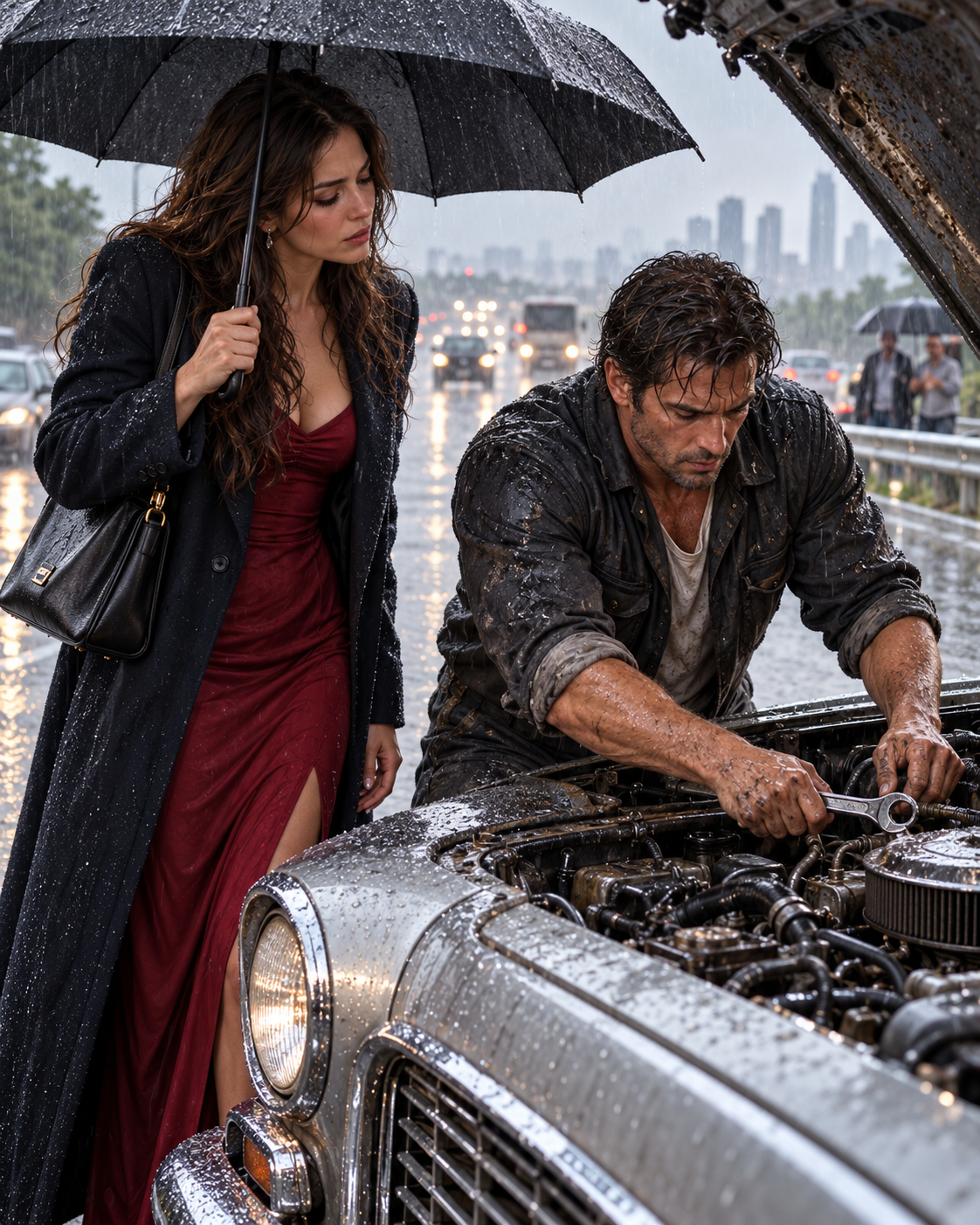
I remember a broken car on a dark road.
I remember a woman holding an umbrella over my head while my hands shook from the cold.
I remember a white tablecloth, a humiliating watch, a cheap diner, and a little girl who believed her father could fix anything.
And I remember the lesson I almost missed.
The strongest things in life are rarely the things that arrive flawless.
They are the things that survive the damage.
The things someone stays for.
The things someone kneels beside in the cold, gets their hands dirty for, and patiently brings back to life.