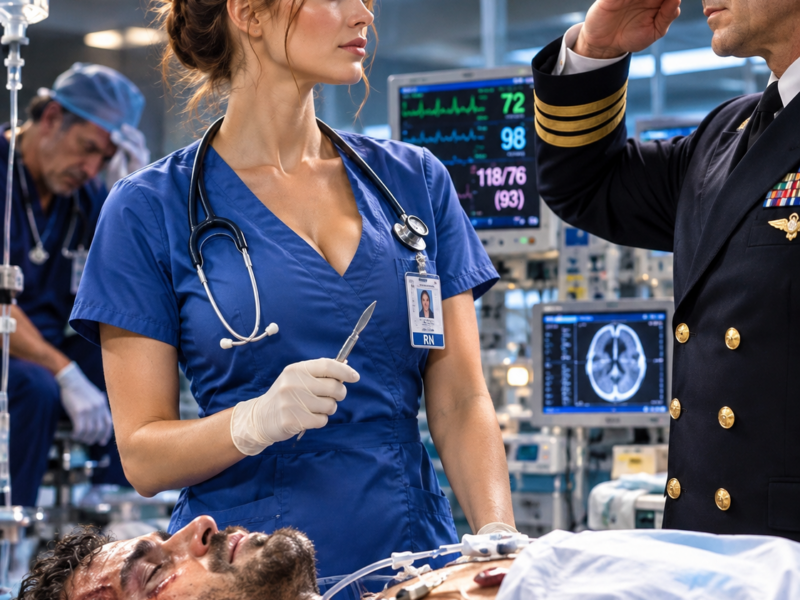
“‘You have two minutes before he dies,’ the surgeon snapped when I stepped toward the bleeding Navy SEAL, but I wasn’t looking at the surgeon
The ICU lights went out.
For three seconds, the entire corridor disappeared into darkness.
Then the emergency generators kicked in, bathing the walls in a dim red glow.
I heard someone shout for security.
A monitor began beeping rapidly behind one of the doors.
And through the narrow ICU window, I saw Mason Reed trying to sit up.
He was still weak from surgery.
His face was pale, and an oxygen line ran beneath his nose.
But he was awake.
I rushed into his room.
“Mason, stay down.”
He grabbed my wrist.
“Did you see him?”
“Who?”
“Ethan.”
I held up my phone.
Mason stared at the photograph, and something changed in his expression.
It wasn’t surprise.
It was recognition.
“You’ve seen him before,” I whispered.
He nodded.
“Three weeks ago.”
My heart started pounding.
“Where?”
“An abandoned medical facility outside Norfolk.”
I pulled a chair beside his bed.
“Start from the beginning.”
Mason glanced toward the door.
“Not here.”
“You’re in intensive care. You’re not going anywhere.”
“Emily, you don’t understand. They know I made it here.”
“Who?”
He swallowed.
“The people who put that device inside me.”
Before I could answer, two security officers entered.
One was carrying a flashlight.
The other held a radio.
“Everyone needs to clear the room,” the first officer said.
I stood.
“He’s my patient.”
“We have instructions to relocate him.”
“From whom?”
“Federal authorities.”
Mason’s grip tightened around my wrist.
“Don’t let them take me.”
The second officer approached the bed.
I stepped between them.
“He’s not medically cleared for transport.”
“Ma’am, move aside.”
“No.”
The first officer reached for my shoulder.
Then a familiar voice came from the hallway.
“Nobody touches that patient.”
Dr. Lawson stood in the doorway.
Behind him was Dr. Patel.
Lawson looked at the two officers.
“I have a patient under active postoperative care. If you want him moved, bring me a signed medical transfer order and the attending physician responsible for accepting him.”
The officer frowned.
“We have federal authorization.”
“Then you should have no trouble producing the paperwork.”
Neither officer answered.
Lawson pointed toward the corridor.
“Out.”
They hesitated.
Then they left.
I looked at him.
“Thank you.”
He didn’t smile.
“Don’t thank me yet. Hospital administration just received a call from someone claiming your patient is connected to a classified security incident.”
“They already tried to take him.”
“I know.”
Lawson lowered his voice.
“Emily, what exactly did you find in that man’s uniform?”
I looked at Mason.
He closed his eyes.
“Everything,” I said.
Lawson studied me.
“Then I think it’s time you told me why you recognized the device.”
I didn’t answer immediately.
Seven years earlier, I’d been a military medical specialist assigned to a special operations support unit.
I wasn’t a combat soldier.
I wasn’t an intelligence officer.
I was the person they called when a soldier was too badly injured to wait for an evacuation.
My commanding officer was Colonel Samuel Whitaker.
He had recruited me personally.
He told me I had steady hands and an instinct for noticing what other people missed.
He also taught me that certain questions could cost lives.
During one deployment in Afghanistan, our team was assigned to a temporary medical station near Kandahar.
That’s where I met Ethan Cole.
Ethan was a combat medic.
He had a habit of making terrible jokes at the worst possible moments.
He carried a battered photograph of his younger sister in his pocket.
He also had a strange symbol tattooed on the inside of his left wrist.
A circle crossed by three lines.
He told me it was a reminder that no one should be treated as disposable.
I never forgot it.
One night, our medical station was attacked.
An explosion tore through the rear entrance.
The building collapsed around us.
I found Ethan beneath a broken support beam.
His legs were trapped.
He was bleeding badly.
I tried to keep him alive while the others cleared the area.
He grabbed my sleeve.
“Don’t let them rewrite what happened.”
I thought he was delirious.
Then he said something else.
“Whitaker knows.”
Those were the last words I heard from him.
The official report stated that Ethan died during the attack.
I was told his body had been recovered.
I was also told that questioning the report could endanger the rest of the team.
Colonel Whitaker personally visited me in the hospital.
He placed a hand on my shoulder and said, “You did everything you could.”
I believed him.
For seven years, I believed him.
Now Mason was lying in my ICU with Ethan’s name on a medical pouch, and a man I’d buried was sending me photographs from an unknown location.
“Emily?”
Lawson’s voice brought me back.
I looked at him.
“I think someone used a device to control the bleeding in Mason’s wound.”
Lawson frowned.
“Control it?”
“Not exactly. I think it was designed to keep the vessel compressed until someone removed it.”
“Why would anyone do that?”
“Because removing it without understanding the mechanism could cause a catastrophic hemorrhage.”
Lawson glanced at Mason.
“That doesn’t explain the second wire.”
“No.”
I looked toward the sealed evidence container.
“Someone wanted him to arrive alive, but they didn’t want him to survive the procedure.”
Mason opened his eyes.
“That’s what Ethan said.”
I turned toward him.
“What did he tell you?”
Mason took a shallow breath.
“That the device was a warning. That if I got to a hospital, someone would try to make sure I never talked.”
“Why didn’t you tell the paramedics?”
“I didn’t know who I could trust.”
He paused.
“Then I saw your name on the hospital roster.”
I stared at him.
“You knew I worked here?”
“Ethan gave me your name.”
“Why?”
“Because he said you were the only person who knew what happened at the medical station.”
I felt my throat tighten.
“He told you I was alive?”
Mason nodded.
“He said you left the military. He said you were trying to live a normal life.”
I looked away.
For seven years, I had thought Ethan was dead.
And somewhere during those years, he had known exactly where to find me.
“How did you meet him?” I asked.
Mason looked toward the window.
“I was assigned to a recovery team. We were sent to retrieve a hard drive from an abandoned facility. The briefing said it contained records connected to a weapons smuggling investigation.”
“Was that true?”
“No.”
“What was on it?”
“Medical records.”
My stomach tightened.
“Whose?”
“People who were treated at military facilities that didn’t officially exist.”
I thought of the explosion in Kandahar.
The false death report.
The symbol on Ethan’s pouch.
“Was Ethan one of the people in those records?”
Mason nodded.
“He wasn’t the only one.”
He closed his eyes.
“Some of them were declared dead. Some were transferred under false identities. Others were listed as having never existed.”
I stood very still.
“Who was responsible?”
Mason looked directly at me.
“Colonel Whitaker.”
The name hit harder than I expected.
I had spent seven years defending that man in my mind.
I had remembered him bringing coffee to my hospital room.
I had remembered him telling me I was strong enough to move forward.
Now I wondered whether he had simply been making sure I stopped looking backward.
“Why would he do that?”
Mason shook his head.
“I don’t know everything. Ethan does.”
“Where is he?”
“He has the original records. He wanted me to bring them out.”
“Did you?”
Mason looked toward the black pouch.
“I brought part of them.”
My eyes moved to the evidence container.
“What’s inside?”
“Not the device.”
He swallowed.
“The key.”
I looked at the pouch that was no longer in the room.
“Daniel Voss took it.”
Mason’s face changed.
“Voss?”
“Do you know him?”
“He’s not a contractor.”
“Who is he?”
Mason stared at the ceiling.
“He’s the man who ran the recovery team.”
I felt a chill.
“The same team that found you?”
He nodded.
“He told us Ethan had betrayed the unit. He said we were supposed to recover the records and eliminate anyone who had seen them.”
“Eliminate?”
Mason didn’t answer.
He didn’t have to.
A knock sounded at the door.
Brooks, the anesthesiologist, looked in.
“Emily, there’s someone downstairs asking for you.”
“Who?”
“Colonel Whitaker.”
For a moment, the room seemed to shrink.
I glanced at Mason.
He grabbed my wrist again.
“Don’t go alone.”
I looked at Brooks.
“Can you stay with him?”
He nodded.
I stepped into the hallway.
Colonel Samuel Whitaker was waiting near the nurses’ station.
He wore a dark suit and carried no visible identification.
His hair had turned almost completely white.
But his posture was unchanged.
He looked like the man who had once stood beside my hospital bed and told me I was going to be okay.
“Emily.”
I didn’t return the greeting.
“Where’s Ethan?”
Whitaker sighed.
“That’s a complicated question.”
“Is he alive?”
He looked toward the ICU.
“You’re letting a wounded man manipulate you.”
“That’s not an answer.”
“Some people are very good at using grief.”
I stepped closer.
“Seven years ago, you told me Ethan died.”
“He did.”
“I received a photograph of him yesterday.”
Whitaker’s expression barely changed.
“Photographs can be fabricated.”
“Mason knows him.”
“Your patient is a compromised military asset.”
“He’s a human being.”
Whitaker gave me a tired look.
“You’re still doing this.”
“Doing what?”
“Putting emotion before judgment.”
I almost laughed.
“You taught me to save lives.”
“I taught you to follow orders.”
“No. You taught me that people could be left behind if the paperwork said they were already dead.”
His face hardened.
“Be careful, Emily.”
I stared at him.
“Why did you use my credentials to authorize Mason’s transfer?”
For the first time, he looked genuinely surprised.
Then he recovered.
“Where did you hear that?”
“Was it you?”
He lowered his voice.
“You have no idea what you’re involved in.”
“Then explain it.”
“I can’t.”
“Or you won’t?”
Whitaker looked toward the elevators.
“Come with me. We can talk somewhere private.”
“No.”
His eyes narrowed.
“You’re making a serious mistake.”
“Maybe. But I’m not leaving this hospital with you.”
He studied me for several seconds.
Then he leaned closer.
“Ask yourself why Ethan chose you. He knew you would be vulnerable to this.”
I didn’t move.
“Maybe he chose me because he knew I wouldn’t abandon him twice.”
Whitaker’s expression changed.
For a brief moment, the man who had mentored me disappeared.
In his place stood someone cold and unfamiliar.
“You’re not going to like what you find,” he said.
Then he walked away.
I watched him disappear into the elevator.
When I returned to Mason’s room, the bed was empty.
The monitor was still running.
The IV line had been disconnected.
A nurse stood near the doorway, pale and shaking.
“Where is he?”
She pointed toward the service corridor.
“Two men came with a transfer order. They said they were taking him for additional imaging.”
“Who signed it?”
“I didn’t see.”
I ran toward the corridor.
The service elevator doors were closing.
I reached them just in time to see a security camera above the entrance.
And beside the elevator, something lay on the floor.
A small piece of black fabric.
I picked it up.
It was from Mason’s hospital gown.
My phone vibrated.
Unknown number.
**STOP FOLLOWING THEM.**
A second message appeared.
**THEY HAVE MASON.**
I called Brooks.
No answer.
I called hospital security.
No answer.
Then another message came through.
**LOOK UNDER THE BED.**
I returned to Mason’s room.
Beneath the bed was a folded piece of paper.
It had been taped to the metal frame.
I opened it.
Inside was a handwritten address and a short message.
“Warehouse 17. If you want the truth about Kandahar, come alone.”
At the bottom was a symbol.
A circle crossed by three lines.
Ethan’s symbol.
I looked at the clock.
It was 11:42 p.m.
I knew I should call the police.
I knew I should tell Lawson.
I knew that going alone would be reckless.
But Mason had just been taken from a hospital by people using official-looking documents.
And Ethan had been missing for seven years.
I took a photograph of the note and sent it to Dr. Lawson.
Then I called the number that had been messaging me.
It rang once.
A familiar voice answered.
“Emily?”
I couldn’t breathe.
“Ethan?”
There was a pause.
Then a quiet laugh.
“Still asking questions before saying hello.”
My eyes filled with tears.
“You’re alive.”
“Apparently.”
“Where are you?”
“Not far.”
“Did you take Mason?”
“No. But I know who did.”
“Then tell me where he is.”
“I will. But you need to understand something first.”
“What?”
“Whitaker isn’t the only person involved.”
I closed my eyes.
“Who else?”
“Ethan hesitated.
“Someone inside your hospital.”
I looked through the glass wall of the nurses’ station.
Dr. Lawson was standing beside the medication cabinet.
He was speaking to a man in a gray suit.
The same man who had taken the pouch.
Daniel Voss.
My hand tightened around the phone.
“Ethan, I need you to tell me exactly what happened in Kandahar.”
“Not over the phone.”
“Why?”
“Because the people who falsified the reports are still listening.”
I looked at the security camera above the corridor.
A tiny red light blinked.
“Where do I meet you?”
“Warehouse 17. Midnight.”
“And Mason?”
“He’s alive.”
“How do you know?”
“Because I helped him escape once. I won’t let them take him again.”
The call ended.
I stood in the hallway, holding the phone.
For seven years, I’d believed the worst thing that happened in Kandahar was losing Ethan.
Now I was beginning to understand that the explosion had only been the beginning.
At midnight, I arrived at Warehouse 17.
The building stood at the edge of an industrial district, surrounded by rusted fencing and abandoned loading docks.
I parked under a broken streetlight.
I didn’t go inside immediately.
I called Dr. Lawson.
He answered on the second ring.
“Emily, where are you?”
“Somewhere I shouldn’t be.”
“That’s not reassuring.”
“Did you see Voss?”
A pause.
“Yes.”
“Was he alone?”
“No.”
“Who was with him?”
Lawson lowered his voice.
“Someone from hospital administration.”
I felt my stomach drop.
“Who?”
“Deputy Director Paul Hargrove.”
Hargrove had been responsible for hospital security and federal liaison matters.
He had signed Mason’s admission paperwork.
He had also approved the transfer order.
“Lawson, I need you to do something.”
“What?”
“Preserve every record connected to Mason’s admission. Every access log. Every transfer order. Don’t let anyone erase anything.”
“Emily, what are you involved in?”
“I’ll explain when I can.”
“Don’t do anything stupid.”
“I’ll try.”
I ended the call.
Then I entered the warehouse.
The inside smelled of dust, oil, and damp concrete.
A single work light hung from the ceiling.
A man stood beneath it.
He was thinner than the photograph.
His hair was nearly shaved, and a long scar ran from his temple to his cheek.
But his eyes were unmistakable.
“Ethan.”
He looked at me for a long moment.
Then he smiled.
“Hey, Emily.”
I crossed the distance between us.
I wanted to hug him.
I wanted to hit him.
I wanted to ask why he had let me believe he was dead.
Instead, I stood in front of him and cried.
Ethan looked down.
“I’m sorry.”
I wiped my face.
“Seven years.”
“I know.”
“You let me bury you.”
“I didn’t have a choice.”
“You always had a choice.”
His eyes filled with something like shame.
“Not then.”
I stepped back.
“Tell me what happened.”
He gestured toward a folding table.
On it lay several photographs, a laptop, and a stack of documents.
“After the explosion, I survived.”
I stared at him.
“You survived the collapse?”
“Yes. But I wasn’t the only one.”
He pointed to a photograph of the medical station.
The rear entrance was covered in debris.
“The attack wasn’t random. Someone planted explosives in the building before the team arrived.”
“Why?”
“Because the medical station was being used to treat detainees who had been moved through an unofficial program.”
I looked at the documents.
“People who were declared dead?”
“Some of them.”
Ethan nodded.
“The program was supposed to be temporary. It became a business. People were transferred, questioned, medically treated, and moved again under false identities.”
“Who ran it?”
“Whitaker controlled the military side. Voss handled recovery and transport. Hargrove helped move medical records through civilian hospitals.”
I thought of St. Catherine’s.
“Why my hospital?”
“Because it has a federal trauma contract. Hargrove could use legitimate emergency admissions to move people without triggering the usual questions.”
My stomach turned.
“Mason?”
“He’s one of the people who found out.”
Ethan tapped a photograph.
It showed Mason standing beside a group of soldiers.
Behind them was a concrete building.
“His team was assigned to recover a storage drive. They found records showing that the program was still active.”
“And someone tried to kill him.”
“Yes.”
“Why didn’t you come to me?”
Ethan looked away.
“Because Whitaker told me you were dead.”
I stared at him.
“What?”
“He said you were killed in a vehicle explosion during a later deployment.”
“That never happened.”
“I know that now.”
He opened a folder.
Inside was a personnel report bearing my name.
It listed me as deceased.
My photograph was attached.
The date was six months after I had left the military.
I felt sick.
“They used my identity.”
“They used both of ours.”
He showed me another document.
A medical transfer authorization.
My signature appeared at the bottom.
It was identical to the one I’d seen in Mason’s file.
“That’s impossible.”
“They copied your credentials from the Kandahar medical station. Whitaker had access to your original authorization records.”
“Why?”
“Because he needed a nurse’s signature to make certain transfers look legitimate.”
I looked at him.
“And you knew?”
“I found out after I escaped.”
“How did you escape?”
Ethan took a breath.
“Voss’s team recovered me from the rubble. They told me I was being transported for treatment. Instead, they moved me to an isolated facility.”
He paused.
“I found the records there. I learned what had happened. I also learned that anyone who knew the truth was being tracked.”
“How did you get out?”
“Someone inside helped me.”
“Who?”
“An administrator named Laura Bennett. She worked in records management. She had been altering transfer logs to protect certain detainees.”
Ethan slid a photograph toward me.
A woman stood outside a small building.
I recognized her.
She was a records supervisor at St. Catherine’s.
I’d seen her in the hallway several times.
“Laura works here?”
Ethan nodded.
“She helped me get the original files out. She was also the person who sent Mason the pouch.”
I stared at him.
“Why didn’t she tell me?”
“She didn’t know whether you were being watched.”
I looked toward the warehouse door.
“Where is Mason?”
Ethan pointed toward the rear of the building.
A second door opened.
Mason stepped out.
He was leaning on a metal cane, still wearing a hospital bracelet.
I rushed toward him.
“What are you doing here? You just had surgery.”
He gave me a tired smile.
“Apparently, I’m difficult to keep in a hospital.”
I looked at Ethan.
“You got him out?”
“With help.”
Mason sat down.
“Voss transferred me to a private vehicle. They were going to take me to an airfield.”
“How did you escape?”
“One of the guards was working with Ethan. He opened the rear door when the vehicle stopped.”
I stared at him.
“You could have died.”
Mason gave a small shrug.
“I was already on my way.”
“That isn’t funny.”
“I know.”
Ethan placed a hand on the table.
“We don’t have much time. Whitaker knows we have the records.”
I looked at the laptop.
“What’s on there?”
“Original transfer logs, medical records, recordings, and command authorizations.”
“Enough to prove what happened?”
“Enough to start.”
“Then we take it to the authorities.”
Ethan shook his head.
“Not yet.”
I felt frustration rise.
“Why not?”
“Because Whitaker has friends in the agencies that would receive it. If we send it through the normal channels, the files could disappear.”
“Then who do we trust?”
A voice came from behind us.
“Me.”
We turned.
Laura Bennett stood in the doorway.
She held a small metal case.
Her hands were shaking.
Ethan exhaled.
“You’re late.”
“I had to make sure I wasn’t followed.”
Laura set the case on the table.
Inside were original paper records and a small encrypted storage device.
“I copied everything before Hargrove realized what I was doing,” she said.
I looked at her.
“You work at my hospital.”
“I know.”
“You helped move Mason?”
“I helped get him into the ambulance. I didn’t know they had placed a device in his wound.”
“Why didn’t you tell me?”
Laura looked at Ethan.
“Because I thought you were already in danger.”
I stared at her.
“Everyone keeps making decisions about what I can handle.”
She lowered her eyes.
“I’m sorry.”
I took a breath.
“What’s on the device?”
“Everything we could recover. But there is one more thing.”
She opened a folder and removed a printed email.
The sender was Colonel Samuel Whitaker.
The recipient was Daniel Voss.
The date was seven years earlier.
The subject line read: **KANDAHAR MEDICAL STATION — FINAL DISPOSITION.**
I read the message.
It instructed Voss to secure the remaining personnel, recover all medical records, and ensure no surviving witnesses could contradict the official report.
At the bottom was a final line.
“Emily Carter must remain unaware of Ethan Cole’s recovery.”
My hands went cold.
I read it again.
Then I looked at Ethan.
“They knew you were alive.”
He nodded.
“Yes.”
“All these years?”
“Yes.”
“Why didn’t they kill you?”
Ethan looked at the floor.
“Because they thought they could still use me.”
I waited.
He continued.
“They wanted me to identify the people in the records. They wanted me to tell them which detainees had survived and where the remaining files were stored.”
“And you refused.”
“Yes.”
Mason leaned forward.
“That’s why they went after me. I had the last copy of the original transfer map.”
I looked at the documents.
“Then we need to release everything.”
Laura shook her head.
“If we do it carelessly, people whose identities are protected could be exposed.”
Ethan nodded.
“We need an independent investigation and a secure chain of custody.”
I thought of Dr. Lawson.
He had refused to abandon Mason.
He had protected him when federal officials tried to remove him.
And he had preserved the hospital records.
“There’s someone we can trust.”
I called Lawson.
I explained everything.
He was silent for a long time.
Then he said, “Bring the records to the hospital. I’ll contact our legal counsel and the inspector general’s office through independent channels.”
“Can you protect the evidence?”
“I can protect the hospital records. The rest needs to be secured by investigators.”
“Will you help us?”
He exhaled.
“Emily, I watched you save a man’s life tonight while everyone else was arguing about whose authority mattered. I’m not going to let that work be erased.”
We agreed to meet at the hospital’s administrative conference room at six in the morning.
Before we left the warehouse, Ethan stopped me.
“There’s something else you should know.”
I turned.
“What?”
“The device in Mason’s wound wasn’t meant to cause an explosion.”
“Then what was it?”
“It was designed to keep pressure on a damaged artery until the fragment was removed.”
I remembered the way the blood had pulsed around the metal.
“The person who placed it knew what they were doing.”
“Yes.”
“Who?”
Ethan looked at Mason.
Mason answered.
“Voss.”
I stared.
“How do you know?”
“Because he explained it to me after I was captured. He said the device would make sure I arrived at a hospital alive. Then he said he knew exactly which doctor would remove it.”
I thought of Lawson.
“Why would he want that?”
“Because he needed the device removed before it could be identified.”
I looked at Ethan.
“Was he expecting me?”
Ethan nodded.
“Your name was on the transfer order. He knew you’d be working.”
I felt a chill.
The wound hadn’t been designed to kill Mason immediately.
It had been designed to create a medical emergency that would force someone to make a specific decision.
If a surgeon removed the fragment without understanding the device, Mason would bleed out.
If someone recognized the mechanism, the entire operation could be exposed.
They had gambled that no one would notice.
They had not counted on me.
At six in the morning, we entered St. Catherine’s through the staff entrance.
Dr. Lawson was waiting with the hospital’s attorney, Sarah Mitchell.
She had already contacted the inspector general’s office.
A federal investigator named Agent Rachel Morgan arrived shortly afterward.
She listened without interrupting.
Then she reviewed the documents.
She examined the original transfer records.
She compared the signatures.
She looked at the medical device evidence.
When she reached the email from Whitaker, her expression changed.
“This is significant,” she said.
“Can you act on it?” I asked.
“We can secure the records and open an investigation. But I need everyone to understand that this will take time.”
Ethan leaned forward.
“We don’t have time. Whitaker knows we’re here.”
Morgan nodded.
“Then we’ll move quickly.”
She arranged protective custody for Ethan and Mason.
Laura agreed to provide a sworn statement.
The hospital secured its records and turned over copies under a documented evidence process.
For the first time, the truth was no longer sitting in a hidden folder or being whispered between frightened people.
It had a case number.
A chain of custody.
And people who were legally responsible for investigating it.
But Whitaker wasn’t finished.
At 9:17 a.m., my phone rang.
His name appeared on the screen.
I answered.
“Emily.”
His voice sounded calm.
Almost gentle.
“You’ve made a terrible mistake.”
“No. I stopped making yours.”
“You have no idea what those files contain.”
“I know what they contain.”
“People will be hurt.”
“People already were.”
He sighed.
“Come to my office. We can settle this without destroying lives.”
“Your office?”
“I can explain everything.”
“You had seven years.”
Silence.
Then he said, “Ethan is lying to you.”
I looked through the conference room window.
Ethan was sitting beside Mason.
Both were alive.
Both were waiting for a chance to tell the truth.
“Then tell me why you declared me dead.”
Whitaker didn’t answer.
“Tell me why you forged my signature.”
Still nothing.
“Tell me why you sent Voss after a wounded soldier.”
His voice changed.
“You don’t understand the larger picture.”
“Then explain it.”
“I was protecting the country.”
I closed my eyes.
“From what?”
“From a scandal that would have damaged operations and endangered sources.”
“By disappearing people?”
“By containing a problem.”
I felt anger rise in my chest.
“Those people weren’t problems. They were patients.”
“Emily, you were never meant to be part of this.”
“But I was.”
I ended the call.
Agent Morgan had heard enough.
She nodded to another investigator.
Within an hour, they had located Whitaker.
He was detained while investigators secured his records and electronic devices.
Daniel Voss was arrested that afternoon after attempting to leave the state.
Paul Hargrove was placed on administrative leave and later charged with falsifying medical transfer documents and obstructing the investigation.
The investigation lasted nearly a year.
It was not clean.
There were hearings, sealed records, legal challenges, and people who insisted that the program had been necessary.
Some witnesses refused to speak.
Some evidence had been destroyed.
And some of the people who had disappeared were never found.
But the original records survived.
They established that at least twenty-seven individuals had been transferred through the unofficial program.
Fourteen had been falsely reported dead.
Several had been denied proper medical treatment.
Ethan’s testimony helped investigators identify three former detainees who were still alive.
Mason’s evidence connected the recovery team to the unauthorized medical device.
And my testimony established that my credentials had been used to falsify transfer records after I had left the military.
I also learned something I hadn’t expected.
The explosion at Kandahar had been ordered to destroy the medical station and the records inside it.
The people who planned it knew Ethan had discovered the program.
They assumed the explosion would kill everyone who could contradict the official report.
It didn’t.
Ethan survived.
And I survived.
But the report had buried us both.
The day I testified, I wore my hospital uniform.
I didn’t wear my old military patch.
I didn’t want to be mistaken for someone I no longer was.
I told the investigators what I had seen.
I described the night of the explosion.
I described Ethan beneath the beam.
I described Whitaker’s visit to my hospital room and the words he had used to convince me to stop asking questions.
When I finished, the lead investigator asked whether I had anything else to add.
I looked down at my hands.
For years, I had remembered them covered in blood.
I had remembered failing to save Ethan.
I had remembered thinking that if I had been faster, stronger, or better, he might have survived.
But now I understood.
I hadn’t failed him.
Someone had deliberately taken the truth away from both of us.
“Yes,” I said.
“I want the record to show that Ethan Cole was alive when he was declared dead. And I want the record to show that I never authorized those transfers.”
The investigator nodded.
“It will.”
Six weeks later, Mason returned to St. Catherine’s for a follow-up appointment.
He was walking without the cane.
The scar beneath his ribs was still healing.
He brought coffee for the entire trauma team.
Dr. Patel complained that it was terrible coffee.
Lawson drank two cups anyway.
Mason stopped beside my station.
“Thought I’d come say thank you.”
“You don’t owe me anything.”
“I disagree.”
He looked toward the trauma bay.
“That night, I thought I was going to die.”
I smiled faintly.
“You were very close.”
“I remember your face.”
I raised an eyebrow.
“Was I that frightening?”
“You looked like you were about to argue with the entire military.”
I laughed.
“That sounds about right.”
He became serious.
“Ethan told me what you did for him.”
I looked down.
“I didn’t do enough.”
“That’s not what he thinks.”
Mason handed me a small envelope.
Inside was a photograph.
Ethan stood beside Mason outside a modest building.
They both looked tired.
But they were smiling.
On the back, Ethan had written:
“You kept your promise. You didn’t let them rewrite what happened.”
I folded the photograph carefully.
For the first time in seven years, I felt something inside me settle.
Not disappear.
Not heal completely.
Just settle.
A few days later, Ethan came to visit.
He waited until the end of my shift.
I found him sitting in the hospital cafeteria, turning a paper coffee cup between his hands.
“You’re early,” I said.
“You’re late.”
“I was saving lives.”
“Still making excuses.”
I sat across from him.
For a while, we talked about ordinary things.
The weather.
The hospital food.
The terrible coffee.
Then Ethan became quiet.
“Do you hate me?”
I looked at him.
“Why would I hate you?”
“Because I let you believe I was dead.”
I thought about that question.
There had been anger.
There still was.
There were years I couldn’t recover and memories I couldn’t simply erase.
But I also knew what he had been facing.
“I don’t hate you,” I said. “But I wish you had found a way to tell me.”
He nodded.
“I wish I had, too.”
“Next time, try a phone call.”
He smiled.
“Next time?”
I looked at him.
“Don’t make me regret saying that.”
We both laughed.
It wasn’t a perfect reunion.
There were still things we couldn’t discuss.
There were still nights when Ethan woke from nightmares.
There were still days when I found myself checking the hospital entrance whenever a stranger walked through it.
But we were no longer ghosts in each other’s lives.
And that mattered.
Three months after Mason’s surgery, the hospital held a small ceremony recognizing the trauma team.
Dr. Lawson gave a speech.
He talked about teamwork, preparation, and the importance of listening to every person in a room.
Then he called me forward.
I hated being the center of attention.
But I walked up anyway.
He handed me a framed certificate.
The words were simple.
**For extraordinary courage and clinical judgment under pressure.**
I looked at the people in the room.
The nurses.
The doctors.
The technicians.
The people who had stood beside me when the hospital was trying to decide whether Mason was a patient or a classified problem.
I didn’t think of myself as a hero.
I had asked for two minutes.
I had noticed something others missed.
And I had refused to let a wounded man become another name in a false report.
That was all.
After the ceremony, Lawson caught up with me.
“You know,” he said, “I never did get an answer to my question.”
“Which one?”
“Why did you recognize the device so quickly?”
I looked at him.
“Because I had seen what happens when people stop looking closely.”
He nodded.
Then he said something I hadn’t expected.
“I was wrong about you that night.”
I smiled.
“You’re going to have to be more specific.”
He laughed.
“I thought you were stepping out of your role.”
“And now?”
“Now I think you reminded us what the role actually means.”
I looked toward the trauma bay.
A new ambulance had just arrived.
The doors opened.
The team moved.
The familiar sounds filled the room.
I adjusted my badge and walked inside.
My name was Emily Carter.
I was a nurse.
I wasn’t a soldier anymore.
But I still knew how to recognize a person who needed help.
And I still knew that two minutes could be the difference between a life being saved and a truth being buried.
This time, we had saved both.
The end.









