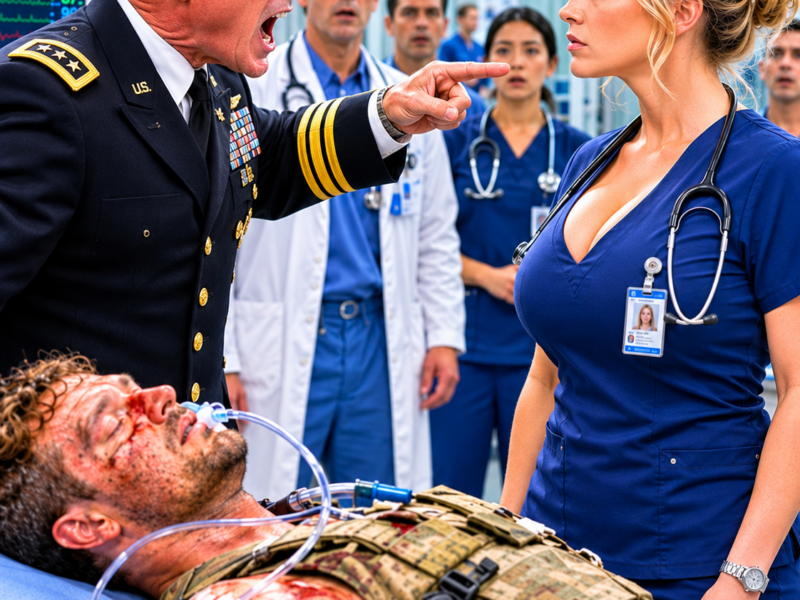
“I was halfway through saving a dying soldier’s daughter when her father, a decorated brigadier general, pointed at me in the middle of Mercy General Hospital
I looked at the paper again.
My name was printed beneath the heading marked LAST MEDICAL PROVIDER.
For a moment, the sounds of Trauma Bay Two seemed to fade.
The monitor continued its steady rhythm beside Devlin’s bed, Petra was checking the IV lines, and somewhere beyond the curtain, another patient was asking for pain medication.
But I wasn’t in San Antonio anymore.
I was back in Helmand Province, standing beside a damaged helicopter with blood running down my sleeves.
“General,” I said carefully, “I need to see the complete medical record.”
Owen didn’t move.
“Tell me what happened.”
“I can’t tell you based on one line on a computer screen.”
“Then tell me what you remember.”
I looked at Devlin.
Her eyes were closed, but I wasn’t certain she was asleep.
“Not here.”
Owen glanced toward his daughter and nodded.
We stepped into the hallway.
The fluorescent lights made his uniform look almost colorless.
He folded the paper once, then opened it again.
“Devlin was deployed to Helmand in October 2019,” he said. “She was a young lieutenant then. She was assigned to a medical support element attached to a Marine convoy.”
“I remember.”
“She told me the convoy had taken fire. She said one of the aircraft was damaged during extraction.”
I kept my eyes on him.
“That isn’t the whole story.”
His expression hardened.
“What aren’t you telling me?”
I took a breath.
“Your daughter wasn’t supposed to be on that aircraft.”
He stared at me.
“What?”
“She had been assigned to another medical team. When the convoy was hit, she volunteered to accompany the evacuation crew because one of the Marines had a severe abdominal injury.”
“She never told me that.”
“She probably didn’t want you to worry.”
Owen looked down the corridor.
“She always did that.”
For the first time, I heard something in his voice that had nothing to do with military rank.
Regret.
I leaned against the wall.
“That night, our aircraft took a hit during extraction. We lost power to one engine. The pilot tried to bring us down near the river.”
I could still smell the fuel.
I could still hear the metal twisting.
“The impact threw everyone forward. One crew member was trapped. A Marine had a head injury. Your daughter was bleeding from her side.”
Owen’s fingers tightened around the folded paper.
“How badly?”
“Badly enough that I thought we might lose her.”
He looked toward the trauma bay.
“And you treated her?”
“I tried.”
I paused.
“She treated herself, too.”
His eyebrows drew together.
“She was injured.”
“She knew that. But she was conscious, and she kept asking about the other people. She wouldn’t let me focus on her until I had checked the crew chief.”
Owen lowered his head.
“That sounds like Devlin.”
“It does.”
For several seconds, neither of us spoke.
Then he asked, “Why was the incident marked confidential?”
I shook my head.
“That’s what I don’t know.”
He looked at the paper again.
“Someone requested this record last month.”
I nodded.
“Apparently.”
“Who?”
“That’s what we need to find out.”
He reached into his jacket and took out his phone.
I put a hand up.
“General, please don’t make calls before we understand what we’re looking at.”
His eyes narrowed.
“Someone has been looking into my daughter’s medical history without my knowledge.”
“Your daughter is an adult. Her medical history belongs to her.”
He looked at me for a moment.
Then he slowly put the phone away.
“You are right.”
I hadn’t expected him to say that.
“Thank you.”
He gave a tired nod.
“Tell me what happened after the aircraft went down.”
I glanced through the glass at Devlin.
“I kept her alive long enough for the rescue team to reach us. But there was something else.”
“What?”
“Before we were extracted, she asked me to make a promise.”
“What promise?”
I looked back at him.
“She made me swear I wouldn’t tell anyone what she had found in the convoy.”
His expression changed.
“What did she find?”
“I never found out.”
Owen looked almost offended.
“You’re telling me my daughter asked you to keep a secret, and you don’t know what it was?”
“She was losing blood. She was confused. I thought it was the injury talking.”
“But you remember it.”
“Every word.”
I could still hear her voice.
Celeste, don’t let them put my name on it.
At the time, I thought she was referring to a casualty report.
I had no idea what she meant.
Until now.
At 4:06 a.m., Devlin was settled in the surgical ICU.
Her blood pressure remained stable, and Dr. Langford had ordered continued monitoring rather than immediate surgery.
Owen sat beside her bed.
He had removed his service jacket and draped it over the back of a chair.
Without the decorations and the formal uniform, he looked older.
His daughter’s hand rested in his.
I was reviewing the overnight chart when Devlin opened her eyes.
“Celeste?”
I stepped closer.
“I’m here.”
She looked toward the chair.
“Dad?”
Owen leaned forward.
“Right here, sweetheart.”
Her gaze moved between us.
Then she noticed the paper in his hand.
“What did you find?”
Owen didn’t answer immediately.
“Your medical record from Afghanistan.”
Her expression changed.
Not surprise.
Recognition.
She looked at me.
“You saw it?”
I nodded.
“Yes.”
She closed her eyes briefly.
“Damn it.”
Owen straightened.
“Devlin, what happened in Helmand?”
She swallowed.
“Not now, Dad.”
“You asked this woman to keep a secret. Her name is in a confidential military record. Someone has been reviewing your medical history. I think I’ve earned an explanation.”
Devlin turned her face toward the window.
“You haven’t earned anything by being my father.”
The words landed harder than she probably intended.
Owen leaned back.
I looked at Devlin.
“You’re not required to explain anything while you’re recovering.”
She gave me a small, grateful look.
Then she reached for the water cup.
“Can I have some?”
I helped her take a sip.
Her fingers were trembling.
After a moment, she whispered, “I didn’t think anyone would connect the two records.”
“What two records?” Owen asked.
Devlin looked at him.
“The aircraft incident and the convoy report.”
He went still.
“What convoy report?”
She looked away again.
“There’s a reason I never told you.”
At 5:30 a.m., Dr. Langford came to check her again.
Her pressure had improved, and the repeat ultrasound showed no significant increase in the bleeding.
He was cautiously optimistic.
“You’re not out of danger yet,” he told her, “but you’re moving in the right direction.”
Devlin gave him a tired smile.
“That’s the nicest thing anyone has said to me tonight.”
He adjusted the monitor lead.
“Try not to make a habit of coming here.”
After he left, I returned to the nurses’ station.
I couldn’t stop thinking about the old report.
I opened the hospital’s records system and reviewed the information available to us.
The confidential note had been attached to a scanned military transfer document.
There was a reference number, a date, and a contact office.
No details about the original investigation.
I called the hospital’s medical records supervisor.
She arrived twenty minutes later, carrying a folder.
“Celeste, this is unusual.”
“How unusual?”
“The request came through an authorized military medical liaison. But the authorization was limited to verifying a previous injury.”
“Then why is there an investigative reference attached?”
She looked at the document.
“That’s what I couldn’t understand.”
She pointed to the bottom.
“There’s a second signature here.”
I leaned closer.
The name was familiar.
Colonel Marcus Hale.
I remembered him from Helmand.
He had been the senior logistics officer coordinating the convoy’s movement that night.
He had also been the officer who arrived at the crash site after the rescue helicopter.
And he had been the one who told me not to discuss what I had seen.
My mouth went dry.
“Can you print the authorization history?”
“Yes, but I’ll need the compliance office to release the full audit trail.”
“Please do that.”
She nodded.
Before leaving, she looked at me.
“Is this connected to Captain Parish?”
“Possibly.”
She hesitated.
“Then be careful. There are some people who don’t like having old records reopened.”
I didn’t answer.
I was beginning to understand why.
At 7:15 a.m., Owen found me outside the ICU.
“Devlin wants to speak with you.”
I followed him inside.
She was sitting slightly upright, with a blanket pulled over her legs.
Her face still looked pale, but her eyes were clearer.
“Close the door,” she said.
Owen did.
Devlin looked at him.
“I need you to listen before you decide what this means.”
He pulled the chair closer.
“All right.”
She took a slow breath.
“That night in Helmand, the convoy was transporting medical supplies and classified communications equipment. We had been told the route was secure.”
Owen nodded.
“I remember the operation.”
“Halfway through the route, one of the vehicles stopped. The driver reported a mechanical issue.”
“That wasn’t in the official report.”
“No.”
She looked at me.
“Because it wasn’t a mechanical issue.”
I felt the old memory return.
A vehicle parked at an angle.
A soldier arguing with another soldier.
A radio transmission that didn’t make sense.
Devlin continued.
“Someone had changed the convoy’s route shortly before departure. The original route was supposed to avoid a section of road where an explosive device had been reported.”
Owen’s expression tightened.
“Who changed it?”
“Colonel Hale.”
He sat back.
“Marcus Hale?”
She nodded.
“At the time, I thought it was a communications mistake. Then we found something in the damaged vehicle.”
“What?”
“A second radio and a handwritten list of vehicle numbers.”
I looked at her.
“That’s what you were talking about before the rescue.”
Devlin nodded.
“I found the list beside the injured driver.”
Owen rubbed his forehead.
“What was on it?”
“Vehicle identification numbers. Departure times. Names of the personnel assigned to each vehicle.”
“Why would someone keep that?”
“Because someone had been tracking our movements.”
The room became very quiet.
Owen looked at his daughter.
“Are you saying someone gave the convoy’s position to the people who attacked it?”
“I’m saying the evidence suggested that.”
“Did you report it?”
“I tried.”
Her voice weakened.
“I gave the list to Colonel Hale because he said he would secure it and forward it through the proper channels.”
I remembered the colonel’s face.
His clean uniform.
His dry hands.
The way he had looked at the blood covering my sleeves.
“What happened next?” I asked.
Devlin looked at me.
“He told me the list had been destroyed in the crash.”
I shook my head.
“But you found it.”
She nodded.
“I kept a photograph.”
Owen leaned forward.
“Where is it?”
Devlin hesitated.
“I don’t have it anymore.”
“Who does?”
She looked at him.
“I gave it to someone I trusted.”
“Who?”
“Staff Sergeant Elmore.”
I remembered Elmore.
The crew chief I had kept alive in the wreckage.
The man who had spent two hours asking me whether he was going to die.
“He’s alive?” I asked.
Devlin nodded.
“He survived. He was discharged a year later.”
Owen looked between us.
“Why didn’t anyone tell me?”
Devlin’s eyes filled.
“Because the first person who tried to report what happened was removed from the operation.”
“Who?”
“Me.”
She swallowed.
“They said I had violated operational security. They said I had taken classified material without authorization. My statement disappeared from the official investigation.”
Owen’s face had gone pale beneath his military bearing.
“Why didn’t you come to me?”
Devlin looked at him for a long time.
“Because you were the one who signed the deployment authorization.”
He didn’t speak.
She continued.
“I knew you hadn’t ordered anyone to change the route. But I also knew that if I came to you, you’d try to fix it through the chain of command.”
“That’s what a commander does.”
“That’s what a commander is supposed to do.”
Her voice cracked.
“But I needed someone to believe me before the same people who erased my report had time to erase everything else.”
Owen stared at the floor.
I watched him struggle with the realization that his daughter had spent years carrying something he hadn’t known existed.
Finally, he asked, “What happened to your military career?”
Devlin gave a humorless smile.
“I was reassigned. Then the promotion board delayed my advancement. Eventually, I stopped asking why.”
Owen looked at her.
“You were supposed to be promoted two years ago.”
“I know.”
He rubbed his hands together.
“I thought you wanted to stay where you were.”
“I wanted to stay in the Army. I didn’t want to spend my life fighting people who were supposed to be protecting the soldiers I served.”
Nobody spoke for a while.
Then Devlin reached for my hand.
“There’s one more thing.”
I sat beside her.
“What is it?”
She looked directly at me.
“The list wasn’t the only thing I found.”
By 9:00 a.m., I had contacted the hospital’s compliance officer and requested preservation of every record connected to the original incident.
I wasn’t going to conduct an investigation from a hospital computer.
That wasn’t my job.
But I could make sure nobody altered the medical records while the proper authorities reviewed them.
Owen had called an attorney he trusted outside his military command.
He had also requested that his daughter’s original statements be preserved.
For the first time that morning, he wasn’t issuing orders.
He was asking questions.
At 9:40, Devlin told us what she had found.
The second item was a small memory card.
It contained photographs of the vehicle identification list, a series of radio logs, and an audio recording from the convoy’s communications channel.
The recording had been made shortly before the attack.
A voice could be heard confirming a change to the route.
Then another voice responded.
“Understood. Proceed as planned.”
The recording ended less than two minutes before the explosion.
I listened to the description twice.
“Do you recognize the voices?” I asked.
Devlin nodded.
“One was the communications officer. The other was Colonel Hale.”
Owen stood near the window.
“Where is the memory card now?”
“I gave it to Elmore.”
“Does he still have it?”
“I don’t know.”
I looked at her.
“Why did you give it to him?”
“Because I didn’t know who else I could trust.”
She paused.
“And because he was the one who had been hurt most by what happened.”
Owen closed his eyes.
He had spent years believing that his daughter’s career had simply stalled.
Now he was hearing that she had been trying to expose something that might have endangered an entire convoy.
“How do we find Elmore?” he asked.
Devlin shook her head.
“I haven’t spoken to him in over a year.”
I remembered the after-action report.
The name.
The address attached to the original casualty follow-up.
“I might be able to help.”
Owen turned.
“How?”
“I still have the contact information from the medical follow-up paperwork.”
He stared at me.
“You kept it?”
“I kept several records from that deployment.”
“Why?”
I looked at him.
“Because I learned a long time ago that memories aren’t always enough when someone decides to change the paperwork.”
It took nearly three hours to locate Staff Sergeant Daniel Elmore.
He was living outside Austin, Texas, working as a maintenance supervisor at a commercial aviation facility.
He answered my call on the fourth ring.
“Hello?”
“Daniel? This is Celeste Drummond.”
Silence.
Then a rough laugh.
“Well, I’ll be damned.”
“It’s been a while.”
“Seven years, give or take.”
“How are you?”
“Still walking. Still complaining. Still hate helicopters.”
I smiled faintly.
“I’m glad you’re doing well.”
He paused.
“Why are you calling?”
I glanced at Owen, who was standing across the ICU waiting area.
“I’m calling because of Devlin Parish.”
The humor disappeared from his voice.
“Is she okay?”
“She’s in the hospital, but she’s stable.”
“What happened?”
“An internal injury. She’s being monitored.”
“Tell her I said she’s not allowed to die before I get to yell at her.”
“I’ll tell her.”
There was another pause.
Then I said, “Daniel, do you still have the memory card?”
I heard him breathe out.
“Who told you about that?”
“Devlin.”
“Is she asking for it?”
“She needs to know whether you still have it.”
He didn’t answer immediately.
Then he said, “I have it.”
Owen moved closer.
“Can you bring it to us?”
Elmore was quiet.
“Who’s with you?”
“General Parish.”
Another pause.
“Well, that’s interesting.”
Owen leaned toward the phone.
“Staff Sergeant, this is Owen Parish.”
“Sir.”
“I’d like to speak with you.”
“Respectfully, General, I don’t know if that’s a good idea.”
Owen accepted the hesitation without argument.
“I understand.”
Elmore continued.
“I spent a year trying to get someone to listen to what happened. Every office sent me somewhere else. Eventually, I stopped calling.”
Owen’s voice was low.
“I should have known.”
“You weren’t the one who was there when they questioned us.”
“No. But I was the commander.”
Elmore exhaled.
“I’ll come to San Antonio tomorrow.”
“Thank you.”
“And General?”
“Yes?”
“Don’t tell Colonel Hale.”
Owen’s expression hardened.
“I won’t.”
Daniel Elmore arrived the following afternoon.
He was 39, broad-shouldered, and walked with a slight limp.
He carried a small black case.
When he entered Devlin’s room, she looked at him for several seconds before smiling.
“You’re late.”
He set the case down.
“You’ve been difficult to visit.”
She laughed, then winced.
“Don’t make me laugh. It hurts.”
He pulled a chair beside her bed.
For a while, neither spoke.
Then he reached for her hand.
“I’m glad you’re still here.”
“Me too.”
He looked at Owen.
“General.”
Owen stood.
“Staff Sergeant.”
Elmore opened the case.
Inside was a small memory card sealed in a plastic evidence envelope.
“I never opened it after she gave it to me,” he said. “I made a copy, then stored the original.”
“Why didn’t you report it?” Owen asked.
Elmore looked at him.
“I did.”
Owen waited.
“Three times. The first time, my statement disappeared. The second time, I was told I had suffered a head injury and my memory might be unreliable. The third time, someone came to my apartment and suggested I should stop asking questions.”
Owen’s face tightened.
“Who?”
“I never saw his face clearly.”
Elmore looked at Devlin.
“But I remembered what you told me.”
She looked confused.
“What?”
“That the truth doesn’t get less true because somebody with a better office doesn’t like it.”
Devlin lowered her eyes.
I watched her wipe a tear from her cheek.
For the first time, she looked less like a captain and more like the young woman who had been lying in the wreckage seven years earlier.
The memory card was handed over through the appropriate investigative channels.
Owen’s attorney arranged for independent forensic examination, and the hospital’s compliance officer documented the transfer because the original records had been accessed through a hospital system.
No one in our trauma department was going to pretend we could investigate a military incident.
But we could make sure the evidence was handled correctly.
Three days later, an investigator from the Army’s independent oversight office arrived.
He interviewed Devlin first.
Then Elmore.
Then me.
I described the aircraft crash, the medical treatment, the convoy conditions, and the conversation I remembered with Devlin.
I didn’t embellish anything.
I didn’t claim to know what the recording proved.
I simply told them what I had seen.
When the investigator asked why I hadn’t reported the confidential conversation earlier, I explained that Devlin had been injured, that I had been ordered to focus on casualty care, and that I had never been given evidence of a wider investigation.
He nodded and wrote everything down.
Before leaving, he said something that stayed with me.
“Sometimes the hardest part of an investigation is establishing which documents were never allowed to become part of the record.”
I knew exactly what he meant.
The investigation lasted four months.
During that time, Devlin underwent regular imaging and physical therapy.
Her spleen healed without surgery, although she needed time to regain her strength.
Owen visited her whenever his schedule allowed.
At first, their conversations were uncomfortable.
He wanted to know why she hadn’t trusted him.
She wanted him to understand that being his daughter had sometimes made it harder to speak freely.
One afternoon, I found them arguing quietly in the ICU family room.
“You could have told me,” Owen said.
Devlin shook her head.
“I tried.”
“You never came to me.”
“I sent you a message.”
He looked confused.
“What message?”
She reached into her bag and pulled out an old phone.
It was cracked along one corner.
She opened an archived message thread.
The date was October 23, 2019.
The message was short.
Dad, something happened on this deployment. I think the official report is wrong. I need to talk to you privately before I make a statement.
Below it was a delivery confirmation.
No reply.
Owen stared at the screen.
“I never saw this.”
“I know.”
He looked at the date again.
“I was in Washington that week. There were hearings. I had dozens of messages.”
Devlin nodded.
“I know that, too.”
He lowered himself into the chair.
“I should have called.”
She looked away.
“Yes.”
There was no anger in her voice.
That somehow made it worse.
Owen reached for her hand.
“I’m sorry.”
Devlin didn’t pull away.
But she didn’t immediately take his hand either.
“I needed my father that week,” she said. “Not a general.”
Owen bowed his head.
“I understand.”
For once, he didn’t try to explain himself.
He simply stayed beside her.
The first major development came in the fifth month.
The forensic examination confirmed that the audio recording had not been edited.
The radio logs also contained discrepancies between the original operational record and the version submitted after the attack.
Investigators found that the convoy’s route had been changed without the required approval.
They also discovered that an earlier warning about suspicious communications had been removed from the final report.
The evidence did not immediately prove who had leaked the convoy’s position.
But it established that the official account was incomplete.
Colonel Marcus Hale was placed under investigation.
Several other personnel were interviewed.
A retired communications officer eventually provided a statement confirming that he had received an instruction to alter the route.
He had been told it came from a higher authority.
He had never questioned it.
He had also never forgotten the names of the Marines who died.
When investigators showed him the recording, he recognized the voice.
He agreed to cooperate.
That testimony changed the direction of the case.
The inquiry uncovered a chain of unauthorized communications involving a contractor who had access to convoy schedules.
The contractor had been passing movement information to an intermediary outside the military.
Whether Colonel Hale had knowingly participated in the leak or had been reckless in handling the information became a central question.
But the evidence was no longer something that could be dismissed as a wounded soldier’s unreliable memory.
The official investigation was reopened.
The earlier findings were withdrawn.
Devlin’s disciplinary record was corrected.
And the promotion review that had been delayed for years was finally reconsidered.
When Owen received the news, he called his daughter immediately.
She listened quietly.
Then she said, “That’s good.”
He laughed softly.
“That’s all?”
“What do you want me to say?”
“I thought you might be happy.”
“I am.”
She paused.
“But it doesn’t bring anyone back.”
Owen didn’t argue.
He knew she was right.
The final report was released eight months after the night Devlin arrived at Mercy General.
It confirmed that the convoy had been sent along an unauthorized route despite an existing threat warning.
It also found that evidence provided by Devlin and Elmore had been improperly excluded from the original inquiry.
Colonel Hale was charged under military law for offenses related to the mishandling of classified operational information and falsification of official records.
The contractor who had received the convoy schedules was also prosecuted.
The investigation did not establish that every decision had been made with the intention of causing the attack.
Some failures came from deliberate deception.
Others came from negligence, fear, and people protecting their careers.
That distinction mattered to the investigators.
It also mattered to the families of the Marines who had died.
For Devlin, the most important part of the report was one sentence.
Her actions had not violated operational security.
She had been trying to preserve evidence of a serious breach.
The Army formally corrected her record.
She was offered the opportunity to return to her previous assignment.
She declined.
Instead, she requested a position in medical training, where she could prepare younger combat medics for the situations she had survived.
Owen supported the decision.
He didn’t try to persuade her to return to the career path he had imagined for her.
That was something new between them.
A year after that night, I received an envelope at the hospital.
There was no official seal on the front.
Inside was a letter from Brigadier General Owen Parish.
It was brief.
He thanked me for saving his daughter.
He thanked me for keeping the old evidence safe.
And he apologized for the way he had spoken to me in Trauma Bay Two.
At the bottom, he had written:
“I spent much of my life believing leadership meant having the authority to make people listen. That night, I watched you make my daughter feel safe without raising your voice once. I wish I had understood sooner that those are not the same thing.”
I folded the letter and placed it in my desk drawer.
Not because I needed recognition.
Because it reminded me that sometimes people learn something important only after the thing they love most is almost taken away.
Devlin came back to Mercy General six months later.
She was wearing civilian clothes and walking without a limp.
Her hair was shorter.
The color had returned to her face.
She found me at the nurses’ station.
“Drummond.”
I looked up.
“Captain Parish.”
She smiled.
“Still calling me Captain?”
“Until you tell me otherwise.”
She laughed.
We walked toward the hospital courtyard.
The late afternoon sun fell across the benches, and the air smelled faintly of fresh rain.
She told me she had started teaching new combat medics.
She was helping them understand that the first thing they needed to learn wasn’t how to stop bleeding.
It was how to recognize when someone was too frightened to admit they were hurt.
I thought that sounded like her.
Then she reached into her bag and handed me a photograph.
It showed the convoy crew standing together before the deployment.
Some were smiling.
Some looked exhausted.
At the far end stood a younger Devlin, her arm around Daniel Elmore.
I recognized myself in the background.
I was carrying a medical bag and looking away from the camera.
On the back, Devlin had written:
For the people who stayed.
I looked at the photograph for a long time.
“Thank you,” I said.
She nodded.
Then she told me something I hadn’t known.
“Elmore visits the memorial every year.”
“I didn’t know.”
“He says he goes because he wants to remember the people who didn’t get to come home.”
She looked across the courtyard.
“I think I’m going to start going with him.”
I placed the photograph carefully inside my pocket.
We stood there without speaking for a while.
The hospital doors opened behind us, and a nurse called my name.
Another patient needed attention.
Devlin gave me a small salute.
I returned it with a smile.
Then I went back inside.
That night, I was assigned to Trauma Bay Two again.
At 2:14 a.m., the ambulance doors opened.
A young man was brought in with a severe leg injury.
His mother followed behind him, crying and trying to keep up with the paramedics.
I stepped toward the gurney.
“You’re safe now,” I told him. “We’re going to take care of you.”
He looked at me with frightened eyes.
“Am I going to lose my leg?”
I glanced at the monitor, then at the team assembling around him.
“Not if we can help it.”
I took his hand for a moment before turning back to the work.
There would always be another siren.
Another frightened family.
Another person who needed someone to remain calm when the world around them was falling apart.
I had learned that medals could be delayed, reports could be rewritten, and even the truth could spend years waiting for someone willing to listen.
But a life in front of you could never wait.
And when the next patient came through those doors, I wanted my hands to be ready.
Because that was the promise I had made long before anyone knew my name.
And it was the one promise I never intended to break.
The End.









