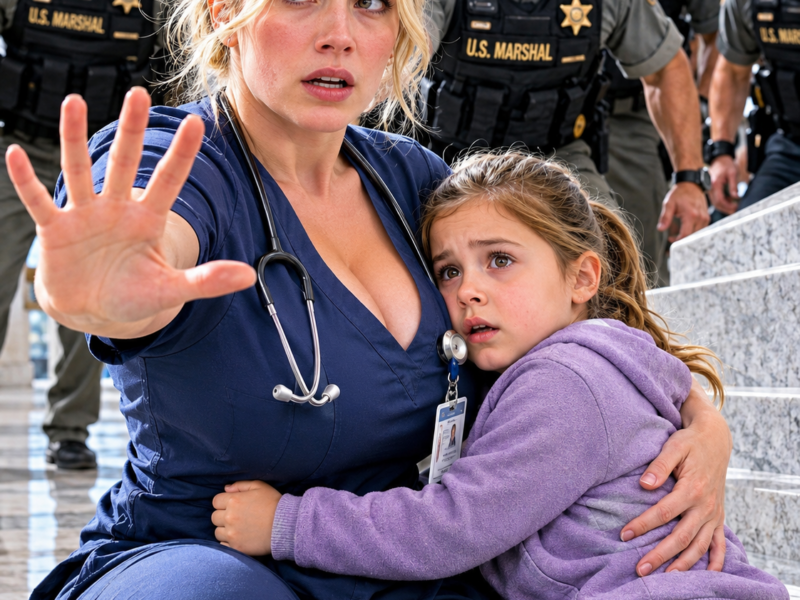
“I was the newest nurse in the courthouse when five federal marshals rushed toward an injured eight-year-old girl, and I stepped directly in front of them
viết task 2 có The end ở cuối
I leaned closer to Sophie, careful not to touch her head or shoulders.
“What do you mean, sweetheart? It wasn’t the first time what happened?”
Sophie swallowed.
Her eyes moved toward the staircase again.
“Someone pushed me.”
The words were so quiet that, for a moment, I wasn’t sure I had heard them correctly.
The lead paramedic stopped preparing his equipment.
Hayes looked at Mercer.
Mercer immediately raised one hand.
“Nobody moves. Give her some room.”
I lowered my voice.
“Sophie, you’re safe right now. Nobody is angry with you. Can you tell me what you remember?”
The little girl tightened her right hand around my sleeve.
“I was looking for my mom.”
“Okay.”
“She told me to wait by the elevators, but I saw someone I knew.”
“Who did you see?”
Sophie hesitated.
Then she looked at the staircase.
“He was wearing a blue jacket.”
Mercer glanced toward Hayes.
“Did anyone see another person near the stairs?”
Hayes shook her head.
“Not that I know of.”
The paramedic gently interrupted.
“We need to keep our attention on her medical condition. We can get the details once she’s safely transferred.”
He was right.
Whatever Sophie remembered, her medical care came first.
I turned back to her.
“We’re going to take you to the hospital now. The doctors will help your arm and make sure everything else is okay.”
“Will my mom come?”
“She’s waiting for you.”
Sophie nodded, but her eyes remained fixed on the staircase.
I wondered what she had seen.
More importantly, I wondered why she seemed more frightened of the person she remembered than of the pain in her arm.
The paramedic completed his assessment and explained the transfer procedure.
Mercer assigned two marshals to assist with the stretcher.
Nobody moved until the paramedic gave the instructions.
“On my count. One coordinated movement. Nobody changes position unless I tell you.”
Sophie looked at me.
“You’re coming?”
“I’m staying until you’re safely handed over.”
She held my fingers.
The team lifted together.
We transferred her onto the stretcher without rushing, and the paramedics secured her for transport.
As we approached the elevator, Mercer moved ahead to clear the corridor.
Hayes walked behind the stretcher.
I stayed beside Sophie.
“Can I ask you something?” she whispered.
“Of course.”
“Are you going to tell the police what I said?”
I looked at her.
“Only the people who need to know so they can keep you safe.”
She considered that answer.
Then she nodded.
The elevator doors opened.
The paramedics rolled her inside, and I stepped out when the lead paramedic told me they had enough room.
Sophie looked at me through the narrowing gap.
“Don’t forget what I said.”
“I won’t.”
The doors closed.
For several seconds, I stood in the empty corridor listening to the elevator descend.
Mercer approached.
“Her mother has been located. She’s at the south entrance.”
“Good.”
He studied my face.
“Did she tell you something?”
“She said someone pushed her.”
His expression changed.
“Did she identify the person?”
“She described a blue jacket. She said she knew him.”
Mercer immediately reached for his radio.
“Hayes, stay with the incident team. We may have a witness statement from the child. Preserve the relevant security footage and document who had access to the stairwell.”
Then he looked at me.
“Don’t question her further. Let the investigators handle that.”
I nodded.
He was right again.
I had a responsibility to Sophie, but that didn’t mean I should turn her into an interview subject.
At the hospital, her mother was waiting near the emergency department entrance.
The moment she saw the stretcher, she rushed forward.
“Sophie!”
The little girl started crying.
“Mom!”
Her mother, Rachel Bennett, took her daughter’s right hand and kissed it repeatedly.
“I’m here, baby. I’m right here.”
I stepped back while the paramedics gave their report.
Rachel noticed me.
“You’re Evelyn?”
I nodded.
“They told me you stayed with her.”
“She needed someone beside her.”
Rachel wiped her cheeks.
“Thank you. I don’t know what I would have done if something happened to her.”
I wanted to tell her that Sophie was in the right place now.
Instead, I simply said, “The doctors are going to take good care of her.”
The emergency physician examined Sophie and ordered imaging because of the neurological symptoms.
While we waited, Rachel sat beside the bed.
She hadn’t released her daughter’s hand once.
I was preparing to return to the courthouse when Sophie called my name.
“Evelyn?”
I turned.
“Yes?”
“Can you stay until they come back?”
Rachel looked at me apologetically.
“I’m sorry. She’s been scared since the evacuation.”
“There’s nothing to apologize for.”
I pulled a chair closer.
The next hour passed slowly.
A nurse checked Sophie’s sensation and movement.
A doctor reviewed the initial images.
Finally, the physician returned with the results.
“We found a small injury involving the cervical spinal cord,” he explained. “There’s swelling, but no fracture or unstable damage that requires emergency surgery right now.”
Rachel covered her mouth.
“Is she going to be okay?”
“We’re encouraged by what we’re seeing. We’ll protect her neck, monitor her neurological function, and have the pediatric spine team evaluate her.”
I watched Rachel’s shoulders drop slightly.
She had been holding herself upright through sheer determination.
Now she finally allowed herself to cry.
Sophie looked at her mother.
“Am I going to be able to use my hand again?”
The doctor crouched beside the bed.
“That’s what we’re going to work on. We already see some encouraging signs, but we need to take this carefully.”
Sophie nodded.
Rachel kissed her forehead.
When the doctor left, I noticed Sophie looking toward the doorway.
“Is he here?”
“Who, sweetheart?”
“The man in the blue jacket.”
Rachel looked at her daughter.
“What man?”
Sophie didn’t answer.
I glanced at Rachel.
Her face had changed.
Not dramatically.
Just enough for me to notice.
“Do you know someone who wears a blue jacket?” I asked.
Rachel shook her head too quickly.
“Lots of people wear blue jackets.”
I didn’t press her.
But I remembered Sophie’s words.
It wasn’t the first time.
And I couldn’t shake the feeling that Rachel knew more than she was saying.
A little later, Mercer called.
“How is the child?”
“Stable. The doctors found a spinal cord injury, but they don’t believe she needs emergency surgery.”
“Good. I need to tell you something.”
I stepped into the hallway.
“We reviewed the courthouse cameras. The staircase camera was working, but the footage has a gap.”
“What kind of gap?”
“Four minutes are missing from the recording.”
I leaned against the wall.
“Technical failure?”
“That’s what the initial system report says.”
“And you believe it?”
There was a pause.
“I believe we need to find out why.”
He told me the security team had discovered that the camera system had been accessed shortly before the evacuation.
Someone had requested maintenance access.
The request was approved using an employee credential.
Mercer wouldn’t give me the person’s name over the phone.
He said investigators were handling it.
I returned to Sophie’s room.
Rachel was standing beside the window, speaking quietly into her phone.
When she saw me, she ended the call.
“Everything okay?” I asked.
“Yes.”
Her voice sounded strained.
Sophie was watching her.
“Mom?”
Rachel turned.
“What is it, baby?”
“Did you tell him?”
Rachel went completely still.
I looked between them.
“Tell who?”
Rachel moved toward the bed.
“Sophie, sweetheart, you need to rest.”
But Sophie pulled her hand away.
“You said not to tell anyone.”
Rachel’s face crumpled.
“Not now.”
That was when I understood that the fall might be connected to something that had happened long before the evacuation.
I didn’t know what.
I only knew that the little girl was afraid to speak in front of her own mother.
I excused myself and went to find the hospital charge nurse.
I wasn’t going to investigate a possible crime.
But I could make sure Sophie had access to someone she could speak to privately.
The charge nurse contacted the appropriate hospital safeguarding staff.
A child protection specialist came to the room later that afternoon.
She introduced herself to Sophie and explained that she wasn’t in trouble.
Rachel was asked to wait outside while they spoke.
I remained nearby because Sophie had requested me.
The specialist sat beside the bed.
“Can you tell me what you meant when you said it wasn’t the first time?”
Sophie stared at the blanket.
Then she began speaking.
Three weeks earlier, she had been visiting her father, Michael Bennett.
Her parents had separated the previous year.
Michael worked as a security systems contractor.
He occasionally performed maintenance at government buildings, including the courthouse.
Sophie had been with him when he received a phone call.
She remembered hearing him argue with someone about a security recording.
He had told the caller that he wasn’t going to delete anything.
Later, he had taken her to the courthouse because he needed to deliver some paperwork.
That’s when Sophie had seen a man in a blue jacket standing near the stairs.
The man had approached Michael.
They argued.
Sophie couldn’t hear everything, but she remembered one sentence.
“You were supposed to erase it.”
Michael had told him to leave.
The man had noticed Sophie watching.
He had smiled at her.
But it wasn’t a friendly smile.
The child protection specialist listened without interrupting.
Then she asked, “Did you see that man today?”
Sophie nodded.
“He was on the stairs.”
“Did he touch you?”
Sophie looked down.
“He told me my dad was a liar.”
The specialist waited.
Sophie continued.
“I tried to go find Mom. Then he grabbed my backpack.”
Her voice became smaller.
“I pulled away, and he pushed me.”
The room became quiet.
Rachel was still outside.
I could hear her speaking to someone in the hallway.
The specialist thanked Sophie for telling her and explained that the appropriate investigators would speak with her again when she was ready.
When she left, I stayed beside the bed.
Sophie looked at me.
“Is my dad in trouble?”
“I don’t know, sweetheart.”
“He’s not bad.”
I gently adjusted the blanket near her uninjured hand.
“You don’t have to decide that right now.”
She looked away.
“I just wanted him to tell the truth.”
I didn’t know what to say.
Sometimes adults created situations so complicated that children ended up carrying pieces of their fear.
Sophie had been carrying hers alone.
That evening, Mercer arrived at the hospital.
He waited outside the room until Rachel agreed to speak with him.
I wasn’t present for their conversation, but I saw Rachel afterward.
She looked as though someone had taken away the ground beneath her feet.
Mercer found me near the nurses’ station.
“We identified the man in the blue jacket.”
“Who is he?”
“His name is Grant Holloway. He was a courthouse facilities supervisor.”
“What was he doing near the staircase?”
“We’re still investigating.”
He lowered his voice.
“The missing footage was accessed through a maintenance account. That account belonged to Michael Bennett.”
I stared at him.
“Sophie’s father?”
“Yes.”
I thought about the little girl asking whether her father was in trouble.
“Did he erase the footage?”
“Not necessarily. The access log tells us whose credentials were used. It doesn’t prove who was behind the keyboard.”
“Could someone else have used them?”
“That’s one of the things we’re checking.”
Mercer paused.
“There’s something else. Holloway was seen leaving the building shortly after the evacuation began.”
“Have you found him?”
“Not yet.”
He gave me a reassuring nod.
“We have investigators working on it.”
I returned to Sophie’s room.
Rachel was sitting beside her daughter, holding a folded piece of paper.
She looked up when I entered.
“Evelyn, can I ask you something?”
“Of course.”
“Did Sophie tell you about her father?”
I nodded.
Rachel looked at the paper in her hand.
“It’s a photograph.”
She unfolded it.
It showed Sophie standing between her parents at a summer fair.
Michael had one arm around his daughter.
Rachel was smiling.
The three of them looked like an ordinary family.
“That was before everything happened,” Rachel said.
I waited.
“Michael and I separated because he became obsessed with something at work. He said he had discovered evidence that someone was falsifying security records.”
She looked toward Sophie.
“He started keeping copies of everything. He wouldn’t tell me what he had found.”
“Did you believe him?”
Rachel’s eyes filled.
“At first, yes. Then he started missing visits. He’d cancel plans because he had to meet investigators or check records. I thought he was choosing his job over his daughter.”
She folded the photograph again.
“Eventually, I stopped listening.”
I didn’t know what to say.
Rachel continued.
“When Sophie told me she had seen someone at the courthouse, I thought she was confused. I told her not to repeat things she didn’t understand.”
She pressed her fingers against her forehead.
“I thought I was protecting her.”
The words stayed between us.
Sophie had been trying to tell her mother something.
Her mother had been too frightened, too exhausted, or too hurt to hear it.
The next morning, the courthouse investigation took a significant turn.
Mercer called the hospital.
They had found a second copy of the missing recording.
It wasn’t on the courthouse server.
It was stored on an external drive in a secure office.
The footage showed Grant Holloway entering the staircase area shortly before Sophie fell.
It also showed Michael Bennett arriving several minutes earlier.
But the most important detail was something neither man had noticed.
A third person had entered the corridor.
The person was carrying a maintenance case.
The footage didn’t show the face clearly.
However, the person stopped beside the security control panel.
The time stamp matched the moment the camera recording was interrupted.
Mercer told me the investigators were trying to identify that person.
I asked whether Sophie had been shown the footage.
“No. We’re not showing her anything that could influence her memory.”
I was relieved.
That afternoon, Sophie managed to move two fingers on her left hand.
The improvement was small, but the physical therapist smiled.
“That’s a good sign.”
Rachel cried again.
This time, she smiled while doing it.
I was finishing my shift when a man approached the nurses’ station.
He looked tired.
His hair was uncombed, and his jacket was damp from the rain.
He carried a small paper bag.
“Excuse me. I’m looking for Sophie Bennett.”
I looked up.
“May I ask who you are?”
“Michael Bennett. I’m her father.”
I checked with the charge nurse before allowing him into the room.
Rachel was already there.
When she saw Michael, she stood.
For several seconds, neither of them spoke.
Then Michael looked at Sophie.
“Hey, peanut.”
Sophie stared at him.
“Daddy?”
He walked toward the bed, then stopped.
“Can I come closer?”
Sophie nodded.
He placed the paper bag on the bedside table.
Inside was a small stuffed rabbit with one floppy ear.
“You left this at my apartment,” he said.
Sophie began crying.
“I thought you weren’t coming.”
Michael sat down.
“I should have come sooner.”
Rachel turned toward the window.
I quietly stepped into the hallway.
Some conversations needed privacy.
A few minutes later, I heard voices rising.
Rachel was asking Michael why he had never told her what was happening.
Michael explained that he had been investigating irregularities in courthouse security records.
He had discovered that Grant Holloway had been using maintenance access to disable cameras during certain periods.
Those periods corresponded with missing evidence in several security incidents.
Michael had reported the issue internally.
But before the investigation could move forward, someone used his credentials to access the system and remove footage.
He believed Holloway had done it.
Rachel asked why he hadn’t told her.
“Because I was trying to keep you and Sophie out of it.”
“She got hurt anyway, Michael.”
He didn’t answer.
There was nothing he could say that would make that sentence less true.
Later, Mercer arrived with an update.
The investigators had identified the person carrying the maintenance case.
It was another facilities employee.
But the employee had been working under instructions from Holloway.
The investigation uncovered a scheme involving falsified maintenance records and deleted security footage.
Holloway had been using his position to conceal unauthorized access to restricted areas.
Michael had discovered the pattern and collected copies of the original logs.
The day Sophie fell, Holloway had confronted her because he believed Michael had kept another copy of the evidence.
He wanted to know where it was.
Sophie didn’t know.
She had only been with her father when he mentioned that he had made backups.
When she refused to tell him anything, Holloway grabbed her backpack.
She pulled away.
He pushed her.
The fall had caused the injury to her spinal cord.
Holloway had then left the building during the evacuation, hoping the security alert would make the incident look like an ordinary accident.
But there was one detail that mattered even more.
The missing camera footage had been recovered.
It showed the entire confrontation.
It showed Holloway approaching Sophie.
It showed him grabbing her backpack.
And it showed him pushing her toward the staircase.
There was no ambiguity.
He was arrested that evening.
The evidence also cleared Michael of the allegation that he had deliberately deleted the recording.
His credentials had been used without his authorization.
The original footage he had preserved helped investigators establish what had happened.
When Mercer told me, I felt a strange mixture of relief and sadness.
Relief because Sophie had been believed.
Sadness because she had needed to be hurt before the truth finally came out.
The following days were spent in the hospital.
Sophie continued to improve.
The numbness in her left hand gradually faded.
She regained movement in her fingers and began working with physical therapy.
Her doctors remained cautious.
They explained that recovery from spinal cord injuries could take time, and they would need to monitor her closely.
But she was making progress.
One morning, I entered her room to check her chart.
She was sitting up with a small bowl of cereal.
Rachel was reading beside her.
Michael was assembling a puzzle on the windowsill.
Sophie looked at me.
“Evelyn!”
“Good morning.”
“Look.”
She lifted her left hand.
Her fingers opened slowly.
Then she closed them again.
I smiled.
“That’s wonderful.”
“I can move them better now.”
“I can see that.”
She looked proud.
Michael stood and moved closer.
“She’s been practicing all morning.”
Rachel laughed softly.
“She made me count every single finger.”
Sophie grinned.
Then her expression became serious.
“Evelyn?”
“Yes?”
“Did you know I was going to get better?”
I pulled a chair beside her.
“I hoped you would. But I didn’t know. That’s why we were so careful.”
She looked at her hand.
“Because you didn’t move me?”
“Because we waited until the medical team could move you safely.”
She thought about that.
Then she nodded.
“Thank you for listening.”
I felt my throat tighten.
I reached for her uninjured hand.
“You did something brave, Sophie. You told people what happened, even when you were scared.”
She looked toward her parents.
“I thought Mom wouldn’t believe me.”
Rachel put down her book.
She moved closer to the bed.
“I should have listened the first time.”
Sophie looked at her.
Rachel took a breath.
“I’m sorry I made you feel like you couldn’t tell me things.”
Sophie didn’t answer immediately.
Then she held out her left hand.
Rachel took it carefully.
Michael looked away, giving them a moment.
There was no dramatic reconciliation.
No promise that everything would immediately return to how it had been.
But for the first time in a long while, the three of them were sitting together without arguing.
Sometimes that was where healing began.
A week later, Mercer and Hayes returned to the hospital to complete their follow-up report.
Sophie was preparing for another examination.
A transport aide had brought a wheelchair.
The nurse explained that she would help Sophie sit up slowly before transferring her.
Rachel held her daughter’s hand.
Michael moved the small table out of the way.
Mercer stood near the doorway.
For a moment, I saw the same instinct in him that I had witnessed on the courthouse floor.
He noticed the wheelchair was slightly too close to the bed.
His hand started moving toward it.
Then he stopped.
He looked at the transport aide.
“Would you like me to move the chair?”
The aide checked the space.
“Just a couple of inches to the left, please.”
Mercer moved it exactly as requested.
Then he stepped back.
Nobody applauded.
Nobody mentioned the courthouse.
There was no need.
The transfer went smoothly.
Sophie sat in the wheelchair, adjusted her left hand on her lap, and looked toward Mercer.
“Are you the man who wanted to pick me up?”
Mercer gave a small, uncomfortable smile.
“I was.”
“Why?”
“Because I thought getting you out quickly was the safest thing to do.”
Sophie considered his answer.
“Was it?”
He glanced at me.
Then he looked back at her.
“Not the way I was planning to do it.”
Sophie nodded.
“Okay.”
Mercer lowered himself slightly so they were at eye level.
“I should have listened sooner.”
She looked at him for a moment.
Then she said, “You listened eventually.”
He smiled.
“That’s true.”
Hayes opened the door.
The transport aide began guiding Sophie toward the elevator.
Rachel walked beside her.
Michael carried the stuffed rabbit.
Mercer stepped aside to give them room.
As they passed, Sophie lifted her left hand and waved.
It was a small movement.
A little unsteady.
But it was hers.
I waved back.
The elevator doors opened.
Her family disappeared inside.
I stood in the hallway for a moment after they were gone.
I remembered that courthouse staircase.
The pink sneaker lying near the railing.
Five marshals rushing forward.
A frightened little girl who couldn’t feel one of her hands.
And a decision that had seemed impossibly small at the time.
Sixty seconds.
That was all I had asked for.
But those sixty seconds had given everyone time to stop assuming they already knew what needed to happen.
I hadn’t saved Sophie by being the loudest person in the hallway.
I hadn’t saved her by proving that the marshals were wrong.
I had helped by recognizing what I didn’t know, asking others to slow down, and eventually stepping aside when the right people were ready to take over.
Months later, Sophie sent a card to the courthouse medical unit.
It was covered in crooked drawings of flowers and stars.
Inside, she had written one sentence in purple marker.
“Thank you for waiting until everyone knew how to help me.”
I kept that card in the top drawer of my desk.
Not because it reminded me that I had been right.
Because it reminded me that, in an emergency, the person who moves fastest isn’t always the person who helps most.
Sometimes the most important thing anyone can do is make room for the right decision.
And sometimes, for a frightened child lying on a courthouse floor, being heard is the first step toward being safe.
The End.









