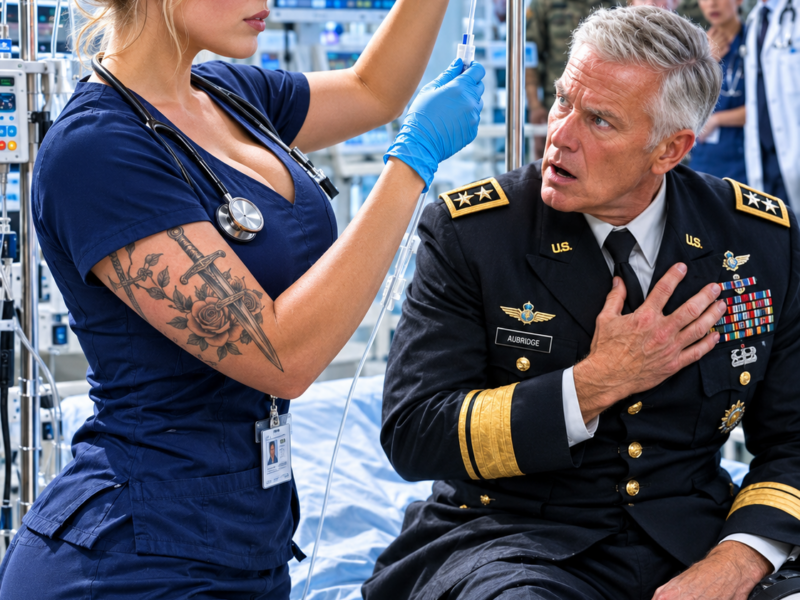
The four-star general asked me what my rank had been, smiling as though he were making a joke at the expense of a nurse who had no business being in his room
The message remained on my screen.
WE KNOW WHO YOU ARE, RAVEN NINE.
For several seconds, neither Major Vasque nor I spoke.
Then the hospital announcement repeated.
“Security alert. All personnel assigned to the east wing, please report to your department supervisors. Do not use the east service corridor until further notice.”
Vasque looked toward the door.
“They’re already inside.”
“How many?”
“Unknown.”
“Then stop standing in the middle of the hallway.”
I moved toward the lockers and pulled my spare jacket from the bottom compartment.
Vasque watched me.
“You’re going back to Hexom?”
“Where else would I go?”
“Nia, listen to me. If Avil has identified you, the situation has changed. You’re no longer just a witness. You’re the person he spent eight years believing was buried in that valley.”
“I know.”
“He’ll do anything to keep that report sealed.”
I slipped my phone into my pocket.
“Then he should have made sure I stayed dead.”
I left the locker room before he could answer.
The ICU was operating under a controlled-access protocol.
Two security officers stood near the nurses’ station. Patricia Mun was speaking with the charge nurse, her expression tight with concern.
When she saw me, she hurried over.
“Nia, where have you been? We have an unexplained security alert, and someone just tried to access General Hexom’s room using credentials that don’t belong to this hospital.”
“Did they get inside?”
“No. Security intercepted them at the east corridor.”
I glanced toward the ICU doors.
“Where’s the general?”
“Room twelve. His condition is stable, but he’s not supposed to be disturbed.”
“I’m checking his dressing.”
Patricia studied my face.
“Is something going on that I need to know?”
I wanted to tell her everything.
I wanted to explain why a classified military operation had followed me into a hospital, why a patient had recognized a tattoo on my arm, and why two people who had supposedly died eight years ago were suddenly becoming a problem for powerful men.
But Patricia was a civilian doctor with patients depending on her.
She didn’t need to carry a secret she couldn’t protect.
“Someone may be trying to reach General Hexom,” I said. “Please make sure no one enters his room without verification.”
Her expression hardened.
“Understood.”
I entered room twelve.
Hexom was awake, propped slightly upright, his injured leg supported by the external fixation frame.
His face looked pale, but his eyes were alert.
“You look like someone just told you the war started again,” he said.
“Something like that.”
He studied me.
“Vasque found you?”
I stopped beside the monitor.
“You know Major Vasque?”
“I knew his name before he became a major. He was the signals analyst attached to the Raven Nine operation.”
I checked the monitor.
“Did you know he survived?”
“No.”
Hexom’s jaw tightened.
“Until last night, I believed everyone in that valley was gone.”
I adjusted his blanket.
“Not everyone.”
He looked down at my covered forearm.
“I need you to tell me what happened.”
“Not here.”
“Why?”
“Because somebody has been monitoring inquiries into Iron Cradle for eight years. And they know you asked questions.”
His eyes sharpened.
“Avil.”
I nodded.
For a moment, he said nothing.
Then he reached toward the bedside table.
“There’s a folder in the drawer.”
I opened it.
Inside were several pages of medical records, a copy of a classified inquiry request, and a handwritten list of names.
At the bottom was Prescott Avil.
“Why did you investigate him?” I asked.
Hexom looked toward the window.
“Two months ago, I received a report concerning irregularities in the procurement of communications equipment used by a special operations unit. The serial numbers traced back to equipment that was supposedly destroyed in Afghanistan.”
My stomach tightened.
“Iron Cradle.”
“Yes.”
“Those records were never supposed to leave the annex.”
“I know.”
He looked at me.
“I was the operational commander responsible for the broader mission. I approved the deployment. I signed the initial casualty report. And for eight years, I believed the team had been lost because of an enemy strike.”
“You weren’t told the truth.”
“No.”
His voice became quieter.
“I signed the report without knowing that the coordinates had been altered.”
I stared at him.
“You didn’t know?”
“I learned about the discrepancy six weeks ago. The strike coordinates were changed after the team had already entered the valley. The revised target package directed the aircraft directly onto your position.”
The room seemed to grow colder.
I had known the strike was deliberate.
I had known someone had betrayed us.
But I hadn’t known the man who had commanded the larger operation had been deceived, too.
“Why didn’t you go public?” I asked.
“I needed proof. If I accused someone at Avil’s level without documentation, the investigation would disappear before it started.”
“And now?”
“Now I have a leg that doesn’t work, a surgeon telling me I may never walk without assistance, and a woman I buried eight years ago standing beside my bed.”
I looked away.
“I’m not buried.”
“I know that now.”
He paused.
“I’m sorry, Nia.”
I turned back.
“For what?”
“For signing a report that said you were dead.”
I held his gaze.
“You didn’t kill us, General.”
“But I should have known something was wrong.”
“Then help us prove it.”
He nodded.
“Tell me what you need.”
Before I could answer, the door opened.
Patricia entered with a security officer.
“General, we have a problem.”
Hexom looked at her.
“What kind?”
“The individual who attempted to access your room has been detained. He was carrying a hospital contractor badge, but the company says he isn’t employed by them.”
“Name?”
“Ethan Cole.”
I felt the muscles in my shoulders tighten.
Vasque had mentioned a team.
“Where is he now?” I asked.
“Security office. They’re waiting for federal investigators.”
“Don’t let him make a phone call.”
The officer looked at me.
“Excuse me?”
“Check his clothing for a second communication device. If he’s working with someone, he’ll try to warn them.”
Patricia stared at me.
“Nia, how would you know that?”
I didn’t answer.
The officer spoke into his radio and hurried away.
Hexom watched me.
“You’ve done this before.”
I looked at him.
“Yes.”
“How many times?”
“Enough.”
His expression shifted.
He didn’t ask another question.
A few minutes later, Vasque appeared at the doorway.
“General.”
Hexom nodded.
“Major.”
Vasque stepped inside and closed the door.
“Avil has made his move. The hospital’s security system shows an attempted override of the east wing cameras. The access request came through a contractor account registered to a company that doesn’t exist.”
“Where is the evidence?” Hexom asked.
“Being copied to an external server.”
“Which one?”
Vasque hesitated.
“The original procurement records are still inside the sealed annex. I need the access authorization tied to your original command.”
Hexom looked at me.
“Can you get it?”
I shook my head.
“Not without triggering another alert.”
Vasque nodded.
“That’s why I came here. I have a partial copy, but the missing authorization would establish who changed the strike coordinates and who approved the diversion of the equipment.”
“Where is it stored?” I asked.
“An encrypted archive maintained by the original intelligence fusion cell.”
I stared at him.
“Avil’s office.”
“Most likely.”
Hexom shifted against his pillows.
“Then we get the archive.”
“No,” I said.
Both men looked at me.
“We don’t go anywhere near his office until we know whether he has someone inside the hospital.”
Vasque frowned.
“We don’t have much time.”
“Then we stop acting like we do.”
I looked at Patricia.
“Doctor, I need you to keep the general’s room restricted to verified medical personnel. No visitors. No contractors. No exceptions.”
She nodded slowly.
“And you?”
“I need to check something.”
Hexom’s voice stopped me.
“Nia.”
I turned.
“Don’t disappear again.”
For a moment, I couldn’t speak.
Then I gave him a small nod.
“I’ll try.”
I left the room with Vasque.
We walked toward the service corridor, keeping our pace ordinary.
The hospital continued around us.
A nurse pushed a medication cart.
A transporter moved an empty wheelchair.
Someone laughed at the far end of the hall.
It was unsettling how normal everything looked when danger was standing just beyond the next door.
Vasque spoke quietly.
“I’ve been following Avil’s financial network for three years. His companies moved stolen equipment through private defense contractors, then sold it to foreign buyers.”
“Where did the money go?”
“Accounts in three countries. The transfers were disguised as consulting payments.”
“Who signed them?”
“Two senior procurement officials. One intelligence officer. And someone at the Department of Defense who has been protected every time we get close.”
“Avil.”
“Avil.”
We reached the supply room.
I opened the door and stepped inside.
There were no cameras in the room, only shelves of sterile equipment and sealed medical supplies.
Vasque followed.
“What’s the plan?”
I took a folded piece of paper from my pocket.
It contained the names of the two men who had died in the valley with me, along with the names of the two others whose bodies had never been recovered.
I had written them down years ago.
Not because I needed reminding.
Because I refused to let the official report become the only record of their existence.
“First, we find out who has access to the hospital,” I said. “Then we protect Hexom. Then we make sure the evidence leaves Avil’s reach.”
Vasque studied the paper.
“You still carry their names?”
“Every day.”
He looked down.
“I should have looked harder for you.”
“You were working with what you had.”
“I knew the strike didn’t make sense.”
“Then you were right to keep asking.”
He nodded.
A sound came from the hallway.
Footsteps.
We both turned toward the door.
A voice spoke from outside.
“Major Vasque?”
Vasque’s hand moved instinctively toward his jacket.
I raised one finger.
Wait.
The footsteps stopped.
Then a soft knock.
“Hospital security. We need to speak with you.”
I looked at Vasque.
“Did you call them?”
“No.”
I moved toward the door and glanced through the narrow window.
A man stood outside in a security uniform.
He looked directly at the glass.
Then he smiled.
I recognized him.
He had been standing near the ICU entrance earlier that morning.
I stepped back.
“That’s not hospital security.”
Vasque reached for his phone.
The man outside tried the handle.
Locked.
Then came a sharp metallic click.
“He’s bypassing the lock,” Vasque whispered.
I looked around.
The supply room had one exit and a narrow service hatch that opened into the adjacent equipment corridor.
I pulled a metal cart toward the door.
“Move.”
The handle turned.
The door opened a few inches before the cart jammed against it.
A shoulder hit the other side.
Once.
Twice.
Then silence.
Vasque moved toward the service hatch.
I opened it and looked through.
Clear.
We slipped into the equipment corridor just as the door began to give way.
A shout followed us.
“Stop!”
I didn’t.
We moved through the corridor and emerged near the staff elevator.
I pressed the button.
Vasque looked over his shoulder.
“Where are we going?”
“To the security office.”
“Why?”
“Because the person pretending to be security needs to be identified before he gets near Hexom again.”
The elevator doors opened.
We stepped inside.
I pressed the ground-floor button.
Then the doors stopped closing.
A hand appeared between them.
The same man stood outside.
He looked at Vasque.
Then at me.
“Nia Thorne,” he said.
I didn’t move.
“Mr. Avil sends his regards.”
The doors began opening again.
I stepped forward before he could enter.
He reached for my arm.
I turned, redirected his grip, and forced him against the elevator wall.
The movement was fast and controlled.
Vasque caught his other arm and secured it.
The man struggled.
“Let go!”
I looked directly at him.
“Who gave you the badge?”
He said nothing.
Vasque removed the man’s identification card and checked the back.
There was a small electronic access token hidden beneath the plastic.
“That’s not hospital equipment,” he said.
I looked at the man.
“Who gave you the token?”
His jaw tightened.
Then he smiled.
“You’re already too late.”
My phone vibrated.
A new message.
This time, it came with an image.
General Hexom’s hospital room.
Taken from inside.
The photograph showed him asleep.
Beneath it were five words.
YOU CAN’T WATCH HIM FOREVER.
I felt something cold settle in my chest.
I turned to Vasque.
“Get security to room twelve. Now.”
He spoke into his phone.
I ran.
By the time I reached the ICU, Patricia was already standing outside Hexom’s room.
Two armed security officers were beside her.
“What happened?” she asked.
“Someone has been inside.”
Her face went pale.
“Inside the room?”
“I don’t know.”
I pushed past the officers and entered.
Hexom was awake.
He looked at me immediately.
“What’s happening?”
I checked the room.
The monitor.
The IV line.
The window.
Nothing appeared disturbed.
Then I saw the folded paper on his bedside table.
It hadn’t been there before.
I opened it.
One sentence.
THE VALLEY SHOULD HAVE TAKEN YOU ALL.
Hexom read it over my shoulder.
His expression became very still.
“They know.”
“Yes.”
He looked toward the door.
“Then we stop waiting.”
Vasque entered a moment later.
“We have a problem. The detained man had a second phone. It contains messages from a number registered to one of Avil’s shell companies.”
“Can you trace it?” Hexom asked.
“Not directly. But we found a scheduled transfer.”
“To where?”
“An encrypted storage facility in Virginia. The archive is being moved tonight.”
I looked at him.
“Moved by whom?”
“Avil’s people.”
Hexom’s jaw tightened.
“If the archive disappears, we lose the only original record of the strike authorization.”
I stared at the note in my hand.
Eight years of searching.
Eight years of watching people pretend that four dead soldiers were an unfortunate footnote in a classified operation.
I had spent those years surviving.
Now I had a chance to make their deaths mean something.
But there was something I needed to know first.
“Major, can you confirm whether the original archive contains the authorization signature?”
Vasque nodded.
“Yes.”
“And the communications log?”
“Yes.”
“Then we don’t need to retrieve it ourselves.”
He looked confused.
“What?”
“We need to make sure nobody can destroy it.”
I turned toward Hexom.
“General, can you issue an emergency preservation order through the appropriate military investigative authority?”
He considered the question.
“I can request one. But if the people protecting Avil are involved, it may take too long.”
“Then send the request to the Inspector General and the Senate Armed Services Committee simultaneously.”
Vasque looked at me.
“I’ve already sent them partial evidence.”
“Then send the new information. Include the attempted hospital intrusion, the false credentials, and the threat against a hospitalized general.”
He nodded.
“I can do that.”
Hexom watched me.
“You’ve been thinking about this for eight years.”
“I’ve been trying not to.”
He lowered his voice.
“It’s time to stop trying.”
The next hour passed in a blur of calls, medical checks, and security briefings.
Patricia insisted that Hexom remain under continuous observation.
Vasque transmitted the evidence.
The hospital’s security director locked down the east wing and began reviewing every access record from the previous twelve hours.
At 11:38 a.m., a call came through to Vasque.
He listened without speaking.
Then he looked at me.
“They found the archive.”
“Where?”
“Virginia. A storage facility registered to one of Avil’s companies.”
“Is it intact?”
“Yes.”
He paused.
“Federal agents have secured it.”
For the first time that morning, I felt my lungs loosen.
But Vasque wasn’t finished.
“They also found a second set of records. Financial transfers connected to the original strike authorization.”
Hexom closed his eyes.
“That’s it.”
“Not quite,” Vasque said. “The authorization was signed by Avil, but the order was countersigned by a senior official in the intelligence directorate.”
“Who?”
Vasque looked at the paper in his hand.
“Deputy Secretary Malcolm Rusk.”
The name meant nothing to me.
Hexom’s expression said otherwise.
“Rusk approved the operational budget,” he said. “He was the civilian official who signed the original mission authorization.”
Vasque nodded.
“And he approved the revised coordinates.”
The room went silent.
The conspiracy was bigger than one contractor.
It had reached into the government itself.
I looked at the general.
“Now what?”
Hexom opened his eyes.
“Now we make sure nobody gets to bury it again.”
That afternoon, the hospital received a formal request from federal investigators to preserve all records related to the attempted intrusions.
The detained men were transferred into federal custody.
The hospital’s security team identified three additional unauthorized access attempts, all linked to contractors working for Avil’s companies.
No one else entered Hexom’s room.
At 5:20 p.m., Vasque returned with another update.
“Avil has been detained.”
I stared at him.
“Where?”
“His office in Arlington. Federal agents executed the warrant an hour ago.”
“And Rusk?”
“Under investigation. His office has been searched. He’s been placed on administrative leave pending the inquiry.”
I sat down.
For the first time in eight years, the people who had ordered the strike were no longer untouchable.
Hexom looked at me.
“It’s over.”
I shook my head.
“The investigation isn’t over.”
“No,” he said. “But the silence is.”
I looked at the tattoo on my forearm.
The broken sword.
The barbed wire.
The coordinates.
Raven Nine.
I had once thought that tattoo was the only thing left of the people I had lost.
Now it was evidence.
And evidence could speak.
The following morning, federal investigators arrived at the hospital.
They interviewed Vasque first.
Then Hexom.
Then me.
I told them what had happened in the valley.
I described the equipment records, the shell companies, the communications station, and the moment the coordinates changed.
I told them how we had requested evacuation after discovering the procurement network.
I told them how the strike came anyway.
I told them about crawling through the mountains for three days with a shoulder wound and no radio.
I told them about the two soldiers who had stayed behind to cover our withdrawal.
I told them how I had heard the final explosion and believed I was the only one left.
And then I told them what I had done afterward.
“I disappeared because I believed the people responsible would find me if I reported what I knew.”
One investigator looked at me.
“Did anyone threaten you directly?”
“No.”
“Then why were you so certain?”
I looked down at my hands.
“Because they had already killed four people to keep the records hidden.”
No one spoke.
The investigator closed his notebook.
“Your testimony will be protected.”
I almost laughed.
I had heard promises like that before.
But this time, there were documents.
There were communications logs.
There were financial records.
There were people who had survived.
And there were two federal agencies that had finally been given enough evidence to act.
For the first time, I believed the truth might outlive the people trying to bury it.
Three days later, Hexom asked me to come to his room.
He was sitting upright, his leg still secured in the fixation frame.
He looked tired, but his expression was different.
Less angry.
Less guarded.
“You’re leaving,” he said.
“Eventually.”
“Where?”
“I don’t know yet.”
He studied me.
“You’ve spent eight years moving from place to place.”
“That’s what kept me alive.”
“Maybe.”
He looked at the window.
“But it also kept you alone.”
I didn’t answer.
He reached toward the bedside table and picked up a folded document.
“I requested a review of the original casualty report.”
I looked at it.
“What does that mean?”
“It means your record will be corrected. The four names listed as killed in action will remain on the memorial, but the official file will acknowledge that the circumstances of the operation were falsified.”
“And me?”
He held the paper out.
“Your status will be restored through the appropriate military process. Your service record, rank, and decorations will be reviewed.”
I stared at the document.
“I’m not sure I want to return.”
“I didn’t say you had to.”
He paused.
“But you deserve to exist on paper again.”
I took the document.
For eight years, I had lived under a name that was real enough to work, pay rent, and open a bank account.
But not real enough to tell anyone who I had been.
I had never expected to see my military record again.
I had never expected to stand in a hospital room and hear a general apologize for a report that had declared me dead.
“Thank you,” I said.
Hexom nodded.
Then he raised his right hand.
It trembled slightly from the effort.
He brought two fingers to his brow.
A formal salute.
“Raven Nine.”
I felt my throat tighten.
“General.”
“You should know something.”
I waited.
“I was the one who approved your team’s deployment. I signed the order that sent you into that valley.”
“I know.”
“I couldn’t bring you home.”
I looked at him.
“You didn’t know where to look.”
“I should have kept looking.”
I considered that.
Then I returned his salute.
“You kept asking questions. That’s why we’re here.”
His hand lowered.
For the first time since I had met him, he looked almost peaceful.
A week later, the first public reports appeared.
They didn’t reveal the full operation.
They couldn’t.
But they confirmed that a senior defense contractor and a former government official were under investigation for corruption, falsification of military records, and the diversion of classified equipment.
The hospital released a statement confirming that General Hexom was recovering and that the security incidents had been resolved.
My name was not mentioned.
Neither was Raven Nine.
That was fine.
The people who needed to know had the truth.
I returned to work.
Patricia met me at the nurses’ station on my first day back.
She placed a fresh cup of coffee beside my chart.
“This one’s actually hot,” she said.
I smiled.
“That’s a dangerous improvement.”
She studied me for a moment.
“You don’t have to tell me what happened.”
“I know.”
“But I want you to know something.”
I looked up.
“You were a good nurse before all this. You’re still a good nurse now. Whatever else happened in your life, that part was never in question.”
I looked at her for a long moment.
“Thank you, Patricia.”
She nodded and returned to her office.
I checked my assignments.
A young soldier had been admitted overnight after a training accident. Another patient was recovering from surgery.
The work was ordinary.
The work mattered.
For the first time in eight years, I didn’t feel the need to count the exits before entering a room.
I still noticed them.
I probably always would.
But I no longer felt as though I had to disappear before someone noticed me.
Two weeks later, General Hexom was transferred to a rehabilitation facility.
Before he left, he asked to see me one last time.
His leg was still badly injured.
He would need months of therapy, and the surgeons had not yet determined how much function he would regain.
But he was standing with assistance when I entered.
A physical therapist stood beside him.
He looked at me.
“Don’t make a big deal out of it.”
“I wasn’t planning to.”
He gave a short laugh.
Then he held out a small envelope.
Inside was a photograph.
Four soldiers stood together in front of a dusty vehicle.
I recognized every face.
One was mine.
The image had been taken shortly before Operation Iron Cradle.
I stared at it.
“Where did you get this?”
“Vasque found it in the old mission archive.”
I ran my thumb along the edge.
For eight years, I had remembered those faces only in fragments.
Now they were together again.
Not as names on a report.
Not as coordinates on a map.
As people.
Hexom watched me.
“I thought you might want it.”
I nodded.
“I do.”
He adjusted his weight against the therapist’s arm.
“Raven Nine.”
I looked up.
“Sir?”
“Thank you for coming back.”
I held the photograph against my chest.
“I didn’t come back for the Army.”
“I know.”
He smiled faintly.
“You came back because someone needed you.”
I looked at him.
“That’s usually how it happens.”
He laughed.
And this time, the sound was not angry.
It was simply human.
When I left the rehabilitation facility, the October air was cold.
I stood outside for a moment, looking toward the road.
The world had not changed overnight.
There were still people who used power to protect themselves.
There were still secrets buried in official reports.
There were still names missing from memorials.
But the truth about Iron Cradle was no longer locked inside a sealed archive.
The four soldiers who had died in that valley had been remembered properly.
The people responsible were facing consequences.
And the one person who had crawled out of the mountains was no longer officially dead.
I pulled my sleeve back.
The tattoo was still there.
The broken sword.
The barbed wire.
The coordinates.
RAVEN 9.
For years, I had seen it as a mark of everything I had lost.
Now I saw something else.
A promise.
I couldn’t bring my team back.
I couldn’t undo the strike.
I couldn’t give those men another chance to come home.
But I could make sure their names were not erased.
I could keep doing the work I knew how to do.
And I could finally stop living as though surviving had been something I needed to apologize for.
That evening, I returned to my apartment and placed the photograph on the shelf beside my bed.
I didn’t hide it in a drawer.
I didn’t turn it facedown.
I left it where I could see it.
Then I sat quietly for a while.
Eight years ago, the world had declared Raven Nine dead.
Three weeks ago, a four-star general had recognized the tattoo on my arm.
And now, for the first time since that valley, I could say my own name without feeling like I was borrowing someone else’s life.
My name was Nia Thorne.
I had served.
I had survived.
And I was still here.
The next morning, I walked into the trauma unit.
Patricia waved from the nurses’ station.
A monitor alarm sounded down the hall.
I picked up my chart and headed toward the room.
There was work to do.
And this time, I didn’t have to disappear to do it.
The End.









