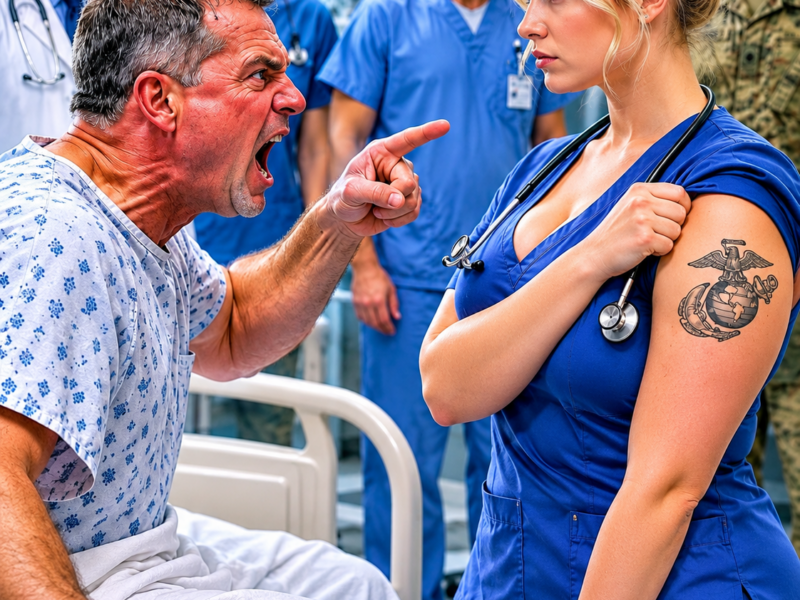
“I watched a 62-year-old Marine colonel throw a medical tray against a hospital wall and tell the charge nurse he would rather die than let another civilian touch him
For twelve years, I had carried the sound of that explosion in my head.
Not every night. Not every morning. But often enough that I could close my eyes in a quiet hospital room and hear the distant crack of gunfire, the frantic shouting over the radio, and the terrible silence that followed.
Now, sitting beside Colonel Bruce Wagner in Room 612, I realized he had been carrying something even heavier.
He had been carrying the belief that three young Marines had died because he sent them into the wrong alley.
I pulled a chair closer to his bed.
“Colonel, before I tell you what happened, I need you to understand something. I was there. I saw what those men did. And I have never forgotten it.”
He stared at the tattoo on my forearm.
“Danny,” he whispered.
I nodded.
“PFC Daniel Miller. Twenty-one years old. From a little town in Ohio. He used to talk about his mother making him pancakes every Sunday when he was home. He kept a photograph of her folded inside his helmet.”
Wagner closed his eyes.
“Tell me.”
I took a breath.
“Your unit had been moving through Marjah for hours. The intelligence briefing said the alley was clear. The route was supposed to take your men past a row of damaged buildings and into an open courtyard. You were trying to get the platoon out before the next wave of insurgent fire.”
“I remember.”
“Danny, Corporal Jason Wyatt, and Lance Corporal Doherty were bringing up the rear. They noticed a white pickup truck parked behind an iron gate. It didn’t belong there. The engine was warm, but nobody was inside.”
Wagner’s eyes opened.
“A truck?”
“A white Hilux. They saw wires running from the dashboard toward the back. Danny recognized what it was before the others did.”
His hand tightened around the blanket.
“A bomb.”
“Yes.”
I let the word settle between us.
“Not a small one, Colonel. It was packed with explosives. If that truck had reached the open courtyard while your battalion was moving through, the blast could have killed dozens. Maybe more.”
He swallowed.
“Why didn’t they call it in?”
“They did. Danny got on the radio. He tried to warn the men behind him. But the truck was already moving.”
I could still see the dust in the air when I remembered it.
“The driver had been hiding nearby. He started the engine and pushed through the gate. Danny and Wyatt ran toward it. Doherty followed them. They were trying to stop it before it reached the courtyard.”
Wagner’s face had gone pale.
“They didn’t have to do that.”
“No,” I said quietly. “They didn’t.”
“Were they ordered?”
“No.”
He looked at me as if he hadn’t heard correctly.
I leaned forward.
“Colonel, nobody ordered those three men to run toward that truck. They made that decision themselves. They knew what was inside. They knew what would happen if it reached the rest of the battalion.”
For a moment, the only sound in the room was the monitor beside his bed.
“Danny got close enough to throw a grenade under the truck,” I continued. “It didn’t stop the vehicle immediately. Wyatt and Doherty were trying to get the gate closed, trying to keep it from reaching the courtyard. Then the explosives went off.”
Wagner pressed his fingers against his eyes.
I remembered the shock wave throwing me against a wall. I remembered the ringing in my ears and the dust so thick I couldn’t see my own hands. I remembered running toward the smoke with my medical bag bouncing against my hip.
And I remembered Danny.
“He was alive when I reached him,” I said.
Wagner lowered his hand.
“Danny?”
“Yes.”
My voice nearly broke, but I forced myself to continue.
“His injuries were catastrophic. I knew it. He knew it, too. I tried anyway. I did everything I could. I kept talking to him because I didn’t want him to be alone.”
“What did he say?”
I looked down at my hands.
“He asked whether the others had made it.”
Wagner’s lips parted.
“He didn’t ask about himself,” I said. “He asked if the rest of the platoon was safe.”
The colonel turned his face toward the window.
I could see his jaw trembling.
“I told him the courtyard was clear. I told him the Marines were moving out. I told him his friends had done it.”
I paused.
“Then he asked me to tell his mother he wasn’t scared.”
Wagner made a small sound in his throat.
“I held his hand until he stopped breathing.”
The room seemed to grow smaller around us.
For twelve years, I had remembered that moment as a failure. I had replayed every decision, every movement, every second I had spent trying to save a young man whose injuries were beyond anything I could fix.
But there was something I had never questioned.
Danny had not died believing his commanding officer had abandoned him.
He had died knowing his friends were safe.
“He knew what he was doing,” I whispered. “All three of them did. They saved the battalion.”
Wagner began to cry.
It wasn’t loud. There was no dramatic outburst. Tears simply slipped down the face of a man who had spent twelve years refusing to let anyone see him break.
“I buried them,” he said. “I wrote the letters. I stood in front of their families. And every time I looked at those mothers, I thought about the order I gave.”
“You gave an order to move your men through a route that intelligence said was clear.”
“I should have checked.”
“You trusted the information you were given.”
“I was the commanding officer.”
“Yes,” I said. “And you were responsible for them. But responsibility isn’t the same thing as guilt for something you couldn’t have known.”
He shook his head.
“You don’t understand what it’s like to send young men into danger.”
I looked at the tattoo on my arm.
“I watched them go. I watched them come back. I held them when they were dying. I know I wasn’t wearing your rank, Colonel, but I know what it means to carry their names.”
He stared at me.
“Then why did nobody tell me?”
That question changed everything.
Because I had asked myself the same thing for years.
I knew what had happened in the alley. I knew what the three Marines had done. But I had never seen the full intelligence picture. I had never been given access to the command investigation. I had assumed the official report contained everything.
Until Wagner reached for the bedside table.
“There’s something I need to show you.”
He pulled a small folder from beneath a stack of personal papers. His hands shook as he opened it.
Inside was a photocopy of an old military document. The edges were yellowed. Several sections had been blacked out, and a red stamp across the top read: RESTRICTED ACCESS.
“Where did you get this?” I asked.
“During a disability review. Three years ago. Someone sent it to me anonymously. I was never supposed to have it.”
He pointed to a paragraph halfway down the page.
“Read that.”
I moved closer.
The document referenced surveillance footage recorded by an unmanned aircraft before the explosion. The footage had reportedly identified suspicious activity around the white truck. A separate intelligence report had warned that a vehicle-borne explosive device might be positioned near the route.
But the information had never reached Wagner’s battalion.
I read the paragraph again.
Then I looked at him.
“Who was responsible for this report?”
He tapped a name near the bottom.
“Brigadier General Craig Fischer. He was the regimental commander at the time.”
I had heard the name. Fischer had been promoted after the deployment and later retired with an impressive record of command assignments.
Wagner’s voice became bitter.
“He knew there was a threat. He knew about that truck. The report says the warning was withheld because the intelligence was considered unconfirmed.”
“Unconfirmed doesn’t mean harmless.”
“I know that now.”
He turned another page.
“The report also says the original after-action findings were revised. The first version identified a failure in intelligence distribution. The final version called the explosion an unexpected enemy attack.”
I felt my stomach tighten.
“Who revised it?”
“Fischer’s office.”
For several seconds, neither of us spoke.
Wagner looked down at the paper.
“I spent twelve years thinking I killed those boys with one order. Meanwhile, someone who knew about the threat was protecting his career.”
I didn’t answer immediately.
Anger was rising in me, but I knew anger alone wouldn’t help us. The document was a photocopy. It could be incomplete. The allegations needed to be verified.
“Colonel, we need to report this.”
He looked at me.
“You think anyone will listen?”
“I don’t know. But we’re going to give them the chance.”
He stared at the folder for a long time.
Then he nodded.
“Get me a phone.”
Before I left the room, I checked his temperature again. It was still dangerously high. His infection wasn’t going to wait for an investigation, and neither was his body.
“I’m calling the infectious disease team,” I said. “You’re getting the central line, and you’re starting intravenous antibiotics. We can discuss the report after you’re medically stable.”
He gave a tired, almost embarrassed smile.
“You’re still giving orders, Doc?”
“Only when people are being stubborn.”
For the first time since I had entered Room 612, he laughed.
It was brief and painful, but it was real.
The medical team arrived twenty minutes later. We explained the procedure, answered his questions, and obtained his consent. He didn’t argue when the doctor began preparing the line. He didn’t demand a different nurse. And when Brittany came in with the medication, he thanked her.
She looked so surprised that I almost smiled.
The treatment started that afternoon.
But the investigation would take much longer.
The next morning, after Wagner’s fever began to come down, I contacted the VA patient advocate and the appropriate military oversight office. We documented the photocopy, recorded the details of where Wagner had obtained it, and made sure the original source could be traced.
I also contacted a former Navy corpsman I had served with in Afghanistan. He put me in touch with two veterans who remembered the incident and knew where the original unit records might be found.
Wagner gave a formal statement.
He described the route, the intelligence briefing, the radio traffic, and the moment the explosion occurred. He identified the three Marines who had died. He also explained that the guilt had followed him through every promotion, every retirement ceremony, and every night he couldn’t sleep.
The first few weeks were difficult.
Some people questioned why we were reopening an incident that had happened twelve years earlier. Others insisted the report had already been reviewed and closed.
But the questions didn’t stop.
One former Marine from Bravo Company came forward. Then another. Then two more.
They remembered hearing Danny’s warning over the radio. They remembered seeing the truck move through the gate. They remembered the three men running toward it.
Their statements matched Wagner’s account.
Investigators requested the original operational records. They reviewed communications logs, intelligence summaries, and the files connected to the surveillance footage. A separate archive search located the original video, which had been stored at a military facility in Quantico.
The footage was not clear enough to identify every person around the truck. But it showed the vehicle being approached and prepared before the battalion entered the area. It also showed activity consistent with the intelligence warning described in the earlier report.
More importantly, the archive contained a record of who had accessed the footage.
Fischer’s name appeared on the authorization sheet.
His signature was there, dated two days before the operation.
The investigation lasted eleven weeks.
During that time, Wagner remained at the VA for treatment and rehabilitation. The infection in his femur responded to the antibiotics, though the doctors warned him that recovery would be slow. He attended physical therapy with the same stubborn determination he had once brought to the field.
I visited him when my shifts allowed.
Sometimes we discussed the investigation. Sometimes we talked about the Marines we had lost. And sometimes we talked about ordinary things, like the terrible coffee in the hospital cafeteria or the way Brittany kept trying to convince everyone that her homemade cookies were edible.
Wagner began asking about my life outside the hospital.
I told him I had never married. I told him I still woke up from dreams about Marjah. I told him I had spent years believing I should have been able to save Danny.
He listened without interrupting.
One afternoon, he said, “You know what I think?”
“What?”
“I think you and I have been punishing ourselves for two different things. I blamed myself for sending them into that alley. You blamed yourself for not bringing Danny home.”
I looked at him.
“Maybe.”
“Neither of us gets to decide that their sacrifice was meaningless.”
That sentence stayed with me.
The findings were eventually presented to a military review board in Arlington.
The original after-action report had been altered. Critical intelligence had not been distributed to the unit. The official explanation had concealed failures in the command process. The board concluded that Fischer had knowingly withheld material information and later made false statements about the handling of the intelligence.
The consequences were severe.
Fischer’s retired grade was reduced by two ranks, affecting the benefits attached to his retirement. His case was also referred for criminal proceedings involving false statements and obstruction.
He initially denied wrongdoing.
But the records were difficult to explain away.
The signed authorization, the archived footage, the earlier intelligence warning, and the testimony of the Marines who had been there formed a picture that could no longer be ignored.
Eventually, Fischer entered a guilty plea to charges involving false statements and obstruction.
I watched the announcement on a television in the hospital break room.
There was no cheering. Nobody clapped. The room was too quiet for that.
I thought about Danny Miller, Jason Wyatt, and Lance Corporal Doherty. I thought about the families who had spent twelve years believing the official report was the complete truth.
And I thought about the man in Room 612 who had finally been given the chance to put down a burden that never should have been his alone.
When I told Wagner the outcome, he sat very still.
“So that’s it?” he asked.
“That’s what the board and the court proceedings have established.”
He looked toward the window.
“I thought I’d feel better.”
“You don’t have to feel anything on anyone else’s schedule.”
He nodded slowly.
“There’s one thing I still need to do.”
I knew what he meant before he said it.
“Danny’s mother.”
He had written to her after the deployment. He had attended the memorial. He had sent messages on anniversaries. But he had never been able to tell her what he now knew.
For years, he had believed that his own order had sent her son to his death.
Now he needed to tell her the truth.
A week later, he made the call.
I wasn’t in the room, but he told me afterward what happened.
Her name was Margaret Miller. She was older now, with silver hair and a voice that Wagner said sounded exactly like the one in the letters she had sent him after the deployment.
He began by apologizing.
Then he told her about the truck, the intelligence failure, and the three Marines who had made the decision to stop it.
He told her that Danny had helped save the lives of dozens of men.
He told her that when I reached him, Danny had asked whether the others were safe.
And finally, he told her what Danny had said about not being scared.
Wagner said there was a long silence.
Then Margaret asked one question.
“Did my boy know he had saved them?”
Wagner closed his eyes when he repeated that part to me.
“Yes,” he told her. “He knew.”
Margaret began to cry.
So did he.
They spoke for nearly an hour.
Before they ended the call, she told him she had kept Danny’s belongings in a small wooden box. His letters. A photograph. A folded American flag. And his dog tags.
She said she had thought about what to do with them for years.
Now she knew.
She wanted the dog tags to go to the corpsman who had held her son’s hand.
I didn’t know about that decision until much later.
By then, Wagner had completed the most difficult part of his treatment. He still walked with a cane, and the pain in his leg had not disappeared, but the infection was under control. He had started attending a veterans’ support group and had even agreed to speak with a counselor about his PTSD.
He wasn’t suddenly healed.
Neither was I.
But something had changed.
The past no longer felt like a locked room that we were both condemned to stand outside.
It had a door.
And, for the first time, we had opened it.
On a Friday afternoon in October, I was finishing my shift at the Charleston VA when Brittany appeared at the nurses’ station.
“Someone’s here asking for you.”
“Who?”
She smiled.
“I think you should see for yourself.”
I walked toward the main entrance.
Colonel Wagner stood near the lobby doors, wearing a dark jacket and holding a small wooden box. His cane rested against his right hand.
He wasn’t alone.
Six men stood behind him.
They were all veterans from the old battalion. Some had gray hair. One wore a baseball cap pulled low over his forehead. Another had a brace on his knee. They looked older than the men I remembered from Marjah, but I recognized something in the way they stood together.
They were still a unit.
Wagner stepped forward.
“Doc.”
I smiled.
“Colonel. What are you doing here?”
“Thought I’d come see the person who keeps telling me what to do.”
One of the men behind him laughed.
Then Wagner held out the wooden box.
“This is for you.”
I looked at it but didn’t take it.
“What is it?”
“Something that belongs with someone who knew him.”
My hands went cold.
I opened the lid.
Inside, resting on a piece of dark blue cloth, were a pair of worn dog tags.
DANIEL MILLER.
I stared at the name.
For a moment, the lobby disappeared. I was back in Marjah, kneeling in the dust, holding a young Marine’s hand while the world burned around us.
I could almost hear him asking whether the others were safe.
“His mother sent them,” Wagner said softly. “She told me she wanted you to have them. She said you were the last person who held her son, and she wanted you to know that she remembers what you did for him.”
I couldn’t speak.
Wagner continued.
“She also said something else. She said she doesn’t want you to remember Danny only as the boy who died in your arms. She wants you to remember him as the man who saved his friends.”
I closed the box.
My eyes were filling with tears.
“I don’t know what to say.”
“You don’t have to say anything, Doc.”
Then Wagner turned toward the six men.
They stepped forward together.
At first, I thought they were simply coming to stand beside him.
Then, one by one, they raised their hands in salute.
It wasn’t a formal ceremony. There were no flags, no speeches, no commanding officer reading names from a list.
Just six aging Marines standing in the lobby of a veterans’ hospital, saluting a Navy corpsman who had once been one of them.
I stood completely still.
Brittany was watching from behind the nurses’ station. Her eyes were wet.
I had spent years believing that the most important thing I had done in Marjah was hold Danny’s hand while he died.
But standing there, with his dog tags resting in my palms and those six Marines saluting me, I understood something I had never allowed myself to believe.
I had not failed him.
I had stayed.
I had listened.
I had made sure he wasn’t alone.
And I had carried his story until the people who needed to hear it finally did.
Wagner lowered his hand.
“Danny would have liked you to have those.”
I looked at the men.
“Thank you,” I whispered.
One of them stepped forward. He had been younger than me during the deployment, barely out of his teens. Now his beard was mostly gray.
“Doc,” he said, “we’ve wanted to tell you this for a long time. We remember what you did. We remember all of it.”
I nodded, unable to trust my voice.
He glanced at the box.
“Don’t let those tags make you sad every time you see them. Let them remind you what he did.”
After they left, I carried the box back to my office.
I placed it on the shelf beside a photograph I had kept since Afghanistan. It showed a group of Marines standing in front of a dusty vehicle, squinting into the sun. Danny was near the center, smiling as if he had never known fear.
I sat down and looked at the photograph for a long time.
For twelve years, I had thought the story ended in that alley.
I thought it ended with an explosion, three names on a casualty report, and a young Marine’s final breath.
But it hadn’t ended there.
It had continued in the guilt of a commanding officer, in the grief of a mother, in the memories of men who had survived, and in the silence of a corpsman who never believed she had done enough.
The truth had taken twelve years to reach the people who needed it.
It couldn’t bring Danny back.
It couldn’t give the other families their sons again.
And it couldn’t erase the nights Wagner and I had spent fighting memories that refused to stay buried.
But it could give those three Marines something the false report had taken from them.
The truth.
They hadn’t died because their commander made a careless decision.
They had chosen to stand between a bomb and the men behind them.
They had protected their brothers.
And Danny Miller had known, until his final breath, that the others were safe.
That night, I took the dog tags home.
I placed them on my bedside table and sat beside them until the sky outside my window turned dark.
I thought about the little town in Ohio where Danny had grown up. I wondered whether his mother still made pancakes on Sundays. I wondered whether she had finally found a way to look at his photograph without seeing only the day she lost him.
Then I touched the worn metal.
“Your story made it home, Danny,” I whispered.
For the first time in years, I didn’t hear the explosion afterward.
I heard his voice instead.
And somehow, that was enough.
Some wars never really end when the fighting stops. They follow people into quiet rooms, crowded hospitals, family dinners, and sleepless nights. They make good people carry blame that was never theirs. But sometimes, after years of silence, the truth finds its way through. Sometimes the people who survived finally learn what the fallen knew all along. And sometimes, the greatest act of courage isn’t charging toward danger or giving an order under fire. Sometimes it’s telling the truth, accepting forgiveness, and allowing yourself to put down what you’ve carried for far too long.
The End.









