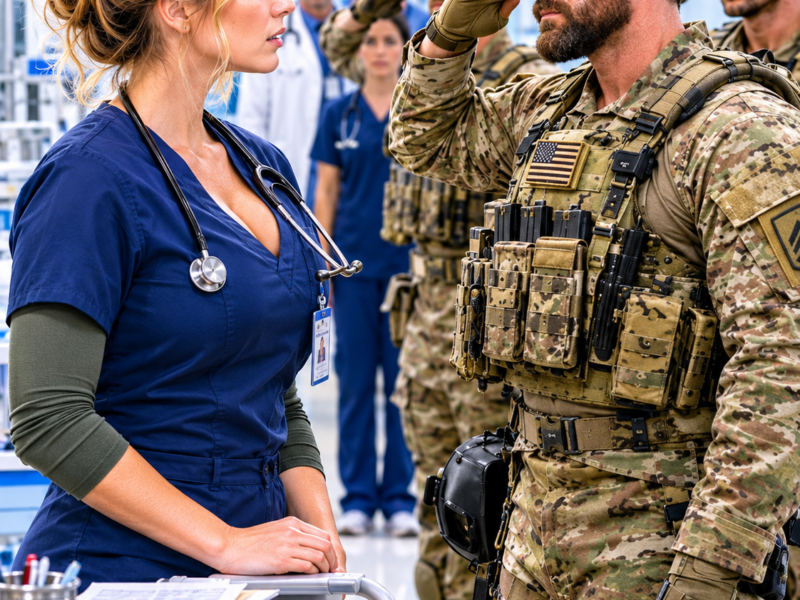
“Five years ago, I went back into a burning building at 9,000 feet to save four men, and I came out believing I had failed the one person I couldn’t reach
For several seconds, I couldn’t move.
The emergency department continued around us. A monitor beeped behind the trauma curtain. Someone laughed near the nurses’ station. The automatic doors opened and closed for a delivery driver carrying a cardboard box.
Ordinary sounds.
An ordinary morning.
And four men standing in front of me, telling me that someone had erased me from the official record of a day I had spent five years trying to forget.
“What do you mean the report said I didn’t survive?” I asked.
Creed looked toward the waiting area.
“Can we talk somewhere private?”
“No.”
His eyebrows drew together.
“I need to finish my shift. If you have something to tell me, tell me here.”
He studied my face.
Then he nodded.
“All right.”
Orin moved closer, his scarred cheek catching the fluorescent light.
“After the building came down, the extraction team found you outside the north wall. You were unconscious. Your right hip was broken, your left shoulder was dislocated, and you had a head injury. You were bleeding badly.”
“I remember the extraction.”
“Do you remember who took you to the evacuation point?”
I shook my head.
“Not clearly.”
“Two men from the recovery team. They got you onto the bird and sent you to the forward surgical facility. From there, you were transferred to Landstuhl.”
“I know that.”
“Then you know somebody had to account for you.”
I looked at him.
“Of course.”
“Your name wasn’t on the original casualty manifest.”
I felt my throat tighten.
“That doesn’t make sense.”
“It didn’t make sense to us either,” Creed said. “We were told you had been transferred under a different classification because of your injuries. We accepted it. We had enough of our own injuries to deal with.”
Paz shifted in his wheelchair.
“But when we started asking questions later, the paperwork didn’t match.”
“What paperwork?”
“Your extraction record. The medical transfer. The casualty report. There were different versions.”
I looked from one man to another.
“You’re saying somebody changed my medical records?”
“We’re saying somebody changed the record of what happened to you,” Creed replied. “And we finally found out why.”
A cold sensation spread through my chest.
“Who?”
Creed glanced at Henley.
Henley reached into his jacket and produced a folded document. He held it out to me.
I didn’t take it immediately.
“Where did you get that?”
“From a former operations clerk who kept copies of the original movement logs,” he said. “He retired two years after the incident. He contacted us when he heard we were looking.”
I opened the paper.
It was a photocopy of a military personnel movement record. My name appeared near the top, followed by a series of dates and locations.
But one entry had been crossed out.
Beside it, someone had typed:
STATUS: DECEASED — NONRECOVERABLE.
I read it twice.
Then a third time.
My hands began to shake.
“That’s impossible.”
“Your death was entered into the administrative system forty-eight hours after the incident,” Henley said.
“But I was alive.”
“We know.”
“I was in Germany. I spent weeks in a hospital. I had surgery. I signed forms. I spoke to doctors.”
“We know, Sarah.”
I looked up sharply.
“Then how could anyone write that I was dead?”
Creed’s jaw tightened.
“Because somebody wanted your name out of the operational record.”
I felt suddenly dizzy.
“Why?”
He didn’t answer right away.
Instead, he looked toward the trauma bay where the woman from the rollover had been taken earlier.
“Do you remember what happened before the building caught fire?”
I closed my eyes.
The memory came back in fragments.
Cold air.
Snow against my face.
A radio that kept cutting out.
The sound of rounds striking the roof.
The smell of burning insulation.
And the four men I had tried to keep alive.
“We were moving casualties through the outbuilding,” I said. “The evacuation route was compromised.”
“That part is in the report,” Orin said.
I opened my eyes.
“Then what isn’t?”
Creed took a breath.
“Before the first explosion, Henley found something in the building.”
Henley nodded.
“There was a communications case under a workbench. It had been moved from the upper floor before the fighting started.”
I remembered seeing a black case near the back wall. At the time, I had assumed it belonged to the local security team.
“What’s in it?”
“Copies of radio traffic. Movement schedules. Intelligence summaries.”
I stared at him.
“That doesn’t explain why my name was erased.”
“It does when you understand what was on those recordings.”
Creed lowered his voice.
“Somebody had given the enemy information about our movement. The route, the timing, and the location of the outbuilding. The attack wasn’t random.”
The words seemed to hang in the air.
I looked at Henley.
“You found evidence of a leak?”
He nodded.
“Not just evidence. A voice.”
“Whose?”
Creed answered.
“Someone from our own command structure.”
I felt my fingers go numb around the paper.
“You’re telling me one of our own people gave them our position?”
“That’s what the recordings suggested.”
“Who?”
“We didn’t know at first. The audio was damaged. But the investigation eventually identified the person who had authorized the communications package.”
He paused.
“Major General Thomas Voss.”
I knew the name.
Voss had been the senior officer overseeing operations in the region. He had been praised publicly for coordinating several successful missions and had later received a prestigious command appointment.
I remembered seeing his photograph in a briefing room.
He had shaken my hand once.
“That’s not possible,” I whispered.
“We thought so too,” Orin said. “But the original recordings were examined by investigators. The voice matched. The authorization records matched. And the communications case was never supposed to be in that building.”
“Then why was it there?”
“Because somebody moved it before the attack,” Henley said.
I stared at the document again.
“Why would he need to make me disappear?”
Creed’s expression darkened.
“Because you were the only person who saw the case after it was opened.”
I couldn’t breathe properly.
I remembered that moment now.
The case had been open. A small recorder was connected to a laptop. I had been crouched beside it, trying to move a casualty away from the wall when a burst of gunfire forced everyone down.
I’d seen the screen.
I’d seen a name.
But I had been exhausted, frightened, and focused on keeping people alive.
I had never understood what I was looking at.
“Did I tell anyone?”
“You told the extraction medic something,” Orin said. “You kept repeating that you had seen a name. You said somebody had opened the case.”
I shook my head.
“I don’t remember.”
“You had a head injury. You were drifting in and out.”
“Did I identify him?”
Creed shook his head.
“Not in a way anyone could use. But somebody knew you might have seen enough.”
I looked down at my hands.
The bracelet lay in Creed’s palm, its frayed end curling slightly against his skin.
“So they marked me dead.”
“Your records were altered,” he said. “The investigation was closed before the evidence could be properly reviewed. The case was classified, and the people who tried to challenge the report were reassigned.”
I stared at him.
“How did you find out?”
“Because Henley never stopped looking.”
Henley lowered his eyes.
He had always been the quietest man on the team. In the field, he could sit for hours without saying a word, watching a road or a ridge until the smallest movement told him something was wrong.
Apparently, he had carried that same patience into the years afterward.
“At first, I just wanted to find out whether you were alive,” he said. “Then I found the clerk who had kept the original movement logs. He told me the death entry had been added after your transfer to Germany.”
“How did he know?”
“He had processed the original paperwork. He remembered your name because he had seen you on the evacuation manifest. When the later report came through, he knew something was wrong.”
I looked at the document.
“Why didn’t he speak up?”
“He tried. His supervisor told him to stop asking questions. A few months later, he was transferred.”
The emergency department suddenly felt too bright.
I pressed my palms against the edge of the desk.
“Five years,” I said.
Nobody answered.
“Five years I’ve been sitting here thinking I abandoned Declan. Thinking I couldn’t save him. And somebody was using the chaos of that morning to erase me.”
Creed nodded.
“We’re sorry, Doc.”
I looked at him sharply.
“Don’t apologize for something you didn’t do.”
“We should have found you sooner.”
“You had your own lives to rebuild.”
Paz gave a small, tired smile.
“Some of us are still working on that.”
I looked at his prosthetic.
“How is it?”
“Better than the first one. Still hurts when the weather changes.”
“Then you need to stop sitting in that chair for three hours at a time.”
He laughed.
“There she is.”
For one brief moment, I almost smiled.
Then I looked back at the document.
“What do you want me to do?”
Creed’s expression became serious.
“Tell the investigators what you remember. They reopened the case after Henley found the records. They need your statement.”
I shook my head.
“No.”
He didn’t argue.
“Sarah—”
“No. I don’t want to go back there.”
“Nobody’s asking you to go back.”
“You just brought five years of my life through the front doors of my workplace.”
Creed looked down.
“I know.”
I wanted to be angry with him. I wanted to tell all four of them to leave and never come back.
But I couldn’t.
Because underneath the fear, there was something else.
A memory.
A name on a screen.
A voice coming through a radio.
And a question I had never been able to answer.
“What happened to Declan’s body?” I asked quietly.
Orin’s face changed.
“We recovered him.”
“Where?”
“He was transferred with the others. His family was notified.”
I nodded.
I had always wondered whether they had found him.
Whether the remains of that building had swallowed him.
Whether anyone had been able to bring him home.
“His mother received him?”
“Yes.”
I closed my eyes.
That was something, at least.
When I opened them, Creed was still holding the bracelet.
“Take it,” he said.
I hesitated.
Then I reached out and accepted it.
The cord felt rough against my palm. The dark stain was still there.
I could remember the cold tent where I had made it. I could remember the men laughing when I handed them out.
And I could remember the moment it fell into the snow.
I closed my fingers around it.
“All right,” I said.
Creed looked up.
“I’ll speak to the investigators. But I won’t make promises about what I remember.”
“That’s all we’re asking.”
I glanced toward the clock.
“Now get out of my emergency department. I still have patients.”
For the first time that morning, Creed smiled.
“Yes, ma’am.”
They left without another word.
The automatic doors opened, letting in a gust of cold air. Then they closed behind the four men.
I stood there for several seconds.
Poppy approached slowly.
“Sarah?”
I looked at her.
“Are you okay?”
“No.”
She nodded, as if that answer made perfect sense.
“Do you need a minute?”
I looked at the bracelet in my hand.
“Maybe five.”
She took over my charting station without asking another question.
I went into the staff bathroom, locked the door, and sat on the closed toilet lid.
I didn’t cry.
I couldn’t.
My body seemed to have forgotten how.
Instead, I stared at the bracelet until the clock on my watch showed that five minutes had passed.
Then I washed my hands, returned to the department, and finished my shift.
Because patients still needed care.
Because the world didn’t stop when your past found you.
And because I had spent five years learning how to keep moving.
But that morning, something had changed.
For the first time, I wanted to know what had happened.
Not just to the men I had carried out.
Not just to Declan.
To me.
The investigators contacted me four days later.
They were part of a military review team working with federal authorities. They asked me to meet them at a secure office near Columbus.
I almost canceled twice.
The first time, I was sitting in my Jeep outside the building with the engine running.
The second time, I was standing in the lobby holding a paper cup of coffee.
Then I saw Creed’s message on my phone.
You don’t have to do this alone, Doc.
I walked upstairs.
The interview room was plain and cold. A long table stood in the center, with three chairs on one side and one on the other.
Two investigators introduced themselves. One was a woman named Lieutenant Colonel Reeves. The other was a civilian investigator named Mark Ellison.
They explained that the inquiry had been reopened after inconsistencies were discovered in the original operational records.
They showed me the movement log.
The death entry.
The extraction manifest.
The altered report.
Then they asked me to describe the morning of the attack.
I started with the weather.
It had been cold enough that the inside of my nose hurt when I breathed. Snow had been falling lightly, making the ground slick. The outbuilding had been used as a temporary casualty collection point after our route was compromised.
I described the first explosion.
The radio failure.
The roof catching fire.
The men who were injured.
I described Creed, Orin, Paz, and Henley.
Then I described Declan.
I told them where I found him. I explained the injury to his upper arm and the debris that had trapped him. I explained why I couldn’t reach the bleeding vessel.
I told them I had gone back inside twice.
I told them I had believed he was still alive when I made the final attempt.
Lieutenant Colonel Reeves listened without interrupting.
When I finished, she asked a question.
“Did you see the communications case?”
I looked down at my hands.
“Yes.”
“Did you open it?”
“No. It was already open when I saw it.”
“Do you remember anything on the screen?”
I closed my eyes.
At first, there was nothing.
Then a flash.
A name.
A line of text.
A voice from the radio.
I opened my eyes.
“There was a transmission log. I remember seeing a name beside an authorization entry.”
“Whose name?”
I swallowed.
“Thomas Voss.”
The investigators exchanged a look.
“Are you certain?”
“I can’t tell you that I’m certain of every detail. I had a head injury. I was under fire. But I remember that name.”
Ellison leaned forward.
“Did you hear anyone say it?”
I thought about the radio.
There had been a voice, calm and familiar, giving instructions while the rest of the building shook.
I remembered the words more clearly than the voice.
“Something about the route being confirmed. Something about holding the extraction point until the signal came through.”
“Was the speaker identified?”
“No.”
Reeves made a note.
“Would you recognize the voice?”
I hesitated.
“I don’t know.”
They didn’t press me.
They asked about my medical evacuation, the hospital in Germany, and the circumstances of my discharge.
I explained that I had undergone surgery on my hip and shoulder. I had spent weeks in rehabilitation. I had been informed that my unit had been disbanded and that my records were being sealed as part of an ongoing security review.
I had never been told I was officially listed as deceased.
The investigator looked at me for a long moment.
“Ms. Tully, did you ever receive a formal death notification?”
“No.”
“Did you ever sign a document confirming that your service had ended because of death or presumed death?”
I shook my head.
“Then someone entered that status without your knowledge.”
I stared at her.
“Can you tell me why?”
“Not yet.”
That answer was honest.
It was also unbearable.
The investigation continued for several months.
During that time, the four men remained in contact with me.
Creed called once a week. Orin sent short messages. Paz sent photographs of his progress in physical therapy, each one accompanied by a complaint about how expensive replacement prosthetic components were.
Henley rarely contacted me, but when he did, it was usually with something useful.
A name.
A date.
A copy of an old report.
He had become very good at finding the details everyone else overlooked.
The investigation uncovered more than any of us had expected.
The communications case had been moved into the outbuilding by a member of the operations staff hours before the attack. The original recordings had been copied onto a second storage device. That device had disappeared from the evidence inventory.
The movement records showed that Major General Voss had authorized a change to the extraction schedule shortly before the first explosion.
The official explanation said the change had been made because of an unexpected enemy movement.
But the original radio logs told a different story.
The route had been compromised before our team entered the valley.
The warning had reached command.
And the warning had not reached us.
Investigators also found that the initial casualty report had included my name under the category of injured personnel. Two days later, a revised version listed me as deceased.
The revision had been approved by an administrative office operating under Voss’s command.
No medical confirmation had been attached.
No recovery record existed.
No body had been identified.
There was only a signature authorizing the change.
Voss’s signature.
When I heard that, I sat very still.
I had spent five years believing my life had become smaller because of what happened inside that building.
Now I was learning that somebody had made a deliberate decision to erase me from the record.
Not because I had died.
Because I hadn’t.
The investigators eventually located the former operations clerk Henley had found. He provided his original notes and testified that he had been instructed to replace the first casualty manifest with the revised one.
He had objected.
His supervisor had told him the order came from above and was not to be questioned.
He had kept a copy because something about the paperwork had bothered him.
The inquiry also recovered a partial audio recording from the communications case.
The recording was damaged, but technical specialists were able to isolate several sections.
One contained a conversation between two officers.
The voices were not immediately identified.
But the second speaker mentioned the extraction route and referred to the outbuilding as a temporary casualty location.
The first speaker responded that the team should remain there until further instructions.
Then came a sentence that made the investigators stop the recording.
“Do not move the package until the medical team is clear.”
I listened to that section twice.
The voice was familiar.
Not because I had spoken to the man often.
Because I had heard him once, in a briefing room, speaking calmly about acceptable operational risk.
It was Voss.
The inquiry did not rely on my memory alone. They compared the recording with archived command briefings and other verified communications.
The voice analysis supported the identification.
Voss was called to provide a statement.
He denied knowing anything about the communications case.
He said the altered casualty report had been an administrative error.
He said the route change had been necessary.
He said the attack had been unpredictable.
Then the investigators showed him the original authorization records.
He changed his account.
He claimed the warning had been incomplete.
Then they showed him the audio.
He requested legal counsel.
The inquiry moved into a formal criminal investigation.
I didn’t celebrate.
I didn’t feel triumphant.
I felt tired.
There is a particular kind of exhaustion that comes from discovering that the thing you feared was true.
For years, I had wondered whether I had imagined details from that morning. Whether the head injury had scrambled my memory. Whether the guilt I carried was based on something I had misunderstood.
Now there were documents and recordings and signatures.
There was evidence.
And there was a name.
One evening, after another long shift, I sat in my Jeep and called Creed.
“They found the recording,” I said.
“I heard.”
“It’s him.”
There was a pause.
“Are you sure?”
“Yes.”
Creed exhaled slowly.
“Then we’re going to see it through.”
I looked at the bracelet hanging from my rearview mirror. I had placed it there the morning after the men visited me.
It swayed slightly when the heater came on.
“I don’t know what happens next,” I said.
“Neither do I.”
“I thought finding the truth would make me feel better.”
“It doesn’t always work that way.”
I closed my eyes.
“Do you still think about that morning?”
“Every day.”
“Even after all this time?”
“Especially after all this time.”
We stayed on the phone for a while without speaking.
Then Creed said something I hadn’t expected.
“Doc, I want you to know something. We didn’t come to find you because we needed you to prove what happened. We came because we wanted you to know we were alive.”
I looked at the bracelet.
“I know.”
“And because we wanted you to stop believing you left us.”
My throat tightened.
“I did leave Declan.”
Creed’s voice softened.
“You went back for him. Twice. Nobody gets to ask you for more than that.”
I didn’t answer.
Because some part of me still wasn’t ready to believe him.
The formal hearing took place in Washington several months later.
I was asked to testify about the communications case, the extraction, and the altered casualty record.
I sat at a long table beneath a row of bright lights and answered questions from the investigators and legal representatives.
Voss sat across the room.
He looked older than I remembered. His hair had gone almost completely white, and his face seemed smaller without the authority of his uniform.
For a long time, he didn’t look at me.
Then one of the investigators asked whether he had authorized the change to my status.
He said he had.
He claimed it had been done to protect the operation while the intelligence review was underway.
“Why was the status changed to deceased?” the investigator asked.
Voss hesitated.
He said he had been told the medical evacuation records were incomplete.
“Did you verify that?”
“No.”
“Did you contact the medical facility in Germany?”
“No.”
“Did you request confirmation from the evacuation team?”
“No.”
“Then why did you approve the entry?”
He looked down at the table.
“I was advised that the record needed to be closed.”
“By whom?”
He didn’t answer.
The investigator placed the authorization form in front of him.
His signature was at the bottom.
“Is that your signature?”
“Yes.”
The room went silent.
I sat very still.
I had imagined this moment many times. I had imagined shouting at him, demanding to know how he could have erased a living person. I had imagined telling him about the surgeries, the nightmares, the nights I woke up believing the roof was collapsing again.
But when I finally sat across from him, I didn’t feel the urge to shout.
I felt something much quieter.
I wanted him to understand that I had been a person.
Not an entry.
Not a problem to be closed.
A person.
Voss eventually admitted that he had authorized the revised casualty report and that he had withheld information about the compromised route.
The investigation concluded that he had concealed intelligence failures, obstructed the review, and knowingly approved false administrative records.
His rank, retirement benefits, and military honors were subject to formal review. Criminal proceedings followed for false statements and obstruction.
He was convicted on the charges established by the court.
The announcement came on a rainy Tuesday.
I was sitting in the break room at Mercy Ridge, eating a sandwich I had forgotten to put in the refrigerator.
Poppy read the news on her phone.
“Sarah?”
I looked up.
She turned the screen toward me.
The headline mentioned the former general’s conviction and the reopening of the five-year-old operational inquiry.
I read it once.
Then I set the phone down.
“Are you okay?”
I thought about the question.
“I think so.”
Poppy sat across from me.
“Was he responsible for what happened to you?”
“Partly.”
She looked confused.
I took a breath.
“He made decisions that put people in danger. Then he tried to hide what those decisions had caused.”
Poppy nodded slowly.
“That’s terrible.”
“Yes.”
I looked at the bracelet on my wrist.
“But it’s over now.”
It wasn’t completely over.
The memories were still there.
Declan was still gone.
My hip still hurt when the weather changed.
And sometimes I still woke up reaching for a medical bag that wasn’t beside my bed.
But the lie had been exposed.
That mattered.
Three weeks later, Creed called and asked if I could meet him and the others.
I agreed.
We met at a small diner outside Columbus. It was the kind of place with cracked vinyl booths, laminated menus, and coffee that tasted as if it had been brewing since the previous afternoon.
Paz arrived first.
He was walking with his prosthetic and a cane, moving slowly but steadily.
I stood when I saw him.
“Look at you.”
He grinned.
“Second prosthetic. Better socket. More stubbornness.”
“Still not following your physical therapist’s instructions?”
“Absolutely not.”
Orin came in behind him.
His burn scars were still severe, but he had gained some weight. His voice was rougher than I remembered, yet his laugh sounded almost the same.
Henley arrived last.
He nodded at me and took the seat beside Creed.
For a while, we talked about ordinary things.
The hospital.
The weather.
Paz’s ongoing disagreement with his insurance company.
Orin’s new job training search-and-rescue volunteers.
Henley had started helping veterans locate missing service records.
Creed was working with a rehabilitation program for former soldiers.
Then the conversation slowed.
Creed reached into his bag and placed a small photograph on the table.
It showed five of us in the valley.
I was standing in the center, wearing a helmet that was too large and a jacket covered in dust. Creed had one arm around Orin. Paz was making a ridiculous face. Henley was looking away from the camera.
Declan stood at the edge.
He was smiling.
I touched the photograph.
“I forgot this existed.”
“We didn’t,” Creed said.
I looked at Declan’s face.
He had been twenty-seven.
He had a younger brother who wanted to become a mechanic and a mother who sent him care packages with too much candy. He had hated powdered eggs and loved old country music. He had once spent an entire afternoon trying to teach Paz how to shuffle cards properly.
He had been a real person.
Not just the man I couldn’t save.
“I keep thinking about what happened inside that building,” I said.
Orin looked at me.
“So do we.”
“I keep wondering if there was something else I could have done.”
Creed leaned forward.
“Sarah.”
I looked at him.
“You got me out.”
He pointed to Orin.
“You got him out.”
Then Paz.
“You kept him alive long enough for the evacuation team to take him.”
Henley nodded.
“And you found me.”
I looked down.
“But Declan—”
“Declan was already gone,” Orin said gently. “You know that.”
I nodded.
“I know.”
Creed placed his hand over the photograph.
“Then let yourself know it.”
I couldn’t answer.
Paz reached across the table and tapped my hand.
“We’re here, Doc.”
Those three words were simple.
But I understood what they meant.
They weren’t asking me to forget.
They weren’t asking me to pretend the morning had been easy.
They were telling me that the people I had carried out of that building had made it through the years.
They had survived.
And they had come back for me.
I looked at each of them.
“Thank you for finding me.”
Creed smiled.
“We never stopped looking.”
The following month, I received a letter from Declan’s mother.
It arrived at the hospital in a plain white envelope with my name written in careful handwriting.
I recognized the return address from the old casualty paperwork.
I sat in the staff lounge before opening it.
The letter was three pages long.
She introduced herself as Margaret. She wrote that Creed had contacted her after the investigation and explained what had happened in the outbuilding.
She had known Declan was killed during the attack.
She had known the official account.
But she had never known that I had gone back for him.
She had never known I had tried twice.
She had never known that I had been injured and nearly died myself.
She wrote that she had spent years wondering whether her son had been alone when he died.
Then she thanked me for trying.
Not for saving him.
For trying.
I read that sentence several times.
At the bottom of the final page, she had written:
“I know you have carried something heavy for a long time. I cannot take away what happened, but I hope you will stop punishing yourself for loving my son enough to go back for him.”
I folded the letter carefully.
Then I sat in the lounge and cried.
Not quietly.
Not with my face turned toward the wall.
I cried the way I should have allowed myself to cry five years earlier.
Poppy found me a few minutes later.
She didn’t ask what was wrong.
She brought me a glass of water and sat beside me.
After a while, she said, “You don’t have to be the strong one every minute.”
I looked at her.
It was something I had told patients many times.
I’d never thought it applied to me.
“You’re right,” I said.
She smiled.
“Don’t tell Dr. Engel I said that. He’ll make me do extra paperwork.”
I laughed through my tears.
It felt strange.
But good.
The next Thursday, I returned to work for my usual overnight shift.
The waiting room held six people.
An elderly man with a cough. A woman with a sprained wrist. A teenager with a stomachache. Two exhausted parents holding a sleeping child.
The fluorescent lights hummed.
The coffee was cold.
The hospital smelled of floor wax and disinfectant.
Everything was exactly as it had been before.
But I wasn’t.
I still wore my dark green compression shirt beneath my scrubs. I still kept my red hair pulled into a practical bun. I still liked quiet more than conversation.
I hadn’t suddenly become a different person.
I hadn’t started attending staff potlucks.
But I no longer kept the bracelet hidden in my pocket.
It rested on my wrist.
When I looked down at it, I didn’t see the moment it fell into the snow.
I saw the men who had picked it up.
I saw Creed standing in the hospital entrance, holding it out to me.
I saw Paz walking on his prosthetic.
I saw Orin laughing.
I saw Henley raising two fingers against his chest.
And I saw Declan in the photograph, smiling at the camera.
At 3:12 a.m., an ambulance arrived with a young man who had fallen from a loading platform at a warehouse.
His breathing was shallow, his skin pale, and his blood pressure was dropping.
Poppy moved toward the stretcher.
“Sarah?”
I stood.
“Let’s take a look.”
She checked his airway while I assessed his circulation. Dr. Engel came in, and the trauma team began working.
For a moment, the young man’s breathing changed.
It became shallow and uneven.
I listened carefully.
The difference between a man about to die and a man who is simply afraid is in the quality of his breathing.
I had learned that lesson in a burning building five years earlier.
I had spent years believing that lesson was all I had brought home.
But now I understood something else.
I had also brought home the people who survived.
I had brought home memories, friendships, grief, and the knowledge that even when we cannot save everyone, our efforts still matter.
The young man stabilized after treatment and was transferred upstairs.
Poppy looked at me as the team cleared the room.
“You okay?”
I glanced at the bracelet around my wrist.
“Yes,” I said.
And this time, I meant it.
At the end of the shift, I walked outside into the cold Ohio morning.
The sky was pale blue, and the parking lot was wet from overnight rain.
I unlocked my Jeep and sat behind the wheel.
The bracelet swayed gently from the rearview mirror.
I started the engine.
For five years, the sound of fire had followed me into every quiet room.
For five years, I had believed that surviving meant leaving something behind.
But that morning, as I watched the bracelet move in the soft light, I finally understood.
I hadn’t left those men behind.
They had come back for me.
And I hadn’t failed Declan by being unable to save him.
I had loved him enough to go back.
Twice.
Some people survive a war and spend the rest of their lives trying to escape the moment that changed them. Others spend years searching for the people who helped them survive it. Sometimes healing doesn’t arrive as a grand apology or a perfect explanation. Sometimes it comes through a frayed bracelet, an old photograph, a letter from a grieving mother, and four men who refuse to let someone they love disappear into her own guilt.
I put the Jeep in reverse and drove toward the pale morning light.
The bracelet stilled.
And for the first time in five years, the silence inside my head no longer sounded like a burning building.
The End.









