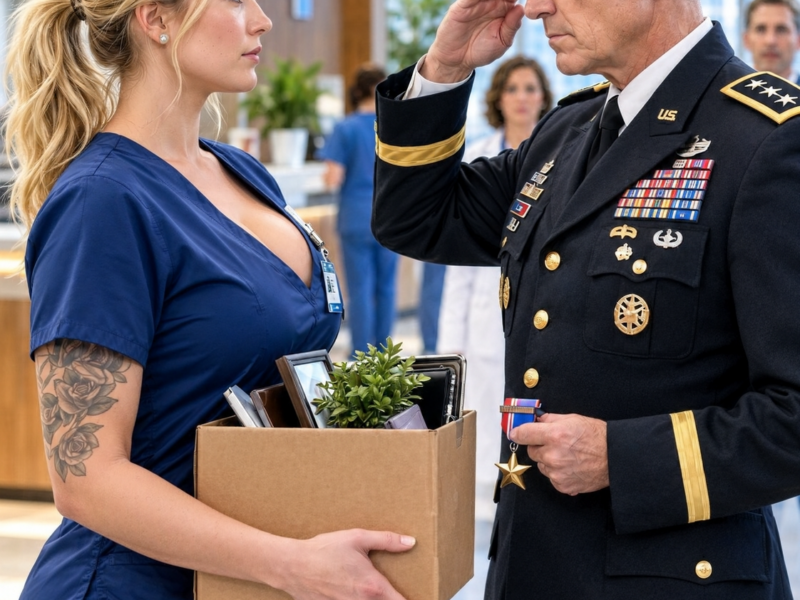
“Dr. Garrett fired me in front of an entire operating room while his patient was bleeding to death, but when a three-star Army general arrived at the hospital forty minutes later
The question hung between us.
“Did Dr. Garrett tell you who Corbin is?”
General Raymond Cobb stood in the locker room doorway, one hand resting on the open medal case. The fluorescent lights reflected off the bronze star inside it.
I looked at him.
“No, sir. He told me she was a patient. Thirty-one years old. Injured in the Capitol Hill explosion.”
Cobb nodded slowly.
“Then he didn’t know.”
“Know what?”
“That she is my granddaughter.”
For a moment, the room seemed to lose all its sound.
I glanced at the medal, then back at him.
“Corbin is your granddaughter?”
“My son’s daughter. She’s the only child in that family.” His jaw tightened. “Her mother called me from the ambulance. They told her Corbin might not survive the trip to the hospital.”
I remembered the blood on the surgical drapes. The monitor screaming. The way Garrett had kept insisting the bleeding was arterial when the pattern told me otherwise.
“She made it,” I said quietly.
“Because you recognized what was happening.”
“Because the team acted in time.”
“Don’t do that, Sergeant.”
His voice wasn’t angry. It was firm.
“Don’t make yourself smaller just because other people are uncomfortable with what you did.”
I looked down at my hands.
Four years ago, those hands had been covered in desert dust and someone else’s blood. I had spent a long time convincing myself they belonged to a person who no longer existed.
Now a little of that old life was standing in front of me.
Cobb lifted the medal case.
“I came here to find you, Danny. Corbin’s emergency brought me through the hospital doors, but I had been looking for you long before tonight.”
“Why?”
“Because you were never properly recognized for what happened at Kandahar.”
I swallowed.
“Sir, that was years ago.”
“Eight months of searching,” he replied. “Eight months after the aid station went quiet. We searched every roster, every hospital record, every lead we could find. You had disappeared.”
“I didn’t want to be found.”
“I know.”
He opened the case fully.
The Bronze Star sat against its dark lining, its small V device catching the light.
“You held that forward aid station for six hours under fire,” he said. “You treated nine wounded soldiers while the position was being hit. You kept the evacuation lane open. You refused extraction until the last casualty was moved.”
“I was doing my job.”
“You were doing more than your job.”
I looked away.
I remembered the dust in my teeth. The radio that kept cutting out. A young corporal asking me whether he was going to die. I remembered telling him to look at me, not at the blood soaking through his uniform.
I remembered the ninth man.
He had been barely conscious when we loaded him onto the last vehicle. I had promised him I would be right behind him.
I hadn’t been.
The blast came before I reached the door.
“I don’t need a medal,” I whispered.
“Maybe not. But the men you saved deserve to know their lives mattered. And you deserve to have the truth recorded.”
He placed the case on the bench between us.
“I won’t force you to accept it.”
For a long time, I couldn’t speak.
Then I touched the edge of the case with one finger.
“I thought if I left, all of that would stop following me.”
Cobb’s expression softened.
“It doesn’t stop following you. But it doesn’t have to decide where you go next.”
I stared at the medal.
The truth was, I hadn’t left the Army because I stopped caring.
I left because I cared so much that I could no longer bear the sound of a monitor flatlining.
I had survived Afghanistan. I had survived the hospital stays, the surgeries, the physical therapy, and the questions from people who wanted me to describe the worst day of my life as if it were a story with a clean ending.
But I couldn’t survive being told that the next person I failed to save would be my fault.
So I disappeared.
I moved to Denver. I changed my routine. I took a job where I could help people without having to explain the things I couldn’t talk about.
And for four years, I convinced myself that being invisible was the same as being safe.
Cobb watched me carefully.
“Corbin asked about you,” he said.
I looked up.
“She was awake?”
“Briefly. Before they took her for imaging. She heard someone say the nurse who recognized the bleeding had been fired.”
I closed my eyes.
“That’s not what she needs to worry about.”
“She wanted to know your name.”
I had no answer.
“She also asked whether you were in trouble.”
“I’m fine.”
“Danny.”
His voice carried the weight of a man who had spent decades hearing people say they were fine when they were anything but.
“You don’t have to convince me.”
A knock sounded against the locker room door.
Dr. Hadley Ren stood outside, still wearing her hospital badge and a dark jacket thrown over her scrubs. Her face looked exhausted.
“General Cobb,” she said. “May I speak with Danny?”
Cobb glanced at me.
I nodded.
He stepped aside.
Hadley came in and closed the door.
“I owe you an apology,” she said.
I leaned against the lockers.
“For what?”
“For allowing a department to become a place where someone can be punished for raising a legitimate clinical concern.”
“Dr. Ren, you weren’t in the operating room.”
“No. But I run the hospital. That makes what happened my responsibility.”
She took a breath.
“I reviewed the operating room recording, the anesthesia timeline, and the emergency notes. I also spoke with Dr. Elkins and Dr. Price.”
I waited.
“Your assessment was correct. The bleeding was coming from a pelvic venous injury. The delay in recognizing it increased the risk to the patient.”
“Corbin is stable?”
“She is in intensive care. The interventional radiology team controlled the remaining bleeding. She’s still critically ill, but her blood pressure has stabilized.”
I felt my shoulders loosen for the first time in hours.
“Good.”
“Dr. Garrett has been removed from clinical duties pending a formal review.”
I looked at her.
“Removed?”
“Temporarily. He will not be operating or supervising cases while the investigation is underway.”
Hadley paused.
“He has also been asked to provide a written account of why he ordered you out of the room.”
I let out a quiet breath.
“He’ll say I challenged his authority.”
“He may. But the recording shows you gave him the information he needed. You didn’t raise your voice. You didn’t insult him. You didn’t refuse an order. You identified a life-threatening problem and asked the team to respond.”
I looked at the floor.
“That didn’t stop him from firing me.”
“No,” she said. “It didn’t.”
There was something honest in her answer that I appreciated.
“I can’t undo what happened tonight. But I can correct the record. Your termination is being rescinded, effective immediately. Your employment status will be restored while we determine the appropriate next steps.”
I shook my head.
“I don’t know if I want to come back.”
“I understand.”
“Do you?”
Hadley didn’t flinch.
“I think I understand more than I did when I walked in here.”
She pulled a folded sheet from her pocket.
“This is a copy of the preliminary incident report. Your clinical observations are documented. So is the timeline of Dr. Garrett’s response.”
I didn’t take it.
“What happens to him?”
“That depends on the review. There will be interviews, an independent clinical assessment, and a credentialing hearing if the findings warrant one.”
“I’m not asking because I want revenge.”
“I know.”
“I just don’t want this happening to someone else.”
Hadley nodded.
“Neither do I.”
For the first time that night, I believed her.
Cobb picked up the medal case.
“There’s one more thing,” he said.
Hadley turned toward him.
“General?”
“Corbin’s family has asked me to pass along their gratitude. Her father is on his way here. He wants to meet the person who helped save his daughter.”
I shook my head.
“He doesn’t owe me anything.”
“That’s not why he wants to meet you.”
Cobb’s eyes held mine.
“Sometimes people need to look at the person who gave them another morning. Let them have that.”
I didn’t know how to answer.
Before I could, my phone vibrated.
An unknown number.
I almost ignored it.
Then I noticed the message preview.
This is Corbin’s dad. My daughter is awake. She keeps asking for Danny.
I read it twice.
The room seemed suddenly too small.
Hadley touched my arm.
“You don’t have to go in if you’re not ready.”
I looked at the message again.
Then I typed:
I’m here.
We walked together toward the intensive care unit.
The hospital had changed in the hour since I’d been fired. The same corridors. The same pale walls. The same antiseptic smell.
But people were looking at me differently.
A respiratory therapist stepped out of a room and gave me a small nod.
One of the nurses who had watched Garrett order me out approached us near the elevators.
“I heard she’s stable,” she said.
“She is.”
The nurse’s eyes glistened.
“I’m glad.”
I nodded and kept walking.
At the ICU entrance, a man in his late thirties stood beside the glass doors. He was tall, with dark hair and a face that looked as though it had aged ten years in one evening.
When he saw Cobb, he hurried toward us.
“Grandpa.”
Cobb embraced him.
“She’s still here, son.”
The man closed his eyes.
Then he turned to me.
“You’re Danny?”
“Yes.”
“I’m Michael. Corbin’s father.”
He took my hand in both of his.
“I don’t know what to say.”
“You don’t have to say anything.”
“She told me what happened. Not all of it. She was in and out. But she remembers someone telling the doctors where the blood was coming from.”
I glanced toward the ICU doors.
“She was very lucky.”
Michael shook his head.
“No. She was lucky you were there.”
His voice broke on the last word.
I had heard gratitude before. From soldiers, from families, from people who had been given a second chance.
It never became easy to receive.
Michael wiped his eyes.
“Can you see her?”
I nodded.
A nurse escorted us inside.
Corbin lay beneath a white blanket, surrounded by monitors and IV lines. Her face was pale. A bandage covered part of her abdomen, and a thin oxygen tube rested beneath her nose.
She looked younger than thirty-one.
For a second, I saw the operating room again.
The blood.
The alarms.
The stillness that had nearly followed.
Then her eyes opened.
“Danny?”
I stepped closer.
“I’m here.”
Her voice was rough.
“You’re the nurse?”
“I am.”
She tried to lift her head, but the nurse gently stopped her.
“Don’t move yet.”
Corbin looked at me with tired, frightened eyes.
“They said you got fired.”
I glanced at Michael.
“That’s being sorted out.”
“Because you helped me?”
“Because someone made a bad decision.”
She frowned.
“I heard you tell them I was bleeding.”
“You needed the team to move quickly.”
“Were you scared?”
The question caught me off guard.
I could have given her the easy answer.
I could have said no.
Instead, I told her the truth.
“Yes.”
She watched me.
“But you stayed.”
I felt something tighten in my throat.
“I did.”
Her fingers shifted against the blanket.
“Thank you.”
I looked at her hand.
There was a small scrape across one knuckle, probably from the explosion.
It was such a small injury compared with what she’d survived.
“You don’t have to thank me,” I said.
“I want to.”
Her eyes closed for a moment.
Then she opened them again.
“My dad said you were a soldier.”
I looked at Cobb.
He gave the smallest nod.
“I was.”
“Did you save people there, too?”
I took a breath.
“I tried.”
Corbin considered that.
“That’s what you did for me.”
I couldn’t speak.
She seemed to understand.
Her eyes drifted closed, and the nurse checked her monitor.
“That’s enough for now,” she said gently. “She needs rest.”
I stepped back.
As we left the room, Michael touched my shoulder.
“She’s going to be okay?”
“The doctors are watching her closely. She’s through the most immediate crisis, but she still has a difficult recovery ahead.”
He nodded, accepting the honest answer.
“Thank you for not promising something you can’t promise.”
I looked at him.
“She’s got a good chance.”
He swallowed and turned toward his daughter.
For the first time in years, I understood that helping someone survive did not mean I had to carry the entire weight of what happened next.
I could do my part.
The rest belonged to the people who loved her and the people trained to care for her.
Cobb waited with me outside the unit.
“You did well,” he said.
“I just spoke to her.”
“You stayed.”
I looked through the glass at Corbin.
“That’s not always enough.”
“No,” he said. “But sometimes it’s the beginning.”
We stood quietly for a while.
Then he held out the medal case again.
“Will you accept it?”
I stared at the bronze star.
“I don’t know how to wear something like that anymore.”
“You don’t have to wear it.”
“I don’t want people looking at it and thinking I was fearless.”
Cobb’s expression changed.
“Then tell them you were afraid.”
I looked at him.
“Tell them you were afraid, and you went back to work anyway. That’s what courage looks like more often than not.”
My eyes burned.
I reached for the case.
The medal felt heavier than it looked.
Not because of the metal.
Because of the names I remembered.
Nine men.
Nine lives.
Nine faces that had stayed with me long after I left the Army.
“I thought nobody remembered,” I said.
Cobb shook his head.
“They remembered.”
He lowered his voice.
“Some of them are still alive. One of them has a family now. Another became a paramedic. One of them asked me every year whether we’d found you.”
I looked down at the case.
“Who?”
“Corporal James Mercer. The one you promised you’d follow out.”
My chest tightened.
“I thought he died.”
“He didn’t.”
For a moment, I couldn’t breathe.
“He made it?”
“He made it.”
I turned away, pressing the case against my chest.
The corridor blurred.
I had spent four years believing that promise had ended in a cloud of dust and fire.
I had believed the last thing James Mercer heard from me was a lie.
But he had lived.
Cobb rested a hand on my shoulder.
“He asked me to tell you something if I ever found you.”
I waited.
“He said he never forgot the medic who stayed until the last vehicle left.”
I closed my eyes.
A sound escaped me that I hadn’t intended to make.
It wasn’t quite a sob.
It was the sound of something locked away finally giving way.
Cobb didn’t try to stop it.
He didn’t tell me to be strong.
He simply stood beside me until I could breathe again.
The following morning, the hospital’s executive review began.
I wasn’t required to attend, but Hadley asked whether I would be willing to provide a statement.
I agreed.
Not for Garrett.
Not for the medal.
For the next nurse who might see something dangerous and hesitate because a surgeon had made it clear that questions were unwelcome.
The conference room was crowded.
Hadley sat at the head of the table. The chief medical officer was beside her. Two members of the hospital’s patient-safety team had joined remotely.
Dr. Garrett sat across from me.
He looked different without the operating room around him.
No surgical gown.
No mask.
No team waiting for his instructions.
Just a man in a pressed shirt, his hands folded tightly on the table.
He didn’t look at me when I entered.
The review began with the timeline.
The explosion.
The ambulance arrival.
The initial assessment.
The surgical decision.
The moment I identified the likely pelvic venous injury.
The eleven minutes that followed.
Anesthesia records showed that Corbin’s blood pressure continued to fall while the team searched for an arterial source that wasn’t there.
The independent reviewer, a trauma surgeon from another hospital, spoke carefully.
“The available evidence supports the concern raised by Mr. Orin. The pattern of bleeding was consistent with a major pelvic venous injury. The delay in changing the working diagnosis increased the patient’s risk.”
Garrett shifted in his chair.
“The situation was chaotic,” he said.
“No one disputes that,” the reviewer replied. “But chaos does not remove the responsibility to reassess when the evidence changes.”
Garrett looked toward Hadley.
“I was leading the operation.”
“And Mr. Orin was raising a clinical concern,” she said. “You could have evaluated it without removing him from the room.”
“He challenged me in front of the team.”
“He identified a possible source of hemorrhage.”
“He was a scrub nurse.”
The words landed with the same contempt they had carried the night before.
Hadley leaned forward.
“And that is exactly why this review matters. Clinical judgment does not become irrelevant because the person speaking is in a different role.”
Garrett’s jaw tightened.
I kept my hands folded.
I didn’t need to win an argument.
I needed the record to be accurate.
The reviewer continued.
“Mr. Orin’s observations were supported by the subsequent imaging and intervention. The treatment plan also included appropriate caution regarding the injured iliac vein and the surrounding pelvic structures.”
Hadley looked at Garrett.
“Do you have anything further to add?”
He stared at the table.
Then, finally, he looked at me.
“You made me look incompetent.”
The room went still.
I answered quietly.
“You were looking at the wrong source of bleeding.”
His face reddened.
“You could have told me privately.”
“I tried to tell you in the operating room.”
“You undermined me.”
“I told you what I was seeing.”
He leaned back.
“You don’t understand the pressure of being responsible for a patient’s life.”
I held his gaze.
“I understand more than you think.”
For the first time, I saw something like uncertainty in his expression.
Hadley ended the meeting.
The hospital placed Garrett on administrative leave while the credentialing committee reviewed his conduct and clinical decisions. His position as vascular surgery director was suspended. The final outcome would depend on the formal findings, not on the anger of the people in that room.
I didn’t ask for anything else.
My termination was formally withdrawn.
The incident report was amended to include my observations and the retaliation that followed.
Hadley offered me my old position back.
I told her I needed time.
She nodded.
“Take it.”
A week later, Corbin was moved out of intensive care.
Her recovery was slow.
She needed another procedure to address complications from the explosion, and the doctors continued monitoring the pelvic injury. But she was awake, talking, and arguing with her father about how much television she was allowed to watch.
When I visited, she was sitting upright with a blanket around her shoulders.
“You look terrible,” she said.
I laughed before I could stop myself.
“That’s a strange way to greet someone.”
“You look like you haven’t slept.”
“Neither have you.”
“Fair.”
She glanced at the medal case I was carrying.
“Is that yours?”
I looked down.
“Apparently.”
“Can I see?”
I opened it and placed it on the bedside table.
She studied the bronze star.
“That’s beautiful.”
“It belongs to a different part of my life.”
“Maybe it belongs to all of it.”
I looked at her.
She shrugged carefully.
“You were a soldier. Now you’re a nurse. You still help people. Seems like the same person to me.”
I didn’t answer immediately.
Because she was right.
The uniform had changed.
The place had changed.
The people had changed.
But the part of me that moved toward someone in danger had never disappeared.
“I don’t know what I’m going to do next,” I admitted.
Corbin smiled faintly.
“Maybe don’t decide while you’re exhausted.”
It was such a simple thing to say.
And somehow, it was exactly what I needed.
A few days later, I met General Cobb at a small café near the hospital.
He had brought a folder.
Inside were copies of the original commendation, the final award paperwork, and a letter from the soldiers who had survived the Kandahar attack.
I read the letter twice.
Then a third time.
It wasn’t formal.
It wasn’t polished.
It was written by men who remembered being afraid and remembered the person who had stayed beside them.
One line was underlined.
You didn’t save us because you weren’t scared. You saved us because you didn’t leave.
I folded the letter carefully.
“I don’t know what to say.”
“Then don’t say anything yet,” Cobb replied.
He stirred his coffee.
“There’s another matter.”
I looked up.
“Corbin’s family asked whether you’d consider speaking to the hospital’s nursing staff about what happened.”
I hesitated.
“I don’t want to become some kind of symbol.”
“Then don’t.”
He smiled slightly.
“Talk about what you saw. Talk about speaking up. Talk about how a team should work when the person with the least authority notices something everyone else has missed.”
I considered it.
“I could do that.”
“I thought you might.”
For the next month, I took time away from the operating room.
I met with a counselor who worked with veterans. I called the old unit. I spoke to James Mercer for the first time in four years.
His voice was older, rougher, but unmistakably alive.
“Orin,” he said when he answered.
I couldn’t speak.
“Hey, brother,” he continued. “Took you long enough.”
I laughed, and then I cried.
We talked for nearly two hours.
He told me about his wife, his two daughters, and the job he had taken after leaving the Army. I told him about Denver, the hospital, and the patient who had nearly died.
He didn’t ask me why I’d disappeared.
Not once.
Before we hung up, he said, “You don’t have to keep paying for the fact that you survived.”
I sat with those words for a long time.
Then I called my sister.
I hadn’t spoken to her properly in months.
She answered on the second ring.
“Danny?”
“Hey.”
Silence.
Then she started crying.
I told her I was sorry.
She told me she was glad I was alive.
Neither of us tried to explain the years between those two sentences.
We didn’t need to.
When I finally returned to St. Ambrose, it wasn’t as a scrub nurse trying to disappear behind a surgical mask.
Hadley had offered me a different role: clinical safety liaison for the surgical services team, with time in the operating room and responsibility for helping staff escalate concerns when patient safety was at risk.
I accepted.
The job didn’t make me a doctor.
It didn’t make me the person in charge of every room.
It gave me something I had wanted without knowing how to ask for it.
A way to help people speak before a mistake became irreversible.
Garrett’s review concluded several weeks later.
The committee found serious failures in his response to the changing clinical picture and his treatment of a staff member who raised a legitimate safety concern. He lost his leadership position and faced restrictions on his surgical privileges pending further competency review.
I didn’t celebrate.
I didn’t feel victorious.
I felt relieved that the hospital had finally looked at what happened without protecting someone’s title.
On my first day back in the operating suite, I stood near the scrub station and watched the team prepare for a routine case.
A young nurse named Olivia was checking the instrument count.
She paused.
“Danny?”
“Yeah?”
“Can I ask you something?”
“Of course.”
She glanced toward the surgeon.
“I think the patient may be reacting to the medication. The monitor changed, but the attending says it’s probably nothing.”
I looked at the monitor.
Then at her.
“What are you seeing?”
She described the changes.
I listened.
“Let’s bring anesthesia in and reassess.”
She nodded, visibly relieved.
As the team responded, I saw the fear in her face begin to ease.
She hadn’t needed to shout.
She hadn’t needed to challenge anyone’s authority.
She had needed someone to listen.
And someone had.
Later that afternoon, I walked past the staff lockers and stopped at the mirror.
The scar above my collarbone was still there.
My right leg still ached when the weather changed.
The memories hadn’t vanished.
Neither had the nightmares.
But for the first time in years, I didn’t feel like I was standing outside my own life, waiting for permission to come back in.
I took the Bronze Star from its case and placed it in the small drawer of my desk.
Not as proof that I was brave.
As a reminder that I had once been part of something larger than my fear.
And that I still was.
That evening, I visited Corbin one last time before she was discharged.
She was sitting in a wheelchair near the window, arguing with Michael about whether she could walk to the car without help.
When she saw me, she grinned.
“Look who came back.”
“I work here.”
“That’s not the same thing.”
I smiled.
“No. I suppose it isn’t.”
She reached out and shook my hand.
“Thank you for staying.”
I held her hand for a moment.
“Thank you for giving me a reason to.”
She looked confused.
So I explained.
“For a long time, I thought the part of me that helped people had been left behind somewhere overseas. You reminded me it hadn’t.”
Corbin’s smile softened.
“Then I guess we both got something back.”
I nodded.
Outside, Denver’s evening lights were coming on.
The city kept moving.
Cars passed.
People hurried home.
Somewhere, an ambulance turned a corner with its siren rising above the traffic.
I listened until the sound faded.
For years, that sound had taken me backward.
Now it reminded me that somewhere ahead, someone was moving toward a person who needed help.
And maybe that was enough.
I had not returned to the Army.
I had not erased what happened at Kandahar.
I had not become the person I was before the blast.
But I had stopped running from the person I had become.
The medal was in my desk.
The nine men were no longer just ghosts in my memory.
Corbin was going home.
And tomorrow, I would walk into another operating room with my eyes open and my voice ready.
Not because I was fearless.
Because I finally understood that courage was never the absence of fear.
It was the decision not to let fear make every choice for me.
The next morning, I arrived early.
I put on my scrubs, washed my hands, and stepped into the surgical suite.
A new patient was waiting.
A new team was gathering.
And this time, when someone spoke up, I knew what I would do.
I would listen.
THe end.









