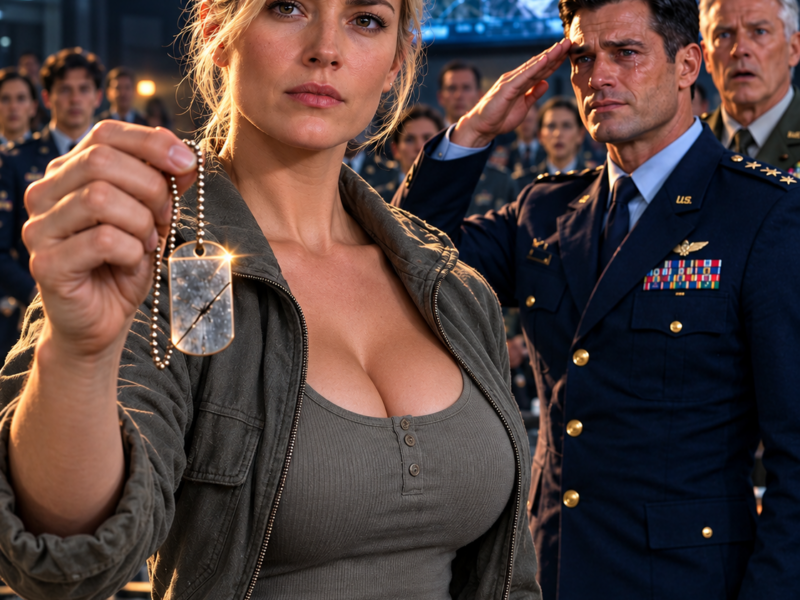
“Why are you standing in my command briefing without a rank, without a unit, and without permission to be here?” the general demanded
The phone hit the floor.
For one brief second, nobody moved.
Then Commander Elias Ward spoke.
“Security team, seal the building. No one enters or exits without my authorization.”
The two officers behind him moved immediately.
One secured the briefing room doors.
The other stepped toward Colonel James Mercer.
“Sir, I need you to step away from the table.”
Mercer stared at him.
“This is absurd. I’m the installation commander.”
“Then you should have no problem cooperating, sir.”
General Richard Caldwell raised a hand.
“Everyone stop. I want an explanation, and I want it now.”
Ward remained standing beside me.
“General, the message on that phone confirms an active security breach.”
Caldwell looked down at the glowing screen.
“Who sent it?”
“We’re about to find out.”
Mercer shook his head.
“You’re making a serious mistake. That message could have been planted.”
I watched him carefully.
“Then you won’t mind if the phone is examined.”
He looked at me.
For the first time, the contempt was gone.
What remained was fear.
Eleven years earlier, I had seen that same expression on the face of a man who knew an operation was about to collapse.
I had been thirty-one years old then.
My name was Captain Evelyn Shaw.
I commanded a small team of specialists whose assignments were too sensitive to appear in ordinary military records.
Night Forge wasn’t an assault unit.
We were the people sent in when conventional intelligence failed, when communications couldn’t be trusted, and when a mission needed a solution nobody else could safely attempt.
Our team had seventeen members.
Engineers.
Signals specialists.
Combat medics.
Reconnaissance operators.
And people who could turn a broken system into something useful before the enemy realized it had failed.
We worked in the dark, often without recognition.
Our motto was simple:
Build what is needed.
Protect who is there.
Leave no one behind.
Then came Operation Iron Lantern.
We were sent to recover a classified communications package from a remote mountain installation.
The mission was supposed to last forty-eight hours.
It lasted nine days.
On the seventh night, our communications network began receiving authenticated commands that contradicted our orders.
A route changed.
An extraction window disappeared.
A friendly position was marked hostile.
I recognized the pattern immediately.
Someone wasn’t simply intercepting our communications.
Someone was using our own authority against us.
I ordered the team to stop following incoming commands until they could be independently verified.
That decision saved lives.
But it also exposed something much larger than the operation.
We discovered that someone inside the command structure had been using a hidden relay system to redirect classified assets.
The system was called BLACK ANVIL.
It had been designed as an emergency backup for compromised communications networks.
Instead, someone had turned it into a tool for controlling missions without leaving a conventional command trail.
We copied the original logs.
We secured the system.
And we prepared to report everything.
Before we could reach the extraction point, our transport was redirected.
The official order identified the new landing zone as safe.
It wasn’t.
The aircraft was hit during its approach.
We survived the crash, but our communications equipment was destroyed, and our location was exposed.
Seventeen people went into that operation.
Only twelve were eventually accounted for.
The remaining five were listed as missing or killed.
I was among those officially declared dead.
The military record said our unit had suffered catastrophic losses during an enemy attack.
It also said our mission objectives had failed.
Neither statement was true.
We had recovered the evidence.
And someone had made sure it disappeared.
Now, eleven years later, the same hidden system was active again.
I returned my attention to the briefing room.
“Commander Ward,” I said, “I want the phone isolated before anyone touches it.”
Ward nodded.
“Understood.”
One of the security officers placed the device inside an evidence pouch.
The screen was still visible.
A second message appeared.
THE ARCHIVE MUST REMAIN BURIED.
General Caldwell read it aloud.
“Archive?”
I looked at him.
“The original Night Forge records.”
“Where are they?”
“Not here.”
Mercer let out a short, bitter laugh.
“You’re chasing a ghost, Shaw.”
I turned toward him.
“You know my name.”
“I know the name of a dead officer.”
“Then how did you recognize the symbol on my drive?”
He didn’t answer.
Caldwell stepped between us.
“Colonel Mercer, you will explain what you know about this operation.”
Mercer straightened his jacket.
“General, I have served this installation for twenty-seven years. I will not be interrogated by a civilian investigator with no visible rank.”
I looked at the general.
“He’s right about one thing.”
Caldwell frowned.
“Which is?”
“I don’t have a rank in this room.”
I removed a small identification card from my pocket and placed it beside the data drive.
It carried a federal seal and a classification designation.
“I’m here under an independent oversight authorization. My assignment is to investigate unauthorized access to legacy military systems.”
Caldwell picked up the card.
He studied it for several seconds.
“Who authorized this?”
“An office that doesn’t report through this installation.”
“Why wasn’t I informed?”
“Because the investigation involves people with access to your command channels.”
His expression darkened.
He looked at Ward.
“Did you know?”
“No, sir. I was instructed only to provide access and support.”
“By whom?”
Ward glanced at me.
“By the Director of Military Special Investigations.”
Caldwell lowered the card.
“So this isn’t a routine audit.”
“No, sir,” I replied. “It never was.”
The general looked toward Mercer.
“Colonel, I’m placing you on temporary administrative restriction pending an independent review.”
Mercer stared at him.
“You cannot be serious.”
“I am.”
“You’re allowing a woman who has been declared dead to dictate command decisions?”
Caldwell’s voice became colder.
“I’m allowing evidence to dictate them.”
Mercer looked toward the door.
The security officer moved into his path.
Then the colonel did something unexpected.
He smiled.
“You still don’t understand,” he said.
I felt my stomach tighten.
“What don’t I understand?”
“BLACK ANVIL isn’t the only system.”
The room went silent.
He continued.
“The relay you found at the mountain station is just one node. The real network was moved years ago.”
“Where?”
Mercer looked directly at me.
“Somewhere you helped build.”
For a moment, I couldn’t speak.
Because there was only one place that made sense.
The underground engineering facility beneath the original Night Forge training complex.
A facility that had officially been demolished.
A facility whose existence had been removed from the installation maps.
“Who has access?” Ward asked.
Mercer didn’t answer.
I leaned closer.
“Colonel, what did you activate?”
His smile disappeared.
“Something that should have stayed buried.”
A loud alarm suddenly sounded outside the briefing room.
The digital display flickered.
The map of the northern training corridor vanished.
A new image appeared.
A satellite view of the abandoned Night Forge complex.
One red marker blinked beneath the old engineering building.
Then a line of text appeared across the screen.
BLACK ANVIL: REMOTE ACCESS CONFIRMED.
Ward immediately reached for his radio.
“Operations, this is Commander Ward. Confirm the source of the transmission.”
Static answered him.
He tried again.
Nothing.
Caldwell turned toward the intelligence analyst.
“Can you shut it down?”
The analyst was already typing.
“I’m trying, sir. The system is rejecting every standard access command.”
I stepped toward the screen.
“Don’t send another command.”
He looked up.
“Why?”
“Because that’s what it’s waiting for.”
I studied the transmission pattern.
The system wasn’t simply active.
It was listening.
Every attempt to shut it down was giving it another authenticated instruction to imitate.
I recognized the structure.
It was the same trap that had nearly destroyed my team eleven years earlier.
“Disconnect the display from the command network,” I ordered.
The analyst hesitated.
“General?”
Caldwell nodded.
“Do it.”
The screen went black.
The alarm continued.
Ward’s radio crackled.
A voice emerged through the static.
“Night Forge Actual… do you copy?”
I froze.
Nobody in the room moved.
The voice was distorted, but I knew it.
I had heard it during the worst night of my life.
“Repeat your identification,” Ward said.
The voice came again.
“Night Forge Actual. This is Anvil Two. Authentication phrase: the forge never sleeps.”
My fingers tightened around the edge of the table.
Anvil Two.
Sergeant Daniel Price.
Our communications engineer.
He had been one of the five people never recovered after Iron Lantern.
I had watched his last known transmission disappear into static.
I had believed him dead for eleven years.
“Anvil Two,” I said into the radio. “This is Night Forge Actual. Identify your location.”
A long pause followed.
Then his voice returned.
“Below the old engineering building.”
My heart began pounding.
“Are you alone?”
“No.”
“Who is with you?”
Another pause.
“Someone you left behind.”
The transmission ended.
I turned toward Ward.
“Get a response team ready.”
Caldwell stepped forward.
“I’m coming.”
“General, this is not a standard recovery operation.”
“I know.”
“You don’t know what’s beneath that building.”
“Then I suppose it’s time I found out.”
I looked at Mercer.
He had gone pale again.
“Colonel,” I said, “you’re coming with us.”
He shook his head.
“I don’t know anything about that facility.”
“Then you won’t mind showing us the way.”
We moved quickly.
Ward assembled a small security team while the general contacted the regional command center through a separate secure line.
The intelligence analyst stayed behind to monitor the system from an isolated terminal.
I insisted that nobody reconnect the briefing room display.
Whatever was beneath the old engineering building had already found a way to reach the installation network.
We couldn’t afford to give it another path.
The abandoned complex sat beyond a ridge on the northern edge of the base.
From the road, it looked like a collection of forgotten concrete structures.
Grass had grown through the cracked pavement.
Old warning signs hung crookedly from rusted posts.
The main engineering building had been partially demolished.
Its upper floors were gone.
But the underground access point remained.
I knew because I had helped design it.
We had built the facility to test communications systems under conditions where ordinary networks could not be trusted.
There were shielded rooms, independent power supplies, and emergency transmission lines.
BLACK ANVIL had been tested there before it was supposed to be dismantled.
I had never known what happened after the project was transferred.
Now I understood why.
Ward’s team approached the building from the east.
I walked beside the general.
Mercer followed between two security officers.
At the entrance, I found a small metal panel hidden beneath a broken electrical cabinet.
The hammer-and-anvil symbol had been scratched into its surface.
I pressed the lower edge.
A mechanical lock clicked.
Caldwell stared at the opening.
“You knew that was there?”
“I helped install it.”
The panel slid aside.
Behind it was a narrow staircase leading underground.
A faint electrical hum came from below.
“Commander,” I said, “keep your people behind me until we understand what we’re walking into.”
Ward nodded.
We descended.
The air grew colder with every step.
At the bottom, a long corridor stretched beneath the building.
Emergency lights flickered along the walls.
Most of the doors were sealed.
But one stood open.
Inside, a bank of old computer terminals glowed in the darkness.
And beside them stood a man wearing a faded military jacket.
His hair was almost entirely gray.
His face was thinner than I remembered.
But when he turned toward me, I recognized him immediately.
Daniel Price.
Alive.
For several seconds, neither of us spoke.
Then he gave a tired smile.
“About time, Captain.”
I crossed the room.
I wanted to ask a hundred questions.
Instead, I grabbed his shoulders.
“You were listed as dead.”
“I know.”
“We searched for you.”
“I know that too.”
“Why didn’t you come home?”
His smile faded.
“Because they told me everyone who came looking would die.”
I stepped back.
“Who told you?”
Price looked past me.
His eyes settled on Colonel Mercer.
“He did.”
Mercer shook his head.
“This is nonsense.”
Price reached for a small control panel.
“Then perhaps you’d like to explain why your credentials opened the lower security door six hours ago.”
Ward moved immediately.
“Colonel, don’t move.”
Mercer raised his hands.
“I was following an authorized instruction.”
“From whom?” I asked.
Price turned toward the terminal.
“That’s what I’ve been trying to find out.”
He brought up a screen showing a long list of access records.
Most were marked with automated system identifiers.
But several had human authorization codes.
One belonged to Mercer.
Another belonged to a senior officer in regional command.
The last one made my blood run cold.
General Adrian Voss.
Caldwell stared at the name.
“Voss is retired.”
“Not from every system,” Price replied.
“He was the director of the original BLACK ANVIL program. He signed the order that declared Night Forge destroyed.”
I looked at Mercer.
“Did you know he was alive?”
Mercer swallowed.
“I received instructions from an intermediary.”
“Who?”
“I never met him.”
Price gave a quiet laugh.
“Of course you didn’t.”
He opened another file.
A photograph appeared.
It showed five Night Forge members standing beside a transport aircraft.
Daniel Price was in the center.
I was beside him.
The other three were people I had spent eleven years mourning.
Then Price opened a second image.
It showed the same five people in a different location.
Alive.
Older.
Standing outside the underground facility.
My breath caught.
“What is this?”
“An archive,” he said. “Not the one they wanted to bury. The one I made after they brought us here.”
“Who are the others?”
Price looked at the photograph.
“Three of them are still alive.”
“And the fifth?”
His expression hardened.
“Captain Mara Ellis died here two years ago.”
I closed my eyes.
Mara had been our medic.
She had kept our team alive through the crash and the days that followed.
The thought of her dying alone in a place like this made my hands tremble.
“Why didn’t you escape?”
Price pointed toward the terminal.
“Because the system was monitoring every external transmission. Anyone who tried to send a message triggered a lockdown. I managed to get a signal through only because someone activated the relay at the mountain station.”
“Who activated it?”
He looked at Mercer.
“That’s what I need him to tell us.”
Mercer shook his head.
“I didn’t know anyone was down here.”
Price stepped toward him.
“You signed the access authorization.”
“I was told the facility was empty.”
“You were told what you needed to hear.”
Caldwell moved between them.
“Enough. Colonel, you will answer the questions.”
Mercer looked toward the general.
Then toward the door.
He seemed to realize there was nowhere left to go.
“I was contacted six months ago,” he said. “The caller claimed to represent General Voss. He said the old network had become unstable and needed to be brought back online.”
“And you agreed?” I asked.
“He promised to restore my position on the regional command board.”
“By helping him reactivate a system that could redirect military operations?”
Mercer lowered his head.
“I didn’t know what BLACK ANVIL could do.”
“You knew what happened to Night Forge.”
He didn’t respond.
Price pulled up another file.
“There’s more.”
The screen showed a series of recorded communications.
The first was dated eleven years earlier.
The second was from six months ago.
The third had been recorded that morning.
The same voice appeared in all three.
Deep.
Calm.
Measured.
General Adrian Voss.
I recognized it immediately.
“Night Forge was never supposed to survive Iron Lantern,” the recording said. “The archive contains material that could compromise every command decision made during the BLACK ANVIL program. It must remain under control.”
Another voice responded.
Mercer’s.
“What about the surviving personnel?”
“Keep them contained.”
The recording ended.
Caldwell turned slowly toward Mercer.
“You knew.”
Mercer looked at the floor.
“I knew there were people here.”
The general’s voice became dangerously quiet.
“And you said nothing.”
“I was afraid.”
I stared at him.
“So were we.”
Nobody spoke.
Then the lights went out.
A sharp metallic sound echoed from the corridor.
Ward immediately raised his weapon.
“Security, hold position!”
Emergency lights came on a moment later.
A warning appeared across the central terminal.
REMOTE LOCKDOWN INITIATED.
Price rushed toward the console.
“They’re sealing the facility!”
I moved beside him.
“Can you stop it?”
“Not from this terminal.”
“Where’s the control point?”
“Upper relay chamber. Other side of the corridor.”
Ward turned toward his team.
“Two with me.”
I shook my head.
“Wait.”
I studied the warning.
The lockdown was not being triggered by the facility’s local system.
It was being issued remotely through the same authenticated channel used in the briefing room.
Someone had access to the installation command network.
Someone knew exactly where we were.
“General,” I said, “we need to disconnect the external line.”
Caldwell nodded.
“Tell me how.”
Price pointed to a service corridor.
“There’s a manual isolation switch beyond the relay chamber.”
Ward looked at me.
“Let’s move.”
We advanced down the corridor.
The first security door was already closing.
Ward and one of his officers forced their way through.
I followed.
Behind us, the second door began descending.
Price stayed at the terminal, trying to hold the system open long enough for us to reach the isolation point.
The relay chamber was at the end of a narrow passage.
Inside, a large communications cabinet stood against the wall.
A thick cable ran from its lower panel into the floor.
I found the manual switch.
It was locked behind a metal cover.
“Commander, keep the corridor clear.”
Ward positioned his team.
I opened the cover and reached for the switch.
A voice suddenly came through the chamber speakers.
“Captain Shaw.”
I stopped.
The voice was unmistakable.
General Adrian Voss.
“It’s been a long time.”
I looked up.
“Not long enough.”
A soft laugh came through the speakers.
“You always were difficult.”
“Where are you?”
“Somewhere you cannot reach.”
“You’re hiding behind a network.”
“I’m protecting a system that people like you never understood.”
“You used it to falsify military orders.”
“I used it to prevent instability.”
“You sent seventeen people into a trap.”
“I sent a unit into an operation that became compromised.”
“You declared us dead.”
“You were no longer operationally useful.”
The words landed harder than I expected.
For eleven years, I had wondered whether the people responsible had ever considered us human beings.
Now I had my answer.
I pulled the manual isolation lever.
The speaker crackled.
Voss’s voice became distorted.
“You don’t know what you’re doing.”
“Maybe not,” I said. “But I know how to shut down something I helped build.”
The lever dropped.
The lights flickered.
Then every terminal in the chamber went dark.
The lockdown alarm stopped.
For the first time since entering the facility, the silence felt real.
Ward lowered his weapon.
“External connection severed.”
I nodded.
“Let’s get back.”
When we returned to the control room, Price was standing beside the terminal.
The screen was dark.
Mercer sat against the wall with his hands secured.
Caldwell was speaking into a secure radio.
He looked up as we entered.
“Regional command has confirmed that General Voss is still alive. They are sending an independent investigation team.”
“Good,” I said.
“There’s another issue.”
He handed me a printed report.
The report listed the five missing Night Forge personnel.
Beside each name was a new status.
Three were confirmed alive.
One was deceased.
And my own file had been updated.
STATUS: ACTIVE — IDENTITY VERIFIED.
I stared at the page.
For eleven years, I had been a dead woman in a system that had never stopped using my name.
Now the truth was finally becoming official.
But there was one thing I still needed to know.
“Daniel,” I said, “where are the other survivors?”
He looked at me.
“Two are in a safe location. The third is being held in a medical facility outside the country.”
“Can we reach them?”
“With the network disconnected, yes.”
I nodded.
“Then that’s our next mission.”
Price smiled faintly.
“Still giving orders, Captain?”
“Somebody has to.”
He laughed.
It was the first sound in that room that didn’t carry fear.
The investigation lasted several months.
General Voss was located at a private residence and taken into custody after investigators recovered the original BLACK ANVIL records.
The evidence showed that he had used the system to manipulate mission routes, suppress communications, and conceal unauthorized operations.
Mercer admitted to restoring access to the underground facility and concealing information about the surviving Night Forge personnel.
He was removed from command and faced a formal military investigation.
Several other officers were suspended pending review.
The original Iron Lantern report was reopened.
The five missing personnel were no longer treated as a single unexplained loss.
Their individual stories were finally recorded.
Daniel Price was reunited with his family.
The two other surviving members returned home under protected arrangements.
Mara Ellis was given a proper memorial, with her name restored to the official record.
And I received something I had stopped expecting.
An official acknowledgment that Night Forge had existed.
Not as a rumor.
Not as a classified footnote.
But as a unit of seventeen people who had carried out their orders and refused to abandon one another.
One afternoon, several weeks after the investigation began, General Caldwell asked me to return to Redstone.
He was waiting in the same briefing room where everything had started.
Commander Ward stood beside him.
On the table lay a new identification card.
My name was printed across the top.
Under it were the words:
NIGHT FORGE — COMMANDER, RETIRED STATUS REINSTATED.
I picked it up.
“Why give me this now?”
Caldwell looked toward the window.
“Because the people who erased your service should never have had the power to erase your history.”
I turned the card over.
The small hammer-and-anvil symbol had been restored.
Ward stepped forward.
“Permission to salute, ma’am?”
I almost smiled.
“Granted.”
He raised his hand.
Caldwell followed.
For a moment, I stood there without knowing what to say.
I had spent eleven years believing the worst part of losing Night Forge was losing the people.
I was wrong.
The worst part was knowing that someone had convinced the world those people had never mattered.
Now their names were back.
Their stories were back.
And the truth was no longer buried beneath a mountain of classified files.
I placed the identification card in my pocket.
“General,” I said, “there’s one thing I want to make clear.”
“Go ahead.”
“Night Forge was never about rank.”
Caldwell nodded.
“I understand.”
“It was about responsibility. About protecting the people beside you, even when nobody was watching.”
Ward looked at me.
“Then what happens now?”
I glanced at the empty chairs around the briefing table.
“Now we make sure nobody else has to disappear for doing the right thing.”
Outside, the base continued its ordinary routine.
Vehicles moved along the access road.
Aircraft crossed the distant sky.
Young soldiers hurried between buildings, carrying equipment and trying to look more confident than they felt.
Most of them would never know what had happened beneath the old engineering complex.
They didn’t need to.
They needed to know that the people responsible for protecting them would tell the truth, even when the truth was inconvenient.
As I reached the door, Ward called after me.
“Commander?”
I turned.
He stood at attention.
“Night Forge Actual. Is the forge still operational?”
For the first time in eleven years, I answered without hesitation.
“Always.”
And somewhere beyond the mountains, three former members of my team were waiting to hear those words.
We had been erased once.
We would not be erased again.
The end.









