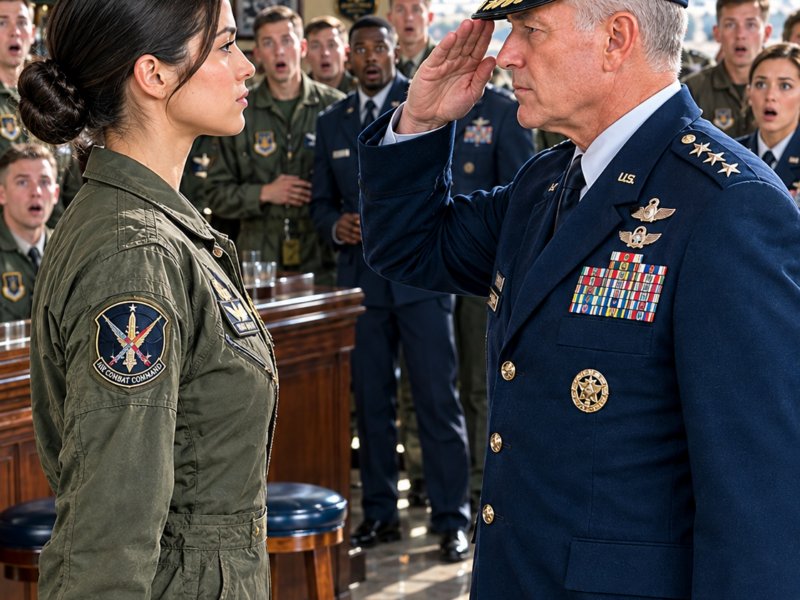
“When two young pilots laughed at my faded flight jacket in the middle of the Air Force base, I kept my eyes on the floor
The general kept the phone in his hand for several seconds after the call ended.
I watched him, waiting for an explanation, but he walked to the office door and locked it.
“Claire, I need you to tell me exactly what happened the night Raven Flight went down.”
I looked at the patch on my sleeve.
“Sir, I filed my report seventeen years ago.”
“I know what you filed. I also know what they allowed you to keep.”
His words landed harder than I expected.
I had spent seventeen years believing that the worst part of that night was losing three men and never learning why we had been sent into a storm with outdated intelligence.
Now, the general was telling me that even my memories might have been shaped by someone else’s decisions.
“Who accessed the file?” I asked.
“Security is checking the terminal.”
“Then why did you tell them not to let him leave?”
Whitmore’s eyes met mine.
“Because the name attached to those credentials belongs to Captain Daniel Mercer.”
For a moment, the office seemed to shrink around me.
Daniel.
I had not spoken his name aloud in years.
He had been my flight lead, my closest friend in the squadron, and the man who had handed me the jacket after pulling me from the wreckage of our aircraft.
According to the official report, Daniel had died before sunrise on October 14, seventeen years ago.
I had watched his helicopter disappear into a wall of smoke.
I had signed the statement confirming that he never made it back to the evacuation point.
And I had carried the guilt of that signature ever since.
“That’s impossible,” I said.
Whitmore didn’t argue.
He simply pulled a chair away from the conference table.
“Sit down, Claire.”
I remained standing.
“Did you know he was alive?”
“No.”
“Did you ever believe he might be?”
The question caught me off guard.
I looked at my hands. There was a faint scar across my right thumb, left by a piece of broken canopy glass during the crash.
“For the first year, I checked every casualty update. Every hospital list. Every unidentified remains report I could get access to.”
“And after that?”
“After that, I learned how to live with not knowing.”
Whitmore lowered his gaze.
“I should have asked you these questions years ago.”
I almost laughed, but there was nothing funny about it.
“You were the general who signed the final report.”
“Yes.”
“You approved the conclusion that Daniel was dead.”
“Yes.”
“And you let me spend seventeen years believing I had left him behind.”
His shoulders sagged slightly.
“I signed what was put in front of me.”
“That isn’t an answer.”
“No,” he said quietly. “It isn’t.”
Before I could press him further, someone knocked sharply on the door.
Whitmore unlocked it.
His aide, Colonel James Ellis, stepped inside with a tablet in one hand and a thin folder in the other.
“We have a problem, sir.”
Whitmore took the folder.
“Tell me.”
“The access request originated from Terminal Four in the secure records wing. The system registered Captain Mercer’s credentials at 9:42 this morning.”
“Who was physically at the terminal?”
Ellis hesitated.
“We have surveillance footage, but there’s a complication.”
“What complication?”
“The camera feed was overwritten twelve minutes before the access.”
Whitmore stared at him.
“Overwritten by whom?”
“The administrator account assigned to the Raven Flight archive.”
The general slowly closed the folder.
“That account was deactivated seventeen years ago.”
“Yes, sir.”
I moved closer to the table.
“Could someone have copied Daniel’s credentials?”
“That’s possible,” Ellis said. “But the request also used a secondary authentication key. One issued personally to Captain Mercer.”
I remembered Daniel tapping a small metal token against his knuckles whenever he was thinking.
He used to call it his lucky coin, though it wasn’t a coin at all. It was an old authentication key he had carried during our final months together.
Before Raven Flight, he had joked that if the Air Force ever lost track of him, that little piece of metal would prove he existed.
I had laughed at him.
Now I couldn’t remember the last time I had seen it.
“What’s on the file?” I asked.
Ellis glanced at the general.
Whitmore answered for him.
“The original mission manifest, the aircraft telemetry, and the initial intelligence assessment.”
“Then open it.”
“We can’t.”
“Why not?”
“Someone placed a new restriction on the archive six minutes ago. The authorization came from the Office of Special Investigations.”
Whitmore’s expression hardened.
“That office doesn’t control historical flight records.”
“It does when the records are linked to an active investigation.”
“What active investigation?”
Ellis shook his head.
“We haven’t been given a case number.”
The silence that followed was more unsettling than the announcement about Daniel’s credentials.
Somebody had accessed a file that officially should have been dormant, erased the camera footage, and then sealed the records again.
They had done all of it within minutes.
This wasn’t an old administrative mistake.
Someone was watching.
And someone had just realized we were looking back.
Whitmore turned to me.
“Claire, I need you to understand something. If Daniel Mercer is alive, then someone has been falsifying federal records for seventeen years.”
“And if he isn’t alive?”
“Then someone is using a dead man’s identity to get into a file that could ruin careers.”
I glanced at my sleeve.
“Either way, the jacket matters.”
For the first time, Whitmore nodded.
“More than you know.”
He reached for the jacket, then stopped before touching it.
“May I?”
I rolled up my sleeve.
He leaned close to examine the patch.
“The Black Compass,” he murmured.
I hadn’t heard that name spoken by another person in seventeen years.
“You know what it is.”
“I know what it was supposed to represent.”
“Then tell me.”
He straightened.
“Not here.”
I felt anger rise behind my ribs.
“Sir, you brought me into this office, told me the dead might be alive, and said the people wearing these jackets were never supposed to exist. You don’t get to decide that I can only have half the truth.”
Ellis looked down at the floor.
Whitmore held my gaze for a long moment.
Then he pulled a second folder from a locked drawer.
It was older than the first, its edges yellowed, its cover marked with a classification stamp that had been crossed out in black ink.
“I was a lieutenant colonel when the Black Compass program was formed,” he said. “It wasn’t a squadron, and it wasn’t an official unit. It was a small flight team assembled for missions that required pilots who could operate without the usual support structure.”
“Covert operations?”
“Some. Others were rescue missions in places where a visible American military presence could make things worse.”
“Why the patch?”
“Because the team needed a way to recognize its own members without putting a unit name on their uniforms.”
I stared at the faded emblem.
“So the jackets were issued to the team.”
“Six of them.”
“Six?”
He opened the folder.
Inside was a photograph of six airmen standing in front of a transport aircraft. Their faces were younger, their uniforms crisp, their expressions somewhere between pride and exhaustion.
Daniel stood on the far left.
I recognized his crooked smile immediately.
Beside him stood a woman I had never seen before, followed by four other men.
I counted the faces twice.
There were six.
But I knew the names of only five.
“Who is she?” I asked, pointing at the woman.
Whitmore looked at the photograph.
“Major Rebecca Shaw. Intelligence liaison. She coordinated the mission planning.”
“What happened to her?”
“She resigned before Raven Flight.”
“Why?”
“She claimed the mission intelligence had been compromised.”
My stomach tightened.
“Compromised how?”
Whitmore closed the folder halfway.
“That was never established.”
“Did anyone investigate her claim?”
“Yes.”
“And?”
“The investigation found insufficient evidence to support it.”
I stared at him.
“That’s the same phrase they used in Daniel’s final report.”
Whitmore didn’t respond.
I took the photograph from him and studied Rebecca’s face. She looked directly at the camera, her expression serious, her hands folded behind her back.
Daniel was smiling.
I had never seen him smile like that during a briefing. It was the expression he wore when he thought the rest of the world had missed something important.
I turned the photograph over.
A handwritten date sat in the lower corner, followed by six names.
The last name had been scratched out so thoroughly that the paper was nearly torn.
“Who was the sixth person?” I asked.
Whitmore reached for the photograph, but I held it away from him.
“Claire.”
“Who was it?”
“I don’t know.”
“You were in charge of the program.”
“I wasn’t in charge of everything.”
The answer sounded too practiced.
I placed the photograph on the table.
“Then let’s find out.”
Ellis’s tablet chimed.
He looked at the screen, and his face changed.
“General, we have a vehicle approaching the north entrance. Security says the driver has requested to speak with Captain Bennett.”
My name.
Not the general’s.
Mine.
“Who is it?” I asked.
Ellis swallowed.
“He refused to provide a name. He said you’d recognize what he brought.”
Whitmore stepped toward the window, though the office was too far from the entrance to see anything useful.
“Is the vehicle registered?”
“No, sir. The plates come back to a vehicle that was reported destroyed in a fire three years ago.”
The general turned to me.
“Do you know anyone who would make an entrance like that?”
I thought of Daniel’s old habits, his dry humor, the way he used to leave messages that sounded like riddles because he didn’t trust ordinary communication channels.
Then I remembered something else.
The night Raven Flight went down, Daniel had told me to wait for his signal before leaving the aircraft.
I had waited.
The signal never came.
I looked at the general.
“I know someone who might.”
Ellis received another message.
He read it, then held the tablet out to Whitmore.
The screen showed a photograph from the security gate.
A man sat behind the wheel of a dark blue sedan, his face partly obscured by the glare on the windshield.
On the passenger seat lay a black leather flight jacket.
A silver compass glinted on the sleeve.
My hand went instinctively to my own patch.
It was identical.
Not similar.
Identical.
Even the small tear along the lower edge was in the same place.
“That’s impossible,” I whispered.
Whitmore examined the image.
“Do you recognize the driver?”
I leaned closer.
The photograph was grainy, but the angle of the man’s shoulders, the way he held his left hand against the steering wheel, and the narrow scar running along his jaw were painfully familiar.
Daniel had that scar before the crash.
I had watched him get it during a training accident in Nevada, when a broken latch sent a panel swinging into his face.
I had driven him to the medical station myself.
“It’s him,” I said.
Ellis looked between us.
“Captain Mercer?”
I couldn’t make myself answer.
The general took the tablet.
“Bring him to the secure conference room. No public announcement. No armed escort unless he becomes a threat.”
Ellis left at once.
Whitmore turned to me.
“If that is Daniel, you need to be prepared for the possibility that he isn’t the man you remember.”
I looked at the photograph again.
“Neither am I.”
We waited in silence for nearly four minutes.
Then the door opened.
A man in a dark civilian coat stepped inside.
His hair had gone almost completely gray, and there were deep lines around his eyes. He was thinner than I remembered, and he carried himself with the cautious movements of someone who had learned to expect danger from ordinary places.
But the scar along his jaw was still there.
So were his eyes.
He looked at the general first.
“Thomas.”
Whitmore didn’t move.
“Daniel.”
Then Daniel turned toward me.
For a moment, neither of us spoke.
Seventeen years of anger, grief, unanswered questions, and memories crowded into the space between us.
I had imagined seeing him alive so many times that I had stopped allowing myself to finish the thought.
In some versions, I struck him.
In others, I demanded an explanation.
Once, in a dream I still hated remembering, I simply hugged him and begged him not to disappear again.
In reality, I stood beside the table and could barely get his name past my throat.
“Daniel.”
He nodded once.
“Claire.”
That was all.
No apology.
No explanation.
Not even a question about how I had survived the years after the crash.
I stared at him.
“You’re alive.”
“Yes.”
“You let me believe you were dead.”
His jaw tightened.
“I know.”
“You let me sign your casualty statement.”
“I know.”
“You let me spend seventeen years wondering whether I’d left you in that aircraft.”
He looked down.
“I read your report.”
I stepped toward him.
“Then you know what it did to me.”
“Yes.”
“Don’t say yes like that makes it better.”
He flinched.
For the first time since he entered the room, I saw the man I remembered beneath the stranger’s face.
“I never thought it would make anything better,” he said.
Whitmore interrupted.
“Daniel, why did you access the Raven Flight archive?”
Daniel reached into his coat and placed a small metal object on the table.
It was a battered authentication key.
The same kind I remembered from his hand seventeen years ago.
“I didn’t access the archive this morning,” he said. “Someone used my credentials.”
Ellis wasn’t in the room to challenge him, and Whitmore said nothing.
I stared at the key.
“Then why come here?”
Daniel looked directly at me.
“Because whoever opened that file knows the original manifest is about to be released.”
Whitmore’s face went rigid.
“Released to whom?”
“The inspector general. And two people outside the military.”
“Who authorized that?”
“Rebecca Shaw.”
The name from the photograph seemed to hang in the air.
I looked from Daniel to the general.
“I thought she resigned before the mission.”
“She did,” Daniel said.
“Then how does she have access to a file that was sealed?”
“Because she never stopped investigating what happened to us.”
He pulled a folded sheet of paper from his coat and placed it beside the authentication key.
The document was a copy of an original flight manifest.
Six names were listed.
I recognized mine.
Daniel’s.
And the names of the three airmen who had officially died with us.
The sixth name had not been scratched out.
It was typed clearly in the final row.
Major Rebecca Shaw.
I looked up.
“She wasn’t on the aircraft.”
“No,” Daniel said. “But she was on the mission.”
The general slowly sat down.
“What does that mean?”
Daniel pressed one finger against the document.
“It means Raven Flight wasn’t sent to rescue the people we were told to rescue.”
I felt a chill creep across my arms.
“Then who were we sent to get?”
Daniel looked at me for several seconds.
“Someone carrying evidence that proved the intelligence had been deliberately falsified.”
I thought about the outdated coordinates, the weather warning that had never reached our crew, and the radio transmission that had directed us toward a landing zone that wasn’t there.
All the details I had spent years blaming on confusion and bad luck suddenly seemed connected.
“Who was that person?” I asked.
Daniel didn’t answer.
Instead, he looked at the patch on my sleeve.
“Did you ever open the lining?”
I frowned.
“What?”
“The jacket. The inside lining near the left pocket. Did you ever check it?”
“No.”
“Not even after the crash?”
“I had other things to worry about.”
He nodded, as though he had expected that answer.
“Then there’s something you need to see.”
I took off the jacket and laid it on the table.
The lining had been repaired twice over the years. One seam had been stitched by a military tailor, and another by my mother, who had tried to fix a tear without asking me why I refused to replace the jacket.
Daniel ran his fingers along the inner pocket.
“Here.”
He pointed to a section of stitching that was slightly darker than the rest.
I had seen it a hundred times.
I had never thought to question it.
“Get a small blade,” he said.
Whitmore opened a drawer and handed him a utility knife.
Daniel carefully lifted the thread.
Something metallic slipped from the lining and struck the tabletop with a soft click.
A thin brass key.
I stared at it.
“What does that open?”
Daniel didn’t touch it.
“An evidence locker at a federal storage facility outside Baltimore. Rebecca placed it there before the mission.”
“Why would she hide a key in my jacket?”
“Because she believed someone would search our aircraft and our personal belongings after the crash.”
“Someone did.”
“I know.”
I remembered the inventory officers examining the wreckage, the questions about our equipment, and the way one investigator had insisted on taking my jacket for inspection before a senior officer returned it to me.
For years, I had assumed it was ordinary procedure.
Now I wondered what they had been looking for.
“Why didn’t you tell me?” I asked.
Daniel’s eyes darkened.
“Because I didn’t know whether you had been compromised.”
The words struck like a slap.
I pulled the jacket toward me.
“You thought I was part of it?”
“I thought someone had access to our communications. Someone knew our route, our timing, and the changes Rebecca had made to the original mission plan. I couldn’t know who was involved.”
“And you decided to disappear without giving me a chance to explain myself.”
“I was ordered to disappear.”
Whitmore rose from his chair.
“By whom?”
Daniel looked at him.
“General, you signed the order.”
The room went silent.
Whitmore’s face became unreadable.
“I signed a containment directive after the crash. I did not order anyone to falsify casualty records.”
“You signed a directive that made it possible.”
“I was told the mission had exposed a serious security breach.”
“It had.”
“I was told the remaining evidence needed to be protected.”
“It did.”
Whitmore’s voice dropped.
“Then what exactly are you accusing me of?”
Daniel leaned forward.
“I’m accusing you of trusting the wrong people.”
For several seconds, the general didn’t speak.
I looked at the two men, both of whom had spent years operating inside a system that rewarded obedience and punished uncertainty.
One had buried the truth.
The other had vanished with it.
And I had been left to carry the official version alone.
“Enough,” I said.
Both men turned toward me.
“I don’t care who signed what seventeen years ago. I want to know why three people died, why Daniel was declared dead, and why someone is trying to erase this file today.”
Daniel nodded.
“That’s why we need to get to the locker.”
Whitmore reached for his phone.
“I’ll authorize an immediate retrieval.”
“No,” Daniel said sharply.
The general stopped.
“Why not?”
“Because the people who sealed the archive will know the moment you issue that order. If they have access to the facility, they’ll move the evidence before we arrive.”
“Then what do you suggest?”
Daniel looked at me.
“The key only works with the person it was issued to.”
I picked it up.
It was lighter than I expected, its brass surface worn smooth around the teeth.
“You’re saying it was issued to me?”
“Rebecca registered it under your name.”
“Why?”
“Because you were the only pilot on that mission who had refused to sign the revised intelligence acknowledgment.”
I stared at him.
I remembered the paperwork.
A last-minute change to the target coordinates had arrived less than an hour before takeoff. I had asked why the coordinates differed from the briefing packet, and the duty officer had told me the change came from intelligence.
I had refused to sign until someone explained the discrepancy.
Eventually, I had signed a receipt acknowledging the updated packet, but not the statement that the intelligence had been independently verified.
At the time, I thought I was being careful.
Now I wondered whether that small act of stubbornness had been the reason Rebecca trusted me.
Daniel watched my face.
“You didn’t know what you were refusing to sign,” he said. “But Rebecca did.”
“What was in that acknowledgment?”
“That the target coordinates had been independently confirmed by two separate intelligence sources.”
“And they hadn’t?”
“No. They came from a single source, and Rebecca believed that source had been deliberately manipulated.”
I closed my fingers around the key.
“Then why send us?”
“Because someone higher up insisted the mission proceed.”
Whitmore looked toward the window.
“Who?”
Daniel’s expression tightened.
“I’m still trying to prove it.”
A knock sounded at the office door.
Ellis entered without waiting for permission.
“General, we have a situation at the records wing.”
Whitmore stood.
“What now?”
“An individual attempted to remove a physical archive box from secure storage. Security stopped him at the loading entrance.”
“Who?”
Ellis looked at Daniel, then at me.
“Major Rebecca Shaw.”
Daniel closed his eyes briefly.
“She knew we’d come here.”
Whitmore reached for his coat.
“Where is she?”
“Security is holding her in the interview suite. She requested to speak to Captain Bennett alone.”
I glanced at Daniel.
“Is she the person you trust?”
He took a long time to answer.
“I trust that she knows what happened.”
“That wasn’t my question.”
“No,” he said. “It wasn’t.”
I slid the brass key into my pocket.
“Then I’ll hear what she has to say.”
The interview suite was a windowless room with a metal table, three chairs, and a camera mounted in the upper corner.
A woman sat on the far side, her hands folded neatly in front of her.
Her hair was silver at the temples, and her face was leaner than the one in the photograph, but the eyes were unmistakable.
Major Rebecca Shaw.
She looked up when I entered.
“Claire Bennett,” she said. “You kept the jacket.”
I sat opposite her.
“You hid a key in it.”
“I did.”
“You let me believe three men and Daniel had died because our mission went wrong.”
Her mouth tightened.
“I let you believe the official report because I was told you were being watched.”
“By whom?”
“People who knew the mission was compromised before we ever took off.”
I leaned forward.
“You’re going to have to do better than that.”
Rebecca nodded slowly.
“You’re right.”
She reached into the pocket of her cardigan and placed a folded photograph on the table.
It showed the same six people from the old Black Compass picture, but this time they stood beside a different aircraft, beneath a hangar sign with a date stamped across the bottom.
I turned it over.
On the back was a handwritten note.
If anything happens to us, the sixth name is the one they will try to erase.
I looked at her.
“What does that mean?”
Rebecca took a breath.
“Raven Flight was designed to retrieve a civilian analyst named Peter Lawson. He had discovered that a series of intelligence reports were being altered before they reached field commanders. Those changes had sent American teams into locations where they were expected to fail.”
“Who altered the reports?”
“We suspected someone inside a contractor organization supporting military intelligence. But Peter had evidence of a wider network, including people with access to classified mission planning.”
“And he was the person we were supposed to rescue?”
“Yes.”
“What happened to him?”
Rebecca looked down at her hands.
“He never made it to the extraction point.”
I waited.
She swallowed.
“We received a message that his vehicle had been intercepted. Daniel wanted to abort. The command center ordered us to continue to the secondary location.”
“Which was where we crashed.”
“Yes.”
“Because the coordinates were wrong.”
“Because the coordinates were deliberately wrong.”
The words were quiet, but they left no room for misunderstanding.
I stared at her.
“Did you know before we took off?”
“I suspected. I didn’t have proof.”
“And you sent us anyway?”
“I tried to stop the mission. I contacted the duty officer, requested a verification, and asked for the launch to be delayed. My requests were denied.”
“Then you should have warned us.”
“I should have,” she said.
No defense.
No excuse.
Just those three words.
For the first time, I saw the cost of the years she had spent carrying the same unanswered questions.
“I thought if I could get Peter out, he’d be able to prove what was happening. I thought the mission was our best chance to expose it.”
“And three people died.”
“Yes.”
“And Daniel disappeared.”
“Yes.”
“And I spent seventeen years believing I’d failed my crew.”
Rebecca’s eyes filled, but she didn’t look away.
“You were never responsible for what happened to them.”
“You don’t get to decide that for me.”
“No,” she whispered. “I don’t.”
The silence stretched between us.
Finally, I asked the question I had been afraid to ask since entering the room.
“Why was my name the sixth name on the manifest?”
Rebecca looked at me carefully.
“Because you were never supposed to be the pilot on that mission.”
I frowned.
“What?”
“The original flight crew included a different pilot. Someone who had been selected because he was willing to sign the revised intelligence statement without asking questions. Two hours before departure, he was removed from the roster after failing a medical evaluation.”
“And I replaced him.”
“Yes.”
“Why?”
“Because Daniel requested you.”
I remembered the conversation.
Daniel had called me after midnight, asking if I could take a last-minute assignment. He had sounded tired, but he hadn’t mentioned the intelligence discrepancy.
I had agreed because I trusted him.
I had never considered that my presence might have mattered to anyone else.
Rebecca continued.
“Daniel knew you would question an unexplained change. He believed that if something went wrong, you would insist on preserving the original records.”
“So he chose me because he thought I would refuse to lie.”
“He chose you because he trusted you.”
I looked at the photograph again.
Six names.
Six people brought together for a mission that had been compromised before the engines started.
And one person who had been deliberately erased from the story afterward.
“Who was the sixth name?” I asked.
Rebecca’s face changed.
“Peter Lawson.”
I looked at the manifest.
His name had been written in the sixth row, beneath the five members of the flight team.
“He wasn’t on the aircraft,” I said.
“No. But he was part of Raven Flight. The mission existed to retrieve him, and the original plan required him to be listed as a protected source.”
“Why erase him?”
“Because if his name remained in the record, someone could prove the rescue operation had been authorized before the intelligence reports were changed.”
I felt a bitter laugh rise in my throat.
“They didn’t just hide what happened to us. They hid the reason we were sent.”
Rebecca nodded.
“That’s why the file matters.”
I took the brass key from my pocket and placed it between us.
“What’s in the locker?”
“The original telemetry recorder, the unaltered mission packet, and Peter’s signed statement.”
“Does it prove who changed the coordinates?”
“It proves the coordinates were changed after approval. It also contains the transmission log showing who authorized the final update.”
“Then why hasn’t anyone retrieved it?”
“Because the locker was sealed under an order that required two independent authorizations. Mine and yours.”
I stared at her.
“You could have contacted me.”
“I tried.”
“When?”
“Three times over the years. Every time, the messages were intercepted or returned unopened.”
I thought about the anonymous envelopes I had received and discarded, the strange calls that ended before anyone spoke, and the one letter my mother had kept because she thought it was a mistake.
I had assumed they were ordinary remnants of a career that involved too much classified paperwork.
Now I wondered how many chances I had missed to learn the truth.
“Why contact me now?”
“Because the storage facility is being transferred to a new contractor next week. Once that happens, the evidence could disappear into a system we no longer control.”
I stood.
“Then we go today.”
Rebecca rose too.
“There’s one more thing.”
I stopped at the door.
“Of course there is.”
She looked at me with a sadness I couldn’t quite read.
“Peter Lawson survived.”
For a moment, I didn’t understand the words.
“You said he never reached the extraction point.”
“He didn’t. But he escaped the interception. He spent years moving between safe locations, trying to get the evidence to someone who could expose the network.”
“Where is he now?”
Rebecca hesitated.
“Under a protected identity.”
“Does Daniel know?”
“Yes.”
I stared at her.
“Does General Whitmore know?”
“No.”
The answer made my stomach tighten.
“Why not?”
“Because the people who altered the Raven Flight records still have influence. We don’t know who can be trusted until the evidence is secure.”
I thought of Whitmore’s fear when he saw the patch.
Of the missing camera footage.
Of the archive that had been sealed minutes after Daniel’s credentials were used.
“Then we don’t tell anyone else,” I said.
Rebecca nodded.
For the first time that morning, I felt that I had a choice that belonged to me.
Not an order.
Not a report to sign.
A choice.
We left the interview suite together.
Daniel was waiting in the corridor, with Whitmore and Ellis a few steps behind him.
I looked at Daniel.
“Peter Lawson is alive.”
He closed his eyes.
“I know.”
The admission hurt more than I expected.
“How long?”
“Not seventeen years,” he said quickly. “I learned the truth three years after the crash. I couldn’t contact you without exposing him.”
“You could have told me you were alive.”
“I could have.”
He didn’t try to defend it.
That made it harder to stay angry.
“I thought I was the only one who survived that night,” I said.
Daniel’s voice softened.
“I know.”
I shook my head.
“No. You don’t.”
I walked past him toward the exit.
The drive to the storage facility outside Baltimore took a little over an hour.
Whitmore arranged two unmarked vehicles, but I refused an armed escort inside the building. We had no idea who might be watching, and the last thing I wanted was to turn an evidence retrieval into a confrontation.
The facility stood behind a chain-link fence at the edge of an industrial park. Its windows were narrow, its loading bays sealed, and its security office occupied a small brick building beside the main gate.
Rebecca presented the first authorization.
I used the brass key to confirm the second.
The guard checked both documents, then led us down a corridor lined with numbered storage doors.
We stopped at Locker 614.
The key turned with a dry metallic click.
Inside sat a gray metal box, a sealed plastic envelope, and a small black recorder wrapped in protective foam.
I lifted the envelope first.
The seal bore my signature.
I recognized the handwriting immediately, though I couldn’t remember signing it.
Beneath my name was a date: October 13, 2009.
The night before Raven Flight.
I opened it carefully.
Inside was a statement written by Peter Lawson.
It described how the intelligence reports had been altered, how mission coordinates had been changed after authorization, and how a contractor employee had admitted that the changes were being made at the request of someone inside the command structure.
There was no final name.
Only a reference number.
Rebecca opened the gray box.
The original mission packet lay on top, its pages marked with handwritten corrections and time stamps.
Daniel took the recorder from the foam.
“This is the original telemetry unit,” he said. “If it hasn’t been tampered with, it will show when the coordinates changed and which station transmitted the update.”
Whitmore looked at the documents.
“Then we have enough to reopen the investigation.”
“Not yet,” Rebecca said.
She pointed to the reference number on Peter’s statement.
“That number links the contractor’s authorization to a classified approval chain. Without the final transmission record, they’ll claim the documents were incomplete or taken out of context.”
Daniel turned the recorder over.
A small red indicator blinked once.
Then went dark.
He frowned.
“This should have a backup power cell.”
I leaned closer.
“Can you access it?”
“Not here.”
A sound echoed from the corridor.
Footsteps.
The guard who had escorted us appeared at the doorway, breathing hard.
“I’m sorry,” he said. “A team just arrived with an emergency seizure order. They’re demanding the box.”
Whitmore stepped forward.
“Who signed it?”
The guard handed him a copy.
The general read the first page.
His expression changed so completely that I knew the answer before he spoke.
“It’s authorized by the Office of Special Investigations.”
“Can they take the evidence?” I asked.
“Not without a valid case number and a documented chain of custody.”
“Does it have those?”
Whitmore checked the paperwork.
“No.”
From the corridor came a man’s voice.
“General Whitmore, please step away from the evidence and allow us to do our jobs.”
A team of three investigators entered the room.
The man in front wore a dark suit and carried a badge on a lanyard. He was in his fifties, with a neatly trimmed beard and an expression that suggested he was accustomed to being obeyed.
“I’m Special Agent Robert Vance,” he said. “This material is subject to an active federal investigation.”
Whitmore held up the seizure order.
“Then show me the case number.”
Vance’s eyes moved to the recorder in Daniel’s hand.
“That’s classified.”
“Not an answer.”
“General, you are interfering with an authorized operation.”
“And you’re attempting to seize evidence without a valid order.”
Vance looked at me.
“Captain Bennett, you need to step away from the box.”
I kept my hands on the edge of the table.
“No.”
His expression hardened.
“This is not a request.”
“Neither is my refusal.”
Daniel moved beside me, but I held up one hand to stop him.
For seventeen years, other people had decided what I was allowed to know, what I was supposed to believe, and which parts of my own story could be erased.
I wasn’t going to step aside now.
Vance lowered his voice.
“You have no idea what you’re dealing with.”
“Then explain it.”
“I don’t have to explain classified matters to you.”
“Then you don’t have enough authority to take this evidence.”
For the first time, his composure cracked.
He glanced toward the other investigators.
“Secure the box.”
One of them reached for it.
Whitmore stepped between the investigator and the table.
“I will not permit an undocumented seizure of evidence relating to a mission I personally supervised.”
Vance stared at him.
“You’re putting your career at risk.”
Whitmore’s voice was steady.
“My career is not the issue.”
I watched him and realized that, for the first time since I had entered his office, he was no longer trying to protect himself from the consequences of the past.
He was choosing what to do about them.
Vance took a phone from his pocket.
“I’m contacting headquarters.”
“Please do,” Whitmore said.
While Vance spoke in the corridor, Daniel examined the recorder again.
He removed the battery cover and found a narrow strip of paper folded beneath the cell.
He handed it to me.
There was a short handwritten message.
If the record survives, listen to the final transmission.
I recognized the handwriting.
Rebecca’s.
I looked at her.
“You knew this was here.”
“I suspected.”
“Why didn’t you tell us?”
“Because I wasn’t sure the recorder had survived. I didn’t want to risk exposing the evidence before we knew what it contained.”
I unfolded the paper completely.
On the reverse side was a series of numbers, followed by a name.
Thomas Whitmore.
I looked up.
The general had seen it too.
His face had gone pale.
“What does that mean?” I asked.
He took the paper from my hand, then gave it back without answering.
Daniel’s voice was quiet.
“It’s the transmission authorization code.”
“You told us you didn’t order the final coordinate change.”
“I didn’t.”
“But your name is on the code.”
Whitmore stared at the paper.
“Then someone used my authorization.”
Vance returned from the corridor.
His expression had changed.
“General, I’ve been instructed to take possession of all material in this room.”
“By whom?”
“That’s not relevant.”
“It is if the order is invalid.”
Vance took a breath.
“I’m giving you one final opportunity to cooperate.”
Whitmore looked at him.
“No.”
For a moment, no one moved.
Then Vance reached inside his jacket and produced a second document.
“This is a temporary suspension order for General Thomas Whitmore, pending review of his involvement in the Raven Flight incident.”
I felt the room tilt.
“They’re suspending you for refusing to hand over evidence?”
“They’ve been waiting for a reason,” Whitmore said.
He removed his identification badge and placed it on the table.
Then he looked at me.
“Claire, take the recorder.”
I hesitated.
“Sir—”
“Take it.”
I picked up the device.
Daniel gathered the original manifest and Peter’s statement. Rebecca closed the box and carried it toward the door.
Vance stepped in front of us.
“If you leave with that material, you will be obstructing a federal investigation.”
I met his gaze.
“Then give me a valid order.”
He said nothing.
We walked past him.
No one tried to stop us.
Outside, the afternoon air was cold and damp. I stood beside the vehicle, holding the recorder in both hands, while Whitmore spoke quietly with Ellis.
Daniel approached me.
“You did well.”
I looked at him.
“Don’t.”
He stopped.
“I don’t need you to tell me I did well. I need you to tell me why you let me believe you were dead.”
He looked toward the parking lot.
“Because I was afraid.”
“Of what?”
“That if I came back, the people responsible would use you to get to me.”
“And you decided I was safer not knowing?”
“Yes.”
I shook my head.
“You made that decision for both of us.”
“I know.”
I waited for him to offer some explanation that would make the years feel less wasted.
He didn’t.
Finally, he said, “I thought keeping you alive was the same as keeping you safe.”
I looked down at the jacket folded over my arm.
“It wasn’t.”
“No,” he said. “It wasn’t.”
That was the first honest apology he had given me, even though he hadn’t used the word.
I wasn’t ready to forgive him.
But I was finally ready to hear the rest.
We took the recorder to a secure laboratory at the base, where a technician isolated its memory module and began extracting the transmission log.
The process took three hours.
I spent those hours sitting beside the lab door, my jacket across my knees, watching the clock move one minute at a time.
Whitmore had been escorted to an administrative office for questioning.
Rebecca remained with the investigators, refusing to leave until her statement was formally recorded.
Daniel sat beside me, saying little.
At 7:16 p.m., the technician came out.
“We recovered the final transmission.”
I stood.
“Can we hear it?”
He nodded and led us into a small review room.
The recording began with engine noise, radio static, and a series of routine confirmations.
Then came the voice of the duty controller, directing Raven Flight toward the secondary coordinates.
I recognized the voice immediately.
It belonged to Colonel Martin Hale, the officer who had approved our mission plan seventeen years earlier.
The recording continued.
Daniel’s younger voice asked for confirmation of the updated landing zone.
Hale repeated the coordinates.
Daniel questioned the weather report.
Hale ordered him to proceed.
Then another voice entered the transmission.
A voice I had heard only in briefings and formal ceremonies.
General Whitmore’s.
“Raven Flight, hold your present position. Do not proceed to the secondary coordinates until the intelligence update is verified.”
I stared at the speaker.
The recording crackled.
Hale responded, “Verification received, sir. Proceeding under your authorization.”
Whitmore’s voice returned, sharper this time.
“Negative. I have not authorized that update.”
Then the transmission cut to static.
A minute later, the recorder captured the impact, the emergency call, and Daniel shouting my name.
I pressed a hand over my mouth.
The aircraft had not gone down because Whitmore ordered us into the wrong landing zone.
He had tried to stop us.
Someone had used his authorization code to make it appear that he had approved the change, then transmitted the false coordinates before his warning could reach us.
The evidence did not identify the person who had done it.
But it proved the mission had been deliberately redirected.
And it proved that the final report had concealed a warning from the very man who had signed it.
The technician stopped the recording.
No one spoke for several seconds.
Then Daniel leaned forward.
“There’s another channel.”
The technician checked the file.
“You’re right. A second transmission was recorded beneath the main channel. It’s faint, but we can isolate it.”
He adjusted the audio filters.
Static filled the room.
Then a woman’s voice emerged.
Rebecca’s.
“Peter, if you can hear this, abort the extraction. The coordinates have been compromised.”
A second voice answered.
“I can’t abort. They’re already here.”
The recording ended.
I turned toward Daniel.
“Who was with Peter?”
He looked at the screen.
“Someone from the command team.”
“Who?”
“I don’t know.”
I remembered the photograph, the scratched-out name, and the note Rebecca had hidden in my jacket.
The sixth name was the one they would try to erase.
Peter Lawson had been the intended rescue.
But someone else had been at the extraction point, someone whose presence could explain why the operation had been redirected and why the evidence had been buried.
The technician looked up.
“There’s one more file.”
He opened a text record attached to the telemetry.
It contained a final transmission authorization, logged seconds before the crash.
The signature field was incomplete, but the system had preserved the user ID.
I read it once.
Then again.
The identifier belonged to Colonel Martin Hale.
The same officer who had ordered us toward the false coordinates.
The same man who had later led the investigation into our deaths.
And according to the personnel database, he was now serving as a senior adviser in the Office of Special Investigations.
I felt a cold certainty settle over me.
Vance hadn’t come to protect the evidence.
He had come to make sure it never left the building.
We brought the recording and recovered files to an independent inspector general the following morning, with copies sent simultaneously to two oversight offices outside the military chain of command.
This time, there would be no single desk where the evidence could disappear.
The investigation moved quickly once the original transmission was authenticated.
Colonel Hale was placed on administrative leave, and his office was searched under a separate warrant. Investigators found altered mission logs, correspondence with the contractor that had supplied the false intelligence, and records showing that the Raven Flight archive had been accessed repeatedly over the years.
They also found a document bearing the names of four people authorized to conceal the mission’s true purpose.
Hale was one of them.
Another was a civilian executive who had since retired.
The third was a former intelligence official who died six years earlier.
The fourth name belonged to a senior administrator whose credentials had been used to seal the archive the morning I met General Whitmore.
Agent Vance was removed from the investigation after evidence showed he had acted on an order that did not exist in the official case system.
He claimed he had been misled.
Investigators were still determining whether he had knowingly participated in the attempted seizure.
Nothing about the process was simple, and not every question received an immediate answer.
The contractor’s role was established, but the full network of people who had benefited from the altered intelligence reports took months to untangle.
Peter Lawson eventually testified under his protected identity.
His statement confirmed that he had escaped the interception and spent years trying to preserve the evidence without exposing the people helping him.
He had survived.
But the three airmen who died with us were not coming back.
Their names were restored to the official mission record, along with the truth that they had followed orders based on intelligence deliberately altered by others.
Daniel’s death declaration was formally corrected.
He was alive, and the record now said so.
The correction did not give him back seventeen years.
It did not restore the friendships he had abandoned or erase the pain his silence had caused.
When the investigation ended, General Whitmore was cleared of authorizing the false coordinates, but he was formally reprimanded for approving a containment directive without ensuring that the evidence was independently preserved.
He accepted the reprimand without appealing.
When I asked him why, he said, “Because I was responsible for what happened after the crash, even if I wasn’t responsible for the crash itself.”
I respected him more for that answer than I had respected him for any medal on his uniform.
A month later, the Air Force held a memorial service for the three airmen whose deaths had finally been recorded accurately.
Their families sat in the front row.
I stood near the back, wearing the same old flight jacket.
This time, no one laughed.
After the ceremony, the mother of one of the fallen airmen approached me.
She held a folded program in one hand and my wrist in the other.
“Did he know?” she asked.
I understood what she meant.
“Did my son know the mission was compromised?”
I swallowed.
“No. He believed he was doing the right thing.”
She nodded, tears gathering in her eyes.
“That’s what I needed to know.”
She touched the patch on my sleeve, then walked back to her family.
I stood there long after the other guests had left.
For years, I had believed that the jacket carried the memory of my failure.
Now I understood that it carried the names of people who had been denied the truth about their own sacrifice.
That didn’t make the loss smaller.
It made remembering them a responsibility I could finally fulfill.
Daniel waited for me outside the memorial hall.
He had been staying in a small apartment near the base while the administrative process continued. We had spoken several times, always carefully, as if we were learning a language we had once known by heart.
He held a paper cup of coffee in each hand.
“Thought you might want one.”
I took it.
“Thank you.”
We stood side by side, watching families carry flowers toward their cars.
“I don’t expect you to forgive me,” he said.
“Good.”
He let out a small, tired laugh.
I looked at him.
“I missed you, Daniel. I missed you for seventeen years. But I also spent seventeen years angry at you, and I don’t know how to separate those things yet.”
“You don’t have to.”
“I’m not promising we’ll ever be what we were.”
“I wouldn’t ask you to.”
I took a sip of coffee.
It had gone lukewarm.
For the first time, the silence between us didn’t feel like something either of us needed to escape.
A week later, I returned to my office and placed the jacket on the back of my chair.
I had considered retiring it, perhaps putting it in a display case alongside the restored mission records.
But every time I tried to fold it away, I found myself reaching for it again.
So I left it where I could see it.
The patch remained faded, the leather worn, and the old stitching uneven.
It was not a symbol of a secret unit anymore.
It was a reminder of the people who had served, the people who had been lost, and the cost of allowing an official story to replace the truth.
The two young lieutenants who had laughed at me that morning eventually sent a written apology.
I accepted it.
They had been careless, not cruel, and I had no interest in turning a moment of embarrassment into a lifelong judgment of their character.
A few months later, one of them stopped by my office.
He looked at the jacket hanging behind my chair.
“Ma’am, may I ask what the patch means?”
I studied him for a moment.
Then I took the jacket down and laid it on the desk between us.
“It means there were people whose names disappeared from the record,” I said. “And people who refused to let them stay missing.”
He looked at the patch, then at me.
“Thank you for telling me.”
When he left, I ran my thumb along the frayed edge of the emblem.
I no longer needed the jacket to prove who I had been.
The truth had finally been recorded.
And the next time someone saw an old flight jacket and assumed its story was over, I would remember that the most important things it carried were never the things sewn onto its sleeve.
The end.









