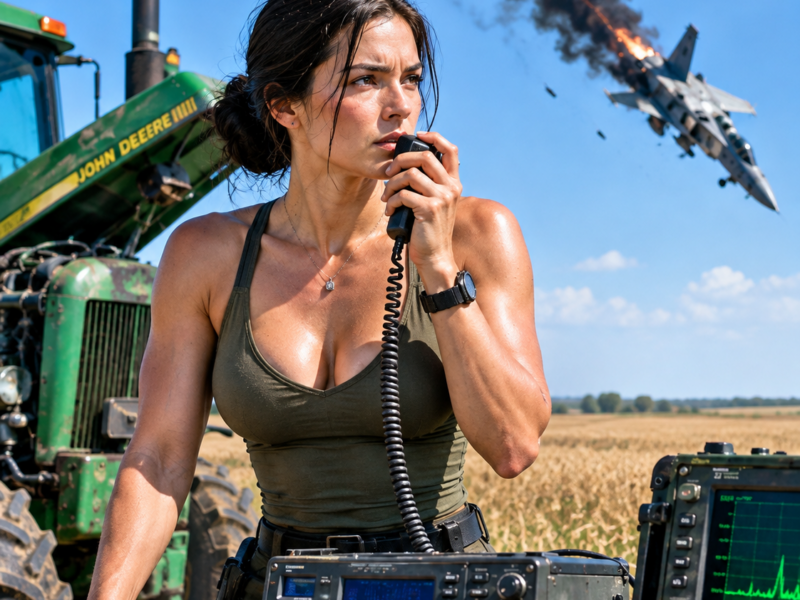
“When the private jet lost both engines over my family’s farm in Montana, the pilots were seconds from ejecting when a woman’s voice crackled through their radio
The jet had landed safely, but the real danger was already on its way to my front gate.
I heard the engines before I saw the vehicles.
Two black SUVs came racing down the county road, throwing dust into the pale Montana morning. A third followed behind them, its windows dark enough to hide whoever sat inside. They didn’t slow at the cattle guard. They didn’t stop to ask permission.
They drove straight through the open gate and stopped beside my farmhouse.
I stood on the porch with a wrench in one hand and my old radio in the other.
For twelve years, I had lived by three rules: keep my head down, keep my past buried, and never answer a military frequency unless someone was about to die.
That morning, I had broken all three.
The first SUV door opened.
A tall man in a dark uniform stepped out. His hair was silver at the temples, his shoulders rigid, his face familiar in the way a nightmare can be familiar even after you have spent years trying to forget it.
General Thomas Whitaker.
I had last seen him beneath the fluorescent lights of a military hospital in Germany, standing beside my bed while doctors argued over whether I would ever fly again.
He had been a colonel then.
And he had looked me straight in the eyes and promised that what happened to my squad would never be forgotten.
Now he stared at me as though he were looking at a ghost.
“Hannah Walker,” he said.
I tightened my grip on the wrench.
“People around here call me Hannah.”
His gaze dropped to the radio in my hand.
“Where did you get that equipment?”
“Bought it at an estate auction.”
“You expect me to believe that?”
“No,” I replied. “I expect you to explain why a general is driving onto private property without an invitation.”
For a moment, neither of us moved.
Then the passenger door of the second SUV opened, and a woman in her thirties climbed out. She wore a dark field jacket, carried a tablet, and moved with the careful confidence of someone who had learned never to turn her back on a room.
“General,” she said quietly. “The aircraft crew is secure. Both pilots are alive. One has a fractured wrist. The other is being checked for a possible concussion.”
“Good,” Whitaker answered without looking away from me.
The woman glanced at me.
“Ma’am, I’m Major Elena Ruiz. We need to ask you a few questions about the transmission you made this morning.”
“You can ask.”
“Your call sign was registered to a pilot listed as deceased twelve years ago.”
I gave a short, humorless laugh.
“Then your records are wrong.”
“The records say you died in a transport crash over the Adriatic Sea.”
“I know what the records say.”
The general’s expression hardened.
“Then perhaps you can explain why a dead woman just saved two military pilots.”
I looked past him toward the distant strip of land where the gray jet had come to rest. Its nose pointed toward the foothills, and one wing sat dangerously close to a drainage ditch. A line of emergency vehicles had formed around it.
“I didn’t save them because I was alive,” I said. “I saved them because they were falling out of the sky.”
Something changed in Whitaker’s eyes.
Not anger.
Recognition.
And beneath it, something that looked very much like fear.
“Everyone inside,” he ordered.
I didn’t move.
“This is my house.”
“Ms. Walker, there are things you don’t understand.”
“Then start explaining.”
His jaw tightened. For a second, I thought he would order his people to take me away. Twelve years earlier, that would have been enough. Back then, I had believed that rank meant responsibility and that orders were issued for reasons someone was willing to defend.
I had learned otherwise.
Finally, Whitaker lowered his voice.
“Your transmission used a routing sequence that has been inactive since Operation Night Lantern. That sequence should not exist outside a sealed archive.”
I felt the cold settle beneath my ribs.
Night Lantern.
I had not heard those words spoken aloud in twelve years.
“Who gave you that name?” I asked.
“No one gave it to me. I was the operations commander.”
“You told me the mission was canceled.”
“It was.”
“You told me my team was being extracted.”
“They were.”
“Then why did I wake up in a hospital with three names missing from the casualty report?”
Whitaker looked away.
It was the smallest movement, barely more than a blink. But I had spent my career reading the faces of men who were trying to conceal bad news.
I recognized it immediately.
“You know,” I whispered.
Before he could answer, Major Ruiz’s tablet chimed.
She looked down, and the color drained from her face.
“General, we have a problem.”
“What?”
“The aircraft’s flight recorder has been accessed remotely.”
Whitaker turned sharply.
“That’s impossible. The recorder is physically isolated.”
“Someone used a valid military credential. The download started less than four minutes after the aircraft touched down.”
“Whose credential?”
Ruiz hesitated.
Then she looked at me.
“Hannah Walker’s.”
The wrench slipped slightly in my hand.
I had not logged into a military system in twelve years.
I had not touched a secure terminal, submitted a flight plan, or signed a service document. I had deliberately avoided even looking at military recruitment advertisements because I knew how easily the past could find a way back through the smallest opening.
Yet someone had just used my name to open a file that should have been inaccessible.
Whitaker took one step toward me.
“Do you have any idea what was aboard that aircraft?”
“No.”
“Then I suggest you tell me everything about the signal you received.”
I looked at the radio.
The old receiver was still warm from the transmission.
“I heard an aircraft losing power. The pilot was struggling to hold altitude. I asked for their heading, wind speed, and remaining control authority. Then I guided them to the strip.”
“You recognized the aircraft’s emergency pattern?”
“I recognized the sound of two engines failing.”
“That’s not what I asked.”
I met his eyes.
“I used to fly, General. Did your records forget that too?”
His face tightened.
Before he could respond, the radio crackled.
A burst of static filled the porch, followed by three sharp clicks.
Then came a voice I had not heard since the night my life was erased.
“Hawk, if you’re listening, don’t trust Whitaker.”
I stopped breathing.
The voice was older, rougher, but I knew it.
I would have recognized it through a storm, through gunfire, through the walls of a burning aircraft.
“Caleb?” I whispered.
The radio hissed.
Then the voice returned.
“Night Lantern wasn’t canceled. We were betrayed. And the man who signed your death certificate is standing in your yard.”
Every person on the porch froze.
Whitaker’s hand moved toward the radio.
I pulled it away.
“Don’t,” I warned.
He stared at me.
“Shut that transmission down.”
“Why?”
“Because whoever is sending it is trying to manipulate you.”
“Then you won’t mind if I hear the rest.”
The radio clicked again.
“Hawk, listen carefully. The recorder on that jet contains the original mission authorization. It proves what happened to our team. They know you survived, and they’re coming to finish what they started.”
A high-pitched tone followed.
Then silence.
I stared at the receiver as if it might speak again.
Caleb Ross had been my wingman. He had flown beside me through storms, training accidents, and combat missions where the difference between courage and stupidity was measured in inches. During Night Lantern, his aircraft had disappeared from radar shortly after mine was hit.
I had seen his last transmission.
I had heard the explosion.
And I had spent twelve years believing he was dead.
Now his voice had come through my radio.
Whitaker reached for the receiver again.
This time, I stepped backward.
“Tell me what happened to my team.”
“Hannah—”
“No more using my first name like we’re friends. Tell me what happened.”
His eyes flickered toward Ruiz.
The major stood very still, watching him.
That was when I realized she might not know the truth either.
Whitaker drew a slow breath.
“Night Lantern was a reconnaissance operation. Your team was sent to verify intelligence about an illegal weapons transfer. The information was compromised before you reached the target.”
“By whom?”
“We never established that.”
“You never established it, or you never admitted it?”
He said nothing.
I remembered the mission in fragments. A red warning light. My aircraft shuddering beneath me. Caleb shouting that the coordinates were wrong. Three friendly aircraft appearing on our tactical display where no friendly aircraft should have been.
Then a flash so bright it turned the cockpit white.
When I woke in Germany, doctors told me I had been recovered from a crash site. They said my squadron had been lost in an accident during a classified operation. They said my identity would be protected until the investigation concluded.
Weeks later, an officer informed me that I had been officially listed as dead.
I had protested.
I had demanded answers.
Then someone left a photograph outside my hospital room.
It showed my younger brother, Daniel, standing outside his apartment in Denver. A red circle had been drawn around his face.
The message on the back contained only seven words:
Some people survive because they stay dead.
I had left the hospital under an assumed name three days later.
I had never told anyone why.
Now I looked at Whitaker and saw the same man who had stood beside my bed, promising that my team would be remembered.
“You told me everyone was dead,” I said.
“I believed they were.”
“You signed the report.”
“Because that was the evidence available to me.”
“And my death certificate?”
He closed his eyes briefly.
“That was ordered above my level.”
The answer landed harder than a confession.
Someone with authority had turned me into a dead woman. Someone had removed my team from the record. Someone had kept the operation sealed long enough for the witnesses to disappear.
And now, after twelve quiet years, a jet had fallen out of the sky carrying evidence that could unravel the whole thing.
“What’s on the recorder?” I asked.
Whitaker glanced toward the aircraft.
“We don’t know yet.”
“Then why is someone downloading it?”
“Because the aircraft was carrying a sealed intelligence package. The flight crew was transporting it to a secure facility when both engines failed.”
“Both engines don’t fail at the same time without a reason.”
“That is what we’re trying to determine.”
I studied him.
For the first time since he arrived, he seemed less like a man in command and more like someone who had just realized the battlefield had moved beneath his feet.
Major Ruiz stepped forward.
“General, we need to move. If that credential was used remotely, the source may still be active.”
“Agreed.”
He looked at me.
“You’re coming with us.”
“No.”
“Hannah, whoever sent that message knows you are here.”
“Then perhaps you should be asking why your systems allowed them to find me.”
His expression hardened again.
“You can’t defend this property against a trained unit.”
I glanced at the barn, the tractor, and the old pickup truck parked beside the grain shed.
“You’d be surprised what a farmer can defend.”
Ruiz almost smiled.
Whitaker didn’t.
Then the radio crackled a third time.
This transmission was not Caleb’s voice.
It was a woman’s.
“Attention, Hawk. If you want the truth, check the north wall of the old hangar. Locker six-one-four. The key is where you left it.”
My heart began to pound.
The old hangar had been abandoned before I bought the farm. It stood beyond the northern pasture, half hidden by cottonwoods and weather-beaten fencing. The previous owner had used it to store agricultural equipment, but its original purpose had been something else entirely.
A private airstrip had operated there during the early days of the Cold War.
Most of its records had supposedly been destroyed.
I had found the hangar during my first winter on the property. Beneath a pile of rotted boards, I had discovered a metal locker bolted to the wall. It had been locked, rusted, and impossible to open.
I had left it alone.
For twelve years, I had left it alone.
“Who was that?” Ruiz asked.
“I don’t know.”
But I did.
The voice belonged to Captain Mara Ellison, the intelligence officer who had briefed us before Night Lantern. She had disappeared from military service six months after our mission. Officially, she had resigned for personal reasons.
Unofficially, I had heard she was dead.
Whitaker heard the recognition in my silence.
“You know who sent that.”
“Maybe.”
“Hannah—”
“I’m going to the hangar.”
“Not alone.”
“Then keep up.”
I started toward the barn.
Behind me, Whitaker issued orders to his security detail. Ruiz followed me without waiting for permission.
We crossed the pasture as the morning wind pushed waves through the dry grass. Beyond the fence, the crashed jet sat surrounded by rescue crews. One of the pilots stood beside an ambulance, his arm in a temporary sling, watching us.
When our eyes met, he lifted his good hand.
I nodded back.
He was alive because I had broken twelve years of silence.
I wasn’t sure how many more people would survive because of it.
The hangar door groaned when I pulled it open.
Inside, the air smelled of dust, old oil, and mouse droppings. Sunlight cut through holes in the roof, illuminating rusted tools and the skeletal remains of a crop sprayer.
The locker was exactly where I remembered it.
Number 614.
I knelt beside it and brushed away the dirt at its base. My fingers found a loose brick beneath a metal shelf. I lifted it and reached into the hollow space.
The key was still there.
For a moment, I couldn’t move.
Someone had known I would come here. Someone had known I had kept the key.
That meant the message wasn’t a random warning.
It was an invitation.
Or a trap.
“Step back,” Whitaker said.
I looked over my shoulder.
He had drawn a compact pistol and held it low beside his thigh.
Ruiz noticed it too.
“General?”
“Stay behind me.”
I stood slowly, keeping my hands visible.
“Are you going to shoot a farmer in her own barn?”
“I’m going to prevent you from opening a container that may hold classified material.”
“Then why did you bring a gun?”
His jaw tightened.
“Because I don’t know who I can trust anymore.”
That, at least, sounded honest.
I placed the key in the lock.
The mechanism resisted, then turned with a metallic click.
Inside were three objects: a sealed black data drive, a paper envelope, and a photograph.
I picked up the photograph first.
It showed five people standing beside a military transport aircraft.
I was in the center, younger and smiling, my flight suit covered in dust. Caleb stood on my right. Mara Ellison was beside him. Two other members of our team stood behind us.
At the far edge of the frame was General Whitaker, still a colonel at the time.
Someone had written on the back:
NIGHT LANTERN — BEFORE THE LIE.
I turned the photograph over again.
Whitaker’s face had gone pale.
“You knew this was here,” I said.
“No.”
“Then why do you look like you’ve seen a ghost?”
He stared at the picture.
“Because that photograph was taken three days before your mission. It was supposed to be in the investigation file.”
“Which was sealed.”
“Yes.”
“By you?”
“No.”
His answer came too quickly.
I set the photograph down and opened the envelope.
Inside was a handwritten note in Mara’s distinctive block letters.
Hannah,
If you’re reading this, then the operation has begun again. They will tell you the original team died because the intelligence was bad. That is only half the truth. Someone deliberately changed the target coordinates and removed the extraction window. We were never meant to return.
The authorization came from a source inside the Joint Operations Directorate. I copied the original order and the transmission logs before they could destroy them. The data drive contains the proof.
Do not trust anyone who asks you to hand it over without seeing the full chain of custody.
One more thing: Caleb survived.
I read the last sentence twice.
Then a third time.
Caleb survived.
My knees weakened, and I caught the edge of the locker.
Ruiz stepped closer.
“Are you all right?”
I couldn’t answer.
For twelve years, I had replayed Caleb’s final transmission in my head. I had wondered whether I could have turned faster, climbed sooner, ignored the command to maintain formation. I had blamed myself for a death that had never been officially recorded because, officially, the entire mission had become a footnote in a sealed report.
And now I was holding proof that my wingman might still be alive.
Whitaker reached for the envelope.
I pulled it away.
“Don’t.”
“Hannah, if that drive contains operational intelligence—”
“It contains the truth about my team.”
“It may also contain information that could endanger people who are still serving.”
“Then we protect them by telling the truth.”
“You don’t understand how high this reaches.”
“That’s what everyone says when they want the rest of us to stop asking questions.”
Ruiz stepped between us.
“General, perhaps we should examine the contents before making decisions.”
Whitaker looked at her sharply.
“You’re out of your depth, Major.”
“Then explain the depth to me.”
For the first time, Whitaker had no immediate answer.
I took the data drive and slipped it into the inside pocket of my jacket.
“I’m keeping this.”
He looked at the jacket.
At the worn fabric.
At the faded flight wings stitched above the pocket.
“You kept it all these years,” he said.
“I kept enough to remember who I was.”
I turned toward the hangar door.
That was when a gunshot cracked across the pasture.
The sound echoed through the hangar, followed by a second shot.
Ruiz drew her weapon.
Whitaker moved toward the door.
Outside, one of the black SUVs had been hit. Its rear window shattered inward, and a security officer crouched behind the engine block.
A dark pickup truck sped away along the fence line.
“They’re here,” Ruiz shouted into her radio. “Shots fired at the north perimeter! Suspect vehicle heading east!”
Whitaker grabbed my arm.
“Give me the drive.”
I jerked free.
“You’re not getting it.”
“Hannah, listen to me. If they know what’s in that locker, they won’t stop at warning shots.”
“Then maybe you should have protected the evidence twelve years ago.”
I ran for the farmhouse.
Ruiz followed.
Behind us, Whitaker shouted orders, but the words were swallowed by the wind and the distant sirens.
We reached the porch as my old radio erupted with static.
“Hawk, this is Caleb. If you have the drive, destroy it.”
I stopped so abruptly Ruiz nearly collided with me.
“Caleb, where are you?”
“Don’t transmit your location. They’re monitoring the frequency.”
“Are you alive?”
A long silence followed.
Then, very softly, he said, “Yes.”
My eyes burned.
“Where have you been?”
“Running.”
“From whom?”
“The people who changed our coordinates. The people who made sure your name disappeared. The people who are still trying to bury Night Lantern.”
A burst of static interrupted him.
“Caleb, I need you to tell me who gave the order.”
“I can’t say it over this channel.”
“Then tell me where to find you.”
“I’ll find you. But first, you need to know something about the jet.”
I looked toward the distant aircraft.
“What?”
“The engine failure wasn’t an accident. The flight recorder wasn’t the target. They wanted the intelligence package destroyed before it reached the facility.”
“What’s in the package?”
“The original Night Lantern authorization. The signed order. The one with the name of the man who sent us into a kill zone.”
The radio clicked twice.
Then Caleb said the words that made the entire world seem to tilt.
“Hannah, the signature belongs to the man standing beside you.”
The transmission died.
I turned.
General Whitaker had reached the farmhouse steps.
He stood with one hand resting near his holster, his face unreadable.
Ruiz raised her weapon toward the ground between us.
“General,” she said, “I need you to step away from the house.”
He stared at her in disbelief.
“Major, stand down.”
“Not until we establish who accessed the recorder.”
“I gave no such order.”
“Then you won’t object to an independent investigation.”
His expression turned cold.
“You have no idea what you’re doing.”
“I’m beginning to,” she replied.
I watched Whitaker carefully.
I wanted to believe Caleb. I wanted the truth to be simple enough that I could put a name to the betrayal and finally stop carrying it. But a voice on a radio was not evidence, and I had spent too many years paying for the things I wanted to believe.
“General,” I said, “did you change our coordinates?”
“No.”
“Did you sign the order that sent us into the target area?”
“I signed the operational plan. The coordinates in that plan were not the coordinates your aircraft received.”
“Who changed them?”
“I don’t know.”
“Then help us find out.”
For the first time, he looked tired.
“I have spent twelve years trying to find out.”
I almost laughed.
“You had twelve years and a rank that opened every door in the building. I had a farmhouse, a broken radio, and a death certificate. Don’t tell me we were doing the same thing.”
He accepted the blow without responding.
Then he removed his service pistol and set it on the porch railing.
“I did not order the coordinates changed,” he said. “But I did sign a report that declared you dead. I knew the evidence was incomplete. I signed it because I was told the alternative would expose an intelligence source and put dozens of people at risk.”
“And you believed that?”
“I believed I was choosing the lesser evil.”
“You chose for everyone else.”
“Yes.”
The admission hung between us.
Before I could answer, a vehicle appeared at the end of the driveway.
This one was not black.
It was an old blue pickup with a dented front fender and mud caked around the wheel wells.
It rolled slowly through the gate and stopped beside the barn.
The driver’s door opened.
A man climbed out.
He was leaner than I remembered, with a gray streak in his dark hair and a slight limp in his left leg. His face was older, his jaw rough with stubble, and a pale scar ran from his ear toward his collar.
But his eyes were the same.
Caleb Ross.
For a moment, neither of us moved.
Then I crossed the yard.
He took two steps toward me, and his bad leg nearly gave way. I caught him before he hit the ground.
“You’re alive,” I whispered.
He let out a shaky breath.
“So are you.”
I struck his shoulder with my fist.
He winced.
“That was for twelve years.”
“I deserved that.”
I hit him again, more gently this time.
“And that was for making me think you were dead.”
“I deserved that too.”
Then I pulled him into an embrace and held on as if the world might try to take him away again.
He smelled of dust, cold air, and old canvas. The familiar details broke through the years more effectively than any memory could have done.
When I finally stepped back, I saw tears in his eyes.
“I tried to find you,” he said. “They told me you died in Germany.”
“They told me you died over the Adriatic.”
“They told us both what we needed to hear.”
He looked past me at Whitaker.
The general had gone very still.
“Caleb,” he said.
“General.”
There was no warmth in the greeting.
Caleb reached inside his jacket and produced a small metal case.
“I brought the other half.”
He placed it on the porch railing beside Whitaker’s pistol.
Inside the case was a sealed storage device and a stack of printed documents.
“What’s this?” Ruiz asked.
“The original mission authorization, the amended coordinates, and the communications log from the night Night Lantern went wrong. I copied them before the archive was wiped.”
Whitaker stared at the documents.
“Where did you get the authorization?”
“From the person who kept it hidden.”
“Who?”
Caleb looked at me.
“Mara Ellison.”
The name struck like another gunshot.
“She survived too?” I asked.
“Yes. She found the altered orders before the mission. She tried to warn command, but the warning was intercepted. After the operation, she recovered what she could and disappeared.”
“Why didn’t she contact us?”
“She did. Every attempt was traced. The first time she reached out to me, someone tried to kill her. After that, we worked through dead drops and isolated channels.”
“Then why contact me now?”
“Because the intelligence package on that jet was the last piece. It contains the routing records showing who altered the coordinates and who ordered the cover-up.”
I looked at the drive inside my jacket.
“And somebody wanted it destroyed.”
Caleb nodded.
“The people responsible have been using the same network for years. They bury evidence, erase identities, and move witnesses until no one can prove a connection. When the package was assigned to that aircraft, they decided to eliminate it before it reached the review board.”
Ruiz stepped forward.
“Do you have names?”
Caleb opened the case and handed her a document.
At the top was the original operational order.
Below the mission details were three signatures.
One belonged to General Whitaker, authorizing the mission itself.
The second belonged to Colonel Martin Voss, director of operations at the time.
The third was a digital authorization from the intelligence liaison who had approved the revised coordinates.
The name was unfamiliar to me.
Ruiz, however, recognized it immediately.
“Deputy Director Adrian Kessler,” she whispered.
Whitaker’s face changed.
“You’re certain?”
Caleb nodded.
“Kessler was the liaison who altered the target package. He sent us to the wrong location, removed our extraction window, and then used the resulting disaster to justify the destruction of the operation’s records.”
“But why?” I asked.
“Because the weapons transfer wasn’t what we thought it was,” Caleb replied. “The site contained evidence of an illegal operation run through a private contractor. The contractor was moving weapons and intelligence assets for people who wanted plausible deniability. Night Lantern was supposed to discover enough to expose them.”
“And Kessler was protecting them?”
“He was part of the network.”
Whitaker studied the papers.
“I reported discrepancies in the mission log after the operation. My report was returned with instructions to classify the event as a navigational failure. When I refused, I was told that the intelligence source would be exposed and an allied operation would collapse.”
“So you signed the death report,” I said.
“Yes.”
“And you let them erase us.”
His voice dropped.
“I thought I could keep the investigation alive from inside the system. I was wrong.”
I looked at the man who had once been my commanding officer. For twelve years, I had imagined him as either a coward or a villain. The truth was worse in a way: he was a man who had made a terrible choice, then spent years telling himself that silence might still serve a greater good.
But his failure had not ended with him.
It had followed me to Montana.
It had taken Caleb’s life apart.
It had left families without answers.
And now it was trying to kill two pilots who had never even heard of Night Lantern.
A new sound rose from the road.
Sirens.
Not the local sheriff’s old cruiser. These were deeper, faster, and coming from several directions.
Ruiz checked her tablet.
“General, the base security channel is reporting an emergency deployment. A team has been dispatched to secure the aircraft and recover the intelligence package.”
“Under whose authority?” Whitaker asked.
She read the screen.
“Deputy Director Kessler.”
Caleb swore under his breath.
“He knows we have the evidence.”
Whitaker picked up his pistol but kept it pointed at the ground.
“Major, contact the inspector general and the federal investigators assigned to the aircraft incident. Tell them we have evidence of attempted evidence destruction and a compromised command channel.”
Ruiz hesitated only a second.
“Yes, sir.”
“And send a copy of every document we have to an independent recipient outside the department. If our systems are compromised, we don’t use them as the only repository.”
She began making calls.
I watched the road.
A line of dark vehicles appeared beyond the trees, moving fast enough to raise a long plume of dust. The same kind of vehicles that had arrived after the jet landed.
Only this time, they were coming in greater numbers.
Caleb stepped beside me.
“You need to get out of here.”
“No.”
“Hannah, I’m serious.”
“So am I.”
“They won’t hesitate to take you.”
“They already tried that twelve years ago. They failed.”
He gave me a tired smile.
“You haven’t changed.”
“I changed plenty. I just kept the parts that mattered.”
Whitaker approached us.
“I need both of you to stay inside until the federal team arrives.”
“Your team or Kessler’s?” Caleb asked.
Whitaker did not flinch.
“That’s a fair question.”
He turned to Ruiz.
“Can you verify the incoming units?”
“Working on it.”
A minute passed.
Then another.
The vehicles slowed near the gate.
Men in tactical gear climbed out and spread along the road. Their uniforms carried no clear unit markings. The lead vehicle stopped, and a man in a dark coat stepped into view.
Even from a distance, Whitaker recognized him.
“Adrian Kessler,” he said.
The deputy director walked toward the gate with the confidence of someone who expected every obstacle to move aside.
He carried no visible weapon.
He didn’t need one.
“Hannah Walker,” he called. “You have something that belongs to the government.”
I stepped down from the porch.
“I have evidence that someone tried to murder two pilots.”
“You have classified material you are not authorized to possess.”
“Then why did someone shoot at my property?”
Kessler’s expression barely changed.
“An unfortunate misunderstanding. We are here to secure the scene and ensure the evidence is handled properly.”
Caleb laughed once, without humor.
“That’s what you said in the report.”
Kessler’s eyes settled on him.
For the first time, his composure cracked.
“Ross. I thought you were dead.”
“You’ve been wrong about a lot of things.”
Kessler looked at Whitaker.
“General, step away from these individuals. You are interfering with an active national security operation.”
Whitaker stood beside me instead.
“No. I’m ending one.”
Kessler’s mouth tightened.
“You don’t have the authority.”
“I have enough authority to refuse an unlawful order. And the evidence is already being sent to investigators outside your chain of command.”
Kessler glanced toward Ruiz.
She held up her tablet.
“Copies have been transmitted. The original flight recorder is being secured by an independent federal team. Any attempt to remove evidence will be documented.”
For a long moment, the only sound was the wind moving through the grass.
Then Kessler smiled.
It was a small, cold expression.
“You think a few files will undo twelve years of classified decisions? You think the public will understand the difference between an altered coordinate and a legitimate operational revision? These records will be buried in litigation. Your testimony will be challenged. Your identities will be dissected. And when this is over, you’ll be left with nothing but accusations.”
I had heard versions of that speech before.
It was the language of people who mistook secrecy for power and exhaustion for surrender.
I stepped closer to the gate.
“You’re right about one thing,” I said. “A file doesn’t bring back the people who died. It doesn’t give me twelve years back. It doesn’t erase the families who were told their loved ones were lost in an accident.”
His smile faded.
“But you made one mistake. You thought that if you erased our names, nobody would remember us.”
I lifted the old radio.
“You forgot that we had friends.”
Caleb stood beside me.
Whitaker moved to my other side.
And Major Ruiz, still holding her tablet, joined us on the porch steps.
Behind Kessler, one of the tactical officers lowered his weapon.
Then another.
A man near the lead vehicle spoke into his radio. I couldn’t hear the words, but I saw the change in Kessler’s face when the response came back.
The independent investigators had arrived.
Two unmarked federal vehicles pulled in behind the tactical team. Their occupants moved with deliberate calm, displaying credentials and issuing clear instructions. One investigator approached Kessler while another went straight to Ruiz to take custody of the documents.
Kessler began talking quickly.
He described a security breach, an unauthorized transmission, a former pilot in possession of restricted material. He spoke as if the right sequence of official terms could turn the truth back into a secret.
But the documents had already left his control.
The flight recorder had been recovered.
The altered coordinates matched the original mission logs.
And the digital authorization bore his signature.
When the investigators asked him to surrender his access credentials, Kessler refused.
That refusal lasted less than a minute.
He was escorted to a vehicle without a struggle, his face rigid with fury.
As the door closed, he looked at me.
“This isn’t over.”
I believed him.
But for the first time in twelve years, the warning no longer made me afraid.
It made me angry.
“Then you’ll have to face us in the open,” I replied.
The vehicle drove away.
Only when it disappeared beyond the trees did I realize how hard my hands were shaking.
Caleb touched my shoulder.
“You did it, Hawk.”
“No,” I said. “We started it.”
The investigation lasted eleven months.
It was not quick, clean, or simple.
The first public statement described the aircraft emergency as a mechanical failure and confirmed that the crew had survived. The second announced a review of classified operational records. The third came after investigators established that the jet’s engine controls had been tampered with and that its intelligence package had been targeted for destruction.
Then the names began to emerge.
Adrian Kessler was charged with conspiracy, obstruction, and offenses related to the sabotage operation. Several officers and private contractors were implicated in the effort to conceal Night Lantern. Colonel Martin Voss, who had approved the altered mission package, was found to have retired under a false medical report after receiving payments through a contractor account.
General Whitaker testified before an independent review panel.
He did not deny signing the report that declared me dead.
He explained why he had done it, but he did not use the explanation as an excuse.
“I allowed an incomplete investigation to become an official truth,” he said. “That decision damaged lives and obstructed justice. I accept responsibility.”
His testimony cost him his position.
He retired before the end of the inquiry, but he remained available to investigators and turned over every document he had preserved.
It was not enough to erase his mistake.
It was, at least, a beginning.
Mara Ellison was found living under a protected identity in a small coastal town in Oregon. When she learned that Caleb and I were alive and the evidence had been secured, she agreed to testify. Her testimony connected the altered coordinates to Kessler’s authorization and explained how the original mission logs had been removed from the archive.
For the first time, the official record acknowledged that Night Lantern had not been a navigational accident.
Our team had been sent into a compromised operation.
The extraction plan had been deliberately removed.
And the subsequent cover-up had concealed the decisions that led to the deaths of three service members.
The government corrected our records.
My death certificate was voided.
My service history was restored.
The families of the fallen received a formal accounting of what had happened, though no document could return the people they had lost.
I traveled to meet them one by one.
There were no speeches that could make those conversations easy. Some families wanted every detail. Others wanted only the truth about the last moments. A few were furious that I had survived and disappeared, and I accepted their anger because I knew what it meant to live with unanswered questions.
I told them what I remembered.
I told them what I didn’t know.
And I never promised that justice would make the pain disappear.
Caleb stayed in Montana for several months while his leg healed and investigators completed their work. We spent long afternoons repairing fences, clearing brush from the old hangar, and sitting on the porch with coffee that always seemed to go cold before either of us finished it.
Sometimes we talked about the mission.
Sometimes we didn’t.
The silence between us slowly became something other than grief.
One evening, he found me cleaning the old radio.
“You still planning to keep that thing?” he asked.
“It works.”
“It belongs in a museum.”
“So do you.”
He laughed, and for the first time since the day he arrived, the sound carried no bitterness.
The two pilots from the jet visited the farm after they were cleared to travel. Their names were Captain Daniel Price and Lieutenant Marcus Bell. Price’s wrist was still healing, and Bell had a faint scar near his hairline from the concussion.
They brought a wooden plaque bearing the aircraft’s call sign and a short message of thanks.
I tried to refuse it.
Price set it on the kitchen table anyway.
“You gave us a chance when we had seconds left,” he said. “We don’t get to pretend that didn’t matter.”
I looked at the plaque for a long time after they left.
Then I hung it beside the kitchen door.
Not because I wanted to remember the day the jet fell from the sky.
Because I wanted to remember that I had answered.
For years, I had believed survival meant staying hidden. I had built my life around the idea that if I made myself small enough, quiet enough, ordinary enough, the people who had erased me would eventually forget I existed.
But the truth had never stopped existing.
It had waited in a locked archive, in a forgotten hangar, in the memory of a man who refused to die quietly, and in a radio that still worked when everything else had failed.
I had spent twelve years thinking the past was a door I had to keep closed.
I finally understood that it was a door I had to open.
A year after the investigation began, the old airstrip was cleared and repaired. I did not turn it into a military facility. I turned it into a volunteer emergency landing site for medical flights and aircraft in distress. Local pilots helped mark the approach. Neighbors donated fuel equipment and supplies. The county approved a basic safety plan, and a regional rescue group added the strip to its emergency maps.
I kept farming.
I still rose before dawn to check the cattle, fix broken irrigation lines, and argue with a tractor that had more years behind it than some of the people who came to visit.
But I no longer hid the flight wings in the back of a drawer.
I stitched them onto the jacket I wore when I worked outside.
The fabric was faded, the cuffs frayed, and the old insignia had lost much of its color. It was not a uniform anymore.
It was simply mine.
One clear autumn morning, I stood at the edge of the runway and watched sunlight spill over the mountains. The wind was gentle, and the radio sat on a folding table beside a thermos of coffee.
A small medical aircraft called in from the west, reporting turbulence and a malfunctioning instrument. The pilot sounded calm, but I heard the strain beneath his words.
I lifted the microphone.
“Aircraft approaching the Walker strip, this is ground station Hawk. I have you on radar through the regional relay. Tell me your altitude and heading.”
A pause followed.
Then the pilot answered.
I guided him toward the runway, adjusting for the crosswind and warning him about a shallow ridge east of the field. His aircraft touched down safely, rolled past the markers, and came to a stop beneath the open sky.
When the pilot climbed out, he looked at me with wide eyes.
“Are you the woman who saved the military jet?”
“I was the woman with the radio,” I said.
He glanced at the old jacket.
“Same thing, I guess.”
I smiled.
“No. Not always.”
He didn’t understand, and I didn’t explain.
Because saving someone was not about being a hero. It was about recognizing the moment when a person needed help and choosing not to look away.
That evening, I returned to the farmhouse and found a letter waiting on the kitchen table.
It had no official seal, no return address, and no name on the envelope.
Inside was a single photograph.
It showed the five of us beside the transport aircraft before Night Lantern: Caleb, Mara, the other members of our team, and me.
On the back, in handwriting I recognized, were the words:
We were never supposed to come home. We did anyway.
I placed the photograph beside the radio.
Outside, the wind moved across the fields, carrying the smell of cut grass and distant rain.
For twelve years, I had believed my life ended the night the military declared me dead.
Now I knew the truth.
My life had continued in the quiet places no report could erase: in the soil beneath my boots, in the people who remembered my voice, in the friends who had survived, and in every transmission answered when someone needed a way home.
I turned off the kitchen light and stepped onto the porch.
Above the Montana hills, a thin line of aircraft lights moved steadily across the darkening sky.
I watched until they disappeared beyond the mountains.
Then I went inside, set the radio beside my bed, and slept without listening for footsteps on the road.
For the first time in twelve years, I no longer needed to disappear to stay alive.
The end.









