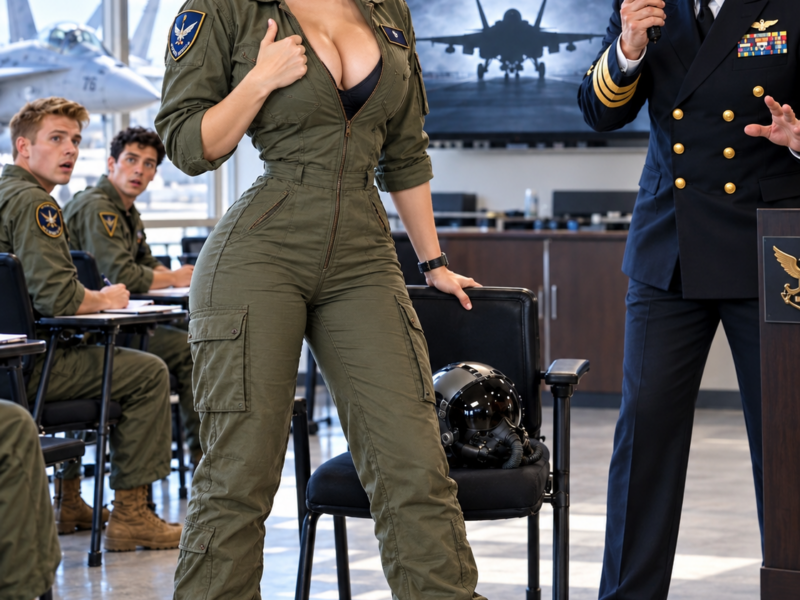
“When Admiral Richard Hayes slammed his fist against the briefing table at Naval Air Station Fallon and demanded, ‘Find Ghost NOW,’
The telephone rang again.
Nobody in the briefing room seemed willing to touch it.
Admiral Hayes stood beside the table, staring at the caller identification as if the name might disappear if he blinked.
DANIEL CARTER.
My father’s name.
Eleven years after the Navy had buried him, his name was glowing on a secure military telephone.
“Admiral,” I whispered.
He raised one hand.
“Nobody moves.”
The phone rang a third time.
Hayes finally picked up the receiver.
“This is Admiral Richard Hayes.”
For several seconds, there was nothing but static.
Then a man’s voice came through.
“Richard?”
The admiral’s face lost its color.
I had never seen a man with so much authority look so completely unprepared.
“Daniel?” he said.
My knees nearly gave way.
The voice on the other end was older than I remembered, rougher around the edges, but I knew it.
I knew the slight pause before he spoke.
I knew the way he pronounced certain words.
It was the voice that used to wake me on Saturday mornings when he promised pancakes.
It was the voice that had told me not to be afraid of thunderstorms.
It was my father.
“Richard, listen carefully,” he said. “You have Emma in the room?”
Hayes looked at me.
“Yes.”
“Then get her away from Mitchell.”
The commander took one step backward.
“That’s enough,” Mitchell said.
Hayes covered the receiver.
“Security!”
Two Marines appeared at the doorway.
Mitchell raised both hands.
“Admiral, you need to understand what’s happening. That transmission could be fabricated.”
The voice on the phone interrupted him.
“Mitchell, if you’re standing there, I know you’ve heard me.”
The commander went completely still.
My father continued.
“You’ve had eleven years to explain what happened over the Pacific. Don’t make my daughter pay for your silence.”
I gripped the edge of the briefing table.
“Where are you?” I called.
Hayes looked at me, then slowly handed me the receiver.
“Emma?”
I couldn’t speak.
“It’s Dad,” I finally managed.
A breath came through the line.
“Hey, peanut.”
Nobody had called me that since I was twelve.
The paper cup slipped from my fingers and rolled across the floor.
I pressed the receiver against my ear.
“You’re dead.”
“I know what they told you.”
“They gave Mom your flag. They held your funeral.”
“I know.”
“You let us believe you were dead?”
The silence that followed hurt more than any explanation could have.
“I didn’t have a choice when it started,” he said. “But I should have found a way to reach you.”
My eyes burned.
“Mom waited for you.”
“I know.”
“She died believing you were gone.”
His breathing changed.
For a moment, the voice on the other end sounded less like a decorated Navy pilot and more like the man who had once carried me on his shoulders through a county fair.
“I’m sorry, Emma.”
I wanted to scream.
I wanted to ask a hundred questions.
Instead, I managed one.
“Why now?”
“Because they found the aircraft.”
Hayes leaned toward the receiver.
“What aircraft?”
“The one you buried in the report,” my father answered. “The one that was never supposed to be found.”
The admiral’s eyes narrowed.
“Daniel, what exactly happened during the Falcon evaluation?”
“Not over an unsecured line.”
“This is a secure military channel.”
“Not secure enough.”
A short electronic beep sounded.
My father lowered his voice.
“Emma, do you still have the silver compass?”
I frowned.
“What compass?”
“The one I gave you before my last flight.”
I remembered it immediately.
A small brass-and-silver compass with a scratched lid.
It had been sitting in my mother’s jewelry box for years. After she died, I’d kept it in the bottom drawer of my apartment.
“Yes.”
“Don’t let anyone take it.”
The line crackled.
“There’s something inside it.”
Then the call disconnected.
For several seconds, I stared at the receiver.
Hayes took it from my hand and placed it back in its cradle.
“Secure the room,” he ordered.
The Marines moved toward Mitchell.
“Admiral, you’re making a serious mistake,” Mitchell said.
Hayes didn’t turn.
“Then you’ll have plenty of time to explain it.”
“Daniel Carter is not alive.”
“Apparently, he disagrees.”
Mitchell looked at me.
“Lieutenant, whatever he told you, don’t trust him.”
I stepped away from the table.
“You recognized his voice before the admiral did.”
Mitchell’s jaw tightened.
“You don’t understand the history here.”
“Then explain it.”
“I can’t.”
“Eleven years ago, my family was told my father died in a training accident. Today, his voice came through that telephone, and you looked terrified. I think I’ve earned an explanation.”
Mitchell looked toward the Marines.
Then he looked back at me.
“Your father wasn’t the only person who disappeared that night.”
Before I could ask what he meant, Hayes ordered the Marines to escort him out.
As Mitchell passed me, he stopped.
“Find the original flight recorder, Emma.”
His voice was barely audible.
“Not the copy they gave your mother.”
Then he walked away.
I turned toward the admiral.
“What did he mean?”
Hayes stared at the closed door.
“I think it’s time you learned what your father was really working on.”
He gestured toward the empty chair.
“Sit down, Lieutenant.”
I didn’t sit.
“I’d rather stand.”
He nodded, as though he understood.
Eleven years earlier, my father had been assigned to an experimental flight program known as Project Falcon.
Officially, it was designed to test a new generation of electronic countermeasures.
Unofficially, it was something much more complicated.
The aircraft involved had been modified to operate with a prototype system capable of disrupting radar tracking and confusing enemy targeting equipment.
The project was classified above my father’s normal clearance level.
He had been one of its lead test pilots.
“During the final evaluation,” Hayes explained, “your father’s aircraft disappeared from our tracking systems.”
“Because of a malfunction?”
“That’s what the investigation concluded.”
“And you believed it?”
Hayes looked down at his hands.
“No.”
The answer came too quickly to be rehearsed.
“Then why did you sign the report?”
“Because I was a captain at the time. I was given a choice between accepting the official findings and watching an entire program collapse.”
“That doesn’t explain why my father was declared dead.”
“No,” he said quietly. “It doesn’t.”
He opened a drawer and removed a thin folder.
Inside were several photographs.
One showed a damaged aircraft resting on a remote stretch of coastline.
Another showed a group of officers standing beside a hangar.
I recognized my father in the second photograph.
He was younger, wearing a flight suit, one arm around another man.
The man beside him was Commander Mitchell.
I looked closer.
There was a third person in the background.
A younger Richard Hayes.
“All three of you knew each other.”
“Yes.”
“What happened?”
Hayes closed the folder.
“Your father discovered that someone was using the Falcon technology outside the approved test program.”
“Who?”
“We never established that conclusively.”
“But you suspected someone.”
He didn’t answer.
That was answer enough.
I thought about the voice on the recording.
They know you’re there.
Then the warning.
You shouldn’t be flying that aircraft.
“Why did my father contact me through that call sign?”
“Because Ghost was the name of the original Falcon test pilot.”
“That was him?”
Hayes nodded.
“And now you appear to be using the same call sign.”
“I never chose it.”
“Then someone chose it for you.”
A chill ran down my arms.
The admiral leaned forward.
“Emma, three days ago, when you entered the restricted training area, did anyone give you coordinates?”
“Yes.”
“Did you recognize the aircraft?”
“No. I only saw it briefly on radar.”
“Was it flying with its transponder disabled?”
“Yes.”
He looked toward the screen.
“That wasn’t an exercise.”
I stared at him.
“What?”
“The aircraft you encountered was not part of the Navy’s training program.”
“Then what was it?”
Hayes hesitated.
“That’s what we need to find out.”
He stood and walked toward the window.
Outside, the afternoon sun reflected off the parked aircraft.
“Your father believed someone had rebuilt the Falcon system. He thought they were testing it using unauthorized flights.”
“And you think they used me?”
“I think they wanted to know whether the system still worked.”
The room seemed to tilt slightly.
“Why me?”
“Because you fly the same way he did.”
I almost laughed.
“Sir, I’ve barely finished my evaluations.”
“Your father used to say you watched the sky before you watched your instruments.”
I looked at him.
“You knew me?”
“Not well. But I met you once when you were a child.”
I remembered a tall man standing in our kitchen, drinking coffee while my father packed for a trip.
I couldn’t remember his face.
Hayes continued.
“Your father trained you without ever intending to. He taught you how to read weather, how to recognize aircraft by sound, how to stay calm when everything around you became confusing.”
“That doesn’t make me him.”
“No. It doesn’t.”
He paused.
“And that’s why I don’t want you flying another mission until we understand what happened.”
I finally sat down.
For the first time that afternoon, my legs felt too weak to hold me.
Then the secure door opened.
An intelligence officer named Sarah Bennett entered carrying a tablet.
“Admiral, we have a problem.”
Hayes turned.
“What now?”
“Someone accessed Lieutenant Carter’s personnel file seventeen minutes ago.”
“From where?”
“An internal terminal at this base.”
“Can you identify the user?”
Sarah glanced at me.
“Commander Mitchell.”
Hayes’s expression hardened.
“He’s under escort.”
“I know. But the access request was submitted before security detained him.”
She placed the tablet on the table.
A video appeared.
It showed a hallway outside the aircraft maintenance hangar.
A figure in a maintenance uniform walked past a security camera carrying a small black case.
The timestamp was from the previous night.
Sarah enlarged the image.
The figure turned toward the camera for less than a second.
I recognized the face.
“That’s Mitchell.”
Hayes leaned closer.
“What is he carrying?”
“We believe it’s a portable data module.”
“Where did he take it?”
Sarah tapped the screen.
The video changed.
Mitchell entered a restricted maintenance building.
He came out twelve minutes later without the case.
“Did anyone search the building?”
“Yes, sir.”
“And?”
“Empty.”
Hayes looked at me.
“Lieutenant, do you have access to your assigned aircraft?”
“Yes, sir.”
“Has anyone worked on it since your last flight?”
I thought for a moment.
“Maintenance replaced a navigation display yesterday.”
“Who authorized it?”
“I don’t know.”
Sarah exchanged a look with the admiral.
“That’s the problem.”
She opened another file.
It contained the maintenance log for my aircraft.
Most of the entries looked routine.
But one line had been added at 02:13 that morning.
A software update.
No technician’s signature.
No authorization number.
I leaned toward the screen.
“What does that update do?”
Sarah shook her head.
“We don’t know yet.”
Hayes reached for the telephone.
“Ground every aircraft connected to that maintenance network.”
Sarah nodded and hurried out.
I looked at the admiral.
“Sir, I need to go home.”
“Why?”
“My father’s compass.”
He considered it for a moment.
“You’re not going alone.”
“I don’t need an escort.”
“That wasn’t a request.”
Within twenty minutes, I was in a government sedan heading toward my apartment.
Two security officers accompanied me.
I watched the highway pass through the window, trying to make sense of the last three hours.
My father was alive.
Someone had used his call sign.
Commander Mitchell knew more than he admitted.
And somewhere inside a small compass, my father had left something behind.
When we reached my apartment complex, one of the officers went inside first.
The building smelled of old carpet and someone’s dinner cooking down the hall.
Everything looked ordinary.
My door was locked.
The deadbolt was untouched.
But the moment I stepped inside, I noticed the kitchen drawer was open.
I never left it open.
The officer checked the bedrooms while the second secured the entrance.
I went straight to my mother’s old jewelry box.
It was on the top shelf of my closet.
The lid was open.
The small velvet compartments had been emptied.
My mother’s wedding ring was still there.
So were her earrings.
But the compass was gone.
I stood staring at the empty space.
“Lieutenant?” one officer called.
I couldn’t answer.
Then I noticed a folded piece of paper beneath the jewelry box.
My name was written on it.
Emma.
The handwriting was unmistakable.
My father’s.
I opened it carefully.
There were only two sentences.
If you are reading this, someone has already found the compass.
Do not trust the man who gave you the folded flag.
I read the second sentence twice.
The folded flag.
Admiral Hayes had delivered it to my mother eleven years ago.
He had stood in our living room while she held the flag against her chest.
I remembered him telling me that my father had been brave.
I remembered him kneeling in front of me and promising that the Navy would always look after our family.
The officer approached.
“Is everything all right?”
I folded the note.
“Call Admiral Hayes.”
He answered on the second ring.
“Did you find it?”
“No, sir.”
“What do you mean?”
“The compass is gone.”
Silence.
Then I told him about the note.
I read the words exactly as my father had written them.
When I finished, Hayes didn’t respond.
“Admiral?”
His voice was different when he finally spoke.
“Emma, listen to me carefully.”
I looked at the officer standing near the door.
“Yes, sir.”
“Do not tell anyone else about that note.”
“Why?”
“Because I think I know who has the compass.”
“Who?”
He took a breath.
“Me.”
I stared at the telephone.
“What?”
“I gave your mother that compass after your father’s funeral.”
“No. My father gave it to me.”
“Not the compass you remember.”
I closed my eyes.
The memory returned.
My father had given me a small compass on my twelfth birthday, several months before his final flight.
He had told me it was for finding my way home.
But after his death, Admiral Hayes had visited us and brought another one.
He said it was a replacement because the original had been damaged.
My mother had placed it in her jewelry box.
I’d assumed it was the same one.
“Why would you have it?” I asked.
“Because I found something inside it before your father’s final flight.”
My fingers tightened around the phone.
“What did you find?”
“An encrypted storage device.”
The room became very quiet.
“Did you open it?”
“No.”
“Why not?”
“Because I was told it contained evidence that could destroy the careers of several senior officers.”
“Did you know my father was alive?”
“No.”
His answer came immediately.
I wanted to believe him.
But I had just read my father’s warning.
“Then why did he write that?”
Hayes was silent.
Finally, he said, “Because your father believed I had betrayed him.”
The call ended shortly afterward.
I stood in my apartment holding the note while the two security officers waited for instructions.
For the first time, I understood that the mystery wasn’t simply about whether my father had survived.
It was about what had happened before he disappeared.
And the compass was only the beginning.
The next morning, Admiral Hayes summoned me to an underground command facility beneath the air station.
He was waiting beside a secure conference room.
He looked as though he hadn’t slept.
On the table sat a small metal case.
Inside it was the compass.
I approached slowly.
“Where did you get it?”
“Your mother gave it to me two days before she died.”
I looked up sharply.
“She knew?”
“She knew I had the original storage device. She wanted me to keep it safe until someone could explain what it contained.”
“Why didn’t she tell me?”
“She was afraid.”
“Of you?”
“Of everyone involved.”
He opened the case.
The compass was smaller than I remembered.
Its silver lid was scratched near the hinge.
Hayes placed it in my hand.
“Your father designed the storage device to look like part of the compass mechanism. It can only be removed with a specific tool.”
“Do you have the tool?”
“No.”
He looked toward the door.
“But someone else does.”
A knock interrupted us.
Sarah Bennett entered.
“Admiral, we’ve identified the signal from the aircraft Lieutenant Carter encountered.”
Hayes turned.
“Where?”
“An abandoned naval testing facility near San Clemente Island.”
He studied the map on her tablet.
“That’s impossible. That site was decommissioned years ago.”
“Apparently, someone has been maintaining it.”
Sarah enlarged the satellite image.
A hangar stood near the coastline.
Beside it was a narrow runway.
I recognized the aircraft parked outside.
The same silhouette I’d seen on my radar three days earlier.
“That’s the plane,” I said.
Sarah nodded.
“We believe it belongs to a private defense contractor operating under a classified Navy subcontract.”
“Who authorized it?” Hayes asked.
Sarah hesitated.
“Commander Mitchell.”
The admiral looked at me.
“He’s been working with them.”
“Then why did he tell me to find the original flight recorder?”
“Because he may have been trying to warn you.”
I remembered his face when the recording played.
The fear.
The hesitation.
The sentence about the original recorder.
Maybe Mitchell wasn’t the person my father had warned me about.
Maybe he was simply another man who had been trapped by the same secret.
Before I could say anything, Sarah received a message.
She read it twice.
Then she looked at Hayes.
“Commander Mitchell has disappeared.”
Hayes closed his eyes briefly.
“Of course he has.”
Sarah continued.
“Security found his escort unconscious in a transport vehicle. Mitchell is gone.”
I looked down at the compass.
The little metal object suddenly felt heavier than it should have.
“Sir, I want to go to San Clemente Island.”
Hayes shook his head.
“Absolutely not.”
“That aircraft is connected to my father.”
“Which is exactly why you shouldn’t go.”
“Someone took the compass from my apartment. Someone accessed my aircraft. My father contacted me directly. You can’t keep telling me to wait while everyone else decides what I deserve to know.”
Hayes stared at me.
For several seconds, I thought he would order me out.
Instead, he pulled a chair away from the table.
“Your father said something similar eleven years ago.”
I looked at him.
“What happened?”
Hayes sat down.
“He discovered that the Falcon system had been copied. He wanted to expose the people responsible. I told him to wait until I could gather enough evidence.”
“And he didn’t.”
“No.”
“Did you stop him?”
Hayes looked at the compass.
“I tried.”
He opened a second folder.
Inside was a photograph of my father’s aircraft on a remote runway.
There was a handwritten note on the back.
If Hayes won’t help, I’ll find another way.
I recognized the handwriting.
It was my father’s.
Hayes pushed the photograph toward me.
“I’ve spent eleven years wondering whether I made the right decision.”
I looked at him.
“Did you?”
He didn’t answer.
That was the first honest answer I’d received from him all day.
Sarah returned with another message.
“The island facility has gone active. We’re detecting a transmission on the original Falcon frequency.”
Hayes stood.
“Can you identify the source?”
Sarah nodded.
“Yes.”
She turned the tablet toward me.
A single line appeared.
GHOST — REQUESTING VISUAL CONFIRMATION.
Then another message appeared beneath it.
EMMA CARTER ONLY.
I felt the blood drain from my face.
My father was asking for me.
Hayes reached for the tablet.
“Absolutely not.”
I took one step forward.
“He’s there.”
“We don’t know that.”
“He knows about the compass. He knows my name. And he specifically asked for me.”
“That could be a trap.”
“It could be.”
I looked down at the compass in my hand.
“But if it is, I want to know who built it.”
Hayes studied me for a long moment.
Then he called for the operations team.
The trip to San Clemente Island was arranged under strict security.
I was not allowed to fly.
That restriction nearly drove me crazy, but I understood the reasoning.
The Navy sent a reconnaissance aircraft and a small security team.
Hayes accompanied us.
As we approached the island, the coastline emerged through the morning haze.
The old testing facility looked abandoned from the air.
Rust covered the hangar doors.
Weeds had swallowed parts of the runway.
But a thin trail of smoke rose from a building near the eastern ridge.
Someone was there.
We landed at a nearby authorized staging area and continued by vehicle.
The closer we got, the more familiar the landscape became.
I had seen it before.
Not in person.
In my father’s photographs.
The same cliffs.
The same hangar.
The same narrow strip of runway.
When I was a child, he had shown me pictures of his test flights.
He had called this place the quietest corner of the world.
Now it looked like a place where secrets went to disappear.
The security team approached the hangar.
Hayes walked beside me.
“Stay behind me.”
I nodded.
The door was slightly open.
Inside, a single aircraft stood beneath the overhead lights.
It was an older test platform, heavily modified.
A portable control station sat beside it.
And near the far wall stood a man wearing a faded flight jacket.
He turned when we entered.
His hair was almost completely gray.
His face was thinner than I remembered.
But his eyes were the same.
My father.
For a moment, I couldn’t move.
He looked at me as though he was afraid I might vanish.
“Emma.”
I had imagined this moment in a thousand different ways.
In some versions, I ran into his arms.
In others, I slapped him.
In most, I asked why he had never come home.
But when I finally stood in front of him, all I could say was, “You look older.”
He gave a small, broken smile.
“So do you.”
I wanted to hate him.
I wanted to hold him.
Instead, I stood there with my hands trembling at my sides.
“Why didn’t you come home?”
His smile disappeared.
“I tried.”
“Eleven years?”
“Not all at once. Not at first.”
He looked toward Hayes.
“Richard.”
The admiral stepped forward.
“Daniel.”
There was no warmth between them.
Only eleven years of unfinished conversations.
My father looked at the compass in my hand.
“You brought it.”
I nodded.
“What’s inside?”
He glanced at Hayes.
“Everything.”
Then he reached for a small tool on the workbench.
Before he could touch the compass, a gunshot cracked through the hangar.
The security team dropped behind the aircraft.
Hayes pulled me down.
My father disappeared behind a metal support column.
A second shot struck the wall above us.
Then a familiar voice came from the hangar entrance.
“Nobody moves.”
Commander Mitchell stepped into the light.
He was holding a pistol.
His uniform was gone.
His face looked exhausted.
Hayes raised his hands slowly.
“Mitchell, put it down.”
Mitchell laughed once.
“You still think you can give orders and make everything disappear.”
“Nobody needs to die here.”
“That’s what you told Daniel eleven years ago.”
My father emerged from behind the column.
“Mitchell, this is over.”
Mitchell pointed the weapon toward him.
“You don’t get to decide that.”
I looked at the gun.
Then at the compass.
Then at the aircraft.
Something about the scene finally made sense.
Mitchell wasn’t trying to kill my father because of what happened eleven years ago.
He was trying to stop him from opening the compass.
“Commander,” I said.
Mitchell turned toward me.
“Don’t.”
“You were the one who told me to find the original flight recorder.”
His expression shifted.
“You have no idea what you’re holding.”
“Then tell me.”
He lowered the weapon slightly.
For the first time, I saw something behind his anger.
Regret.
“Your father wasn’t supposed to survive the final Falcon flight,” he said.
My father closed his eyes.
Mitchell continued.
“The aircraft’s control system was remotely overridden. Daniel discovered it during the test. He managed to eject, but the system had already transmitted the prototype data to another aircraft.”
“Whose aircraft?”
“Mine.”
The words hung in the air.
I stared at him.
“You were flying the second plane?”
Mitchell nodded.
“I was ordered to follow Daniel’s aircraft and verify the system. When it malfunctioned, I was told to destroy the evidence.”
My father stepped forward.
“Don’t leave anything out.”
Mitchell looked at him.
“I didn’t know they intended to make it look like you died.”
“But you knew afterward.”
Mitchell said nothing.
“Didn’t you?” I asked.
His grip tightened around the pistol.
“Yes.”
“Then why?”
“Because they threatened my family.”
The anger in his face broke for a moment.
“My daughter was eight years old. They showed me photographs of her school. They knew where she lived. They told me that if I spoke, she would disappear.”
He looked at the floor.
“I signed the report. I repeated the lie. And every year after that, I told myself I had done it to keep her safe.”
My father spoke quietly.
“You could have told the truth later.”
“I know.”
“You could have come to me.”
“I know.”
“Instead, you helped them keep the system running.”
Mitchell’s eyes filled.
“I thought I could control it.”
A sudden noise came from the portable control station.
Sarah, who had been crouched near the equipment, looked up.
“Admiral, the system is active.”
Hayes turned.
“Shut it down.”
“I can’t. Someone has initiated a remote transmission.”
My father rushed toward the controls.
“How long?”
“Less than two minutes.”
The aircraft’s instruments began lighting up.
A low mechanical hum filled the hangar.
Sarah stared at the display.
“Someone is trying to upload the Falcon data.”
My father looked at the compass.
“Emma, I need the storage device.”
I moved toward him.
Mitchell raised his pistol again.
“Don’t touch it!”
Hayes stepped between us.
“Mitchell, this is your last chance.”
Mitchell looked at the admiral.
Then at my father.
Then at me.
His weapon lowered.
The sound of the aircraft grew louder.
“Do it,” he whispered.
I handed the compass to my father.
He removed the small metal cover and used the tool to release a tiny storage module hidden inside.
He connected it to the control station.
A series of files appeared.
“These are the original flight logs,” he said.
Sarah began copying them.
“There’s a problem,” she announced.
“What?”
“The transmission is already leaving the facility.”
My father stared at the screen.
“Then stop the relay.”
Sarah shook her head.
“The remote transmitter is outside the hangar. We can’t reach it from here.”
I looked toward the aircraft.
Its navigation display was showing a familiar set of coordinates.
The same coordinates I’d received three days earlier.
I leaned toward the screen.
“That’s not a transmission route.”
My father turned.
“What?”
“Those coordinates are the location where I lost radar contact during the exercise.”
He stared at the display.
Then his expression changed.
“Emma, get away from the console.”
But I was already looking at the pattern.
The system wasn’t simply sending data.
It was using the aircraft’s navigation network to create a false position signal.
Every radar station monitoring the test would receive the same misleading information.
The aircraft would appear somewhere it wasn’t.
And someone could move through restricted airspace without being detected.
I pointed at the screen.
“That’s how Ghost disappeared.”
My father nodded slowly.
“Yes.”
The realization hit me.
“Someone was testing the system on my flight.”
“Yes.”
“Why?”
He looked at me.
“Because they needed a pilot who could fly the aircraft manually if the system failed.”
I remembered the voice guiding me through the maneuver.
My father’s voice.
He hadn’t simply contacted me.
He had been watching.
He had been trying to keep me alive.
“Can we shut it down?” I asked.
My father looked at the control panel.
“Only if we interrupt the original signal.”
Sarah pointed toward a secondary console.
“That one?”
He nodded.
“But it requires a manual override.”
Hayes looked at the security team.
“Can anyone access it?”
Sarah shook her head.
“The panel is locked.”
Mitchell stepped forward.
“I know the code.”
Everyone turned toward him.
He approached the console slowly.
My father watched him.
“Why didn’t you tell us?”
Mitchell looked at the keyboard.
“Because I thought I could still make this right without admitting what I did.”
He entered a sequence.
The screen flashed red.
ACCESS DENIED.
He tried again.
Nothing.
“The code was changed,” he whispered.
My father looked at the storage device.
Then at me.
“Emma, your flight recorder.”
I frowned.
“What about it?”
“Your original recorder captured the authorization handshake when the system contacted your aircraft.”
Sarah looked up.
“If we can retrieve that handshake, we can identify the controlling station.”
“Where is it?” Hayes asked.
I looked at my father.
“Back at Fallon.”
He nodded.
“Then we need to get it.”
The transmission countdown showed thirty-eight seconds.
There was no time.
Sarah pulled the storage device from the console and connected it to a portable terminal.
“I can interrupt the upload if I have the original authorization key.”
My father pointed to a small series of numbers on the screen.
“That’s the key.”
Sarah typed.
The system rejected it.
“Something’s missing.”
My father looked closer.
Then he looked at me.
“Your aircraft’s identification code.”
I recited it from memory.
Sarah entered the number.
The screen changed.
A progress bar appeared.
Ten percent.
Twenty.
Forty.
The aircraft’s engines began winding down.
Seventy.
The warning lights turned from red to amber.
Ninety.
The upload stopped.
A second later, the entire control system went dark.
The hangar fell silent.
I looked at the screen.
“Is it over?”
Sarah checked the terminal.
“The transmission has been stopped.”
My father slowly lowered his hands.
For the first time since I’d seen him, he looked exhausted.
Hayes approached Mitchell.
“You’re coming with us.”
Mitchell nodded.
He didn’t resist when the security officers took his weapon.
As they led him away, he stopped beside me.
“Your father was right about one thing.”
I waited.
“I should have told the truth.”
I looked at him.
“Yes.”
He lowered his eyes.
“I hope someday you understand why I was afraid.”
I thought about his daughter.
I thought about my mother.
I thought about the years we had spent believing a lie.
“I understand being afraid,” I said. “I don’t understand making other people live inside your fear.”
He had no answer.
And I didn’t need one.
The investigation lasted eight months.
The original Falcon files exposed a network of unauthorized testing, falsified reports, and misuse of classified military technology.
Several senior officers were removed from their positions.
Two civilian contractors faced federal charges.
Commander Mitchell cooperated with investigators and eventually pleaded guilty to falsifying official records and obstructing the investigation.
His daughter was placed under protection after investigators confirmed that the threats against his family had been real.
Admiral Hayes testified before the review board.
He admitted that he had accepted the original report despite knowing the investigation was incomplete.
He also admitted that he had kept the storage device from my mother without telling her what it contained.
He retired before the end of the year.
My father was officially reinstated as a living person.
That process took longer than I expected.
There were medical examinations, interviews, security reviews, and more paperwork than I’d ever seen in one place.
He had spent eleven years living under a protected identity while investigators tried to establish who was responsible for the Falcon operation.
He hadn’t been free to contact us.
But the truth was more complicated than the official explanation.
He had made choices.
Some were necessary.
Some were cowardly.
And some had hurt the people he loved.
I didn’t forgive him immediately.
We started with coffee.
Then lunch.
Then a quiet drive along the coast.
He told me about the years he had spent moving between temporary locations, about the people who had helped him, and about the nights he had listened to old recordings of my mother’s voice.
I told him about her final years.
About the hospital.
About the way she kept his old photograph beside her bed.
One afternoon, we sat together outside a small diner near Monterey.
He looked across the parking lot.
“Did she ever stop waiting?”
I stirred my coffee.
“No.”
He lowered his eyes.
“Emma…”
“She stopped expecting you to come home,” I said. “But she never stopped loving you.”
He didn’t speak for a while.
Then he reached into his jacket and placed something on the table.
It was the original silver compass.
The one he had given me when I was twelve.
Its lid was scratched, but the needle still moved.
“I kept it with me all these years,” he said.
I picked it up.
“Why?”
“Because I wanted to remember what I was supposed to come home for.”
I turned the compass over in my hand.
The needle settled toward north.
For a long moment, neither of us spoke.
Then I asked him the question I’d been carrying since the day he disappeared.
“Did you ever think about calling me?”
He looked at me.
“Every day.”
“Even when I graduated?”
“Yes.”
“When Mom died?”
His eyes filled.
“Especially then.”
I nodded slowly.
I wasn’t ready to tell him everything was forgiven.
Maybe I never would be.
But I reached across the table and placed my hand over his.
He held it carefully, as if he understood that trust was something he would have to earn one day at a time.
A year later, I returned to Naval Air Station Fallon.
I was no longer the rookie pilot standing unnoticed against the back wall.
My evaluation was complete, my record was clean, and my commanding officers had stopped referring to me as the new lieutenant.
During my first official flight after the investigation, the control tower requested my call sign.
I looked at the open sky beyond the runway.
For a second, I thought about my father.
Then I answered.
“Falcon Two, ready for departure.”
The tower cleared me for takeoff.
As the aircraft climbed, the desert fell away beneath me.
I glanced at the compass mounted beside my instruments.
Its needle trembled once, then settled.
My father had taught me that a compass didn’t tell you where you belonged.
It only helped you find your way when everything else became uncertain.
I used to think the hardest part of losing him was believing he was gone.
I was wrong.
The hardest part was learning that someone could love you, miss you, and still make choices that left you alone.
But that morning, high above the Nevada desert, I finally understood something else.
Finding my father had brought him back into my life.
Learning the truth had given me back my memories.
And choosing to keep flying meant that his mistakes would never decide the direction of my future.
The end.









