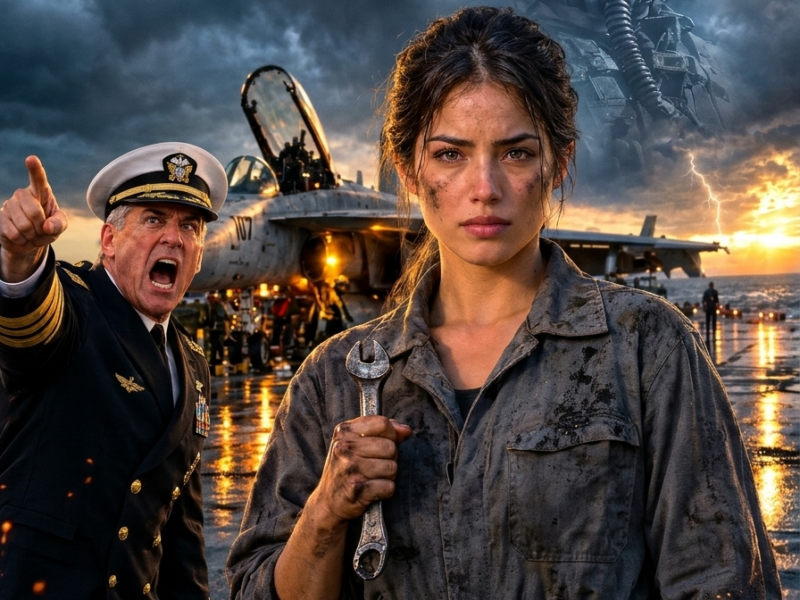
“We need an F-18 pilot now!” the commander screamed across the aircraft carrier’s control room
The alarm bells inside the control room of the USS Theodore Roosevelt didn’t merely ring; they hammered against the steel bulkheads with a brutal, vibrating violence that made the air itself feel unstable. Emergency red strobes bathed the glass consoles in a rhythmic, blood-colored pulse, casting long, frantic shadows across the faces of the tactical officers. The smell of ozone, hot copper, and stale adrenaline filled the pressurized room, five levels above the flight deck where waves crashed against the hull in the freezing waters of the North Atlantic.
Commander James Mitchell slammed his heavy, calloused palm onto the edge of the primary radar table, shattering a plastic stylus in the process. His face was flushed a furious scarlet, his jaw clenched so tightly the muscles in his neck strained against his collar.
“Where is my replacement pilot?” he screamed, his voice cutting through the chaotic layer of radio chatter, teletype printers, and overlapping verbal reports. “I have a twenty-million-dollar F/A-18E Super Hornet idling on Catapult Two, and my lead interceptor is currently bleeding hydraulic fluid into the sea! Someone give me a qualified stick now!”
Nobody answered. The young officers scattered around the room kept their eyes glued to their flickering monitors, deliberately avoiding his gaze. The aircraft carrier was operating on a skeletal tactical readiness crew following a grueling three-week joint NATO exercise, and the air wing’s prime operational pilots were either grounded by mandatory rest cycles or currently airborne in a frantic, losing battle against an unknown adversary.
I stood three paces back from the main tactical station, near the heavy steel hatch of the secondary communications bay. I was wearing the faded green utility coveralls of an aviation electronics technician, a digital diagnostic tablet pressed flat against my chest. My hair was pulled back into a severe, regulation bun, and my posture was deliberately unobtrusive—the stance of someone who had spent eleven months training herself to look like background furniture.
My name was Lieutenant Sarah Bennett. To the two thousand sailors aboard the Roosevelt, I was simply the quiet, obsessive technician who worked eighteen-hour shifts in the subterranean avionics bays, recalibrating radar arrays and fixing encrypted flight-data recorders that other mechanics couldn’t figure out.
They didn’t know about the classified service file locked inside a vault at Naval Air Station Fallon. They didn’t know about the five hundred hours of carrier-based tactical combat time logged under a ghost designation. And they certainly didn’t see the jagged, three-inch keloid scar hidden beneath the starched collar of my coveralls—a permanent souvenir from a piece of shattered canopy acrylic that had sliced through my skin during a high-G ejection three years prior.
“Sir,” Lieutenant Commander Vance, the carrier’s tactical coordinator, said as he stepped toward Mitchell, pointing a trembling finger at the status screen. “The only qualified pilot physically present on the command deck with an active carrier-landing currency is Lieutenant Bennett.”
Commander Mitchell turned his head slowly toward me, his eyes narrowing into an expression of sheer, unadulterated disbelief. He looked at my grease-stained sleeves, my tablet, and the modest rank insignia pinned to my collar as though someone had just told him a tasteless joke in the middle of a funeral.
“She’s maintenance support,” Mitchell barked, his voice dripping with condescension. “We are dealing with a live tactical intercept, Vance! I don’t need someone to fix a computer board; I need someone who can pull seven Gs without vomiting into their oxygen mask!”
“I hold an active naval aviator qualification, Commander,” I said, stepping forward. My voice was quiet, even, and devoid of tremor. I kept my eyes locked on his, allowing no emotion, no anger, and no hesitation to show.
Mitchell stared at me, his chest heaving as he tried to process the statement. “If you hold a stick qualification, Lieutenant, then why in God’s name are you down in the avionics bay wiping grease off radar terminals?”
I lowered my eyes for a fraction of a second, looking at the glowing tactical display between us. “Because I asked to be transferred out of the cockpit, sir.”
Before Mitchell could demand an explanation or issue a reprimand, the master radio console on the wall behind him erupted into a violent storm of static. A voice broke through the speaker—distorted, strained, and filled with the ragged, heavy breathing of a man fighting against gravitational lockup.
“Mayday! Mayday! Roosevelt, this is Viper Two!” the voice crackled. “I’ve lost primary and backup hydraulic systems! Control stick is stiff! I’ve got two bogeys riding my six at three hundred knots, and my fuel state is down to nine hundred pounds! I can’t shake them!”
The voice belonged to Lieutenant Daniel Brooks. My pulse spiked, a sudden, cold jolt of adrenaline shooting through my veins. Daniel. He was a pilot I had known long before I was reassigned to the Roosevelt—a man who had been a junior officer in my former squadron, a man who had sat in the mess hall with me on the night my world fell apart. He was also the last person I had promised never to leave behind in hostile airspace.
Three years earlier, I had been one of the Navy’s youngest, most decorated F/A-18 pilots, assigned to Strike Fighter Squadron 103 operating over the disputed waters of the Black Sea. During a classified night recon mission, our four-ship formation was ambushed by unflagged, high-performance adversaries utilizing experimental radar-jamming tech.
When the sky erupted into fire, I was faced with a brutal, impossible choice: press the attack against the primary enemy flight or break vector to escort a crippled C-130 transport carrying twelve wounded American servicemen out of the kill zone.
I chose the transport. I turned my nose toward the defenseless transport, drew the enemy’s fire onto my own aircraft, and sustained heavy damage while successfully guiding those twelve men back into friendly territory.
We saved every single life on that transport. But while I was drawing the enemy’s attention, my wingman’s aircraft went dark on radar. He vanished into the freezing, storm-lashed sea. The official naval inquiry that followed was swift and ruthless. To protect a high-level diplomatic secret regarding the origin of those unflagged fighters, the military leadership suppressed the transcript of my orders. The official report blamed me for abandoning my tactical formation. They called it pilot error. They called it cowardice under fire.
My combat career was destroyed in a single afternoon. I didn’t fight the transfer. I locked my flight suit in a steel locker, took an administrative reassignment as an avionics technician, and swore I would never touch a control stick again.
Until now.
“Lieutenant Bennett,” Mitchell barked, grabbing my arm and pulling me toward the tactical display. His arrogant facade had completely evaporated, replaced by the desperate terror of a commander about to lose two jets and a pilot under his watch. “If you take that Super Hornet up there, you answer directly to me. You get Brooks back to this deck, or don’t bother coming back yourself. Do you understand?”
I looked at the radar screen, where Daniel’s blue icon was flickering, surrounded by three aggressive red track symbols closing in for the kill.
“Understood, sir,” I said quietly.
He stepped closer, his eyes scanning my face, looking for any sign of panic. “Do you even know what you’re getting into up there? The weather is dropping to zero-zero visibility, and those bogeys aren’t playing by standard rules of engagement.”
I met his eyes, my gaze turns colder than the ocean outside. “Better than you think, Commander.”
Without waiting for his dismissal, I turned on my heel, threw my diagnostic tablet onto the communications desk, and bolted out the heavy steel hatch toward the flight deck ladderwells.
Three minutes later, I was strapped tightly into the ejection seat of Super Hornet Aircraft 104 on Catapult Two. The familiar, sterile scent of bottled oxygen, aviation turbine fuel, and heated glass displays filled my helmet. My fingers, encased in soft Nomex flight gloves, were trembling slightly as I pulled the leg restraint straps tight and flipped the master avionics switches.
It wasn’t fear of dying that made my hands shake. It was the crushing, suffocating weight of memory—the sound of alarms, the smell of burning wiring, and the echo of my wingman’s final, frantic radio call three years ago.
The flight deck director in his yellow jersey stepped in front of my canopy, making the sweeping hand signal for engine spool-up. I shoved the twin throttles forward into full afterburner. The twin General Electric F414 engines behind me roared into life with a deafening, earth-shattering scream that shook the entire forty-thousand-ton hull of the aircraft carrier.
I leaned my head back against the headrest, gripped the control stick with my right hand, and gave the night-deck director a crisp salute.
The catapult fired.
The acceleration was violent and instantaneous, slamming four Gs of force into my chest as the aircraft went from zero to one hundred and sixty knots in less than two seconds. The bright yellow deck lights vanished beneath my nose, replaced by the pitch-black, freezing void of the Atlantic night.
“Viper One, this is Roosevelt Tower,” the command radio crackled in my earpiece as I retracted the landing gear and established a steep, three-thousand-foot-per-minute climb. “Confirm radar contact and state callsign for entry into tactical airspace.”
I flipped the master encryption switch on my console with my thumb.
“Viper One, Lieutenant Sarah Bennett. Airborne and operational,” I transmitted, my voice steady against the roar of the engines.
A heavy, five-second silence stretched across the secure military satellite relay. Then, a new voice cut through the static—a deeper, older, and far more commanding voice that made my throat lock up instantly.
“Sarah?”
My blood ran cold inside my flight suit. I recognized that voice instantly. It belonged to Admiral Robert Hayes—the former strike group commander who had presided over my military court-martial, the man who had personally signed the order stripping me of my flight status and sealing my records three years ago.
“Where have you been, Lieutenant?” Hayes demanded, his tone laced with a mixture of shock and immediate authority.
“Flying, sir,” I replied coldly, banking the Super Hornet hard to the left, setting a intercept course for Daniel’s last known coordinates.
Another long pause followed over the line. Then, Admiral Hayes said something that caused my fingers to tighten around the stick until the leather of my glove groaned.
“Sarah, listen to me very carefully. You are to abort the mission immediately. Turn your aircraft around, dump your payload, and land back on the Roosevelt.”
I stared at the multi-function radar screen in front of me. Daniel’s jet was now less than twelve miles away, taking hits, his speed dropping rapidly as his engines starved for hydraulic fluid.
“Negative, Admiral,” I said, my voice hardening like tempered steel. “I have a damaged pilot to bring home. I’m not leaving another wingman in the water.”
“You don’t understand!” Hayes’s voice lost its composure, dropping to an urgent, desperate whisper that barely carried over the satellite static. “The aircraft you’re chasing… the bogeys closing in on Brooks… they aren’t foreign adversaries, Sarah. The threat isn’t coming from the front.”
Before I could ask him what he meant, a sharp, piercing audio chime rang out inside my helmet. The threat warning receiver on my dashboard lit up like a Christmas tree.
A single, unidentified radar contact had just materialized on my six-o’clock position—not coming from the direction of the enemy sector, but rising directly out of the storm clouds behind my own flight path. It was flying at Mach 1.8, completely dark to standard identification-friend-or-foe transponders.
Then my secure internal squadron radio crackled. A low, raspy, painfully familiar voice spoke my name—a voice that had haunted every single nightmare I had suffered over the last thirty-six months.
“Hello, Sarah,” the ghost whispered through the static, a faint, mocking laugh trailing behind his words. “Did you really think you could leave me behind twice?”
My lungs seized. The air vanished from my chest.
Because the man speaking through my classified, military-grade headset was Lieutenant Eric Miller—my former wingman.
The man I had watched get shot down over the Black Sea. The man the United States Navy had officially declared dead three years ago.
The darkness outside my canopy was absolute, a suffocating expanse of black sky and turbulent storm clouds that blurred the line between the sky and the ocean below. Inside the cockpit of Super Hornet 104, the emerald glow of the heads-up display illuminated the frantic movement of my eyes as I stared at the tactical radar screen.
The single radar contact behind me was closing the gap at an impossible rate of speed. It didn’t maneuver like a standard production fighter; its flight path was unnaturally smooth, making minute, micro-adjustments that suggested an advanced flight control system far superior to anything currently deployed by Allied forces.
“Eric?” I breathed into my mask, my voice barely audible over the hum of the cockpit environmental systems. “Eric… is that you?”
“Who else were you expecting, Sarah?” the voice crackled back over the encrypted channel. It wasn’t the warm, arrogant voice of the twenty-four-year-old wingman I had flown with in VFA-103. It was hollow, metallic, and scraped raw by years of isolation and unknown trauma. “Did you think three years of administrative paperwork and a mechanic’s coveralls would erase what you did over the Black Sea?”
“I didn’t abandon you, Eric!” I shouted into the mic, my thumb hovering over the flare release switch as the threat receiver chimed with an intermittent range-gate lock. “Command gave the order to escort the transport! They told me you were down in the water! They told me your distress beacon went dark!”
“Command lied to you, Sarah,” Eric replied, his voice chillingly calm. “Just like they lied to the families of those twelve men on the transport. They didn’t want you to save those soldiers because of humanitarian duty. That transport was carrying two defecting engineers from an unauthorized defense syndicate—men who carried the primary access codes for the next generation of autonomous combat platforms.”
My mind raced, trying to piece together the shattered fragments of a truth I had been denied for three years. The inquiry, the sealed records, the sudden dismissal of my statements—it hadn’t been about hiding a tactical mistake. It had been about hiding a black-budget military asset that had gone rogue.
“And you… what happened to you, Eric?” I asked, banking my F/A-18 into a wide, five-G turn to force the aircraft behind me to overshoot my position.
“I didn’t die in the ocean, Sarah,” he said softly as his jet effortlessly matched my turn, maintaining its deadly position directly on my six o’clock without losing a knot of speed. “I was retrieved by the people who built the system. They fixed my plane. They fixed me. And for three years, I’ve been waiting for Naval Air Forces to send the one pilot who could actually give my new systems a proper test.”
“Sarah! Do not engage him!” Admiral Hayes’s voice cut back onto the master tactical frequency, sounding increasingly frantic. “Viper One, this is Roosevelt Command! Break off your intercept! That aircraft is an experimental unmanned-assisted platform—it’s designated Project Erebus! It was designed using data harvested from your own combat logs!”
The realization hit me like a physical blow to the chest. The Navy hadn’t just buried my career to hide a scandal. They had used my flight records—my reflexes, my tactical choices, my decision-making algorithms under fire—to train an automated combat AI integrated into an advanced airframe. And Eric wasn’t just flying the plane; he was linked directly into its control architecture.
“He’s not going to let me break off, Admiral,” I said, my voice dropping into a cold, focused register as my survival instincts took total control. “And I have a pilot who needs help.”
Seven miles ahead, Lieutenant Daniel Brooks’s crippled F/A-18 was losing altitude fast, descending through four thousand feet. The two unflagged enemy fighters flanking him were drawing closer, preparing to deliver the final strike before he could reach the safety of the carrier’s outer defense bubble.
“Daniel, do you copy?” I transmitted on the local squadron frequency.
“Sarah?” Daniel’s voice came back, thick with pain and static. “Is that really you? My primary display is dead! I’ve got no controls on my left wing, and I’m losing oil pressure in Engine Two!”
“I’ve got you, Daniel,” I said, shoving my throttles into full afterburner, the sudden burst of acceleration pushing me toward his location at Mach 1.2. “I’m on your vector. Drop your nose five degrees, maintain three hundred knots, and do not make any sudden turns. I’m going to clear your tail.”
“Sarah, look out behind you!” Daniel screamed. “You’ve got a bogey locked onto your—”
Before he could finish, Eric’s aircraft fired a short, high-speed burst from its internal cannon. Tracer rounds cut through the night sky, passing within inches of my canopy, the white-hot shells lighting up the dark clouds like miniature lightning bolts.
“You always were too sentimental, Sarah,” Eric’s voice sneered in my ear. “You broke formation three years ago to save strangers. And now you’re going to die trying to save a pilot who couldn’t even keep his own hydraulics running.”
“I didn’t break formation to save strangers, Eric,” I snapped, executing a violent barrel-roll that threw my jet into a vertical dive toward the freezing ocean below. “I did it because it was the right choice. And I’m not letting you take anyone else!”
I plunged through the cloud layer at nine hundred miles per hour, the dark ocean rising up to meet me with terrifying speed. Three thousand feet. Two thousand feet. Fifteen hundred feet.
The low-altitude warning system inside my cockpit began to scream: “PULL UP! PULL UP!”
Eric’s aircraft followed me into the dive, its advanced sensors tracking my every movement, predicting my standard recovery pull-out based on the data logs the Navy had fed into its system three years ago.
He expected me to pull hard back on the stick at one thousand feet to avoid hitting the water.
He was wrong.
I didn’t pull back. Instead, I opened my air brakes, inverted the Super Hornet completely, and pulled the nose down even further, skimming the tops of the oceanic waves at three hundred feet, dumping a thick wall of sea spray and hot jet exhaust directly into the intake ducts of the aircraft trailing behind me.
The violent ingestion of salt water and hot jet wash hit Eric’s experimental fighter like a sledgehammer. Over my shoulder, I saw his engine intakes flash with a bright, blue flame as his flight control computer struggled to process the sudden, violent disruption in airflow. His aircraft wobbled for a microsecond—a tiny, human-like glitch in an otherwise perfect, algorithmic flight path.
That single microsecond was all the opening I needed.
I slammed the flight stick to the right, kicking full left rudder in a high-G, post-stall maneuver known as a broadway slide. The Super Hornet rotated on its axis, pointing its nose directly at the flank of the two enemy fighters that had been closing in on Daniel’s crippled jet.
“Fox Two!” I roared, pulling the missile trigger on my stick.
A Sidewinder missile shot off my wingtip rail with a blinding flash of orange light, its solid-fuel rocket motor leaving a curling white tail through the dark air. It streaked across the three-mile gap, home in on the thermal signature of the lead hostile, and detonated squarely against its tailpipe. The enemy jet exploded into a magnificent fireball, shedding flaming debris into the churning sea below.
The second hostile fighter, realizing its tactical advantage had vanished, immediately broke off its attack on Daniel, executing a desperate, high-G climbing turn into the safety of the storm clouds overhead.
“One down!” I shouted over the radio. “Daniel, pull your nose up! You’re clear!”
“Copy that, Viper One!” Daniel panted, his voice filled with overwhelming relief. “I’ve got control back on my right stick! Heading toward the carrier now!”
“Keep flying straight, Daniel. Do not stop until your hook catches the wire,” I ordered, banking my jet back around to face the real threat.
Behind me, Eric’s aircraft had recovered from the engine stall. Its twin vectoring nozzles glowed a dangerous, cherry red as it rose out of the wave tops like a phantom rising from a grave. He didn’t fire another missile. He didn’t use his cannon. He simply hovered on my radar screen, maintaining a precise three-mile perimeter, shadowing my every movement with surgical, terrifying precision.
“Impressive, Sarah,” Eric’s voice sounded in my helmet, devoid of all anger, replaced by a flat, unnatural calm that made my skin crawl. “You used the ocean dynamics to bypass the predictive flight algorithms. You always were creative under pressure.”
“It’s over, Eric,” I said, keeping my master arm switch active, my targeting reticle hovering over his radar signature. “Your support flight is gone. You’re low on fuel, and you’re flying inside the Roosevelt’s surface-to-air missile envelope. Land the plane. Let the Navy get you the help you need.”
A cold, bitter laugh echoed through the headset. “Help? You think I want their help? You think I want to go back to sitting in a windowless room at Fallon while Admiral Hayes decides which black-budget project gets to dismantle my mind next?”
“Eric, please—”
“They didn’t save me after the crash, Sarah!” he shouted, his calm demeanor finally shattering into raw, violent agony. “They picked me out of the water, strapped me into a simulator harness, and spent thirty months mapping my central nervous system into a guidance computer! They told me you were dead! They told me the entire squadron was wiped out! They created this phantom so they could build a machine that doesn’t feel pity, doesn’t feel guilt, and doesn’t disobey orders!”
My heart broke inside my chest. The anger I had carried for three years against the wingman who had vanished dissolved instantly, replaced by a sickening wave of grief. He hadn’t betrayed me. He had been transformed into a weapon by the very institution we had both sworn an oath to serve.
“They lied to both of us, Eric,” I said softly, my voice trembling as I eased the pressure on my control stick. “They made us ghosts so they could control the narrative. But you don’t have to be their weapon anymore. Break your link. Turn off the override switch. Fly back to the carrier with me.”
For five long seconds, the night sky was silent. The only sound in my ears was the rhythmic, heavy breathing of two pilots who had been erased from existence by a government that considered them expendable assets.
On my radar display, the yellow lock-on box around Eric’s aircraft began to flicker. The automated targeting computer on his experimental jet was struggling against a manual input—a human hand fighting against the digital directives hardwired into the control column.
“Sarah…” Eric whispered, his voice sounding small, fragile, like the young man who used to sit beside me in the ready room before every morning patrol. “I can’t… I can’t break the link. It’s hardwired into the flight bus. If I disengage, the flight safety protocol triggers an automatic self-destruct.”
My blood ran cold. “What?”
“The Navy didn’t want this technology falling into anyone else’s hands,” Eric said, his voice regaining a strange, peaceful clarity. “If the neural interface loses connection or if the pilot attempts an unassigned vector, the airframe initiates a zero-delay core overload. They never intended for me to come back, Sarah. I was just a flight test.”
Before I could reply, my heads-up display flashed a bright, orange warning banner: WARNING: SATELLITE OVERRIDE DETECTED.
Admiral Hayes’s voice re-entered the frequency, cold, clinical, and completely devoid of human warmth.
“Viper One, this is Roosevelt Command,” Hayes stated flatly. “Be advised, Project Erebus has suffered a catastrophic security compromise. Pursuant to Directive 904, remote destruction protocols have been authorized from Strategic Command.”
“No! Hayes, wait!” I screamed into the microphone. “Cancel that order! He’s trying to disengage!”
“The decision has already been executed, Lieutenant,” Hayes replied, his tone as indifferent as a death certificate. “Thank you for your service, Sarah. Your record will be fully reinstated posthumously.”
The sky around Eric’s jet didn’t explode into a standard orange fireball.
Instead, a brilliant, blinding pulse of white electrical light erupted from the fuselage of Project Erebus as its internal core systems were overloaded by remote command from the satellite link above. The experimental aircraft pitched wildly to the left, its electronic stabilization controls dying instantly as its tail control surfaces locked into a hard downward trim.
“Sarah!” Eric’s voice screamed through the headset, distorted by intense static and the violent electrical interference surging through his flight suit. “Primary controls dead! The cockpit canopy is locked from the outside! I can’t eject!”
“Hold on, Eric! I’m coming!” I roared, slamming my throttles forward into full afterburner, the Super Hornet surging through the air to close the three-mile gap between us.
“Viper One, drop your pursuit immediately!” Hayes’s voice barked over the emergency channel. “That airframe contains high-yield experimental batteries! The secondary thermal detonation will destroy anything within a five-hundred-yard radius!”
“Shut up!” I screamed at the admiral, severing the satellite link with a sharp flick of my wrist switch. I cleared my frequency, leaving only the direct plane-to-plane connection between my cockpit and Eric’s falling jet.
Eric’s fighter was descending in an inverted spin toward the black ocean below, dropping through two thousand feet at three hundred knots. Trailed by thick, toxic white smoke and brilliant purple arcs of electrical discharge, it looked like a dying star plummeting from the heavens.
I knew the math. I knew the operational parameters. If I got close enough to engage manual canopy release protocols or use my aircraft’s wing surface to stabilize his fall, the impending thermal explosion from his battery banks would instantly vaporize my own fuel tanks, killing us both in the cold Atlantic waters.
Every textbook, every naval tactical manual, and every flight instructor at TOPGUN would have told me to pull up, save my multi-million-dollar aircraft, and live to fight another day.
I grabbed the control stick with both hands, planted my feet firmly against the rudder pedals, and pushed the nose of my Super Hornet straight down into the burning wake of his descent.
“Sarah, stop!” Eric gasped, his voice weakening as oxygen starved his helmet. “You can’t save me! Get back to the carrier! Save yourself!”
“I left you behind once because I trusted their orders, Eric!” I shouted back, tears burning behind my visor as I matched his descent speed at eight hundred feet above the water, bringing my starboard wingtip within five feet of his spinning fuselage. “I’m not doing it again! We go home together, or we don’t go home at all!”
I extended my trailing edge flaps, using the precise, high-G maneuvering capability of the F/A-18 to slide my aircraft directly beneath his crippled fighter. The turbulent jet wash from his burning airframe slammed into my canopy, shaking my entire instrument panel so violently that the digital screens flickered and blurred.
The heat radiated through my windshield, scorching the paint on my nose cone, the smell of burning composite materials bleeding through my environmental filter.
“Eric! Listen to me!” I screamed over the roar of the engines. “The emergency canopy jettison switch on your left console! The secondary mechanical pull handle between your boots! It’s completely manual—it’s not wired into the main computer system!”
“It’s jammed!” Eric coughed, his voice fading. “The frame melted during the core overload!”
“Then kick it!” I roared, pulling my aircraft up until my canopy was barely thirty inches below his inverted cockpit glass. “Kick the glass, Eric! Use the emergency survival knife on your vest! Break the seal!”
Through the thick smoke and glowing electrical arcs, I saw him move. Inside the dim, flickering cockpit of Project Erebus, Eric raised his booted foot and slammed it against the cracked, heat-stressed acrylic of his canopy.
Once. Twice. Three times.
On the fourth blow, a web of white fractures exploded across the canopy glass. The rushing atmospheric pressure caught the weakened acrylic, and with a violent pneumatic pop, the canopy shattered into thousands of harmless fragments, blowing away into the freezing night sky.
“Canopy clear!” Eric choked out, the freezing Atlantic air rushing into his cockpit, clearing the toxic fumes.
“Eject! Eject now!” I screamed.
“The rails are locked, Sarah!” he replied, terror returning to his voice. “The ejection charge isn’t firing!”
The ocean was now less than four hundred feet below us. The dark, white-capped waves looked like jagged teeth waiting to crush anything that touched them. We had less than four seconds before both aircraft impacted the water.
I didn’t think. I acted on pure, instinctive reflex—the reflex of a pilot who refused to let an algorithm or a corrupt command dictate who lived and who died.
I pulled back hard on my flight stick, raising the heavy nose of my Super Hornet up until my vertical tail fins made direct, physical contact with the belly of his falling jet.
The violent metallic collision shook my entire airframe with a concussive crunch that rattled my teeth. The physical impact dislodged his trapped ejection seat from its warped guide rails.
Inside his cockpit, the secondary mechanical pressure sensor detected the physical separation. The rocket motor beneath Eric’s seat ignited with a brilliant, roaring flash of yellow light.
His ejection seat shot upward into the night sky, its primary parachute deploying instantly with a loud, snapping crack that echoed over the roar of the ocean.
A fraction of a second later, Project Erebus impacted the water at three hundred miles per hour. A colossal column of white water, steam, and flaming debris erupted into the air as the experimental core detonated beneath the waves, sending a shockwave through the atmosphere that slammed my Super Hornet sideways like a ragdoll.
I fought the controls with everything I had, pulling six Gs of force, screaming against the pressure in my throat as I forced my aircraft’s nose back toward the horizon, clearing the crest of the waves by less than thirty feet.
I leveled out. My engines were groaning, my master warning light was flashing amber, but the controls responded.
I banked my jet into a slow, gentle turn, looking out my canopy window.
Down below, drifting slowly through the dark, turbulent clouds toward the icy sea, a single white parachute canopy swayed in the night sky, illuminated by the burning oil slick on the ocean surface.
I pressed my radio switch, my breathing heavy, ragged, and filled with a profound, emotional warmth I hadn’t felt in three years.
“Roosevelt Tower, this is Viper One,” I transmitted, my voice clear and absolute across every naval frequency in the sector. “I have a pilot down in the water at grid coordinates Alpha-Niner. Send the Search and Rescue helicopter immediately.”
Silence held the line for three long seconds. Then, Lieutenant Commander Vance’s voice came back—not Hayes, but Vance, his tone filled with raw, unscripted pride.
“Copy that, Viper One. Rescue Helicopter Alpha-One is already airborne and en route to those coordinates. Outstanding work, Sarah… welcome back to the sky.”
The landing on the flight deck of the USS Theodore Roosevelt was far from smooth. Super Hornet 104 was battered, its nose cone scorched black by thermal entry, its starboard tail fin visibly bent from the physical impact with Eric’s aircraft.
As I brought the aircraft down onto the pitching deck in zero-visibility rain, the tailhook caught the primary arrestor wire with a violent, bone-jarring jerk that brought the multi-million-dollar fighter to a complete stop within two hundred feet.
The flight deck crew, clad in their brightly colored shirts, didn’t move with their usual mechanical discipline. They stood along the edges of the deck, staring at my battered aircraft as I taxied into the park zone near the island structure.
I shut down the twin engines. The deafening roar of the turbines slowly died away, replaced by the rhythmic drumming of cold rain against my canopy glass.
I unbuckled my harness, pulled off my oxygen mask, and let out a long, shuddering breath. For the first time in three years, the crushing weight on my chest—the guilt, the shame, the ghost of a forgotten mission—was gone. It had been left behind in the freezing depths of the Atlantic Ocean.
The canopy hissed open, letting in the damp, salty sea air. As I climbed down the boarding ladder, my boots hitting the wet flight deck with a heavy thud, a team of medical personnel rushed past me toward the secondary elevator where the Search and Rescue helicopter had just touched down.
I watched as the side door of the SH-60 Seahawk slid open. Two navy corpsmen helped a man step down onto the deck. He was soaked to the bone, wrapped in a thick wool blanket, his face pale and shivering from the arctic wind, but his eyes were clear, focused, and entirely human.
Eric looked across the rain-slicked flight deck and caught my eye.
He didn’t say a word. He didn’t need to. He simply offered a faint, tired nod—a silent acknowledgment between two aviators who had flown into the deepest pit of military cynicism and emerged together on the other side.
“Lieutenant Bennett.”
I turned around slowly. Standing ten feet away, flanked by two armed marine guards, was Admiral Robert Hayes. He was wearing his full dress overcoat, but his face looked hollow, aged by the absolute collapse of a secret he had spent three years trying to preserve.
Beside him stood Commander James Mitchell, looking at me with an expression that had completely shifted from dismissive contempt to profound, speechless respect.
“Admiral,” I said, standing at attention, my hands resting at my sides.
Hayes looked at my battered aircraft, then looked back at me, his jaw tightening as he realized the tactical logs from my Super Hornet had already been automatically uploaded to the Navy’s master cloud network—bypassing his ability to erase or modify the records ever again.
“You disobeyed a direct order from a flag officer, Lieutenant,” Hayes said, though there was no strength left in his voice. It was the dry, mechanical statement of a man who knew his career was over. “You compromised a classified defense program and brought a compromised asset aboard this vessel.”
“With all due respect, Admiral,” I replied, stepping closer to him, my voice ringing out clearly over the sound of the wind and rain. “I didn’t disobey an order. I fulfilled my oath. I rescued an American aviator and neutralized an unauthorized, rogue combat platform that threatened the lives of sailors on this ship.”
Commander Mitchell stepped forward, placing himself slightly between me and the admiral. He looked at Hayes with a cold, firm stare that signaled an absolute shift in the ship’s internal command dynamic.
“The tactical logs have been secured by base intelligence, Admiral,” Mitchell said flatly. “And as the commanding officer of this vessel, I am placing Lieutenant Sarah Bennett back on active flight status effective immediately. Her record is cleared.”
Hayes stared at Mitchell, then at me, realizing he had lost all leverage. Without another word, he turned on his heel and walked away into the shadows of the island superstructure, flanked by his marine escort.
Commander Mitchell turned back to me. He didn’t offer an apology for how he had spoken to me in the briefing room, and I didn’t need one. Instead, he raised his hand to his brow and delivered a slow, crisp, and absolute military salute.
“Welcome back to the squadron, Viper One,” Mitchell said quietly. “Get some rest. You’ve got the morning patrol at zero-five-hundred.”
“Thank you, sir,” I replied, returning the salute with steady pride.
An hour later, I stood near the bow of the flight deck, wrapped in a heavy leather flight jacket, watching the first light of dawn break through the heavy storm clouds on the eastern horizon. The rain had stopped, replaced by a cool, crisp morning breeze that smelled of clean saltwater and open sky.
Beside me, leaning against the safety netting with a cup of hot black coffee in his hands, stood Eric. His skin was still pale, but the haunted, mechanical look in his eyes had completely vanished.
“What happens now, Sarah?” Eric asked softly, staring out at the golden sunlight reflecting off the endless, rolling waves. “The Navy is going to undergo a massive investigation. Hayes is going to face a court-martial. And us… we’re still ghosts on paper.”
I looked up at the vast blue sky above us—a sky that no longer felt like a place of tragedy, but a canvas of infinite possibility.
I smiled, pulling my flight gloves from my pocket and slipping them over my hands.
“Now, Eric?” I said, turning my face toward the morning sun. “Now we fly.”
The end.









