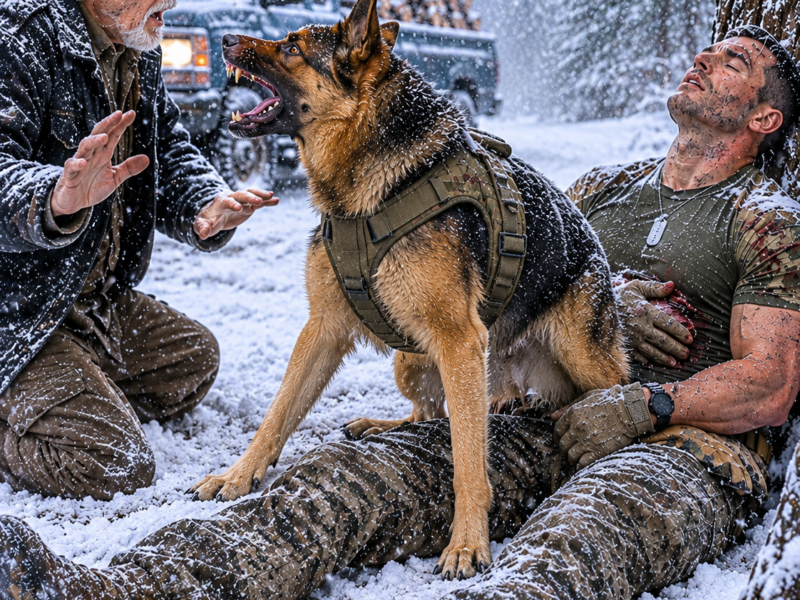
“Twenty-three cars passed me and my injured German Shepherd on the shoulder of a freezing Virginia highway, but when an old carpenter finally stopped his battered pickup
Walter’s fingers tightened around my sleeve as the black SUV’s engine continued running across the highway.
“Get in my truck,” he whispered.
I looked at him.
“Not until you tell me what’s happening.”
He glanced toward the SUV.
“Son, I promise I’ll explain. But if those men see you opening that envelope, they’ll know I gave it to you.”
Ranger struggled to his feet.
His injured rear leg trembled, but he positioned himself between me and the approaching vehicle.
I’d seen that stance hundreds of times during our deployments.
It meant he sensed a threat.
“Easy, buddy,” I whispered.
Walter opened the passenger door of his old Ford.
“Come on. There’s a road behind the tree line. I know somewhere we can talk.”
I didn’t like leaving my truck.
I liked leaving the SUV behind even less.
But Walter had stopped when twenty-three other drivers hadn’t.
And whatever he knew about Ranger, I needed to hear it.
I helped Ranger into the back seat, climbed into the passenger side, and Walter started the engine.
As we pulled away, I looked through the rear window.
The black SUV remained on the shoulder.
Then its headlights came on.
It began following us.
Walter noticed.
“Don’t worry. They won’t follow us all the way.”
“How do you know?”
“Because I’ve been dealing with people like that longer than you think.”
He turned onto a narrow country road.
The pavement gave way to gravel, and the trees closed around us.
For nearly ten minutes, neither of us spoke.
Ranger lay across the back seat, his head resting against the old man’s toolbox.
Every few seconds, I checked his breathing.
He was still cold.
I reached back and rubbed his neck.
“We’re almost there, buddy.”
Walter glanced at me.
“You talk to him like he’s a person.”
“He understands more than most people.”
The old carpenter nodded.
“I know.”
We eventually reached a small property surrounded by tall oak trees.
There was a white farmhouse, a detached garage, and a wooden workshop with a faded sign above the entrance.
BENNETT WOODWORKS.
Walter parked beside the workshop.
“Welcome to my home.”
I helped Ranger out.
He limped toward the porch, sniffed the wooden steps, and sat down.
Walter watched him.
For a moment, his face softened.
Then he looked at me.
“Now we can talk.”
Inside the workshop, the smell of sawdust and cedar filled the air.
Tools hung neatly along the walls.
Several unfinished wooden chairs stood near a workbench.
There were photographs everywhere.
Walter poured two cups of coffee and placed one in front of me.
I didn’t touch it.
“Tell me about Shadow.”
He sat opposite me.
“Twelve years ago, I was hired to build kennels for a special working-dog unit at the naval base.”
He pulled an old photograph from a drawer.
It showed several German Shepherds standing beside their handlers.
“Most of those dogs were ordinary military working dogs. They trained for explosives, tracking, and patrol work.”
He pointed to a younger dog near the back.
“That’s Shadow.”
I studied the photograph.
The dog had the same black saddle, the same pale markings above the eyes, and the same notch in the left ear as Ranger.
“Who was his handler?”
“Petty Officer Daniel Brooks.”
The name meant nothing to me.
Walter continued.
“Daniel was a good man. Quiet. Didn’t talk much about himself. He and Shadow were inseparable.”
“What happened to him?”
Walter stared at his coffee.
“He died during an overseas assignment.”
I leaned forward.
“How?”
“That’s what nobody could agree on.”
He explained that Daniel had returned from an operation with serious injuries.
Shadow had been with him.
Both were transported to a military medical facility.
Daniel died two days later.
Shadow was listed as transferred to another unit.
But Walter had never believed the official explanation.
“Why?”
“Because three weeks later, a man came to my workshop and ordered me to build a special transport crate.”
“What was special about it?”
“It had no ventilation windows, no identification markings, and a locking system that couldn’t be opened from the inside.”
I stared at him.
“What was it for?”
Walter lowered his voice.
“Shadow.”
I felt something tighten in my chest.
“You’re telling me they transported a military working dog in a sealed crate?”
“I asked the same question.”
“What did they say?”
“They told me the dog had become dangerous.”
I looked toward Ranger.
“Was he?”
Walter shook his head.
“Not according to Daniel.”
He reached into a drawer and removed a second photograph.
This one showed Daniel Brooks sitting on the ground with Shadow’s head resting in his lap.
They were both smiling.
On the back was a handwritten note.
For Walt. Thanks for building him a place to sleep.
I turned the photograph over again.
“Why did you keep this?”
“Because Daniel gave it to me. And because I knew something was wrong when they came to collect Shadow.”
Walter stood and walked toward a large cabinet.
He unlocked it and removed a small metal box.
“I was told to destroy every drawing, every receipt, and every record connected to that kennel.”
He placed the box on the table.
“I didn’t.”
Inside were several folded blueprints, receipts, and a small notebook.
One page contained a list of names.
I recognized one immediately.
Lieutenant Commander Michael Reeves.
The same man in the photograph.
“Why was Reeves involved?”
Walter sat down again.
“He was the officer who supervised the transfer.”
I looked at the paper.
There was another name beneath Reeves.
A civilian contractor named Harold Mason.
“Who is Mason?”
Walter rubbed his chin.
“I never met him. But he paid for the crate.”
I studied the notebook.
There were several dates, amounts, and handwritten notes.
One entry stood out.
S-09 — SECONDARY TRANSFER — PRIVATE FACILITY.
I looked up.
“What’s S-09?”
Walter pointed toward the photograph.
“Shadow’s identification number.”
I glanced at Ranger’s collar.
S-09.
The letters I’d seen a hundred times suddenly felt much heavier.
“Why would they transfer him to a private facility?”
“I don’t know.”
Walter paused.
“But I know where that facility was.”
He took a map from the cabinet and unfolded it.
It showed an area outside Roanoke, near an abandoned industrial complex.
A red circle had been drawn around a property called Black Creek Research.
I’d heard of it.
Years earlier, it had been the subject of a local newspaper investigation involving animal testing.
The company had closed after several employees resigned.
I looked at Walter.
“Is that where Shadow went?”
“I believe so.”
“Then why didn’t you tell anyone?”
He lowered his eyes.
“I tried.”
The room went quiet.
“I contacted the military police. I sent letters to the base. I even went to see Daniel’s family.”
“What happened?”
“Nobody wanted to hear it.”
He swallowed.
“Then, one night, someone broke into my workshop. They didn’t steal tools or money. They took every photograph I had of Shadow.”
He looked toward the old photograph in my hand.
“Except that one.”
“Why?”
“I had hidden it inside the back of a wooden cabinet.”
I thought about the black SUV.
The envelope with my name.
The strange timing of Walter’s appearance.
“Mr. Bennett, how did you know I’d be on that highway today?”
He didn’t answer immediately.
Then he opened a small drawer and removed a folded newspaper clipping.
It was from three months earlier.
The headline read:
Retired Navy SEAL and Military K9 Partner Begin New Life in Virginia.
Beneath it was a photograph of me standing beside Ranger at a veterans’ event.
I felt my stomach drop.
“You’ve been watching me.”
Walter shook his head.
“Not watching. Looking for you.”
“That’s not much better.”
“I know.”
He explained that after seeing the article, he had contacted the veterans’ organization to ask whether they could help him reach me.
But they wouldn’t release my contact information.
He had eventually learned that I had an appointment at a veterinary clinic near the highway.
He had driven out that afternoon hoping to find me.
“Why didn’t you just send the envelope?”
“Because I didn’t know whether someone was intercepting your mail.”
I leaned back.
“And the SUV?”
Walter looked toward the window.
“I don’t know who they are. But I know the kind of people who don’t want that notebook found.”
I picked up the envelope.
“Then let’s see what’s inside.”
Walter nodded.
I carefully opened it.
There were three sheets of paper and a small photograph.
The first sheet contained a letter.
It was addressed to me.
But it wasn’t written by Walter.
The handwriting was different.
The letters were narrow and slightly slanted.
At the bottom was a signature.
Daniel Brooks.
I read the first line.
If this reaches Ethan Cole, then someone finally found S-09.
I looked up.
“Daniel wrote this?”
Walter nodded.
“He left it with me shortly before he died.”
I read on.
I don’t know whether Shadow will survive the transfer. If he does, they will probably change his name and remove his identification.
Please don’t let them tell you he was dangerous.
He saved my life, and I failed to save his.
My throat tightened.
The letter continued.
There is something inside the old kennel that they don’t know I left behind. If you ever find Shadow again, look beneath the third floorboard.
I lowered the paper.
“Which kennel?”
Walter walked to the cabinet and removed another blueprint.
“The one I built for him.”
He tapped the drawing.
“Still standing, as far as I know.”
I looked at the map.
Black Creek Research.
The old facility.
The third floorboard.
Ranger suddenly raised his head.
His ears pointed toward the workshop door.
Walter stood.
“What’s wrong?”
I listened.
A vehicle had stopped outside.
Then came the sound of a car door closing.
I moved toward the window.
A black SUV sat near the entrance.
The same one from the highway.
Two men stepped out.
One wore a dark jacket.
The other carried a clipboard.
Walter’s face drained of color.
“They found us.”
I looked at him.
“Do you have another exit?”
He pointed toward the back of the workshop.
“Through the storage shed. There’s a trail leading into the woods.”
I clipped Ranger’s leash to his collar.
He stood, but his injured leg buckled slightly.
I supported his weight.
“Come on, buddy.”
Before we could reach the rear door, someone knocked on the workshop entrance.
Three slow knocks.
Then a voice.
“Mr. Bennett? We’re looking for a dog.”
Walter closed his eyes.
I moved him behind me.
“Stay with Ranger.”
I opened the door just enough to see the man outside.
He was in his late forties, clean-shaven, wearing an expensive black coat.
He smiled politely.
“Mr. Cole, I presume.”
“Who are you?”
“Harold Mason.”
The name from the notebook.
I felt my grip tighten around the door.
“What do you want?”
“Something that belongs to my employer.”
“Then you should talk to a lawyer.”
Mason smiled again.
“I don’t think you understand the situation. That animal has been involved in a confidential research program for many years.”
“He’s retired.”
“That isn’t your decision.”
“He lives with me.”
Mason glanced past my shoulder.
His eyes landed on Ranger.
For a moment, the polite expression disappeared.
“There you are.”
Ranger growled.
Mason took one step forward.
I closed the door.
Then I heard the sound of metal striking wood.
Someone was trying the handle.
“Back door,” I told Walter.
We moved through the workshop.
The rear door opened into a narrow storage area filled with lumber.
I pushed it open and helped Ranger outside.
Walter followed.
We crossed the yard and entered the tree line.
The ground was uneven, and Ranger struggled to keep pace.
I slowed down.
“Take your time, buddy.”
Behind us, a door slammed.
Then footsteps.
Walter pointed toward a narrow dirt road.
“There’s an old barn about half a mile down. We can get help there.”
We made it to the barn without being seen.
Walter used an old telephone inside to call the county sheriff.
I contacted Laura Bennett, an NCIS investigator I’d worked with during my final years in the Navy.
I explained everything.
She listened without interrupting.
When I finished, she said something that surprised me.
“Ethan, I’ve heard the name Black Creek before.”
“From where?”
“We’ve been investigating several missing military working-dog records. The original reports were filed years ago, but the case was recently reopened.”
“Who reopened it?”
“I did.”
I looked at Ranger.
“Then you need to get here.”
“I’m already on my way.”
The next morning, a team of investigators arrived.
Mason and the second man had left Walter’s property before the sheriff reached the workshop.
But they had left something behind.
A set of photographs showing the old carpenter’s house and workshop.
They had been taken over several weeks.
Walter sat on his porch while an investigator documented the evidence.
He looked older than he had the previous afternoon.
“I should have told someone sooner,” he said.
I sat beside him.
“You tried.”
“Not hard enough.”
I didn’t know what to say.
Sometimes guilt doesn’t care whether you’ve done everything you could.
It simply waits for a quiet moment to remind you of what you couldn’t do.
Laura approached with a folder.
“We found the original property records for Black Creek Research.”
She opened it.
The facility had been purchased by a private contractor twelve years earlier.
The company had received funding through several government-related research agreements.
Most of the records had been destroyed after the facility closed.
But one document remained.
It listed several animals transferred from the naval base.
Among them was S-09.
I looked at the date.
It was the same date Daniel Brooks had died.
“Can we get inside?”
Laura nodded.
“We’re arranging a search warrant.”
Walter stood.
“I’m coming.”
Laura shook her head.
“Mr. Bennett, you don’t need to put yourself through that.”
He looked at her.
“I built the kennel. I know every inch of it.”
She considered this.
Then she nodded.
We drove to Black Creek that afternoon.
The facility was surrounded by a chain-link fence.
Weeds covered the entrance road.
Several windows had been boarded up.
It looked like a place people had forgotten.
But the locks on the main gate were newer than the building.
The investigators entered first.
I followed with Ranger.
Walter walked slowly behind us.
Inside, the air smelled of damp concrete and rust.
There were empty rooms, broken desks, and old equipment.
We found several kennels in the rear building.
Most were open.
Some had been dismantled.
Then Walter stopped.
“There.”
He pointed toward a wooden kennel at the far end.
The structure was old but intact.
Its door had a small metal plate.
S-09.
Ranger moved closer.
His nose touched the wooden frame.
He sniffed once.
Then again.
He let out a soft whine.
I knelt beside him.
“Do you remember this place?”
He lowered his head.
Walter approached the kennel.
“This is the one.”
He opened the door.
Inside were old blankets and a rusted water bowl.
I examined the floor.
The boards were worn, but one section looked slightly different.
I counted from the entrance.
One.
Two.
Three.
I crouched and pressed my fingers against the third floorboard.
It moved.
An investigator brought over a small crowbar.
We lifted the board carefully.
Beneath it was a narrow metal compartment.
Inside was a sealed plastic case.
Walter covered his mouth.
I opened it.
There were several photographs, two small notebooks, and a compact digital recording device.
Laura called for the evidence team.
The notebooks belonged to Daniel Brooks.
The first contained training records.
The second contained names and dates.
But the recording device was what mattered.
After it was examined by specialists, we learned that it contained several audio files.
The first was a conversation between Daniel and Lieutenant Commander Reeves.
The second was a recording of Harold Mason discussing unauthorized animal transfers.
The final recording was dated two days before Daniel’s death.
I listened to it in a secure room at the NCIS office.
Daniel’s voice was tired but clear.
“Commander, these dogs aren’t equipment. They’re living animals. They were trained to protect people, not to be used for procedures nobody has approved.”
Reeves answered.
“You’re making this bigger than it is.”
“Then why are you moving them without records?”
“Because the program has authorization.”
“Not for this.”
There was a pause.
Then Mason spoke.
“Daniel, I suggest you think about your future.”
Daniel’s response was quiet.
“My future isn’t the issue. These dogs are.”
The recording ended.
The next file contained a conversation about the transfer of S-09.
Reeves had ordered the dog’s identification changed.
Mason had arranged the private transport.
The reason was eventually revealed through the investigation.
Black Creek had been conducting unauthorized testing involving chemical detection and stress-response training.
Some procedures had been legitimate research.
Others had violated military rules and animal welfare regulations.
Daniel had discovered that the program’s records were being altered to hide injuries and unauthorized transfers.
He had tried to report it.
Instead, he was removed from the program.
The official report claimed he died from complications after an accident.
But the evidence showed that he had been denied timely medical treatment after refusing to sign false records.
His death hadn’t been an ordinary accident.
And Shadow had been transferred because he was the last living animal directly connected to the investigation.
For years, people had been paid to keep his identity hidden.
Eventually, the case became much larger than anyone expected.
Harold Mason was arrested.
Reeves was questioned and later charged with conspiracy, evidence tampering, and multiple violations related to the unauthorized program.
Several other officials and contractors were investigated.
Walter’s notebook, Daniel’s recordings, and the old kennel records helped establish the truth.
But the most important discovery for me wasn’t found in a report.
It came from a photograph inside the plastic case.
It showed Daniel sitting beside Shadow in the old kennel.
On the back, he’d written:
To whoever finds this: he deserves a home where nobody calls him an asset.
I read the sentence twice.
Then I looked at Ranger.
He was lying beside my chair.
His head rested on his paws.
He had no idea that a room full of people had spent years discussing his past.
He only knew that I was there.
And that was enough.
The investigation took nearly a year to conclude.
During that time, Ranger received treatment for his injured leg.
The specialist determined that his limp was caused by an old injury that had worsened with age.
There was no miracle cure.
But with medication, physical therapy, and shorter walks, he improved.
Walter visited us regularly.
At first, he brought wooden toys.
Then he built a small ramp for Ranger so he wouldn’t have to climb the porch steps.
He refused to accept payment.
“Just let him use it,” he said.
One afternoon, I asked Walter why he’d spent twelve years trying to find the dog.
He was sanding a piece of oak in my garage.
He stopped and looked at me.
“Because I promised Daniel.”
He ran his hand across the wood.
“That young man trusted me with something important. I couldn’t bring him back, but I could at least try to keep his dog from disappearing.”
I nodded.
“That’s a long time to carry a promise.”
Walter gave a small smile.
“Some promises don’t get lighter just because the years pass.”
Six months later, we held a small ceremony at a veterans’ center.
It wasn’t a military parade.
There were no speeches about classified operations or government programs.
It was simply a gathering to honor Daniel Brooks and recognize the people who had helped expose what happened at Black Creek.
Walter sat in the front row.
I sat beside him.
Ranger lay quietly at my feet.
When the speaker mentioned Daniel’s name, Walter lowered his head.
I looked at the old carpenter.
He was holding a small wooden box in both hands.
Inside was a new identification tag.
It had been made from polished brass.
One side read:
RANGER.
The other side read:
HOME.
After the ceremony, Walter attached it to Ranger’s collar.
“There,” he whispered.
“That’s better.”
Ranger sniffed his hand and gently leaned against his knee.
Walter smiled.
For the first time since I’d met him, he didn’t look like a man carrying an old secret.
He looked like someone who had finally kept a promise.
A year later, I was driving along the same stretch of Virginia highway.
The weather was warmer.
The road was dry.
Ranger sat beside me, resting his head near the open window.
We passed the place where my truck had broken down.
I slowed slightly.
There was a small roadside memorial nearby.
A wooden plaque stood beneath an oak tree.
Walter had made it himself.
It read:
For those who stop when someone needs help.
I pulled onto the shoulder.
Ranger climbed out slowly.
His leg was better, though he still moved carefully.
I stood beside the plaque and looked toward the road.
Cars passed.
Some drivers glanced over.
Others continued without noticing us.
I thought about the twenty-three vehicles that had driven past that afternoon.
I didn’t hate them.
I didn’t know what they were dealing with, what they feared, or why they hadn’t stopped.
But I would always remember the twenty-fourth.
The old carpenter who had pulled over in a battered blue Ford.
The man who had recognized a dog nobody else remembered.
And the promise he’d carried for twelve years.
Ranger nudged my hand.
I looked down.
“Ready to go, buddy?”
His tail moved once.
I opened the passenger door and helped him climb inside.
Before starting the engine, I looked one last time at Walter’s wooden plaque.
For most of my life, I’d believed courage meant moving toward danger when everyone else moved away.
That afternoon, an old carpenter taught me there was another kind.
Sometimes courage was simply pulling over, stepping out into the cold, and refusing to drive past someone who needed you.
I started the truck.
Ranger settled beside me.
And this time, when we drove away, neither of us was alone.
THe end.









