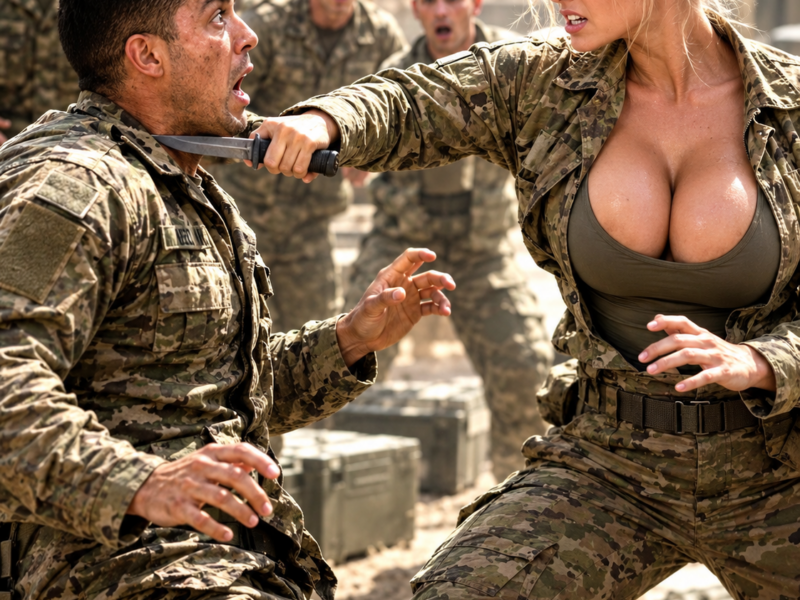
“Three soldiers stepped into the training ring, laughing because they thought the new female recruit would be an easy target
For several seconds, I said nothing.
Major Voss had placed my real identity on his desk, beside a photograph of a woman who was supposed to be missing.
He wanted my handler’s name.
I wanted to know how much he already knew.
“I don’t have a handler,” I said.
Voss gave a short laugh.
“That’s a poor answer.”
“It’s the only one you’re getting.”
His expression hardened.
“Do you know what happened to Lieutenant Sarah Mitchell?”
“I came here to find out.”
“No. You came here because someone told you she was worth finding.”
He tapped the photograph.
“Sarah made a serious mistake. She confused a training program with a criminal conspiracy. She started collecting information she didn’t understand, and people got hurt.”
“Where is she?”
“Safe.”
“Then let me speak to her.”
“Not until you tell me who sent you.”
I looked down at the photograph again.
The handwriting on the back was unmistakably Sarah’s. I’d studied her messages, her reports, even the notes she’d left in the margins of training evaluations.
She had written those six words herself.
MAYA, DON’T TRUST THE MAN WHO SENT YOU.
But there was something else.
The photograph showed Sarah wearing a blue civilian jacket. Her left hand was visible near her waist.
Two fingers were curled inward.
A signal.
Not one I’d learned in basic military training.
It was a field signal used by my former unit.
Two fingers meant: I AM NOT ALONE.
Sarah had been trained by someone who knew our protocols.
And she was trying to tell me something without Voss noticing.
“Major,” I said, “if she’s safe, why are you hiding her?”
Voss closed the folder.
“Because people like you turn every question into an operation.”
He pressed a button on his desk.
The office door opened.
Two armed security personnel entered.
“Escort Lieutenant Collins to temporary quarters,” he said. “She is to remain there until her credentials are verified.”
I stood slowly.
“Am I being detained?”
“You’re being protected.”
“From whom?”
Voss looked directly at me.
“From the people who sent you.”
The guards moved closer.
I allowed them to escort me out.
Fighting my way through the hallway would have accomplished nothing. I needed to know whether Voss was bluffing, whether Sarah was alive, and whether my own agency had been compromised.
The temporary quarters were in an old administrative building behind the training barracks.
The room had a narrow bed, a desk, and a window overlooking the vehicle yard.
One guard stood outside.
The other remained near the entrance.
They took my phone and identification but left my duffel bag.
That was their first mistake.
At 1530, I found a folded note inside the lining of my bag.
I had not put it there.
It contained four words.
ROOM 18. AFTER LIGHTS OUT.
No signature.
I read it twice, then slipped it back into the lining.
At 1900, a meal tray arrived.
At 2100, the hallway grew quiet.
At 2215, I heard three soft knocks.
I opened the door just enough to see Senior Staff Sergeant Coleman standing outside.
He held a maintenance clipboard.
“Your window’s stuck,” he whispered.
“Is it?”
“Has been for years.”
He glanced toward the guard station.
“Room eighteen. Old communications wing. Ten minutes.”
Then he walked away.
I waited until the guard outside changed shifts.
When the footsteps faded, I moved.
The window opened with a slight squeal. I climbed onto the narrow service ledge and dropped into the maintenance passage below.
I reached the old communications wing without being seen.
Room 18 was at the end of a corridor that smelled of dust and electrical insulation.
The door was unlocked.
Sarah Mitchell stood inside.
She looked thinner than in the photograph, and there was a faint scar along her jaw. But she was alive.
For a moment, neither of us spoke.
Then she said, “You shouldn’t have come.”
“I’ve heard that twice today.”
“Then maybe you should start listening.”
I stepped inside.
“Who sent you that photograph?”
“No one. I arranged for it to reach Voss.”
“Why?”
“Because I knew someone would eventually come looking for me. I needed to find out whether the person they sent could be trusted.”
“And you decided to test me?”
“I decided to warn you.”
I held up the photograph.
“Why did you write that message?”
Sarah looked toward the door.
“Because I don’t know whether your handler is still your handler.”
A chill moved through me.
“My handler is Agent Nathan Cole. He’s been overseeing this assignment from the beginning.”
“Then you need to ask him why he authorized your transfer here after my last report.”
I stared at her.
“What report?”
Sarah pulled a small notebook from beneath a loose floor panel.
Inside were dates, names, and short descriptions of incidents involving female recruits.
Several names were familiar.
The three women from my briefing.
But the final page contained something I hadn’t expected.
A list of outside recipients.
One name appeared at the top.
Nathan Cole.
I looked up.
“Why would my handler receive these reports?”
“Because he wasn’t receiving them as an investigator.”
Sarah leaned closer.
“He was receiving them as the person who approved the program.”
I felt the room tilt.
“That’s impossible.”
“I thought so too.”
She turned the notebook toward me.
“Six months ago, I discovered that the injuries and missing personnel weren’t isolated incidents. Certain recruits were being selected for a classified behavioral assessment. They were subjected to unauthorized stress exercises, intimidation, and physical pressure. The stated purpose was to identify people who could withstand hostile interrogation.”
“That doesn’t explain why women disappeared.”
“Some refused to participate. Some reported what happened. Others were transferred to medical facilities under false names.”
“Who ordered it?”
“Voss runs the facility. But he isn’t the person who designed the program.”
I looked at the list again.
“Cole.”
Sarah nodded.
“He helped establish the assessment criteria. Voss turned them into a private training operation.”
“Why would they do that?”
“To sell the results.”
She opened another section of the notebook.
The names of several private defense contractors appeared beside coded payment references.
The program had been presented as a way to test resilience under extreme pressure. In reality, it was generating psychological and physical response data that contractors wanted for interrogation technology and predictive behavior systems.
The recruits had never consented to being test subjects.
And the reports had been falsified to hide the injuries.
“Where are the women now?” I asked.
“Two were transferred to a medical center outside the base. One is being held in a restricted housing unit under a disciplinary order.”
“Sarah, why didn’t you get out?”
“I tried.”
Her voice dropped.
“They caught me before I reached the gate. After that, Voss made sure I couldn’t send another report.”
I studied her face.
“Then why is he keeping you alive?”
“Because I have the original records.”
She reached into her jacket and produced a small storage device.
“The notebook is only a copy. This contains the full assessment data, the medical records, and the payment trail.”
I took it.
“Why didn’t you send it to the inspector general?”
“I did.”
She looked at me.
“Three times.”
“And?”
“The first two reports were closed without investigation. The third disappeared.”
I thought of the encrypted message my handler had sent before the assignment.
DO NOT EXPOSE YOUR TRAINING.
At the time, I had assumed he was worried about my cover.
Now I wondered whether he had been worried about what I might discover.
“Does Voss know you have this?”
“He knows I copied something. He doesn’t know where the original is.”
“Where is it?”
Sarah hesitated.
“Somewhere you won’t be able to reach without help.”
Before I could ask more, a door slammed in the hallway.
Sarah went pale.
“Someone’s coming.”
I put the device inside my sleeve.
“Is there another exit?”
She pointed to a narrow service hatch.
“Through there. It connects to the old vehicle bay.”
I moved toward it.
Sarah caught my arm.
“Listen to me. If Cole contacts you, don’t answer. Don’t explain. Don’t give him a chance to make you believe this is a misunderstanding.”
“What about you?”
“I’ll be fine.”
“That’s not an answer.”
She gave me a tired smile.
“It’s the only one I have.”
The handle outside began to turn.
I climbed through the hatch.
The door opened behind me.
I heard Voss’s voice.
“Lieutenant Mitchell, we need to talk.”
Then another voice.
“Where is Collins?”
Nathan Cole.
My handler.
I froze.
Sarah answered calmly.
“I don’t know.”
Cole laughed.
“You’ve never been good at lying.”
I moved through the hatch and dropped into the vehicle bay.
The service door was locked, but a maintenance cart stood beside it. I used the small metal tool in my boot to release the emergency latch.
Outside, the night air was cold.
I crossed the yard and reached the perimeter road.
My first instinct was to call Cole.
My second was to destroy the phone I no longer had.
I needed an independent channel.
I remembered Rebecca Lawson, an inspector general investigator whose name had appeared in a previous internal case file. She had handled a procurement investigation involving a contractor connected to Fort Redstone.
I didn’t have her number.
But I knew where she worked.
The nearest public phone was inside the base medical building.
I walked there using the maintenance road, keeping away from the main security cameras.
A nurse at the reception desk looked up as I entered.
“Can I help you?”
“I need to make an emergency call.”
“Do you have authorization?”
“No.”
She studied my face.
“Are you injured?”
“Not yet.”
Something in my voice made her reach for the phone.
“Wait here.”
She disappeared through a side door.
A minute later, a doctor came out.
He was in his forties, with a calm expression and a name badge that read DR. SAMUEL ORTIZ.
“Lieutenant Collins?”
I nodded.
“I was told you might come.”
My hand moved instinctively toward my waist.
He noticed.
“I’m not security,” he said. “I’m one of the doctors who treated the women from the assessment program.”
I stared at him.
“You knew?”
“I treated them. I documented their injuries. Then I was ordered to change the records.”
“By whom?”
“Major Voss.”
He lowered his voice.
“I refused.”
“What happened?”
“They removed me from the medical team. I kept copies of the original reports.”
He opened a small office and locked the door.
“Sarah told me you might need help.”
I looked at him.
“You’ve been in contact with her?”
“Not recently. But she left instructions.”
He placed a sheet of paper on the desk.
It contained an address outside the base and a phone number.
“That’s where the two transferred women are staying. They were released from the facility last week under medical supervision.”
“Why weren’t they sent home?”
“Because they were afraid someone would come looking for them.”
I picked up the paper.
“Can you get me to Rebecca Lawson?”
Ortiz nodded.
“I can get you something better.”
He opened a cabinet and removed a sealed envelope.
“Her office issued a preservation request two weeks ago. It was never delivered to the base.”
I opened it.
The document ordered the preservation of personnel records, medical files, and communications connected to the assessment program.
At the bottom was Rebecca Lawson’s signature.
The request had been ignored.
I looked at Ortiz.
“Why keep this?”
“Because I knew one day someone would ask why the records were missing.”
He handed me a secure phone.
“Call her.”
Rebecca answered on the second ring.
“This is Lawson.”
“My name is Maya Collins. I’m at Fort Redstone. I have evidence of an unauthorized assessment program involving service members.”
There was a pause.
“Who gave you my number?”
“Dr. Samuel Ortiz.”
“Is Sarah Mitchell with you?”
“No. She’s still inside.”
“Do not go back for her.”
“She’s in danger.”
“So are you. Listen carefully. I’m sending a federal team to the base. I need you to preserve the device and avoid contact with anyone in the command structure.”
“Your preservation request was ignored.”
“I know.”
“Then how do I know this team won’t be stopped?”
“You don’t.”
Her honesty caught me off guard.
“But I have a federal warrant application ready, and I’m bringing people from outside the military chain of command. You need to stay where you are until they arrive.”
I looked at the door.
“I can’t leave Sarah.”
“Collins, if you go back in there alone, you may become another missing name on that roster.”
I closed my eyes.
Then I heard a crash from somewhere outside.
Ortiz moved to the window.
“Vehicles.”
I stepped beside him.
Two dark SUVs had entered the medical building parking lot.
One stopped near the entrance.
The other blocked the exit.
Ortiz turned off the lights.
“Those aren’t federal vehicles.”
My phone vibrated.
A message had appeared on the screen.
UNKNOWN NUMBER.
WE KNOW YOU HAVE THE DEVICE. COME TO THE TRAINING HALL. ALONE.
I showed Rebecca the message through the secure call.
“Do not move,” she said. “We’re three minutes away.”
A loudspeaker crackled outside.
“Lieutenant Collins, this is Major Voss. Come outside with your hands visible.”
Ortiz looked at me.
“There’s a second exit through the supply corridor.”
I shook my head.
“Sarah is still in the building.”
“Then we need to get help inside.”
The door handle moved.
Someone tried it once.
Then twice.
A voice spoke from the other side.
“Doctor Ortiz, open the door.”
Ortiz looked at me.
“There’s a patient in the examination room.”
“What patient?”
He pointed.
I moved into the adjoining room and found a young woman sitting on the examination table.
She couldn’t have been older than twenty-two.
A hospital bracelet circled her wrist.
Her name was Private First Class Hannah Brooks.
She looked at my uniform and began to cry.
“Please don’t let them take me back.”
I crouched in front of her.
“I’m not going to let anyone take you anywhere without explaining why.”
“They said I was being discharged.”
“Who?”
“Major Voss.”
She gripped my sleeve.
“They said I was going to meet my mother. But I heard them talking outside. They said the transfer had to happen before the inspectors arrived.”
The door shook again.
Ortiz whispered, “We can’t stay here.”
I looked at Hannah.
“Can you walk?”
She nodded.
“Good. Stay behind me.”
We moved into the supply corridor just as the office door opened.
I heard boots and Voss’s voice.
“Find the device. Find Collins.”
The corridor ended at a loading bay.
A delivery truck was parked outside.
Ortiz opened the side door and guided Hannah toward it.
I followed.
Then I saw the driver.
Sergeant Blake Turner.
He looked at me, then at the woman behind me.
For one second, neither of us moved.
Turner slowly lowered the clipboard in his hand.
“Major said you’d be in the medical building.”
“Then you should probably tell him he was right.”
He glanced toward the entrance.
“I’m supposed to take the patient to another facility.”
Hannah stepped behind me.
“I’m not going with him.”
Turner looked at her.
Something changed in his face.
“That’s not what I was told.”
I studied him.
“Who gave you the order?”
“Voss.”
“Did he tell you she was being transferred voluntarily?”
Turner didn’t answer.
“Did you see the medical records?”
He looked down.
“No.”
“Then you’re being used.”
He swallowed.
“I don’t know what’s happening here.”
“Then make a decision.”
A shout came from inside the building.
Turner looked toward the sound.
Then he opened the truck’s passenger door.
“Get in.”
We climbed inside.
He drove us through the service gate, using a route that avoided the main checkpoint.
For several minutes, nobody spoke.
Finally, Turner said, “I saw the reports.”
I turned toward him.
“What reports?”
“The disciplinary files. The injuries. The transfers.”
“Why didn’t you say anything?”
“Because I was told the women were lying.”
“Did you believe that?”
He gripped the steering wheel.
“I wanted to.”
It wasn’t an excuse.
But it was the first honest thing I’d heard from him.
We reached a small service road outside the base.
Rebecca Lawson’s team was waiting near an unmarked vehicle.
Two federal agents approached with their credentials visible.
I handed Rebecca the storage device.
“Original data,” I said. “Sarah Mitchell is still inside. Major Voss and Nathan Cole are looking for her.”
Rebecca immediately radioed the response team.
Then she turned to Turner.
“Sergeant, I need you to tell me everything you know.”
Turner looked at me.
I nodded once.
He began talking.
His statement changed the direction of the investigation.
He identified the officers who had arranged the unauthorized exercises, the contractors who had observed them, and the personnel who had been ordered to alter the training reports.
He also confirmed that Major Voss had told him to intimidate me during the first morning’s evaluation.
The physical confrontation had never been an accident.
It had been a test.
They wanted to see how I reacted under pressure, whether I would expose my training, and whether I would become aggressive enough to justify a disciplinary removal.
The plan had been to discredit me before I could reach Sarah.
The federal team entered Fort Redstone with the warrant shortly after midnight.
They secured the communications wing, the medical building, and the administrative offices.
Sarah was found in Room 18.
She was alive.
Voss was arrested while attempting to leave through a restricted vehicle gate.
Nathan Cole was detained at a federal office two states away after investigators traced his messages to the program’s administrative network.
He insisted he had been conducting a legitimate assessment.
The evidence told a different story.
The storage device contained original medical records, unauthorized surveillance footage, payment records, and internal messages showing that Cole had approved the program’s design.
Voss had expanded it beyond the original authorization, using physical intimidation and falsified disciplinary actions to keep participants silent.
The contractors had paid for access to the data.
They wanted to understand how service members responded to coercion, isolation, and threats.
The program had never been approved for human testing.
And the people subjected to it had never been told they were part of an experiment.
The investigation took months.
Some of the officers cooperated.
Others denied everything.
The contractors tried to argue that the data had been collected as part of routine training.
But the medical records, the altered reports, and the testimony of the women made that defense difficult to sustain.
Cole was charged with conspiracy, obstruction, and misuse of classified information.
Voss faced additional charges related to assault, unlawful detention, and falsification of official records.
The investigation also uncovered evidence that several senior officials had received warnings and failed to act.
Not all of them were charged.
Some retired before the findings became public.
Some lost their positions.
Others were still being investigated when I left Fort Redstone.
Sarah spent weeks recovering.
The two other women were eventually reunited with their families.
Hannah returned to active duty only after a medical review and a choice that was entirely hers.
Dr. Ortiz’s records became a central part of the case.
And Sergeant Turner gave investigators a full statement.
He was disciplined for his role in the intimidation campaign, though his cooperation was considered during the proceedings.
I never became his friend.
But I understood that the first time he had laughed at me, he hadn’t known who I was.
The second time he had raised his fist, he had known exactly what he was doing.
That distinction mattered.
Three months after the arrests, I returned to the training field.
The ring was empty.
A new group of recruits stood in formation nearby.
Their instructor was a woman named Staff Sergeant Coleman.
She noticed me and walked over.
“Agent Collins.”
I smiled faintly.
“I’m back to my real name now.”
She nodded.
“Then welcome back, Lieutenant.”
I looked at the ring.
“Is Turner still assigned here?”
“No. He’s been transferred pending the outcome of his disciplinary review.”
I nodded.
For a while, we watched the recruits practice.
Then Coleman said, “You know, some of them heard what happened.”
“I hope they heard the truth.”
“They did.”
She paused.
“They also heard that you could have hurt Turner much worse than you did.”
I looked at the empty mat.
“I wasn’t there to win a fight.”
“What were you there to do?”
I thought about Sarah’s photograph, the six words written on its back, and the people who had been forced to disappear because they refused to stay quiet.
“I was there to make sure the next woman who reported something wrong didn’t vanish.”
Coleman nodded.
“That sounds like a mission worth finishing.”
A week later, I met Sarah outside the base.
She had returned to civilian clothes and was preparing to give her final statement.
She handed me a folded photograph.
It showed us standing together in front of the training building.
This time, neither of us was hiding.
“You kept it,” I said.
“I thought you should have one without a warning on the back.”
I laughed softly.
Then I noticed the handwriting beneath the photograph.
WE WERE NEVER THE PROBLEM.
I looked at her.
“Did you write that?”
She nodded.
“I wish someone had told us sooner.”
I folded the photograph and placed it in my jacket.
“I think they tried.”
Sarah looked toward the base.
“Do you think things will change?”
“Not because a few people were arrested.”
“Then what?”
“Because the people who were told to stay quiet finally have somewhere to speak.”
She smiled.
For the first time since I had arrived at Fort Redstone, the expression on her face looked unguarded.
When I left the base, I carried no false identification, no hidden device, and no orders to pretend I was someone else.
I had entered as a recruit because the truth had been buried beneath uniforms, rank, and paperwork.
I left knowing that the people who had buried it could no longer pretend it wasn’t there.
And I kept one thing from that assignment.
The photograph Sarah had given me.
Not because it reminded me of the danger.
Because it reminded me that courage wasn’t always the person who could win a fight.
Sometimes it was the person who kept telling the truth after everyone with authority had ordered them to stop.
The end.









