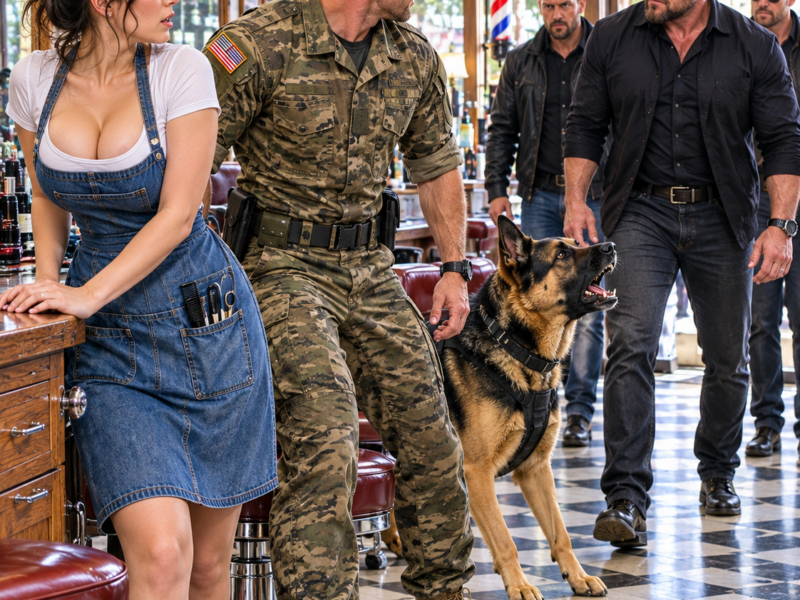
“Three men stormed into my barbershop, threatened to destroy everything, and told me I had one minute to hand over the money
The man outside tapped on the window a third time.
I didn’t move.
Neither did Ranger.
The black SUV idled at the curb, its headlights washing the barbershop in pale light. The man in the dark suit held his leather folder against his side, looking through the glass as though he already owned the building.
Olivia stood behind me, one hand pressed against the counter.
“Marcus,” she whispered, “who are these people?”
I looked at the message on my phone again.
“Walk away from the barbershop, Marcus Reed. We know exactly who you are.”
I had spent enough years in the military to recognize a warning designed to provoke a reaction. Whoever had sent it wanted me frightened, angry, or careless.
I intended to give them none of those things.
“Do you have a back exit?” I asked.
Olivia nodded toward the narrow hallway behind the shampoo station.
“There’s a door that leads to the alley.”
“Good. Keep it locked. And don’t go outside alone.”
“What are you going to do?”
“Find out why they’re so interested in you.”
I called the local police and reported the threats, the property damage, and the men who had demanded money. I gave the dispatcher the SUV’s description and license plate, then asked for an incident number.
The man outside watched me make the call.
His smile faded.
A moment later, he stepped away from the window, climbed into the SUV, and pulled into traffic.
I recorded the direction it traveled before turning back to Olivia.
“You did the right thing,” I told her.
She looked unconvinced.
“Last time I called the police, they came the next day. The men came back that evening.”
“Then we’ll make sure the report includes the threats against your brother and the message I received.”
“You really think a report will stop them?”
“No,” I said honestly. “But it creates a record. And records matter when people try to pretend nothing happened.”
She stared at me for a moment, then nodded.
I helped her sweep up the broken glass. We left the damaged photograph on the counter, carefully separated from the shards, and covered the broken jar with a cloth.
It was nearly closing time, but Olivia didn’t seem ready to leave.
“My brother, Ethan, finishes school at four,” she said. “He’s sixteen. He usually takes the bus to my apartment.”
“Does anyone know his route?”
“The men know where he goes to school.”
“Then call him. Tell him to stay inside the school office until a trusted adult can pick him up. Don’t send him out alone.”
She took out her phone with shaking fingers.
While she called, I looked at the message again and searched my memory for anyone who might have known I was in Savannah.
My military service was no secret, but my current location wasn’t public. I had rented a small apartment under my own name, yet I hadn’t posted about the move or told many people.
Someone had either recognized me or obtained information about me.
Neither possibility was comforting.
When Olivia finished her call, she told me Ethan would remain at school until she arranged a pickup with a family friend.
“Thank you,” she said.
“You don’t need to thank me for that.”
“I do when someone takes my brother’s safety seriously.”
I met her eyes.
“Then let’s make sure he gets home safely.”
The police arrived about twenty minutes later. Two officers took photographs of the damaged counter, the broken frame, and the glass on the floor. One spoke with Olivia while the other asked me to describe the confrontation.
I gave them the facts, avoiding guesses about the men’s motives.
When I showed them the threatening message, the younger officer frowned.
“Do you know who sent this?”
“No.”
“Any idea why they know your name?”
“I’d like to know the same thing.”
He copied the number into his report and asked whether I would be willing to provide the original message if investigators needed it.
“Of course.”
The officers took Olivia’s statement and recorded the demand for five thousand dollars. They also noted her account of the previous threats and the pressure involving her brother.
Before leaving, the older officer handed Olivia a card with a case number.
“If they come back, call us immediately. Don’t confront them yourself.”
Olivia nodded, though I could see that she had heard similar promises before.
After the officers left, I asked her whether she had kept the paperwork connected to her mother’s loan.
She looked toward a small office behind the shop.
“I have everything she left me. Contracts, receipts, letters. I just never understood half of it.”
“Could I take a look?”
She hesitated.
“Why?”
“Because if they’re using a debt to threaten you, the documents may tell us whether the debt is legitimate.”
She studied me, then unlocked the office.
It was a cramped room with a desk, two filing cabinets, and a shelf of old appointment books. A framed photograph of Olivia and her mother sat beside a lamp.
Olivia pulled a thick envelope from a drawer.
“My mother borrowed money to keep the shop open when she started treatment. She wanted to sell the business, but I convinced her we could keep it going. She signed an agreement with a company called Southern Commercial Recovery.”
“Did you ever meet anyone from that company?”
“Only a woman who handled the paperwork. She came twice, and she seemed professional. After my mother died, I received a letter saying the loan had been transferred to another company.”
“Which company?”
“Palmetto Asset Solutions.”
I opened the envelope and looked through the documents.
The original agreement listed a principal amount of twelve thousand dollars. The repayment schedule was clear. The interest rate was high, but the figures were written down.
Then I found the transfer notice.
It referred to a different balance and included a new payment schedule Olivia said she had never agreed to.
A handwritten note in the margin read: REVISED BALANCE — SPECIAL HANDLING.
I turned the page over.
There was a reference number at the bottom, followed by a name.
D. Voss.
I didn’t recognize it, but I photographed the page with Olivia’s permission.
“Did your mother know this debt had been transferred?”
“She received the letter two weeks before she died. She told me not to worry about it because she believed the original payments were enough.”
“Did she make payments after that?”
“I made them. Every month. I have the receipts.”
I compared the dates and amounts.
The payments were real. The receipts matched the bank statements Olivia had kept. Yet the balance on the new schedule had increased despite those payments.
That didn’t prove fraud by itself, but it was a serious discrepancy.
“Keep all of this,” I told her. “Don’t give the originals to anyone who shows up claiming to represent the company. If an investigator needs them, make copies and document what you provide.”
Olivia sat down heavily.
“My mother worked thirty years to build this place.”
“I can see that.”
“She cut hair from this chair until her hands hurt. When she got sick, she still came in because she was afraid the shop would close. And now these people walk in and talk like it belongs to them.”
Her voice broke.
I gave her a moment.
Then I said, “They may want you to believe you have no choices. That doesn’t mean it’s true.”
She wiped her eyes.
“Why are you helping me, Marcus? You don’t know me.”
I considered the question.
“I came here for a haircut. I didn’t expect to watch three men threaten a woman in front of a child. Once I saw what was happening, walking away didn’t feel right.”
“That’s all?”
“That’s enough.”
She looked at Ranger, who had settled beside the office door.
“He hasn’t taken his eyes off you since those men arrived.”
“He’s observant.”
“More observant than most people.”
I smiled faintly.
“Usually.”
That evening, I arranged for a trusted neighbor to accompany Olivia to collect Ethan from school. I followed at a distance in my own vehicle, not because I intended to frighten anyone, but because I wanted to make sure they reached her apartment without incident.
Nothing happened.
Ethan was a slim teenager with his sister’s dark eyes and a quick, guarded way of looking at strangers. He asked who I was, and Olivia explained what had happened at the shop.
“So those guys are coming back?” he asked.
“We don’t know,” she replied.
He looked at me.
“Can you stop them?”
“I can help your sister document what they’re doing and make sure the right people know about it.”
“That’s not what I asked.”
I respected the directness.
“No one can promise you that trouble will never come back. But we can make it harder for those men to hurt your family in secret.”
Ethan considered that answer before nodding.
I stayed only long enough to confirm they were safely inside. Then I returned to my apartment with Ranger and the feeling that I had walked into a problem much larger than a protection racket.
The next morning, I contacted a former military friend who now worked in private investigations. His name was Daniel Brooks. I explained the threats, the suspicious loan transfer, and the message I had received.
I didn’t ask him to do anything illegal or to confront anyone. I asked whether he could recommend a licensed attorney experienced in financial coercion and business disputes.
He called me back an hour later with a name: Rebecca Shaw, a local attorney who handled small-business fraud cases.
I gave Olivia the contact details. She made the appointment herself.
That afternoon, I returned to the barbershop.
Olivia had cleaned the broken glass, repaired the loose counter hinge, and placed her mother’s photograph in a temporary frame. She was cutting a customer’s hair when I walked in.
For the first time since I had met her, she looked as though she had slept.
“You came back,” she said after the customer left.
“I still need a haircut.”
“You’re going to become my most expensive regular.”
“I’ll try not to bankrupt you.”
She smiled, but the expression faded when she noticed my phone.
“Did you hear anything?”
“Not yet.”
I didn’t tell her that I had spent part of the morning checking whether my name or service history had appeared in any public posts connected to Savannah. I found nothing that explained the message.
At four o’clock, a delivery driver brought a large envelope to the shop. It contained no return address, only Olivia’s name printed neatly across the front.
She opened it while I stood beside the counter.
Inside was a single sheet of paper.
FINAL NOTICE. FAILURE TO PAY THE REVISED BALANCE WILL RESULT IN IMMEDIATE ENFORCEMENT ACTION.
Below that was a copy of the revised loan schedule.
The amount demanded was now eight thousand dollars.
Olivia stared at the page.
“They’ve added another three thousand in one day.”
“Don’t call them,” I said. “Let Rebecca review this first.”
She folded the paper, then stopped.
There was writing on the back.
YOUR BROTHER IS OLD ENOUGH TO WALK HOME ALONE. ACCIDENTS HAPPEN.
The room seemed to grow colder.
I took a photograph of the letter and called the police, reporting a new threat against Ethan. Olivia called her attorney’s office and left an urgent message.
This time, the fear in her eyes was different.
“They’re going to hurt him,” she whispered.
“We don’t know that,” I said. “But we’re treating the threat seriously.”
I helped her contact Ethan’s school. They agreed to keep him in the office until his pickup arrangements were confirmed. Rebecca called back within twenty minutes and told Olivia to preserve the envelope, the letter, and all previous correspondence.
She also said she would request a formal review of the debt and advise Olivia on the appropriate legal steps.
It wasn’t an immediate solution, but it was the first time someone had treated Olivia as a person with rights rather than a target who could be bullied into paying.
That evening, as I walked Ranger along the side street behind the shop, I noticed a gray sedan parked across from the alley.
The driver was watching the rear entrance.
I didn’t approach the vehicle. I recorded its license plate from a safe distance and reported it to the officer handling the case.
The sedan drove away before the police arrived.
I was beginning to understand the pattern. The men wanted Olivia to feel watched at all times. They wanted every ordinary sound to become a warning and every unfamiliar face to look like another threat.
Fear was part of the business.
And they were very good at it.
Two days later, Rebecca Shaw met Olivia at the shop. She reviewed the original loan agreement, the transfer notice, the payment receipts, and the two threatening letters.
I sat in the waiting area with Ranger while they spoke privately.
When Rebecca emerged, she looked concerned but composed.
“The transfer documents raise serious questions,” she said. “The balance doesn’t reconcile with the original agreement, and the company has not provided a clear accounting of the payments. I’m sending a formal demand for records and advising my client not to make any additional payment until the claimed balance is properly substantiated.”
“Can they still try to take the shop?” I asked.
“They can threaten many things. Whether they have a lawful basis is another question. We’ll review the contract and any valid security agreement before reaching a conclusion.”
Olivia came out behind her.
For the first time, she seemed to have something solid to hold on to.
“Rebecca says they can’t simply walk in and take the business because they say I owe them money.”
“Correct,” Rebecca said. “But don’t underestimate them. We’ll keep the legal process moving, and you should continue reporting every threat.”
She looked at me.
“And you, Mr. Reed, should avoid direct confrontations. You’ve done enough by helping document what happened.”
“I agree.”
I meant it.
My training had taught me that discipline sometimes meant restraint. There was no reason to turn a legal case into a personal fight.
Unfortunately, the men outside Olivia’s shop had other ideas.
That Friday, Derek returned.
He came alone, carrying no paper and wearing the same gold chain. He walked in shortly after lunch, when the shop was busy.
Olivia stiffened, but she didn’t retreat.
“Your attorney sent us a letter,” Derek said.
“Then you should respond to her.”
He laughed.
“You think a lawyer can protect you?”
“I think the law gives me rights, and I’m entitled to understand what you’re claiming.”
For a moment, Derek looked surprised.
Then he glanced at me.
“You’re still here.”
“I’m getting my haircut.”
“You must really like this place.”
“I do.”
He stepped closer to Olivia’s chair.
“Let’s make this easy. You pay the balance, and we forget all this.”
“There is no verified balance,” Olivia replied. “My attorney has asked for an accounting.”
Derek’s smile disappeared.
“You’re making a mistake.”
“No. I’m asking you to prove what you say I owe.”
The customers had gone quiet. A man waiting near the window took out his phone.
Derek noticed.
“Put that away.”
The customer didn’t move.
Derek reached toward him.
I stood up, placing myself between them without touching Derek.
“Leave him alone.”
Derek looked at me with open hatred.
“You think you’re some kind of hero?”
“No.”
“Then stop acting like one.”
“I’m asking you to leave the customers alone and take your dispute to the attorney.”
He leaned closer, lowering his voice.
“You have no idea who you’re dealing with.”
“Then tell me.”
His eyes flicked toward Olivia, then back to me.
For a fraction of a second, his expression changed. I saw something beneath the anger—not confidence, but fear of someone else.
Then he stepped away.
“This isn’t over,” he told Olivia.
She held his gaze.
“Then talk to my lawyer.”
Derek turned and left.
The customer near the window lowered his phone. Olivia let out a long breath.
“You didn’t have to stand up again,” she said.
“He was reaching for a customer.”
“You could have been hurt.”
“So could he.”
She shook her head, but there was something new in her expression: not relief exactly, but a little less helplessness.
The police took another report and obtained the customer’s video. It showed Derek making threats and reaching toward the man’s phone. The footage did not capture every word, but it supported the accounts of the people inside the shop.
Rebecca added the incident to her records.
That night, I received another message from the same unknown number.
LAST CHANCE. LEAVE SAVANNAH BEFORE YOU LEARN WHAT HAPPENED TO THE LAST PERSON WHO HELPED HER.
I stared at the screen for a long time.
Then I forwarded it to the investigator handling the case.
I did not reply.
The next morning, Rebecca called Olivia with news. Palmetto Asset Solutions had responded to the formal demand, but its accounting contained inconsistencies. Several payment entries were missing, and the company had failed to produce a signed document supporting the revised balance.
Rebecca had also identified a connection between Palmetto and a private firm that handled debt collection for several local businesses.
The firm’s registered manager was listed as Daniel Voss.
The same name I had seen in the margin of the transfer notice.
Olivia looked at the paperwork spread across her desk.
“Who is he?”
Rebecca explained that the company appeared to be connected to the men who had been collecting money, but she cautioned that a name on a document did not prove that Voss had personally ordered the threats. She was checking corporate records and preparing requests for additional documents.
I remembered the man in the dark suit standing outside the shop, holding his folder and smiling through the glass.
I wondered whether that had been Voss.
Before I could say anything, Olivia’s phone rang.
It was Ethan.
He was calling from school to say that a man had approached the front office asking to take him home. The man had claimed to be a family friend, but the school staff had refused to release him because he wasn’t on the approved pickup list.
The man had left without causing a scene.
Olivia went pale.
“Did he say his name?” she asked.
Ethan didn’t know.
“Did you recognize him?”
“No. He said you were waiting outside.”
Olivia thanked him for calling and told him to remain with the office staff until she arrived.
I was already reaching for my keys.
We drove to the school together, with Rebecca calling the police to report the attempted pickup. When we arrived, Ethan was waiting in the main office with a staff member.
He looked frightened but unharmed.
Olivia wrapped her arms around him.
“I’m sorry,” she whispered.
“You didn’t do anything,” Ethan said, though his voice shook.
I spoke with the school administrator and made sure the incident was documented. The staff provided a description of the man and confirmed that he had shown no valid identification.
A patrol officer arrived to take a report.
The attempted pickup changed everything.
Until then, the men had relied on intimidation, property damage, and threats. Now someone had tried to gain access to a teenager by pretending to have permission from his family.
The police took the matter seriously.
They reviewed the school’s visitor records and requested available security footage. Rebecca advised Olivia to keep Ethan’s school and pickup information private and to notify the school in writing about who was authorized to collect him.
Olivia was shaken, but she followed every instruction.
That evening, she sat in the shop after closing, staring at her mother’s photograph.
“I wanted to believe if I paid them enough, they would leave us alone,” she said. “I thought I could protect Ethan by keeping my head down.”
I sat opposite her.
“People who use fear to collect money often make you think there’s a price that will buy peace. But if they can keep changing the price, there’s no end to it.”
She looked up.
“What if they really do hurt him?”
“We keep taking the threats seriously, we work with the police, and we don’t let them isolate you. You have your attorney, the school has a record, and the investigators have evidence. You’re not handling this alone anymore.”
She nodded, though the worry remained.
The following week, the investigation moved quickly.
The police obtained the SUV’s registration records and identified the man in the dark suit as Daniel Voss. He was a director of Palmetto Asset Solutions and had a history of complaints involving aggressive debt collection, though the earlier complaints had not resulted in charges.
The evidence from Olivia’s shop, combined with the school report and the threatening messages, gave investigators grounds to seek additional records and interview the people involved.
Derek and the two men who had entered the shop were identified. One of them, the younger man in the red jacket, was recorded on a nearby business camera threatening a shop owner on the same street. Another business owner came forward after learning that Olivia had reported the incidents.
The pattern was becoming clear.
Several small businesses had been pressured to pay debts that changed without explanation. In some cases, owners had received letters from companies they had never dealt with. In others, collectors had threatened to damage property or embarrass family members.
Not every claim was necessarily false, and the investigators treated each account separately. But the documents and witness statements suggested that the same group had been using questionable debt transfers to demand money beyond what some business owners believed they owed.
Olivia’s case was no longer an isolated dispute.
Rebecca helped her submit a formal complaint and challenge the balance through the appropriate legal channels. She also arranged for the original documents to be copied and preserved.
I continued to help Olivia with practical matters—repairing the damaged counter, replacing the cracked frame, and making sure the shop had working cameras at the entrances. I didn’t install anything secretly or attempt to track the men. We used ordinary security measures and shared relevant information with the police.
Ranger became a familiar presence at the shop. Customers began bringing him treats, and the little boy who had cried during the first confrontation returned with his father. He asked if Ranger could sit beside his chair while he got a trim.
“Only if you promise not to pull his ears,” I told him.
“I won’t!”
Ranger lay quietly beside him, accepting a careful pat on the shoulder.
Olivia watched from behind her chair.
“You know,” she said, “when those men first came in, I thought the shop was finished.”
“It isn’t.”
“No. It isn’t.”
For the first time, she said it without sounding as though she was trying to convince herself.
The decisive break came when investigators searched the offices connected to Palmetto Asset Solutions under a court-authorized warrant. They recovered payment records, copies of loan transfers, internal messages, and a list of businesses targeted by the collection team.
Some records supported legitimate debts. Others showed unexplained adjustments and instructions to continue demanding payment even when the original balance had been disputed.
The messages also revealed that Voss had been communicating with Derek about Olivia’s shop. He had known about the pressure tactics and had approved further visits after Olivia asked for proof of the revised amount.
The evidence did not establish that Voss had personally sent every threatening message, but it connected him to the operation and the decision to continue pursuing Olivia after the threats began.
Investigators also recovered communications referring to my military background and instructing the men to identify me before approaching the shop again. That explained how they had known my name.
Someone had recognized me from a public photograph associated with my previous service. The information was not classified, but it had been gathered and used to intimidate me.
I learned that detail from the investigator several days later.
“You were never the original target,” she said. “They became concerned when you intervened and started asking questions.”
“So they tried to scare me away.”
“That appears to be what happened.”
“Did they know anything else about me?”
“We found no evidence that they had access to restricted military information. At this stage, it looks like they used publicly available details and information they gathered locally.”
I was relieved, but not surprised. People who wanted to appear powerful often relied on the fear their threats created. The truth was usually less mysterious than they wanted their targets to believe.
Derek was arrested after investigators collected evidence connected to the threats and attempted intimidation. The other two men were also charged in connection with their roles. Voss was arrested after the financial records and internal messages were reviewed by prosecutors.
Their cases proceeded separately, and the charges against each man reflected the evidence that could be established. I gave a statement about what I had witnessed in the shop, the messages I had received, and the incidents that followed.
I did not exaggerate what I knew.
I had not seen Voss order anyone to threaten Ethan. I had not been present when the men discussed their plans. I told investigators what I had directly observed and provided the messages and photographs I had preserved.
The rest was their job.
Months passed before the legal process reached its conclusion. During that time, Rebecca challenged the claimed balance on Olivia’s behalf. Palmetto failed to substantiate several of the added charges, and the dispute was resolved without Olivia having to pay the inflated amount the collectors had demanded. The original loan records and payment receipts were central to that outcome.
The criminal case also exposed the collection operation’s methods. Voss and the men involved faced consequences through the court process, and restrictions were placed on the business activities connected to the unlawful conduct. The final outcomes varied according to each person’s role and the charges proven.
Olivia kept Harper’s Barbershop.
She didn’t become rich overnight, and the months of fear did not disappear simply because the men were arrested. She still had bills to pay, customers to keep, and a business to rebuild.
But she had something the men had tried to take from her.
The ability to make decisions without someone standing over her and demanding money.
The first time she reopened the shop after the main arrests, she placed her mother’s restored photograph on the counter. The frame was new, but the picture was the same: two women smiling in front of the business they had built together.
She invited me to come in before opening.
“I want you to have the first haircut,” she said.
“I’ve been paying for haircuts here the whole time.”
“This one’s free.”
“I don’t know. That sounds suspicious.”
She laughed.
For a moment, the shop sounded like it had before the men came through the door.
Ranger settled in his usual place near the window. Sunlight fell across his back, and the bell above the door rang as the first customer arrived.
Olivia looked around the room.
“I used to think being strong meant handling everything by myself,” she said. “I didn’t want anyone to know how scared I was.”
“Being strong doesn’t mean you never need help.”
She nodded.
“I’m learning that.”
A few weeks later, Ethan came into the shop carrying a paper bag. Inside was a small dog biscuit he had bought for Ranger with his own money.
“For the best security guard in Savannah,” he announced.
Ranger accepted the treat gently.
“Don’t let it go to his head,” I said.
“It’s too late,” Olivia replied. “He already knows he’s the boss.”
We laughed, and Ethan went back to helping his sister arrange the waiting chairs.
I eventually finished my haircut and paid for it anyway. Olivia protested, but I insisted. She had worked too hard to rebuild the business for me to treat her labor as charity.
Before I left, she walked me to the door.
“Do you ever wonder what would have happened if you’d just walked out that first day?” she asked.
“Sometimes.”
“What do you think?”
I looked back at the chairs, the clean counter, and her mother’s photograph.
“I think you would have kept fighting. You were already doing that before I arrived.”
She shook her head.
“Maybe. But I wouldn’t have known where to start.”
“You started by telling the truth.”
That seemed to stay with her.
I stepped outside with Ranger beside me. The street was busy with ordinary life. A delivery van pulled up to the bakery next door. Someone waved from across the road. The shop windows reflected the afternoon sun.
There was no black SUV waiting at the curb.
No man in a dark suit tapping on the glass.
No message warning me to leave town.
The threats had not been imaginary, and the outcome had not been guaranteed. It had taken records, witnesses, legal help, police work, and Olivia’s determination to make the truth visible.
My military training had helped me remain calm when the men tried to intimidate her. Ranger’s alertness had helped me notice the danger before it escalated. But neither of us could have solved the problem alone, and brute force would never have corrected a fraudulent balance or protected a small business in the long term.
What mattered was that Olivia had refused to surrender her shop, her family, or her right to ask for proof.
I had come to Savannah looking for a quiet place to get a haircut.
Instead, I had witnessed what happens when people mistake fear for power—and what happens when the person they expect to break decides to stand her ground.
As I walked away, Ranger glanced back toward the barbershop.
Through the window, Olivia was helping a young customer choose a style. She was smiling again, and the photograph of her mother stood safely behind the counter.
I rested a hand on Ranger’s head.
“Come on, buddy. Let’s leave her to her work.”
He fell into step beside me.
Behind us, the bell above Harper’s Barbershop rang again, welcoming another customer inside.
This time, nobody was afraid to walk through the door.
The End.









