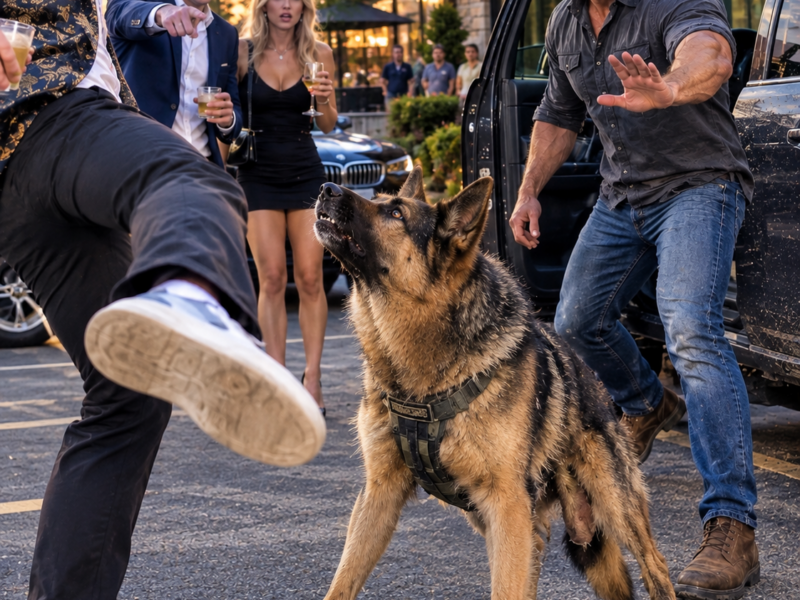
“Three drunk rich kids laughed as they kicked my limping military dog outside a waterfront restaurant in Virginia Beach
The man in the dark suit stopped six feet from my truck, looked at Ranger, and smiled as if he had just found something he had been searching for.
“Daniel Brooks,” he said. “I was hoping we could have a private conversation.”
I kept one hand on Ranger’s collar and the other near the truck door. The three young men stood behind him, suddenly sober. The tallest one had stopped laughing. The second kept glancing toward the black SUV. But the youngest—the one who had recognized Ranger—was staring at the ground as though he wished it would open beneath him.
“Funny,” I said. “I was hoping you’d explain why those boys thought it was acceptable to kick an injured military dog.”
The man’s smile barely moved.
“Boys make mistakes when they drink.”
“Dogs get hurt when men make excuses.”
Ranger pressed his shoulder against my leg. He was seven years old, retired from service, and had spent years learning to recognize danger before I could see it myself. His ears were forward. His body was still. That was enough for me.
The man noticed.
“Your dog has always been unusually protective.”
I felt the temperature drop inside my chest.
“Always?”
He had said too much.
“Who are you?” I asked.
“Richard Voss. I represent the families of the young men involved. We’d like to compensate you for the inconvenience.”
I looked down at Ranger’s trembling hind leg.
“Inconvenience?”
Voss opened a leather folder and pulled out an envelope.
“Five thousand dollars. Enough to cover veterinary expenses, a new kennel, whatever you need. In exchange, everyone goes home, and this unfortunate incident stays private.”
The tallest young man let out a nervous breath, as if the problem had finally been solved.
I didn’t take the envelope.
“Put it away.”
Voss’s expression hardened for the first time.
“Mr. Brooks, I don’t think you understand the situation.”
“No,” I replied. “I think I understand it perfectly. Three drunk men assaulted an injured veteran, and now somebody with a lawyer’s smile is trying to purchase silence.”
“Ranger is a retired working dog,” Voss said quietly. “His records are complicated. You may want to be careful about making accusations.”
That sentence landed harder than the kicks had landed on Ranger.
Complicated records.
I had heard those words before, three years earlier, when I’d asked why certain documents from our final deployment had disappeared.
I looked at the youngest boy.
“What did you mean when you said you weren’t supposed to touch him?”
His lips parted, but Voss turned sharply.
“Ethan. Don’t.”
So the boy had a name.
Ethan looked at the man, then at Ranger. His face had gone pale.
“He’s the dog from the photograph,” he whispered.
“What photograph?”
“The memorial one. Chesapeake. The Navy corpsman. You were standing beside him.”
I remembered the photograph. It had been taken three years earlier at a memorial service for Petty Officer First Class Lucas Bennett, a corpsman who had saved two men during a mission and never made it home himself. Ranger had stood beside me in his old working harness, his muzzle gray around the edges, his eyes fixed on the flag-draped casket.
The local paper had published the image the following morning.
But that still didn’t explain why a drunk kid had recognized my dog.
Ethan swallowed.
“My father showed us another picture. He said if we ever saw this dog, we were supposed to call him immediately.”
Voss stepped forward.
“That is enough.”
I moved between him and the boy.
“Why?”
“Because you’re frightening them,” Voss snapped.
“No. You’re frightening them.”
For one brief second, nobody moved.
Then Ethan did something I hadn’t expected. He reached into his jacket and pulled out a phone.
“I recorded it,” he said.
The tallest boy grabbed for his wrist.
“Are you insane?”
Ethan jerked away.
“I recorded everything. The dog. The kicks. What you said about making him bark.”
The second boy cursed under his breath.
Voss’s face changed completely.
“Give me the phone, Ethan.”
“No.”
It was a small word, but the first honest one I had heard all night.
Voss reached for him.
Ranger growled.
The sound rolled out of his chest, low and controlled. Voss stopped with his hand suspended in the air.
I didn’t need to raise my voice.
“Take one more step toward that boy, and we’ll have a very different conversation.”
For several seconds, the only sound was traffic rolling along the wet road.
Then Voss slowly lowered his hand.
“This is a family matter,” he said.
“Then handle it with your family. You’re on a public sidewalk, and your friends just assaulted my dog.”
I took out my phone and called the police.
Voss didn’t try to stop me. Instead, he watched me with the cold patience of someone who believed he could still control the outcome.
That worried me more than his threats.
While we waited, I crouched beside Ranger. He had stopped growling, but his breathing was shallow. His left hind leg trembled whenever he tried to shift his weight.
“Easy, buddy,” I whispered.
He leaned his head into my palm.
I had seen that look in combat zones, in shattered buildings, and beside men who insisted they were fine when the blood on their clothes said otherwise.
Ranger was trying to hide his pain from me.
That hurt more than anything those boys had done.
When the officers arrived, the three young men began talking at once. They described it as a joke, an accident, a misunderstanding. Voss introduced himself as a representative of their families and offered to arrange immediate payment for veterinary treatment.
One officer looked at the envelope.
“Sir, did you offer him money in exchange for not reporting an assault?”
Voss closed his folder.
“I offered to resolve a misunderstanding.”
The officer wrote something in his notebook.
“Then you won’t mind explaining that downtown.”
The second officer knelt near Ranger without touching him.
“Can you get him to an emergency vet?”
“I can,” I said.
“Go. We’ll take statements from everyone.”
I started toward the truck, but Ethan stepped in front of me.
“Please,” he said. “You have to listen to me before they take me home.”
Voss turned toward him.
“Ethan, get in the vehicle.”
The boy flinched.
That tiny reaction told me more than any confession could have.
I looked at the officer.
“He says he has evidence. Can he give you his statement here?”
“Of course,” the officer replied. “Ethan, you can speak to us separately.”
Voss’s jaw tightened.
For the first time, I saw fear in his eyes.
Not fear of me.
Fear of what Ethan might say.
I loaded Ranger into the truck as gently as I could and drove straight to the emergency veterinary hospital. Every red light felt like a personal insult. Ranger lay across the back seat, his muzzle resting on the blanket I kept there for him.
At one intersection, he lifted his head and looked at me in the mirror.
“I know,” I said. “We’re almost there.”
His tail moved once.
That was all I needed.
The veterinarian, Dr. Priya Shah, met us at the entrance. She had treated Ranger twice before, once for a torn paw pad and once for an infection he had stubbornly tried to ignore.
She took one look at his leg and called for a technician.
“We’re going to examine him and get some images,” she told me. “I need you to wait outside the treatment area.”
I hated those words.
Wait outside.
In the military, waiting outside a room where someone you loved was hurt was sometimes harder than going into danger yourself.
I sat in a plastic chair beneath a clock that seemed determined to move backward. My hands smelled of wet fur and the faint metallic scent of blood. I kept seeing the same image: Ranger trying to stand while three young men laughed.
I had trained myself not to dwell on anger. Anger made you careless. It made you miss details.
So I focused on details.
The oldest boy had kicked Ranger first. The second had laughed and encouraged him. Ethan had stood apart, laughing at first, but stopped when Ranger tried to crawl away. Then Ethan had said something I couldn’t hear clearly before the second boy shoved him backward.
And Voss had arrived too quickly.
He had known Ranger’s name before I said it. He had known my name. He had brought an envelope already prepared.
This wasn’t an ordinary drunk-driving-home kind of mess.
My phone vibrated.
An unknown number had sent a text.
Stop asking questions about the dog.
I stared at it for several seconds, then took a screenshot and forwarded it to the officer who had given me his card.
A second message arrived.
You have already lost enough people, Daniel. Don’t make this worse.
My fingers went cold.
I had heard that phrasing before.
Not the exact words, but the same message hidden underneath them: We know what you care about. We know how to hurt you.
Three years earlier, after Lucas Bennett’s death, I had filed a report about discrepancies in the mission records. Equipment had failed at a critical moment. The official investigation had blamed bad luck and incomplete intelligence.
I had never believed the explanation.
Two weeks after I questioned it, my request for additional records was denied. A month later, I was told the matter had been closed.
Then Ranger retired.
I took him home, told myself that leaving the service meant leaving those unanswered questions behind, and tried to build a quiet life around a dog who had earned one.
Apparently, somebody hadn’t forgotten us.
Dr. Shah emerged from the treatment area just before midnight.
“Ranger has significant bruising and swelling around his left hind leg,” she said. “We’re seeing a soft-tissue injury, but the X-rays don’t show a new fracture. Given his history, I’m concerned about aggravating an old injury. We’re treating his pain and keeping him under observation.”
“Will he walk again?”
“He should be able to walk, but he’ll need rest and careful rehabilitation. I can’t promise how quickly he’ll recover.”
I nodded, forcing myself to accept what I could control.
“Can I see him?”
“Briefly.”
Ranger was lying on a padded bed with a blanket over his back. His eyes brightened when I entered, and he tried to lift his head.
“Don’t you dare get up,” I told him softly.
I sat beside him and rested my forehead against his.
“I’m sorry, old man.”
He licked my wrist.
That was Ranger. He had never understood apologies. He understood that I was there, and that was enough.
When I returned to the waiting room, a police officer was standing by the entrance. It was the younger of the two officers from the restaurant.
“Mr. Brooks? Ethan has given us a statement. He asked whether you’d speak with him.”
“Is he still there?”
“He’s at the station with his mother. She’s cooperating. His father has not been contacted yet.”
“Why not?”
The officer hesitated.
“Because Ethan told us something that may be connected to a larger investigation.”
He handed me a card.
“Detective Marisol Vega would like to meet you tomorrow morning. She’s investigating allegations of stolen military equipment and falsified contracts. Your name came up in an older report.”
I took the card.
“What does this have to do with Ranger?”
“That’s what we’re trying to establish.”
The next morning, I left Ranger resting at home with medication, water, and a neighbor who had volunteered to check on him. He watched me from his bed, ears raised, as if he knew I was going somewhere dangerous.
“I’m not going far,” I promised.
He blinked slowly.
I had learned that dogs could forgive you for leaving, but they never stopped noticing when you did.
Detective Vega met me in a plain conference room at the police station. She was in her forties, with tired eyes and a voice that suggested she had little patience for theatrical explanations.
She slid a photograph across the table.
It showed a younger Ranger beside a military transport vehicle. His working harness was clearly visible, and a numbered equipment tag hung from the strap.
I recognized the image immediately.
It had been taken during our final deployment, shortly before the mission that killed Lucas.
“Where did you get this?” I asked.
“From a private contractor’s archive. The same company that supplied equipment to your unit.”
She placed another photograph beside it.
This one showed Ranger beside me at the Chesapeake memorial.
“The company has been tracking the dog for years,” she continued. “We believe someone thought he might lead them to missing records.”
I looked at the images again.
“Ranger can’t lead you to records. He’s a dog.”
“Of course. But animals are sometimes present when their handlers aren’t aware of what’s being recorded. His harness may have carried a device during your deployment.”
I stared at her.
“His harness was standard issue.”
“According to the official records, yes. But the contractor’s internal documents refer to a modified harness assigned to your unit. The serial numbers don’t match.”
A memory surfaced: a technician insisting that Ranger’s harness needed to be replaced before our final patrol. He had taken the old one away and returned a new harness the following day. I had checked the buckles and stitching, tested the fit, and moved on. We had been preparing for an operation with too many unknowns and too little time.
I had never thought about that harness again.
“Are you saying someone put a recording device on my dog?”
“We’re investigating that possibility. We don’t know whether a device was installed, whether it was used, or whether any evidence still exists.”
“And the boys?”
“Two of them are sons of executives connected to the contractor. The third is Ethan Vale, whose father is the company’s chief financial officer.”
The pieces began to settle into place.
“Why would they kick him?”
Vega folded her hands.
“Ethan says his friends were trying to provoke the dog. They had been told that if Ranger reacted aggressively in public, someone would use the incident to petition for his seizure as a dangerous animal. That would place him in custody while a private veterinary examiner evaluated him.”
I felt sick.
“They wanted to take him?”
“We have messages suggesting that was the plan. Ethan says he didn’t understand what was happening until the other two began hurting Ranger. He also claims his father told him that the dog was connected to a missing file.”
“Did he show you the messages?”
“He did. We’re verifying them.”
I stood up and paced to the window.
“They kicked a wounded dog to create a legal excuse to seize him.”
“That is what the evidence appears to suggest.”
“And Voss?”
“Richard Voss represents the contractor and several executives. He was at the restaurant because he expected the boys to contact him if the situation developed as planned.”
I turned back.
“Then why did he try to pay me off?”
“Because you called the police before he could control the narrative.”
For a moment, neither of us spoke.
Then Vega opened a folder and showed me a document with redacted names and a series of equipment numbers. One of them matched the tag on Ranger’s old harness.
“We have reason to believe the contractor falsified maintenance records and sold equipment intended for military use. The missing file could establish who approved the changes and who knew the equipment was unreliable.”
“And Lucas?”
Vega didn’t look away.
“His death may have been linked to the equipment failure you reported. We cannot establish that yet.”
I sat down slowly.
For three years, I had lived with the official explanation because I had no evidence strong enough to challenge it. I had carried guilt that belonged to a complicated chain of decisions, failures, and unanswered questions.
Now a detective was telling me that the truth might have been buried deliberately.
“What do you need from me?”
“Anything you remember about the harness, the equipment exchange, and your final mission. And if you still have Ranger’s old gear, don’t alter it. We may need to examine it.”
“I kept everything,” I said. “The harness, his working vest, the old leash. All of it.”
Vega nodded.
“Good. Don’t hand it to anyone except our evidence team. We’ll arrange a documented collection.”
Before I left, she asked one final question.
“Did Ranger ever react strangely to a particular person after he retired?”
I thought about it.
“Once. About a year ago, a man came to my house claiming he was conducting a survey for veterans’ services. Ranger wouldn’t let him near the porch. I assumed the man smelled unfamiliar.”
“Do you remember his name?”
“No. He never gave me a card.”
Vega wrote something down.
“Please contact me if he returns.”
When I got home, Ranger was lying in the sun near the living room window. His injured leg was wrapped, and he had barely touched his food. But when I knelt beside him, he lifted his head and pressed his nose into my chest.
“I’m here,” I whispered.
For a while, I forgot about the contractor, the missing records, and the message on my phone. There was only the dog who had followed me through danger and then spent three years helping me learn how to live without it.
That afternoon, Ethan called.
Detective Vega had arranged the conversation with his mother’s permission. He sounded younger than he had at the restaurant, and much less certain of himself.
“I know you probably hate me,” he said.
“I don’t know you well enough to hate you.”
“I laughed when they started. I didn’t stop them. I just stood there.”
“That’s true.”
He went quiet.
“I keep thinking about it. He was trying to get away, and they kept following him.”
I looked at Ranger, who was asleep with his nose tucked beneath his paw.
“Then remember it honestly,” I said. “Don’t turn yourself into a hero because you finally did one right thing. But don’t pretend you can’t do better from here.”
“I have the video,” Ethan said. “And messages from my father. He told me to make sure the dog was identified before anyone called the police. I didn’t know why until last night.”
“Have you given everything to the detective?”
“Yes.”
“Then keep cooperating. Tell the truth, even when it makes you look bad.”
“I will.”
He hesitated.
“Mr. Brooks, I think my father knew about the mission.”
I didn’t answer immediately.
“What makes you say that?”
“I found an email on his laptop months ago. It mentioned a failed field test, a handler, and a dog. It said the report needed to be corrected before a review. I didn’t understand it then.”
“Did you save it?”
“I took a picture of the screen. I thought it was something I could use if my father ever tried to blame me for something.”
I closed my eyes for a moment.
“Send it to Detective Vega. Don’t send it to me. Let her preserve it properly.”
“I already did.”
“Good.”
He took a shaky breath.
“I’m sorry about Ranger.”
“Be sorry enough to make sure it doesn’t happen again.”
After the call, I sat with Ranger until he woke. I offered him water and helped him stand long enough to take a few careful steps outside. His leg was stiff, and he leaned against me, but he made it to the grass.
He looked up at me as if waiting for a command.
“No mission today,” I told him.
His tail moved once.
For the next two weeks, Detective Vega and her team worked quietly. They collected Ranger’s old equipment, photographed every buckle and tag, and documented the harness exactly as I had stored it. I gave them my memories of the final mission and the equipment exchange, including details I had dismissed as ordinary at the time.
I didn’t chase suspects or try to conduct my own investigation. I had spent enough years learning that evidence could be destroyed by good intentions as easily as by bad ones.
Instead, I focused on Ranger’s recovery.
We took short walks, rested often, and practiced the simple exercises Dr. Shah prescribed. Some days he managed the length of the driveway. Other days, he stopped halfway and leaned against my leg.
I never rushed him.
Then, one cold Thursday morning, Detective Vega called.
“We’ve obtained a warrant,” she said. “The contractor’s offices are being searched. Investigators found internal emails, altered equipment logs, and a payment trail that appears to connect the company to the false maintenance reports.”
“What about Lucas?”
“We found documentation showing that the equipment failure was reported before the mission. The warning was marked as resolved, but the supporting inspection was never completed. We’re still investigating who authorized that change.”
I gripped the edge of the kitchen counter.
“So the report was falsified.”
“The evidence strongly suggests it. We need to establish individual responsibility before making final conclusions.”
“And Ethan’s father?”
“He’s cooperating through his attorney. His messages and the documents from his laptop are important, but we’re verifying everything independently.”
I looked toward the living room, where Ranger lay beside the window.
“Will this clear my report?”
“It will support the concerns you raised. There will be a formal review of the original investigation.”
I thanked her, then stood very still in my kitchen.
I had imagined this moment many times over the years. In some versions, I was furious. In others, I felt vindicated.
In reality, I felt exhausted.
Justice, I was learning, rarely arrived like a door being kicked open. It came in files, interviews, warrants, and people finally being willing to say what they knew.
Three days later, I received a call from Lucas Bennett’s sister.
Her name was Anna. She had contacted me once after the memorial, but we had not spoken in years.
“I heard they’re reopening the investigation,” she said. Her voice trembled. “Is it true?”
“It is.”
“Does that mean Lucas might not have died because someone made a mistake?”
I chose my words carefully.
“It means there is evidence that warnings were ignored and records were falsified. The investigation is still ongoing, but your brother deserved the truth, and they’re finally looking at it.”
She began to cry quietly.
“I just want to know that he wasn’t forgotten.”
“He wasn’t,” I said. “Not by me.”
After we hung up, I sat beside Ranger and let the weight of three years settle over me. He placed his head on my knee. I stroked the gray fur around his ears and remembered Lucas laughing when Ranger stole a sandwich from his pack, then pretending to be offended when the dog refused to give it back.
For the first time in a long while, the memory didn’t end with the mission.
It ended with Lucas smiling.
The case took months, not days. Investigators confirmed that maintenance warnings had been improperly closed and that contractor executives had concealed information about defective equipment. Several people faced criminal charges related to fraud and evidence tampering. The inquiry into the mission itself continued under military review, and I was called to testify about the warnings I had reported.
The evidence did not answer every question, and it did not bring Lucas home. But it established that the concerns I had raised were real and deserved to be investigated.
Richard Voss was charged with attempting to interfere with the investigation and with other offenses supported by the evidence. The three young men faced consequences for their part in the assault. The two who had kicked Ranger were ordered to complete court-supervised programs and pay restitution as part of their resolutions, while Ethan cooperated with investigators and accepted responsibility for his own conduct.
Ethan later sent me a letter. It wasn’t polished, and it didn’t ask me to forgive him.
He wrote that the worst part of that night wasn’t the police or the charges. It was remembering how easy it had been to laugh when everyone else was laughing.
I kept the letter in a drawer, not because it erased what he had done, but because it reminded me that accountability meant more than being caught.
It meant changing what you did when nobody was watching.
By spring, Ranger could walk comfortably again. He still had a slight stiffness in his left hind leg on cold mornings, and Dr. Shah told me to keep his exercise moderate. He seemed perfectly content with that arrangement.
His favorite place became the patch of sunlight beside my living room window. From there, he could watch the neighborhood, supervise my coffee, and bark at delivery trucks as if national security depended on it.
One afternoon, I took him back to the waterfront restaurant.
I had avoided the place for months, but the weather was clear, the air smelled of salt, and Ranger had been restless all morning. We sat at an outdoor table with a bowl of water at his feet.
A little girl walking with her grandfather stopped at a respectful distance.
“Is he a soldier dog?” she asked.
“He was,” I said. “He helped keep people safe.”
She looked at the old scar on his shoulder.
“Was he brave?”
I glanced down at Ranger. He was watching a gull attempt to steal a French fry from a nearby table.
“He was brave,” I said. “But being brave doesn’t mean you never get hurt. It means you keep going, and you let people help you when you need it.”
The girl considered that seriously, then gave Ranger a small wave.
He wagged his tail.
After she left, I rested my hand on his back and watched the boats move across the water.
I thought about the night the boys had laughed, the man who had tried to buy my silence, and the truth that had waited years for someone to look closely enough.
I thought about Lucas, whose name would no longer be buried beneath a report that told only half the story.
And I thought about Ranger, who had never asked for recognition, payment, or revenge. He had only needed someone to stand between him and the people who believed they could hurt him without consequences.
I had spent much of my life believing that protecting others meant being the strongest person in the room.
Ranger had taught me something different.
Sometimes protection meant staying beside someone who couldn’t explain what had happened to them. Sometimes it meant refusing an envelope, making a phone call, or telling a frightened young man to speak the truth even when it cost him.
And sometimes it meant kneeling beside an injured old dog, placing your hand on his shoulder, and promising him that he would never have to face the world alone.
Ranger lifted his head and nudged my palm.
“Ready to go home, buddy?”
He stood carefully, leaned against my leg for a moment, then took his first step toward the truck.
I walked beside him.
This time, nobody was watching from a black SUV. Nobody was waiting to seize him. Nobody was asking us to stay quiet.
There was only the sound of the water, the wind off the Chesapeake, and the steady rhythm of Ranger’s paws against the pavement.
For three years, I had carried the weight of questions that no one seemed willing to answer.
Now I understood that the truth could take time, and that justice did not always look like victory.
Sometimes it looked like a report finally corrected.
Sometimes it looked like a family learning the truth about the person they had lost.
And sometimes, if you were lucky, it looked like an old war dog walking home beside the person who had promised to protect him.
Ranger climbed into the truck, settled onto his blanket, and rested his head against the seat.
I closed the door gently.
“Home,” I told him.
And for the first time in years, the word felt like enough.
The end.









