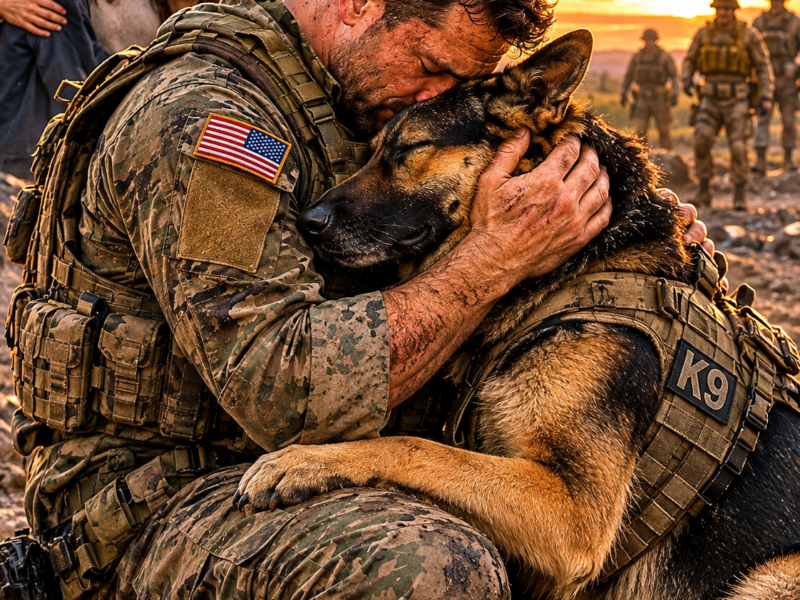
“They told me I was lucky to be alive. They said my partner had done something extraordinary that night
The morning after I woke up, I finally understood that surviving wasn’t the same as being saved.
My body was healing. The doctors said the surgery had gone well, my blood pressure was stable, and I would probably make a full recovery.
But every time I closed my eyes, I saw Rex lying on the warehouse floor.
I remembered his injured legs struggling to pull me across the concrete. I remembered the blood on his fur. Most of all, I remembered the way he had looked at me when I reached for his paw.
He hadn’t been afraid of dying.
He had been afraid of leaving me.
And I hadn’t been able to save him.
For three days, I had held on to the hope that someone would tell me there had been a mistake. Maybe Rex had been transferred to another veterinary hospital. Maybe he was recovering somewhere, waiting for me to come and bring him home.
But Captain Miller had already given me the truth.
My partner was gone.
I lay in the hospital bed, staring at the ceiling, when Sarah gently placed a glass of water beside me.
“You need to drink something.”
I shook my head.
“Daniel, please.”
“I keep thinking I should have done something.”
She sat beside me.
“You were shot. You couldn’t move.”
“I should have pulled him away.”
“How?”
“I don’t know. I should have done something.”
Sarah took my hand.
“You didn’t abandon him. You were unconscious. Rex knew you loved him.”
I looked toward the bedside table.
His collar was still there.
I reached for it and ran my fingers over the worn leather. The metal identification tag moved slightly, making a small sound.
For six years, that sound had meant Rex was nearby.
Now it was the only sound I had left.
A little later, Captain Miller returned.
He was carrying a small evidence envelope and a folder.
“Daniel, I spoke with the investigation team. They finished examining the equipment recovered from Rex’s harness.”
I looked at him.
“Is this what you mentioned yesterday?”
He nodded.
He placed the envelope on the table and carefully removed a small black device.
It was a compact audio recorder used during certain K9 deployments. The department had attached it to Rex’s harness to capture training exercises and review operational decisions.
The device was badly damaged.
“Most of the recording was corrupted,” Captain Miller explained. “But the technicians recovered a portion of the audio.”
I swallowed.
“What does it show?”
“Some of what happened before you were shot. And something that may explain why Rex kept returning to the storage section.”
He connected the recorder to a small laptop.
A moment later, the room filled with static.
Then I heard my own voice.
“Police department! Come out with your hands visible!”
I closed my eyes.
There was the sound of footsteps, Rex breathing, and something metallic falling.
Then a man’s voice shouted.
A gunshot followed.
Another.
Then my voice, strained and distant.
I gripped the edge of the blanket.
Captain Miller paused the recording.
“There’s a section you should hear.”
He pressed play again.
This time, beneath the noise, I heard something faint.
“Help…”
I opened my eyes.
“What was that?”
“We believe it was Thomas Reed, the maintenance worker who was trapped inside the building.”
I remembered the investigation report.
Thomas had been missing after the shooting. Officers had eventually found evidence that he had been hiding in an old service corridor.
The recording continued.
Rex barked several times.
A man shouted, “Get away from there!”
Then came another gunshot.
There was a crash, a struggle, and a painful whine.
My voice called out.
“Rex!”
The sound of heavy breathing filled the room.
Then I heard myself whisper:
“Good boy…”
The recording captured the dragging sound as Rex pulled me across the warehouse floor.
A few seconds passed.
Then came one soft bark.
Another pause.
And a final, faint whine.
The recording stopped.
I stared at the laptop.
“Play the last part again.”
Captain Miller did.
The same sounds.
One bark.
A pause.
A faint whine.
Then silence.
I lowered my head.
“That was him saying goodbye.”
Captain Miller didn’t answer.
He didn’t need to.
Sarah put her arms around me as I cried.
I had spent six years hearing Rex bark in training yards, parking lots, and dark buildings.
I knew the difference between his warning bark, his excited bark, and the short sound he made when he wanted me to look at something.
That final bark was different.
It was weak.
It was tired.
But it was still Rex.
And even then, he had been trying to tell me something.
Captain Miller waited until I had calmed down.
“Daniel, there’s another reason I wanted you to hear this.”
He opened the folder.
“The investigation team believes Rex detected Thomas Reed before the first shots were fired. The recording confirms he was trying to alert you to something near the storage area.”
I looked at him.
“Then he was trying to save Thomas too.”
“That’s what the evidence suggests.”
I thought about the moment Rex had stopped near the cabinets.
At the time, I had assumed he was tracking the gunman.
I had been so focused on the weapon and the danger in front of us that I hadn’t understood what my partner was trying to show me.
He had heard someone calling for help.
He had found someone trapped.
And he had tried to lead me there.
Even after I was shot, he had continued trying to help.
“Did Thomas survive?” I asked.
“Yes. He’s recovering. The detectives are taking another statement from him today.”
I looked at Rex’s collar.
“Then Rex saved two lives.”
Captain Miller nodded.
“At least two.”
I turned toward the window.
For the first time, I felt something beneath the grief.
It wasn’t happiness.
It wasn’t peace.
But it was the knowledge that Rex’s final mission had meant more than I understood.
He hadn’t just dragged me out of danger.
He had helped save another man who might otherwise have disappeared inside that warehouse.
And I wanted his story told properly.
Not as an incident report.
Not as a line in a department file.
As the story of a partner who refused to give up.
I was discharged from the hospital a few days later.
The doctors gave me strict instructions to rest, avoid lifting heavy objects, and attend physical therapy.
Sarah drove me home.
Lily sat in the back seat holding a small cardboard box decorated with blue paper and red hearts.
She had barely spoken during the drive.
When we turned onto our street, I saw our house.
The front porch looked exactly the same.
The flowerpots Sarah had arranged were still beside the steps. Lily’s bicycle was lying on its side near the garage.
Everything looked ordinary.
But I knew something was missing.
Rex usually waited near the front window whenever I was due home.
Sometimes he recognized the sound of my patrol car before Sarah did.
He would run to the door, his tail moving, his nails tapping against the floor.
That afternoon, the window was empty.
I opened the car door slowly.
Lily climbed out.
“Daddy?”
I looked at her.
She was holding the box tightly against her chest.
“Yes, sweetheart?”
“Is Rex inside?”
I couldn’t answer immediately.
She looked toward the house.
“Maybe he’s sleeping.”
I knelt carefully in front of her.
“Lily, I need to talk to you.”
Her expression changed.
She already knew.
Children sometimes understand the truth before adults find the courage to say it.
I took her hands.
“Rex was very brave that night. He protected me when I was hurt.”
“I know.”
“He also tried to help another man who was trapped in the warehouse.”
Her eyes filled with tears.
“Is he at the dog hospital?”
I shook my head.
“No, sweetheart.”
She stared at me.
“Then where is he?”
I struggled to find words that wouldn’t hurt her.
“Rex was injured very badly. The doctors tried everything they could, but they couldn’t save him.”
She looked down at the box.
For a moment, she didn’t move.
Then she whispered:
“So he’s not coming home?”
I pulled her into my arms.
“No, baby. He’s not coming home.”
She began to cry.
I held her while Sarah came around the car and knelt beside us.
We stayed there on the driveway for a long time.
Eventually, Lily opened the box.
Inside was a pink ribbon.
It was the same kind she had tied around Rex’s neck the Christmas before.
“I wanted him to wear it again,” she whispered.
I looked at the ribbon.
It seemed so small in her hands.
“He would have loved it.”
She pressed it against my chest.
“Can we keep it for him?”
I nodded.
“We’ll keep it somewhere special.”
When we entered the house, I noticed Rex’s water bowl beside the kitchen counter.
His bed was near the couch.
His favorite rubber ball was under the coffee table.
There was even a small patch of fur caught in the corner of his blanket.
I sat down on the floor.
For a moment, I couldn’t move.
This was the place where Rex had spent his happiest hours.
He had slept beside the couch while Sarah watched television. He had followed Lily from room to room. He had waited by the door whenever I put on my uniform.
I reached for his blanket.
It still smelled faintly of him.
Lily placed the pink ribbon on his bed.
Then she sat beside it.
“Can we leave his bed here?”
Sarah looked at me.
I nodded.
“Of course.”
We left everything where it was.
Not because we expected Rex to return.
But because we weren’t ready to erase the spaces he had filled.
Two weeks later, I received a phone call from Captain Miller.
“Daniel, Thomas Reed would like to meet you.”
I was sitting in the living room, looking through photographs of Rex.
“Thomas?”
“The maintenance worker. He’s recovered enough to leave the rehabilitation center. He asked whether he could thank you personally.”
I glanced at Rex’s photograph.
“Of course.”
Captain Miller paused.
“There’s something else. He wants to thank Rex too.”
I closed my eyes.
“Bring him over.”
Thomas arrived the following Saturday.
He was a thin man in his early fifties with a slight limp and a healing scar near his temple.
He carried a paper bag.
When I opened the door, he held out his hand.
“Officer Brooks?”
“Daniel. Please.”
He shook my hand carefully.
“I’m Thomas Reed.”
“I know. Come in.”
He stepped inside and looked around the living room.
His eyes stopped at Rex’s bed.
Then he noticed the framed photograph on the mantel.
“That’s him,” he said quietly.
I nodded.
“That’s Rex.”
Thomas approached the photograph.
For several seconds, he simply stared at it.
Then he placed the paper bag on the table.
“I brought something.”
Inside was a small wooden frame.
It contained a handwritten letter and a photograph of the warehouse after the investigation.
“I wasn’t sure what to give you,” Thomas said. “I don’t have much. But I wanted you to have this.”
I took the frame.
The letter was written in careful handwriting.
It read:
To Rex, the dog who found me when nobody else knew I was there.
I heard you before I saw you. I was hurt, scared, and certain nobody was coming. Then you appeared in the darkness. You kept coming back, even when it was dangerous. I don’t know whether you understood what I was saying, but I believe you knew I needed help.
You never got to hear me say thank you. So I’m saying it now.
Because of you, I got another chance to see my family.
I will remember you for the rest of my life.
At the bottom, Thomas had signed his name.
I read it twice.
Then I looked at him.
“Thank you.”
Thomas wiped his eyes.
“I have a daughter. She’s twenty-two. When she heard what happened, she told me I should never waste another day without telling the people I love how much they mean to me.”
He looked at Rex’s photograph.
“That dog gave me the chance to do that.”
I couldn’t speak.
Thomas continued.
“I also wanted to tell you what I remember from that night.”
I gestured toward the couch.
We sat down.
“When I was trapped behind the cabinet, I heard the dog scratching at the door. I couldn’t see him clearly. I thought he was going to attack me because of all the noise.”
He took a breath.
“But he didn’t. He kept pushing his nose through the gap and barking. Then he ran away and came back again.”
“That’s what the recording showed,” I said.
Thomas nodded.
“I think he was trying to get you to follow him.”
I looked at the photograph on the mantel.
“He was.”
Thomas lowered his head.
“I heard the gunshots after that. I thought he had been killed.”
“He was badly injured.”
Thomas closed his eyes.
“I’m sorry.”
I shook my head.
“Don’t apologize. You didn’t do anything wrong.”
He looked at me.
“Would he have gone back for me if he hadn’t been hurt?”
I thought about Rex.
About his courage.
About the way he always searched until he was certain there was no one left to find.
“Yes,” I said. “He would have.”
Thomas nodded.
Then he stood and walked toward Rex’s bed.
He crouched carefully and placed a small dog treat beside the blanket.
“I know he can’t eat this,” he said, his voice shaking. “But I wanted to leave him something.”
After Thomas left, I stood in the doorway for a long time.
I looked at the treat beside Rex’s bed.
For the first time, I understood that his life had touched people whose names we would never know.
He had been more than my partner.
He had been a source of hope for strangers who had been afraid, injured, or lost.
And his final actions had given two families the chance to keep their loved ones.
The department held Rex’s memorial ceremony on a cold Saturday morning.
The training center was filled with officers, K9 handlers, firefighters, paramedics, and members of the community.
Some people had worked directly with Rex.
Others had met him only once.
A mother stood near the back with a little boy who had been found by Rex during a search two years earlier.
I recognized them.
The boy had been missing for nearly four hours after wandering away from a family picnic near a wooded trail.
Rex had found him curled beneath a fallen tree.
The child was now older, but he still remembered the dog.
He carried a small drawing.
It showed a German Shepherd beside a smiling boy.
Above them, in uneven letters, were the words:
Thank you, Rex.
I felt my throat tighten.
At the front of the room was a large photograph of Rex.
He was sitting beside me in his police harness, his ears raised and his eyes bright.
I remembered the day it had been taken.
He had just completed his advanced tracking certification.
After the photograph, he had stolen a training glove and refused to give it back until I traded him three treats.
That was the Rex I wanted people to remember.
Not only the dog who died in a warehouse.
The dog who had made ordinary days brighter.
Captain Miller stepped to the microphone.
“Today, we gather to honor a partner who gave everything in service to others.”
He described Rex’s six years of work.
He spoke about the missing children, the dangerous searches, and the officers he had protected.
Then he spoke about the warehouse.
“During the incident, Rex was seriously injured while protecting Officer Daniel Brooks. Despite his injuries, he continued trying to move his handler to safety. His actions also helped reveal the location of a trapped warehouse employee, who later survived.”
The room fell silent.
“Rex’s courage was not measured by the danger he faced. It was measured by the lives he helped protect.”
Captain Miller held up a polished medal.
“The department is proud to award K9 Rex the Medal of Exceptional Valor, posthumously, in recognition of his extraordinary courage and devotion to duty.”
I walked to the front.
My side still hurt when I moved too quickly, but I wanted to stand without assistance.
Captain Miller handed me the medal.
I held it in both hands.
The inscription read:
K9 REX — EXCEPTIONAL COURAGE AND DEVOTION TO DUTY.
For a moment, I couldn’t see clearly.
I remembered the first day Rex had arrived at the department.
He had been young, restless, and too curious for his own good.
He had chewed through a training lead and stolen a sandwich from a desk.
I had wondered whether we would ever become a good team.
Now I was standing in front of a room full of people, holding the medal that recognized the partner who had saved my life.
Captain Miller handed me Rex’s old badge, mounted on a wooden plaque.
Underneath it were the words:
Faithful Partner. Fearless Protector. Forever Remembered.
He leaned toward me.
“He deserved this.”
I nodded.
“Yes. He did.”
Then Captain Miller asked whether I wanted to speak.
I looked at the crowd.
I saw Sarah and Lily in the front row.
I saw Thomas Reed standing near the aisle.
I saw the little boy holding his drawing.
I took a breath.
“I’ve been asked to talk about what Rex did that night.”
I looked down at the medal.
“But I don’t want you to remember him only for the way he died.”
I paused.
“Rex was a wonderful police dog. He was brave, disciplined, and loyal. But at home, he was also a terrible thief. He stole food whenever he could. He hated thunderstorms. And he let my daughter dress him up in pink ribbons.”
A few people laughed softly.
I smiled.
“Those were the moments that made him part of our family.”
My voice grew quieter.
“On the night I was shot, Rex had every reason to stop. He was injured. He was frightened. He was in danger. But he came back for me. He pulled me away from the gunfire, and he kept trying until I was somewhere safe.”
I looked toward Thomas.
“He also helped save a man who had been trapped inside that building.”
Then I looked at Rex’s photograph.
“I wish I could tell him thank you. I wish I could take him home, put his favorite blanket beside the couch, and give him the biggest meal of his life.”
My voice broke.
“But I can’t.”
I held the medal against my chest.
“So I will do the only thing I can. I will tell his story. I will teach other handlers what he taught me. And I will make sure that no one who hears his name forgets what kind of partner he was.”
I paused.
“Rex brought me home. I just wish I could have brought him home too.”
The room rose to its feet.
Officers applauded.
Some wiped their eyes.
But I barely heard them.
I was looking at the empty space beside me.
The place where Rex should have been sitting.
After the ceremony, a young officer approached.
His name was Evan Miller, one of the first responders who had entered the warehouse.
He carried a small photograph.
“Sir, I wanted you to have this.”
It showed Rex beside my stretcher.
His body was injured, but his head was turned toward me.
“I took it after the paramedics reached you,” Evan explained. “I didn’t know what to do with it at first. I thought it might be too painful.”
I studied the picture.
“Thank you.”
Evan hesitated.
“I was there when Rex was taken away. He had stopped moving, but he was still facing your direction.”
I swallowed.
“Was he?”
Evan nodded.
“I don’t know if that means anything. But I thought you should know.”
I held the photograph carefully.
“It means everything.”
Before leaving, Evan asked whether I would consider helping with the department’s K9 training program once I had recovered.
I looked toward the training yard.
Several dogs were practicing obedience exercises.
One young German Shepherd was struggling to stay focused. His handler kept repeating the command, growing frustrated.
The dog looked confused.
I remembered Rex at that age.
He hadn’t been perfect.
He had needed patience, trust, and someone willing to understand him.
“Yes,” I said. “I’d like to help.”
Evan smiled.
“That would mean a lot.”
I looked at Rex’s photograph again.
“Maybe I can make sure other partners get the time they deserve.”
My recovery took longer than expected.
The bullet had damaged muscle and caused complications that required additional physical therapy.
For a while, I couldn’t walk far without pain.
I had to learn how to climb stairs slowly and how to sleep without waking up every time I moved.
But the hardest part wasn’t physical.
It was the silence.
At the station, I had become used to hearing Rex’s paws behind me.
At home, I had become used to seeing him lying near the kitchen.
Now, whenever I entered a room, I found myself looking down.
I would almost say his name.
Then I would remember.
Some mornings, I woke up and forgot for a few seconds.
Those were the worst moments.
I would turn toward the other side of the bed, expecting to hear his collar jingling because he had wandered into the bedroom.
Then reality returned.
I kept Rex’s bed in the living room.
Sarah asked once whether I wanted to move it.
I shook my head.
“Not yet.”
She nodded.
There was no need to explain.
Lily handled her grief differently.
She drew pictures of Rex and put them in a folder.
Sometimes she talked to his photograph before going to bed.
Sometimes she cried.
And sometimes she laughed at memories.
One evening, she showed me a drawing of Rex wearing the pink ribbon.
Beside him was a picture of a medal.
At the bottom, she had written:
My hero dog.
I put it on the refrigerator.
A few days later, she came into the living room holding her favorite book.
“Can I read to Rex?”
I looked at his empty bed.
“Of course.”
She sat beside it and opened the book.
She read slowly, stumbling over a few words.
When she finished, she closed the book and placed her hand on the blanket.
“Goodnight, Rex.”
I turned away so she wouldn’t see my tears.
Children don’t always understand death the way adults do.
But Lily understood love.
And she was finding her own way to keep it alive.
Three months after the shooting, I returned to the police training center.
I was no longer on active patrol.
My doctor had cleared me for light duties, and Captain Miller had arranged for me to help with K9 handler training.
On my first morning, I stood near the training field and watched a young handler work with his German Shepherd.
The dog was energetic but easily distracted.
The handler kept pulling on the lead.
“Come on! Focus!”
The dog looked away.
I walked over.
“Mind if I try something?”
The officer nodded.
I crouched beside the dog.
He sniffed my hand, then looked up.
I waited.
After a moment, his ears lifted.
“Good boy,” I said.
The handler smiled.
“How did you get him to do that?”
I stood up.
“I didn’t. I gave him a reason to trust me.”
I explained that a K9 handler had to learn the dog as much as the dog learned the handler.
You had to recognize small changes in posture, breathing, and attention.
You had to understand when a dog was signaling danger, when it was confused, and when it needed a break.
Most importantly, you had to remember that a working dog was still a living partner.
Not a machine.
Not equipment.
A partner.
Over the following weeks, I worked with several new teams.
I told them stories about Rex.
I told them about his first tracking exercise, when he followed the wrong scent and ended up beside a food truck.
I told them about the day he found a missing child.
And I told them about the warehouse.
I never described his death as a failure.
Rex had not failed.
He had done everything he could.
The failure would have been forgetting what he taught us.
One afternoon, Captain Miller approached me with a document.
“We’ve decided to establish an annual award.”
I looked at the page.
At the top was a photograph of Rex.
Beneath it were the words:
THE REX VALOR AWARD
“For exceptional courage, loyalty, and service by a K9 team.”
I read it twice.
“You named it after him?”
Captain Miller nodded.
“The department voted unanimously.”
I couldn’t speak for a moment.
Then I looked at Rex’s photograph.
He was sitting proudly in his harness.
His ears were raised, and his eyes were fixed on the camera.
“Thank you,” I said.
Captain Miller shook his head.
“We should be thanking him.”
The award would recognize a K9 team each year.
Not only teams that faced gunfire or dangerous suspects, but teams that showed extraordinary dedication, compassion, and courage in the service of others.
I liked that.
Rex had never measured his work by medals.
He had simply kept searching.
The first Rex Valor Award ceremony took place the following spring.
A young officer named Marcus Hill received the award with his Belgian Malinois, Scout.
Scout had recently helped locate an elderly man who had wandered away from his home during a winter storm.
The man had been found alive in a wooded area, suffering from hypothermia.
Marcus stood beside Scout as Captain Miller read the commendation.
When the medal was handed to him, Marcus looked down at his dog.
Scout wagged his tail.
The room applauded.
I sat in the front row beside Sarah and Lily.
Lily leaned toward me.
“Do you think Rex would like Scout?”
I smiled.
“I think he would.”
“Would they play together?”
“Probably. Although Rex might try to steal Scout’s treats.”
She laughed.
It was the first time in months that I had heard her laugh about Rex without becoming sad afterward.
When the ceremony ended, Marcus approached us.
“I’ve heard a lot about Rex,” he said. “I’m honored to receive an award named after him.”
I looked at Scout.
“Take good care of your partner.”
“I will.”
“Remember, the medal belongs to both of you. But the responsibility belongs to you.”
Marcus nodded.
“I understand.”
Scout sniffed my hand.
I scratched behind his ears.
For one brief moment, I felt the old familiar warmth of having a K9 beside me.
It hurt.
But it also felt good.
I realized I didn’t have to stop loving Rex to appreciate another dog.
Love wasn’t something that had to be replaced.
It could grow around the memories.
On the first anniversary of the warehouse shooting, Sarah and I took Lily to a small park near our home.
It was the place where Rex used to run during his days off.
We brought his collar, his medal, and the photograph from the Christmas when Lily had tied the pink ribbon around his neck.
The sky was clear.
A gentle wind moved through the trees.
Lily placed a small bunch of flowers beside the bench.
Then she took the pink ribbon from her pocket.
“I want to leave this here,” she said.
I looked at her.
“Are you sure?”
She nodded.
“I want other people to know he was loved.”
We tied the ribbon around a small wooden plaque that had been placed near the bench.
It read:
In memory of Rex, a loyal partner and beloved family member.
Below it was a second line:
He protected others until his final breath.
Lily stepped back.
Then she looked up at me.
“Daddy, do you still miss him?”
“Every day.”
“Does it ever stop hurting?”
I thought about that.
“No. Not completely.”
She frowned.
“Then how do you feel better?”
I sat beside her.
“I think you learn to carry the memories without letting the sadness take everything away.”
She looked toward the trees.
“Like remembering the pink ribbon?”
“Exactly.”
Sarah sat beside us.
For a while, we watched the branches move in the wind.
Then Lily spoke again.
“I think Rex would be happy that you help the other dogs now.”
I looked at her.
“Why?”
“Because he loved helping people. And now you’re helping his friends.”
I felt tears rise.
I pulled her close.
“You’re right, sweetheart.”
We stayed at the park until the sun began to set.
Before leaving, I touched the plaque.
“Thank you, partner.”
I didn’t expect an answer.
But I no longer needed one.
That evening, I placed Rex’s collar in its wooden display box.
His medal rested beside it.
The old badge was mounted beneath his photograph.
Lily’s Christmas picture stood on the other side.
The pink ribbon was no longer in the box.
It was tied around the memorial plaque at the park.
I stood in front of the mantel for a long time.
I thought about the first morning I had met Rex.
He had been a young dog with oversized paws and a habit of chewing anything he could reach.
I remembered the first time he successfully tracked a scent through a training course.
I remembered the first missing child he helped find.
I remembered how he used to rest his head on my knee whenever I sat down.
And I remembered the warehouse.
The gunfire.
The pain.
The dragging sound.
His final bark.
For a long time, I had believed that night was the worst thing that had ever happened to me.
It was.
But it was also the night I learned how deeply a life could touch another.
Thomas Reed had been given another chance to see his daughter.
A little boy had grown up remembering the dog who found him.
New K9 handlers were learning to listen to their partners.
And a young girl had learned that courage wasn’t about being unafraid.
It was about loving someone enough to stand beside them when things became frightening.
Rex had left behind more than a badge or a medal.
He had left behind people who were alive because he had refused to give up.
He had left behind a family who would never forget him.
And he had left behind a partner who would spend the rest of his life trying to be worthy of the trust he had been given.
I turned off the living room lights.
The photograph on the mantel caught the glow from the hallway.
Rex looked ready to run.
I smiled sadly.
“Goodnight, buddy.”
Then I walked toward the bedroom.
The house was quiet.
His paws would never tap across the floor again.
His collar would never jingle beside the front door.
And no matter how many years passed, there would always be a space in our home that belonged to him.
But I no longer thought of that space as empty.
It was filled with six years of memories.
Six years of trust.
Six years of a friendship that had changed my life.
Rex had saved me that night.
He had also saved Thomas.
But the greatest thing he left behind was the reminder that love is not measured by how long someone stays.
It is measured by what they give while they are here.
I had spent six years calling Rex my partner.
I would spend the rest of my life honoring that word.
He never came home.
And I will miss him for as long as I live.
But because he gave everything to bring me back to my family, I still have mornings with Sarah, laughter with Lily, and the chance to help other K9 teams find their way through the darkness.
That is the gift he left me.
And every time I see a police dog sitting proudly beside its handler, I remember the German Shepherd who once stood beside me.
The dog who never walked away.
The dog who kept searching.
The dog who brought his partner home.
I touched the photograph one last time.
“You’re still with me, Rex.”
And for the first time, those words didn’t feel like a goodbye.
They felt like a promise.
The end.









