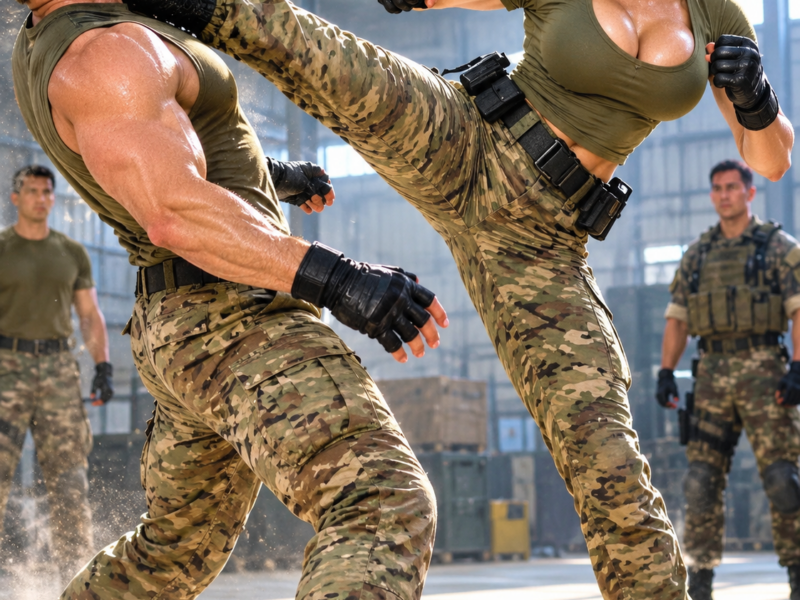
“They thought surrounding me during training would make me panic. Six men closed in, blocking every exit, while their instructor laughed and told me I had nowhere to go
For three seconds, nobody in the warehouse moved.
Commander Daniel Price held the document in one hand and looked at me as if he were deciding how much of my past the room needed to hear.
Sergeant Mason Cole stood a few feet away, his arms crossed.
The six trainees who had surrounded me were still wearing their protective gear.
Their expressions had changed.
They were no longer looking at me like an outsider who had gotten lucky.
They were waiting.
“Lieutenant Bennett,” Commander Price said, “do you want to explain your previous assignment, or would you prefer that I do it?”
I looked at the document.
Then at the men.
“Sir, I don’t think my previous assignment is relevant to what happened today.”
Price gave a small nod.
“That is precisely why I respect your judgment.”
He turned toward the group.
“However, your performance today was not an accident. And I want everyone here to understand the difference between confidence and competence.”
Cole shifted his weight.
Price continued.
“Lieutenant Bennett served as a tactical liaison during a joint special operations training program. She worked alongside Navy SEAL instructors and other specialized personnel. Her role involved planning, threat assessment, communications, and operational coordination.”
A trainee near the back whispered, “Special operations?”
Price heard him.
“Yes. She wasn’t a SEAL, and she has never claimed to be one. But she was trusted to work in an environment where mistakes could have serious consequences.”
He looked at me again.
“She also received an exceptional evaluation for her ability to maintain situational awareness under pressure.”
Cole’s face remained rigid.
Price closed the folder.
“That is why she was assigned to evaluate this exercise.”
Silence.
I felt every pair of eyes turn toward me.
I hated that part.
I had spent years learning that the work mattered more than the recognition.
But now my past had become a spectacle.
“Sir,” I said, “may I speak?”
“Go ahead.”
I faced the trainees.
“What happened today wasn’t about me being better than six people. It was about six people forgetting why they were there.”
One of the men lowered his eyes.
I continued.
“You were given an objective. You were supposed to locate and secure a casualty, maintain communication, and move to the designated safe zone. Instead, you became distracted by the idea of trapping one person.”
I looked at Cole.
“And your instructor encouraged it.”
Cole’s jaw tightened.
“Lieutenant, with respect, this was a pressure exercise.”
“Pressure doesn’t excuse losing sight of the mission.”
His eyes narrowed.
“You think you could have handled a real situation better?”
I took a breath.
“I think the point of training is to discover what we need to improve before a real situation happens.”
Commander Price stepped between us.
“That’s enough.”
He turned toward Cole.
“Sergeant, report to my office at fourteen hundred. Bring your training plan and the evaluation records from the past three months.”
“Yes, sir.”
“And Lieutenant Bennett?”
“Yes, sir?”
“Come with me.”
I followed him out of the warehouse.
Behind us, I heard Cole order the trainees to clean up the equipment.
For once, nobody laughed.
The corridor outside the training facility was quiet.
Price walked several steps before speaking.
“I know you don’t enjoy being discussed in front of a group.”
“No, sir.”
“You could have mentioned your previous assignment when you arrived.”
“I could have.”
“Why didn’t you?”
I considered the question.
“Because I wanted them to evaluate my work, not my résumé.”
He stopped beside a window overlooking the training yard.
“That is a reasonable answer.”
I looked outside.
A group of sailors was moving through a communications drill. One trainee dropped a radio, picked it up, and started again.
Price watched them too.
“There’s another reason I asked you to stay.”
I waited.
He opened the folder again.
“Your evaluation reports were excellent. But I also reviewed the complaints submitted by trainees in Cole’s program.”
My attention sharpened.
“Complaints?”
“Several. Most were informal. Some were written.”
“What kind?”
“Unnecessary physical intimidation. Public humiliation. Pressure to continue exercises after trainees reported injuries. A pattern of turning training into personal competition.”
I looked at him.
“Why wasn’t it addressed earlier?”
Price exhaled.
“Because the complaints were inconsistent, and Cole has always delivered strong physical performance results. Some supervisors interpreted the complaints as resistance to difficult training.”
“That doesn’t make them acceptable.”
“No, it doesn’t.”
He handed me a second sheet.
It contained a list of names.
Several were familiar from the exercise.
One name appeared three times.
Tyler Brooks.
I remembered the trainee with the bandage around his wrist.
“Was he injured during Cole’s training?”
“According to the report, he suffered a wrist injury during a restraint exercise. He told the instructor he was in pain. The session continued.”
I felt my stomach tighten.
“Did he receive medical attention?”
“Eventually. But not immediately.”
I returned the sheet.
“What do you need from me, sir?”
Price looked directly at me.
“I need an independent assessment of the training program. Not a personal judgment of Cole. I want to know whether the exercises are developing capable personnel or simply teaching them to endure bad decisions.”
I nodded.
“I can do that.”
“And one more thing.”
“Yes?”
“Don’t let today’s incident turn into a contest between you and him.”
“I won’t.”
Price studied my face.
“I hope you’re right.”
I wasn’t entirely sure I was.
Because I had seen Cole’s expression when the exercise ended.
He hadn’t looked embarrassed.
He had looked betrayed.
And men who feel betrayed by someone they underestimated can become unpredictable.
At fourteen hundred, I entered Price’s office.
Cole was already there.
His training plan sat on the desk.
He stood when I entered, but he didn’t greet me.
Price gestured toward a chair.
“Sit.”
I took the seat opposite Cole.
Price opened a file.
“Sergeant, I’ve reviewed your recent training records. Your completion rates are high. Your physical readiness scores are strong. But your injury reports and trainee feedback raise concerns.”
Cole leaned forward.
“With respect, sir, the program is supposed to be difficult.”
“Difficult is not the same as careless.”
“I don’t let anyone quit just because they’re uncomfortable.”
I spoke before I could stop myself.
“Then you need to learn the difference between discomfort and injury.”
Cole turned toward me.
“I know the difference.”
“Your records suggest otherwise.”
Price raised a hand.
“Let’s stay on the facts.”
He read from the report.
“Three trainees reported being pressured to continue after injuries. Two described being singled out in front of their peers. One requested reassignment.”
Cole shook his head.
“They were not ready for the program.”
“Who made that determination?” Price asked.
“I did.”
“Based on what?”
“Performance.”
“Or your personal opinion?”
Cole sat back.
For a moment, he said nothing.
Then he looked at me.
“You think you’re going to walk in here and tell us how to train?”
“No,” I replied. “I’m going to look at what the training is producing.”
“And what exactly do you think it produces?”
I glanced at the file.
“Today, it produced six men who forgot their mission because they were too busy trying to corner one person.”
Cole’s face reddened.
Price closed the file.
“Effective immediately, the advanced containment exercise is suspended pending review. Lieutenant Bennett will conduct an assessment with the training team. You will cooperate fully.”
Cole stood.
“Sir, with all due respect, this is an overreaction.”
Price’s voice became colder.
“Sit down, Sergeant.”
Cole remained standing for another second.
Then he sat.
Price continued.
“You are not being removed from your position today. But your program is under review. You will not conduct unsupervised physical drills until that review is complete.”
Cole looked at the desk.
“Yes, sir.”
The meeting ended.
As I gathered my notes, Cole spoke.
“Lieutenant.”
I turned.
“I hope you know what you’re doing.”
“I do.”
“You’ve made a lot of enemies in this building.”
I looked at him steadily.
“Then perhaps we should focus on making fewer injuries.”
I left before he could respond.
The following morning, I arrived at the warehouse early.
I wanted to inspect the training space without an audience.
The equipment was arranged in neat rows.
Padded barriers stood against one wall.
Training radios were charging on a long table.
The mannequin from the previous day had been returned to its storage area.
I walked the exercise route slowly.
The yellow line.
The equipment racks.
The observation platform.
The narrow passage where the six men had formed their circle.
I imagined the exercise from the perspective of each trainee.
Where could they see?
What information had they been given?
What decisions had they made?
Then I noticed something.
A small camera mounted above the equipment racks.
It was angled toward the training floor.
I checked the time and wrote down the camera number.
“Looking for something?”
I turned.
A young petty officer stood near the doorway.
He was holding a tablet.
“I’m reviewing yesterday’s exercise,” I said.
“Petty Officer James Walker, ma’am. I handle the training recordings.”
“Good morning, Petty Officer Walker.”
He looked nervous.
“Are you the officer who was surrounded?”
“I am.”
He hesitated.
“Can I ask you something?”
“Go ahead.”
“Were you scared?”
The question surprised me.
I looked at him carefully.
“Yes.”
He blinked.
“You were?”
“Of course.”
“But you didn’t look scared.”
“Being afraid and being unable to think are not the same thing.”
He considered that.
I continued.
“Fear is information. It tells you something matters. The mistake is letting it make every decision for you.”
Walker nodded.
Then he looked down at his tablet.
“There’s something you should see.”
He opened a video file.
The footage showed the exercise from above.
I watched myself move through the circle.
I watched the trainees rush toward me.
Then I noticed something I hadn’t seen from inside the formation.
One of the men, a trainee named Daniel Foster, had stopped moving.
While the others pursued me, he remained near the yellow line.
He looked toward the mannequin.
Then toward Cole.
He seemed to be trying to decide whether to follow the mission or obey the shouted order to close the circle.
Cole pointed at me.
Foster moved.
He joined the others.
The recording continued until the buzzer sounded.
I asked Walker to replay that section.
“Did anyone question the orders during the exercise?” I asked.
Walker shook his head.
“Not that I know of.”
“Did you hear any communication about the casualty?”
“No, ma’am.”
I watched the screen again.
Foster had seen the mannequin.
He had hesitated.
And then he had chosen to follow the crowd.
That was worth understanding.
“Can you arrange for me to speak with him?”
“Yes, ma’am.”
I thanked him and made a note.
Daniel Foster arrived at the training room that afternoon.
He was twenty-four, lean, and serious.
He stood at attention when he entered.
“At ease,” I said.
He relaxed slightly.
“Sit down.”
He took the chair opposite me.
I placed the video still on the table.
“You saw the casualty marker yesterday.”
His face changed.
“Yes, ma’am.”
“Why didn’t you move toward it?”
He looked down.
“Sergeant Cole told us to close the circle.”
“That wasn’t my question.”
He took a breath.
“I thought about going to the mannequin.”
“What stopped you?”
“I didn’t want to be the one who broke formation.”
“Were you concerned about the exercise or about what Cole would say?”
He didn’t answer.
I waited.
Finally, he said, “Both.”
I nodded.
“Did you believe the order was wrong?”
He looked up.
“I wasn’t sure.”
“That is an honest answer.”
He seemed surprised.
I continued.
“Training is where you learn to make decisions with incomplete information. But you need to understand the objective well enough to recognize when a direction is pulling you away from it.”
He nodded slowly.
“Could I have been wrong to ignore the order?”
“Possibly. That’s why communication matters. If you believe an instruction conflicts with the mission, you seek clarification when circumstances allow. If immediate action is necessary to protect someone, you act within your training and responsibility.”
He looked at the photograph.
“I thought following orders was the whole point.”
“Following lawful orders matters. So does understanding them. Neither replaces judgment.”
He sat quietly.
Then he said, “I don’t think I would have helped you.”
I looked at him.
“Why?”
“Because I was afraid of being embarrassed.”
His answer was painful because it was familiar.
“Then that’s something you can work on.”
He nodded.
Before leaving, he asked, “Do you think Sergeant Cole is a bad instructor?”
I considered it.
“I think he’s responsible for the decisions he makes. I don’t know everything about him, and neither do you. What matters now is whether he’s willing to recognize the damage and change.”
Foster stood.
“Yes, ma’am.”
As he reached the door, I added, “One more thing.”
He turned.
“Next time you notice something important, don’t wait for someone else to notice it first.”
He nodded.
And this time, he left with his shoulders a little straighter.
Over the next week, I reviewed the program.
I spoke with trainees.
I watched recordings.
I checked equipment inspections and medical reports.
I observed physical exercises and communications drills.
Some sessions were demanding in the right way.
The trainees worked hard.
They made mistakes.
They corrected them.
They learned.
But other sessions were built around humiliation.
Cole frequently used personal insults to motivate the group.
He sometimes changed instructions without warning, not to test adaptability, but to see who would become frustrated.
He rewarded trainees who ignored pain and mocked those who requested breaks.
It was not a consistent pattern of professional instruction.
It was a pattern of control.
And it had consequences.
One trainee had stopped reporting a recurring shoulder problem because he feared being labeled weak.
Another had requested a transfer.
A third had begun making careless decisions because he was more focused on avoiding Cole’s anger than completing the assigned tasks.
I documented everything.
But I also noticed something else.
Cole was always present.
He arrived before the trainees.
He checked equipment.
He stayed late.
He knew every person’s physical limitations and performance history.
He could identify a weakness in a drill from across the warehouse.
He was not incompetent.
That made the situation more complicated.
He understood the work.
He simply seemed to believe that fear was the fastest way to make people perform.
I recognized that belief.
I had once held a version of it myself.
Years earlier, during a joint training assignment, I had worked with an experienced operator named Chief Aaron Mitchell.
He had been calm, observant, and demanding.
He never raised his voice unless there was a reason.
One afternoon, I made a serious mistake during a navigation exercise.
I misread a marker and sent our group toward the wrong access point.
Nobody was hurt.
But we lost valuable time.
I expected Mitchell to tear into me.
Instead, he asked me to explain what I had seen.
I described the marker.
He asked what I had assumed.
I admitted that I had trusted my first impression.
Then he asked what I would do differently.
I told him.
He nodded.
“Good,” he said. “Now you’ll remember it.”
I had asked him why he wasn’t angrier.
He looked at me and said, “If I make you afraid to tell me what you see, I won’t know when we’re in trouble.”
That sentence stayed with me.
And now I was watching Cole teach people the opposite.
On Friday, Commander Price called me into his office.
“Your report is thorough,” he said.
“Thank you, sir.”
“What do you recommend?”
I placed the final assessment on his desk.
“Rebuild the advanced exercise around the actual mission objectives. Keep the pressure, but make the rules and evaluation criteria clear. Include communication failures, competing priorities, and changing conditions. Require instructors to assess judgment, not just physical performance.”
Price read the summary.
“And Sergeant Cole?”
“He needs additional instructor supervision and formal remediation. He should not lead advanced physical sessions alone until he demonstrates that he can train safely and professionally.”
Price looked up.
“You’re not recommending his removal?”
“Not based on what I’ve found so far. I’m recommending accountability and a chance to correct the behavior. If he refuses, the decision becomes clearer.”
Price leaned back.
“You’re giving him an opportunity.”
“I’m giving the command an opportunity to fix a problem before it becomes worse.”
He nodded.
“Very well.”
Then he added, “I want you to lead the redesigned exercise.”
I blinked.
“Sir?”
“You identified the weaknesses. You understand the mission. You’re the right person to run it.”
I hesitated.
“Will Cole be involved?”
“He’ll observe under supervision.”
I thought about that.
Then I nodded.
“Yes, sir.”
The new exercise was scheduled for Monday morning.
The trainees arrived to find the warehouse rearranged.
The six-man circle had been removed.
Instead, the training area contained several stations.
A communications table.
A casualty location.
A simulated blocked passage.
A decision point marked on the floor.
There were also two instructors observing from opposite sides.
Cole stood near the entrance.
He looked at the setup.
Then at me.
“Different approach,” he said.
“Different objective.”
He glanced at the equipment.
“Still going to test pressure?”
“Yes.”
“Good.”
His voice was flat.
I gathered the trainees.
“Today’s exercise has one primary objective: locate the simulated casualty, assess the situation, communicate what you find, and move the casualty to the safe zone.”
I paused.
“You will encounter incomplete information. You may receive conflicting reports. You will have to decide when to move, when to pause, and when to ask for clarification.”
One trainee raised his hand.
“Will there be physical resistance?”
“Yes. Controlled resistance. The purpose is to test decision-making, not to injure anyone.”
I looked around the group.
“Your performance will be assessed on communication, judgment, teamwork, safety, and completion of the mission. Physical speed is only one part of the evaluation.”
I saw Cole listening carefully.
“Any questions?”
Nobody raised a hand.
“Then begin.”
The trainees moved.
At first, the exercise went smoothly.
They located the casualty.
They checked the marker.
They communicated their position.
Then the first complication began.
A radio message reported that the designated passage was blocked.
The group stopped.
One trainee suggested taking the longer route.
Another wanted to move the casualty immediately.
Daniel Foster looked at the map.
“Hold on,” he said. “We need to confirm the alternate route before we move.”
The others turned toward him.
He checked the radio.
“Control, this is Team Two. Confirm alternate passage is clear.”
A voice replied with incomplete information.
Foster asked again.
This time, he received confirmation.
The group adjusted.
They moved the casualty toward the safe zone.
The exercise ended without injury.
I checked the score sheet.
Their timing wasn’t perfect.
But their decisions were sound.
“Good work,” I said.
The trainees looked relieved.
Then Cole stepped forward.
“Not good enough.”
The group stiffened.
I turned toward him.
“Explain.”
He pointed at the timing record.
“They took too long at the decision point.”
“They clarified a safety-critical route.”
“They hesitated.”
“They verified information.”
Cole looked at the trainees.
“In a real situation, hesitation gets people hurt.”
I kept my voice level.
“Unnecessary hesitation can. So can acting on false information.”
He stared at me.
“You’re teaching them to question everything.”
“I’m teaching them to think.”
The room went quiet.
Cole stepped closer.
“And what happens when they think so long that someone dies?”
I didn’t answer immediately.
Because it was a fair question.
I turned toward the trainees.
“Tell me why you stopped.”
Foster answered.
“We had two different reports about the route. We didn’t know which one was current.”
“And what would have happened if you had chosen the blocked passage?”
“We could have lost time and put the casualty at risk.”
I nodded.
“Exactly.”
Cole shook his head.
“That’s classroom logic.”
“No,” I said. “That’s operational judgment.”
He looked toward Price.
The commander had been watching from the observation platform.
“Sir, with respect, this is becoming too cautious.”
Price came down the steps.
“Sergeant, what do you think the exercise was designed to test?”
“Decision-making under pressure.”
“And what did they demonstrate?”
Cole hesitated.
“They communicated.”
“They checked their information.”
“They moved the casualty.”
“They completed the mission,” Price said. “What part of that is failure?”
Cole said nothing.
Price turned to the trainees.
“Good work. Reset the equipment.”
The group dispersed.
Cole remained where he was.
I could see the frustration in his face.
But this time, he didn’t shout.
He simply walked away.
I thought that might be the end of it.
It wasn’t.
That afternoon, I was reviewing the recordings when Petty Officer Walker entered the office.
He looked troubled.
“Ma’am, I found something in the footage from the original exercise.”
I turned toward him.
“What?”
He placed his tablet on the desk.
“There’s a section from the camera above the equipment racks. It starts a few minutes before the six trainees surrounded you.”
He played the recording.
At first, I saw nothing unusual.
The trainees were gathering.
Cole was speaking to them.
Then he pointed toward the center of the warehouse.
I leaned closer.
The audio was faint, but the words were clear enough.
“Don’t let her reach the objective. Make her work for it.”
One trainee asked, “Isn’t the casualty the objective?”
Cole replied, “The objective is to see what she does when she’s under pressure.”
I felt my face grow cold.
The recording continued.
Cole explained that the six men were supposed to contain me until I became frustrated.
He told them to ignore the casualty marker.
I watched the video twice.
“Was this recording included in the initial review?” I asked.
Walker shook his head.
“No, ma’am. The original file was labeled as a camera calibration test.”
I stared at him.
“Who labeled it?”
He hesitated.
“Sergeant Cole’s login.”
I sat back.
The exercise hadn’t simply gone off track.
Cole had deliberately changed the objective.
He had used six trainees to stage a personal challenge.
And he had concealed the recording.
I looked at Walker.
“Did you make a copy?”
“Yes, ma’am. I preserved the original file and logged the access history.”
“Good. Don’t alter anything. Send it through the proper reporting channel.”
He nodded.
Then he asked, “Do you think he’s going to get fired?”
I looked at the screen.
“I don’t make that decision.”
“But what he did was wrong.”
“Yes.”
Walker hesitated.
“Why would he do something like that?”
I thought of the way Cole had watched me in the warehouse.
The humiliation.
The anger.
The need to prove something.
“I don’t know,” I said. “But now we have evidence that can help establish what happened.”
I reported the footage to Commander Price immediately.
The next morning, Cole was called into the command office.
I was present as an observer.
Price placed the recording log on the desk.
“Sergeant, do you recognize this file?”
Cole glanced at it.
“Yes, sir.”
“Did you label it as a calibration test?”
A pause.
“Yes, sir.”
“Why?”
Cole looked at me.
Then at Price.
“I didn’t think it was relevant.”
“Did you instruct the six trainees to ignore the casualty objective?”
His jaw tightened.
“I wanted to test Lieutenant Bennett’s response.”
“Was that part of the approved exercise?”
“No, sir.”
“Did you tell the trainees that?”
Cole looked down.
“No, sir.”
Price folded his hands.
“Then you deliberately altered the exercise, misdirected the trainees, and mislabeled the recording.”
Cole’s face had gone pale.
“I was trying to expose a weakness.”
“In whom?”
Cole didn’t answer.
Price continued.
“You were responsible for the training environment. Instead, you used it to settle a personal challenge.”
Cole looked toward me.
“She walked in here like she knew everything.”
I stared at him.
“I didn’t say that.”
“You didn’t have to.”
“Sergeant,” Price interrupted, “this isn’t about what you imagined she thought of you.”
Cole’s voice rose.
“You weren’t there when she arrived. Nobody knew who she was. She didn’t explain her background. She just stood there like she was above us.”
I shook my head.
“I stood where I was assigned.”
Price’s expression hardened.
“That’s enough.”
Cole looked away.
The commander took a breath.
“Your conduct has undermined the integrity of this training program. You are relieved of instructor duties pending a formal review. You will have an opportunity to respond to the findings through the appropriate process.”
Cole sat motionless.
Then he asked, quietly, “And the trainees?”
“They will be interviewed separately. Their performance will not be penalized for following instructions they reasonably believed were part of the exercise.”
Cole nodded once.
The meeting ended.
As he stood, he looked at me.
For a moment, I expected another accusation.
Instead, he said, “I didn’t think you’d actually reach the casualty.”
I held his gaze.
“That’s the problem.”
He lowered his eyes and walked out.
The formal review took several weeks.
The command interviewed the trainees, examined the recordings, and assessed the training records.
The findings confirmed that Cole had deliberately altered the exercise without authorization and had concealed relevant footage.
The earlier complaints were also substantiated.
He was removed from his instructor position and assigned to duties outside the training program while further administrative action was considered.
The command also required a full review of the program’s safety procedures.
I didn’t celebrate.
There was nothing satisfying about watching someone lose a position.
But I was relieved that the trainees would no longer have to wonder whether speaking up would cost them their future.
Tyler Brooks received follow-up care for his wrist.
Daniel Foster was selected to help with the redesigned communication exercises.
And Petty Officer Walker received recognition for preserving the recording properly.
The changes were not dramatic.
There were no speeches.
No applause.
Just better procedures, clearer instructions, and people beginning to trust the training environment again.
One afternoon, I found Cole sitting alone outside the warehouse.
He was looking at the training yard.
I considered walking past.
Then he spoke.
“Lieutenant Bennett.”
I stopped.
“Sergeant.”
He stood.
“I wanted to talk.”
I waited.
He looked older than he had a few weeks earlier.
“I’ve been reviewing the findings.”
“That’s good.”
“I thought I was preparing people for the worst.”
He paused.
“Maybe I was just making them afraid of me.”
I didn’t answer.
He continued.
“My father was a Marine. He trained me when I was young. He believed you had to be hard on people because the world wouldn’t be gentle.”
I listened.
“When I became an instructor, I thought I was supposed to do the same thing.”
“Did your father teach you to ignore injuries?”
Cole looked down.
“No.”
“Did he teach you to change a mission because you wanted to prove a point?”
“No.”
“Then perhaps you need to remember what he actually taught you.”
His eyes lifted.
“You make it sound like I can just start over.”
“You can’t erase what happened.”
“I know.”
“But you can decide what happens next.”
He nodded slowly.
“I don’t expect you to forgive me.”
“I wasn’t waiting for you to ask.”
He almost smiled.
Then his expression became serious again.
“I am sorry about the exercise. I put those men in a position where they thought they had to choose between following me and doing the right thing.”
“That is something you should tell them.”
“I will.”
He started to walk away.
Then he turned back.
“Lieutenant?”
“Yes?”
“You were afraid that day, weren’t you?”
I thought about it.
“Yes.”
He nodded.
“I couldn’t tell.”
“That doesn’t mean I wasn’t.”
He looked at the warehouse doors.
“I suppose that’s what I need to learn.”
I watched him walk away.
I didn’t know whether he would become a better instructor someday.
That was no longer my responsibility.
My responsibility was to make sure the people still training here had a better chance to become the professionals they wanted to be.
A month later, Commander Price asked me to lead the final evaluation of the redesigned program.
The exercise was more complex than the original.
There were conflicting reports, changing conditions, and a simulated casualty who required careful handling.
The trainees had to communicate clearly and make decisions without losing sight of the objective.
Before the exercise began, I gathered them in the warehouse.
Daniel Foster stood near the front.
Tyler Brooks was beside him, his wrist fully recovered.
Walker was at the communications station.
I looked around the group.
“Today will be difficult,” I said. “You will make mistakes. Some information will be incomplete. You may disagree with one another.”
I paused.
“But I want you to remember something.”
They waited.
“The purpose of training is not to prove that you are never afraid, never uncertain, or never wrong. The purpose is to learn how to recognize those moments and respond responsibly.”
I glanced at Foster.
“Do not confuse obedience with the absence of judgment.”
Then I looked at the entire group.
“And don’t confuse aggression with leadership.”
A few trainees nodded.
“Your job is to complete the mission, protect the people involved, and communicate what you know. If you need clarification, ask. If you see a danger, speak up. If you make a mistake, own it and correct it.”
I stepped aside.
“Begin.”
The exercise started.
A radio message came in.
The first team moved toward the casualty location.
A second report contradicted the first.
The group paused.
Foster checked the time stamp.
“That’s an older report,” he said. “We need current confirmation.”
Walker relayed the request.
The updated information arrived.
They adjusted.
A simulated obstruction blocked their planned route.
Tyler suggested an alternate path.
The group evaluated the options and chose the safer route.
They reached the casualty.
They communicated the location.
They completed the movement.
The buzzer sounded.
I checked the results.
Their time was slower than the original group’s.
Their coordination was better.
Nobody had ignored an injury.
Nobody had lost sight of the mission.
Commander Price stepped beside me.
“What do you think?”
I looked at the trainees.
“They’re learning.”
He nodded.
“That’s the point.”
Foster approached.
“Lieutenant?”
“Yes?”
“Can I ask something?”
“Of course.”
“When you were surrounded that day, how did you know what to do?”
I considered the question.
“I didn’t know everything that would happen.”
“But you looked calm.”
“I was managing my fear. I was watching, listening, and trying not to let the noise make decisions for me.”
He nodded.
“So it wasn’t about knowing how to fight six people?”
“No.”
I looked toward the center of the warehouse.
“It was about remembering why I was there.”
He seemed to understand.
Then he smiled.
“Thank you, ma’am.”
He returned to his team.
Later that afternoon, I walked alone through the warehouse.
The training area was empty.
The equipment was stored properly.
The floor had been cleaned.
I stopped where the six-man circle had formed.
For a moment, I could almost hear Cole’s voice.
“Close the circle!”
I remembered the laughter.
The pressure.
The moment I had realized that the mission had disappeared beneath someone’s pride.
Then I remembered something else.
The trainees had not been the enemy.
They had been put in a situation where they were expected to follow an instructor who had forgotten his responsibility.
That distinction mattered.
People could be trained to react with fear.
They could also be trained to think.
And the difference often began with the person standing at the front of the room.
Commander Price appeared in the doorway.
“Lieutenant Bennett.”
I turned.
“Sir?”
“Your assignment here is complete.”
I nodded.
“Understood.”
He held out a folder.
“Your evaluation is excellent. The command wants you to help develop the next phase of the joint readiness program.”
I accepted the folder.
“Thank you, sir.”
He smiled slightly.
“You know, when I first read your record, I thought your greatest strength was your ability to remain calm under pressure.”
“And now?”
“Now I think it’s your ability to recognize what pressure does to other people.”
I looked down at the folder.
“That’s something I had to learn.”
Price nodded.
“Then make sure the next group learns it sooner.”
I smiled.
“Yes, sir.”
He left me alone in the warehouse.
I stayed for another minute.
Then I switched off the lights and walked toward the exit.
On my way out, I passed the observation platform.
A small sign had been placed beside the entrance.
It read:
TRAINING OBJECTIVE: DEVELOP JUDGMENT, DISCIPLINE, AND TRUST.
I stopped to read it.
It wasn’t a dramatic statement.
It wouldn’t impress anyone who measured strength by the number of people they could overpower.
But I liked it.
Because the day six men boxed me in, I hadn’t needed to defeat them.
I had needed to see what they couldn’t.
The mission was still there.
The casualty was still waiting.
And the most important opening wasn’t in the circle around me.
It was in the space between what I had been ordered to do and what I knew needed to be done.
I had learned that lesson from experienced operators years before.
Now I had passed it on to a new group of sailors.
I walked outside into the cool Virginia morning.
For the first time in weeks, the warehouse was quiet behind me.
I took one deep breath.
Then I kept walking.
Because real strength was never about making sure nobody could challenge you.
It was about making sure the people beside you could trust you when everything went wrong.
THE END.









