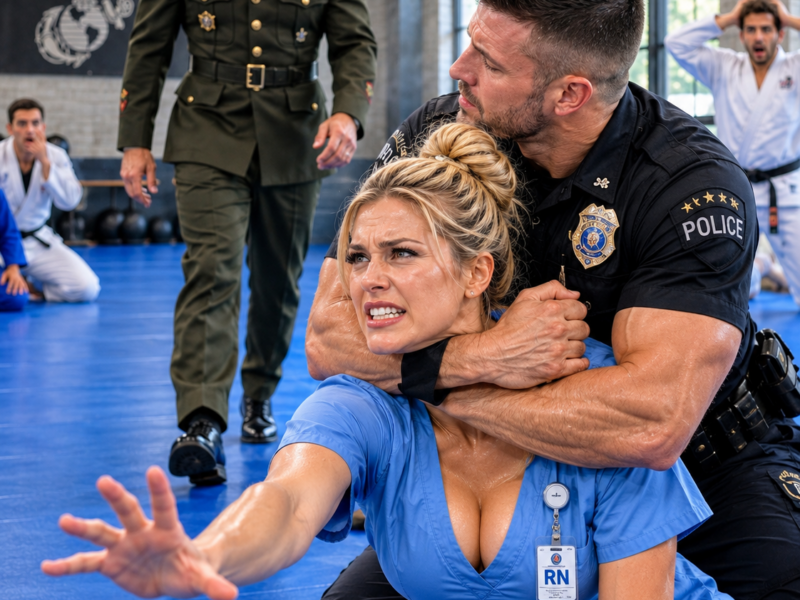
“They thought I was just a quiet nurse who had no business stepping onto a training mat
The folder felt heavier than it looked.
I stood in the training room, still wearing my navy-blue nursing uniform, while Officer Derek Vaughn stared at me as if I had suddenly become someone he didn’t recognize.
The senior Navy officer waited.
“Petty Officer Mitchell,” he repeated. “We need to speak privately.”
I glanced at the lieutenant.
“Can someone explain why this officer was allowed to keep choking me after I tapped out?”
Lieutenant Hill’s jaw tightened.
“He wasn’t.”
Derek stepped forward.
“It was a misunderstanding. She moved unexpectedly, and I was trying to maintain control.”
The lieutenant turned toward him.
“You were told not to apply pressure to her neck.”
“It was a demonstration.”
“You were told to stop.”
Derek looked around for support.
Nobody offered any.
The senior officer handed the folder to Lieutenant Hill.
“Preserve the training room footage. Secure every phone recording. I want written statements from everyone who witnessed the incident.”
Derek’s face changed.
“Sir, you’re making this into something it isn’t.”
The officer looked directly at him.
“You made that decision when you refused to release her.”
Then he turned back to me.
“Sarah, can we talk?”
I took the folder.
“First, I want to see the footage.”
The officer nodded.
“Fair enough.”
My name is Sarah Mitchell.
For almost two years, I had worked as a nurse at Naval Medical Center San Diego.
I kept my head down.
I showed up early.
I stayed late when the emergency department was overwhelmed.
I didn’t discuss my former service unless someone specifically asked.
Most people knew I had served in the Navy.
Very few knew what I had done.
Before I became a nurse at the medical center, I had served as a Navy SEAL medical specialist.
I had completed the training, earned my place, and deployed with a team whose members trusted me to keep them alive.
I wasn’t a superhero.
I wasn’t invincible.
I had been scared plenty of times.
I had also made mistakes.
But I knew how to recognize danger, how to stay calm under pressure, and how to protect someone when a situation turned ugly.
After my final deployment, I left operational service.
I wanted a life where the worst thing I had to hear was a patient complaining about hospital food.
For a while, I got exactly that.
Then a man named Lieutenant Commander Nathan Cole disappeared.
And everything changed.
Nathan had been my team leader during my last deployment.
He was the kind of person who remembered everyone’s birthday but forgot his own.
He could make a room laugh after a terrible day.
He was also one of the best operators I had ever worked beside.
During our final mission together, our team had been sent to recover a missing intelligence officer from an abandoned compound.
The intelligence was wrong.
The compound wasn’t abandoned.
We walked into an ambush.
Nathan was wounded while pulling another operator out of the line of fire.
I treated him behind a damaged concrete wall while the rest of the team fought to reach our extraction point.
He kept telling me to leave him.
I kept telling him to shut up.
Eventually, we got him aboard the evacuation aircraft.
But his injuries were severe.
He survived surgery.
Then he disappeared from the military medical system.
The official explanation was that he had been transferred to a specialized rehabilitation facility.
No one could tell me where.
I asked his commanding officer.
I asked the medical liaison.
I submitted formal requests.
Every answer was the same.
The information was restricted.
I tried to respect that.
Until three weeks ago, when I received an anonymous message.
It contained a single sentence.
“Your team leader didn’t leave voluntarily.”
I deleted it.
Then I received another.
“Ask why his final medical record was changed.”
That one I saved.
I contacted an old colleague.
He advised me not to investigate.
He said the matter was being handled.
Then he stopped answering my calls.
I had spent the last several weeks trying to find out whether Nathan was alive, whether he had been transferred, and why the people who were supposed to care for him had suddenly stopped speaking.
I had no idea that the answer would arrive in a folder carried into a training room.
The senior officer introduced himself as Commander Thomas Reed.
He had served with our old unit before moving into a Navy investigative role.
He led me into a small conference room.
Lieutenant Hill joined us.
Derek was escorted elsewhere to give his statement.
Commander Reed placed a photograph on the table.
I recognized the man immediately.
Nathan Cole.
He was sitting in a wheelchair outside a medical facility.
His hair was longer.
His face was thinner.
But it was him.
I stared at the photograph.
“Where is he?”
“Alive,” Reed said.
I let out a breath I hadn’t realized I was holding.
“Where?”
“Under protective medical supervision.”
“Why?”
“Because someone attempted to access his medical records and move him without authorization.”
I looked at the photograph again.
“Who?”
Reed opened the folder.
“We believe a private security contractor has been trying to locate him. The contractor has connections to people involved in your final deployment.”
I sat back.
“What does that have to do with Derek Vaughn?”
“That’s what we’re trying to establish.”
He slid another document toward me.
It was a copy of an access log.
Someone had attempted to retrieve a restricted medical file using credentials associated with a joint police-military training program.
The request had been made two days earlier.
The name attached to the access attempt was Derek Vaughn.
I read it twice.
“Why would a police officer want Nathan’s medical records?”
“We don’t know yet.”
“Did he know who Nathan was?”
“We believe he did.”
I looked up.
“Then why was he assigned to this exercise?”
Reed paused.
“That is one of the questions we need to answer.”
I felt the old tension returning.
The kind that settled between my shoulders before a mission.
“Commander, I don’t want to be treated like bait.”
“You won’t be.”
“Then tell me everything you can.”
Reed exchanged a glance with Lieutenant Hill.
“Your former team leader witnessed something during that final deployment. Something that could expose a group of people who have been selling restricted military information.”
I looked at the access log.
“And they think he remembers.”
“Yes.”
“Does he?”
Reed nodded.
“He has started to recover fragments. Names. Dates. A location.”
I closed the folder.
“Then I want to see him.”
“Not yet.”
The answer came too quickly.
I stood.
“I just found out a man I thought had been abandoned is alive. You don’t get to tell me to wait without explaining why.”
Reed didn’t raise his voice.
“Sarah, Nathan is recovering from a serious injury. He has been through months of isolation and uncertainty. We cannot risk overwhelming him or exposing his location.”
I hated that he was right.
I hated it more because I understood.
“Then let me help with the medical side.”
“We may need you for that.”
“May?”
“First, we need to understand what happened in that training room.”
I frowned.
“Derek?”
“Derek may have been trying to identify you.”
I thought about his expression when I broke his hold.
The way he had watched me before the demonstration.
The way he had insisted I step onto the mat.
“You think he knew who I was?”
“We think someone told him to find out.”
A chill moved through me.
“Who?”
Reed closed the folder.
“We’re still working on that.”
I left the conference room with more questions than answers.
Lieutenant Hill walked beside me.
“Are you okay?”
“I’ll be fine.”
“That was a pretty controlled response in there.”
I looked at him.
“Would you prefer I throw a chair?”
He almost smiled.
“Not in the conference room.”
For the first time that afternoon, I laughed.
Then I remembered the access log.
“Lieutenant, I need the training footage.”
“We’re securing it now.”
“I want to see what happened before Derek put his arm around my neck.”
Hill looked at me carefully.
“Why?”
“Because I want to know whether he was demonstrating a technique or testing my reaction.”
Hill nodded slowly.
“I’ll make sure you get a chance to review it.”
That evening, I returned to the emergency department.
I changed into clean scrubs and finished my shift.
I treated a child with a broken wrist.
I helped an elderly man who had fallen at home.
I checked on a young sailor whose panic attack had convinced him he was having a heart attack.
Normal work.
Necessary work.
But my mind kept returning to Nathan.
At 8:43 p.m., my phone buzzed.
Unknown number.
I almost ignored it.
Then a message appeared.
“Stop asking about Cole.”
I stared at the screen.
Another message followed.
“You already lost him once.”
I took a screenshot.
Then I forwarded it to Commander Reed through the secure contact he had given me.
His reply came less than a minute later.
“Do not respond. Stay inside the medical center. Security is being notified.”
I looked up.
The emergency department was busy.
A paramedic team was bringing in a patient.
A nurse was calling for a trauma cart.
I put my phone away and went back to work.
I was not going to abandon patients because someone wanted to frighten me.
At 9:16 p.m., the hospital security supervisor approached the nurses’ station.
“Ms. Mitchell?”
I turned.
“Yes?”
“There’s someone asking for you at the main entrance.”
“Who?”
“He says he’s a police officer.”
I felt my stomach tighten.
“Did he give you a name?”
“Derek Vaughn.”
I set down my chart.
“Tell him I’m unavailable.”
The supervisor nodded.
A moment later, my phone rang.
Commander Reed.
“Sarah, where are you?”
“Emergency department.”
“Good. Do not leave the building.”
“Derek is here.”
“I know. We have officers on the way.”
“Why is he here?”
“We’re trying to determine that.”
I looked toward the entrance.
Through the glass, I could see a man standing near the security desk.
Derek.
He wasn’t wearing his training gear.
He was in uniform.
His hands were at his sides.
He looked calm.
Too calm.
Then he raised his head and looked directly toward me.
Even from across the lobby, I could see his mouth move.
He said my name.
I turned away.
A few minutes later, two investigators arrived.
They spoke with security, then escorted Derek into a private administrative office.
I was asked to provide a statement.
I described the messages.
The confrontation.
The access log.
And the moment Derek refused to release me.
The investigators asked whether I had any reason to believe he knew about my former service.
“I don’t know,” I said. “But he seemed interested in testing me.”
One investigator wrote something down.
“Did he say anything unusual before the demonstration?”
“He told me I should stick to bandages and blood pressure cuffs.”
“And afterward?”
“He accused me of attacking him.”
The investigator nodded.
“Thank you. We’ll follow up.”
I thought that would be the end of it.
It wasn’t.
At 6:30 the next morning, Commander Reed called.
“We found something.”
I sat up in bed.
“What?”
“Derek’s department issued him a temporary assignment to the joint training program. The request came from a private security company.”
“Which company?”
“Meridian Tactical Solutions.”
The name meant nothing to me.
Reed continued.
“It’s a contractor that provides security and logistics support for government facilities. One of its senior consultants previously worked with the medical transport network connected to your final deployment.”
I was fully awake now.
“Did Derek know about Nathan?”
“We found messages between him and someone at Meridian. They discussed locating a former Navy operator who was receiving treatment under a restricted identity.”
“That’s Nathan.”
“Yes.”
“Why did they send Derek to the hospital?”
“We believe they wanted to identify anyone connected to Nathan. Your reaction during the demonstration may have confirmed that you were the person they were looking for.”
I closed my eyes.
“So the chokehold was a test.”
“We can’t prove that yet.”
“But you suspect it.”
“Yes.”
I stood and walked to the window.
“What happens now?”
“Derek has been placed under investigation. We are reviewing his communications and the contractor’s records.”
“And Nathan?”
“We’re moving him to a secure facility.”
“When?”
“Today.”
“I want to go with him.”
“Sarah—”
“I am a trained medical professional. I know his medical history. I know what happened during the mission. If he’s going to be moved, I want to make sure the transition is safe.”
Reed was silent for a moment.
“Meet us at the medical center in one hour.”
The transfer was scheduled for noon.
I arrived early.
Nathan was still at the secure facility when I first saw him.
He was sitting in a wheelchair near a window.
His left arm rested in a brace.
A physical therapist stood beside him.
When he noticed me, he stared for several seconds.
Then he smiled.
“Mitchell.”
I stopped.
“Commander.”
He looked me up and down.
“You look different.”
“I’ve been sleeping indoors.”
“Must be nice.”
I laughed, but my eyes burned.
He held out his hand.
I took it carefully.
“I thought you were dead,” I said.
“I heard.”
“You could have sent a postcard.”
He gave a weak smile.
“I wasn’t exactly in a position to visit the post office.”
I pulled a chair beside him.
For a moment, we simply sat together.
Then I asked the question that had been waiting inside me.
“Do you remember what happened?”
His smile disappeared.
“Pieces.”
“Do you remember the contractor?”
He looked toward the therapist.
The therapist quietly stepped outside.
Nathan lowered his voice.
“Meridian wasn’t just providing transport support. They were moving restricted equipment and intelligence materials through medical evacuation channels.”
I felt my jaw tighten.
“Using casualty transports?”
“Sometimes. They knew emergency movements were rarely questioned. They could hide equipment in medical cargo and move personnel under false identities.”
“Who was involved?”
“Someone from the command logistics office. A man named Victor Shaw.”
I recognized the name from an old deployment briefing.
He had been a civilian logistics coordinator.
“What did you see?”
Nathan looked down at his hands.
“I found a discrepancy in the evacuation manifests. Equipment was listed as medical supplies, but the weights didn’t match. I reported it.”
“And then the ambush?”
He nodded.
“I think they knew I was investigating. The mission was changed at the last minute. We were sent to a location where the team could be isolated.”
“Why didn’t they kill you?”
“They wanted to know what I had copied.”
“Did you?”
Nathan nodded.
“I made a backup of the manifests and the communications record. I hid it before the mission.”
“Where?”
He looked directly at me.
“You were the last person I told.”
I searched my memory.
The mission.
The helicopter.
The blood.
The evacuation.
I remembered Nathan handing me a small medical pouch before surgery.
He had told me to keep it safe.
I had assumed it contained his personal items.
“Where is it?” I whispered.
“Do you still have it?”
I shook my head slowly.
“I don’t know.”
Nathan’s expression tightened.
“Sarah, it had a red medical tag on the zipper. I told you it was important.”
The memory came back.
The pouch had been placed in a temporary storage locker after the evacuation.
I had signed it over to the medical transport officer.
I remembered the man’s name.
Victor Shaw.
My stomach dropped.
“That’s how they knew you had given it to me.”
Nathan nodded.
“And that’s why they were looking for you.”
I stood.
“Commander Reed needs to know.”
Nathan caught my wrist gently.
“Wait.”
“What?”
“There’s something else.”
His eyes were tired.
But his voice was steady.
“Derek wasn’t the only person looking for you.”
Before I could ask what he meant, Commander Reed entered the room.
“Sarah, we have a problem.”
He held up a tablet.
A security alert was displayed on the screen.
Someone had accessed the medical center’s transport records using a compromised account.
The transfer route for Nathan’s new facility had been viewed.
I looked at Nathan.
Then at Reed.
“How long?”
“Less than ten minutes.”
“Then the route is compromised.”
Reed nodded.
“We’re changing the transfer plan.”
Nathan tried to rise.
“I can walk.”
“No,” I said immediately.
He gave me a familiar look.
“Still giving orders?”
“When you stop trying to stand on a damaged leg, I’ll consider negotiating.”
For a moment, the old Nathan was back.
Then the room’s security phone rang.
Reed answered.
His expression changed.
“What do you mean, the south entrance?”
He listened.
Then he turned toward us.
“Security has identified an unauthorized vehicle near the loading area.”
The therapist stepped back inside.
Two armed personnel entered.
Reed lowered his voice.
“Everyone stays here until the area is secured.”
I moved beside Nathan.
He looked at me.
“Guess the quiet life didn’t last.”
“No,” I said. “Apparently not.”
The next few minutes passed slowly.
We heard footsteps in the corridor.
A radio crackled.
Someone called for the security supervisor.
Then came a sharp metallic crash from somewhere near the loading entrance.
Nathan gripped the wheelchair arm.
“That’s not normal.”
“No,” I said. “It isn’t.”
The security personnel moved toward the door.
Reed held up one hand.
“Wait.”
A voice came over the radio.
“Control, we have an individual attempting to enter the restricted corridor. He is claiming to be medical transport.”
Reed looked at me.
“Do you recognize the name on the transfer authorization?”
I shook my head.
He read it aloud.
“Victor Shaw.”
Nathan went pale.
“That’s him.”
Reed spoke into his radio.
“Do not let him near the patient. Detain him and secure the area.”
The response came almost immediately.
“Copy.”
Then another voice broke through.
“Control, the individual is refusing instructions.”
A pause.
“Possible weapon.”
Reed moved toward the door.
The two security personnel followed.
I stayed beside Nathan.
My pulse was racing, but my thoughts were clear.
I checked the room.
One door.
One window.
A medical cart.
A portable oxygen cylinder.
A call button beside the bed.
I wasn’t armed.
I wasn’t on an operational team.
I was a nurse.
And Nathan was my patient.
“Can you transfer to the bed?” I asked.
“With help.”
“Good. We’re moving you away from the door.”
He nodded.
We worked carefully.
His injuries made every movement painful, but he managed to get onto the bed.
I checked his breathing and pulse.
His heart rate was elevated.
Understandably.
“Stay with me,” I said.
“I’m not going anywhere.”
The radio crackled again.
“Subject detained.”
I let out a breath.
A moment later, Reed returned.
“It’s secure.”
“What happened?”
“Shaw attempted to enter the restricted area using a forged transfer authorization. Security stopped him before he reached this room.”
Nathan closed his eyes.
“It’s over.”
Reed looked at him.
“Not yet.”
He held up a small evidence bag.
Inside was a flash drive.
“Shaw had this in his possession.”
Nathan stared at it.
“That might be the backup.”
Reed nodded.
“Our technical team is examining it now.”
I sat beside Nathan.
For the first time in days, I allowed myself to feel tired.
The investigation moved quickly after that.
Victor Shaw was arrested.
Investigators recovered the original transport pouch from a storage facility used by Meridian Tactical Solutions.
Inside it was the red-tagged medical pouch.
The backup drive was still there.
The records confirmed what Nathan had suspected.
Meridian had used medical evacuation channels to move restricted equipment and intelligence materials.
Several individuals had helped alter transport manifests.
One of them was a senior logistics officer.
Another was a contractor responsible for coordinating security assignments.
Derek Vaughn’s communications showed that he had been paid to identify people connected to Nathan.
He had been told to observe me.
To provoke a reaction.
To report whether I had received specialized combat training.
The investigation did not establish that he had been ordered to choke me.
But it did establish that he had deliberately escalated the demonstration after being told to stop.
That distinction mattered.
He was suspended from duty while the department completed its review.
The police department also opened a separate inquiry into his conduct during training.
I gave a full statement.
So did the officers who had witnessed the incident.
The video showed everything.
My first warning.
Derek’s refusal to release the young officer.
His insistence that I step onto the mat.
My repeated attempts to signal that the hold was too tight.
And the moment he finally let go only after I escaped.
There was no room for his story about a harmless demonstration.
A week later, I was asked to attend a meeting with the department’s training commander.
Derek was there.
He looked smaller without the audience around him.
The commander spoke first.
“Officer Vaughn, the department has completed its initial review. Your conduct during the exercise violated safety protocols and departmental policy.”
Derek stared at the table.
“You were specifically instructed not to apply pressure to the neck,” the commander continued. “You failed to release the participant when she signaled distress.”
Derek shifted in his chair.
“I thought she was exaggerating.”
I looked at him.
“You thought I was exaggerating?”
He didn’t answer.
The commander continued.
“You are being removed from defensive tactics instruction pending the outcome of disciplinary proceedings. Your conduct has also been referred for further review.”
Derek finally looked up.
“Can I say something?”
The commander nodded.
Derek turned toward me.
“I didn’t know who you were.”
I held his gaze.
“That was the problem.”
He frowned.
“What does that mean?”
“You didn’t know me. You didn’t know my training, my experience, or what I was capable of. You decided I was weak because I was wearing a nursing uniform.”
He looked away.
“And when I asked you to stop, you decided my safety mattered less than your demonstration.”
His face tightened.
“I wasn’t trying to hurt you.”
“Then you should have stopped when I tapped.”
Silence filled the room.
I stood.
“I don’t need you to admire me, Officer Vaughn. I need you to understand that nobody should have to prove they’re strong enough to deserve basic safety.”
I left without waiting for an answer.
A few days later, Nathan was transferred to a secure rehabilitation facility.
This time, I went with him.
The transport was quiet.
No unauthorized vehicles.
No false paperwork.
No last-minute route changes.
Just a medical team, two security officers, and a patient who complained about the quality of the hospital coffee.
At the facility entrance, Nathan looked at me.
“You know, Mitchell, you could have chosen an easier career.”
“I did.”
He laughed.
“Right. Nursing.”
I smiled.
“Exactly.”
He was quiet for a moment.
“Do you ever miss it?”
I knew what he meant.
The team.
The missions.
The people who had trusted me with their lives.
“Sometimes,” I admitted. “But I don’t miss having to pretend I don’t care when someone gets hurt.”
Nathan nodded.
“That’s why you were good at it.”
I looked toward the rehabilitation building.
“I wasn’t always good at it.”
“None of us were.”
He reached for my hand.
“I’m glad you stayed.”
I squeezed his fingers.
“So am I.”
Three months later, I returned to the same training facility where Derek had choked me.
This time, I wasn’t there to observe.
I had been invited to help revise the medical safety procedures for the joint training program.
Lieutenant Hill greeted me at the entrance.
“Captain Mitchell.”
I raised an eyebrow.
“Petty Officer is fine.”
He smiled.
“Commander Reed said your service record was updated after the investigation. Your current rank is Captain.”
I looked down at my identification.
He was right.
The promotion had been approved months earlier, but the paperwork had been delayed while the investigation was underway.
I had never cared much about the title.
But I understood what it represented.
Not status.
Responsibility.
Lieutenant Hill walked me into the training room.
The mats had been replaced.
New safety markings covered the floor.
A group of officers waited near the wall.
One of them was the young officer Derek had restrained during the first demonstration.
He stepped forward.
“Ma’am, I wanted to thank you.”
“For what?”
“For speaking up that day.”
He glanced toward the mat.
“I thought I was supposed to tolerate it because he was senior.”
I shook my head.
“Training should challenge you. It should never require you to ignore an injury.”
He nodded.
Then he asked the question I had heard more than once since the incident.
“Were you scared?”
I considered it.
“Yes.”
He seemed surprised.
“Even with your training?”
“Especially with my training. I knew exactly what could happen if he didn’t release.”
The officer absorbed that.
I continued.
“Being trained doesn’t mean you stop feeling fear. It means you learn not to let fear make every decision for you.”
He nodded slowly.
The exercise began.
I stayed near the edge of the mat, reviewing the medical response plan.
When one officer fell awkwardly and grabbed his wrist, the instructor stopped immediately.
The medical team moved in.
Nobody laughed.
Nobody told him to toughen up.
I checked the injury and arranged transport for an X-ray.
It was a small moment.
But it mattered.
Later, as I packed my clipboard, Lieutenant Hill approached.
“Do you think you’ll ever go back to operational service?”
I looked across the room.
At the young officers practicing safely.
At the medical staff who had learned to speak up.
At the people who now understood that a uniform didn’t tell the whole story.
“I don’t know,” I said.
Then my phone buzzed.
A message from Nathan.
A photograph appeared on the screen.
He was standing with a physical therapist, using a walking frame.
His smile was crooked.
His eyes were bright.
Under the picture, he had written:
“First steps. Don’t make a big deal out of it.”
I smiled.
Then another message arrived.
“Also, the coffee here is worse than yours.”
I laughed.
Lieutenant Hill looked at me.
“Good news?”
“The best kind.”
I put my phone away.
For a long time, I had believed that leaving the SEAL community meant leaving behind the person I used to be.
I was wrong.
I had carried that person into every hospital room.
Every emergency.
Every moment when someone needed another person to stay calm.
Derek had looked at my nursing uniform and seen someone easy to intimidate.
He had mistaken compassion for weakness.
He had mistaken silence for surrender.
And he had learned, in the worst possible way, that a person didn’t have to announce their strength to possess it.
I was still a nurse.
I was still a former SEAL.
And I didn’t need to choose between those two truths.
Because the strongest thing I had ever done wasn’t escaping a chokehold.
It was refusing to let someone else’s arrogance decide who I was.
THE END.









