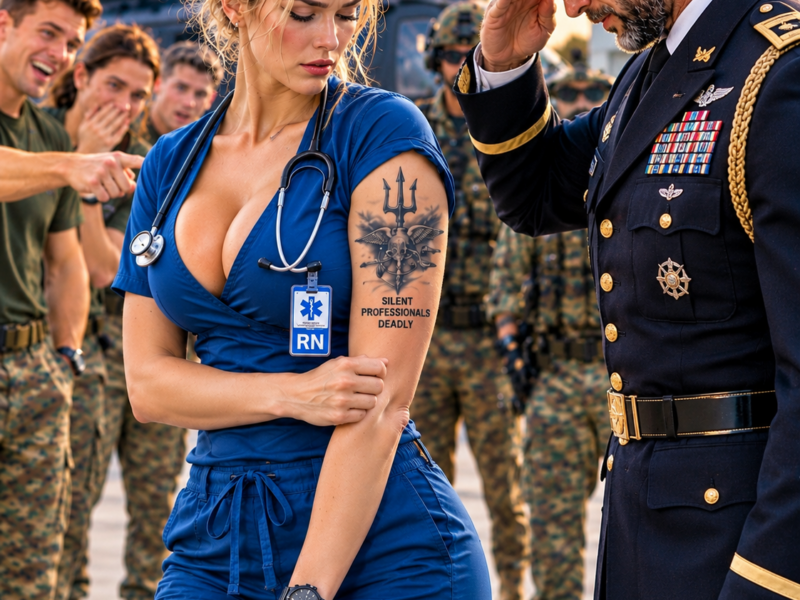
“They laughed when they saw the tattoo on my shoulder. One called it a fake soldier’s souvenir
For several seconds, nobody moved.
Thirty-seven soldiers stood at attention.
Sergeant First Class Logan Pierce was among them, his face pale and his jaw clenched.
Colonel Whitaker turned toward me.
“Staff Sergeant Hayes, would you mind telling them what happened?”
I looked at the soldiers.
I could have told them about the deployment.
I could have listed the missions, the medals, and the years I had spent treating wounded men under fire.
But none of that explained the tattoo.
So I began with the night I had almost stopped believing in its meaning.
“Five years ago,” I said, “I was assigned to an airborne medical support unit overseas. We were supporting a patrol that had been sent to recover civilians from a remote village.”
The room remained silent.
“The mission was supposed to take less than three hours. We had a small medical team, limited supplies, and an evacuation aircraft waiting at a temporary landing zone.”
I glanced at the colonel.
He nodded.
I continued.
“Our team leader was Captain Daniel Whitaker.”
The colonel’s expression tightened.
His son.
I had known that before I ever saw the tattoo.
But I had never expected to stand in front of his soldiers and explain what happened.
“Captain Whitaker was twenty-seven,” I said. “He was stubborn, impatient, and convinced that every problem could be solved if people stopped complaining and followed the plan.”
A few soldiers smiled faintly.
“He also remembered every soldier’s name. He knew who had children, who was struggling at home, and who hadn’t slept properly in three days.”
Colonel Whitaker looked down.
“That morning, we received a report that several civilians were trapped near an abandoned building. The patrol moved in. I stayed with the medical element until the first emergency call came through.”
I paused.
“The first casualty was a young soldier with a serious leg injury. The second had shrapnel wounds. The third was Captain Whitaker.”
The room seemed to shrink around me.
“Our radio traffic became confused. The patrol was taking fire, and the planned evacuation route was blocked. The aircraft couldn’t land where we expected.”
I remembered the dust.
The noise.
The terrible feeling of knowing that people were hurt somewhere beyond my reach.
“I loaded what medical supplies I could carry and moved toward the patrol’s last reported position.”
A soldier near the front shifted his weight.
I looked at him.
“When you’re a medic, you don’t get to choose whether someone is worth saving. You don’t get to decide that a person is too difficult, too stubborn, or too far away.”
I continued.
“You go because someone needs you.”
I could still see the scene as clearly as if it had happened yesterday.
Captain Whitaker was trapped behind a damaged vehicle.
His left leg was injured.
His shoulder was bleeding.
He had been trying to help another soldier when the second explosion hit.
I reached him just as he was attempting to stand.
“Captain, sit down.”
He looked at me.
“Hayes, we need to move.”
“You’re not moving anywhere until I check that leg.”
“That’s an order.”
“Then consider this a medical disagreement.”
Even in pain, he laughed.
That was the last time I heard him laugh.
I told the soldiers what happened next.
“We stabilized the wounded as best we could. But the situation deteriorated. Our extraction window was closing, and the patrol was running out of ammunition.”
I looked at Colonel Whitaker.
“Captain Whitaker told me to leave him.”
The colonel’s eyes filled slightly.
“He said the other wounded needed to get out first. He said he could wait.”
I took a breath.
“I told him no.”
Nobody moved.
“I told him that my job wasn’t to leave people behind because the situation was difficult. It was to get them home if there was any way to do it.”
I remembered the argument.
The shouting.
The radio operator telling us the aircraft had to depart.
Captain Whitaker had grabbed my sleeve.
“Hayes, listen to me. You have to get them out.”
I had looked at him.
“I’m not leaving you.”
He had stared at me for a long moment.
Then he said something I never forgot.
“Make sure the others get home.”
I nodded.
And I made a promise.
I would get him home, too.
We moved the first wounded soldier to the evacuation point.
Then the second.
By the time I returned, Captain Whitaker’s condition had worsened.
He was losing blood.
His leg was badly damaged.
I applied another dressing and prepared him for movement.
He was barely conscious.
I called for help.
The radio answered with static.
I tried again.
Nothing.
So I did what I had been trained to do.
I improvised a carry system using the equipment available.
I secured him as carefully as I could and began moving toward the alternate extraction point.
The ground was uneven.
The air was thick with dust.
Every step felt like it took an hour.
At one point, I fell.
My knee struck a piece of broken concrete.
I remember looking down and seeing blood on my trousers.
Then I heard Daniel’s voice.
“Hayes.”
He was still conscious.
“Keep moving.”
I looked at him.
“You’re not allowed to give me orders right now.”
He smiled weakly.
“Then consider it a request.”
I kept moving.
When we reached the extraction point, the aircraft was already preparing to lift.
The crew chief saw us.
He jumped down.
Together, we loaded Daniel aboard.
I climbed in after him.
And then I started working.
I treated his injuries throughout the flight.
I monitored his breathing.
I controlled what bleeding I could.
I kept talking to him because I was afraid that if I stopped, he might not stay with me.
He survived the flight.
He made it to surgery.
But his injuries were severe.
I stayed outside the operating room for hours.
When the surgeon finally came out, he told me Daniel was alive.
I sat down on the floor.
I couldn’t stand anymore.
The colonel looked at me.
“Why didn’t you tell me?”
I met his eyes.
“Because I was ordered not to discuss the details of the mission while the investigation was underway.”
He nodded slowly.
I continued.
“Daniel survived, but he didn’t return to active duty. His recovery was long. He lost part of his leg and needed multiple surgeries. He eventually moved into a rehabilitation program.”
The colonel swallowed.
“I visited him,” he said quietly.
I looked at him.
“I know.”
That was the part I hadn’t expected him to say.
He had visited his son.
He had been there during the long recovery.
But he hadn’t known who had carried him out of that combat zone.
“I didn’t want a medal,” I said. “I didn’t want recognition. I wanted him to have a chance to live the rest of his life.”
I touched the tattoo on my shoulder.
“The words came later.”
Never Leave One Behind.
“I got it after I left the Army. It wasn’t for anyone else. It was a reminder to myself that no matter how bad things got, I had to remember why I became a medic.”
The room remained silent.
Then Colonel Whitaker turned toward the formation.
“Do you understand what you’ve been laughing at?”
Nobody answered.
He looked directly at Sergeant Pierce.
“Sergeant First Class Pierce. Step forward.”
Pierce stepped out.
“Yes, sir.”
“Did you question Staff Sergeant Hayes about her tattoo?”
“Yes, sir.”
“Did you imply she had no right to wear it?”
Pierce hesitated.
“Yes, sir.”
“Did you mock her professional judgment during today’s medical exercise?”
“Yes, sir.”
The colonel waited.
Pierce’s face reddened.
“I did, sir.”
“Why?”
Pierce glanced toward me.
“I assumed she was exaggerating her background.”
“Based on what?”
He said nothing.
The colonel’s voice grew firmer.
“Based on the fact that she was a woman? Based on the fact that she was a nurse? Based on the fact that she didn’t spend the morning telling everyone how impressive she was?”
Pierce looked down.
“I made an assumption, sir.”
“You made several.”
The colonel turned toward the formation.
“Every person in this room needs to understand something. Rank, experience, and reputation do not give you permission to humiliate someone whose service you don’t understand.”
He pointed toward the medical station.
“Staff Sergeant Hayes corrected a dangerous mistake during this exercise. Instead of listening, you made her the target of a joke.”
He looked back at Pierce.
“You will submit a written account of your conduct. You will also complete the medical safety review that you interrupted. And you will apologize to the soldiers whose training was compromised by your behavior.”
“Yes, sir.”
The colonel paused.
“And you will do it without making excuses.”
“Yes, sir.”
Pierce turned toward me.
For a moment, he looked as if he wanted to say something.
Then he stopped.
“Staff Sergeant Hayes, I apologize. I was disrespectful. I judged you without knowing your history, and I dismissed your medical concerns.”
I studied him.
“Thank you.”
He looked surprised.
I continued.
“But I want you to remember something more important than my history. The next person you dismiss might not have a tattoo, a uniform, or a record you can look up. They might simply be someone trying to stop you from making a mistake.”
Pierce nodded.
“I understand.”
“I hope so.”
The colonel turned toward the soldiers.
“Formation, attention!”
Thirty-seven boots struck the floor.
He stood straight.
“Today, you have heard about a medic who refused to abandon a wounded soldier. That is not a story about a tattoo. It is a story about duty.”
He paused.
“Staff Sergeant Hayes, please stand with us.”
I hesitated.
“Sir, I’m assigned to the medical staff.”
“I know where you’re assigned.”
He gestured toward the open space beside him.
“Please.”
I stepped forward.
The soldiers remained at attention.
Colonel Whitaker faced them.
“Present arms.”
The movement was immediate.
Hands rose.
Boots stayed still.
Thirty-seven soldiers rendered a salute.
I felt my throat tighten.
I returned it.
Not because I needed the recognition.
Because I understood what it meant.
When the salute ended, the colonel turned toward me.
“Thank you for bringing my son home.”
I shook my head.
“Sir, he did the hard part. He survived.”
The colonel smiled sadly.
“He tells the story differently.”
I looked at him.
“What does he say?”
“He says you were the most stubborn medic he ever met.”
I laughed.
“That sounds accurate.”
The colonel’s expression softened.
“He also says you never let him believe he was alone.”
For a moment, I couldn’t speak.
Then he handed me a folded piece of paper.
“There’s something else.”
I opened it.
It was an invitation to a small ceremony scheduled for the following week.
The Army medical unit was recognizing several service members for their work during past deployments.
My name was listed.
I stared at it.
“I don’t need this, sir.”
“I know.”
“Then why?”
“Because there are people in this building who should know what good service looks like. Not because they need to admire you. Because they need to understand the responsibility they carry.”
I looked across the room.
The young private who had asked about my tattoo was still standing near the front.
His eyes were fixed on the invitation.
The colonel followed my gaze.
“Private?”
The young man straightened.
“Sir!”
“Do you have something to say?”
The private swallowed.
“Staff Sergeant Hayes, I wanted to ask you something earlier.”
I smiled.
“Go ahead.”
He looked at the tattoo.
“Did you ever regret going back for him?”
The question caught me off guard.
I thought about the night.
The blood.
The broken vehicle.
The sound of the aircraft engines.
I thought about the months of rehabilitation that followed.
And the years Daniel had spent learning to walk again.
“No,” I said.
The private nodded.
“Even though you could have been hurt?”
“Yes.”
“Why?”
I looked at him carefully.
“Because I knew what would happen if I left him. I would have spent the rest of my life wondering whether there was something else I could have done.”
He considered that.
“But what if you hadn’t made it?”
“Then someone else would have had to make a difficult decision. That’s part of service.”
I paused.
“But don’t confuse courage with doing something reckless. We had a plan. We had training. We used what we knew. And we kept trying.”
The private nodded.
“Thank you, ma’am.”
I returned to the medical station.
The exercise was delayed while the instructors reviewed the mistakes.
I helped them identify the airway issue and the evacuation error.
Pierce stayed behind.
He listened.
He took notes.
He didn’t interrupt.
It wasn’t a miracle.
One apology didn’t transform a person.
But it was a beginning.
The following week, I attended the recognition ceremony.
It was held in a modest auditorium on base.
No elaborate decorations.
No television cameras.
Just a small group of soldiers, officers, medical personnel, and family members.
Colonel Whitaker spoke first.
He described the importance of medical readiness and the responsibility of every soldier to protect the people beside them.
Then he invited me to the front.
I walked up, uncomfortable with the attention.
The citation recognized my service during the deployment and my role in the evacuation of Captain Daniel Whitaker.
It also acknowledged my later work in military medical training.
I accepted it.
I didn’t make a speech.
I simply said thank you.
After the ceremony, the colonel approached me.
“My son asked whether you’d be willing to see him.”
I looked at him.
“Where is he?”
“At the rehabilitation center. He’s been asking for weeks.”
I smiled.
“Then I think it’s time.”
The next morning, I drove to the facility.
I had visited Daniel once after the mission.
But that had been years ago.
We had exchanged a few messages since then.
His recovery had taken him through several difficult stages.
He had learned to walk with a prosthetic.
He had returned to civilian life.
He had even started working with a veterans’ support organization.
But we had never really talked about that night.
When I entered the rehabilitation garden, he was sitting on a bench.
His father stood nearby.
Daniel looked up.
For a moment, neither of us moved.
Then he smiled.
“Hayes.”
I laughed.
“Captain.”
He shook his head.
“Don’t call me that.”
“Then stop calling me Staff Sergeant.”
He stood carefully.
His prosthetic leg was visible beneath his trousers.
I walked toward him.
“It’s good to see you.”
He nodded.
“It’s good to be seen.”
We shook hands.
Then he surprised me by pulling me into a hug.
I held on for a moment.
“Your father told me about the ceremony,” he said.
“He invited me.”
“He’s been waiting a long time to thank you.”
I glanced toward the colonel.
“I didn’t do anything special.”
Daniel pulled back.
“That’s not what I remember.”
I looked at him.
“You were the one who kept telling me to leave.”
“Because I was trying to be noble.”
“You were being difficult.”
He laughed.
“Fair.”
We sat together.
For a while, we talked about ordinary things.
The hospital.
His work.
The weather.
The terrible coffee at the rehabilitation center.
Then Daniel looked at my shoulder.
“Still got it?”
I moved the fabric slightly so he could see the tattoo.
“Of course.”
He studied the words.
“Never Leave One Behind.”
I nodded.
He looked down at his hands.
“I’ve thought about that night a lot.”
“So have I.”
“I used to feel guilty.”
“About what?”
“About you having to carry me. About what happened to your knee. About the time you spent recovering afterward.”
I shook my head.
“Daniel, I was a medic. I made a decision. You were wounded. That was the job.”
“But—”
“No.”
I placed a hand on his shoulder.
“You don’t owe me your life. You owe yourself the chance to live it.”
He stared at me.
Then his eyes became wet.
“I’ve been trying.”
“I can see that.”
He smiled.
“I’m working with a group that helps injured service members return to civilian life. I tell them what I learned during rehabilitation.”
“That’s good work.”
“Sometimes I tell them about you.”
I raised an eyebrow.
“Please don’t.”
He laughed.
“I tell them about the medic who wouldn’t listen to a captain.”
“That sounds like a terrible example.”
“It sounds like exactly the example they need.”
We sat until the afternoon sun began to fade.
When I finally stood to leave, Daniel walked with me toward the entrance.
He moved slowly.
But he was moving.
And that was enough.
As I drove back to the training facility, I thought about the soldiers who had laughed at my tattoo.
I thought about Pierce.
I thought about the private who had asked whether I regretted going back.
The truth was that I had never regretted the decision.
But I had regretted how long I carried the memory alone.
For years, I had treated the tattoo as something private.
A reminder.
A promise.
A way to remember the people who had not made it home.
Now I understood that it could also be a lesson.
Not about medals.
Not about rank.
Not about who had the most impressive record.
About responsibility.
About listening.
About never deciding that another person’s life was less important because saving it was inconvenient.
Two months later, I returned to the training facility for another exercise.
The first thing I noticed was the new sign outside the medical station.
It read:
MEDICAL SAFETY IS EVERYONE’S RESPONSIBILITY.
Inside, the soldiers were preparing their equipment.
Pierce was there.
He approached me with a clipboard.
“Staff Sergeant Hayes.”
“Sergeant.”
“We revised the casualty response sequence based on your recommendations.”
I reviewed the document.
It was thorough.
The airway protocol was corrected.
The evacuation procedures had been updated.
The instructors had added a mandatory medical stop when a casualty showed signs of distress.
“Looks good,” I said.
Pierce nodded.
“Thank you.”
He hesitated.
“There’s something else.”
I looked up.
“Go ahead.”
“I spoke with the soldiers after the incident. I told them I was wrong to mock you. I also told them that I shouldn’t have dismissed your medical concerns.”
I studied him.
“How did they take it?”
“Some were surprised.”
“And the others?”
He gave a small, embarrassed smile.
“They said it was about time.”
I laughed.
“That sounds fair.”
He looked toward my shoulder.
“Can I ask about the tattoo now?”
I considered him for a moment.
“You can.”
“What does it mean to you now?”
I looked down at the words.
Never Leave One Behind.
“It means I don’t measure a person’s worth by how easy they are to help.”
Pierce nodded slowly.
Then he stepped aside to let the soldiers pass.
The exercise began.
This time, when I stopped a simulation because a casualty’s condition had been overlooked, nobody argued.
The instructor called for a pause.
The team reviewed the mistake.
They corrected it.
And they continued.
It was a small change.
But small changes were how people learned to trust each other.
At the end of the day, the young private approached me again.
He had been promoted.
His name tape read CARTER.
“Ma’am?”
“Yes, Private?”
“I’ve been thinking about what you said.”
“About what?”
“Courage isn’t ignoring fear. It’s knowing what matters more.”
I smiled.
“That’s a good way to put it.”
He glanced at the tattoo.
“Do you think I’ll ever earn something like that?”
I shook my head.
“Don’t spend your life trying to earn someone else’s symbol. Find the promise you want to keep. Then live up to it.”
He nodded.
“I’ll remember that.”
As I walked out of the training building, I saw Colonel Whitaker waiting near the entrance.
He was holding a photograph.
“Thought you might like this.”
I took it.
It showed Daniel standing between his father and several former members of our medical team.
Everyone was smiling.
On the back, Daniel had written:
“Thanks for refusing to leave me behind.”
I held the photograph for a long moment.
Then I slipped it into my pocket.
The colonel watched me.
“You know,” he said, “my son used to believe that being strong meant never needing help.”
I looked at him.
“And now?”
“Now he tells young soldiers that surviving sometimes means letting someone carry you.”
I smiled.
“That’s a lesson worth learning.”
The colonel nodded.
Then he looked toward the tattoo on my shoulder.
“I’m glad you kept it.”
“So am I, sir.”
He extended his hand.
I shook it.
And for the first time in years, I didn’t feel the need to hide the words beneath my sleeve.
I walked toward my car.
The tattoo was still there.
The memory was still there.
But the guilt had finally become something else.
A reminder that one person’s life could change because another person refused to walk away.
And if those soldiers remembered anything from that day, I hoped it wasn’t the story of a medic who carried a wounded captain through a combat zone.
I hoped they remembered the simpler lesson.
Respect the person standing beside you.
Listen when someone warns you.
And never mistake a quiet voice for a weak one.
The End.









