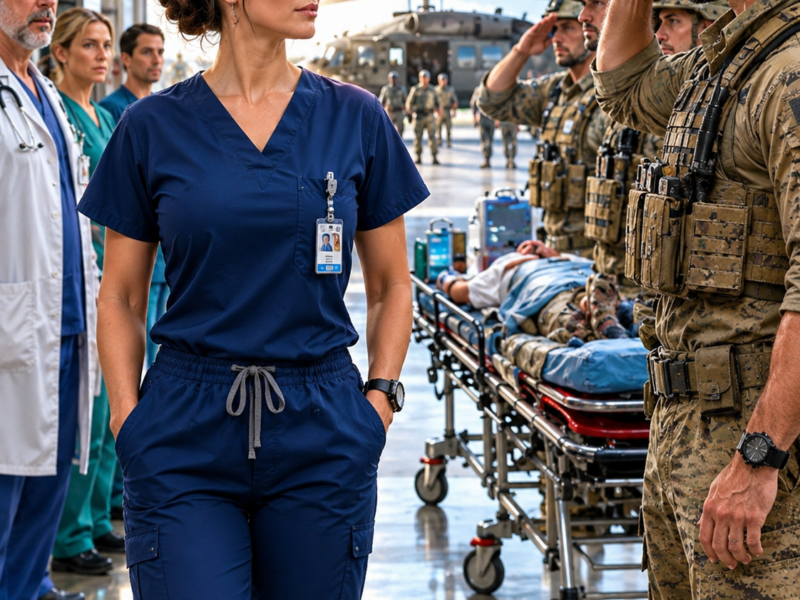
“They laughed when the quiet new nurse struggled to lift a trauma bag, called her useless, and told her she didn’t belong in an emergency department
I stared at Captain Reeves, unable to answer.
The black case.
Three years earlier, I had carried it down a mountain while gunfire echoed through the valley. It was small, matte black, and secured with a biometric lock. Michael Grant had handed it to me moments before he disappeared.
“Whatever happens,” he had said, “don’t let Voss get this.”
I had asked him what was inside.
He had looked at me with an expression I had never forgotten.
“Proof.”
Then he had pushed me toward the extraction point.
I never saw him again.
“I don’t know what you’re talking about,” I told Reeves.
His eyes narrowed slightly.
“Emily, we don’t have time for this.”
“Then you shouldn’t have come here asking questions in a hospital hallway.”
Technical Sergeant Cole stepped closer.
“Ma’am, Michael specifically requested you.”
My chest tightened.
“Where is he?”
“We don’t know exactly. The transmission was relayed through an old emergency frequency. Our analysts traced it to a communications station outside Colorado Springs.”
“Then why are you standing here?”
“Because the message included a warning. Whoever sent it knew we were listening.”
Captain Reeves glanced toward the entrance.
“And someone else knows we found you.”
I followed his gaze.
A dark SUV had stopped outside the ambulance entrance.
Two men remained inside.
The driver was watching the hospital doors.
I recognized the vehicle.
Not because I had seen it before, but because I knew the kind of people who used vehicles like that when they wanted to look ordinary.
“Get away from the windows,” I whispered.
Reeves immediately understood.
“Cole.”
The sergeant moved toward the lobby.
Karen Whitmore appeared beside me.
“What is going on?”
“Please get the staff away from the entrance,” I said.
She stared at me.
“You don’t give orders here.”
“I know. But I need you to trust me for thirty seconds.”
Something in my voice made her hesitate.
Then the SUV’s rear door opened.
A man stepped out.
He wore a charcoal coat and carried no visible weapon. His hair was gray at the temples, and he walked with the calm confidence of someone who expected every door to open for him.
Colonel Richard Voss.
He looked through the glass and smiled.
Not warmly.
Recognizing me.
“That’s him,” I whispered.
Reeves moved between us and the entrance.
“Stay behind me.”
Voss entered the hospital with the two men from the SUV.
“Captain Reeves,” he said pleasantly. “I was hoping we could avoid a scene.”
“Then you shouldn’t have followed us.”
Voss ignored him.
His eyes settled on me.
“Emily Brooks. It’s been a long time.”
I didn’t answer.
He looked around the emergency department.
“I see you’ve found a quieter line of work.”
“Why are you here?”
“To make sure you aren’t dragged into something you don’t understand.”
A bitter laugh escaped me.
“I understood enough three years ago.”
His smile disappeared.
“Apparently not.”
Captain Reeves stepped forward.
“Colonel, we have orders to locate Staff Sergeant Grant.”
“Staff Sergeant Grant is missing. His status hasn’t changed.”
“Then why did you come here?”
Voss looked at him.
“Because your team has been chasing a ghost.”
I watched his face.
He wasn’t surprised by the recording.
He was trying to control what happened next.
“Did you hear the transmission?” I asked.
Voss turned toward me.
“I heard many things over the years.”
“Did you hear Michael?”
For the first time, something shifted in his expression.
A brief tightening around his eyes.
Then it was gone.
“Michael Grant is dead, Emily.”
“You said that before.”
“And I was correct.”
“You never recovered his body.”
Voss stepped closer.
“Some losses are difficult to accept. That doesn’t mean you should spend your life inventing conspiracies.”
I could feel my pulse in my fingertips.
He knew about the case.
He knew I had kept it.
And he was here because he believed I might finally reveal where it was.
Karen moved beside me.
“Colonel, this is a hospital. You cannot intimidate my employees.”
Voss gave her a polite glance.
“I’m not intimidating anyone.”
“You’re disrupting patient care.”
“Then I’ll be brief.”
He looked directly at me.
“Emily, I need you to come with me.”
“No.”
His expression hardened.
“You don’t know what you’ve kept.”
“I know enough to know you shouldn’t have it.”
A silence fell over the hallway.
Voss leaned closer.
“Think carefully. There are people who died because you made the wrong decision on that mountain.”
I remembered the extraction.
The smoke.
The screaming over the radio.
Michael’s final command.
And the sound of a helicopter lifting away without him.
“You left him there,” I said.
Voss’s jaw tightened.
“I made the only decision possible.”
“You left him.”
“I saved the rest of your team.”
“You told us the area was clear.”
His eyes sharpened.
“Be careful.”
“Then tell me why Michael’s voice came through that transmission.”
Voss looked at Reeves.
“Take her off duty if you have to. She is clearly distressed.”
Reeves didn’t move.
“Colonel, you’re not authorized to remove a civilian employee from her workplace.”
Voss gave a small nod to the man behind him.
The man reached inside his coat.
Cole reacted instantly.
“Hands where I can see them!”
The emergency department went silent.
Karen gasped.
A patient began crying in the next room.
I stepped forward.
“Don’t do this here.”
The man froze.
Voss lifted one hand.
“Enough.”
His expression was no longer friendly.
“Emily, you have one opportunity to walk away from this. Give me the case, and everyone can go back to their lives.”
I stared at him.
“Where is Michael?”
Voss said nothing.
That was my answer.
He hadn’t come to retrieve a dead man’s belongings.
He had come to silence someone who was still alive.
“I’m not giving you anything,” I said.
Voss studied me for a long moment.
Then he turned.
“Captain, this conversation isn’t finished.”
He and his men left.
Through the glass, I watched the SUV disappear into traffic.
Reeves waited until it was gone before speaking.
“We need to move.”
“Where?”
“To a secure location.”
I looked toward Karen.
She was still standing beside the nurses’ station, pale and furious.
“Emily, I need an explanation.”
“I know.”
“Now.”
I swallowed.
“Three years ago, I was assigned to a combat pararescue team in Afghanistan. We were sent to recover an intelligence officer from a remote communications site. The operation was compromised. We lost contact with our extraction aircraft, and Staff Sergeant Grant disappeared.”
Karen looked at me as if she were seeing a different person.
“You were a combat medic?”
“A pararescue medic.”
“Why didn’t you tell us?”
“Because I wanted this job to be about the patients, not what happened before.”
She glanced toward the doors.
“And now?”
“Now someone from that mission may be alive.”
Karen’s expression softened slightly.
“Your patients still need you.”
“I know.”
“Then don’t leave them without a plan.”
For the first time that morning, I felt something close to gratitude.
I gave her a quick report on my assignments. Another nurse agreed to cover my remaining patients, and Karen personally signed the transfer sheet.
She didn’t apologize.
But she stopped treating me like a problem.
Before I left, she caught my arm.
“Emily.”
I turned.
“Whatever happened over there, don’t let those men decide who you are here.”
I nodded.
Then I followed Reeves and Cole outside.
A military vehicle waited at the far end of the parking lot.
As we drove away, Reeves handed me a secure tablet.
“We found the source of the transmission.”
A map appeared.
An abandoned communications station sat twenty miles west of the city, near an old mountain road.
“Why would Michael be there?”
“We think someone is using the station to relay messages without going through official military channels.”
“Someone helping him?”
“Maybe.”
I stared at the map.
“Or someone keeping him there.”
Reeves didn’t answer.
After several minutes, he spoke again.
“There’s something else you should know. The transmission contained an authentication phrase from your old unit.”
“What phrase?”
“Blue Lantern.”
My stomach tightened.
Only four people had used that phrase.
Michael.
Me.
Our radio operator, Sergeant Aaron Pike.
And Colonel Voss.
“Where’s Pike?”
“Retired. Living in New Mexico.”
“Is he involved?”
“We don’t know.”
I looked out the window.
“Then we have a problem.”
Reeves nodded.
“That’s why I need you to tell me where the case is.”
I turned toward him.
“I won’t give you its location until I know who’s receiving it.”
“Emily, I’m not asking you to hand it over. I’m asking you to help us secure it.”
“Who authorized this operation?”
“General Harlan.”
“Which Harlan?”
“Major General David Harlan. Air Force Special Operations Command.”
I watched his face.
He was telling the truth as far as he knew.
But three years earlier, I had learned that official authorization didn’t always mean honest intentions.
“Call him,” I said.
Reeves frowned.
“Now?”
“On a secure line. Let me hear him confirm that he knows about the case.”
He studied me, then nodded.
A few minutes later, a call connected.
A deep voice answered.
“Reeves.”
“Sir, I have Emily Brooks with me.”
There was a pause.
“Emily.”
I closed my eyes.
General Harlan had been the officer who personally informed our families that the mountain mission had ended in tragedy.
“General.”
“I’m glad you’re alive and well.”
“Thank you, sir.”
“We need your cooperation. Michael Grant may be alive. We believe he has information connected to a serious criminal investigation.”
“What investigation?”
Another pause.
“Misappropriation of military equipment, falsified operational records, and unauthorized payments to a private defense contractor.”
I felt cold.
The black case.
It had never contained a weapon or a classified device.
It contained evidence.
Financial records, audio files, and copies of mission orders that showed military equipment had been diverted through a contractor called Northstar Tactical.
The equipment had appeared in places it was never supposed to be.
Some of it had ended up in the hands of armed groups.
And the people who questioned the shipments had been labeled unreliable, reassigned, or declared casualties.
“Was Colonel Voss involved?” I asked.
The line went quiet.
“Emily, that matter is under review.”
“That’s not an answer.”
“I cannot discuss an ongoing investigation over this channel.”
“Then I can’t tell you where the evidence is.”
Reeves looked at me.
The general sighed.
“Your caution is understandable. I will arrange an independent inspector general representative to meet you.”
“When?”
“Within the hour.”
I nodded.
“Then I’ll cooperate.”
The call ended.
Reeves put the tablet away.
“You could have told us that earlier.”
“I could have.”
“Why didn’t you?”
“Because the last time I trusted a senior officer, my team was abandoned.”
He didn’t argue.
We reached a secured Air Force facility just before four.
I was escorted into a small conference room. A woman in civilian clothes waited inside. She introduced herself as Special Agent Laura Mitchell, from the Air Force Office of Special Investigations.
She placed her credentials on the table.
“I’ve reviewed the original mission report,” she said. “I also reviewed the transmission you heard.”
“Then you know Michael may be alive.”
“I do.”
“Do you know where he is?”
“We have a likely location. But we need the case to confirm the identities of the people involved.”
I sat down.
“Why now?”
Mitchell opened a folder.
“Because a Northstar Tactical executive was found dead last week. Before he died, he sent an encrypted message to a former military contact. That message contained a reference to your old unit.”
“Who was the contact?”
“Sergeant Aaron Pike.”
I felt the room shrink.
“Pike received it?”
“He did. He contacted us yesterday.”
“Where is he?”
“Under protective custody.”
“Is he safe?”
Mitchell hesitated.
“We believe so.”
That hesitation told me everything.
I leaned forward.
“Agent Mitchell, I want to see him.”
“That’s not possible yet.”
“Then tell me what happened.”
She opened another document.
“Pike says he helped Michael escape from a holding site six months after the mission. He also says Michael was injured and needed medical care.”
“Why didn’t he contact us?”
“According to Pike, he tried. The communications were intercepted.”
I looked down at my hands.
Six months.
Michael had been alive for six months after we were told he was dead.
“Where was he held?”
“An unregistered medical facility operated under a Northstar subcontract.”
My throat tightened.
“They kept him alive?”
“Apparently.”
“Why?”
“To force him to reveal where the evidence was hidden.”
I stared at the folder.
They had tortured him for information he didn’t have.
He had trusted me with the case, and I had spent three years believing he was dead.
“Does he know where I am?”
“Yes.”
“Then take me to him.”
Mitchell closed the folder.
“We’re working on that.”
“That’s not good enough.”
“Emily, you need to understand that we don’t know who is compromised. If we move too quickly, we could lose him again.”
I stood.
“And if we wait?”
She met my eyes.
“We may lose him anyway.”
For several seconds, neither of us spoke.
Then a technician entered the room.
“Agent Mitchell, we have a problem.”
She turned.
“What?”
“The communications station just went offline.”
Reeves stood immediately.
“Did you get a location?”
“Not exactly. But we received another short transmission before it dropped.”
The technician played it.
Static.
A breath.
Then Michael’s voice.
“Emily… don’t bring the case.”
A pause.
“It’s a trap.”
The recording ended.
I felt the floor shift beneath me.
Mitchell grabbed her radio.
“Lock down the station. Send a team to the coordinates.”
Reeves looked at me.
“What does he mean, it’s a trap?”
I knew exactly what he meant.
Someone wanted the case.
And someone had convinced Michael that I was the one bringing it.
I took a breath.
“Where is the case?”
Mitchell looked at me.
“Emily—”
“It’s in a storage locker in Pueblo. I placed it there under a false name three years ago.”
Reeves reached for his phone.
“Then we’ll secure it.”
“No.”
He stopped.
“I’ll show you where it is. But no one touches it until Agent Mitchell verifies the chain of custody and confirms the general’s authorization in writing.”
Mitchell nodded.
“Agreed.”
We left the facility with two investigators and a security detail.
The storage facility was nearly empty when we arrived. I walked past rows of metal doors until I reached Unit 214.
My hands trembled as I entered the access code.
The lock clicked.
Inside sat an old duffel bag, a folded jacket, and a cardboard box.
I moved the box aside.
The black case was underneath.
For three years, I had imagined opening it.
For three years, I had wondered whether it contained enough evidence to explain why Michael had vanished.
Now, standing in front of it, I wasn’t sure I wanted to know.
Mitchell approached.
“Is that it?”
I nodded.
She examined the lock and photographed the serial number.
“Don’t open it yet.”
“I know.”
A sound came from the corridor.
Footsteps.
Reeves turned.
“Who’s there?”
A man appeared at the end of the aisle.
He wore a dark jacket and held a phone.
For one terrible second, I thought it was Voss.
But it wasn’t.
It was Sergeant Aaron Pike.
He looked older, thinner, and frightened.
“Emily,” he whispered.
I took one step toward him.
“Pike?”
He glanced behind him.
“We need to leave.”
Mitchell moved forward.
“Sergeant Pike, stay where you are.”
He shook his head.
“You don’t understand. They found out I talked.”
“Who?”
Pike looked directly at me.
“Voss.”
A sharp metallic crash sounded outside.
Then another.
Reeves drew his weapon.
“Everyone down!”
The storage unit lights went dark.
A flashlight beam swept across the corridor.
Someone shouted.
I heard running footsteps and the crack of a gunshot.
Mitchell pulled me behind a concrete pillar.
“Stay down!”
Pike was still near the entrance.
“Get the case!” he shouted.
I crawled toward the duffel bag.
A shadow moved across the doorway.
Then a familiar voice cut through the darkness.
“Emily!”
My heart stopped.
“Michael?”
A figure stumbled into the unit.
He was thinner than I remembered, with a beard, a scar across his forehead, and one arm held close to his body.
But his eyes were unmistakable.
Michael Grant.
Alive.
He looked at me for a second, and I saw the same man who had stood beside me on that mountain.
Then his gaze shifted to the case.
“Don’t open it,” he said.
I moved toward him.
“Michael, you’re hurt.”
“Later.”
He caught my wrist.
“Listen to me. The case isn’t what Voss is after anymore.”
“What do you mean?”
Michael glanced toward the corridor.
“He already has a copy.”
The words hit me harder than the gunfire.
“Then why did he keep looking for this?”
“Because the original contains something he can’t erase.”
He reached into his jacket and pulled out a small memory card.
“Something that proves who gave the order.”
Before I could ask another question, a voice echoed through the storage facility.
“Emily Brooks!”
Colonel Voss.
He was standing beyond the corridor, surrounded by armed men.
“Put the case down,” he called. “And step away from Grant.”
Michael tightened his grip on my wrist.
“Don’t trust anyone who says they’re here to save you.”
I looked at Mitchell.
She had her weapon raised, but her expression had changed.
“Agent?” I whispered.
She didn’t answer.
Voss stepped into view.
“Emily, you have no idea how many people have died because of that case.”
I stood between Michael and the doorway.
“I know exactly how many.”
His expression darkened.
“Then you know why this has to end.”
He raised one hand.
His men moved forward.
And then Agent Mitchell lowered her weapon.
For one horrifying moment, I thought she had chosen his side.
But she turned toward Voss.
“Colonel Richard Voss,” she said, “you are under investigation for conspiracy, obstruction, and the unlawful detention of a United States service member.”
Voss laughed.
“You think that badge protects you?”
“No,” she replied. “The recording does.”
She held up a small device.
The storage facility filled with Voss’s own voice.
If Grant survives, make sure he never reaches a tribunal. The evidence is worth more than the men.
Voss’s face went white.
Michael closed his eyes.
I understood then.
The memory card wasn’t just evidence of the theft.
It contained the order that had condemned our team.
Voss lunged toward Mitchell.
Reeves tackled him before he reached her.
The armed men behind Voss hesitated. One dropped his weapon. Another stepped away from the doorway.
Within seconds, the facility filled with the voices of investigators calling out commands.
I barely heard them.
I was holding Michael.
“You’re really here,” I whispered.
He gave a weak smile.
“I’m sorry it took so long.”
I shook my head.
“Don’t apologize.”
His knees buckled.
I caught him before he fell.
“Medical team!” I shouted.
For the first time in three years, I wasn’t trying to hide what I knew.
I was doing what I had always done.
Keeping someone alive.
The next several hours passed in fragments.
Michael was taken to a military hospital under armed protection. Doctors discovered an old fracture that had healed badly, nerve damage in his left arm, and complications from years of inadequate treatment.
He was exhausted, dehydrated, and dangerously underweight.
But he was alive.
I stayed beside his bed until he woke.
When his eyes opened, he looked around the room.
“Did we get Voss?”
“Yes.”
“And the case?”
“Secured.”
He exhaled.
“Good.”
I sat closer.
“Michael, why didn’t you tell me you were alive?”
His eyes moved toward the window.
“Because I couldn’t.”
“Pike said he helped you escape.”
“He did. But we were watched. Every message we sent was intercepted.”
“You could have found a way.”
He looked at me.
“I tried.”
His voice cracked.
“Emily, I heard your name on a recording. They told me you’d been killed during a separate operation. I thought you were gone.”
I felt tears rise.
“Who told you that?”
“Voss’s people.”
I looked down.
“They told me you were dead, too.”
Michael nodded.
“They wanted us isolated. If we believed everyone else was gone, we couldn’t coordinate.”
I took his hand.
“You should have known I wouldn’t disappear.”
He managed a faint smile.
“I know that now.”
The investigation continued for months.
The black case contained original financial records, intercepted communications, and copies of mission orders. The memory card Michael had carried contained a recording of Voss directing the abandonment of our team after we discovered the illegal shipments.
It also revealed that Voss had worked with two Northstar executives to falsify casualty reports and conceal the disappearance of military personnel who could testify.
Aaron Pike provided a full statement.
He admitted he had initially helped Voss cover up the operation because he feared for his family. Later, he helped Michael escape and secretly contacted investigators.
Pike was not excused for his part in what happened.
But his testimony helped expose the entire network.
Colonel Voss was arrested and charged. Several officers and contractors were removed from their positions. The investigation revealed that our mission had never been a routine recovery operation.
We had been sent to retrieve an intelligence officer who had uncovered the theft.
When we found the evidence, the people responsible decided our team was expendable.
The official report had called it a failed extraction.
The truth was that our helicopter had been ordered away.
Michael had survived because a local family hid him after he crawled from the wreckage of a secondary transport vehicle. Later, Pike located him and arranged medical care through an illegal facility.
It had taken three years for the truth to reach daylight.
At the formal hearing, I sat behind Michael as he testified.
His voice was still weak, but every word was clear.
When the prosecutor asked whether he recognized the voice on the recording, Michael looked directly at Voss.
“Yes,” he said. “That was the commanding officer who ordered us abandoned.”
Voss stared straight ahead.
He didn’t look at us again.
After the hearing, Michael and I walked slowly through the courthouse courtyard.
He leaned on a cane.
“You going back to the hospital?” he asked.
“Tomorrow.”
He smiled.
“I thought you might.”
“I still have patients who need me.”
He looked at me for a long moment.
“You know, you never stopped being a pararescue medic.”
“I know.”
“You just changed the battlefield.”
I looked at the sky.
For years, I had believed that leaving the military meant leaving a part of myself behind. I had tried to become someone who never had to remember the sound of gunfire or the feeling of a teammate slipping away.
But I hadn’t needed to erase that woman.
I had needed to understand her.
A week later, I returned to St. Catherine’s.
Karen was waiting near the nurses’ station.
She looked at me, then at the small scar on Michael’s arm where he had visited me the previous afternoon.
“I owe you an apology,” she said.
I raised an eyebrow.
“For what?”
“For deciding who you were before I knew anything about you.”
I nodded.
“Thank you.”
She hesitated.
“And for what it’s worth, the trauma team has been asking when you’re coming back.”
I smiled.
“I’m already here.”
The next shift was busy.
A child arrived with a broken arm. An elderly patient needed help breathing. A young construction worker came in with a deep cut across his palm.
The ordinary emergencies kept coming.
I tied my hair back, washed my hands, and stepped into the trauma bay.
Nobody called me useless.
Nobody asked whether I belonged.
And I no longer needed them to understand where I had been.
Because the Air Force had come looking for a missing combat pararescue medic.
They had found him.
But they had also found the woman who had spent three years believing she had failed him.
And this time, when someone needed help, I didn’t hesitate.
I was exactly where I was supposed to be.
THE END.









