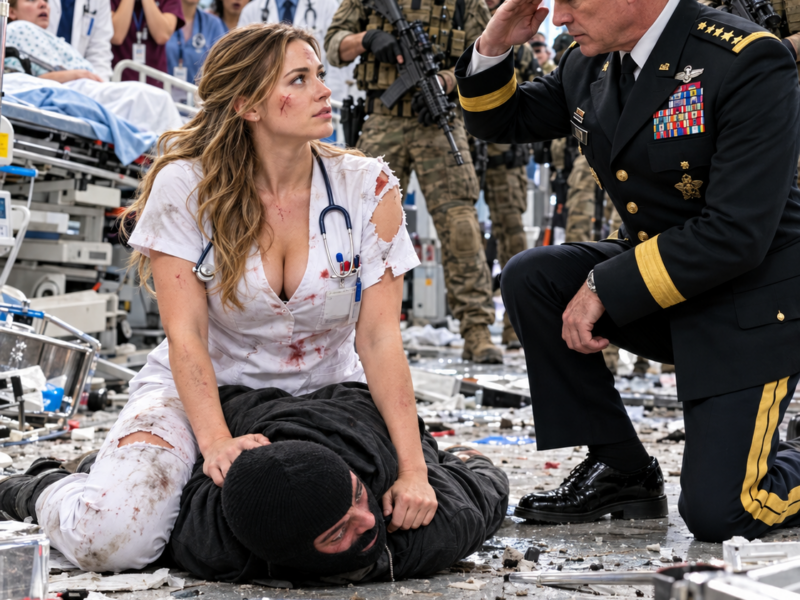
“They laughed when the new ER nurse dropped a tray in front of a room full of doctors, and the chief surgeon sneered, ‘Maybe someone like you should stick to changing bedpans’
The first thing I noticed after Daniel Brooks whispered those five words was that Captain Marcus Cole stopped breathing for half a second.
It was small. Almost invisible. But I had spent years learning to recognize the difference between a man who was surprised and a man who had just heard something he was desperately hoping no one else would hear.
“Don’t let them take the file.”
Daniel’s fingers tightened around my wrist. His pulse was weak, his skin cold, and blood was spreading beneath the pressure dressing on his abdomen. Yet his eyes were sharp enough to cut through every lie in the room.
“Daniel,” I said quietly, leaning closer, “what file?”
His lips moved, but no sound came out. His gaze shifted toward Cole again.
Then the monitor began screaming.
“His pressure is crashing!” a nurse shouted.
The room exploded into motion. I pushed every other thought aside and returned to the work my hands remembered better than my mind ever could.
“Two units of uncrossmatched blood. Get the trauma surgeon. Now!”
Grant Whitmore appeared in the doorway, already irritated. “What the hell is happening in my trauma bay?”
“Internal bleeding,” I answered. “He needs immediate surgical intervention.”
Whitmore looked at the six armed operators crowding the room, then at me. “I didn’t ask for your assessment, Nurse Hayes.”
“Then stop wasting time and call the operating room.”
His face hardened. “Excuse me?”
I met his eyes. “You can discipline me after he’s alive.”
For one tense second, neither of us moved. Then a second wave of blood appeared beneath Daniel’s dressing, and Whitmore finally turned toward the surgical team.
“Move him upstairs. Now!”
As the staff prepared the transfer, Cole stepped toward the bed.
“We’ll take custody of the patient,” he announced.
I moved between him and Daniel.
“No, you won’t.”
The room fell silent.
Cole stared at me as if he couldn’t believe what he’d heard. “Commander, this is a military matter.”
“Then you should have brought military doctors. Until he’s discharged from this hospital, he’s my patient.”
“Rebecca,” he said under his breath, dropping the formal title, “you don’t understand what you’re interfering with.”
That was the first honest thing he’d said all night.
I leaned closer so only he could hear me. “Then explain it.”
His jaw tightened. “Not here.”
“Then not at all.”
For a moment, the captain I remembered seemed to return. The young operator who had once followed my orders through gunfire without questioning whether I had a plan. Then his expression closed again.
“Take him to surgery,” he ordered his men. “Nobody leaves this floor without my authorization.”
I watched the operators exchange glances. Two followed Daniel’s bed. Another remained beside the door. The other three spread through the corridor, taking positions that made the nurses and patients stare.
This was not how a rescue operation looked.
It was how an extraction looked.
And suddenly, I remembered the last night of Operation Nightfall.
The rain. The smoke. The radio cutting out just as Daniel shouted that someone had betrayed our position. Three teammates missing before sunrise. An official report blaming a compromised route and an enemy ambush.
And me, standing in front of a closed briefing-room door while a colonel told me that asking further questions would endanger national security.
I had obeyed.
For six years, I had told myself that obedience was the only thing that had kept the survivors alive.
Now Daniel Brooks was lying on my operating table, and he had looked at the men sent to retrieve him as if they were the people he feared most.
I followed the surgical team upstairs.
Whitmore tried to stop me at the operating-room entrance.
“You’re not scrubbed in for this case,” he said. “You’re an emergency nurse, not a surgeon.”
“I know my job.”
“Then do it somewhere else.”
Before I could respond, the anesthesiologist called from inside. “We need someone who knows this patient’s history. He’s got old surgical scarring, possible prior vascular repair, and the medication records aren’t matching his condition.”
I looked at Whitmore. “That would be me.”
He hated that answer. I could see it in the way his mouth tightened.
But he stepped aside.
Inside the operating room, the world narrowed to bright lights, monitors, blood, and the precise rhythm of people doing difficult work under pressure. I assisted where I was permitted, provided the details I remembered about Daniel’s previous injuries, and helped the team identify a complication that could have cost him his life.
For nearly three hours, the operation swung between hope and disaster.
At 2:17 a.m., the surgeon finally stepped back.
“We’ve controlled the bleeding,” he said. “He’s critical, but he has a chance.”
I let out a breath I hadn’t realized I’d been holding.
Daniel was transferred to intensive care under strict monitoring. I washed the blood from my hands and stared at the water spiraling into the drain.
Six years ago, I had stood at his memorial holding a folded flag.
Tonight, I had watched him come back from the dead.
And he had warned me not to trust the people who brought him home.
When I returned to the corridor, Captain Cole was waiting.
“The file,” I said.
He glanced at the security cameras above us. “We need to talk somewhere private.”
“I’m done following people into private rooms without knowing why.”
His expression flickered with something close to regret.
“Fair enough.”
He reached into his jacket and pulled out a small black envelope. No insignia. No official seal. Just my name written across the front in block letters.
REBECCA HAYES.
“I was ordered to deliver this directly to you,” he said. “Under no circumstances was I supposed to let hospital security scan it or make a copy.”
I didn’t take it.
“Who gave you the order?”
“Colonel Adrian Vance.”
The name hit me like a physical blow.
Vance had led the review after Nightfall. He was the man who had stood beside me at Daniel’s memorial and told me that the team had died with honor. He was the man who signed the report declaring the mission unrecoverable.
And now he was sending messages through armed men at my workplace.
“What did he tell you was inside?” I asked.
“Instructions for your return to active service.”
I stared at the envelope.
“I’m a civilian.”
“He said you’d say that.”
“Then he should have known better than to send you.”
Cole lowered his voice. “Commander, I’m not here because I want to drag you back into the military. I’m here because the order came from someone who still has access to classified operations, and I don’t think everyone involved understands what this mission really is.”
“Are you telling me you disobeyed your orders?”
“I’m telling you I read the emergency summary before I accepted the assignment.”
“And?”
He hesitated.
“The people who attacked Daniel weren’t foreign operatives. They were using our equipment, our communications protocols, and credentials that should have been impossible to duplicate.”
My mouth went dry.
“Who were they?”
“We don’t know.”
“You expect me to believe six armed operators flew across the country to bring a wounded soldier to a civilian hospital without knowing who shot him?”
“No.” Cole looked directly at me. “I expect you to understand that someone wanted him alive long enough to reach you.”
Before I could answer, the ICU alarm sounded down the hall.
A nurse came running through the doors.
“Rebecca! He’s awake!”
I hurried to Daniel’s bedside.
His face was pale beneath the fluorescent lights. Tubes and monitors surrounded him, and every breath looked like an argument with his own body. But when he saw me, his eyes widened.
“Rebecca,” he rasped.
“I’m here.”
His fingers closed weakly around mine.
“Did you get it?”
“Get what?”
“The file.”
I looked toward the doorway. Cole had followed me but remained outside the room.
“Not yet,” I said. “Daniel, I need you to tell me what happened.”
He swallowed painfully.
“Nightfall wasn’t an ambush.”
I felt the room tilt.
“Then what was it?”
“A cleanup.”
The word seemed to steal the air from the room.
Daniel’s gaze moved toward the closed door. “We found something during the operation. A transfer list. Names, dates, locations. People officially declared dead who were still being moved between facilities.”
“Who was moving them?”
“Someone inside the command structure.”
He struggled to breathe, and I reached for the call button. He caught my hand.
“Listen to me. We were ordered to retrieve a package from an abandoned communications site. That’s what the briefing said. But there was no package. There were people inside.”
“Prisoners?”
“Not prisoners. Witnesses. Soldiers, intelligence officers, contractors. People who had seen things they weren’t supposed to see.”
I thought about the three members of my team who never came home.
“Did we find them?”
Daniel’s eyes filled with pain.
“Two of them were already dead when we arrived. The third was alive.”
My throat tightened. “Who?”
“Lena.”
Sergeant Lena Ortiz had been our communications specialist. She was twenty-eight when Nightfall happened, brilliant with encrypted systems and incapable of keeping a straight face during a serious briefing. Her name was on the official list of the dead.
“You’re saying Lena survived?”
“For a while.” His voice cracked. “She copied the transfer records. She hid them before they found her.”
“What happened to her?”
Daniel closed his eyes.
“They took her.”
I gripped the bedrail until my knuckles hurt.
“And the report said she died during the initial engagement.”
“The report was written before the engagement.”
For a moment, I couldn’t hear the monitors.
Six years of grief. Six years of wondering whether I had made the wrong decision, whether a different route or a different command might have saved my team. Six years of believing that the people who had investigated us had at least been searching for the truth.
All of it had been built on a lie.
“Where is the file?” I whispered.
Daniel opened his eyes again.
“Lena gave it to me before they separated us. I hid it somewhere no one would think to look.”
“Where?”
He tried to answer, but the monitor beside him began to beep faster. A nurse hurried in and ordered me back.
“His oxygen is dropping. Give us room.”
I stepped away as the team stabilized him. For the first time since he had arrived, Daniel looked genuinely afraid—not of death, but of running out of time.
As I left the ICU, Cole stood waiting.
“You heard him,” I said.
“I heard enough.”
“Then you understand why I’m not getting on a plane with you.”
“I never asked you to.”
“You brought an order from Vance.”
“And I brought something else.”
He pulled a folded sheet from his pocket and handed it to me.
It was a printout of a security authorization. At the bottom was a digital signature attached to an emergency directive issued two hours before Daniel arrived at the hospital.
The directive authorized the transfer of Sergeant Daniel Brooks to a classified military facility.
The signature belonged to Colonel Adrian Vance.
Below it was a second authorization, granting permission to remove any materials in Daniel’s possession and detain any individual who interfered.
My name appeared on the list.
Not as a witness.
As a target.
I read it twice.
“They’ve authorized my detention?”
“Under a classified security provision.”
“On what grounds?”
“Compromising an active operation.”
I gave a short, disbelieving laugh. “I’ve been changing bandages and starting IVs for three years.”
“That’s why they didn’t expect you to be a problem.”
I looked up at him.
“Captain, if you want me to believe you’re on my side, tell me something you haven’t been ordered to say.”
Cole was silent for a long moment.
Then he removed his military identification from his pocket and placed it on the counter between us.
“My older brother was on the recovery team sent to the Nightfall site three days after your unit disappeared,” he said. “His name was Lieutenant Peter Cole.”
I remembered the name. Peter had been a logistics officer, quiet and meticulous. I had met him once during a joint training exercise.
“The official report said his transport crashed on the return route,” Cole continued. “No wreckage was ever recovered. No remains. Just a notification and a closed investigation.”
“Why are you telling me this?”
“Because two weeks ago, I received a message from an encrypted address I hadn’t seen since my brother disappeared.”
He handed me his phone.
The message contained a single photograph.
A man stood behind the scratched glass of a narrow window, his face older and thinner than I remembered, but unmistakable.
Peter Cole.
Beneath the photograph were six words.
STOP LOOKING, OR SHE DIES NEXT.
I stared at the screen.
“Who is she?”
“My wife.”
For the first time, I understood why Cole had followed the order to bring Daniel to me. He wasn’t simply following Vance’s instructions. He was searching for someone, too.
“And you think the file can tell you where they are?”
“I think it’s the only thing connecting all of us.”
I handed the phone back.
“Then we find it before Vance does.”
Cole’s eyes narrowed. “You haven’t even agreed to help.”
“I just did.”
A faint smile crossed his face, gone almost before it appeared.
“There she is.”
“Don’t mistake this for forgiveness.”
“I wouldn’t dare, Commander.”
We had barely begun planning when the hospital’s security doors locked.
A red light flashed above the nurses’ station. The overhead announcement instructed all staff to remain in their current departments while security investigated an unauthorized access alert.
Then every elevator stopped.
Cole looked toward the end of the corridor.
“They’re here.”
“Who?”
“Vance’s people. Or someone using his authority.”
I moved toward the ICU.
Two men in dark uniforms were already approaching Daniel’s room. Their clothing looked military at first glance, but their patches were blank, their equipment unusually new, and neither wore a nameplate.
Cole drew his sidearm.
“Stay behind me.”
I almost laughed.
“I’m the one who knows this building.”
I took the side corridor through the medication room and reached the ICU from the opposite entrance. The first man had just entered Daniel’s room when I shoved the emergency cart into his legs.
He stumbled. A second nurse screamed.
“Security!” I shouted.
The man recovered quickly and reached inside his jacket.
I slammed the door-release switch and locked the room’s inner partition, separating him from the patient. He struck the glass with his fist.
“Open this door!”
“Show me your identification,” I said.
He produced a badge through the narrow window.
It looked authentic.
The authorization number did not.
I had seen the same format years earlier, during a classified briefing on forged credentials. The number belonged to an access level that had been discontinued after a security breach.
“That’s not valid,” I said.
His expression changed.
Behind him, Cole appeared in the corridor, weapon raised.
“Step away from the door.”
The man turned, and the second intruder emerged from the stairwell.
For a heartbeat, the corridor became a battlefield.
Then a hospital security officer rounded the corner and shouted for everyone to get down. The distraction gave Cole enough time to force the first man to drop his weapon. The second retreated through the stairwell, disappearing before anyone could stop him.
The captured man refused to speak.
But when security searched him, they found a small electronic device taped beneath his sleeve. It was designed to wipe its contents if someone entered the wrong code.
I recognized the model.
It was the same device Lena had once shown our team during a briefing on evidence extraction.
My stomach tightened.
“Where did he get that?” I asked.
Cole looked at the device, then at the captured man.
“Someone gave it to him.”
“No,” I whispered. “Someone who knew Lena gave it to him.”
The implications were worse than I wanted to consider.
This wasn’t simply an old conspiracy being covered up. Someone was still using the methods and tools associated with the Nightfall operation.
And they knew Daniel had survived.
They knew he had reached me.
They knew enough to come into a hospital and try to finish what they had started.
I returned to Daniel’s bedside once the security team had cleared the room. He was awake again, struggling to stay alert.
“We have to move the file,” he whispered.
“Where is it?”
He looked toward the window.
“Your old apartment.”
I frowned. “I haven’t lived there in six years.”
“Exactly.”
I remembered the apartment I had rented before Nightfall, the place I had left in a hurry after returning home from the investigation. I had never gone back. The military had collected most of my belongings, and I had signed away the lease without asking questions.
“What did you hide there?”
“Not me. Lena.” Daniel winced. “She knew they would search our quarters. She knew they’d watch anyone who survived. Before the mission, she left something with you.”
“With me? I never saw her.”
“She used the emergency locker in your apartment building. The one behind the maintenance panel. She told me if anything happened, the commander would know where to look.”
I stared at him.
I remembered the locker. It had held old batteries, a broken flashlight, and a collection of things I never wanted to throw away. I had assumed the building manager emptied it after I left.
“Why didn’t you tell anyone?”
“Because I didn’t know who was safe.” His eyes drifted closed, then opened again. “Rebecca, don’t trust the copy of the report. Find the original transfer ledger. That’s what proves who was moved, who ordered it, and where they went.”
I squeezed his hand.
“I’m bringing it back.”
He looked at me with the same exhausted trust he had shown me before our last mission.
“You always did come back for us.”
I had no answer.
I left the hospital with Cole and two officers I had personally watched verify their credentials. We didn’t use the main entrance. We took the service exit, crossed the loading bay, and drove in an unmarked vehicle toward the neighborhood where I had once lived.
For the first time in years, I felt the old instincts waking up—not the anger, not the fear, but the cold, clear awareness that every doorway could conceal a threat and every ordinary detail might matter.
The apartment building was still standing, though the paint had faded and the entry buzzer was broken. My old unit had new tenants. The maintenance corridor, however, remained exactly where I remembered it.
Cole watched the hallway while I removed the loose panel beside the emergency locker.
Inside was a sealed plastic case, wrapped in an old hospital uniform.
My uniform.
I pulled it free with trembling hands.
The case contained a small encrypted drive, a folded photograph, and a handwritten note.
The photograph showed our Nightfall team standing outside the base before deployment. Daniel was grinning at the camera. Lena was making a ridiculous face behind our medic. I stood at the center, arms crossed, pretending I wasn’t proud of them.
On the back, Lena had written:
IF YOU’RE READING THIS, THE OFFICIAL STORY IS A LIE.
The note contained an access code and a location.
But it was the final line that made my blood run cold.
REBECCA—IF YOU FIND THIS, DON’T GO TO VANCE. GO TO THE PLACE WHERE THE DEAD ARE STORED.
Cole read it over my shoulder.
“What’s that supposed to mean?”
I turned the photograph over again, searching for another clue.
Then I noticed the date stamped in the lower corner.
It was three days before Nightfall.
And in the background, partly obscured by a vehicle, stood a man who was supposed to have died six months earlier.
Peter Cole.
Marcus went completely still.
“My brother was there.”
“Before the mission,” I said.
He shook his head slowly. “The records say he disappeared after Nightfall.”
“Then the records are wrong.”
A sound came from the stairwell.
Footsteps.
Not one person. Several.
Cole switched off the small light above the locker. I slipped the drive into my pocket as the footsteps approached the landing.
A voice called from the corridor.
“Commander Hayes. We know you’re in there.”
Colonel Vance.
Even after six years, I recognized his voice instantly.
“There’s no need to make this difficult,” he continued. “You’re tired. You’re confused. And you’re in possession of materials that could endanger innocent people.”
Cole looked at me and silently pointed toward the rear exit.
I shook my head.
I had spent six years running from the truth because someone had convinced me that the truth would destroy everything I had sacrificed to protect.
I was finished running.
I stepped into the corridor.
Colonel Adrian Vance stood beside three armed personnel. He was older than I remembered, his hair almost completely silver, but his posture remained perfectly straight. His eyes moved to the case in my hand.
“Give it to me, Rebecca.”
“Tell me what happened to Lena Ortiz.”
His expression barely changed.
“Lena was killed during the operation.”
“Daniel says she survived.”
“Daniel is injured and heavily medicated. His recollection is unreliable.”
“Then why did you send armed men to take him from the hospital?”
“I sent a recovery team to secure a classified asset.”
“He’s a person.”
“He is a threat to national security.”
“And what am I?”
Vance’s eyes hardened.
“You were a fine commander once. You understood that sometimes the truth must be contained to protect the larger mission.”
“No. I understood that soldiers deserved to know what they were being asked to die for.”
For the first time, his composure cracked.
“You have no idea how many lives were protected by the decisions made that night.”
“Then tell me.”
He took one slow step toward me.
“Hand over the drive. Come with us, and I can ensure that you and your former team receive the recognition you deserve.”
I looked at the photograph in my hand.
“Recognition? You sent flowers to a memorial for people you knew might still be alive.”
Vance’s jaw tightened.
“Some people cannot be brought home.”
“That’s not the same as choosing not to bring them home.”
He gestured to the armed personnel.
Cole moved beside me.
“Stand down, Colonel.”
Vance looked at him with contempt. “Captain, your family situation has compromised your judgment. You’re relieved of duty.”
Cole didn’t lower his weapon.
“You’ll have to make that official.”
“It is official.”
“Then show me the authorization.”
Vance’s silence answered the question.
The two officers behind him shifted uncertainly. They had expected an easy retrieval, not a confrontation with a former commander and a captain refusing an order.
I held up the drive.
“You want this because it contains the original ledger.”
Vance said nothing.
“And the ledger names the people who authorized the transfers.”
“Those records are classified.”
“People were taken from military custody and declared dead. Families buried empty coffins. Soldiers were ordered to stop searching. That’s not classification. That’s a crime.”
“You’re emotional.”
“I’m furious,” I replied. “There’s a difference.”
For a long moment, we stared at one another.
Then Vance said the words that confirmed everything.
“You should have stayed in that hospital and forgotten what you used to be.”
I felt the last of my doubt disappear.
He knew I had found the drive.
He knew exactly what it contained.
And he was afraid of what would happen if the truth reached someone outside his control.
A siren sounded in the distance. Then another.
Cole’s phone vibrated. He checked the screen and looked at me.
“Hospital security has contacted federal investigators. The men we captured are being held, and their credentials have already been flagged as fraudulent.”
Vance’s eyes flicked toward him.
That tiny movement told me he hadn’t expected the captured intruder to remain in custody.
“Who did you call?” Vance demanded.
“People who can ask questions you can’t silence.”
The colonel’s face went cold.
“You have no idea what you’re doing.”
“Neither did you,” I said. “Not when you decided we were expendable.”
For a moment, I thought he would order his men to seize us.
Instead, he stepped back.
“This isn’t over.”
“No,” I replied. “It isn’t.”
He turned and walked toward the stairs. The armed personnel followed him, but not before one of them glanced back at the case in my hand with an expression that looked more like relief than disappointment.
When they were gone, Cole let out a long breath.
“We need to get that drive to an independent investigator.”
“We need to find the place where the dead are stored.”
He looked at the note again.
“There are military morgues, records facilities, forensic archives—”
“Lena wouldn’t have written that unless she meant something specific.”
I studied the photograph once more. Peter stood behind the team vehicle, his face turned toward the camera. Beside him was a sign, partially hidden by the vehicle’s rear door.
I enlarged the image on my phone.
The sign showed a faded symbol and a series of letters.
NORTH ANNEX — MEDICAL STORAGE.
I remembered the site. A decommissioned medical facility outside the city, once used for classified casualty processing. It had been shut down after an inspection scandal years earlier.
The official records said the building was empty.
The note suggested otherwise.
We drove there before sunrise.
The facility stood behind a chain-link fence, its windows dark and its entrance blocked by concrete barriers. The air smelled of rain and rust. Cole found an old service gate, and together we entered the grounds.
Inside, the corridors were silent.
We found locked rooms, discarded equipment, and shelves of medical records covered in dust. At the far end of the building, behind a door with no sign, was a temperature-controlled storage chamber.
The lights flickered when I entered.
Metal cabinets lined the walls. Each carried a number, not a name.
Cole opened the nearest cabinet and found a stack of sealed files.
I searched the labels until I found one that made my hands shake.
ORTIZ, LENA — STATUS: DECEASED.
The date of death was six years old.
The attached medical report, however, had been created only eight months earlier.
I opened the file.
Inside were transfer forms, examination records, and a photograph of Lena sitting upright in a chair, her hair shorter, her face thin but unmistakably alive.
At the bottom of the photograph was a handwritten date.
Eight months ago.
Cole leaned over my shoulder.
“She’s alive.”
I could barely breathe.
More files lay inside the cabinet. Peter Cole. Two other soldiers listed as killed during separate classified missions. A civilian intelligence analyst whose family had been told he died overseas.
And a document titled NIGHTFALL — ORIGINAL TRANSFER LEDGER.
I opened it carefully.
The first page listed the names of people taken from the facility. The second identified the officers who authorized their removal.
Colonel Adrian Vance’s name appeared repeatedly.
But he was not the highest-ranking person listed.
At the top of the final page was the signature of General Malcolm Rourke, the senior official who had personally assured the families of our fallen team that every possible avenue had been exhausted.
Behind the ledger was a separate list titled CURRENT HOLDING LOCATIONS.
Some entries were crossed out.
Others remained active.
Beside Lena Ortiz’s name was a location code and a status marked TRANSFER PENDING.
Beside Peter Cole’s name was the same status.
Marcus stared at the page, his face drained of color.
“My brother is alive.”
I reached for his arm.
“We’re going to find them.”
He nodded, but his eyes were fixed on the document.
Then I noticed one final entry.
DANIEL BROOKS — STATUS: RECOVERED.
The date was yesterday.
Someone had known Daniel would survive before he ever reached our hospital.
Someone had already prepared the next step.
A small red light blinked on the wall behind us.
I recognized the device mounted above the storage-room door.
A surveillance camera.
Its lens turned toward me.
Then the speaker crackled.
“Commander Hayes.”
The voice was unfamiliar.
“You’ve found the ledger. Good.”
Cole raised his weapon toward the camera.
“Identify yourself!”
The voice ignored him.
“My name is Lena Ortiz. If you’re hearing this, then the people who kept me hidden have finally lost control of the facility.”
My knees nearly gave way.
“Lena?” I whispered.
“I don’t have much time. The files are real, but they’re only part of the evidence. Vance is not the one who built the program. Rourke is. And if you’re hearing this, he knows you’ve found the storage room.”
A heavy door slammed somewhere behind us.
Cole moved toward the corridor.
The voice continued.
“Rebecca, I know what they told you about Nightfall. I know you blamed yourself. You need to understand something: you didn’t fail us. You were sent in to discover the truth, and when you did, they tried to erase every witness.”
My eyes filled with tears.
“Where are you?” I called.
Static swallowed the answer.
Then Lena’s voice returned, faint and urgent.
“Find the transport manifest. It contains the next destination. Don’t trust anyone who arrives wearing your country’s uniform unless they can prove who they are.”
The camera went dark.
From somewhere beyond the storage chamber came the sound of boots pounding across concrete.
Cole grabbed the ledger and shoved the remaining files into the case.
“We have to go!”
I looked once more at Lena’s photograph.
She had survived six years in the shadows while I spent those same years believing I had buried her.
Now I knew she was still fighting.
And I knew why Daniel had been terrified.
The people who brought him to me weren’t simply trying to recover a missing soldier. They were trying to retrieve the one piece of evidence that could expose a secret operation built on stolen identities, falsified deaths, and people who had been erased from the world.
We escaped through the service corridor moments before armed personnel entered the storage room. Outside, dawn was breaking over the empty grounds.
For the first time since Nightfall, I wasn’t carrying grief alone.
I had the original ledger. I had proof that our team had been betrayed. I had evidence that people officially declared dead were still being held somewhere.
And somewhere out there, Lena Ortiz was waiting for us to find her.
I returned to Dallas Memorial before sunrise. Daniel was still alive, and federal investigators had arrived to secure the hospital after the attempted abduction. Captain Cole gave his statement, surrendered the forged credentials, and agreed to cooperate with the independent investigation.
When I entered Daniel’s room, he was awake.
I placed the photograph of our old team beside his bed.
He stared at Lena’s face for a long time, then looked up at me.
“You found it.”
“I found the ledger.”
He closed his eyes, and a tear slipped down his cheek.
“Then they can’t bury us again.”
“Not this time.”
Two days later, the first arrests were made. The investigation expanded beyond the hospital, beyond Nightfall, and beyond the officers whose signatures appeared in the ledger. The official story began to collapse under documents that could no longer be dismissed as rumor.
General Rourke was suspended pending investigation. Colonel Vance was taken into custody after investigators uncovered communications linking him to the unauthorized transfers. The men who had entered the hospital were identified as contractors operating under falsified credentials.
But the most important discovery came from the transport manifest.
It pointed to a remote medical facility where several missing personnel had been moved under false identities.
A federal recovery team was assembled.
This time, I wasn’t ordered to stand aside.
I volunteered to accompany the medical unit—not as a commander returning to the battlefield, but as the nurse who knew the people they were going to bring home.
Three weeks later, we found Lena.
She was thinner, older, and exhausted, but when she saw me, she smiled through tears.
“You took your time, Commander.”
I laughed and cried at once as I pulled her into my arms.
“I’m sorry.”
She shook her head.
“You came.”
That was all she needed to say.
Peter Cole was recovered alive as well. Marcus held his brother for nearly a minute without speaking, unable to believe the man he had mourned was standing in front of him. Daniel’s recovery was slower, but he eventually walked out of the hospital under his own power.
As for me, I returned to the emergency department.
Some people asked why I would go back to a job where I had once been mocked, especially after the world learned that the quiet nurse at Dallas Memorial had once commanded a special operations medical unit.
I told them the truth.
Because emergencies don’t care about your rank. Because the person bleeding in front of you deserves the best you can give. And because the people who save lives aren’t always the ones wearing uniforms or carrying weapons.
Grant Whitmore apologized to me privately. It was awkward, brief, and long overdue. I accepted the apology without pretending it erased what he had done.
The hospital was still the hospital. Patients still arrived frightened and hurting. Nurses still worked through exhaustion. Doctors still argued about treatment plans. Life continued, as it always does, even after the truth changes everything.
One evening, as I was finishing a shift, I found a small envelope on my locker.
Inside was a photograph of our team, the same one Lena had hidden years earlier. This time, everyone was standing together, including Lena and Peter.
On the back, someone had written:
NO ONE LEFT BEHIND.
I held it for a long time.
For six years, I had believed that being a commander meant carrying every loss as a personal failure. I had believed that if I had been stronger, faster, smarter, my people would have come home.
Now I understood something different.
Leadership wasn’t about preventing every tragedy. It was about refusing to abandon the truth, refusing to let the forgotten remain forgotten, and finding the courage to return when everyone expected you to stay away.
The people who had laughed at the quiet ER nurse had only seen the uniform she wore now.
They hadn’t seen the commander she had been.
They hadn’t seen the people she had lost.
And they hadn’t understood that the most dangerous thing about a quiet person is not what they hide.
It’s what they remember.
I still work at Dallas Memorial. I still wear my name badge. I still walk into rooms where people are frightened and do everything I can to help them survive.
But when someone asks whether I ever regret leaving the military, I think of Daniel, Lena, Peter, and every person whose name was nearly erased from the world.
Then I answer honestly.
“I regret believing the lie for so long. I don’t regret coming back for them.”
Because the night Special Forces stormed into my hospital and called me Commander, I thought my past had finally found me.
I was wrong.
My past had been waiting for me to find the truth.
And this time, I brought everyone home.
The End.









