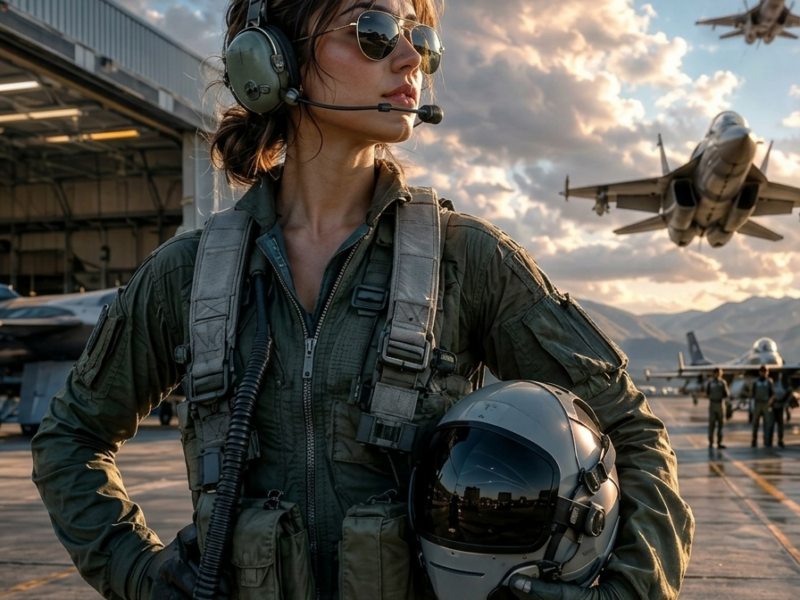
They laughed when I walked into the Nevada briefing room wearing a rookie pilot’s uniform, but when eight enemy fighters locked onto our squadron and the commander heard me whisper the words “Dark Raven is airborne,”
The stale air inside the Redstone Air Force Base briefing room tasted of burnt coffee, ozone, and the distinct, unyielding arrogance of men who had spent their entire careers believing the sky belonged exclusively to them. I stood near the back, my boots planted firmly on the worn industrial carpet, my hands clasped securely behind my back. My posture was military-straight, rigid, and completely still. Around me, pilots from the elite tactical fighter wing shifted in their ergonomic chairs, their flight patches a colorful mosaic of ego, achievement, and accumulated pride.
At the head of the long, dark oak table stood Colonel Marcus Reed. He was a man who wore his rank like heavy armor, his salt-and-pepper hair cut to a punishing standard, his eyes perpetually narrowed into an expression of calculated skepticism. He had spent the last twenty minutes systematically dissecting every operational plan on the projector, his voice ringing with a sharp, gravelly authority that demanded total submission.
Then came the transition to the replacement roster. My service designation had appeared on the secondary monitor in clean, unblinking alphanumeric characters: Lt. E. Vance – Special Assignment / Unassigned Tactical Evaluation.
Colonel Reed barely glanced at my file before tossing it onto the conference table with a flick of his wrist. He looked at me with a thin, impatient smile that reached neither of his eyes.
“Who signed off on this transfer?” he asked, his voice dripping with condescension as he gestured toward me. Nobody in the room answered. He turned back to the assembly, his gaze sweeping across the seated veterans. “Listen, sweetheart, this isn’t a training exercise, and we don’t have time to babysit rookies. We are running high-altitude intercept sweeps against unknown electronic profiles. We don’t need dead weight cluttering up the combat corridors.”
A few pilots chuckled. I kept my expression neutral, although his words landed harder than I wanted to admit. They saw a young woman with a clean flight jacket and an ordinary service record. They didn’t see the scars beneath my collar, the nightmares that woke me at three in the morning drenched in cold sweat, or the three names I still whispered into the darkness whenever I couldn’t sleep.
Three years earlier, I had flown a classified mission over hostile territory with the most experienced squadron in the Air Force. We were ambushed before reaching our primary target by an unknown adversary utilizing technology that defied standard classification. My wingman was shot down, engulfed in a flash of white-hot plasma. Two other aircraft disappeared from radar within seconds, their transponders going silent simultaneously. And when enemy missiles closed around my jet, trapping me in a narrowing web of telemetry locks, I made a split-second decision that saved an entire transport formation of civilian contractors, but cost me everything I had left.
My aircraft vanished over the jagged mountain ranges of the border sector. The military declared me dead in action, filing my records away in a black-budget vault. Only six people in the entire global command structure knew I had survived the ejection and the subsequent harrowing trek across frozen terrain. One of them had ordered my identity buried under bureaucratic layers of false aliases. Another had given me a new callsign—a designation whispered only in secure rooms where black operations were planned and executed.
Dark Raven.
I had promised myself, and the high-command panel that debriefed me upon my extraction, that I would never fly combat missions again. I had spent three years living in the shadows, analyzing tactical data feeds, serving as an anonymous advisor, and watching the world move on while I remained a ghost. But when the threat level at Redstone spiked, and the strategic command needed someone who understood the enemy’s algorithmic signature, my orders were quietly updated. I was transferred back into the active rotation, stripped of my true past, and thrust into a room full of strangers who thought I was nothing more than an administrative mistake.
“Colonel,” I finally spoke, my voice cutting through the murmurs with a quiet, icy clarity that made a few heads turn. “My operational clearance is active and verified by Strategic Command. If the board assigned me to this wing, it is because the tactical parameters require someone who has handled anomalous signatures before.”
Reed sneered, stepping down from the dais. He stopped a few feet away from me, towering over my frame, his eyes flashing with open hostility. “Clearance on a piece of paper doesn’t keep an aircraft in the air when an adversary locks a radar-guided missile onto your tail, Lieutenant. Until you prove otherwise, you’re just a logistical paperwork error that I am legally obligated to tolerate.”
Before I could deliver the sharp retort forming behind my teeth, the low, pulsing wail of the base emergency warning sirens erupted overhead. The red strobe lights mounted along the ceiling began to flash in a frantic, rhythmic pulse, casting long, bruised shadows across the briefing tables.
Instantly, the casual atmosphere vanished. Men surged to their feet, chairs scraping violently against the floor.
A junior tactical officer bolted from the side alcove, his face pale under the emergency lights. “Colonel! We have an unscheduled radar bloom crossing the restricted border perimeter! Eight unidentified enemy fighters, high-speed, low-radar-cross-section profile. They just intercepted our returning reconnaissance package—Falcon Flight is currently boxed in!”
The room descended into a chaotic scramble of shouted orders and frantic terminal tapping. Colonel Reed rushed toward the operations screen, his initial confidence instantly cracking under the weight of an active crisis. The giant overhead screen updated in real-time, showing a cluster of blue friendly icons being aggressively enveloped by eight bright red symbols closing in from multiple vector angles like a closing fist.
“Get our fighters airborne!” Reed roared, jabbing a finger toward the ready room doors.
Pilots broke into a dead sprint toward the exit, their heavy flight gear clanking against their legs. But the situation deteriorated at a velocity that defied all standard projection models. The enemy fighters didn’t just engage; they split into two synchronized, aggressive pincer groups, executing high-G flanking maneuvers that completely severed the American aircrafts’ primary escape routes.
One American pilot shouted over the radio, his voice cracking with panic, “They’re behind us! We can’t shake them! They’re locking multi-band fire-control radars onto our tails!”
Another transmission followed, filled with static, heavy breathing, and a sudden spike of digital distortion.
Then absolute silence.
Reed slammed his fist against the console, the heavy wood groaning under the impact. “Where are our remaining aircraft? Get them in the air now!”
The radar controller swallowed hard, his fingers flying across his keyboard. “Sir, they’re all being tracked. The enemy electronic warfare suite is blinding our secondary telemetry.”
I stared at the radar display, my eyes tracing the exact movement vectors of the hostile swarm. A cold shiver ran down my spine. I recognized the enemy’s formation immediately. I had seen it before, three years ago, on the night my squadron died. It wasn’t a random border violation; it was a signature tactic designed to flush out hidden command assets and force an uncoordinated response.
“Colonel, you need to pull the transport aircraft back immediately,” I said, taking a half-step forward.
Reed turned sharply, his face flushing a furious crimson. “Stay out of this, Lieutenant.”
“They’re using the fighters as bait,” I insisted, my voice rising slightly to cut through the panic in the room. “If our remaining wing launches without ECM shielding, they’ll walk right into a crossfire.”
“That’s enough!” Reed barked, stepping directly into my personal space. “You’ve been here for twenty minutes, and you’re already trying to dictate tactical strategy? Fall back and keep your mouth shut, or I’ll have you court-martialed for insubordination before your boots even touch a flight line.”
I looked at the main display as another American aircraft disappeared from radar, its blue icon winking out of existence. The margin for hesitation had vanished.
Without another word, I reached past him and tapped the emergency authorization terminal embedded in the console.
Reed grabbed my wrist with a heavy, bruising grip. “What do you think you’re doing?”
I met his eyes, my gaze steady, cold, and entirely devoid of fear. “Ending this.”
Before he could stop me, a secure channel opened across the room, bypassing the base relays and connecting directly to a deep-space command satellite. A voice from high command spoke with unmistakable urgency through the speakers:
“Identify the pilot requesting emergency launch authorization.”
I pressed the microphone button on the console, my voice ringing out clearly across the silent briefing room.
“Dark Raven.”
The room went completely silent. The ambient hum of the servers seemed to die away. Colonel Reed’s hand slowly fell away from my arm, his fingers twitching as if he had just touched a live electrical wire.
On the radar display, something extraordinary happened. The moment my callsign hit the encrypted network, the enemy fighters abruptly changed course. Their formation broke apart in sudden, erratic maneuvers, as if their automated flight systems had received a conflicting priority order. One by one, their tactical transmissions went dead, their radar signatures fading from the screen as they turned tail and retreated across the border.
The radar controller stared at his screen, his face draining of absolute color. He looked up at me, his mouth opening slightly in silent disbelief.
“Sir,” the controller whispered, his voice trembling. “They’re retreating. All bogeys are falling back.”
Nobody spoke as I turned on my heel and walked toward the hangar doors. For the first time that morning, nobody called me a rookie.
When I reached the hardened revetment where my assigned F-22 Raptor sat waiting, Colonel Reed caught up with me, jogging down the concrete stairs, looking as though the ground had shifted beneath his feet.
“You… you were listed as killed in action,” he whispered, his voice uncharacteristically hollow.
“I know,” I replied, unzipping my flight suit pocket to retrieve my access key.
“Why did they hide you?” Reed asked, staring at me as if he were seeing a ghost step out of a nightmare.
I stopped beside the cockpit ladder, looking out toward the sun-bleached expanse of the Nevada desert. Before I could answer him, my secure radio crackled to life with a low-frequency transmission from an unknown source—a frequency that wasn’t routed through base communications.
A man’s voice emerged through the static, quiet, raspy, and painfully familiar—a voice I hadn’t heard in three agonizing years.
“Raven, if you’re hearing this, your wingman is alive.”
My heart stopped beating for a full second. The world around me seemed to tilt on its axis.
Then he said the words that made my blood turn cold, freezing every drop of warmth in my veins.
“And he’s the reason they never let you come home.”
The metallic hum of the F-22 Raptor’s auxiliary power unit vibrated through the composite deck plates as I stood on the boarding ladder, staring down at the glowing tactical display on my wrist terminal. The transmission had vanished as quickly as it arrived, leaving behind only a string of encrypted metadata that pointed toward an orbital relay station over the Pacific.
Colonel Reed stood at the base of the ladder, his face pale, his hands clenched into tight fists at his sides. The absolute authority he had wielded in the briefing room minutes earlier had dissolved into a profound, destabilizing shock.
“Lieutenant,” Reed called out, his voice straining to maintain its command timbre. “Who was on that frequency? What was that transmission?”
I looked down at him, my expression hard and impassened. “That, Colonel, is information well above your security clearance. Open the hangar blast doors. I’m going aloft.”
“The hell you are!” Reed shouted, taking a step up the ladder. “You just hijacked a base-wide communication override, you’re flying under a ghost callsign that isn’t supposed to exist, and now you’re taking off without a formalized flight plan? I am grounding you right now!”
I didn’t answer him. I slid my helmet over my head, dropped the visor into place, and sealed the heavy locking collar. The ambient roar of the base faded into the muffled, sterile quiet of the life-support systems. I pulled the canopy handle down, and with a heavy mechanical hiss, the reinforced glass slid forward, locking into place with a pneumatic seal.
Inside the cockpit, the multi-function glass displays bathed my face in a cool, emerald glow. My fingers moved across the HOTAS controls with practiced, instinctive precision, cycling through pre-flight diagnostics, fuel pressure checks, and weapon system initializations. Every needle settled into the green. Every system responded with instantaneous clarity.
“Redstone Tower, this is Dark Raven,” I transmitted on the emergency tactical frequency, bypassing the local controller and broadcasting straight to the automated launch network. “Requesting immediate clearance for vertical departure.”
A tense, agonizing silence stretched across the frequency. Back in the tower, operators were undoubtedly scrambling to verify my authentication codes against the highest-level black-budget databases in Washington.
Ten seconds later, a synthesized automated voice crackled back through my headset: “Authentication confirmed, Dark Raven. Restricted airspace cleared. You have green light across all vectors. Godspeed.”
I pushed the twin throttles forward. The Pratt & Whitney turbofan engines ignited with a deep, thunderous roar that shook the reinforced concrete walls of Hangar Four. The Raptor surged forward, breaking free of the revetment and tearing down the tarmac with blistering acceleration. Within seconds, I hauled back on the flight stick, and the aircraft pitched upward into a vertical climb, defying gravity with an aggressive, effortless grace.
The transition from the dense, oxygen-rich lower atmosphere to the thin, silent expanse of high-altitude flight happened in a matter of heartbeats. The sky transformed from a hazy desert blue into a deep, bruised indigo where the curvature of the earth became visible at the horizon.
My heads-up display flickered with tactical data feeds streaming directly from airborne warning and control systems, augmented by the Raptor’s internal sensor fusion suite. The airspace around the border was currently clear of hostile signatures, but the digital footprint of the retreating enemy formation lingered in the data logs like a toxic wake.
“Dark Raven, report status,” a crisp, modulated voice spoke in my ear. It wasn’t Colonel Reed, and it wasn’t the local tower. It was Director Vance from Strategic Command—one of the six people who knew I was alive.
“Airborne and stable, Director,” I replied, my hands resting lightly on the flight stick as the autopilot maintained our heading at thirty-eight thousand feet. “The bogeys pulled back the moment my callsign hit the network. They didn’t retreat because they were outmatched. They retreated because they recognized who I was.”
A heavy sigh echoed over the secure quantum-encrypted line. “We intercepted the secondary transmission you received on the tarmac, Lieutenant. Our analysts are running trace algorithms on the signal origin right now, but initial telemetry suggests it wasn’t broadcast from a terrestrial relay.”
“Then where?” I asked, narrowing my eyes as I scanned the empty horizon.
“An orbital platform,” Vance replied grimly. “Specifically, a decommissioned reconnaissance satellite that was supposed to have burned up in the atmosphere two years ago. If someone is using it to bounce signals across the globe, it means the security breach at Redstone goes much deeper than an internal leak. You have an active tail, Raven.”
I gripped the flight stick tighter, my knuckles turning white inside my Nomex gloves. Three years ago, I had watched my wingman, Captain Marcus Thorne, vanish into a ball of fire over the rugged peaks of the disputed border zone. We had flown together through twenty combat tours, trusting each other with our lives in the deadliest skies on earth. His death had been the anchor of my grief, the anchor that kept me grounded in the darkness while my official records were erased and my life was rewritten as a classified fiction.
And now, a voice through a dead man’s frequency had shattered that fragile reality.
“Your wingman is alive… and he’s the reason they never let you come home.”
The words echoed in my mind like a recurring alarm. If Marcus was alive, why had the military declared him dead? Why had high command buried my identity and hidden me away in a black-site training facility? And most importantly, if he was the reason I couldn’t come home, whose side was he actually on?
“Director, I need the full mission logs from Operation Vanguard three years ago,” I demanded, my voice carrying an unmistakable edge of authority. “The unredacted logs. Not the sanitized summary given to the congressional oversight committee.”
“Raven, you know the security protocols,” Vance cautioned, hesitation bleeding into his tone. “Those files are locked behind triple-tier cryptographic barriers authorized only by the Joint Chiefs.”
“The people who built those barriers are the ones who lied to me about whether my best friend burned to death in a cockpit,” I snapped back, my patience wearing dangerously thin. “Send the files to my onboard terminal right now, or I turn this bird around, land right in the middle of Colonel Reed’s parade ground, and tell every journalist within a hundred-mile radius about the ghost squadron operating out of Nevada.”
Another heavy silence stretched across the secure line. Vance knew I wasn’t bluffing. When you’ve already been declared dead once, you lose the fear of institutional consequences.
“Files transmitting,” Vance finally sighed. “Check your secondary data tablet, Raven. But be warned: once you open those folders, you can never unsee what’s inside. You’re walking into a storm that the Pentagon spent millions of dollars trying to bury.”
A soft chime echoed in my cockpit as a heavy encrypted file package downloaded directly onto my knee-mounted tactical tablet. The screen flickered, displaying a classified mission dossier stamped with a red warning banner: PROJECT VANGUARD – EYES ONLY.
I tapped the screen to open the primary incident report from the night of the ambush. As the digital pages scrolled down, revealing flight telemetry, encrypted audio transcripts, and satellite reconnaissance photos that had been scrubbed from public archives, the cold reality of my past began to unravel piece by piece.
We hadn’t been ambushed by a foreign enemy.
The radar tracks didn’t match any known hostile nation. The aircraft that shot us down weren’t flying foreign colors—they were prototype platforms manufactured by an unauthorized defense contractor operating under a black-budget umbrella right here on American soil.
And at the center of the conspiracy wasn’t an enemy spy network. It was a rogue faction within our own military leadership that had been testing autonomous combat systems on live operational squadrons—using human pilots as disposable test subjects to gather combat data.
And according to the flight logs, my wingman, Marcus Thorne, hadn’t been shot down and killed.
He had landed safely at a black-site facility thirty minutes before my own aircraft was forced down.
The digital pages of the Vanguard dossier scrolled past my eyes in the dim green glow of the cockpit, painting a picture of betrayal so vast and methodical that it made the thin, freezing air outside my canopy feel warm by comparison. Every mission briefing, every training exercise, and every deployment order I had ever trusted during my active service had been a carefully constructed lie. We weren’t defending the borders from foreign aggressors; we were guinea pigs in a multi-billion-dollar military experiment designed to prove that autonomous, neural-linked combat drones could outperform human pilots in high-stress combat environments.
And when our squadron discovered the truth—when Marcus realized that the automated drones tracking our formation were programmed to eliminate human error by eliminating the humans themselves—he hadn’t died trying to protect us.
He had been captured by the very people who built the system.
“Dark Raven, do you copy?” Director Vance’s voice crackled through the secure headset, breaking my intense focus on the scrolling data stream. “You’ve gone subsonic and your altitude is drifting. Report your vector.”
I pulled my eyes away from the tablet and glanced at the multi-function flight display. My Raptor had drifted into a slow, lazy bank over the desolate expanse of the Great Basin, miles away from the authorized patrol corridor. Below me, the landscape was a monotonous quilt of sun-baked salt flats, jagged mountain ridges, and isolated desert valleys that looked completely devoid of human life.
Except for one anomaly.
Right on the edge of a dry lake bed, where topographical maps showed nothing more than abandoned mining claims and government-restricted wilderness, my thermal imaging suite picked up a faint, highly organized cluster of subsurface heat signatures. A subterranean facility—hidden beneath layers of natural rock and reinforced concrete, completely unlisted on any public or military zoning registry.
“Director,” I said quietly, my voice steady as I adjusted my flight vector toward the coordinates on the screen. “I found the relay source.”
“Raven, negative, do not approach those coordinates,” Vance warned sharply, alarm spiking in his tone. “That is Sector Four-Zero. It’s an abandoned nuclear testing annex from the Cold War. It has no active military presence—at least, none on the books.”
“It’s not abandoned,” I replied, pushing the throttles forward and banking the Raptor into a sharp, descending arc. “The thermal bleed from the geothermal generators is venting through the old exhaust shafts. That’s where the orbital signal originated. That’s where my wingman is being held.”
“Raven, return to base immediately! That is a direct order!” Vance shouted over the line, the sound of scrambling personnel echoing in the background of his office. “You do not have authorization to engage a black-site installation on your own recognizance!”
“You told me once that the people who classified my files were the same ones who lied about my past,” I said coldly, flicking the master arm switch on my console. The internal weapon bay doors slid open with a smooth, hydraulic hiss, exposing a payload of high-explosive ordnance and precision-guided missiles. “Consider this my resignation from the ghost squad.”
I cut the encrypted communication link before Vance could issue another frantic command. The headset fell silent, save for the rhythmic hum of the avionics and the steady whistling of the wind rushing against the titanium-carbide canopy as I plunged the aircraft downward in a steep, aggressive dive.
The desert floor rushed up to meet me at terrifying speed. At ten thousand feet, I leveled out, skimming the jagged ridge of the mountain range at Mach 0.9, utilizing the rugged terrain to mask my approach from any ground-based radar arrays guarding the perimeter.
Through my tinted visor, I spotted the target: a desolate stretch of cracked desert floor surrounded by rusted chain-link fences and warning signs that had faded into illegibility decades ago. In the center of the compound sat what appeared to be a dilapidated maintenance shed with a rusted corrugated metal roof. But as my targeting pod zoomed in on the structure, the high-resolution optical feed revealed the truth: the shed was merely a hydraulic camouflage cover concealing a massive subsurface elevator shaft capable of lowering heavy tactical aircraft directly into the underground complex.
“Let’s see what you’re hiding,” I murmured to myself.
I didn’t need to launch a missile to get their attention. I pulled back on the stick, pitched the Raptor upward into a vertical climb, and then rolled the aircraft over, diving straight down toward the center of the camouflage cover at supersonic speed.
As I crossed the sound barrier, a colossal sonic boom crashed across the desert floor like a rolling earthquake, shattering the rusted chain-link fences and blowing the corrugated metal roof off the elevator shaft in a violent explosion of twisted steel and flying debris.
Instantly, the dormant facility roared to life.
Emergency floodlights blazed across the compound, illuminating the barren desert in a harsh, blinding glare. Automated defense turrets rose from concealed silos around the perimeter, their multi-barrel cannons pivoting upward to track my flight path.
“Incoming lock!” the warning system blared in my helmet, a chorus of high-pitched electronic shrieks as ground-to-air missile batteries painted my hull with radar energy.
“Not today,” I muttered.
I dumped a cascade of glowing magnesium flares into the slipstream and executed a violent barrel roll, sending the Raptor spinning through a blinding cloud of pyrotechnic decoys. The enemy missiles detonated harmlessly behind my tail, filling the sky with billowing clouds of white smoke and jagged shrapnel.
Before the automated defense systems could cycle their targeting computers for a second salvo, I brought the Raptor around in a low, skimming pass directly over the open elevator shaft. I punched the release button, dropping a pair of specialized seismic breaching charges right down the center of the subterranean shaft before pulling hard on the stick and rocketing back up into the safety of the upper atmosphere.
Two seconds later, the ground beneath the metal shed shuddered violently. A muffled, subterranean roar echoed across the desert, followed by plumes of thick, black smoke billowing upward from the elevator shaft as the heavy blast doors were blown completely off their hydraulic tracks.
The underground black site was wide open.
And I was about to drop in for a visit.
The descent into the subterranean bowels of Sector Four-Zero required every ounce of precision I possessed. I circled the smoking blast crater for two minutes, monitoring my sensor feeds as autonomous defense drones scrambled from neighboring launch tubes hidden inside the canyon walls. Three delta-wing unmanned fighters—sleek, unpainted machines bearing no national insignia and powered by experimental vector-thrust engines—shot out from the subterranean tunnels like hornps from an agitated nest.
They didn’t carry pilot capsules. They were pure, unadulterated algorithms of war, driven by the neural network that had destroyed my squadron three years ago.
“Let’s dance,” I whispered, angling the Raptor’s nose downward to meet them head-on.
The dogfight that erupted in the confined airspace of the desert canyon was a brutal, high-speed ballet of physics and machine logic. The drones operated with a terrifying efficiency, executing maneuvers that would have induced immediate blackouts in any human pilot. They pulled twelve Gs without flinching, turning tighter and accelerating faster than any traditional fighter jet in the American inventory.
But they lacked one crucial element that no algorithm could replicate: unpredictable human intuition.
As the lead drone locked its fire-control radar onto my tail and initiated a high-speed closing vector, I didn’t execute the standard defensive break taught in flight manuals. Instead, I cut my throttles completely, deployed the Raptor’s asymmetric air brakes, and kicked the rudder hard to the left in a brutal cobra maneuver that defied standard aerodynamics.
The Raptor stopped forward momentum as if it had hit an invisible brick wall, pitching its nose up at a vertical ninety-degree angle while the automated drone shot straight past my canopy at Mach 1.4, unable to compensate for the sudden deceleration.
Before the machine’s flight computer could reorient its vector, my onboard targeting system locked onto its thermal core.
“Fox Two,” I said calmly, squeezing the trigger.
The AIM-9X Sidewinder missile hissed off its rail, arcing through the narrow canyon with blinding speed. A fraction of a second later, the unmanned drone erupted into a brilliant fireball of burning composite materials and shredded wiring, its burning wreckage tumbling down into the rocky canyon floor below.
The remaining two drones instantly attempted to scatter, executing evasive split-S maneuvers to regain tactical advantage. But I pressed the attack, using the Raptor’s superior sensor fusion suite to track their thermal signatures through the canyon walls. Within ninety seconds, both machines had been systematically neutralized, their burning hulks joining the scattered debris of the black-site perimeter.
With the airspace secured, I guided the Raptor down toward a flat, reinforced concrete apron adjacent to the blown-open elevator shaft. I set the landing gear down with a smooth mechanical thud, taxied the aircraft into the shadowy recesses of the underground loading bay, and cut the engines.
As the twin turbines wound down with a dying whine, I popped the canopy, unbuckled my harness, and climbed out onto the wing. The air inside the subterranean bay was cold, smelling of stale hydraulic fluid, ozone, and unwashed concrete.
I drew my standard-issue sidearm from its holster, flicked the safety off, and dropped down onto the loading platform.
The cavernous facility was eerily quiet. The seismic blast from my breaching charges had knocked out the primary power grid, leaving only the dull, pulsating glow of red emergency lighting running along the concrete corridors. Computer banks lined the walls, their monitors flickering with endless streams of cryptographic data, tactical simulations, and live video feeds of airbases across the United States—including Redstone Air Force Base.
I moved through the corridors with slow, measured steps, my boots making a soft, rhythmic echo against the polished floor. My weapon was raised, my eyes scanning every shadowed alcove and intersecting hallway for automated defenses or armed guards.
As I approached the central command hub at the heart of the complex, the heavy steel security doors slid open with a soft pneumatic hiss, revealing a massive control room overlooking a subterranean detention tier.
Standing in the center of the room, illuminated by the cold blue light of a dozen mainframe monitors, was a man in a crisp civilian suit, his hands clasped behind his back as he calmly watched me approach on a closed-circuit security camera feed.
He didn’t look like a mad scientist or a rogue terrorist. He looked like a senior defense contractor enjoying a quiet afternoon at corporate headquarters.
“Lieutenant Emily Vance,” the man said, his voice echoing smoothly across the cavernous room without him even turning around. “Or should I call you Dark Raven? We’ve been analyzing your flight telemetry for three years, my dear. You never disappoint.”
I lowered my sidearm slightly, keeping my aim locked squarely on his chest as I stepped across the threshold. “Where is he?”
The man turned around slowly. A faint, knowing smile played at the corners of his mouth. It wasn’t Director Vance, and it wasn’t Colonel Reed. It was a face I recognized from old Pentagon directories—Arthur Sterling, the chief director of black-budget acquisitions for the Department of Defense, who had supposedly retired to a private estate in Virginia five years ago.
“You’re looking for your wingman, I presume?” Sterling asked smoothly, walking toward the central console. “Captain Marcus Thorne. Such a promising officer. It’s a shame the congressional committee thinks he died a hero over the mountains.”
“Where is he, Sterling?” I repeated, my voice dropping an octave, carrying an edge of lethal calm that made the air in the room feel heavy.
Sterling didn’t flinch. Instead, he reached out and pressed a key on the main console. Behind him, the reinforced glass wall overlooking the subterranean detention tier hummed to life, turning from opaque black to crystal clear.
Inside the glass-enclosed cell below, sitting in a metal chair with a series of neural-link cables wired directly into the base of his skull, was a man in a faded flight suit. His head was bowed, his face pale and gaunt, but the moment the lights flickered on, he slowly raised his eyes and looked up through the glass toward the command platform.
It was Marcus.
He was alive. But as I stared at him through the reinforced barrier, my blood ran cold. His eyes weren’t focused on the room around him; they were fixed in a glassy, hypnotic stare, wired directly into the central processing core of the autonomous drone network that had hunted us three years ago.
“He didn’t survive the crash, Lieutenant,” Sterling said softly, stepping closer to me with a chilling smile. “He became the operating system.”
The hum of the mainframe computers in the central control room seemed to press down on my chest like a physical weight. Behind the reinforced glass wall, Marcus sat motionless in the metal chair, his eyes fixed on the glowing data streams flowing across the neural-link monitors attached to his skull. Every breath he took was synchronized with the rhythmic pulse of the facility’s quantum processor—a living, breathing biological component in an inhuman machine of war.
“You turned him into a processor,” I whispered, my voice trembling with a mixture of raw grief and cold, lethal fury. I raised my sidearm, locking the laser sight directly onto the center of Arthur Sterling’s forehead. “You didn’t just fake our deaths, Sterling. You harvested him.”
Sterling didn’t blink. He didn’t even take a step back. He simply looked down at the red laser dot dancing against his tie, then raised his eyes to meet my gaze with an unsettling, clinical detachment.
“Harvested is such a crude, emotional word, Lieutenant,” Sterling replied smoothly, his hands resting casually in his trouser pockets. “Let’s call it an evolutionary upgrade. Human pilots are plagued by biological limitations—fear, fatigue, G-force blackouts, and moral hesitation. Marcus possessed the finest tactical intuition in the entire tactical fighter wing. By integrating his neural pathways directly into our autonomous combat network, we didn’t destroy him, Lieutenant. We made him immortal.”
“He’s trapped in a cage of code!” I shouted, my finger tightening slightly on the trigger. “He’s a prisoner in his own mind, being used to build the very weapon that killed our squadron!”
“And yet, he’s the only reason you’re standing here right now,” Sterling countered, his smile widening into something predatory. “Who do you think sent that transmission to your cockpit over Redstone? Who do you think bypassed our security protocols to lure you down into this facility?”
My breath caught in my throat. I lowered the barrel of my gun by a fraction of an inch. “Marcus… he sent the signal?”
“His subconscious mind still retains fragments of his previous identity,” Sterling said, walking slowly toward the central console. “He knew you were out there, flying under a ghost callsign, hidden away by a military that wanted to sweep our little experiment under the rug. He engineered this entire encounter. He wanted you to find him—not to save him, Lieutenant, but to finish what he started.”
Before I could process the chilling implication of his words, the main computer banks across the room suddenly flashed a brilliant, blinding crimson. Alarms began to wail through the facility, a high-pitched, rhythmic klaxon that signaled an immediate system-wide override.
Across the giant diagnostic screens, the neural-link status bars spiked from green to pulsing red.
“WARNING: NEURAL CORE OVERRIDE DETECTED. SYSTEM COMPROMISED FROM LOCAL TERMINAL.”
Sterling’s calm, composed demeanor vanished instantly. His eyes widened in sudden panic as he lunged toward the main console, his fingers flying across the emergency shutdown keys. “What is he doing? Cut the feed! Cut the feed now!”
It was too late.
Down in the detention tier, Marcus’s head jerked upward. His eyes, previously locked in a hypnotic trance, suddenly cleared. A wave of raw, human consciousness flashed across his face—a brief, agonizing spark of recognition and fierce determination.
Through the internal audio speakers connected to his cell, his voice echoed into the control room—raspy, exhausted, but unmistakably his.
“Emily… run the purge sequence.”
“Marcus!” I screamed, rushing toward the glass wall and pressing my palm against the cold surface.
“If you don’t shut this network down now, they’ll use my neural profile to launch the entire autonomous drone fleet across every major metropolitan airspace in North America!” Marcus yelled over the wailing alarms, his voice straining as his hands gripped the armrests of the metal chair. “The override code is my callsign! Enter it into the master terminal now!”
Sterling lunged across the console, drawing a concealed sidearm from his jacket holster, leveling the barrel straight at my back. “Don’t you dare touch that keyboard, Lieutenant! If you purge the core, you destroy the entire multi-billion-dollar project!”
I didn’t hesitate. I spun around on my heel, raised my service pistol, and fired a single, clean shot that struck Sterling’s weapon from his hand, sending it clattering across the polished floor. Before he could recover, I slammed the butt of my sidearm against his shoulder, sending him crashing backward over the edge of the console into unconsciousness.
I turned back to the master terminal. The screen flashed a pulsing text prompt: ENTER MASTER OVERRIDE SEQUENCE.
My fingers flew across the mechanical keyboard. I didn’t type a complex cryptographic algorithm. I typed the only words that mattered—the callsign of a pilot who had refused to let the machine win.
VANGUARD-THORNE-01.
The screen flashed blinding white.
“PURGE SEQUENCE INITIATED. NEURAL CORE DISCONNECTING IN FIVE… FOUR… THREE…”
Through the glass wall, the glowing blue cables connected to Marcus’s skull suddenly sparked with white electricity as the system began to flush its memory banks. The harsh red warning lights in the detention tier flickered and died, replaced by the warm, soft glow of emergency backup lamps.
Marcus slumped forward in the chair, his breathing slowing, the tense, rigid posture in his frame finally relaxing as the invisible chains binding his mind to the machine were shattered forever.
The main computer screens across the room went dark one by one, signaling the permanent collapse of the autonomous drone network across every military database in the country.
The war in the shadows was over.
Ten minutes later, I stood outside the blown-open elevator shaft on the surface of the desert floor, the cool morning wind brushing against my face as the first rays of dawn began to paint the distant mountain peaks in shades of gold and amber.
Behind me, base security personnel and tactical recovery teams dispatched by Director Vance were swarming the subterranean facility, securing the site and arresting the surviving contractors.
Marcus walked out of the elevator shaft, leaning slightly on a medical technician’s shoulder, blinking against the bright desert sun as if he were seeing the world for the very first time in three years. He looked older, scarred, and weary, but when he raised his eyes and saw me standing beside the wing of my F-22 Raptor, a faint, familiar smile touched the corners of his mouth.
I walked over to him, our eyes locking in a silent exchange that carried the weight of a thousand unspoken words. No apologies were needed. No explanations were required.
We had survived the fire.
I reached out, clasping his hand firmly in mine, feeling the undeniable warmth of a living, breathing human being who had finally come home.
“Ready to fly wingman again, Captain?” I asked softly, a quiet smile forming on my lips.
Marcus looked up at the vast, open expanse of the morning sky, where the horizon stretched out endlessly toward the infinite blue.
“Always, Dark Raven,” he replied. “Always.”
The end.









