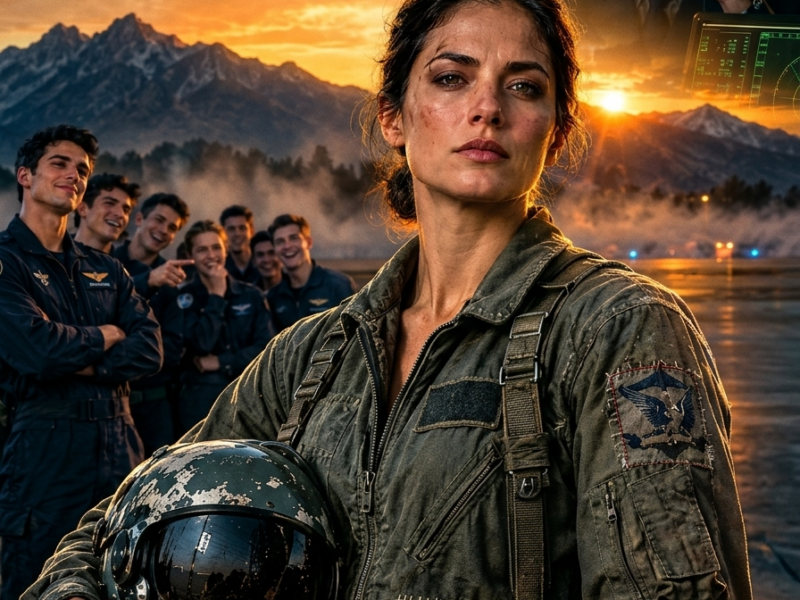
They laughed when I walked across the crowded flight line at Nellis Air Force Base wearing a faded flight suit with no visible rank insignia
The desert wind across Nellis Air Force Base carried the familiar scent of scorched jet fuel, baking asphalt, and ozone—a volatile aroma that had defined more than a decade of my life. The early morning sun burned through the thin Nevada atmosphere, casting harsh, unforgiving light across the flight line where a pristine row of F-16 Fighting Falcons sat idling like tethered apex predators. Standing on the heat-rippled tarmac in a faded, olive-drab flight suit that lacked any visible rank insignia, I felt like an apparition wandering through a world that had moved on without me.
My flight suit was old—a relic from an era before classified records were scrubbed and official histories were rewritten. The standard unit patches were frayed at the edges, their stitched threads bleached pale by sunlight, and my leather name tag barely hung on by a few threads of Velcro. To the uninitiated eye, I looked less like an elite aviator and more like an unauthorized intruder who had wandered in from the desert.
A young pilot wearing crisp, newly issued flight gear and polished boots stepped out from a nearby crew shelter, accompanied by three fellow lieutenants. He glanced at my worn gear, his lips curling into an easy, arrogant smirk.
“Did they send us a mechanic?” he called out, nudging the man next to him. “Because if you’re here to service the avionics, ma’am, the maintenance bay is two hangars down.”
His companions chuckled, their low laughs carrying over the whine of distant auxiliary power units. I stood motionless, my eyes fixed on the horizon, saying nothing. I didn’t care about their smirks or their casual disrespect. They were kids who had never flown through a wall of anti-aircraft artillery over hostile mountains. They hadn’t watched their fuel gauges bleed to empty while praying for a tanker that wasn’t coming.
Before the laughter could fade, Colonel James Walker stepped out of the squadron briefing room, holding a heavy metal clipboard and wearing the severe, impatient expression of an officer whose schedule was far too valuable to be disrupted by an unannounced civilian. He took three long strides toward me, his eyes sweeping over my faded gear with immediate distaste.
“Ma’am, this is an active fighter squadron,” Walker said, his voice flat and unyielding. “Visitors need security authorization to even step past the red flight-line boundary.”
Without a word, I reached into the zippered pocket of my flight suit, pulled out a battered leather ID wallet, and handed it to him.
Walker took it with two fingers, barely glancing at the credential card inside before tossing it back onto his clipboard. “You’re here for the flight evaluation?”
“Yes, sir,” I replied quietly.
He let out a short, cynical smirk, shaking his head as if participating in a poorly executed joke. “Then I suggest you take a seat on the observation deck. You’re wasting our fuel and my pilots’ briefing time.”
I looked past his shoulder, my gaze locking onto a specific F-16 Viper parked near the active taxiway—a block-50 variant with low-observable paint and a heavily upgraded electronic warfare suite. “I was told I’d be flying that aircraft.”
The quiet humor on the tarmac evaporated instantly. The young lieutenant, Carter, took a step forward, his jaw set in disbelief. “Not a chance. That’s a frontline air-superiority bird, not a simulator.”
Colonel Walker sighed, rubbing the bridge of his nose in exasperation. “Let’s not waste everyone’s time here. I don’t know who pulled strings at Main Command to get you a gate pass, but nobody straps into my jets without my explicit sign-off.”
I could have argued. I could have listed the thousands of combat flight hours recorded in my missing logbooks, the dangerous night insertions over hostile territory, or the names of the men and women I had dragged back to friendly airbases on half an engine and sheer willpower. But words were meaningless on a tarmac governed by rank and arrogance. So I simply asked for my helmet bag and requested tower clearance.
Twenty minutes later, after a series of frantic phone calls from higher headquarters that forced Walker to begrudgingly yield, I was strapped into the tight, reclined seat of the F-16’s cockpit. The smell of cold oxygen, hydraulic fluid, and old leather washed over me, instantly grounding my nerves. My hands moved across the instrument panels by muscle memory alone, throwing switches, arming the digital flight controls, and booting up the multi-function displays with a speed that startled the ground crew chief standing on the ladder outside.
I pulled the heavy polycarbonate canopy down, sealing out the roaring ambient noise of the base, and keyed the radio transmitter built into my mask.
The control tower crackled through my headset, sharp and mechanical. “Unidentified pilot on Taxiway Echo, confirm call sign for departure clearance.”
I took a long, steady breath, feeling the cold air fill my lungs, and spoke into the microphone.
“Widowmaker, ready for departure.”
Absolute silence enveloped the frequency. For five agonizing seconds, no static, no wind noise, and no air traffic chatter came through the headset.
Then, the tower controller’s voice returned, carrying a sudden, nervous edge. “Say again, pilot? Confirm call sign.”
“Widowmaker,” I repeated, my voice steady as stone. “Requesting immediate clearance to runway zero-nine right.”
High above the tarmac, inside the air-conditioned glass vault of the Nellis control tower, an older air traffic controller—a veteran master sergeant with graying hair—abruptly stood up from his radar console, pushing his headset against his ear. He turned toward the observation console where Colonel Walker was standing, monitoring the launch sequence with a sour look on his face.
“Colonel,” the controller said, his voice dropping into a tense whisper. “Did you hear that call sign?”
Walker frowned, adjusting his garrison cap. “What’s the problem, Sergeant? Just give her the clearance so she can embarrass herself in the pattern and we can get back to schedule.”
The controller turned to face him fully, his face pale beneath the harsh fluorescent lights. “Sir… that’s the call sign from Operation Black Lantern.”
Walker froze. The color drained from his face so fast it looked as if he had been struck. He took three rapid steps toward the master controller’s desk, snatching the primary command radio microphone off its hook.
“Pilot, identify yourself immediately!” Walker demanded, his voice dropping all pretense of professional detachment. “Identify yourself right now!”
I looked through the crystal-clear canopy at the long strip of gray asphalt stretching out toward the desert mountains under the rising sun.
“Captain Rebecca Hayes, sir.”
The colonel stopped moving entirely. His hand trembled against the radio housing.
Six years earlier, a classified strike mission deep inside hostile airspace had gone horribly wrong. Three American aircraft were severely damaged by an unknown radar-guided surface-to-air missile system, two pilots were listed as missing in action, and one female flight leader was officially reported killed in action after refusing to eject, staying behind to cover the retreat of her shattered wing.
That flight leader had been me.
My official file was stamped with a red seal: KILLED IN ACTION / RECOVERY IMPOSSIBLE. My family had received a folded American flag at a closed-door ceremony. My squadron had held a memorial service with a missing-man formation. And the Pentagon had classified the entire operation so deeply that even high-ranking officers were court-martialed for merely speaking its name aloud.
But Colonel Walker knew the truth. He had been the mission commander sitting in the secure tactical operations center six years ago, issuing the orders that sent us into that meat grinder.
“Stand down, Hayes!” Walker screamed into the microphone, his voice cracking with panic. “Abort engine start! Stand down immediately! MP units are on their way to your aircraft!”
I wrapped my gloved fingers around the throttle, pushing it forward into the military power detent. The single Pratt & Whitney engine behind me roared to life with a deafening, earth-shaking rumble.
“Negative, sir,” I whispered into the mask. “I have unfinished business.”
The radio channel went dead silent once more. But before I could release the wheel brakes, a second voice broke through the classified frequency—a voice that was rough, rasping, and trembling with disbelief.
“Rebecca…?”
I froze. My hand locked around the throttle control. I knew that voice. I would know it anywhere in the world. It belonged to Major Daniel Brooks—my wingman, my closest friend, and the pilot whose aircraft had plunged into the burning mountains during Black Lantern. The man I had spent six long, agonizing years believing had died in a fireball of aviation fuel.
“Daniel?” I whispered, my heart slamming wildly against my ribs.
There was a long, static-laced pause on the frequency. When Daniel spoke again, his words delivered a shock that left my hands completely numb against the controls.
“Don’t trust the colonel, Rebecca… He knows what really happened to your wingman.”
Through the cockpit canopy, I looked up toward the glass tower. Walker was no longer at the microphone. He was sprinting out of the control room toward the emergency stairs, his face twisted in desperate rage.
And just before the radio frequency was cut off by an automated firewall, Daniel whispered one final, terrifying sentence:
“Rebecca… your brother wasn’t the only one they left behind.”
The sudden cutoff of the radio frequency left a ringing vacuum in my ears, filled only by the heavy, rhythmic thump of my heart against my chest and the low, mechanical hum of the F-16’s environmental control system.
Your brother wasn’t the only one they left behind.
The words echoed in my mind like an artillery blast. For six years, I had operated under the devastating belief that my younger brother, Lieutenant Michael Hayes, had died in a separate training accident at Eglin Air Force Base—a cover-up I had only recently uncovered—and that my wingman, Daniel Brooks, had been obliterated in the skies over hostile territory during Operation Black Lantern. Now, in a single harrowing second, the terrible reality began to unfurl: Black Lantern was not a failed tactical raid. It was a calculated purge.
Without waiting for the ground crew or tower clearance, I slammed the throttle into full afterburner.
A twin column of blue flame erupted from the exhaust nozzle, pinning me back into my seat with raw kinetic force. The F-16 leaped down the runway, its tires screaming against the asphalt before lifting off into the desert sky. I pulled back hard on the control stick, pitching the nose up into a vertical climb, punching straight through the desert heat shimmer and soaring toward the deep blue ceiling of the upper atmosphere.
Below me, Nellis Air Force Base shrank into a grid of tiny gray boxes. I could see flashing red and blue lights speeding across the tarmac toward the empty spot where my jet had been parked just moments before. Emergency sirens were undoubtedly wailing across the facility, locking down the perimeter.
“Unlabeled Falcon, this is Nellis Command,” a new, authoritative voice boomed through my backup UHF radio channel. “You are operating an un-cleared aircraft in restricted airspace. Divert immediately to Tonopah Test Range or face military interception.”
I flipped my multi-function displays to tactical radar mode, ignoring the warnings. “Command, this is Captain Rebecca Hayes. I have reason to believe high-ranking officers within this wing are actively compromising national security and covering up missing personnel.”
“Captain Hayes, your credentials are invalid and your aircraft is classified as stolen. Turn back now.”
Before I could reply, my radar warning receiver (RWR) shrieked a high-pitched, metallic tone inside my helmet.
BEEP-BEEP-BEEP-BEEP!
I glanced down at the tactical display. Two amber tracks had materialized on the edge of my radar screen, sweeping in fast from the west at Mach 1.5. They were two F-22 Raptors—America’s premier stealth fighters—flying in a tactical wedge formation. They hadn’t been scrambled from the main alert pad; they were already airborne, patrolling the desert perimeter as if they had been waiting for me to take off.
“So that’s your play, Walker,” I muttered under my breath, my hands adjusting the flight controls into a defensive posture. “You’re not going to arrest me. You’re going to shoot me down and call it a rogue pilot incident.”
The leading Raptor belonged to Lieutenant Carter—the arrogant young pilot who had mocked my faded flight suit on the tarmac less than thirty minutes ago.
“Rogue Falcon, this is Leader,” Carter’s voice cracked over the tactical channel, stripped of its previous smugness and replaced by nervous tension. “We have missile lock on your airframe. Eject now or we will engage.”
“Carter, listen to me!” I shouted into my mask, rolling the F-16 into a hard left turn to break their radar tracking angle. “Colonel Walker lied to you! Operation Black Lantern wasn’t a tactical failure—it was an illegal operation to abandon American pilots! Major Daniel Brooks is still alive!”
“Shut up!” Carter snapped, though his voice betrayed a flicker of doubt. “Major Brooks died six years ago! The colonel showed us the classified casualty files during our pre-flight briefing!”
“He showed you what he wanted you to see to turn you into his executioner!” I fired back. “Check your tactical data-link feed! Look at the origin of the radio signal that broke through the tower frequency five minutes ago! It didn’t come from inside the base—it came from an unregistered relay site fifty miles north, inside the Groom Lake exclusion zone!”
A heavy pause settled over the radio. On my radar display, I saw the secondary Raptor—flown by Carter’s wingman—hesitate, dropping back fifty knots to analyze the data-link telemetry.
“Carter…” the wingman’s voice came through, hesitant and uncertain. “She’s right. The signal origin wasn’t local. It was routed through a encrypted military satellite hub with a Level-5 clearance tag.”
“Ignore it!” Carter bellowed. “She’s manipulating the avionics! I’m taking the shot!”
The RWR inside my helmet suddenly went from a rhythmic warning tone to a continuous, ear-splitting scream.
LOCK-LOCK-LOCK-LOCK!
Carter had activated his fire-control radar, authorizing an AIM-120 AMRAAM radar-guided missile launch.
I didn’t panic. Panic gets pilots killed. Instead, I pulled the throttle back to idle, kicked the rudder pedal hard to the right, and deployed my airbrakes simultaneously. The F-16 decelerated violently, dumping four hundred knots of airspeed in three seconds. Carter’s high-tech stealth fighter, rushing in at supersonic speed to secure his kill, overshot my position before his flight computer could adjust to my radical maneuver.
His massive gray Raptor flashed directly over my canopy, close enough for me to see the individual rivets on his tail fin.
I immediately slammed the throttle back into full afterburner, flipped my nose around, and locked onto Carter’s exhaust nozzles, reversing our roles in a heartbeat.
“I’m on your six, Carter,” I said, my voice dead calm. “I could have taken you out three seconds ago. Now lower your weapons and tell me where Walker sent the recovery team six years ago.”
Carter’s voice sounded choked, filled with absolute disbelief. “How… how did you turn like that in a Block-50?”
“Because I didn’t learn to fly in a simulator,” I replied coldly. “Now talk.”
Before Carter could answer, a blinding burst of white light erupted from the mountain valley five thousand feet below us. A ground-based surface-to-air missile—a mobile Russian-made SA-10 system that had no business being inside a U.S. military testing range—streaked upward toward the sky, leaving a thick trail of gray smoke behind it.
It wasn’t targeting my jet.
It was locked onto Carter’s wingman.
“Break right! Chaff and flares! Break right now!” I roared over the tactical channel, my flight instincts instantly overriding any personal survival thoughts.
The secondary Raptor pilot reacted instantly, banking hard toward the canyon floor while dumping a cloud of burning magnesium flares and radar-jamming chaff from his lower fuselage. The surface-to-air missile ripped through the mountain air, missing his left wingtip by less than fifty feet before detonating in a brilliant orange ball of fire that rocked his stealth jet with violent turbulence.
“Where the hell did that come from?!” Carter screamed, his formation breaking apart in complete panic. “That’s an adversary missile system! On our own range?!”
“It’s not an exercise, Carter!” I yelled, diving my F-16 down toward the canyon walls to stay below the missile battery’s radar horizon. “Walker isn’t just trying to cover his tracks—he’s cleaning house! Whoever operates that ground battery is wiping out anyone who heard Daniel’s transmission!”
Below us, deep within a jagged, desolate canyon near the edge of the Groom Lake restriction zone, stood a heavily fortified, unmarked military compound disguised as an abandoned mining facility. Parked beside a cluster of concrete bunkers was a mobile radar unit and a tactical command truck bearing no national markings.
That was where the signal had come from. That was where Daniel was being held.
“Carter, take your wingman and return to Nellis,” I ordered, my eyes scanning the canyon floor for anti-aircraft gun placements. “Tell the base security forces that Walker has an unauthorized contractor mercenary unit operating heavy weaponry inside federal airspace.”
“Captain…” Carter stammered, his former bravado completely shattered. “I… I didn’t know.”
“Now you do,” I said coldly. “Now get out of here before another missile comes up.”
Without waiting for his reply, I flipped my flight controls into manual mode, rolled the F-16 inverted, and plunged straight down into the narrow, winding canyon toward the hidden compound. High-altitude anti-aircraft radar couldn’t track an airframe flying eighty feet off the ground through a maze of solid granite cliffs.
The canyon walls blurred past my canopy at five hundred knots. My altitude warning system blared continuously—ALTITUDE! PULL UP!—but I ignored it, using every ounce of flying skill I possessed to keep the jet pinned to the floor of the ravine.
As I rounded a sharp cliff edge, the hidden facility came into full view. Armed guards wearing dark, unmarked tactical uniforms were frantically firing heavy machine guns toward my approaching jet, their tracer rounds streaking past my canopy like lines of crimson fire.
I didn’t fire a single weapon. Instead, I lined my airframe up directly over their command trailer, lowered my altitude to fifty feet, and engaged the afterburner.
The supersonic shockwave of my low-altitude pass hit the compound like a fuel-air explosive. The roof of the command trailer was torn off violently, windows shattered into dust, and the mercenary gunners were knocked off their feet by the sheer physical force of the sonic boom.
I pulled the jet up into a tight, high-G loop, bled off my airspeed, dropped my landing gear, and lined the F-16 up with a narrow, dirt supply road that stretched along the canyon floor. Landing an advanced jet fighter on an unpaved desert trail was an insane maneuver that should have torn the landing gear straight off the airframe, but I touched down gently, keeping the nose wheel high until the brakes caught the loose dirt, bringing the aircraft to a screaming stop just fifty yards from the perimeter fence.
I unbuckled my harness, threw open the canopy, and pulled a compact 9mm sidearm from my flight suit holster. Slipping out of the cockpit, I dropped down onto the hot desert sand, moving toward the smoking remains of the command trailer with my weapon raised.
The dust was thick, filling the afternoon air with a choking brown fog. Groaning men lay scattered across the ground, disoriented by the shockwave of my pass.
I kicked open the splintered door of the main concrete bunker, stepping into a cool, dark room illuminated only by the flickering green light of tactical server racks and radar monitors.
“Daniel!” I shouted, my voice echoing off the concrete walls. “Daniel, are you here?!”
At the far end of the bunker, chained to a steel support pillar, sat a man in a tattered, oil-stained flight suit. His beard was thick and graying, his face hollowed by years of captivity, but his eyes—bright, intense, and instantly recognizable—locked onto mine through the gloom.
“Rebecca…” he rasped, his voice trembling as a tear cut a clean line through the dust on his cheek. “You… you actually came.”
I dropped my weapon to its sling, rushed forward, and pulled a heavy combat knife from my boot to pry the lock mechanism open on his chains.
“Six years, Daniel,” I choked out, tears stinging my own eyes as I worked furiously at the steel bindings. “Six years I thought you were dead.”
“I was supposed to be,” Daniel whispered, leaning heavily against my shoulder as the chains clattered to the floor. “Walker… Walker didn’t just abandon us during Black Lantern, Rebecca. He sold the flight coordinates to a private defense contractor named Apex Global. They needed high-grade military pilots to test stolen foreign flight software in live scenarios. They’ve been holding six missing NATO aviators here for six years.”
My blood ran cold. “Six aviators…?”
Daniel looked up at me, his hollow eyes filled with a terrifying, devastating truth. “Your brother wasn’t killed at Eglin, Rebecca. He discovered the paper trail for Apex Global’s funding… so they staged his crash and brought him here.”
My breath caught in my throat. “Michael… Michael is alive?”
Before Daniel could answer, the sudden, heavy thud of tactical boots echoed from the bunker entrance behind us. I whipped around, pulling my sidearm up in a flash.
Standing in the doorway, backed by four heavily armed private mercenaries holding assault rifles, was Colonel James Walker. He held a small, black remote detonator in his gloved hand, his face pale, sweat-beaded, and twisted into a mask of pure desperation.
“You should have stayed dead, Captain Hayes,” Walker whispered, his thumb resting over the red trigger on the detonator.
“Put the gun down, Rebecca,” Colonel Walker commanded, his voice trembling slightly despite the four mercenaries standing behind him with their rifles trained on my chest. “You have no idea what you’re stepping into. You think this is just about a failed mission? You think this is about a few missing pilots?”
I kept my pistol leveled directly between his eyes, my hand locked like iron. Behind me, Daniel slowly pulled himself up, using my back as support to keep his weakened legs from collapsing under him.
“I know what it’s about, Walker,” I said, my voice dropping into a low, deadly register. “It’s about money. It’s about Apex Global buying access to classified flight telemetry, using live pilots as human test subjects so private corporations can secure trillion-dollar Pentagon contracts.”
Walker let out a short, hollow laugh that sounded more like a death rattle. “You always were too smart for your own good, Captain. But you’re still remarkably naive. Apex Global isn’t a rogue contractor. They are the procurement division. The men who sign the checks for the Air Force, the senators who sit on the Armed Services Committee, the generals who pin medals on your chest—they all sit on the board of directors.”
He stepped closer, holding up the black remote detonator in his hand.
“Do you know what this button does?” Walker asked, pointing toward a thick bundle of fiber-optic cables running along the bunker ceiling. “This facility is wired with thermite charges. The moment my heart rate stops, or the moment I press this thumb down, three tons of incendiary compound will ignite, burning every server, every flight log, and every living soul in this canyon into unidentifiable ash. The official story tomorrow morning will be simple: a tragic crash of a stolen F-16, resulting in a localized explosion that killed a rogue pilot and a group of squatters.”
“You won’t do it,” I said, taking a small step forward, taking the heat off Daniel. “You’re too much of a coward to die for them.”
“I don’t have a choice!” Walker screamed, his composure completely shattering as his eyes widened in terror. “If General Vance finds out I let you reach this bunker, my family won’t survive the week! They don’t leave loose ends, Rebecca! They didn’t leave your brother behind because he was a bad pilot—they kept him alive because he possessed the root decryption keys to their entire shadow network!”
General Marcus Vance. The name hit me like a physical blow once again—the four-star general who had sat at the head of the Joint Chiefs of Staff, the man who had shaken my hand at my brother’s memorial service.
“Where is Michael?” I demanded, my thumb pulling back the hammer on my pistol with an audible click. “Tell me where my brother is, or I swear to God you won’t live to press that button.”
Walker swallowed hard, his eyes darting frantically between my pistol and the door behind him. “He’s not here… He was transferred three days ago to the primary processing facility in Alaska—the High-Altitude Arctic Range. They’re preparing to wipe the main server array and shut the entire program down permanently before Congressional oversight catches on.”
“Shutting it down…” Daniel gasped from behind me, his voice choked with horror. “That means they’re going to execute the remaining test pilots.”
“Yes!” Walker yelled. “They’re clearing the board! Everyone dies—the pilots, the ground crews, the mechanics, and me! Unless…”
He paused, his chest heaving as he looked directly at me.
“Unless what, Walker?” I asked coldly.
“Unless you use that F-16 out on the road to fly the raw telemetry data out of this sector before the network goes black,” Walker whispered, a desperate, pathetic plea emerging in his tone. “The server rack in the back corner of this room contains the unencrypted audio logs of Vance signing the authorization orders for Black Lantern. It has the bank account routing numbers, the contractor wire transfers, and the live tracking coordinates for the facility in Alaska. Take the drive, Rebecca. Take it and destroy Vance before he kills us all.”
I looked past him toward the green LED lights flashing on the server rack in the corner.
“Why give it to me?” I asked, my grip on the gun remaining steady.
“Because you’re the only pilot alive crazy enough to fly through a NORAD air-defense sector without getting shot down,” Walker said, his voice breaking. “And because I want to live.”
Before I could answer, a loud, metallic CLANG echoed through the bunker’s ventilation system, followed by the rapid, muffled burst of silenced automatic gunfire from the canyon outside. The four mercenaries standing behind Walker instantly spun around, raising their weapons toward the doorway.
“Sir! We have unknown hostiles entering the canyon!” one of the guards shouted into his tactical headset. “They’re wearing unmarked gray gear—it’s Vance’s cleanup crew! They’re hitting the perimeter!”
Walker’s face turned completely white. “No… no, they were supposed to give me until midnight!”
A heavy tactical grenade bounced through the bunker doorway, rolling across the concrete floor and coming to a stop right at Walker’s feet.
“Get down!” I roared, grabbing Daniel by the collar of his suit and hauling him behind a massive steel server cabinet just as the grenade exploded in a blinding burst of white light and thunderous force.
The concussive force of the flashbang grenade rattled my teeth and left a high-pitched, deafening ring in my ears. Thick, bitter white smoke filled the bunker instantly, obscuring the doorway in a swirling haze.
Through the fog, I heard the rapid, controlled burst of suppressed weapons—POP-POP-POP-POP!—as General Vance’s professional execution squads moved ruthlessly through the compound, eliminating Walker’s mercenaries with terrifying, industrial efficiency.
“Rebecca… the drive…” Daniel coughed, his hands trembling as he pointed toward the corner server rack, which was flickering wildly as power fluctuations surged through the room.
I didn’t waste a second. Staying low beneath the swirling smoke, I crawled through the debris to the main server console. A heavy-duty, military-grade encrypted hard drive sat mounted in the primary data port, its red transfer light blinking rapidly. I slammed my knife blade into the retaining latch, popped the drive free, and shoved it deep inside the inner breast pocket of my flight suit, zipping it tight against my heart.
A few feet away, Colonel Walker lay slumped against the wall, disoriented and bleeding from his ears, his hand still clutching the black detonator.
Before he could process what was happening, I lunged forward, grabbed the detonator from his fingers, and smashed it against the concrete floor, shattering the plastic casing and snapping the antenna off entirely.
“You don’t get to take the easy way out, Colonel,” I growled, grabbing him by his collar and hauling him to his feet alongside Daniel. “You’re coming with us to stand trial.”
“We’ll never make it to the jet!” Walker sobbed, clutching his bruised chest as gunfire shattered the glass windows of the bunker’s upper office. “They have the canyon blocked!”
“Then we make our own exit,” I said coldly.
I pulled two defensive frag grenades from the chest rig of a fallen mercenary guard, pulled the pins on both, and tossed them out the bunker doorway into the advancing cleanup crew.
BOOM! BOOM!
The double explosion rocked the canyon entrance, showering the hall with dust, stone, and screaming hostiles.
“Move! Run!” I screamed, hoisting Daniel over my left shoulder while keeping my pistol drawn in my right hand, dragging Walker by his belt loop as we burst out of the smoking bunker into the blinding desert sunlight.
The canyon was a war zone. Two unmarked stealth helicopters hovered low over the ridge line, their door gunners laying down a hail of heavy caliber fire into the compound. But my F-16 was still sitting intact on the dirt supply road, its single Pratt & Whitney engine idling softly, a beacon of hope amidst the chaos.
“Get in the rear maintenance bay!” I ordered Walker, shoving him toward the cargo compartment behind the main wheel wells where ground crews stowed equipment. “Daniel, strap into the secondary survival seat behind the main cockpit!”
Working with frantic, desperate speed, we loaded into the jet just as enemy bullets began to ping off the titanium skin of the airframe. I jumped back into the front cockpit, slammed the canopy closed, and engaged full power.
The F-16 roared down the dirt trail, kicking up a massive cloud of dust that blinded the helicopter gunners. We lifted off the ground with inches to spare, clearing the canyon wall by a razor-thin margin before soaring up into the clear, blue Nevada sky.
Below us, the hidden bunker erupted in a massive column of fire as Vance’s cleanup crew detonated their own charges to erase the facility from the map. But they were too late. The truth was no longer trapped in the desert sand. It was flying at Mach 2 in the breast pocket of my flight suit.
I flipped on my long-range communications array, tuning the frequency to the primary NORAD command channel—bypassing Nellis, bypassing Vance’s regional network, and connecting directly to the Chief of Staff of the Air Force in Washington, D.C.
“Unknown aircraft, this is NORAD Central,” a calm, authoritative voice came through my headset. “Identify your flight plan immediately.”
I took a long, deep breath, looking down at the encrypted hard drive secured against my chest, and then looking back through the canopy mirror at Daniel, who was smiling through his tears in the seat behind me.
“This is Captain Rebecca Hayes,” I said, my voice ringing out clear, unbroken, and powerful across the continent. “I am carrying the complete, unencrypted evidence of Operation Black Lantern, high-level treason within the Pentagon, and the live coordinates of missing American aviators. I am requesting immediate presidential escort to Andrews Air Force Base.”
A long pause settled over the line, followed by the sound of rapid shuffling papers and frantic whispers in the highest command bunker in the nation.
“Captain Hayes… we copy clear,” the voice returned, its tone suddenly laced with absolute reverence. “F-22 escorts are launching from Langley to bring you home.”
I looked out across the shimmering horizon toward the northern mountains, where the cold winds of Alaska lay waiting for me. My brother was still out there, waiting in the shadows of a system that had tried to erase us.
I pushed the throttle forward, watching the airspeed indicator surge past Mach 1.5, tearing through the sky like a spear of lightning.
They thought they had buried me six years ago. They thought they could leave my brother and my wingman in the dark. But they forgot one fundamental truth about the skies:
The shadows don’t own the air. We do. And the storm was just beginning.
THE END.









