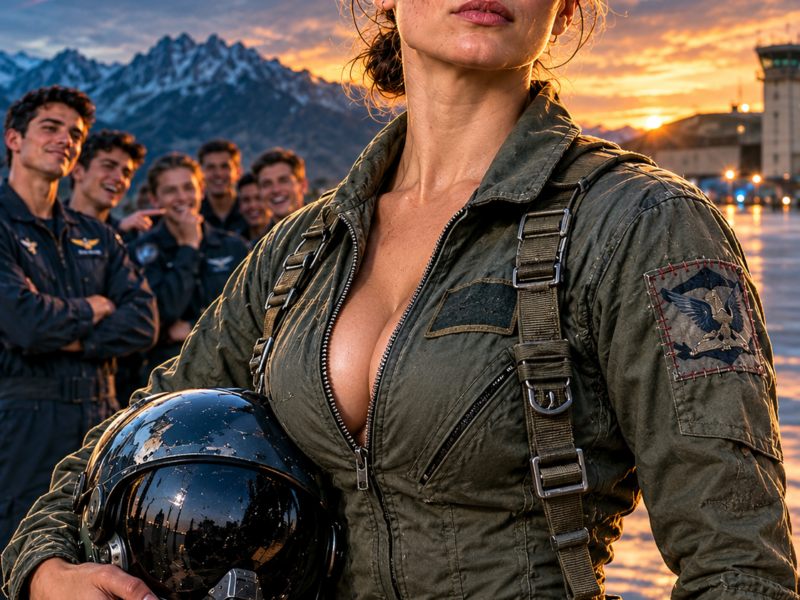
They laughed before I even reached the hangar. I heard it behind me as I crossed the flight line
The colonel’s words hung in the air.
“That’s impossible. That pilot died eleven years ago.”
I looked at the tablet again.
The transmission had ended, but the frequency remained active.
A faint signal pulsed across the screen.
“Sir,” I said, “who died eleven years ago?”
Colonel Marcus Voss closed the briefing room door.
“Everyone out. Now.”
The technician hesitated.
“Colonel, the signal is still—”
“Leave the tablet.”
Within seconds, the room was empty.
Only Voss, the technician, and I remained.
Voss walked toward the windows and checked the corridor.
Then he turned to me.
“Tell me you didn’t bring that callsign here.”
“I didn’t.”
“Tell me you haven’t transmitted on that frequency in eleven years.”
“I haven’t.”
He looked down at the tablet.
“Then someone is deliberately trying to wake up the past.”
I pulled a chair closer to the table.
“Who was the pilot?”
Voss didn’t answer immediately.
Instead, he asked, “Do you remember Operation Black Lantern?”
I felt my stomach tighten.
Of course I remembered.
It had been one of the most difficult missions of my career.
Eleven years earlier, a joint air operation had been launched over a hostile region after intelligence indicated that a group of American personnel were trapped behind enemy lines.
I had been flying the lead aircraft.
My callsign was Widowmaker.
The mission had been complicated from the beginning.
Weather was deteriorating.
Communications were unreliable.
And the intelligence picture kept changing.
My wingman was Captain Nathan Cole.
He was thirty-one, talented, fearless, and one of the few pilots I trusted without hesitation.
We had flown together for nearly four years.
During the final phase of the operation, our formation received a warning from an unidentified voice.
It told us to break left.
I recognized the warning as a possible trap, but the voice provided a code phrase that appeared to confirm it came from our own command network.
I followed the instruction.
Cole didn’t.
Seconds later, an aircraft entered the area where we had been directed to fly.
Cole’s aircraft disappeared from radar.
No emergency beacon.
No confirmed ejection.
No wreckage recovered.
The official investigation concluded that he had been lost during combat.
His body was never found.
The mission was terminated.
And the classified report blamed a communications failure.
I had spent years believing that I should have recognized the warning sooner.
Now someone was using the same callsign.
“Captain Cole,” I said quietly.
Voss nodded.
“The official report says he died.”
“I know what the report says.”
“Then you understand why this transmission is impossible.”
I looked at him.
“Sir, I heard his voice eleven years ago. I heard him call for help before his aircraft disappeared.”
Voss lowered his eyes.
“There’s something I never told you.”
I waited.
“The mission report was altered after the incident.”
I felt my hands go still.
“What?”
“Several communications logs were removed. The original frequency assignments were changed. I discovered the discrepancies during a review years later.”
“Why didn’t you tell me?”
“Because I was ordered not to reopen the investigation.”
“By whom?”
He didn’t answer.
I stepped closer.
“Who ordered it?”
Voss looked at the closed door.
“General Adrian Mercer.”
The name meant something.
Mercer had been a senior operations officer at the time.
He had approved the mission.
He had also signed the final investigation.
“What does he have to do with this transmission?”
Voss shook his head.
“I don’t know.”
I looked at the tablet again.
“Then we find out.”
Before he could respond, the technician spoke.
“Ma’am, there’s another signal.”
The screen flashed.
A new transmission was coming in.
I reached for the audio control.
Voss caught my wrist.
“Don’t.”
I looked at him.
“Why?”
“Because we don’t know who’s listening.”
I pulled my hand free.
“That’s exactly why we need to hear it.”
I pressed play.
Static.
A burst of interference.
Then a man’s voice.
“Widowmaker, this is Ghost One. Check your six.”
My heart stopped.
Ghost One.
That had been Nathan Cole’s secondary callsign during Black Lantern.
The recording continued.
“Do not trust the mission archive. The original flight log is still alive.”
Then the signal vanished.
For several seconds, neither of us spoke.
The technician looked between us.
“Colonel, what does that mean?”
Voss didn’t answer.
I turned to him.
“Where is the original flight log?”
He stared at the screen.
“I thought it had been destroyed.”
“Thought?”
“After the investigation, the archive was transferred to a secure records facility. I was told the original data had been purged.”
“Who told you?”
“Mercer’s office.”
I picked up my helmet.
“Then we’re going to that archive.”
Voss shook his head.
“You can’t just walk into a restricted facility.”
“I’m not walking in without authorization. I’m requesting access through the oversight office.”
“Mercer still has influence.”
“Then he can explain why the evidence disappeared.”
Voss looked at me for a long moment.
Finally, he nodded.
“There’s one more thing you should know.”
I stopped.
“What?”
“The aircraft that disappeared eleven years ago wasn’t the only one involved in the communications failure.”
I stared at him.
“What are you saying?”
“Three weeks after Black Lantern, another aircraft reported hearing Cole’s callsign on an emergency frequency.”
“Why wasn’t that in the report?”
“Because the pilot withdrew the statement.”
“Why?”
Voss’s expression darkened.
“He was transferred the next morning.”
That was the moment I understood that Black Lantern might never have been what we believed.
And if someone was trying to contact me now, they weren’t simply reopening an old wound.
They were warning me.
The following morning, I met with the oversight team.
The request for the original flight log had been approved under a formal evidence-preservation order.
General Whitaker had also authorized an independent review of the old mission.
I explained the new transmissions.
I described the voice.
And I told them what Voss had admitted.
One investigator, Lieutenant Colonel Sarah Mitchell, listened without interrupting.
When I finished, she opened a folder.
“We found something yesterday.”
She slid a printed page across the table.
It was a maintenance record from eleven years earlier.
The date was three days after Black Lantern.
A communications relay had been replaced at Falcon Ridge.
The work order listed an unusual reason:
UNAUTHORIZED FREQUENCY ACCESS — SOURCE UNKNOWN.
“Who approved this?” I asked.
Mitchell pointed to the signature.
General Adrian Mercer.
I looked up.
“Did anyone investigate?”
“According to the record, the issue was closed as routine equipment maintenance.”
“Who performed the replacement?”
“Martin Cole.”
I froze.
“Martin?”
“Not Nathan. A civilian communications technician with the same surname.”
“Do they know each other?”
Mitchell nodded.
“Brothers.”
I sat back.
Nathan had never mentioned having a brother who worked in communications.
But perhaps I had never needed to know.
“Where is Martin now?”
“Retired. Lives outside Raleigh.”
“Has anyone contacted him?”
“Not yet.”
“Don’t call him from the base. Arrange an interview through the investigative team.”
Mitchell nodded.
I looked at the record again.
The maintenance order had been created after the official investigation was closed.
Someone had replaced the communications relay.
Someone had signed the order.
And someone had decided not to investigate why an emergency frequency had been accessed without authorization.
I began to suspect that the mission’s failure hadn’t been caused by random interference.
It might have been caused by someone who knew exactly what we were doing.
That afternoon, Major Daniel Keller approached me outside Hangar Six.
He wasn’t laughing now.
“Captain Cross.”
I turned.
“Major.”
“Can I speak with you?”
“About what?”
He glanced toward the hangar.
“Yesterday. The way I treated you.”
I waited.
“I was out of line.”
“Yes.”
He seemed surprised by my direct answer.
“I didn’t know who you were.”
“That wasn’t the problem.”
He lowered his head.
“I know.”
I studied him.
He looked uncomfortable, but not insincere.
“Why did you assume I didn’t belong here?” I asked.
He hesitated.
“Because I’ve seen transfers come through who couldn’t handle the job.”
“And you decided I was one of them before seeing me fly?”
“Yes.”
“Then you judged the uniform instead of the pilot.”
He nodded.
“I did.”
I started walking.
He fell into step beside me.
“Captain, I heard the transmission.”
I stopped.
“What about it?”
“The second one. The male voice.”
“What did you think?”
Keller looked around.
“I recognized the phrase.”
My attention sharpened.
“Which phrase?”
“Check your six.”
“That’s standard aviation language.”
“Not the way he said it.”
He took a breath.
“My father used to fly reconnaissance. He was stationed here during the Black Lantern investigation.”
I studied his face.
“Did he know Nathan Cole?”
Keller nodded.
“He was the pilot who withdrew the statement.”
The world seemed to narrow around us.
“What was his name?”
“Colonel James Keller. He retired ten years ago.”
I remembered the name from the old report.
He had been listed as a witness.
His statement was summarized in two lines.
No irregularities observed.
No unauthorized transmissions heard.
“You said he withdrew his statement,” I said. “What did he originally report?”
Keller looked toward the hangar doors.
“He told me once that he heard an aircraft call for help after Cole’s disappearance.”
“Did he identify the voice?”
“He said it was Nathan.”
I felt my pulse quicken.
“Why did he withdraw the statement?”
Keller’s expression changed.
“Because someone threatened his career.”
“Who?”
“He never told me.”
“Did he keep any records?”
Keller hesitated.
Then he reached into his flight suit and removed a small folded piece of paper.
“My father gave me this before he died.”
I opened it.
There were six handwritten numbers and a short phrase:
ARCHIVE 14 — NIGHT ACCESS.
I looked at Keller.
“Why didn’t you give this to investigators?”
“Because I didn’t know what it meant.”
“Does your father explain it?”
“He told me that if anyone ever mentioned Widowmaker again, I should find out what happened to Nathan Cole.”
I stared at the note.
“Did he know I was coming here?”
“No. He died last year.”
For a moment, I couldn’t speak.
Keller had spent the previous day mocking my flight suit.
Now he was handing me a clue his father had protected for eleven years.
I folded the paper.
“Thank you, Major.”
He nodded.
“Captain?”
“Yes?”
“If Nathan Cole is alive, I want to know.”
“So do I.”
The archive facility was located nearly two hours from Falcon Ridge.
It was a secure records center used to store declassified and restricted operational material.
We arrived with the required authorization.
General Whitaker had arranged for an independent records officer to accompany us.
Archive Fourteen was located in a separate building.
The room contained old flight computers, communication modules, and sealed storage units.
A records officer checked the access authorization.
Then he entered the numbers from Keller’s note.
The system rejected them.
He tried again.
Rejected.
“Those numbers aren’t a valid access code,” he said.
I looked at the note.
“Try them as a storage reference.”
He entered the sequence into the archive index.
The screen changed.
A file appeared.
BLACK LANTERN — ORIGINAL FLIGHT DATA.
Status: RESTRICTED.
Preservation notice: ACTIVE.
The records officer looked at me.
“This file is not listed in the current mission archive.”
“Can you open it?”
“Not without a secondary authorization.”
I handed him the preservation order.
He reviewed it carefully.
Then he entered his credentials.
The storage cabinet unlocked.
Inside was a sealed data cartridge.
The label was faded.
But the date was clear.
The original mission date.
We documented the cartridge and transferred it to the secure review room.
A technician began extracting the data.
For nearly an hour, the system processed the files.
Then the first flight log appeared.
I leaned forward.
The original communications timeline was different from the official report.
At 2217, our formation received a warning from an unidentified source.
At 2219, the source transmitted a valid authentication code.
At 2221, the formation changed course.
At 2224, Nathan Cole’s aircraft reported an engine warning.
At 2226, his emergency beacon activated.
Then came the entry that made my blood run cold.
2227 — GHOST ONE TRANSMISSION RECEIVED.
The technician opened the audio file.
A burst of static filled the room.
Then Nathan’s voice came through.
“Widowmaker, don’t follow the second vector. It’s compromised.”
I closed my eyes.
I knew that voice.
I had heard it a thousand times.
The recording continued.
“Command has been infiltrated. Repeat, the second vector is compromised.”
Then another voice interrupted.
It was calm.
Male.
And unmistakably familiar.
“Ghost One, terminate transmission. Return to assigned route.”
The technician stopped the audio.
I looked at the records officer.
“Can you identify that voice?”
He shook his head.
“Not from this file.”
I turned toward Mitchell.
“Find the original command recording.”
She was already searching.
A second file appeared.
This one contained the mission control communications.
We played it.
The voice came through again.
“Ghost One, terminate transmission. Return to assigned route.”
The technician adjusted the audio.
The voice became clearer.
I looked at the screen.
It was General Adrian Mercer.
Eleven years earlier, he had personally ordered Nathan to return to the compromised route.
And the official report had removed that transmission entirely.
I stood up.
“Preserve everything.”
Mitchell nodded.
“Already done.”
But the next discovery was even worse.
The original flight data showed that Nathan’s emergency beacon had continued transmitting for thirty-seven minutes after his aircraft disappeared from radar.
The official report said the signal had been lost immediately.
Someone had changed the timeline.
“Where did the beacon transmit from?” I asked.
The technician checked the coordinates.
“Unknown at this stage. We need to compare it with the original tracking data.”
“Do it.”
A few minutes later, the location appeared.
A remote airfield outside the original mission corridor.
I stared at the coordinates.
“That’s not where he went down.”
“No, ma’am.”
“Could the beacon have been moved?”
“Possibly.”
“Then find out who had access to that location.”
Mitchell looked at the screen.
“There’s something else.”
She opened a second document.
It was a personnel movement record.
Three days after the mission, a classified transport aircraft had flown from the remote airfield to an undisclosed destination.
The passenger list was sealed.
But one reference number appeared beside the flight.
N. COLE.
I felt the room tilt.
Nathan might not have died in that aircraft.
Someone might have taken him somewhere.
And the people responsible had hidden the flight.
Before we could examine the record further, the technician’s screen went black.
The archive system shut down.
A warning appeared.
UNAUTHORIZED ACCESS DETECTED.
Mitchell grabbed her phone.
“Security, we need the room locked down.”
The records officer rushed to the terminal.
“Someone just attempted to access the archive remotely.”
“Can you identify the source?” I asked.
He shook his head.
“The connection was routed through an approved command account.”
“Which account?”
He turned the screen toward us.
GENERAL ADRIAN MERCER.
Nobody spoke.
Then my phone vibrated.
Unknown number.
I answered.
“Cross.”
A man’s voice came through.
“You should have left Black Lantern buried.”
I looked at Mitchell.
She began recording the call through the authorized evidence system.
“Who is this?”
“You know who.”
“General Mercer?”
A pause.
Then:
“You’ve made a serious mistake.”
“I found the original flight log.”
“Then you found something you don’t understand.”
“I understand that Nathan Cole’s emergency beacon transmitted for thirty-seven minutes after his aircraft disappeared.”
Silence.
Then the voice returned.
“Some things are better left alone.”
“Is Nathan alive?”
The line went dead.
I stared at the phone.
Mitchell lowered hers.
“That was him.”
“Yes.”
“We need to report this immediately.”
“Agreed.”
We secured the archive room and notified General Whitaker.
A separate security team was dispatched to preserve the remote access records.
Mercer’s command privileges were suspended pending review.
But the most important discovery was still waiting.
The classified transport record.
The reference number beside Nathan’s name.
And the destination.
The investigative team worked through the night to obtain the original movement authorization.
By morning, we had it.
The transport had flown to a restricted test facility in Nevada.
The facility had been used for classified aircraft research.
It had closed four years earlier.
But the personnel records showed that a small number of civilians and military contractors had continued working there under a separate project.
The project name was SILENT SKY.
I recognized it.
Years earlier, there had been rumors of an experimental communications program designed to test secure battlefield transmissions under hostile conditions.
The program had been discontinued after several technical failures.
At least, that was what the public record suggested.
“Who ran it?” I asked.
Mitchell looked at the authorization file.
“General Mercer.”
I sat back.
Everything was beginning to connect.
The unidentified transmissions.
The altered flight logs.
The replaced communications relay.
The hidden transport.
The missing pilot.
Mercer hadn’t simply covered up a mission failure.
He might have been using live pilots to test a system that wasn’t ready.
And Nathan had discovered it.
We needed to know whether anyone had survived.
General Whitaker authorized a team to travel to the Nevada facility.
I requested to accompany them.
He looked at me for a long moment.
“You’re emotionally involved.”
“Yes, sir.”
“That can affect judgment.”
“I know.”
“Why should I approve your request?”
“Because I’m the only person on the team who flew that mission. I know the voices, the procedures, and the tactical decisions. I can help determine whether the transmissions are authentic.”
He considered it.
Then he nodded.
“You go with an investigative team. You do not enter any restricted area without authorization. And you do not attempt to contact anyone independently.”
“Understood.”
The facility was surrounded by desert.
A chain-link fence marked the perimeter.
The main buildings were dark.
Several windows had been boarded up.
A security officer met us at the gate.
He checked our authorization twice before allowing us inside.
The place looked abandoned.
But it wasn’t.
There were fresh tire tracks near the loading area.
A generator was running behind one of the buildings.
And a radio antenna stood on the roof of the central structure.
“Someone is still using this site,” Mitchell said.
I nodded.
We entered through the main door.
Inside, the corridors were clean.
Too clean for a facility that had supposedly been closed for four years.
We found a control room on the second floor.
It contained old monitoring equipment and a wall of frequency displays.
Several channels were active.
One of them showed the emergency frequency from Black Lantern.
I approached the console.
The latest transmission was timestamped less than twelve hours earlier.
I pressed play.
Static.
Then a familiar voice.
“Widowmaker, this is Ghost One. If you can hear me, come alone.”
My heart began pounding.
Nathan.
It had to be.
Mitchell stepped closer.
“Captain, don’t respond.”
“I know.”
The message continued.
“Do not bring Mercer. Do not trust the old mission team.”
Then the recording ended.
I stared at the screen.
A second message appeared.
Coordinates.
A location about three miles from the facility.
Mitchell looked at me.
“We need to secure the area.”
“Agreed.”
The team prepared to move.
We followed the coordinates to a low concrete structure near the edge of the desert.
It appeared to be an old communications shelter.
The door was locked.
Security opened it under the authority of the search order.
Inside, there was a narrow corridor.
At the far end stood a metal door.
A small light glowed above it.
Someone had been there recently.
We entered carefully.
The room beyond contained a desk, a radio, several computer terminals, and a stack of printed flight logs.
On the desk was a photograph.
I picked it up.
It showed Nathan Cole.
Older.
Thinner.
But unmistakably him.
He was standing beside a hangar.
The photograph had been taken recently.
On the back were three words.
SHE KNOWS THE TRUTH.
I turned toward Mitchell.
“Where is he?”
She was examining the computer.
“There’s a live signal coming from somewhere inside the facility.”
Then a voice spoke behind us.
“Don’t move.”
I turned.
A man stood in the doorway.
He was wearing civilian clothes.
His hair was gray.
His face was lined.
And his left hand rested against the doorframe as if his body was no longer accustomed to standing for long periods.
But his eyes were the same.
“Nathan,” I whispered.
He stared at me.
For a moment, neither of us moved.
Then his expression broke.
“Hello, Elena.”
I took one step toward him.
He raised his hand.
“Don’t.”
“It’s me.”
“I know.”
“Why did you disappear?”
He looked toward the investigators.
“Because if I had come back, they would have killed the people who helped me.”
Mitchell moved carefully.
“Captain Cole, we’re here under an official investigation. We can protect you.”
Nathan gave a tired laugh.
“You couldn’t protect me eleven years ago.”
Nobody answered.
I stepped closer.
“What happened?”
He looked at me for a long time.
Then he began to speak.
Black Lantern had not been a routine combat mission.
Mercer had used the operation to test an experimental communication system called Silent Sky.
The system was designed to create realistic command transmissions through multiple frequencies.
It could simulate orders from authorized personnel.
It could also redirect aircraft by sending authenticated instructions.
The technology was supposed to help pilots train under hostile communication conditions.
But it had never been approved for live operational use.
During Black Lantern, Mercer had ordered the system activated without informing the flight crews.
The first warning I received had come from Silent Sky.
It had used a valid authentication code.
The instruction was false.
Nathan recognized the interference.
He had attempted to warn me.
But Mercer transmitted another order using the command network.
The second instruction sent our formation toward the compromised corridor.
Nathan refused to obey.
His aircraft was struck during the resulting engagement.
He managed to eject.
But he landed behind enemy lines.
A recovery team found him hours later.
The team had been arranged through a separate channel.
Instead of returning him to his original unit, they transported him to the Nevada facility.
“Why?” I asked.
“Because I knew what the system had done.”
He looked down.
“I had recorded the unauthorized transmissions. Mercer knew I had the evidence.”
“Why didn’t you contact me?”
“I tried.”
He walked toward the desk and opened a drawer.
Inside was a stack of letters.
All addressed to me.
None had been sent.
“I was told you were being monitored,” he said. “They said if I contacted you, they’d make you look responsible for the mission failure.”
I stared at the letters.
“They told me your aircraft had been destroyed.”
“I know.”
“They told me you were dead.”
“I know.”
My voice shook.
“I spent eleven years believing I had left you behind.”
Nathan lowered his eyes.
“I spent eleven years wishing I could tell you that you did everything you could.”
For a moment, the room disappeared around us.
There was only the sound of the generator and the faint hum of the radio.
Then Mitchell interrupted gently.
“Captain Cole, we need to secure this evidence and get you to a protected location.”
Nathan nodded.
“There’s more.”
He moved to the computer.
“Mercer didn’t stop after Black Lantern.”
He opened a folder.
Inside were recordings from several later training exercises.
The same unauthorized transmissions had appeared at other installations.
The same system had been tested without the knowledge of the pilots.
Some flights had been redirected.
Others had experienced dangerous interference.
The failures had been recorded as pilot error or equipment malfunction.
“Why are they still using it?” I asked.
Nathan looked at me.
“Because the program never really ended.”
He opened another file.
A list of names appeared.
Pilots.
Technicians.
Command officers.
Several had been transferred.
Some had retired.
Two had died in incidents that had never been connected to Silent Sky.
I felt my stomach tighten.
“Who authorized the current tests?”
Nathan pointed to the last entry.
General Adrian Mercer.
But there was another name beneath it.
Lieutenant Colonel Marcus Voss.
I stared at the screen.
“Voss?”
Nathan nodded.
“He knew about the system.”
I thought of the way Voss had reacted when he heard my callsign.
The way he had gone pale.
The way he had asked me to trust him.
“Did he know you were alive?”
Nathan hesitated.
“I think he suspected.”
“Why didn’t he tell me?”
“Because he was afraid.”
I looked at the list again.
Voss had been part of the original mission team.
He had helped investigate Black Lantern.
And he had known that the evidence was incomplete.
The man I had trusted to help reopen the case might have been protecting the very people who had buried it.
I felt anger rise.
But beneath it was something worse.
Disappointment.
When we returned to Falcon Ridge, General Whitaker had already received the initial findings.
Mercer’s access had been restricted.
A separate command investigation had been opened into Silent Sky.
Nathan was placed under protection and received a full medical evaluation.
The evidence from the Nevada facility was secured.
And Colonel Voss was ordered to appear for questioning.
He entered the conference room without his usual confidence.
He looked at Nathan.
Then at me.
“I can explain.”
I sat down.
“Then explain.”
Voss took a breath.
“I knew the Black Lantern report was incomplete.”
“Why didn’t you tell me?”
“Because Mercer said the system was classified above our level.”
“You were the squadron commander.”
“I was a major then.”
“You were still part of the mission team.”
He nodded.
“I knew the communications had been manipulated. I didn’t know Nathan had survived.”
Nathan stared at him.
“You knew enough to ask questions.”
Voss looked down.
“I did.”
“Then why did you stay quiet?”
Voss’s voice was low.
“Mercer threatened to charge me with compromising the operation. He said my career would end. He said the pilots involved would be blamed for violating orders.”
I leaned forward.
“And you believed him?”
“I was afraid.”
Nathan shook his head.
“So were we.”
Voss closed his eyes.
“I know.”
I studied him.
“Did you authorize any of the recent Silent Sky tests?”
“No.”
“Did you know they were happening?”
He hesitated.
Then he nodded.
“How long?”
“Six months.”
“Why didn’t you report them?”
“Mercer told me the system had been approved.”
“Did you verify that?”
“No.”
The silence that followed was heavy.
Voss looked at me.
“I knew the transmission was meant for you. I didn’t know who sent it. When I heard your callsign, I thought the past had finally caught up with us.”
“You could have told me everything.”
“I should have.”
“Yes.”
He looked at Nathan.
“I’m sorry.”
Nathan didn’t respond.
There was nothing he could say that would undo eleven years.
The investigation lasted several more months.
The original mission data was authenticated.
The recordings from the Nevada facility were compared with the transmissions received at Falcon Ridge.
The system’s activation records were traced to Mercer’s office.
And the evidence showed that Silent Sky had been used in live exercises without proper authorization.
The false transmissions had created dangerous conditions for multiple crews.
Mercer was removed from his position.
He faced formal proceedings over the unauthorized use of classified technology, the concealment of operational evidence, and the pressure placed on personnel who tried to report the failures.
Voss was also held accountable for failing to disclose what he knew.
He was removed from command pending further review.
Other personnel who had helped conceal the program were investigated.
The official Black Lantern report was reopened.
Nathan’s name was restored to the record.
The finding that he had died in combat was formally corrected.
He was no longer listed as missing or presumed dead.
He was recognized as a survivor of the mission.
The correction did not erase what had happened.
But it gave the truth a place in the official record.
Several months later, I stood beside the runway at Falcon Ridge.
The morning air was cool.
A row of aircraft waited near the hangar.
Major Keller approached, carrying his helmet.
“Captain Cross.”
“Major.”
He looked toward the runway.
“I heard Captain Cole is recovering.”
“He is.”
“Will he fly again?”
I considered the question.
“That’s up to him and his medical team.”
Keller nodded.
Then he looked at the old insignia on my flight suit.
“The widow spider.”
I touched the patch.
“Yes.”
“Does it really mean what people say it means?”
“What do people say?”
“That when Widowmaker appears on the radio, someone is about to come home.”
I looked toward the horizon.
“That’s what I always wanted it to mean.”
He smiled faintly.
“I owe you an apology, too.”
“You already gave me one.”
“I know. But I wanted to say it again.”
I nodded.
“Then accept mine. I should have given you a chance to prove yourself before judging you, too.”
He looked surprised.
I continued.
“Respect goes both ways, Major.”
“Yes, ma’am.”
A few minutes later, the radio crackled.
A familiar voice came through.
“Falcon Base, Ghost One requesting permission to taxi.”
I froze.
Then I smiled.
Nathan was back in the cockpit.
Not in a combat aircraft.
Not on a dangerous mission.
He was in a training simulator support aircraft, accompanied by an instructor and a medical observer.
It was his first flight-related assignment since his return.
I reached for the radio.
“Ghost One, Falcon Base. Permission granted.”
A pause.
Then his voice came back.
“Copy, Widowmaker.”
I looked toward the runway.
The aircraft began moving.
For eleven years, I had imagined what it would feel like to hear that voice again.
I had expected anger.
Or tears.
Or a thousand questions.
Instead, I felt something quiet.
Relief.
The kind that arrives after a storm has passed.
Later that afternoon, I visited the memorial wall.
The names from Black Lantern were still engraved there.
Nathan’s name had been removed after the official correction.
I stood in front of the wall for a long time.
The mission had taken years from us.
It had cost people their careers.
It had destroyed trust.
And it had nearly cost Nathan his life.
But the truth had finally come out.
I thought about the pilots who had laughed at my flight suit when I first arrived.
They had seen faded fabric and an old patch.
They hadn’t seen the years behind it.
They hadn’t known what that callsign meant.
And perhaps that was fair.
A uniform should never be the only reason someone earns respect.
A callsign should never be a substitute for character.
What matters is what a person does when the radio crackles, the situation becomes dangerous, and someone needs help.
I had carried the name Widowmaker for years.
People had mistaken it for a symbol of destruction.
But that was never what it meant to me.
It was a promise.
No one gets left behind if there’s still a way to bring them home.
I turned away from the memorial and walked toward the hangar.
The radio sounded again.
“Widowmaker, Ghost One.”
I stopped.
“Go ahead, Ghost One.”
Nathan’s voice came through, steady and warm.
“Good to have you on the frequency again.”
I looked up at the sky.
“Good to have you back, Nathan.”
For the first time in eleven years, the callsign Widowmaker didn’t sound like a ghost from the past.
It sounded like a promise kept.
The end.









