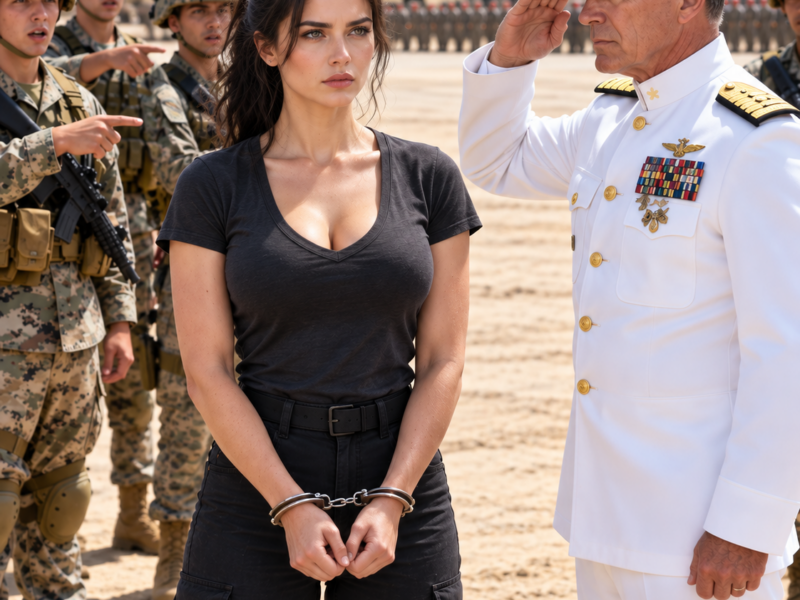
“They handcuffed me in front of an entire Navy base for impersonating a SEAL, laughed when I refused to explain my identity
The secure phone rang again.
Commander Hayes didn’t answer it.
He stood behind his desk, staring at the classified file on his monitor as though the words might rearrange themselves into something less terrifying.
I waited.
Three years ago, I had waited for a rescue that never came.
I had waited for someone to question the report that declared my team dead.
I had waited for the military to acknowledge that six operators had vanished during a mission they were never supposed to be on.
Now I was standing in the commander’s office, alive, and the man responsible for overseeing this base couldn’t even look me in the eye.
“Captain Carter,” Hayes finally said, “I need you to tell me exactly what happened during Operation Nightfall.”
I glanced at the closed door.
“Before I do, Commander, I need three things.”
His eyebrows lifted.
“Three things?”
“An independent investigator. A secure communications channel that your staff cannot access. And confirmation that no one in this building has authority to transfer me without notifying regional command.”
Hayes’s expression tightened.
“You’re making serious demands.”
“No, sir. I’m making sure history doesn’t repeat itself.”
For several seconds, he said nothing.
Then he reached for the secure phone.
“Get me Admiral Whitaker. Priority access. Tell her Captain Elizabeth Carter is physically present and requesting immediate protection under her classified personnel designation.”
He listened.
His face changed.
“What do you mean, the line has been restricted?”
He looked at me.
Then he lowered his voice.
“Who authorized the restriction?”
A pause.
Hayes slowly placed the receiver down.
“The system says the request originated from Naval Intelligence.”
I felt the old coldness settle into my chest.
There it was.
The same organization whose officers had ordered us into Nightfall.
The same organization that had closed the investigation before our families were even notified.
The same organization that had turned six missing operators into six officially confirmed deaths.
“Commander,” I said, “you need to understand something. If someone has restricted your access to my file, that means they already know I’m here.”
As if summoned by the words, footsteps sounded outside the office.
A knock followed.
Three precise strikes.
Hayes moved toward the door, but I caught his arm.
“Don’t open it until you check the security feed.”
He looked at me, startled.
“Why?”
“Because three years ago, someone used an official authorization to get my team into a place they were never supposed to enter.”
I held his gaze.
“And someone else used an official authorization to make sure we never came back.”
Hayes turned toward the security terminal.
The corridor camera showed two men in dark suits standing outside.
Neither wore a visible rank insignia.
One held a leather folder.
The other looked directly into the camera.
Then he smiled.
I knew that smile.
My stomach dropped.
“Who is that?” Hayes asked.
“Deputy Director Adrian Voss.”
Hayes stared at me.
“The intelligence liaison?”
“The man who signed our original mission authorization.”
The knock came again.
This time, a voice followed.
“Commander Hayes, open the door. We have orders to take custody of Captain Carter.”
Hayes hesitated.
I stepped away from the desk.
“Ask them to provide the authorization through the regional command network.”
He pressed the intercom.
“Please transmit your custody order through the official system for verification.”
The man outside didn’t answer immediately.
Then Voss spoke.
“Commander, this is a sensitive national security matter. You are not authorized to delay us.”
Hayes looked at me.
I gave him a small nod.
He switched off the intercom.
“I’m beginning to understand why you asked for an independent investigator,” he said quietly.
“Good. Now understand why you need to keep that door closed.”
For the next thirty seconds, neither of us moved.
Then the security terminal chimed.
A new message appeared.
REGIONAL COMMAND ALERT: UNVERIFIED CUSTODY REQUEST. DO NOT RELEASE SUBJECT WITHOUT DIRECT CONFIRMATION.
Hayes read it twice.
His face hardened.
He returned to the intercom.
“Deputy Director Voss, your request has not been verified. You’ll need to wait for regional confirmation.”
A long silence followed.
Then Voss’s voice returned, stripped of its earlier politeness.
“You have no idea what you’re interfering with.”
Hayes glanced at me.
“I’m starting to get an idea.”
The men walked away.
I didn’t relax.
Neither did Hayes.
“Captain,” he said, “what exactly happened during Operation Nightfall?”
I sat down.
For the first time since entering his office, I felt the weight of three years settle fully onto my shoulders.
“Nightfall was officially a reconnaissance mission,” I began. “Six operators were assigned to recover a missing intelligence specialist from an abandoned communications facility overseas. We were told the site had been cleared and that local forces had withdrawn.”
“Who authorized the mission?”
“Deputy Director Voss approved the intelligence package. Our operational orders came through a joint command channel.”
“And you were the field commander?”
“Yes.”
I paused.
“The briefing was wrong. The facility wasn’t abandoned. Someone had restored power to the underground section, and there were armed personnel guarding the access roads. Our communications were disrupted within minutes of arrival.”
Hayes leaned forward.
“Why didn’t you abort?”
“Because the distress beacon we were sent to recover was transmitting from beneath the facility. We believed the intelligence specialist was alive.”
“And was he?”
“Yes.”
I could still see the narrow corridor, the emergency lights, and the man we found chained to a support column.
He had been injured, dehydrated, and terrified.
But he was alive.
“He told us he had uncovered an unauthorized weapons program connected to several military contractors. He said he’d copied records showing that equipment intended for allied forces had been diverted to a private network.”
Hayes frowned.
“That would explain the classified designation. But it doesn’t explain why your team was erased.”
“Not yet.”
I took a breath.
“Once we recovered him, our extraction route was compromised. Someone had transmitted our position before we reached the landing zone. We came under fire, and two members of my team were wounded.”
“What did you do?”
“I called for immediate extraction.”
“And?”
“The request was denied.”
Hayes stared at me.
“Denied? By whom?”
“The voice on the channel identified itself as joint operations command. We were ordered to move to a secondary location and wait for further instructions.”
“Did you comply?”
“Yes. We had wounded personnel, limited ammunition, and no reliable communications. We followed the order.”
I looked down at my hands.
“That was the last time I heard a friendly voice on our channel.”
For a moment, the room seemed to shrink.
“They knew where we were. They knew we were wounded. And they knew we had the intelligence specialist.”
I raised my eyes.
“Then someone authorized an airstrike on our position.”
Hayes went very still.
“An airstrike?”
“The first strike hit the ridge behind us. The second destroyed our extraction point. We escaped into an underground service tunnel, but the blast separated us.”
I swallowed.
“I found three of my operators in a maintenance chamber. The others were missing. The intelligence specialist was gone.”
“And you?”
“I was injured. I managed to reach a backup radio and sent a distress transmission. A rescue team eventually found me outside the facility.”
Hayes’s voice was barely audible.
“The official report says your aircraft was destroyed during extraction and your entire team was killed.”
“My aircraft was never destroyed. We hadn’t even reached it.”
He stared at the file.
“Who wrote the report?”
“Voss’s office submitted the initial assessment. A review board signed off on it less than forty-eight hours later.”
“Forty-eight hours?”
“They declared six people dead without recovering six bodies.”
Hayes leaned back, visibly shaken.
“Why didn’t you challenge the report?”
“I did.”
I let the words hang between us.
“I filed a statement. I requested a formal inquiry. I provided the transmission logs I had recovered.”
“And what happened?”
“My evidence was classified. My medical records were restricted. My assignment was suspended. Then I was told that continuing to discuss Nightfall could expose surviving personnel to danger.”
Hayes lowered his head.
“And you believed them?”
“I believed that my team might still be alive.”
My voice cracked on the last word.
“That was why I stopped fighting the paperwork. I thought if I stayed quiet, I might eventually find them.”
The commander said nothing.
For three years, I had imagined telling this story to someone who could actually change something.
I had imagined anger.
Disbelief.
Questions.
I hadn’t imagined the silence.
Finally, Hayes looked up.
“Why come here now?”
“Because someone sent me a message two days ago.”
I reached into my pocket and removed a folded piece of paper.
It had been delivered to my apartment in an unmarked envelope.
No return address.
No signature.
Just six words typed on a blank sheet.
ONE OF YOUR TEAM IS STILL ALIVE.
Beneath them was a time, a date, and the name of this base.
Hayes read it.
“Who sent this?”
“I don’t know.”
“Why didn’t you bring it to federal investigators?”
“Because the message included a warning.”
I unfolded the paper completely.
At the bottom, in smaller letters, was another sentence.
TRUST NO ONE WHO HAS ALREADY SEEN YOUR FILE.
Hayes looked up sharply.
“And you came here anyway?”
“I came because this base was the last location named in the original Nightfall communications record.”
I pointed toward the monitor.
“Your command system logged a transfer request connected to my file six months ago. Someone tried to move the Nightfall archive into a new compartment. The request was denied, but the access record came from this installation.”
Hayes’s face tightened.
“I’ve never seen that request.”
“Then someone used your command authority without your knowledge.”
He reached for the terminal.
“I’ll pull the access log.”
“Not through the regular network.”
He stopped.
I leaned forward.
“If the person who sent that message is right, the system is compromised.”
Hayes looked at the black card in the evidence bag.
Then at the sealed file.
“There’s an offline archive in the records vault,” he said. “Older mission documents were retained on a separate system during the transition to the current network.”
“Can you access it?”
“I can authorize the records officer to retrieve the original Nightfall package.”
“Then do it without sending a request through the intelligence network.”
He nodded and reached for the office phone.
Before he could dial, the secure phone rang again.
This time, the display showed a regional command identifier.
Hayes answered.
“Commander Hayes.”
A woman’s voice came through.
“General Whitaker here. Is Captain Carter with you?”
“Yes, ma’am.”
“Put her on the line.”
I took the receiver.
“Captain Carter speaking.”
“Elizabeth, this is Admiral Whitaker. I reviewed the alert from your location. Are you safe?”
“For now, ma’am.”
“Has anyone attempted to take custody of you?”
“Deputy Director Voss and an unidentified associate. Their authorization was not verified.”
There was a pause.
“Do not release yourself to anyone claiming authority over your file. I’ve dispatched an independent security team. They’ll arrive shortly.”
“Thank you, ma’am.”
“There’s something you need to know. The original Nightfall archive was accessed this morning using a credential assigned to a person officially listed as deceased.”
My grip tightened around the phone.
“Who?”
“The access record identifies Staff Sergeant Marcus Bell.”
For a moment, I couldn’t speak.
Marcus had been our communications specialist.
He had been the youngest member of the team, quick with a joke and quicker with a radio.
His file said he died during the first strike.
“That’s impossible,” I whispered.
“Is it?”
I looked at Hayes.
“Admiral, I need the raw access log. Not a summary.”
“You’ll receive it through the independent channel. And Captain?”
“Yes, ma’am?”
“If Marcus Bell is alive, someone has been maintaining his identity in the system for three years.”
The line went silent.
I handed the receiver back to Hayes.
He looked at me carefully.
“Could the message have come from Bell?”
“Possibly.”
“Then perhaps he’s the one who wants you to find him.”
“Or someone wants me to believe that.”
I stood.
“Commander, where is your records vault?”
He hesitated.
“Lower level, east wing.”
“Then let’s go.”
We left the office through a side corridor and descended a stairwell that smelled of concrete and machine oil.
Hayes had insisted on bringing the younger officer who had first questioned my credentials.
His name tag read PARKER.
He walked a few steps behind us, glancing toward every doorway.
“Sir,” Parker said quietly, “there’s something I should tell you.”
Hayes turned.
“Go ahead.”
“When Staff Sergeant Miller first scanned the card, the system returned a restricted alert. It didn’t say the credentials were fake.”
“What did it say?” I asked.
Parker swallowed.
“Access attempt detected. Special handling required.”
I stopped walking.
“Did Miller see that?”
“Yes, ma’am. He closed the alert before it finished loading.”
Hayes’s jaw tightened.
“Why didn’t you report it?”
“I wasn’t sure what it meant. And Staff Sergeant Miller told me not to interfere.”
I studied him.
“Did you save a copy?”
Parker nodded.
“I took a photograph of the screen with my phone before he closed it.”
He pulled out his device and showed us the image.
The alert contained a second line.
SUBJECT IDENTITY MATCH CONFIRMED. NOTIFY ARCHIVE CUSTODIAN.
Below it was a timestamp.
And a notification recipient.
Adrian Voss.
Hayes stared at the screen.
“He knew you were here before we even opened the file.”
“He may have known before I arrived,” I said.
The three of us continued toward the vault.
At the end of the corridor, Hayes entered his code and pressed his palm against a biometric reader.
The door clicked open.
Inside, rows of secure cabinets lined the walls.
An older terminal sat on a steel desk beneath a fluorescent light.
Hayes approached it.
“This system was taken offline four years ago. It still contains the original mission manifests and some archived communications.”
“Can it show who changed the report?”
“If the access history wasn’t deleted.”
He powered it on.
The screen flickered, then displayed a login prompt.
Hayes entered his credentials.
A list of archived operations appeared.
He typed NIGHTFALL.
The system returned three records.
One was the mission briefing.
One was the casualty report.
The third was labeled POST-OPERATION ADDENDUM — RESTRICTED.
Hayes opened the briefing first.
We reviewed the names of the six operators, the extraction coordinates, and the original mission objectives.
Then we opened the casualty report.
The text was familiar.
Too familiar.
It repeated the same claims I had spent three years disputing.
But the timestamps were different.
The report had been created before the airstrike.
I leaned closer.
“Go back.”
Hayes scrolled upward.
There it was.
A line buried in the file metadata.
INITIAL CASUALTY ASSESSMENT GENERATED: 03:12.
The first strike had occurred at 04:06.
The official report had been prepared fifty-four minutes before the event it claimed to describe.
Parker stared at the screen.
“That means they knew the casualties before the mission ended.”
“Or they had already decided what the official story would be,” I said.
Hayes opened the post-operation addendum.
The document contained a series of communications authorizations.
Most were redacted.
One wasn’t.
A request had been submitted to redirect the extraction aircraft away from our designated landing zone.
The authorization signature belonged to Adrian Voss.
Beneath it was a second signature.
Commander Daniel Hayes.
The room fell silent.
Hayes looked as if he’d been struck.
“That isn’t my signature.”
I studied the document.
The digital signature had been issued using his command certificate.
But the timestamp showed that the authorization had been approved while Hayes was attending a public briefing at another installation.
“Someone used your credentials,” I said.
Hayes gripped the edge of the desk.
“I never authorized that mission change.”
“I believe you.”
He looked at me, surprised.
“Why?”
“Because if you had been part of it, Voss wouldn’t have needed to erase the record. He would have made sure your name was protected.”
Hayes looked back at the screen.
“What do we do now?”
I pointed to the third record.
“We open the full audit trail.”
He selected the option.
A warning appeared.
THIS RECORD HAS BEEN ACCESSED WITHIN THE LAST SIX HOURS.
Then another line loaded beneath it.
MOST RECENT USER: M. BELL.
My heart began pounding.
Marcus was alive.
Or someone wanted us to think he was.
The terminal chimed.
A message appeared on the screen.
No sender.
No routing information.
Just one sentence.
CAPTAIN CARTER, IF YOU ARE READING THIS, DO NOT TRUST THE RESCUE TEAM.
Parker stepped away from the desk.
“Ma’am?”
I stared at the message.
The independent security team was supposed to arrive within minutes.
Someone had known we would come to the vault.
Someone had left us a warning.
Then the building lights went out.
Emergency lighting flickered on along the floor.
A metallic bang echoed from somewhere above us.
Hayes reached for his radio.
“Security, this is Commander Hayes. Report.”
Only static answered.
Parker drew a breath.
“Sir, the stairwell door just locked.”
I looked toward the vault entrance.
A small red light had appeared beside the door.
The room was now sealed from the outside.
Hayes tried his access code.
The reader flashed red.
“Override denied.”
I moved toward the terminal.
“Can you get us out through the maintenance corridor?”
“There is one,” Hayes said, “but the access door is on the other side of the archive room.”
“Then we move.”
I pulled the black identification card from the evidence bag Parker had carried down with us.
The card had no photograph, no printed rank, and no visible unit designation.
But the classified file had recognized it.
I held it against the reader beside the archive door.
For one second, nothing happened.
Then the reader flashed green.
Parker stared at me.
“What exactly is that card?”
“Something that was never supposed to fall into the wrong hands.”
The door unlocked.
We moved through the archive room and into a narrow service passage.
Behind us, the terminal emitted another alert.
I turned back just long enough to read the final message.
MARCUS BELL IS NOT THE ONLY SURVIVOR.
I felt the breath leave my lungs.
Six operators had been declared dead.
I had spent three years searching for signs that even one might have survived.
Now the archive was telling me there were others.
We reached the maintenance stairwell and climbed toward the loading bay.
At the top, Hayes held up a hand.
Voices came from the other side of the door.
“Clear the lower corridor.”
“Secure the vault.”
“Find Carter.”
Those weren’t the voices of the security team I had been promised.
Hayes’s face hardened.
He lowered his voice.
“There’s another exit through the vehicle bay.”
We moved down the stairs and slipped into a storage area beside the loading dock.
Through a narrow window, I saw two black vehicles parked outside.
Four armed men were moving toward the main entrance.
One of them carried the same leather folder Voss had held.
I recognized the man walking beside him.
Staff Sergeant Miller.
The officer who had arrested me.
The officer who had insisted I was an impostor.
He wasn’t merely trying to embarrass me.
He was helping them find me.
Parker looked sick.
“Staff Sergeant Miller is supposed to be on security duty.”
“Not anymore,” Hayes said.
I watched the men through the window.
“Commander, do you have a secure radio that doesn’t use the base network?”
Hayes shook his head.
“Not here.”
Parker lifted his phone.
“I might.”
We looked at him.
“My father works for emergency communications. He gave me a satellite device for field exercises. It’s not registered to the base.”
“Do you have it with you?” I asked.
He nodded and pulled a compact device from the side pocket of his uniform.
The screen showed a weak signal.
I took it and entered the emergency number General Whitaker had provided.
The connection took several seconds.
Then a voice answered.
“Independent command channel.”
“This is Captain Elizabeth Carter. The base records vault has been compromised. Our communications are restricted, and armed personnel are searching for me under an unverified custody order.”
“Captain, identify your current location.”
I gave the loading bay coordinates.
“Do not move toward the main entrance,” the voice replied. “A security unit is approaching your position. Authentication phrase?”
I froze.
The authentication phrase was supposed to be delivered through General Whitaker’s secure channel.
I had not received it.
“Negative,” I replied. “I haven’t been given a phrase.”
A pause.
Then the voice said, “Understood. Hold your position. We will send verification through a separate channel.”
I ended the call.
Parker looked confused.
“Why didn’t you give them your identity code?”
“Because I didn’t know who was on the other end.”
Hayes stared at me.
“You think that wasn’t General Whitaker’s team?”
“I think someone is using official channels to move people around this base. Until I can verify who’s actually in command, no one gets my trust for free.”
A sound came from the service passage.
Footsteps.
Someone had found the open door.
I motioned for Hayes and Parker to move behind a row of storage crates.
The loading bay door began to rise.
A man stepped inside.
He wore a plain tactical uniform and carried a compact radio.
He looked around the room, then spoke into his microphone.
“Target not located. Checking the vehicle bay.”
He took three steps toward the crates.
I waited until he passed the first row.
Then I stepped out behind him.
“Stop.”
He spun around.
His hand moved toward his weapon.
“Don’t,” I said.
He froze.
I could see the moment he recognized me.
“Captain Carter?”
“Who sent you?”
“Regional security.”
“Authentication phrase?”
He hesitated.
That was enough.
I moved to disarm him, but before I could reach him, a second figure appeared at the far entrance.
“Stand down!” the newcomer shouted.
A woman in a dark uniform raised her identification badge.
“Commander, Major General Whitaker’s office. Captain Carter, I’ve been ordered to escort you to a secure location.”
I didn’t move.
“Authentication phrase?”
The woman gave it immediately.
It matched the one General Whitaker had used during our last secure call.
I lowered my hands.
“Name and unit?”
“Major Sarah Lin, regional protective detail.”
I checked her credentials through the satellite device.
The information matched.
For the first time since my arrest, I allowed myself to breathe.
Major Lin secured the first man and called for additional personnel.
Then she looked at Hayes.
“Commander, you’re required to accompany us. The base command network has been placed under emergency restriction.”
Hayes nodded.
“What happened to the original security team?”
“Some members are being questioned. Others have been moved to a separate command post.”
I looked at the corridor behind us.
“Where is Voss?”
“Unaccounted for.”
Of course he was.
We left through the loading bay and boarded an armored vehicle.
As we drove away, I watched the base disappear behind the security fence.
Three years ago, I had left a battlefield believing I was the last survivor.
Now I knew the battlefield had followed me home.
And the people responsible were still trying to finish what they had started.
The secure facility was located outside the main installation, behind two checkpoints and a reinforced perimeter.
General Whitaker was waiting in a conference room when we arrived.
She was in her early sixties, with short gray hair and a steady gaze that made most officers sit straighter without being told.
She stood when I entered.
“Captain Carter.”
“Ma’am.”
She motioned for me to sit.
“Commander Hayes has provided his account. We’ve also secured the archive terminal and the unauthorized custody records.”
“Did you recover the message from Marcus?”
“Yes.”
“Can you locate him?”
“We’re tracing the access credential. But I need to ask you something first.”
She placed a folder on the table.
Inside were photographs of the six members of my team.
Marcus Bell.
Sergeant Noah Price.
Corporal Daniel Ross.
Lieutenant Michael Grant.
Specialist Aaron Wells.
And me.
The photograph had been taken two days before Nightfall.
Whitaker tapped the image of Marcus.
“The record shows that his credentials were used to access the archive from a remote terminal. The connection was routed through a decommissioned communications station.”
“Where?”
“An old naval relay facility on the coast. It was closed after a fire four years ago.”
I leaned forward.
“Is anyone stationed there?”
“Not officially.”
“Then that’s where we need to go.”
Whitaker studied me.
“You’ve just been the target of an unauthorized arrest, a compromised command network, and a possible abduction attempt. You’re not going anywhere until we understand what we’re dealing with.”
“Ma’am, Marcus is leaving messages through a system only he knows. If he’s alive, he may be in danger.”
“And if the messages are bait?”
“Then I’ll know before I get close.”
Whitaker was silent for several seconds.
Finally, she closed the folder.
“You will not go alone. A vetted team will accompany you, and every member will be screened outside the compromised network.”
“Understood.”
“One more thing, Captain. The records indicate that the original Nightfall intelligence specialist was never recovered.”
I looked at her.
“He was with us when we entered the facility.”
“Your official report says he died during the extraction.”
“He was alive when I last saw him.”
Whitaker’s expression sharpened.
“Do you know his name?”
I closed my eyes, trying to recall the briefing document.
The specialist had been given a cover identity.
We had been told not to ask about his background.
But I remembered the name he’d whispered when we pulled him from the underground chamber.
“Elias Ward.”
Whitaker glanced at her notes.
“That name doesn’t appear in the original personnel manifest.”
“Because he wasn’t a service member. He was an intelligence contractor.”
“Then we have another problem.”
“No, ma’am,” I said. “We have the reason they erased us.”
Whitaker waited.
I leaned forward.
“They didn’t need to kill my team to hide a failed mission. They needed to make sure no one could testify about what we recovered.”
I pointed at the photographs.
“If Marcus is alive, he may know where the others went. If Elias survived, he may know who ordered the airstrike.”
Whitaker’s gaze held mine.
“And if Voss gets to them first?”
“Then we’ll be right back where we started.”
The general stood.
“Prepare the team.”
We left before sunrise.
The old relay facility stood beside a stretch of empty coastline, its concrete walls weathered by salt and years of neglect.
The perimeter fence had collapsed in several places.
We found fresh tire tracks near the service entrance.
Someone had been there recently.
The protective team secured the outer buildings while I approached the main access door with Major Lin.
The lock had been forced.
Inside, the air smelled of damp concrete and burned wiring.
A narrow corridor led to a communications room where old equipment stood beneath a layer of dust.
One terminal was active.
A small green light blinked beside the keyboard.
On the screen was a message.
CAPTAIN CARTER. IF YOU CAME ALONE, YOU WOULD ALREADY BE DEAD.
I stared at the words.
Marcus had always been blunt.
He had also been the only person on our team who could make a bad situation sound even worse.
A second message appeared.
CHECK THE ROOM BEHIND THE TRANSMITTER WALL.
I looked toward the far side of the room.
A metal panel had been fitted over an old maintenance opening.
Major Lin signaled to the security team.
They removed the panel.
Behind it was a narrow passage leading to a small underground chamber.
A man sat against the far wall.
His beard was long.
His uniform was torn and stained.
A scar ran from his forehead to his cheek.
But when he lifted his head, I recognized him immediately.
“Marcus.”
He stared at me as if he couldn’t trust his own eyes.
Then he struggled to stand.
“Captain?”
I crossed the chamber and caught him before he fell.
For several seconds, neither of us spoke.
Then he laughed once, weakly.
“I knew you’d come.”
I held him tightly.
“You were supposed to be dead.”
“So were you.”
I pulled back and studied his face.
“What happened to the others?”
His expression changed.
“Some survived the first strike. We were separated during the escape. The people who found us weren’t rescuers.”
“Who were they?”
“Contractor security. They were sent to recover the intelligence specialist and destroy anything connected to Nightfall.”
“Did they find Elias?”
Marcus nodded slowly.
“They took him.”
My stomach tightened.
“Where?”
“I don’t know. But he left something before they moved him.”
Marcus reached into a torn pocket and pulled out a small data drive.
“I kept this hidden. It contains a copy of the original mission recording and the authorization chain for the strike.”
I took the drive.
“Why didn’t you send it to command?”
“I tried. Every time I accessed the network, someone tracked the connection. I realized the system itself was compromised.”
He looked at Major Lin.
“Is this team clean?”
She gave him the same authentication phrase General Whitaker had provided.
Marcus exhaled.
“Good.”
I sat beside him.
“Marcus, tell me what happened after the strike.”
He lowered his head.
“When the first explosion hit, I was thrown into the lower service tunnel. I broke my leg. Two men found me and dragged me out. They wore military equipment, but their unit markings had been removed.”
“Were they ours?”
“I thought so. Until they started asking about the intelligence specialist.”
He swallowed.
“They wanted the drive he had copied. They wanted the names of everyone who had seen the files.”
“And you?”
“I lied. I told them you had destroyed the evidence before the strike.”
I looked at him.
“Why?”
“Because I didn’t know whether you were alive. And if they believed you had the evidence, they would keep looking for you.”
I felt anger rise, then fade beneath the exhaustion.
“You should have told me.”
“I couldn’t. They kept me in a private medical facility for months. When I escaped, I discovered my identity had been marked deceased. My credentials were still active, but every attempt to contact command triggered an alert.”
“So you stayed hidden.”
“I stayed alive.”
He looked at the data drive.
“Until I found the archive access record. I knew someone was still moving files. Then I heard you had been arrested.”
I frowned.
“How did you know?”
“Because the alert reached the old relay system. The same system they used to track our team during Nightfall.”
I looked at Major Lin.
“Can we copy the drive?”
She nodded.
“Our technical team can create a verified image in a secure environment.”
“Do it.”
Marcus caught my sleeve.
“Claire, there’s one more thing.”
I turned back.
“The people who ordered the strike weren’t just trying to hide the weapons program.”
“What else?”
“They were using the operation to test a targeting system that could redirect allied weapons without the operators knowing. Elias had proof that the system had been installed in equipment supplied to several units.”
I felt a cold weight settle in my chest.
“That would explain the airfield attack.”
“Exactly. They needed the data from Nightfall to finish the system. The new attack was meant to recover the last authentication key.”
“Who was supposed to receive it?”
Marcus looked at me.
“Voss.”
The room fell silent.
General Whitaker’s team immediately transmitted the information through the independent channel.
Within an hour, the data drive had been copied and verified.
The recording showed the original withdrawal order.
The strike authorization.
The altered casualty assessment.
And a voice clearly identifiable as Adrian Voss, directing the operation to proceed despite confirmation that friendly personnel remained in the target area.
The evidence was devastating.
But it wasn’t the end.
A message arrived through the secure channel just as the technical team finished its analysis.
Voss had been located at a private airfield twenty miles inland.
He was preparing to leave the country.
General Whitaker authorized an arrest operation.
This time, the team carried verified orders, independent communications, and a chain of custody for every piece of evidence.
I watched from the command vehicle as the officers surrounded the aircraft.
Voss stepped out of a small administrative building, holding a briefcase.
When he saw the security team, he stopped.
Then he looked directly at me.
Even from a distance, I could see the recognition in his eyes.
“You should have stayed dead, Captain.”
I walked toward him.
“You should have written a better report.”
His jaw tightened.
“You have no idea what you have uncovered.”
“I know six people were declared dead before their mission was over. I know someone ordered a strike on their position. I know you altered the records and tried to have me taken into custody when I came back.”
“You think this is about me?”
“I think you’ll have a chance to explain it to investigators.”
He looked toward the aircraft.
For one moment, I thought he might run.
Instead, he lowered the briefcase.
“You can’t prove who gave the final order.”
I held up the sealed evidence bag containing the original recording.
“We don’t need to guess anymore.”
The officers moved in.
Voss was arrested without a struggle.
As they escorted him away, he turned back once.
“You have no idea how many people will fall if this comes out.”
I met his gaze.
“Then they should have thought about that before they sent us to die.”
The investigation lasted months.
The evidence from Nightfall was matched with financial records, contractor communications, and the intercepted transmission from the airfield attack.
Several officers were removed from duty.
The contractor’s executives faced criminal charges.
The officials who had falsified the report were formally investigated.
And the six names on the Nightfall casualty list were reviewed one by one.
Marcus recovered under medical supervision.
Two other operators were eventually located through the reopened investigation.
One had spent years in a rehabilitation facility under a protected identity.
The other had been held under an assumed name after refusing to cooperate with the people who had ordered the strike.
Both were alive.
Elias Ward was found later, and his testimony confirmed the weapons program that had triggered the original cover-up.
For the first time, the official record reflected what had actually happened.
Operation Nightfall had not ended in the deaths of six operators.
It had ended in a deliberate betrayal, followed by an attempt to erase the survivors.
My own record was corrected.
The accusation of misconduct was withdrawn.
My rank and service history were restored.
But the most important moment came in a small room at the regional command center, where the surviving members of Nightfall gathered for the first time in three years.
Marcus was there, leaning on a cane.
Noah Price sat beside him, his left hand still stiff from an old injury.
Daniel Ross stood near the window, quieter than I remembered.
Elias Ward had joined us for the final briefing.
We didn’t wear our old uniforms.
We didn’t need to.
For a long time, none of us knew what to say.
Then Marcus looked around the room and gave a tired smile.
“Six names on a dead list,” he said. “That’s a pretty lousy way to make history.”
Noah let out a laugh that sounded dangerously close to a sob.
I looked at each of them.
For three years, I had carried their names as if they were gravestones.
Now they were standing in front of me, alive and imperfect and real.
“I should have found you sooner,” I said.
Marcus shook his head.
“You came back.”
“That isn’t enough.”
“It has to be enough for today.”
He was right.
We couldn’t get back the years we’d lost.
We couldn’t erase the fear, the injuries, or the nights each of us had spent wondering whether the others had survived.
But we could stop pretending the official report was the truth.
And we could make sure no one else had to carry the blame for a crime committed by people who hid behind their rank.
Several weeks later, I returned to Naval Station Norfolk.
The same security building stood beside the main gate.
The same cameras watched the entrance.
The same checkpoint guards checked credentials.
Staff Sergeant Miller was no longer assigned there.
Commander Hayes met me outside the headquarters building.
He stood at attention.
“Captain Carter.”
“Commander.”
“I owe you an apology.”
I waited.
“I accepted the initial report without questioning why six bodies were never recovered. I allowed a classified designation to replace basic accountability. And when you arrived, I almost let someone else decide what happened to you.”
He looked me in the eye.
“I should have asked more questions.”
“Yes,” I said. “You should have.”
He nodded, accepting the answer without defending himself.
Then he stepped aside.
The doors to headquarters opened.
Inside, the framed photographs still lined the walls.
But a new photograph had been placed near the entrance.
It showed the surviving members of Operation Nightfall standing together in front of the old relay facility.
Beneath it was a simple plaque:
OPERATION NIGHTFALL — IN HONOR OF THOSE WHO SERVED, THOSE WHO SURVIVED, AND THOSE WHO REFUSED TO LET THE TRUTH BE BURIED.
I stood there for a long time.
I had once believed that clearing my name would make everything right.
It didn’t.
Justice couldn’t return the years we had lost.
It couldn’t erase the moment I heard the order to withdraw while my teammates were still trapped.
It couldn’t undo the damage caused by a lie repeated until people stopped asking whether it was true.
But it could give us something we had been denied.
The chance to tell our own story.
As I turned toward the exit, Marcus called from the hallway.
“Captain Carter!”
I looked back.
He held up a small black card.
The same kind of card that had led to my arrest.
“Think they’ll ever make these things look normal?”
I smiled for the first time that day.
“Not if I have anything to say about it.”
He laughed.
We walked out together into the sunlight.
For three years, they had told the world I was an impostor.
They had used a classified file to silence me, a false report to bury my team, and official orders to make a crime look like duty.
But they had made one mistake.
They had assumed that if they erased our names, no one would come looking for the truth.
They were wrong.
Because a uniform can be taken away.
A record can be altered.
A person’s reputation can be destroyed by a single sentence typed by someone sitting safely behind a desk.
But the truth doesn’t belong to the person with the highest rank.
It belongs to the people who lived it.
And sometimes, the most dangerous thing a supposedly dead soldier can do is walk through the front gate, look the commander in the eye, and refuse to disappear again.
The End.









