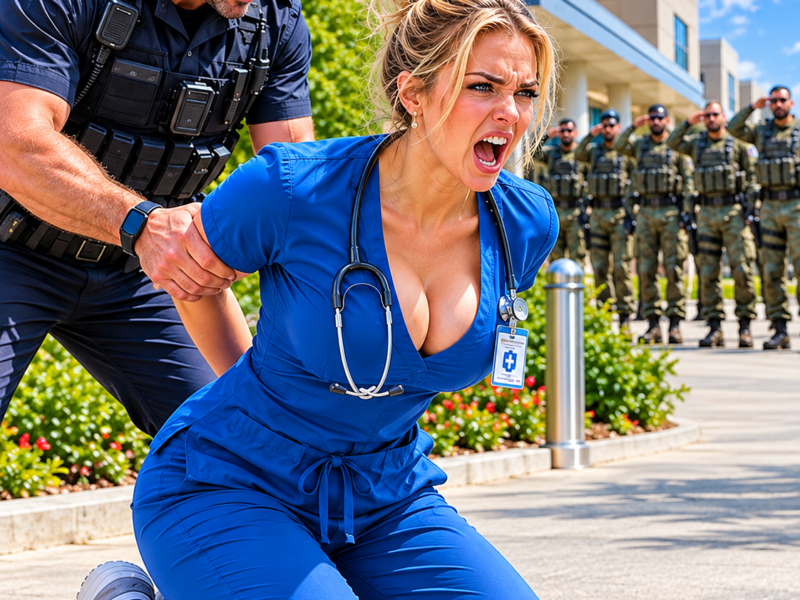
“They handcuffed me in front of a crowded hospital lobby because one police officer decided my military service was a lie.
The first thing I noticed was that nobody in the lobby was breathing normally.
Thirty Navy SEALs stood in perfect formation.
The senior officer remained in front of them, his eyes fixed on me.
And Officer Ryan Mercer still had his hand near the cuffs behind my back.
“Remove them,” the officer said.
Mercer swallowed.
“Sir, she’s being detained for possible stolen valor.”
The officer didn’t raise his voice.
“I heard you the first time.”
“I’m following up on a complaint.”
“Then you should have followed up on the facts before putting your hands on her.”
Mercer looked toward the hospital security desk.
No one moved to help him.
I turned slightly.
“Sir, I can stand here with handcuffs on. But my patient is upstairs.”
The officer’s expression softened.
“Tyler Bennett?”
I nodded.
“His mother is waiting outside the trauma unit. He needs someone who knows his history.”
The officer looked at the Navy personnel beside him.
“Get a medical team to his room. Make sure his care isn’t interrupted.”
Then he faced Mercer again.
“Take those cuffs off.”
Mercer hesitated.
“Sir, I need to understand who she is.”
The officer stepped closer.
“Her name is Captain Anna Brooks. She served with a special operations medical detachment. She was assigned to my command.”
He paused.
“And she saved the lives of men standing behind me.”
Mercer’s face changed.
But I wasn’t interested in watching him become embarrassed.
I wanted the cuffs off.
I wanted to return to work.
And I wanted to know why thirty men I hadn’t seen in five years had suddenly appeared at my hospital.
The officer reached for the key.
The cuffs opened.
I rubbed my wrists.
“Thank you.”
He nodded.
“I’m Commander James Whitaker. We met briefly during your last deployment.”
“I remember, sir.”
“I’m sorry this happened.”
I looked toward Mercer.
“An apology won’t fix the way he treated me. But it would be a start.”
Whitaker nodded once.
Then he turned toward the lobby.
“Gentlemen, stand easy.”
The thirty men relaxed.
One of them stepped forward.
He was older than I remembered, with silver beginning to show at his temples.
His name was Marcus Reed.
He had been my team leader.
And five years earlier, I had watched him disappear into a storm of dust and smoke.
I stared at him.
“Marcus?”
He smiled.
“Hey, Doc.”
My throat tightened.
I took one step toward him.
Then another.
“You’re alive.”
He nodded.
“Last time I checked.”
I almost laughed.
Instead, I covered my mouth.
I had spent five years trying not to imagine this moment.
Five years telling myself that the missing men were gone.
Five years accepting the official report because nobody would tell me anything else.
And now Marcus was standing in front of me.
Alive.
Behind him stood the rest of the men from our former unit.
Some had been part of my team.
Others had served alongside us during the same operation.
I recognized every face.
Or what remained of it.
One man had a prosthetic leg.
Another walked with a cane.
A third had a deep scar running from his ear to his jaw.
They had all survived something.
And somehow, they had found their way back to me.
Marcus looked at my wrists.
“Did he hurt you?”
“I’m fine.”
“That wasn’t what I asked.”
I glanced at the red marks.
“He was more interested in making a public example than asking questions.”
Marcus’s jaw tightened.
Commander Whitaker intervened.
“We’ll address the officer’s conduct through the proper channels.”
I nodded.
“Good. Because I have a patient upstairs.”
Marcus smiled faintly.
“Still putting everyone else first.”
“Some habits are hard to break.”
He looked toward the elevator.
“Can we talk somewhere private?”
I hesitated.
“After I check on Tyler.”
“Of course.”
I walked toward the elevator.
The lobby parted around me.
Nobody said anything.
I could feel people watching.
The same people who had watched Mercer put me in handcuffs.
Now they were watching thirty SEALs follow me with quiet respect.
I hated the attention.
But I understood why it mattered.
The truth had been questioned in public.
It deserved to be corrected in public, too.
Upstairs, Tyler Bennett was awake.
His mother sat beside his bed, holding his hand.
When I entered, she stood immediately.
“Anna, are you okay?”
“I am.”
She looked at my wrists.
“What happened?”
“An unfortunate misunderstanding.”
Tyler shook his head.
“That’s not what happened.”
I approached his bed.
“Don’t worry about it.”
He looked furious.
“He said you were lying about being a captain.”
I adjusted his blanket.
“Tyler, your job right now is to recover.”
“But you really were—”
“That’s enough.”
He stopped.
I checked his monitor.
His heart rate was stable.
His breathing was improving.
The surgeon had repaired the worst of the damage, but he would need additional treatment and rehabilitation.
I explained the next steps to his mother.
Then I checked his medication schedule.
Only after I was certain he was comfortable did I step away.
At the door, Tyler called my name.
“Captain Brooks?”
I turned.
“Yes?”
“Thank you for not leaving me.”
I smiled.
“I never planned to.”
When I returned to the lobby, Commander Whitaker was waiting.
Marcus stood beside him.
The other SEALs had moved outside to give the hospital staff room.
“Are you ready?” Whitaker asked.
I looked at Marcus.
“Tell me why you’re here.”
His smile disappeared.
“Because we found something.”
He handed me a small photograph.
It showed a young man standing beside a damaged military transport vehicle.
I recognized him immediately.
Petty Officer Daniel Hayes.
Daniel had been one of the men listed as missing during our final deployment.
He had been declared dead.
His family had received a formal notification.
His name was engraved on a memorial wall.
But in the photograph, Daniel was alive.
Thin.
Bearded.
Standing in front of a building I didn’t recognize.
I looked up.
“Where did you get this?”
“Three weeks ago,” Marcus said.
“Where is he now?”
“Back in the United States.”
My fingers tightened around the photograph.
“Why didn’t anyone tell me?”
Marcus glanced at Whitaker.
“Because we weren’t sure who we could trust.”
I looked between them.
“Start from the beginning.”
We moved into a small conference room.
Commander Whitaker closed the door.
Marcus sat across from me.
For a few seconds, he didn’t speak.
Then he began.
Five years earlier, our unit had been assigned to support an evacuation mission in a remote region overseas.
The mission was supposed to recover a group of intelligence personnel trapped after their communications network went down.
The briefing said the area was secure.
The route was approved.
The extraction window was limited.
But Marcus had noticed that the location in the final operational packet did not match the coordinates in the original intelligence report.
He had raised the issue.
The answer from command was that the route had been updated.
No explanation.
No supporting intelligence.
Just an order to proceed.
I remembered that day.
I remembered the way Marcus had looked at the map.
I remembered him asking me whether the medical evacuation route was safe.
I had told him it wasn’t.
The terrain was too narrow.
There were too many blind approaches.
And the designated landing zone had almost no cover.
I had submitted a written medical risk assessment.
It was rejected.
Marcus had asked for a delay.
That request was denied, too.
Then the mission began.
Within minutes, our team came under fire.
The lead vehicle was hit.
Communications went down.
Several operators were wounded.
I treated two men behind a damaged wall while Marcus and Daniel tried to reach the extraction point.
The last time I saw them, Marcus was pulling Daniel away from an overturned vehicle.
A blast threw me against the ground.
When I woke up, I was aboard an evacuation helicopter.
I was told the others hadn’t made it.
The official report listed Marcus and Daniel among the dead.
No bodies were recovered.
No remains were returned.
No one could explain why the extraction records had been changed.
I requested the full mission report.
My request was denied.
I filed a formal complaint.
Then I was ordered to stop asking questions.
A few months later, I left operational service.
I kept my medical credentials.
I continued working.
And I tried to accept that the men I had lost were never coming back.
Now Marcus was telling me that Daniel had survived.
“What happened to you?” I asked.
Marcus leaned back.
“We were captured.”
The room went quiet.
“Both of you?”
He nodded.
“Daniel and I survived the initial attack. We were taken to a holding site outside the original mission area.”
I stared at him.
“How long?”
“Daniel was held for nearly four years. I was moved twice before I managed to escape.”
My chest tightened.
“Why didn’t you contact us?”
“We couldn’t. We didn’t know which communication channels were safe. And after I escaped, I discovered that someone had been monitoring anyone connected to the original operation.”
“Who?”
Marcus looked at Whitaker.
The commander answered.
“Colonel Richard Lawson. He was the senior logistics officer responsible for approving the revised mission route.”
I remembered Lawson.
He had been present during the final briefing.
He had dismissed my medical concerns.
He had signed the report declaring the operation an unavoidable loss.
“Why would he do that?”
Marcus placed another document on the table.
“Because the mission wasn’t what we were told.”
The document contained a list of equipment movements and transport authorizations.
Several entries were marked with codes.
I recognized some of them from our old medical evacuation records.
“Those are supply transfers,” I said.
“That’s what they were labeled,” Marcus replied. “But the shipments contained restricted surveillance equipment and intelligence files.”
I looked closer.
The transport dates matched our mission schedule.
“Someone was using the evacuation route to move sensitive material.”
“Yes.”
“And the mission was changed to cover it up?”
Marcus nodded.
“We believe Lawson redirected the team because we were getting too close to the operation.”
I felt cold.
“Did he know about Daniel?”
“He knew Daniel had seen the shipment records.”
“And you?”
“I found the altered manifests after the attack.”
I looked at the photograph.
“Then why bring this to me now?”
Marcus leaned forward.
“Because the original medical assessment you filed is the one piece of evidence they couldn’t erase.”
I stared at him.
“My report?”
“It documented that the revised landing zone was unsafe. It was filed before the mission. It proves the change was made despite a formal warning.”
Commander Whitaker opened a second folder.
“We recovered a copy from an archived medical operations database. Your signature is on it.”
I looked at the page.
There it was.
My name.
My assessment.
My warning.
And the date.
Five years earlier.
I remembered writing it.
I remembered being told to stop questioning the plan.
I remembered the guilt that followed.
“I thought nobody had read it.”
“Someone did,” Whitaker said. “And they tried to have it removed.”
I looked up.
“Who?”
“An internal investigator discovered the attempted deletion last month.”
Marcus nodded.
“That’s why we came back.”
I glanced toward the door.
“And the thirty SEALs?”
A faint smile crossed Marcus’s face.
“They wanted to be here.”
“All thirty?”
“All thirty.”
I looked down at the photograph again.
“Why today?”
Marcus’s expression became serious.
“Because someone has been trying to identify you. The officer who handcuffed you isn’t the only person who knows about your past.”
I thought of Mercer.
His phone.
His accusations.
The way he had seemed determined to make me admit something I had never claimed.
“Was he involved?”
“We don’t know,” Whitaker said. “But the complaint that brought him to the hospital was submitted through an anonymous account. It contained details about your former service that weren’t publicly available.”
“Who submitted it?”
“That’s what we’re investigating.”
I pushed back my chair.
“I want to see that complaint.”
Whitaker nodded.
“I expected you would.”
He placed a tablet in front of me.
The complaint was short.
It claimed that I had falsely represented myself as a Navy captain and had been using military connections to gain professional advantages.
It included a photograph of me wearing a uniform.
I stared at it.
The picture had been taken during a medical evacuation ceremony.
I was standing beside Marcus.
He was wearing his operational uniform.
I was wearing mine.
The image had been cropped to remove the date and event details.
“Where did they get this?”
“We’re tracing it.”
I looked at the bottom of the complaint.
There was a sentence that made my stomach tighten.
“Subject has access to restricted medical and mission information. Recommend immediate questioning.”
I looked at Whitaker.
“They weren’t trying to expose stolen valor.”
“No,” he said. “They were trying to get close enough to question you about the mission records.”
Marcus leaned forward.
“They wanted to know whether you still had a copy of your report.”
I stared at the screen.
“And Mercer?”
“Could be an unwitting participant,” Whitaker said. “Or something more.”
I thought about the way he had treated me.
His confidence.
His insistence on making the accusation public.
He hadn’t seemed interested in verifying anything.
He had wanted a reaction.
And now I understood why.
They had wanted to know whether I would panic.
Whether I would reveal something.
Whether I would contact someone from my old unit.
I looked at Marcus.
“You said the original report was recovered. Where is it now?”
“Secure evidence storage.”
“Who has access?”
“Investigators and authorized command personnel.”
“Then we need to check whether anyone has tried to access it.”
Whitaker nodded.
“We already did.”
He turned the tablet around.
A new security alert was displayed.
An access attempt had been made forty minutes earlier.
The request had come from an account assigned to the hospital’s external security contractor.
I recognized the company name.
It was printed on the badge of the security supervisor who had been standing near the lobby when Mercer detained me.
I stood.
“Someone inside this hospital is helping them.”
Whitaker closed the folder.
“That’s why we need to move carefully.”
I looked at Marcus.
“Where’s Daniel?”
“Safe.”
“Does he know I’m here?”
“He asked us to find you.”
I swallowed.
“Can I speak to him?”
Marcus nodded.
“He’s waiting.”
The call was made through a secure video connection.
A few seconds later, a man’s face appeared on the screen.
He looked older.
Much thinner.
His hair was almost completely gray.
But I knew him.
“Daniel?”
His eyes filled.
“Doc.”
I covered my mouth.
For a moment, I couldn’t speak.
Then I laughed through the tears.
“You look terrible.”
He smiled.
“It’s good to see you too.”
I leaned closer to the screen.
“I thought you were dead.”
“I know.”
“I went to the memorial.”
“I heard.”
“I stood there for an hour.”
Daniel lowered his eyes.
“I’m sorry.”
I shook my head.
“Don’t apologize for surviving.”
He smiled faintly.
“Marcus said you’d say that.”
I laughed again.
Then I asked the question I had been afraid to ask.
“Do you remember the mission?”
His expression changed.
“Every minute.”
“Do you remember the shipment records?”
He nodded.
“I saw Lawson’s people moving equipment through the evacuation corridor. I copied part of the manifest before we were attacked.”
“Where is it?”
“Not with me.”
“Where?”
He looked toward someone outside the camera’s view.
“I gave it to a medical officer before the mission.”
I felt my heart stop.
“Who?”
“You.”
I sat back.
“What?”
Daniel nodded.
“I remember you putting the original documents inside a red medical case. You said you were taking it to the field hospital.”
I searched my memory.
A red medical case.
I remembered carrying one.
But after the evacuation, everything had been chaotic.
I had been injured.
I had been transferred between facilities.
My equipment had been inventoried by several different teams.
“I don’t remember what happened to it.”
Daniel’s expression tightened.
“That’s okay. We can find it.”
Whitaker interrupted.
“Captain, we need to discuss something else.”
I turned.
He had received a message.
His expression was hard.
“What is it?”
“The hospital contractor’s supervisor has left the building.”
I looked at the tablet.
“Can security stop him?”
“They’re trying.”
Marcus stood.
“Then we need to secure the evidence.”
Whitaker shook his head.
“We have investigators on the way.”
I looked at the video screen.
“Daniel, stay where you are. Don’t contact anyone outside the secure channel.”
He nodded.
“Understood.”
The call ended.
I picked up my phone.
“I need to check on Tyler.”
Whitaker frowned.
“Sarah, this situation is bigger than one patient.”
“Tyler is still my patient. I won’t abandon him because someone is trying to frighten me.”
Marcus gave a small smile.
“Some things never change.”
I returned to the emergency department with a security escort.
Tyler was stable.
His mother was reading to him.
I checked his vital signs and reviewed the latest notes.
Then I told the charge nurse that I would be unavailable for a short period while the hospital completed a security review.
She looked worried.
“Are you sure you’re okay?”
“I will be.”
She lowered her voice.
“Everyone saw what happened downstairs.”
“I know.”
“Some people are saying the officer made a mistake.”
I looked at her.
“Then make sure the correction is just as public as the accusation.”
She nodded.
When I returned to the conference room, Commander Whitaker was speaking with two investigators.
Marcus stood beside the window.
The room felt different.
More urgent.
One investigator approached me.
“Captain Brooks, we located the security supervisor.”
“Where?”
“Parking structure. He was attempting to leave with a storage device.”
“Did you recover it?”
“Yes.”
He placed an evidence bag on the table.
Inside was a small black drive.
The investigator explained that the device contained copied access credentials and a list of restricted medical records.
One of the files was labeled with my name.
Another was labeled with Marcus’s.
A third contained Daniel’s alternate identity.
I felt anger rise in my chest.
“They were tracking all of us.”
“Yes.”
“Why?”
“To determine who had access to the original mission records and whether anyone had retained copies.”
The investigator opened another file.
It contained a message exchange between the supervisor and an unknown contact.
One line stood out.
“Brooks was detained. She did not disclose the location.”
I looked up.
“They were watching the lobby.”
Whitaker nodded.
“They knew the officer would approach you.”
“Did they tell him to handcuff me?”
“We don’t know.”
The investigator continued.
“The supervisor has agreed to cooperate. He claims he was paid to collect information, not to interfere with police activity.”
I looked at the screen.
“Who paid him?”
He hesitated.
“An account connected to Meridian Defense Consulting.”
Marcus turned sharply.
“That’s Lawson’s company.”
Whitaker nodded.
“It’s a private consulting firm that was established shortly after his retirement.”
The pieces were finally fitting together.
Lawson had used his position to alter the mission.
He had helped conceal the shipment records.
He had allowed men to be declared dead.
And now he was paying people to find the evidence that could expose him.
I looked at the investigator.
“Where is Lawson?”
“Currently at his residence. We have a warrant request in progress.”
“Then he knows you’re coming.”
“Yes.”
I turned toward Whitaker.
“We need to move the evidence before he can destroy anything else.”
Whitaker nodded.
“That’s already underway.”
The next few hours were a blur of calls, reports, and interviews.
I gave my full statement.
Marcus provided his account.
Daniel submitted his testimony through the secure connection.
The investigators recovered the original medical report from the archived database.
They also found a copy of the transport manifest in a storage system connected to the old deployment.
The records were enough to establish that the mission route had been changed without proper authorization.
They also showed that the medical evacuation corridor had been used to move restricted equipment.
The investigation into Lawson expanded.
By the end of the day, investigators had obtained evidence linking him to the altered mission records, the contractor payments, and the attempt to access our restricted files.
Lawson was arrested that evening.
He did not confess immediately.
He denied knowing anything about the altered route.
He claimed the shipment records were incomplete.
He said Marcus and Daniel had misunderstood what they saw.
But the documents told a different story.
And the men who had survived the mission were finally able to tell theirs.
The next morning, Commander Whitaker returned to the hospital.
He found me in the staff lounge, drinking coffee that had gone cold.
“It’s moving forward,” he said.
I looked up.
“Lawson?”
“Under investigation. His company records have been secured. Several former employees are cooperating.”
“And the original report?”
“Preserved.”
I nodded.
“What about Mercer?”
Whitaker sat across from me.
“The police department has opened a formal investigation into his conduct. The footage and witness statements are being reviewed.”
“Will he be charged?”
“That decision belongs to the authorities handling the case.”
I looked at my wrists.
The marks had faded, but they were still visible.
“I don’t want special treatment.”
“You aren’t receiving any.”
“Good.”
Whitaker smiled faintly.
“Your former team asked me to give you something.”
He placed a small box on the table.
I opened it.
Inside was a patch.
The old unit insignia.
The one we had worn during the deployment.
On the back, someone had written:
“FOR THE ONE WHO NEVER LEFT US.”
I stared at it.
I couldn’t hold back the tears.
Marcus appeared in the doorway.
“Thought you might want that.”
I looked up.
“You kept one?”
“Every one of us did.”
He walked over and sat beside me.
For a while, we said nothing.
Then I asked him the question I had been avoiding.
“Why did you wait five years?”
Marcus looked down.
“Because we were still trying to get everyone home.”
I nodded.
“And now?”
“Now we’re going to finish what we started.”
I looked at the patch.
“I don’t know if I can go back to being that person.”
Marcus shook his head.
“You don’t have to.”
He glanced toward the emergency department.
“You’re already doing the work.”
I looked at him.
“What work?”
“Keeping people alive.”
I smiled.
“That’s a little different from what we used to do.”
“Not as different as you think.”
Two weeks later, the hospital held a small recognition ceremony.
The police department had issued a public statement correcting the false allegations against me.
Officer Mercer had been removed from duty pending disciplinary proceedings.
The hospital also confirmed that I had never claimed to be an active-duty captain.
My military record was verified.
My service was documented.
And the accusation that had been made in front of the lobby was formally withdrawn.
I didn’t ask for an apology.
I didn’t need one to know the truth.
But Mercer requested a meeting.
I agreed.
He came without his uniform.
He looked tired.
And for the first time, he didn’t seem interested in performing for an audience.
“I owe you an apology,” he said.
I waited.
“I made assumptions. I thought you were lying. I let my ego get involved.”
“You handcuffed me in front of patients.”
“I know.”
“You ignored my request to verify my service.”
“I know.”
“And you turned a hospital into a stage for your accusation.”
He looked down.
“I know.”
I folded my hands.
“Why?”
He took a breath.
“I was given information that made me believe you were impersonating an officer. I wanted to prove I was right.”
“Who gave you that information?”
He hesitated.
“I don’t know his full name. A man contacted me through a department tip line. He said you were using a false military identity and that you had access to restricted information.”
“Did he tell you to arrest me?”
“No.”
“Did he tell you to embarrass me?”
“No.”
“Then that part was your decision.”
Mercer nodded.
“Yes.”
I looked at him for a long moment.
“I hope you learn something from this. Not about my service. About the next person you decide doesn’t deserve to be heard.”
He nodded again.
“I will.”
I stood.
“That is all I wanted to say.”
I left the room.
There was no dramatic victory.
No applause.
Just a conversation that should have happened before the handcuffs ever came out.
The following month, Tyler Bennett was discharged from the hospital.
He had a long recovery ahead, but he was walking with assistance.
Before leaving, he came to the nurses’ station with his mother.
He held out a folded card.
“For you.”
I opened it after they left.
Inside was a short message.
“Thank you for treating me like a person when everyone else was looking at your uniform.”
I read it twice.
Then I placed it in my locker beside the old unit patch.
A few days later, Marcus visited again.
This time, he wasn’t wearing his dress uniform.
He brought coffee.
Real coffee.
“Thought you might need this,” he said.
I took the cup.
“You know I work nights. Coffee is practically a medical requirement.”
He laughed.
We sat outside the hospital entrance.
The sun was setting over the parking lot.
For the first time in five years, I didn’t feel like I was waiting for another phone call telling me someone else was gone.
Daniel was alive.
Marcus was alive.
The evidence had been recovered.
And the men who had been declared dead were finally being recognized for what they had endured.
“Are you coming back?” Marcus asked.
I looked at him.
“To the team?”
He nodded.
“We could use you.”
I took a slow sip of coffee.
“I don’t know.”
“You don’t have to decide today.”
I smiled.
“That’s the first sensible thing you’ve said in years.”
He laughed.
Then his expression became serious.
“Whatever you decide, Anna, you’re still one of us.”
I looked through the hospital windows.
Inside, nurses were moving between rooms.
A doctor was speaking with a worried family.
A young patient was asking for water.
My world was here now.
But the people sitting beside me had never stopped being part of it.
“I know,” I said.
Marcus stood.
“Then I’ll see you around, Captain.”
I watched him walk toward the parking lot.
A few minutes later, my phone buzzed.
A message from Daniel.
It was a photograph of him standing outside in the sunlight.
He looked healthier.
Stronger.
Underneath, he had written:
“Next time we meet, no hospital beds.”
I smiled and typed back:
“Only if you promise to follow medical instructions.”
His reply came almost immediately.
“No promises, Doc.”
I laughed.
Then I put my phone away and returned to the emergency department.
The lobby was busy.
People were coming and going.
A police officer stood near the entrance, speaking quietly with a security guard.
For a moment, I remembered the handcuffs.
The accusations.
The crowd watching.
Then I remembered the thirty men who had walked through those doors.
They hadn’t come to make me look powerful.
They had come because they remembered what I had done when nobody was watching.
I had never needed strangers to believe my service.
I had never needed a crowd to recognize my rank.
I had only wanted the truth to survive.
And now it had.
I adjusted my badge, checked the next patient’s chart, and stepped into the hallway.
A nurse called my name.
“Anna, we need you in room twelve.”
“On my way.”
I walked toward the room.
Still quiet.
Still a nurse.
Still Captain Brooks.
And finally, after five long years, no longer carrying the past alone.
THe end.









